

A developer sees "1M tokens" and prepares to send an entire repository, its issue history, and a long design report in one request. The key detail in the gemini 4 Argon 1M context window is that 1,048,576 tokens are shared by input, thinking, and output. It is not one million input tokens plus another million for the answer. Google lists a 65,536-token default synchronous output cap, while long decode can extend generation up to the remaining shared capacity. Google's model specification supplies the limits; this guide turns them into a budget and a decision about long context, retrieval, and chunking.
Key takeaways
- The 1,048,576-token context is a combined input, thinking, and output budget.
- Default synchronous output is capped at 65,536 tokens; long decode does not add more context.
- Use long context when relationships across a known source set matter; use retrieval or chunking when they do not.
What Does Gemini 4 Argon's 1M Context Window Mean?
The 1,048,576-token budget is shared
A context window is the token limit available to a request. For Argon, Google documents a unified total of 1,048,576. The prompt, attached source material, thinking tokens, and generated answer draw from this allowance. It describes capacity, not a promise that every detail will be equally easy to retrieve or reason about.
If a request contains 900,000 source tokens, at most 148,576 remain across thinking and output, before interface-specific restrictions. An application that assumes it can then request a 200,000-token answer has overcommitted the same budget.
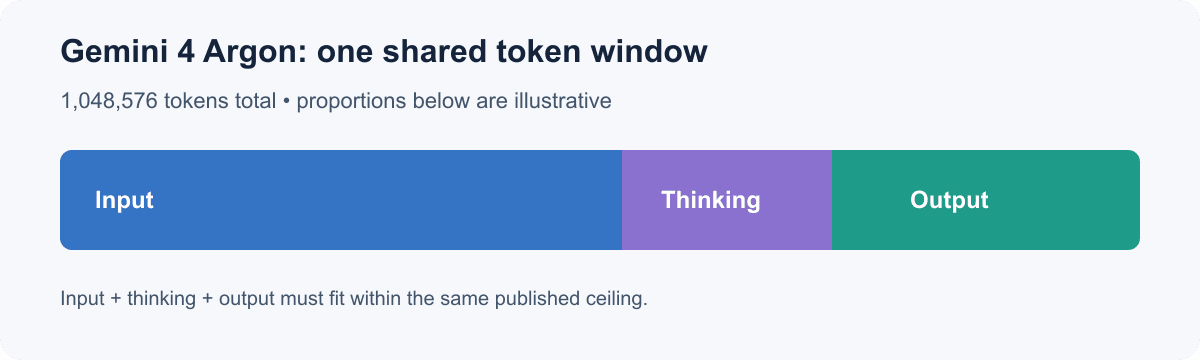
The published window is one shared ceiling. Segment sizes are conceptual, not a fixed allocation.
Input, thinking, and output draw from one window
A useful planning equation is:
input tokens + thinking tokens + output tokens <= 1,048,576
This is a budget check, not a claim that developers can set an exact thinking-token count for every call. Google lists thinking settings of low, medium, and high; internal consumption can vary by task and settings. Reserve space for reasoning rather than treating the theoretical remainder as guaranteed answer capacity.
Argon accepts text, image, video, audio, and PDF input, with text output. Media accounting is not equivalent to plain text, so a file count or page count cannot reliably predict total tokens. Inspect usage metadata from a representative request.
Context Window vs. Output Limit: The Crucial Difference
The default output cap
The model page lists a maximum output of 65,536 tokens for default synchronous generation, about one sixteenth of the total window. A request can fit within the overall context limit and still exceed the active output cap.
For many applications, that default is ample. A repository review or document synthesis usually needs a focused answer, not one as long as the source set. A bounded output is easier to review, store, and pass to another step.
What long decode changes
Long decode supports much longer generation, up to 1,048,576 tokens according to the model specification. It does not expand the total window. If the prompt already occupies most of it, less capacity remains for thinking and output. The API path, SDK, request settings, and response handling also matter, so check the current integration guidance before relying on a long response in production.
Use long decode only when the deliverable truly needs extensive generated material, such as a large structured transformation returned in one operation. If the answer can be split into validated sections, staged generation can make incomplete results easier to detect and recover.
How to Budget Input, Thinking, and Output Tokens
Start with the deliverable, then estimate source tokens using the selected model's counting route where available. Count instructions, tool results, schema text, and conversation history too. Reserve a margin for thinking and estimation error instead of spending the theoretical remainder.
The figures below are arithmetic examples, not fixed reasoning consumption. "Planning remainder" is the total after the assumed input and reserved thinking allowance. Actual service limits still apply.
| Assumed input | Thinking reserve | Planning remainder for output | Example |
|---|---|---|---|
| 120,000 | 20,000 | 908,576 | Several manuals, concise synthesis |
| 500,000 | 40,000 | 508,576 | Codebase review with file references |
| 900,000 | 50,000 | 98,576 | Archive comparison with a bounded answer |
Illustrative arithmetic from a 1,048,576-token ceiling; reserves are planning assumptions.
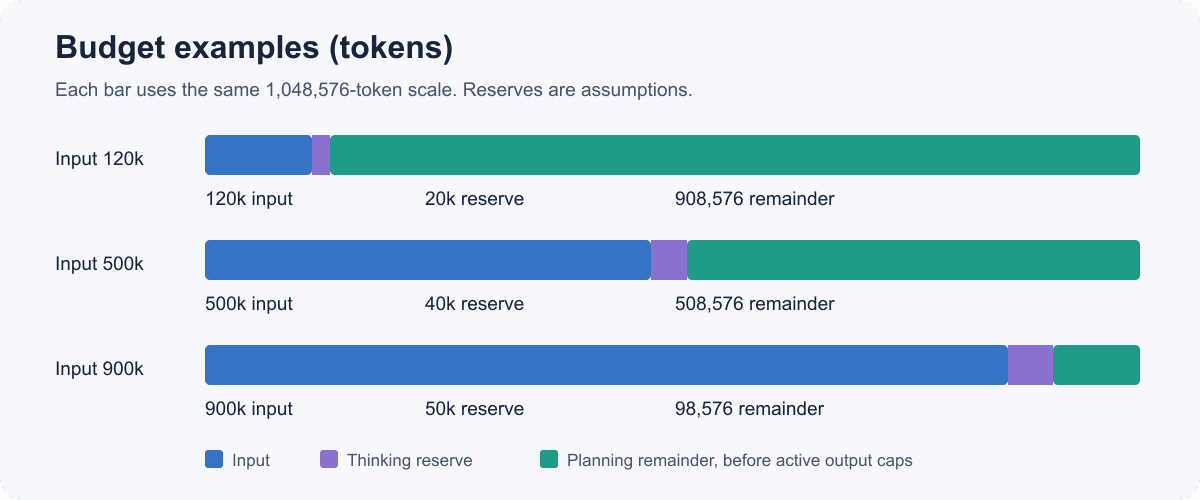
Use this request-planning checklist:
- Input: estimated source and prompt tokens.
- Thinking: reserve capacity based on task complexity and supported settings.
- Output: choose a cap that fits the deliverable.
- Check: total the three amounts and leave room for estimation error.
- Path: confirm the selected endpoint or SDK supports the output length and continuation behavior.
For a 500,000-token codebase review, a team might reserve 40,000 tokens for thinking and target a 25,000-token answer. That plan uses 565,000 tokens on paper and leaves headroom for imperfect estimates or extra instructions. The team should still verify actual usage and configured generation limits. The reserve is a planning tool, not a prediction of private reasoning.
Before a batch run, sample more than one type of request. A short documentation page, a code-heavy module, and a PDF with tables can produce different token counts even when their file sizes look similar. Count representative inputs, then compare estimates with usage returned by the API. If the model's actual thinking or output reporting differs from your assumptions, update the reserve and cap before increasing batch size. This small calibration step helps keep a long-context workflow inside its token and budget envelope.
What Can You Fit in a Million Tokens?
Documents, code, and multimodal material
A million tokens can make one-pass analysis plausible for a set of manuals, several contracts, a large source tree, or a long transcript with notes. Google has used rough illustrations such as around 1,500 pages of text or 30,000 lines of code. Treat these as scale examples, not guarantees. Layout, code density, language, formatting, and tokenization all affect the count.
For repository work, include build files, generated code, comments, dependency metadata, tests, and relevant issue context in your estimate. Then ask whether the task needs everything. A cross-module architecture review may benefit from a broad source set; a question about one error message probably does not.
Multimodal inputs also complicate estimates. A video's duration, frame sampling, audio, resolution, and API treatment can affect usage and the evidence the model sees. For a narrow question, include only relevant media and inspect usage from a representative request before scaling up.
Token counts are not page counts
A token is a model-processing unit, not a word, character, page, or line. Identifiers, tables, source code, and non-English writing can tokenize differently from ordinary prose. A page estimate cannot tell you whether your particular collection fits.
Capacity is also different from quality. Fitting a source set does not prove the model will find every buried exception, preserve every dependency, or resolve conflicting passages correctly. The specification establishes a limit, not exhaustive recall or a task-specific accuracy score. For consequential conclusions, request source locations and validate important claims against the originals.
When a 1M Window Helps, and When It Doesn't
Long context is most useful when an answer depends on relationships scattered across material that a simple query may not retrieve. It is less compelling for repeated narrow questions across a changing corpus, where retrieval can select a smaller evidence set. These are workflow tradeoffs, not a universal accuracy ranking.
| Approach | Consider it when | Tradeoff |
|---|---|---|
| Long-context request | A one-off analysis needs relationships across a known source set | Large input can raise cost and latency; verify coverage |
| Retrieval | Users ask repeated questions across a changing corpus | Indexing and retrieval determine which evidence reaches the model |
| Chunking | Documents can be processed as independent units or stages | Cross-chunk relationships need reconciliation |
| Hybrid | You need broad orientation followed by focused evidence checks | More orchestration and state handling |
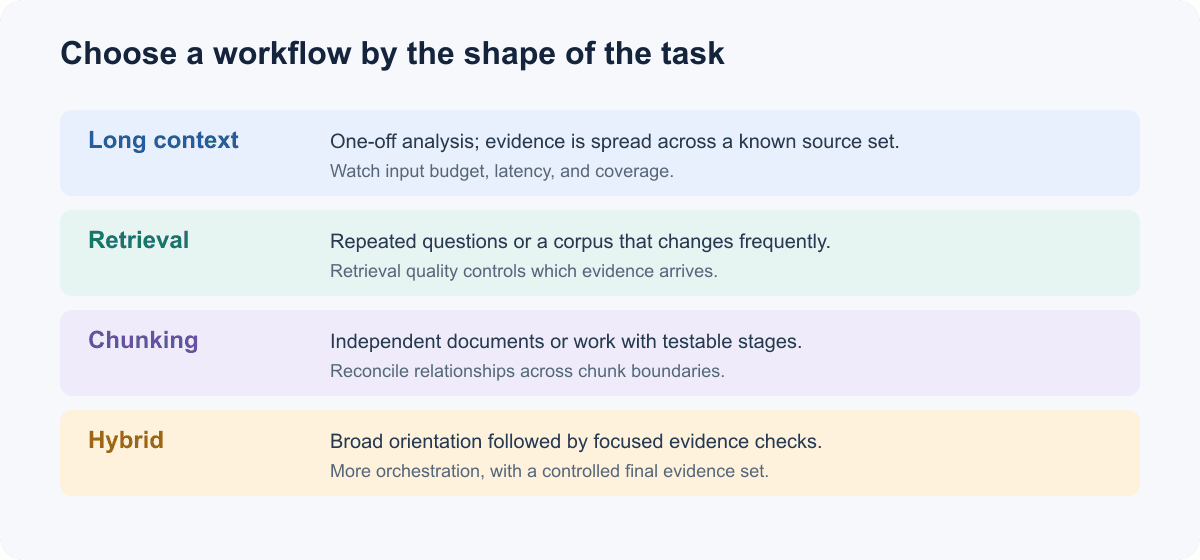 Choose from the task shape and query pattern, then validate on representative inputs.
Consider long context for comparing policies whose clauses affect one another, reviewing a change across many software modules, or synthesizing documents where a detail in one source changes another's interpretation. Retrieval fits repeated support questions against a growing knowledge base. Chunking works when source units are independent or each stage has a testable output. A hybrid workflow can map the collection first, then retrieve and verify passages for a final answer.
Evaluate options against the same representative questions. Track whether required evidence was included, whether citations point to the right passages, token use, response time, and recovery effort after an incomplete answer. That gives your team evidence for its workload instead of assuming a larger window automatically improves it.
Using Gemini 4 Argon for Long-Context Tasks
Confirm the model ID and request path
Google lists the Gemini API model ID as `gemini-4-argon`. Confirm that it is enabled for your account and that the exact API surface supports the features you need. The same model name does not guarantee every proxy, SDK, console, or client exposes identical limits or long-decode behavior.
Before production, verify:
- The model ID and availability for your account or region.
- The synchronous output cap and how long decode is requested or returned.
- Whether the SDK handles continuation, and how it reports partial or failed responses.
- Supported thinking settings, tools, caching, and modalities for the selected API.
- The request's actual input and output usage fields.
Google's long-context guide describes the unified budget. Its SDK and API guidance can change, so pin a supported SDK version, inspect the current example, and integration-test the same transport and response handling planned for production. Do not copy parameter names from an older model integration without checking that they still apply.
Make the output contract smaller than the source set
Give the model a bounded task and response shape. For a repository audit, request findings grouped by severity with file paths and line references, and state whether to include hypotheses or only confirmed defects. For a contract comparison, name the clauses and request section identifiers or brief supporting excerpts. This is easier to review than "analyze everything." For large responses, plan for continuation and partial completion. Persist identifiers and response chunks when the SDK exposes them, validate structured output before downstream use, and retry only a failed portion when possible. These are safeguards to implement and verify, not a claim that every SDK handles interruptions identically.
Pricing and Access: What to Verify Before You Run
Google's announcement currently lists introductory rates of $2 per million input tokens and $10 per million output tokens through November 30, 2026, followed by stated rates of $4 and $20 per million. This is time-sensitive: re-check the official Gemini 4 Argon announcement before publishing or forecasting spend. Estimate input and output separately because prompt-heavy and generation-heavy workloads have different cost profiles.
Argon availability through Atlas Cloud is not confirmed in the directory pages checked for this article. The Atlas Gemini model catalog shows the Gemini models and access details currently listed there; it does not establish that Argon is available. Confirm a model-specific detail page, protocol, and price before routing requests or comparing costs.
Start with a representative request and record model and SDK versions, token usage, latency, errors, and task-specific quality checks. Revisit the budget and retrieval choice when source sets or query patterns change. The Gemini 4 Argon 1M context window is useful when its breadth solves a real cross-source problem and your request has a clear budget and verification plan.
Frequently Asked Questions
Is Gemini 4 Argon's 1M window shared by input and output?
Yes. Google defines a single 1,048,576-token window shared across input, thinking, and output. The amount left for an answer depends on the request and applicable interface limits.
What is Gemini 4 Argon's default output limit?
The specification lists 65,536 tokens for default synchronous output. Long decode can support larger generation, subject to the remaining shared capacity and API path.
Can Gemini 4 Argon generate 1M tokens in one response?
The model page lists long decode up to 1,048,576 output tokens, but this is an upper capability, not a guarantee that a request containing input can also return a million tokens. Input and thinking occupy the same total window.
Does a 1M context window mean every detail will be recalled accurately?
No. It describes the maximum token budget, not perfect retrieval or reasoning. Require evidence references and test known edge cases from your own material.
Is Gemini 4 Argon currently available through Atlas Cloud?
I could not confirm an Argon-specific model listing or detail page in the Atlas Cloud catalog checked for this article. Check the current directory before assuming support; the Gemini catalog link above does not itself establish Argon availability.





