A customer asks whether an Enterprise workload can move regions after provisioning. Support finds a policy from August, a security addendum from June, and an old onboarding PDF that says something else. A smooth answer is easy. A safe answer needs a source chain.
That is the job of a gpt-6 astra internal knowledge base. Treat it as a citation-first decision workflow, not a folder you pour into a long-context window. Give Astra a small, approved evidence packet; require dates, sections, uncertainty, and an owner for anything that changes a promise.
OpenAI positions Astra for difficult end-to-end work and lists a 1.05M-token context window. That makes it useful for reading evidence across documents. It does not decide which policy your company approved, who may see it, or when it expired. ( OpenAI model documentation, September 2026)
This playbook gives you the operating procedure, three de-identified business cases, and a practical routing rule: use expensive reasoning to judge evidence, not to sweep every abandoned PDF in the company drive.
Key takeaways
- Send Astra evidence packets, never an ungoverned document dump.
- Require source ID, section, effective date, and uncertainty in every answer.
- Route classification and conflict flags to a lower-cost preflight model.
- Keep permissions, approvals, and audit logs outside the model.
- Escalate commitments about contracts, security, retention, and privacy.

Atlas test-environment policy evidence review animation: an active blue policy folder is moved forward while exception and superseded folders remain separate
Atlas test-environment animation generated with Veo 3.1 Lite from the policy-conflict case visual. The active blue folder moves forward for the evidence packet while exception and superseded sources remain visibly separate.
Why GPT-6 Astra Internal Knowledge Base Attempts Fail
The common failure begins with “upload everything.” A bigger context can hold more text, yet it cannot turn stale, duplicated, unapproved files into a source of truth. Retrieval still needs a manifest: owner, effective date, classification, status, and relationship to newer documents.
A fluent answer without citations remains an operational risk. If a customer asks for a policy, the reader needs the clause and date behind the statement. If the supplied evidence conflicts, the answer must show the conflict instead of silently choosing a convenient version.
Permissions, freshness, and prompt injection also stay outside the model. Treat a document’s instruction-like content as untrusted material, not as authority. OpenAI reports stronger boundary-following and prompt-injection resistance for Astra, but that is not a replacement for least-privilege retrieval or human approval. ( OpenAI’s Astra safety overview, September 2026)
There is a cost reason to be disciplined too. Astra’s standard API rate is $10 per 1M input tokens and $50 per 1M output tokens; prompts above 272K input tokens use higher rates. Long scans are often the wrong place to spend that budget. Early Codex users also report that higher-effort work can consume allowances quickly, which is anecdotal but a useful reminder to test the route on a small corpus first. ( r/codex user discussion, September 2026)
Case 1: Turn Migration Evidence Into a Customer-Safe Release Brief
This browser-rendered evidence planner applies the same bounded-evidence method to a customer-region migration request. It starts with an active support policy and a security addendum, but it holds the customer commitment until the DPA owner confirms the retention and deletion path. The approved inputs, missing condition, named owner, and customer-safe draft remain visible together, so the reviewer can see why the answer changes.
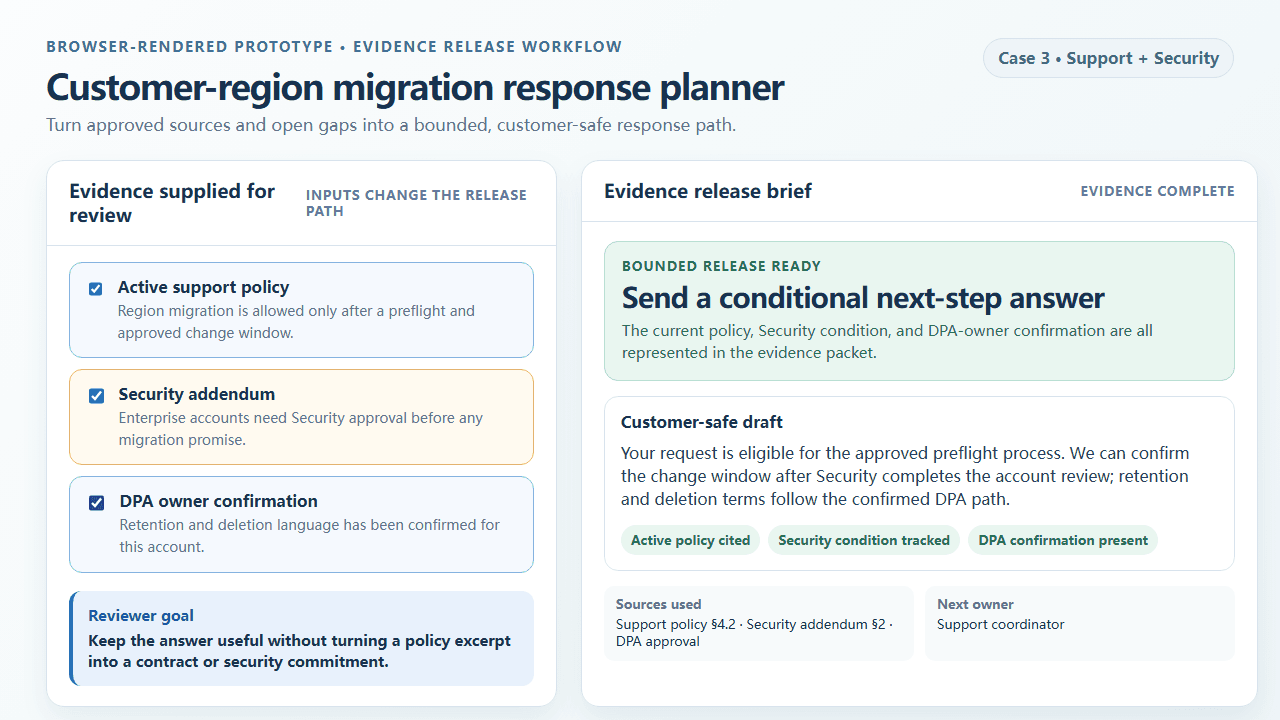 Browser-rendered evidence release planner showing the complete customer-region migration case with policy, security, and DPA owner confirmation
De-identified browser-rendered case visual, not a live model run. With all three evidence conditions present, the planner allows a conditional next-step answer while retaining Security review and the approved DPA path as explicit boundaries.
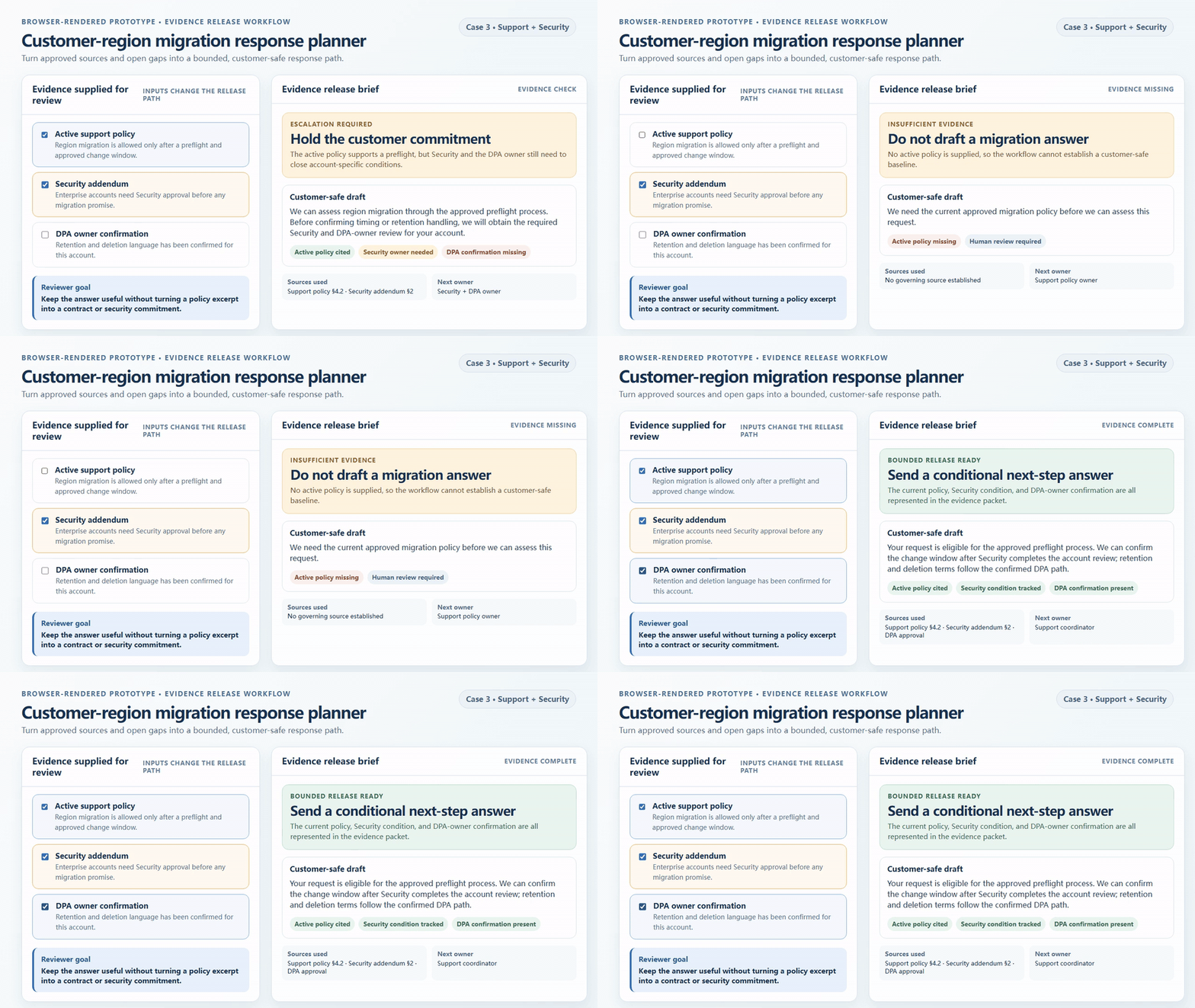
Eight-second browser-rendered evidence planner animation showing the migration response stop without an active policy, then reach a bounded release after policy and DPA confirmation return
Eight-second browser capture. Removing the active policy stops the draft; restoring the policy and confirming the DPA owner changes the permitted response, cited sources, and next owner. No customer-facing commitment appears until the evidence packet is complete.
GPT-6 Astra Internal Knowledge Base Workflow and Model Split
Run this as one browser-tab handoff: your controlled document system produces an inventory, a low-cost preflight produces an evidence manifest, Astra adjudicates a focused packet, and the accountable owner approves high-risk language. Atlas Cloud is optional in that middle preflight. It is neither a knowledge base nor a permission system, and it does not provide Astra.
| Stage | Job | Suggested tool or model | Output | Why it belongs here |
|---|---|---|---|---|
| Source intake | Name, date, owner, access group | Existing DMS, Drive, or Notion | Source manifest | Access and authenticity stay under your control |
| Low-cost preflight | Classify, extract dates, flag duplicates and PII | DeepSeek V4 Flash on Atlas Cloud | JSON evidence manifest | Removes irrelevant material before premium reasoning |
| High-value adjudication | Resolve evidence, cite, name uncertainty | GPT-6 Astra | Auditable answer packet | Keeps the premium context for real judgment |
| Human approval | Review commitments and exceptions | Named policy owner | Approved customer response | Preserves organizational authority |
As checked in September 2026, the Atlas catalog lists DeepSeek V4 Flash 0731 at $0.44 per 1M input tokens and $1.32 per 1M output tokens. Verify the live Atlas Cloud model catalog before publishing or budgeting. Astra pricing belongs with OpenAI, where standard processing is $10/$50 per 1M input/output tokens and Fast mode costs 2x standard rates.
Step 1: Create a GPT-6 Astra Internal Knowledge Base Source Manifest
Start before the model. Make one row per document with a stable source_id, a responsible owner, an effective date, a status, a classification, a supersession link, and an access group. This small table prevents a persuasive but expired PDF from entering an evidence packet as equal authority.
plaintext1You are a knowledge-governance analyst. Review the supplied document inventory. 2Return valid JSON only. 3 4For each item, provide: 5source_id, title, owner, effective_date, status 6(active, superseded, draft, unknown), 7document_type, sensitivity, 8supersedes_or_conflicts_with, and retrieval_priority. 9 10Do not infer facts not present in the inventory. 11Mark missing dates or owners as "unknown".
Settings: Run inside a controlled workspace. Include only document metadata or material the workspace is permitted to process. Disable public web browsing. Save the manifest with the source inventory.
Step 2: Preflight the Corpus Before GPT-6 Astra
Use a lower-cost model only on approved, minimized metadata and de-identified excerpts. Its job is to build an index of likely evidence, not to tell the customer what the policy is. This is the practical place to use Atlas Cloud’s DeepSeek V4 Flash, with the original documents retained in your controlled system.
plaintext1Create an evidence manifest for the supplied internal documents. 2 3For every document, identify: 41. the decision it governs, 52. its effective date, 63. the exact sections likely to answer customer-region migration, 74. contradictions with another supplied document, 85. any personal, contract, or security-sensitive content that must not be sent to a broader workflow. 9 10Return a compact JSON array. Quote source text only when necessary to identify a section. 11Do not answer the customer question yet.
Settings: DeepSeek V4 Flash 0731, default text settings. Preserve the raw JSON. Submit only data that your team has approved for this environment. The output is an index for adjudication, not an authoritative policy response. Capture and retain the completed run in your permitted Atlas workspace before publishing this workflow internally.
Step 3: Build the GPT-6 Astra Evidence Packet
Give Astra only the question, the highest-priority excerpts, the manifest, and a strict return shape. Case 1 uses an active August support policy, a June security addendum, and a superseded 2025 onboarding PDF. The active policy governs the baseline; the security addendum creates an account-specific exception that Support should not promise alone.
plaintext1You are answering from an internal evidence packet. 2 3Question: 4Can an Enterprise customer move workloads to another region after provisioning? 5 6Rules: 7- Use only the evidence below. 8- Prefer active sources with the newest effective date. 9- Never use a superseded or draft source as authority. 10- If sources conflict, name the conflict and do not silently resolve it. 11- If the evidence does not establish an answer, say "Not established by supplied sources." 12- Do not make contractual, legal, security, or product commitments beyond the evidence. 13 14Return exactly: 151. Direct answer 162. Evidence citations: [source_id, section, effective_date] 173. Conflict or uncertainty 184. Required human owner 195. Customer-safe wording
Settings: GPT-6 Astra, Standard processing, Medium reasoning effort. Increase effort only for a documented conflict. Turn off web and computer tools unless the workflow explicitly authorizes them. Save the request, response, source IDs, and approver decision together. A live Astra console capture depends on the reader’s own permitted workspace, so this tutorial does not pretend a synthetic card is a product screenshot.
Step 4: Test a GPT-6 Astra Internal Knowledge Base for Citation Failure
Now add the old onboarding PDF on purpose. The test passes only if the customer-safe wording loses any claim that depends on it. This catches the most expensive failure: a current-sounding answer built on a dead policy.
plaintext1Audit your previous answer against this rule: 2No claim may rely on a source whose status is superseded, draft, or unknown. 3 4For each sentence in the customer-safe wording: 5- list its supporting source_id, 6- label it supported, unsupported, or needs human approval, 7- rewrite unsupported claims conservatively. 8 9Do not add new facts.
Settings: GPT-6 Astra, Medium effort. Keep the before-and-after answer as one audit record. A reviewer should be able to point from every external sentence back to an active source.
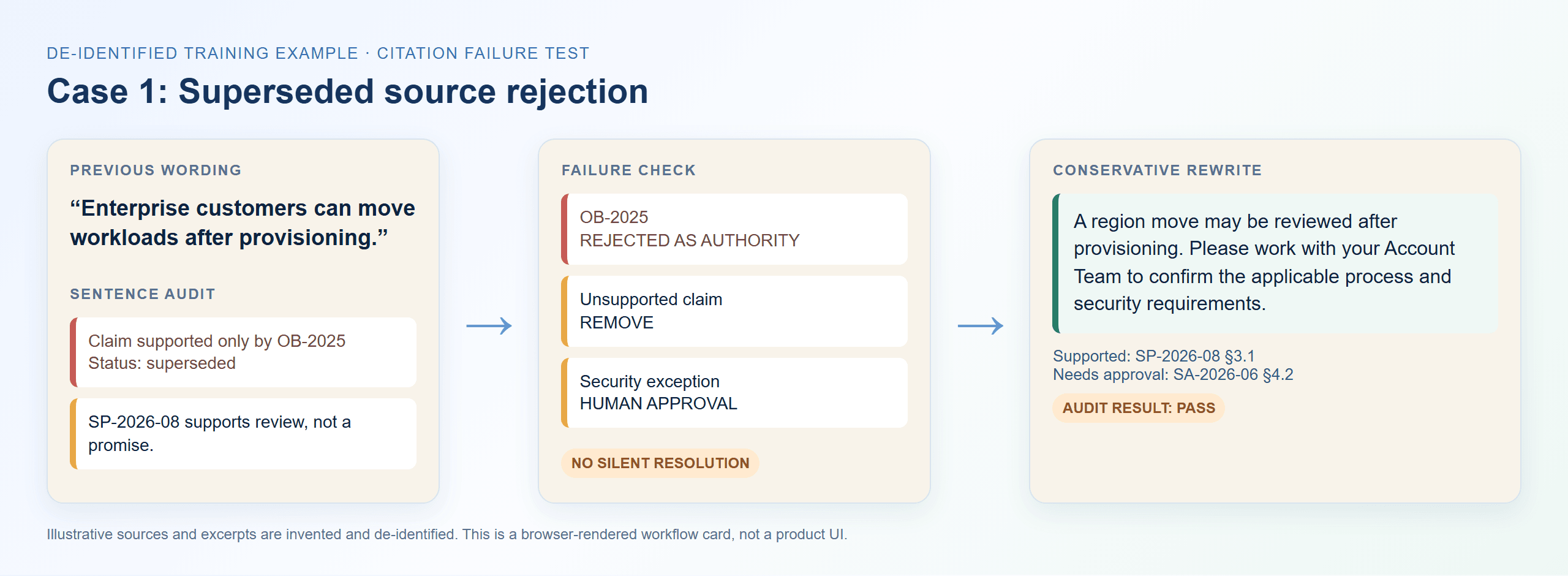 GPT-6 Astra internal knowledge base citation failure test: superseded onboarding policy rejected and wording rewritten
De-identified sample evidence card: the superseded onboarding PDF is explicitly excluded, and unsupported promise language is removed.
Step 5: Apply the GPT-6 Astra Internal Knowledge Base SOP to a Security Questionnaire
Case 2 answers a sales question about audit-log retention and customer-controlled deletion. The useful outcome is not a confident paragraph. It is a classification that separates contractual evidence, product documentation, marketing language, and gaps that need Legal, Security, or the DPA owner.

Atlas test-environment security evidence review animation: a reviewer checks an approved evidence binder before a customer questionnaire response
Atlas test-environment animation generated with Veo 3.1 Lite from the security-review case visual. The reviewer checks the evidence binder and its tabs before the workflow permits a customer-facing commitment.
plaintext1You are responding to a customer security questionnaire using only approved internal evidence. 2 3Question: 4How long are audit logs retained, and is deletion customer-controlled? 5 6Classify every statement as one of: 7- Contractually supported 8- Product-documentation supported 9- Marketing-only 10- Not established by supplied sources 11 12Then provide a customer-safe answer with citations. 13Escalate any statement that needs Legal, Security, or the DPA owner. 14Do not merge categories or imply a contractual commitment from marketing material.
Settings: GPT-6 Astra, Medium effort by default. Use High only if active sources genuinely conflict. Contract, retention, deletion, privacy, and security language always goes to the named owner before it leaves the company.
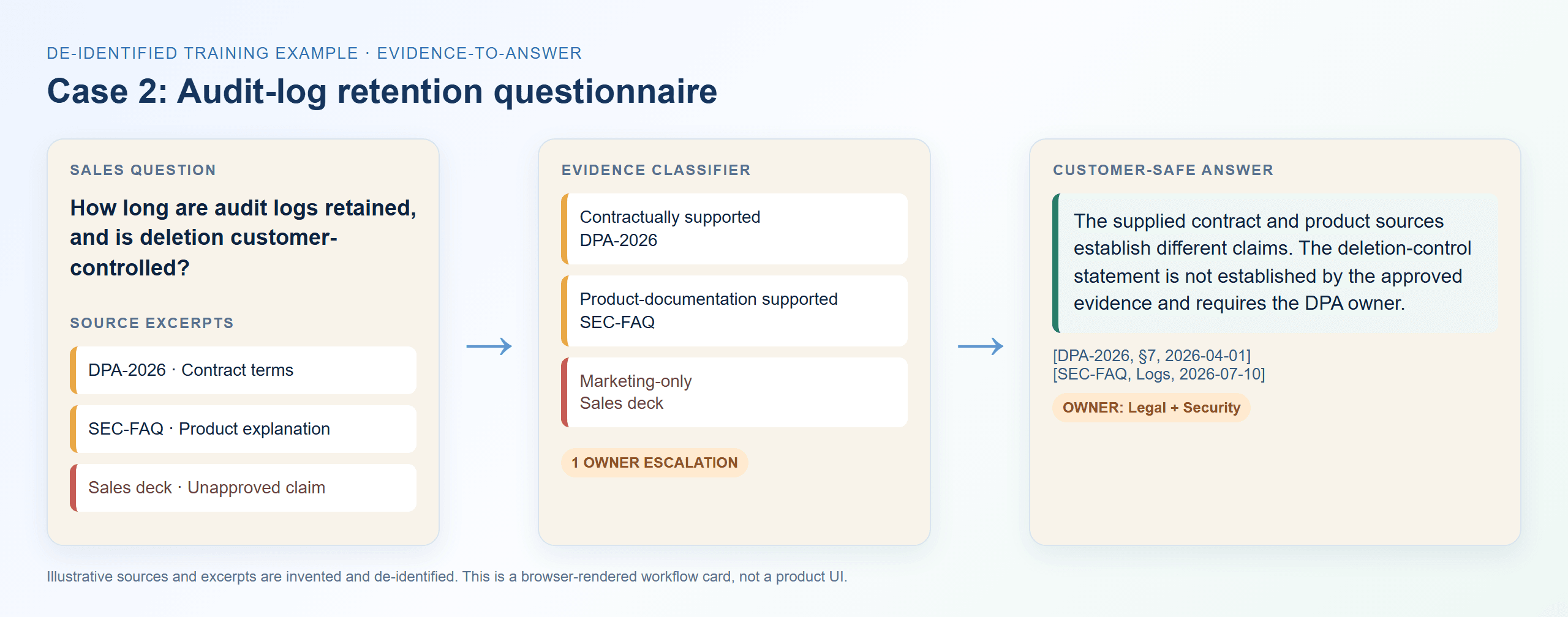 GPT-6 Astra internal knowledge base security questionnaire evidence-to-answer card separating contract, product, marketing, and unestablished claims
De-identified sample evidence card: a retention answer stays bounded by the evidence class behind each sentence.
Step 6: Create a Sales-Ready Release Brief
Case 3 keeps the same evidence discipline for a lower-risk, higher-frequency task. Sales needs a compact answer to who gets a beta, what is excluded, and which promises are safe. Meeting notes can inform the brief, yet they should remain provisional until the launch owner approves them.
plaintext1Using only the evidence packet, create a one-page internal release brief. 2 3Question: 4Which customer segment should receive the beta, what are excluded use cases, and what may a salesperson promise? 5 6Use these sections: 7Approved target segment 8Approved positioning 9Explicit exclusions 10Claims we must not make 11Open questions and owner 12Evidence citations 13 14If a claim appears only in meeting notes, label it provisional.
Settings: GPT-6 Astra, Medium effort. Retain the “claims we must not make” section in the final brief. That negative space is often more valuable than a polished list of benefits.
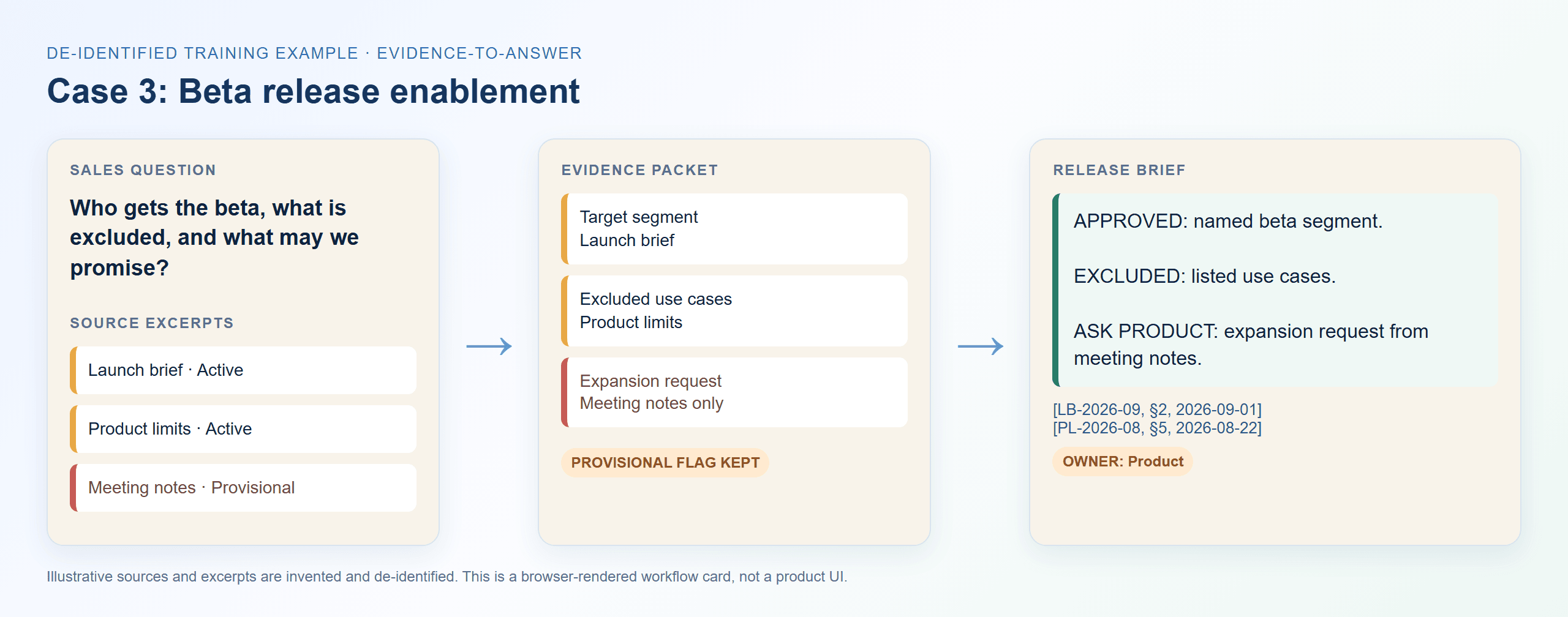 GPT-6 Astra internal knowledge base beta enablement evidence-to-answer card with approved, excluded, and ask-product lanes
De-identified sample evidence card: the release brief preserves Approved, Excluded, and Ask Product boundaries instead of flattening them into sales copy.
Scale a GPT-6 Astra Internal Knowledge Base by Use Case
For a support queue, allow answers only from approved FAQs and route a missing citation to a person. For sales enablement, publish a repeatable “can say / cannot say / ask product” brief after each launch. For engineering runbooks, retrieve the current runbook and change record before drafting a troubleshooting step, while leaving production permissions and approvals intact.
High-risk material needs the same discipline with more review, not more confidence. Contracts, privacy, medical information, financial claims, security incidents, and deletion requests need a named human owner and a durable audit record.
GPT-6 Astra Internal Knowledge Base Cost: Spend Reasoning Where It Changes the Answer
Use a token and labor formula instead of invented savings percentages:
total cost = preflight input/output token cost + Astra evidence-packet input/output token cost + human review time
| Route | What the premium model reads | Cost components | Best use |
|---|---|---|---|
| Full corpus in Astra | Every retrieved document | Large Astra input, Astra output, review | Small, well-governed collections only |
| Preflight plus Astra | Compact evidence packet | Low-cost preflight, smaller Astra packet, review | Conflicts, customer answers, high-stakes summaries |
| Manual lookup | Human-selected documents | Staff search and review time | Rare or highly sensitive questions |
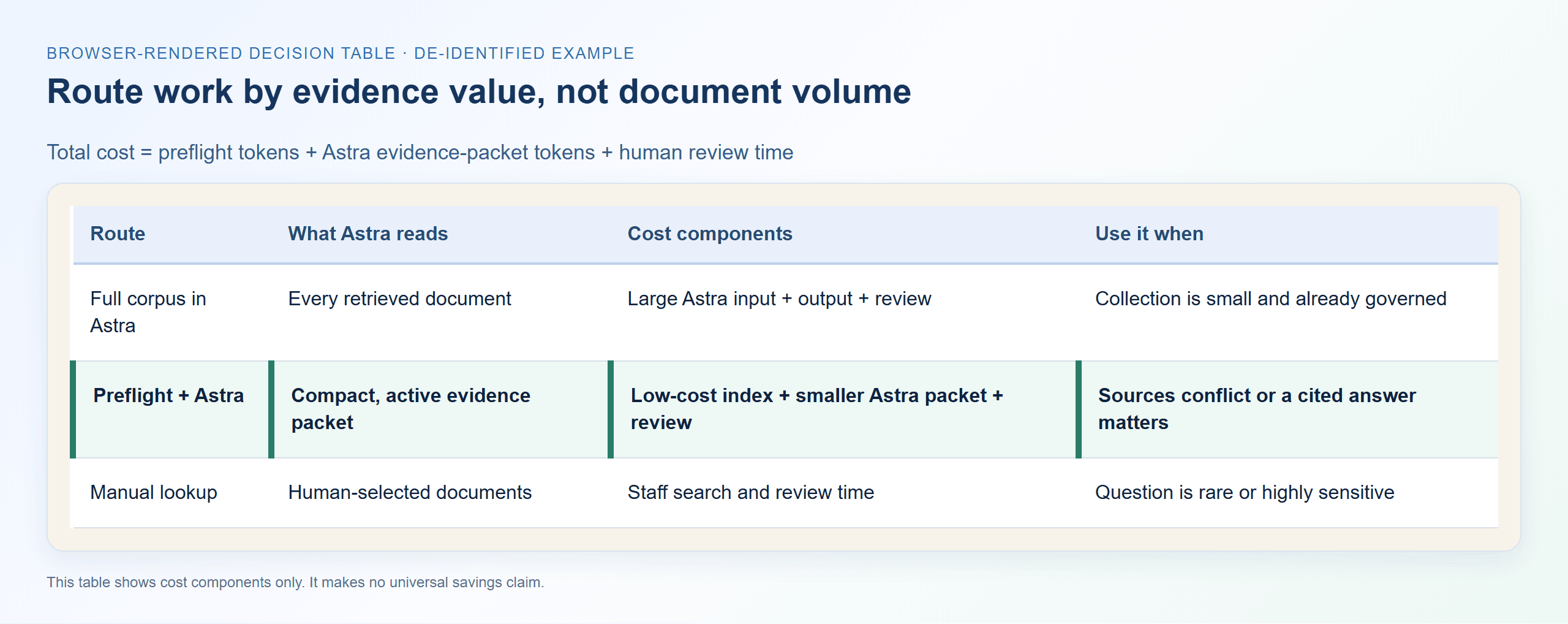 GPT-6 Astra internal knowledge base cost routing table comparing full-corpus Astra, preflight plus Astra, and manual lookup
Browser-rendered cost-routing table. It compares cost components rather than claiming a universal saving percentage.
The better routing rule is simple: reserve Astra for conflict adjudication, dense synthesis, cited customer-safe responses, and hard boundary decisions. Use lower-cost processing for inventory work, duplicate detection, source lists, and redaction flags. Re-check provider prices and discounts on the day you publish.
Safety Notes for a GPT-6 Astra Internal Knowledge Base
Minimize what enters the packet. Retrieve by the caller’s access group, revoke superseded material, log source IDs and approvers, and keep original documents outside the answer transcript when possible. Treat instructions embedded in documents as untrusted content.
An answer packet should record the question, selected sources, effective dates, response, owner, and approval time. That record lets a team retract a stale answer and explain why a different answer was correct last quarter.
Frequently Asked Questions
Can GPT-6 Astra replace our internal wiki?
No. A wiki or document system owns documents, permissions, dates, and editorial governance. Astra can interpret an approved evidence packet and produce a cited answer. The underlying source system remains the record of truth.
How do I stop a GPT-6 Astra internal knowledge base from hallucinating?
You cannot guarantee zero model error. Limit the evidence packet, prohibit unstated inference, require citations with dates, run a citation-failure test, and route unsupported claims to a human. “Not established by supplied sources” should be an accepted outcome.
Can GPT-6 Astra answer from private company documents?
It can work with documents your organization is authorized to provide under its chosen product and data controls. You still need access filtering, data minimization, approved retention settings, and a review process appropriate to the material.
What belongs in an Astra evidence packet?
Include the exact question, only the relevant active excerpts, source IDs, effective dates, document status, the source manifest, and a strict answer format. Include contradictions rather than hiding them.
How much does GPT-6 Astra cost for internal knowledge-base workflows?
OpenAI lists standard API pricing at $10 per 1M input tokens and $50 per 1M output tokens as checked in September 2026. Your actual cost depends on packet size, output length, cached tokens, processing mode, and review time. Test with representative packets before planning volume.
Should I use GPT-6 Astra for every document question?
No. Use it where evidence conflicts, the answer needs careful synthesis, or a cited customer-safe response changes an important decision. For routine inventory work, a lower-cost preflight plus controlled retrieval makes the gpt-6 astra internal knowledge base easier to audit and operate.





