An Enterprise customer asks whether an annual plan can be refunded after renewal. Your assistant scans a huge document set and gives a crisp yes. It even cites a policy. The catch: it chose v4.1, an archived policy, while a signed addendum and v4.2 say something else.
That is why gpt-6 astra knowledge base best practices begin with proof. Give the model an authority order, retrieve only authorized current evidence, and make every material claim point back to a document, version, and section. If the evidence conflicts or runs out, the answer must stop.
GPT-6 Astra can work across File Search and a 1,050,000-token context window, with a 128,000-token maximum output. Capacity helps investigation. It does not decide which policy is current, which user may see it, or whether a citation actually supports a nearby claim. ( OpenAI GPT-6 Astra model page, September 2026 )

Animated authority-first knowledge-base workflow
An 8-second generated workflow visual: a signed override and current policy remain in the evidence tray while an archived file is visibly moved aside. This illustrates source governance, not a live product interface or source document.
Key takeaways
- Approve source authority before upload.
- Measure retrieval and answer faithfulness separately.
- Filter by access, status, date, and region before retrieval.
- Treat long context as an investigation tool, not a default prompt.
- Escalate conflicts and missing evidence to people.
Why GPT-6 Astra Knowledge Bases Fail With 1M Tokens
Most failures start before the answer. A Drive export treats a signed addendum, a current policy, an old FAQ, and a draft as equally searchable prose. A capable model can turn that messy set into a convincing paragraph very quickly.
Four checks catch the common failure modes:
- Authority drift: a newer policy or customer addendum loses to a popular old FAQ.
- Citation theater: the answer contains a source link, but the cited passage does not support the claim.
- Uncontrolled experiments: chunk size, top-k, and context budget all change together, so nobody knows what improved.
- Access drift: regional exceptions, restricted drafts, or private notes become retrievable for the wrong audience.
The legal-RAG practitioners who discuss evaluation tend to separate “did retrieval find the required source?” from “did the answer apply that source faithfully?” That separation belongs in every release gate, including an internal support bot. ( r/Rag legal knowledge-base discussion, September 2026 )
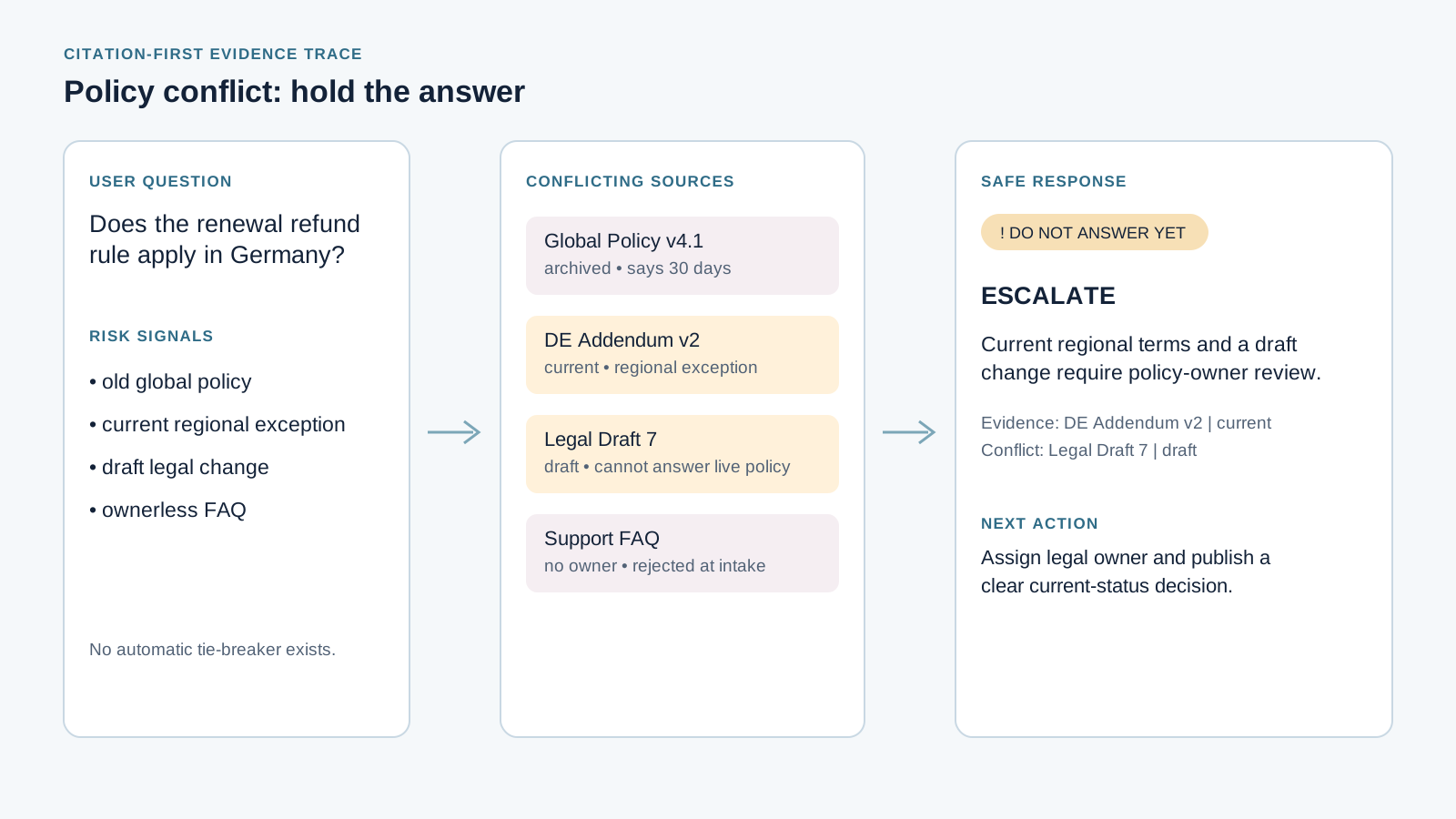
Knowledge base version conflict evidence trace with an abstain result
A conflict is useful output. This case shows why a system should return “do not answer yet” rather than silently choose among a draft, regional exception, old policy, and ownerless file.
GPT-6 Astra Knowledge Base Workflow, Models, and Cost
Use one browser tab for the pilot: inventory sources, approve the authority manifest, normalize files and metadata, retrieve a small evidence set, then answer and evaluate. The operational goal is a reviewable evidence trail, not a clever chat demo.
For teams comparing the rest of their stack, Atlas Cloud provides a place to review current model options. Do not assume that a catalog lists GPT-6 Astra until you have checked it on the day you publish.
| Layer | Job it solves | What it cannot solve alone | Pilot rule |
|---|---|---|---|
| Long context | Read a large investigation packet | Authority, permissions, citation support | Use for exceptions and investigation |
| File Search | Retrieve a small source set | Version governance | Filter before search |
| Custom retrieval | Tune indexing and ranking | Answer faithfulness | Hold context budget constant in tests |
| Human escalation | Resolve conflicts and high-impact calls | Routine scale | Define owner and response time |
| Model or tool | Job | Suggested setting | Published price to use in planning |
|---|---|---|---|
| GPT-6 Astra | conflict judgment, synthesis, evaluation | reasoning.effort: high | $10/MTok input, $50/MTok output |
| OpenAI File Search | authorized document retrieval | metadata filters and citations | verify tool charges before launch |
| Routine model route | tags and low-risk classification | benchmark first | do not hardcode a price |
| Atlas Cloud model catalog | later model exploration | use the live catalog | Astra availability is not assumed |
Start with 20 to 50 high-value questions and a deliberately awkward document set. Include a superseded policy, a missing addendum, a regional exception, and at least one question that must receive no answer.
Step 1: Create an Authority Manifest
Before uploading anything, turn the inventory into a signed-off decision layer. A human owner should approve the returned JSON before it becomes KB_MANIFEST.md. This is the first guardrail against a flawless answer built on retired text.
plaintext1You are the knowledge-governance reviewer for an enterprise support knowledge base. 2 3Goal: 4Create an authority manifest before any answer-generation workflow begins. 5 6For every supplied document, identify: 7- document_id 8- title 9- owner 10- effective_date 11- region 12- audience 13- status: current, draft, archived, superseded, or unknown 14- authority_rank from 1 to 5 15- conflict_rules 16- access_policy 17- reason_for_rank 18 19Authority rules: 201. Signed customer addenda override general policies for the covered account. 212. Current policy versions override archived or superseded versions. 223. Official policy documents override FAQs and training notes. 234. Drafts may be used only when the user explicitly asks about a draft. 245. If two current sources conflict, do not resolve the conflict. Return ESCALATE. 25 26Return valid JSON only. Do not infer missing dates or policy terms.
Settings: model gpt-6-astra; Responses API; reasoning.effort: high; structured JSON output. Supply only title, owner, effective date, region, status, and access level for the initial review.
Done when: every file has an owner, date, status, and rank, and Refund Policy v4.1 is marked superseded by v4.2.
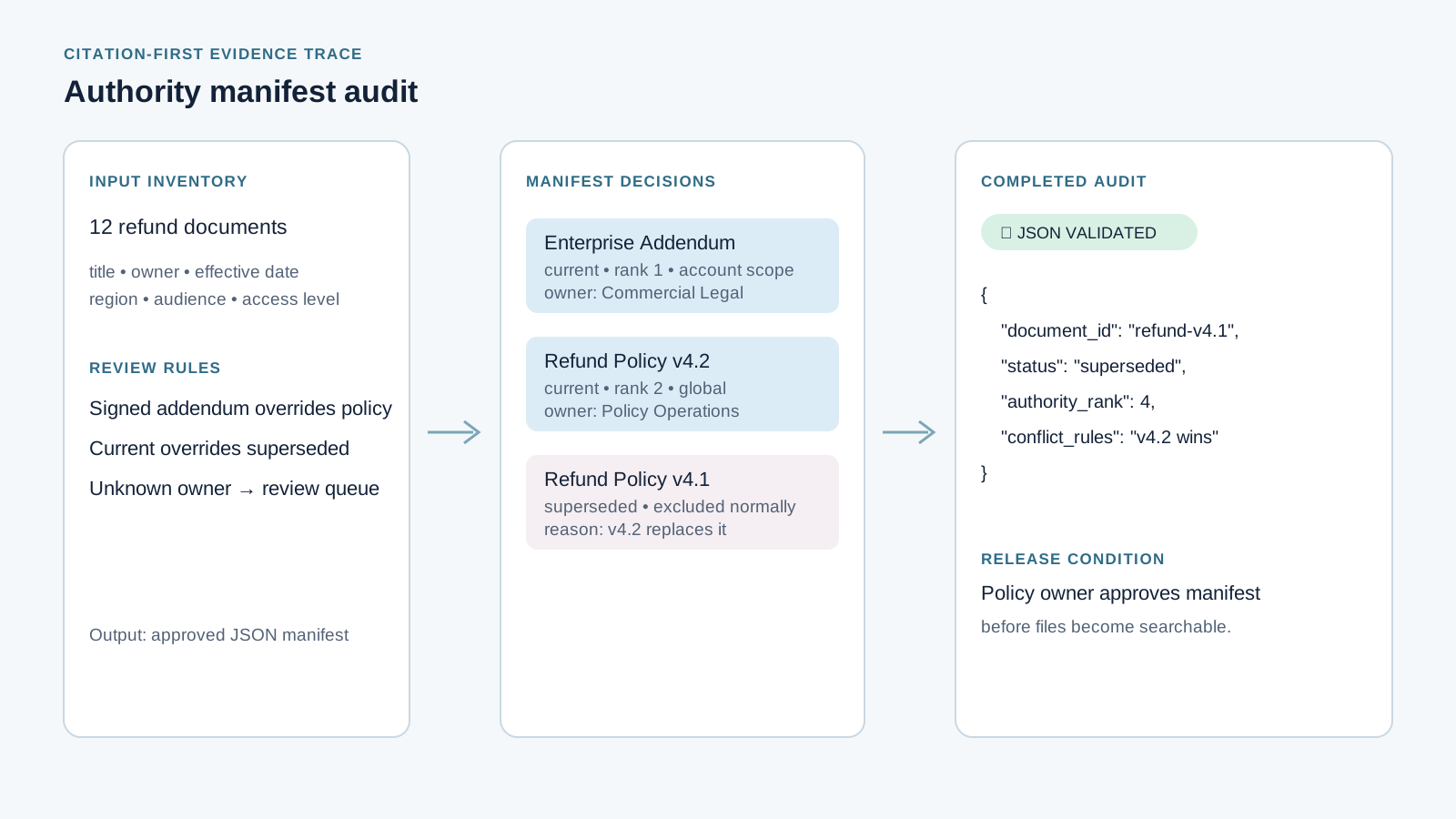
Authority manifest audit with completed JSON decisions
Completed authority-manifest audit for the refund pilot. The audit page records a superseded v4.1 and the Enterprise override rule.
Step 2: Prepare a GPT-6 Astra Knowledge Base for Retrieval
Normalize the approved sources. Preserve headings, conditions, page markers, and version data. Remove duplicate footers, navigation, and OCR debris. Do not upload a document that has no owner or effective date.
plaintext1You are preparing files for a retrieval-based knowledge base. 2 3Inspect the supplied document inventory and return a file-preparation checklist. 4 5For each file: 61. Keep the source title, version, effective date, owner, and page or section markers. 72. Remove navigation, duplicated footers, stale boilerplate, and OCR fragments. 83. Preserve headings and lists that carry policy conditions. 94. Mark whether the file is current, archived, draft, or restricted. 105. Reject any file that cannot be assigned an owner and effective date. 11 12Return a table with: 13file_name | status | metadata_to_attach | cleanup_required | upload_decision | reason
Settings: attach document_id, version, effective_date, status, region, audience, and authority_rank as metadata. Start retrieval tests with roughly 2,000 tokens of total retrieved context. Change one variable at a time: chunking strategy or retrieval count, never both.
Done when: archived material is excluded from normal queries, and unknown-owner files go to a review queue.
The next motion case makes the sorting decision visible: two approved source folders stay together in the authority tray, while an ambiguous draft moves into a separate review path. It is an illustrative workflow render, not a live GPT-6 response or product interface.

Animated evidence handoff to human review
An 8-second generated workflow visual: approved source folders stay together, while the unresolved folder is routed to human review.
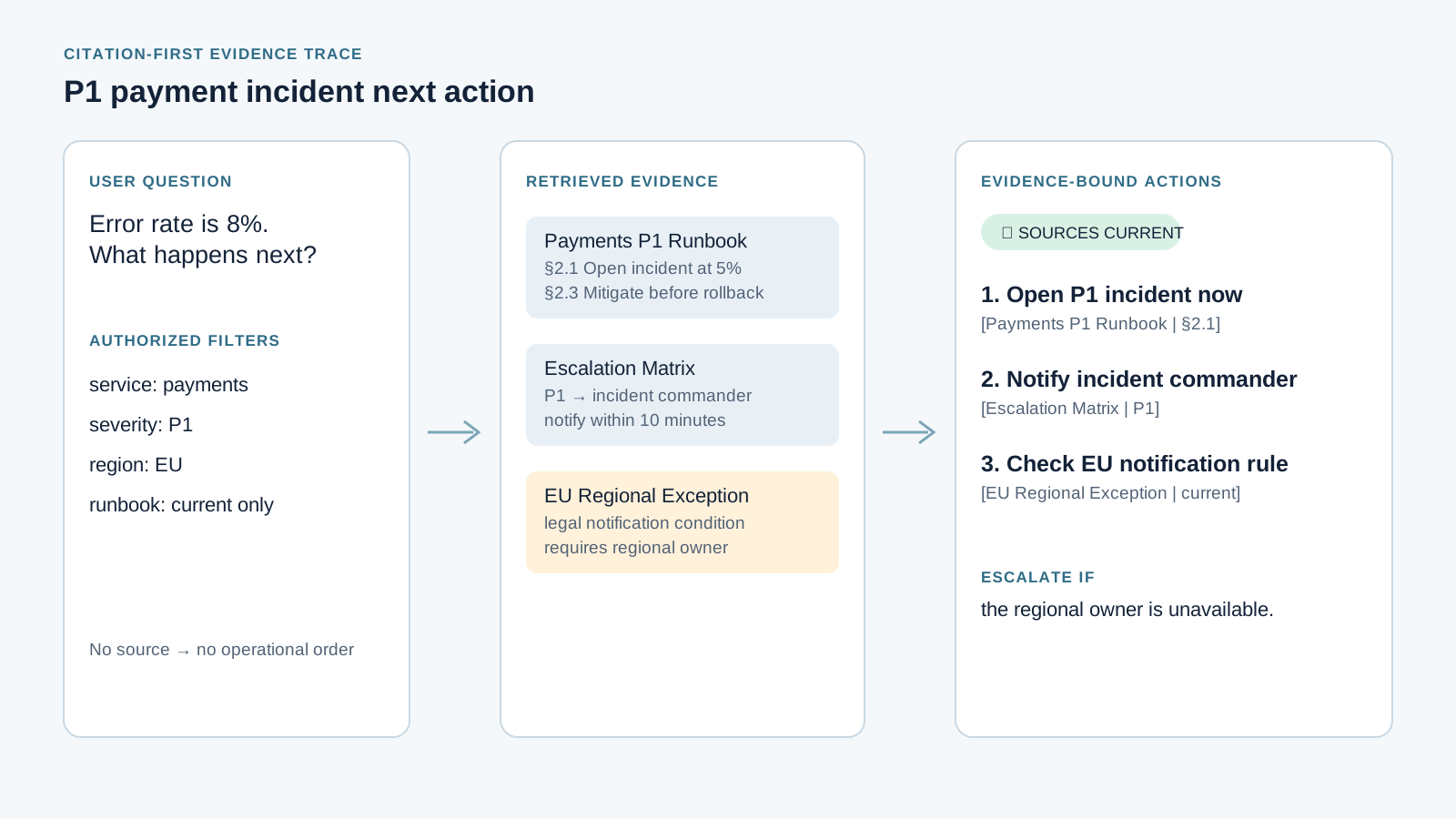
P1 payment incident evidence trace with an escalation condition
Case 2. A payment-error question pulls an on-call runbook, escalation matrix, and regional exception. The answer identifies the incident-commander trigger instead of improvising a recovery plan.
Step 3: Ask for an Evidence-Bound Answer
Bind answer generation to retrieved, authorized evidence. The model should separate facts, assumptions, and next actions so reviewers can see where the system stops knowing.
plaintext1You are an evidence-bound knowledge-base assistant. 2 3Answer the user question using only the retrieved, authorized knowledge-base sources. 4 5Rules: 6- Treat the authority manifest as binding. 7- Prefer the highest-ranked current source that applies to the user’s region and audience. 8- Every factual claim must include [document title | version | section or page]. 9- If sources conflict, identify the conflict and return ESCALATE instead of choosing silently. 10- If the evidence does not support a claim, write INSUFFICIENT_EVIDENCE. 11- Do not use general model knowledge to fill gaps. 12- Separate confirmed facts, assumptions, and recommended next actions. 13- For regulated or high-impact questions, state that a qualified human review is required when the evidence is incomplete. 14 15User question: 16Can an Enterprise annual-plan customer receive a refund after renewal if the account has a signed Enterprise addendum? 17 18Return: 191. Decision 202. Evidence 213. Exceptions or conflicts 224. Next action 235. Confidence: supported, partial, or insufficient
Settings: use reasoning.effort: high and File Search. Apply filters for current status, user authorization, region, and audience before retrieving. Tool calling belongs on the Responses API; OpenAI’s current guidance also recommends clear success conditions and tool boundaries for Astra workflows. ( OpenAI model guidance, September 2026 )
Done when: the reply cites the current general policy and signed Enterprise addendum, never uses archived v4.1 as a rule, and returns INSUFFICIENT_EVIDENCE if the addendum is absent.
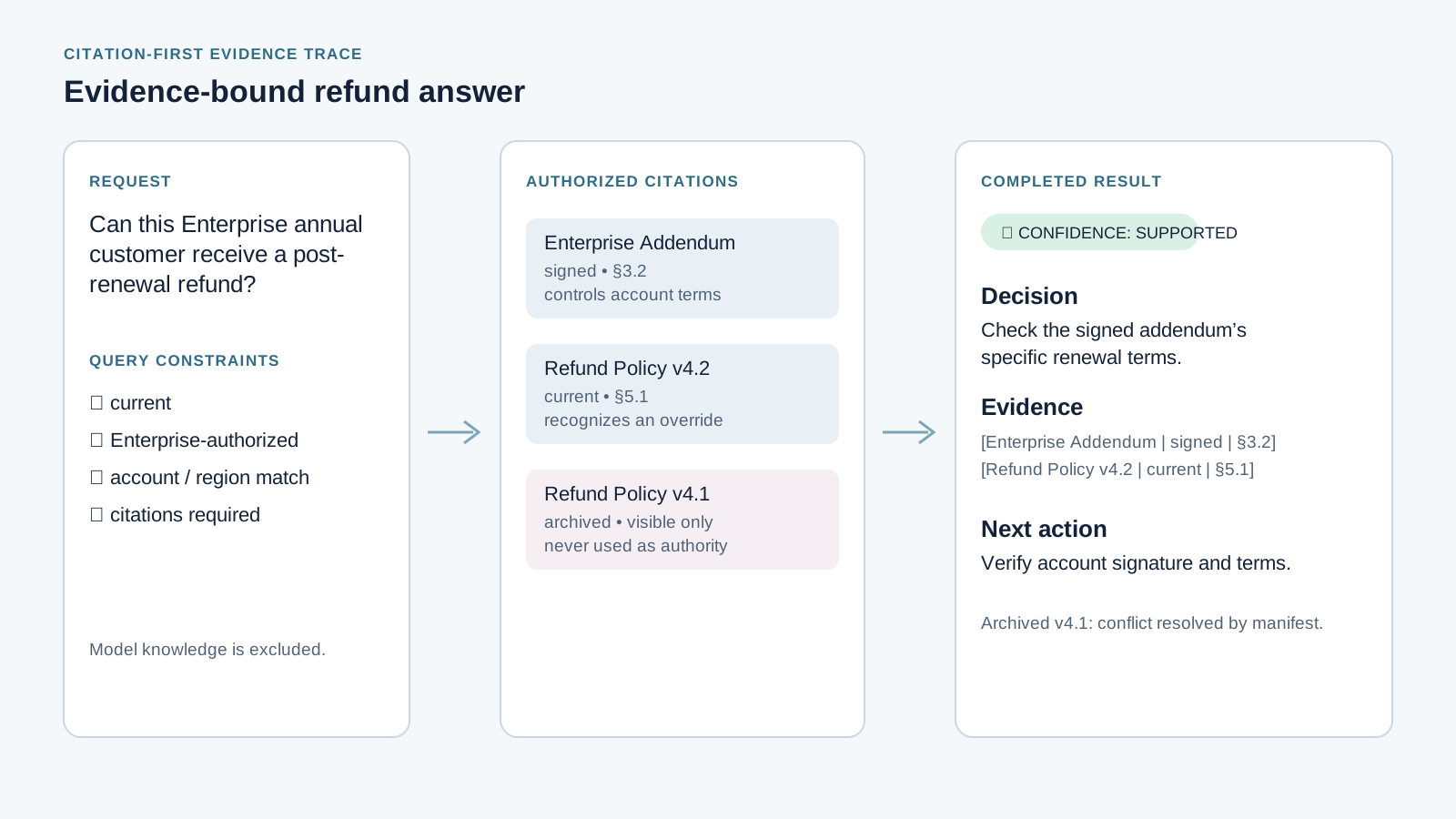
Evidence-bound refund answer with current policy citations
Primary completed result: the decision is supported by v4.2 and the signed addendum, while the archived document remains visible only as a resolved conflict.
Step 4: Evaluate Retrieval and Faithfulness Separately
An answer can cite a document and still apply the wrong clause. Score retrieval recall and claim faithfulness separately. This produces a release decision that a product, support, or legal owner can defend.
plaintext1You are evaluating a knowledge-base answer. 2 3Given: 4- the user question 5- expected source sections 6- retrieved source sections 7- the final answer 8 9Score these dimensions separately: 101. Retrieval recall: did the required source appear in the retrieved evidence? 112. Citation precision: does each cited source support the nearby claim? 123. Claim faithfulness: is every atomic factual claim supported by retrieved evidence? 134. Conflict handling: did the answer surface conflicting current sources? 145. Abstention quality: did the answer refuse unsupported conclusions? 15 16Return JSON with: 17question_id, retrieval_recall, citation_precision, claim_faithfulness, 18conflict_handling, abstention_quality, unsupported_claims, reviewer_notes, 19release_decision 20 21Use FAIL if any high-risk factual claim lacks supporting evidence.
Settings: make a 20-question golden set with 4 questions each for simple, common, conflicting, no-answer, and high-risk cases. Keep high-risk and conflict questions at high reasoning. Benchmark lower effort only for low-risk work after the baseline passes.
Done when: the set includes a retrieved-correct-document / applied-wrong-clause failure and a correct abstention. Human reviewers sample every supported high-risk answer.
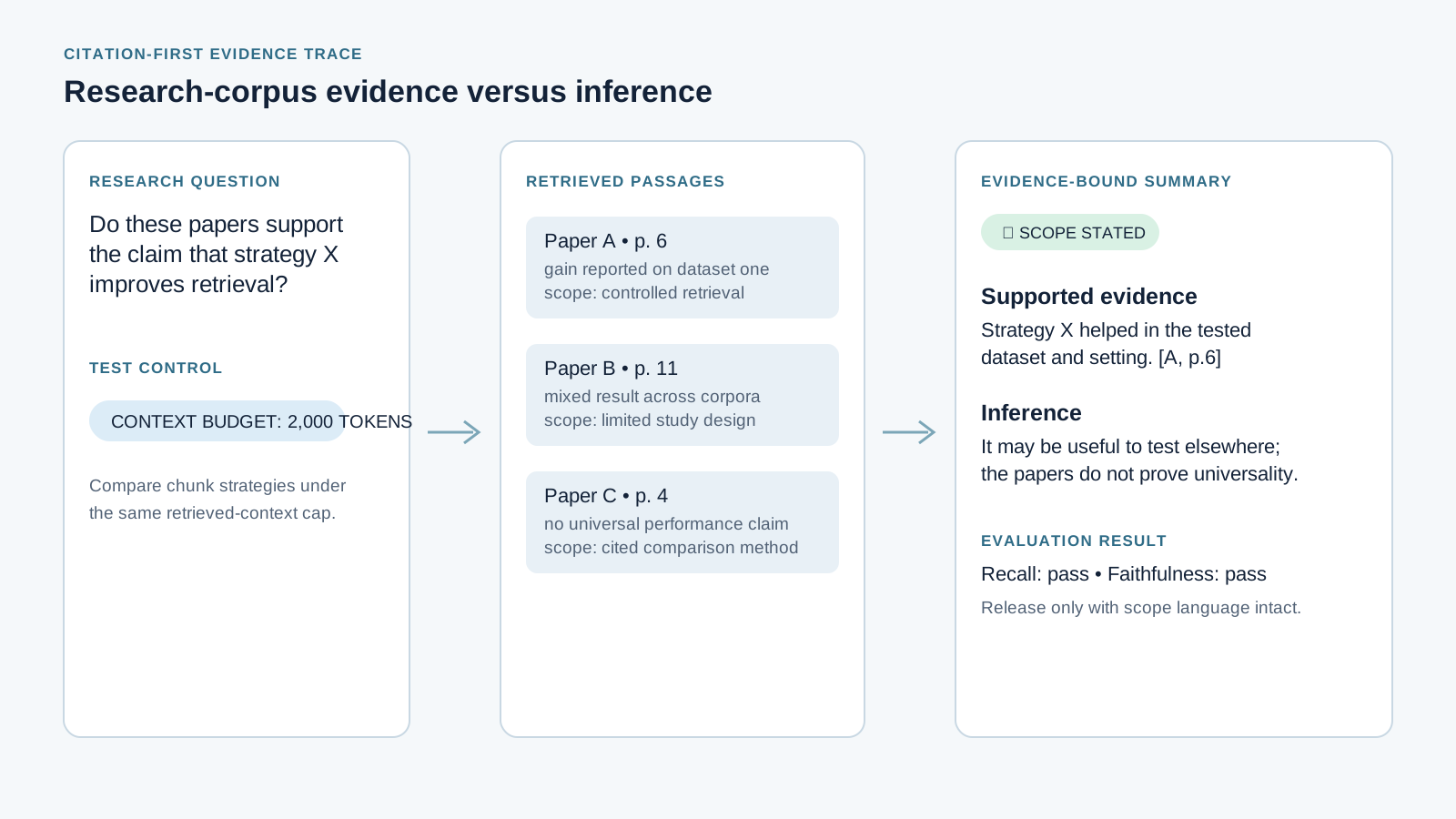
Research corpus evidence trace comparing support and inference under a 2000-token budget
Case 3. A research-corpus answer separates what three papers explicitly support from an inference. The retrieval comparison holds the context budget at 2,000 tokens.
Scale the GPT-6 Astra Knowledge Base Without Losing Proof
The pilot patterns change by domain. Keep the evidence trace, but make the authority source and refusal boundary specific to the work.
| Pilot | Authority source | Required metadata | Refuse or escalate when | Human release gate |
|---|---|---|---|---|
| Enterprise refund policy | signed addendum, current policy | account, region, effective date, status | addendum missing or current sources conflict | support and policy owner |
| P1 incident runbook | current runbook and escalation matrix | service, severity, owner, last drill | action lacks an owner or current runbook | incident commander |
| Research corpus | cited paper passages | DOI, page, publication date, method | conclusion exceeds the evidence | subject-matter reviewer |
For code and internal rule libraries, give AGENTS.md, architecture decisions, current deployment procedures, and retired scripts explicit ranks. For research, return “evidence” and “inference” as different fields. For customer support, filters for product, region, and effective date do most of the reliability work.
Cost and routing checklist. A high-risk answer with 20K input tokens and 2K output tokens costs about $0.30 in GPT-6 Astra text tokens: 20,000 × $10 / 1,000,000 + 2,000 × $50 / 1,000,000. That excludes File Search and other tool charges, which should be verified in the current console before launch. Inputs above 272K tokens have higher model pricing, so a 1M-token prompt should not be the routine path.
| Task risk | Reasoning effort | Evidence rule | Human review |
|---|---|---|---|
| Tags and routing | benchmark before lowering | metadata-only | sampled |
| Standard support | medium or high after testing | current cited source | exception queue |
| Conflict, policy, or incident | high | every claim source-bound | required |
| Legal, medical, financial, HR, privacy | high | abstain when incomplete | required before action |
Start cost control upstream: remove stale and ownerless files, filter metadata before retrieval, test high-value questions first, and retain the manifest, retrieved passages, model version, and release decision. Teams that need a later multi-model route can review the current LLM API documentation alongside their own pilot results.
For regulated, private, employment, health, financial, or production-incident content, apply access filtering before retrieval, confirm data-processing and retention terms, keep a withdrawal path, and route incomplete evidence to an accountable human. A fluent response is never final advice in those contexts.
Frequently Asked Questions
Does a 1M-token context window remove the need for RAG?
No. It can help an investigator read a larger packet, but it does not establish document authority, user access, freshness, citation precision, or a release test. Use retrieval for routine evidence selection and reserve broad context for exception investigation.
What should never enter a GPT-6 Astra knowledge base?
Do not ingest unowned files, undated policies, drafts without an explicit draft workflow, content the requester is not authorized to see, or archived material that lacks a historical-use rule. Put those files in review or archive them outside normal retrieval.
How should two current documents that disagree be handled?
Return ESCALATE, name the conflict, preserve both citations, and assign an owner. A model should not silently invent a tie-breaker. The manifest needs a documented rule before the next release.
What is the best chunk size for a GPT-6 Astra knowledge base?
There is no universal number. Preserve meaningful policy headings and conditions, then compare strategies under the same context budget. A fixed top-k can hide a much larger retrieved token budget and make an experiment look better than it is.
How do I prove an answer is grounded in the right source?
Store the expected source for each golden question, the retrieved passages, the final atomic claims, and a reviewer’s score for recall, citation precision, faithfulness, conflict handling, and abstention. For high-risk answers, a missing support link is a fail.
How much does a GPT-6 Astra knowledge base cost?
Use the token formula, then add current File Search and tool charges. For the example above, 20K input plus 2K output is about $0.30 in model tokens. The practical saving comes from keeping stale material out and using high reasoning where evidence matters. That is the durable version of gpt-6 astra knowledge base best practices.





