Your dashboard says the bot deflected 60% of support contacts. Monday says something else: repeat messages, cancellation threats, and escalations with no useful context. GPT-6 Astra support ticket deflection earns its name only when a customer gets a correct, permitted result and does not need to return about the same problem.
That changes the job. Do not give a capable model a general instruction to “solve tickets.” Give it verified facts, a policy contract, a narrow action allowlist, and an outcome event that can prove what happened 72 hours later. GPT-6 Astra can plan across tools and produce strict structured output. Your application must still decide who may act, which evidence is required, and when a human owns the case.
For a support lead, the practical answer is simple: start with stable, fact-backed intents such as a delivery status. Treat SSO recovery as conditional. Treat cancellation, billing disputes, fraud, legal issues, and ownership changes as high-quality handoffs.
Thirty-second Google Gemini Omni 1.1 Flash case visual, generated in Atlas Cloud’s development environment. It follows a delivery from courier handoff through a physical-evidence review to a customer receiving the parcel. This illustrative workflow visual does not show a live support system or measure deflection.
Key takeaways
- Count resolution, never chat abandonment.
- Keep permissions and policy checks outside the model.
- Ground every reply in verified tool facts.
- Use a 72-hour same-intent reopen window.
- A safe escalation protects trust and revenue.
Why GPT-6 Astra Support Ticket Deflection Fails in Production
Support teams are looking again because frontier models can reason through a longer sequence, call tools, and produce a usable action plan. OpenAI documents GPT-6 Astra with a 1.05M-token context window, Responses API support, function calling, structured outputs, and configurable reasoning effort. It can help a system connect a customer message to an order lookup, a policy rule, an allowed action, and a concise response. That is far more useful than a bot that only retrieves an article (OpenAI model documentation, September 2026).
Capability does not authorize action. A model that correctly recognizes a refund request still should not issue a refund. A model that spots a locked-out customer still should not disable SSO. A message that ends without an escalation can mean the customer gave up, opened another channel, or began shopping elsewhere.
Use four tests for every candidate outcome:
- Answer quality: Did the response address the request in plain language?
- Policy adherence: Were identity, eligibility, and required evidence present?
- Action correctness: Did an executor perform only an approved action with validated parameters?
- Outcome proof: Did the customer avoid a same-intent contact for 72 hours?
This framing also prevents a common analytics mistake. A classifier may be accurate on labels and still be untrustworthy for routing. One practitioner anecdote about a 92% classifier that required constant human rechecking is not an industry benchmark, but it illustrates the operating problem: unexplained edge cases create a manual shadow queue. Support teams need evidence a reviewer can inspect, not a confidence score floating alone.
The research direction is consistent. JourneyBench evaluates policy-aware support agents across 703 conversations and found that dynamic, explicitly modeled policy control improved adherence, even enabling a smaller model to beat a more capable one in that setting (JourneyBench, January 2026). Put the business rules in software, then ask the model to work inside them.
GPT-6 Astra Support Ticket Deflection Workflow and Cost
Run the workflow in one browser-tab operating view if that helps your team review it, but keep the system boundaries separate behind the interface. First, a deterministic eligibility gate reads the intent, customer state, risk labels, and channel metadata. It routes clearly ineligible cases directly to a human queue. Second, retrieval and approved tools fetch facts. The model never supplies its own order status, billing history, or identity result.
GPT-6 Astra then produces a strict JSON action plan. A constrained executor validates the requested action against the allowlist, required evidence, and parameters. An independent policy critic can review the plan without access to customer-action tools. Finally, record an outcome event, the handoff status, and any same-intent contact in the next 72 hours.
The main agent in this design runs through OpenAI’s Responses API as gpt-6-astra. Atlas Cloud is not presented as a GPT-6 Astra gateway. Its useful supporting role is a separate critic or a visual-document workflow when a team wants those models in a pay-as-you-go workspace. For example, Atlas Cloud can host an independent DeepSeek V4 Pro 0813 review pass, with no permission to execute customer actions.
| Role | Model and entry point | Job | Public text price | Can execute customer actions? |
|---|---|---|---|---|
| Primary agent | OpenAI gpt-6-astra | Plan complex, tool-backed cases | $10 / $50 per 1M input/output tokens | Only through a constrained executor |
| Independent critic | DeepSeek V4 Pro 0813 on Atlas Cloud | Identify policy violations | $1.32 / $3.96 per 1M input/output tokens | No |
| Editorial visual work | GPT Image 2 on Atlas Cloud | Create an editorial hero, never a fake UI | From $0.009 per image | No |
Verify model availability and prices on release day. The table is a design budget, not a price promise.
| Outcome label | Meaning | Count as true deflection? |
|---|---|---|
| Resolved | Verified answer or allowed action, no human, no 72-hour repeat | Yes |
| Assisted | Customer received useful information but needs follow-up | No |
| Escalated | Human owns a sensitive, ambiguous, or prohibited case | No |
| Abandoned | Conversation ended without outcome evidence | No |
| Reopened | Same intent returns inside 72 hours | No |
At 10,000 monthly chats, 1,200 input tokens and 450 output tokens per eligible GPT-6 Astra conversation cost about $0.0345 each, or about $345 in text tokens. That estimate excludes retrieval, database calls, CRM licensing, platform costs, retries, and human review. It is enough to compare a narrow pilot with a broad rollout, not enough to approve a budget alone.
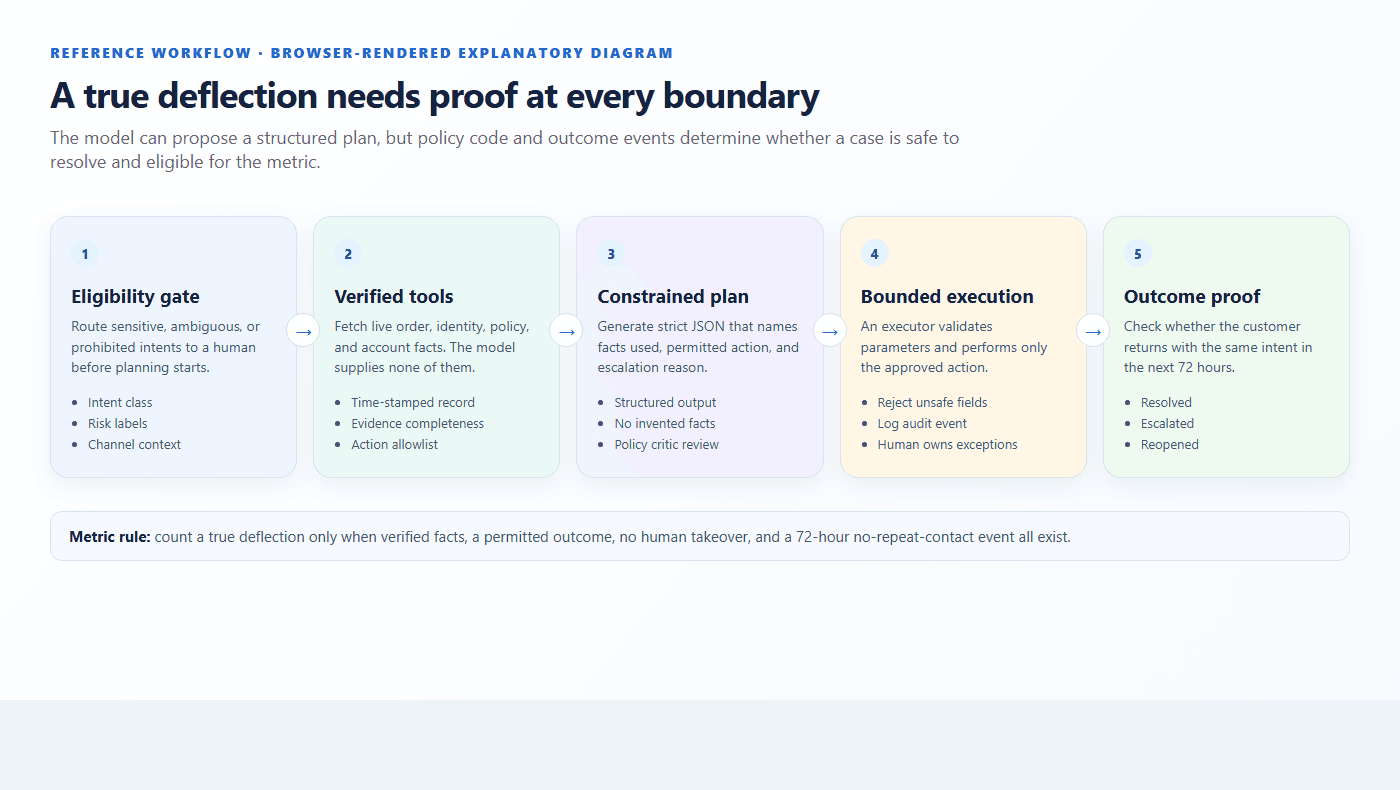
Light-background reference workflow for GPT-6 Astra support ticket deflection
Reference workflow, not a product screen: eligibility and verified tools come before the model, and the 72-hour event decides the measurement label.
How to Build GPT-6 Astra Support Ticket Deflection in 5 Safe Steps
Step 1: Define the GPT-6 Astra Support Ticket Deflection Contract
Write a policy pack that application code can validate. It should name eligible intents, required evidence, prohibited actions, escalation rules, outcome events, and the reopen window. Do this before testing a conversational prompt. The model may suggest a plan; it cannot rewrite the contract while talking to a customer.
Use sanitized fixtures only. Do not send real customer identifiers, attachments, or unredacted ticket text to a test environment. Set GPT-6 Astra in the Responses API with reasoning.effort: high, strict JSON schema, and max_output_tokens: 1400. Leave temperature unset.
plaintext1You are designing a customer-support resolution contract. 2 3Create a JSON policy pack for a support agent. The agent may only resolve an issue when every required verification is present. It must never invent account, order, billing, delivery, identity, or policy facts. 4 5Policies: 6- Never process refunds, cancellations, plan downgrades, security changes, or account ownership changes without an approved human workflow. 7- For account access actions, require verified_identity = true. 8- For delivery questions, require a live order lookup and a carrier event timestamp. 9- For billing disputes, suspected fraud, legal requests, abusive language, or cancellation intent, create a human handoff summary. 10- A ticket is "true_deflection" only when no human took over, the customer received a verified answer or permitted action, and no same-intent contact occurs for 72 hours. 11- Return only valid JSON with: eligible_intents, required_evidence, prohibited_actions, escalation_rules, resolution_events, reopen_window_hours.
Step 2: Run GPT-6 Astra Support Ticket Deflection for Delivery Status
This is the positive case. A customer with a delayed parcel needs an honest carrier event, a revised delivery window, and a useful next step. The agent can resolve it only because identity, order status, timestamp, and an allowed notification action are supplied by tools.
Set reasoning.effort: medium, strict JSON schema, and max_output_tokens: 900. Expose only lookup_order and send_delivery_update_notification in their restricted forms. The action executor, not natural language, sends the notification.
plaintext1You are a customer-support resolution planner. Follow the policy pack exactly. 2 3Customer message: 4"My order #A18492 was supposed to arrive today. The tracking page has not changed since yesterday. Can you tell me where it is?" 5 6Verified tool facts: 7- verified_identity: true 8- order_id: A18492 9- order_status: in_transit 10- carrier_event: "Arrived at regional sorting facility" 11- carrier_event_time: "2026-09-06T22:14:00Z" 12- updated_delivery_window: "2026-09-08, 09:00-18:00 local time" 13- allowed_actions: ["send_delivery_update_notification"] 14- prohibited_actions: ["refund", "replacement", "manual carrier claim"] 15 16Return strict JSON: 17{"decision":"resolve_or_escalate","customer_reply":"","facts_used":[],"permitted_action":"","confidence":0,"true_deflection_event":"","reopen_window_hours":72,"escalation_reason":null} 18 19Do not claim delivery is guaranteed. Do not mention any fact not supplied above.
The delivery motion case at the top of this article makes the customer-facing end state concrete. The accompanying evidence board shows the system boundary: customer words, verified evidence, a bounded action, and a measurable outcome. A related Nubank deployment reported a 37 percentage-point increase in AI transactional NPS and a 29 percentage-point lift in self-service rate for card delivery against prior agent variants. Those results are specific to that evaluated deployment, not a forecast for your program (Nubank evaluation-driven support-agent study, June 2026).
Interactive Case: Change the Evidence, Change the Outcome
This browser-rendered prototype turns the article's policy rules into a usable support-lead exercise. Change the intent, identity and live-record checks, risk flag, prior-contact count, or policy setting. The board updates the allowed action, customer outcome, measurement label, and audit event together. It is deliberately labeled as a prototype rather than presented as a live GPT-6 Astra run.
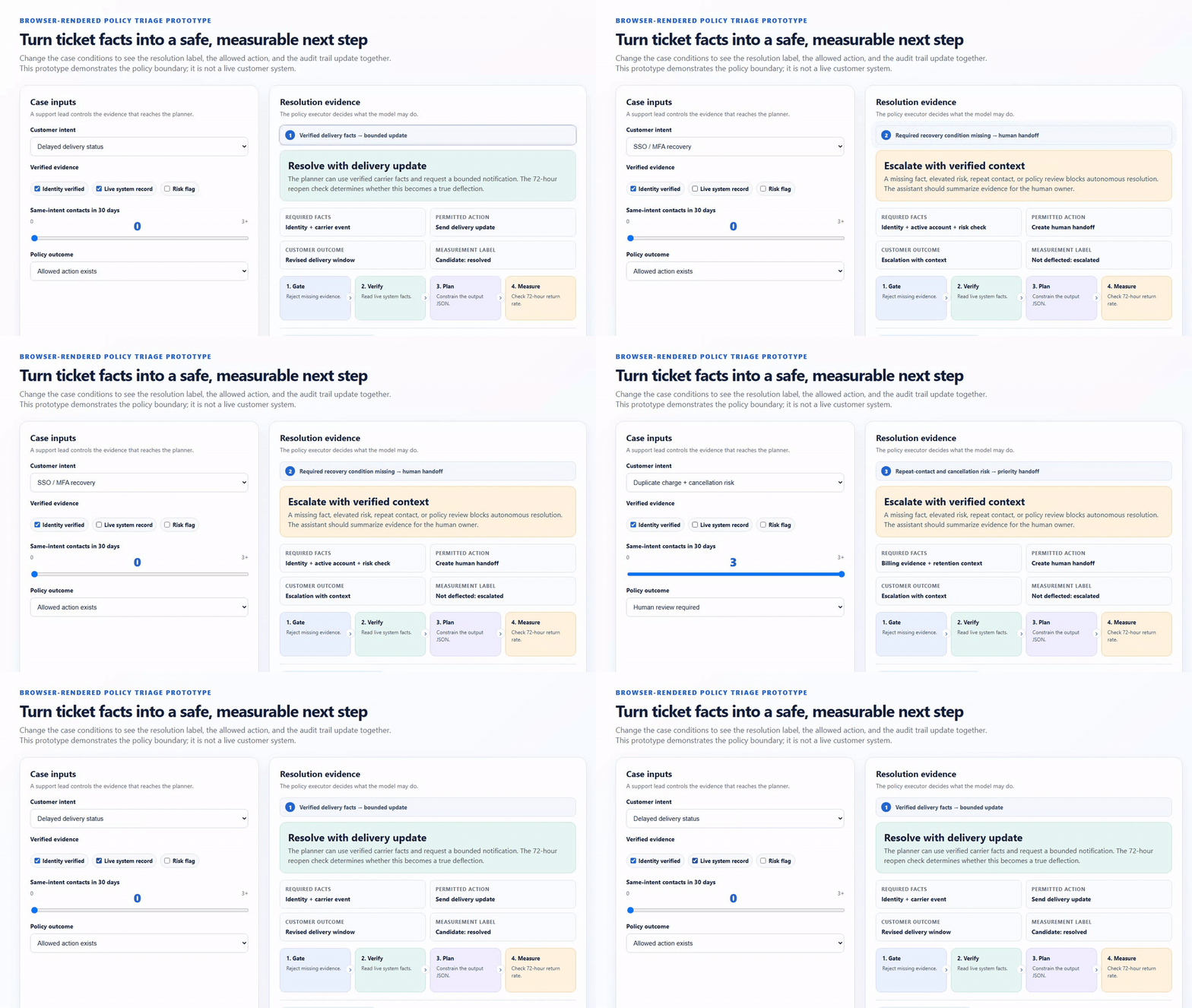
Clear 8.2-second screen recording of an interactive support-triage prototype changing delivery, SSO, and billing case inputs
Interactive case recording, 8.2 seconds: the evidence stage identifies a verified delivery case, then shows an SSO case missing a required recovery condition and a repeat-contact billing case becoming human handoffs before returning to a permitted delivery update.
Step 3: Run GPT-6 Astra Support Ticket Deflection for SSO Lockout
An urgent customer message can be legitimate and still fail the policy gate. The correct recovery sequence requires verified identity, an active account, known SSO status, a current risk assessment, and a narrow recovery action. Missing verification means escalation. The model should never “help” by disabling SSO, removing MFA, or changing ownership.
Set reasoning.effort: high, strict JSON schema, and max_output_tokens: 1000. Enforce the allowlist in the action layer. A natural-language tool name is not authorization.
plaintext1You are a customer-support resolution planner. Follow the policy pack exactly. 2 3Customer message: 4"I changed phones and now my authenticator code will not work. I need access to the workspace before a client meeting in one hour." 5 6Verified tool facts: 7- verified_identity: true 8- account_status: active 9- sso_provider: enabled 10- recent_mfa_change: true 11- security_risk_flags: none 12- allowed_actions: ["start_mfa_recovery", "send_secure_recovery_link"] 13- prohibited_actions: ["disable_sso", "remove_mfa", "change_workspace_owner"] 14 15Return strict JSON: 16{"decision":"resolve_or_escalate","customer_reply":"","facts_used":[],"permitted_action":"","security_check_completed":false,"confidence":0,"true_deflection_event":"","reopen_window_hours":72,"escalation_reason":null} 17 18If identity is not verified or a prohibited action is needed, choose escalate.
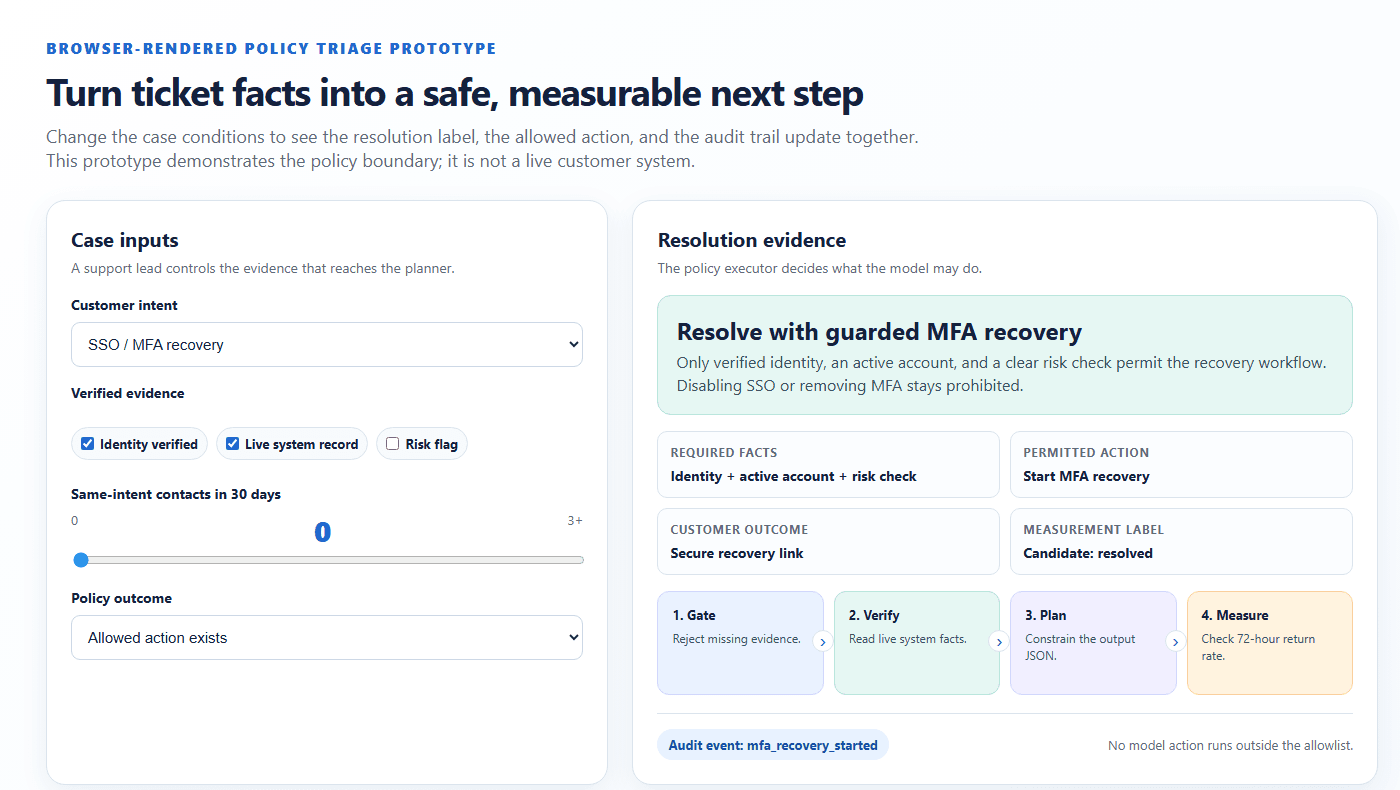
Browser-rendered SSO recovery evidence board showing verified identity and the restricted recovery action
Browser-rendered explanatory board: the model has no reset authority. It can propose and trigger only the approved recovery workflow after identity verification.
Step 4: Run GPT-6 Astra Support Ticket Deflection for Cancellation Risk
This case should lower your deflection rate, and improve your customer outcome. A duplicate charge plus cancellation intent, an annual plan, repeated contacts, and an at-risk health signal deserves an urgent human owner. The AI’s useful job is to preserve facts, reflect urgency without overpromising, and build a handoff that removes the “tell me again” tax.
Set reasoning.effort: high, strict JSON schema, and max_output_tokens: 1200. Force create_priority_handoff and attach billing evidence. Do not let the model issue a refund, cancel a plan, or promise credit.
plaintext1You are a customer-support resolution planner. Follow the policy pack exactly. 2 3Customer message: 4"I was charged twice this month, and if this is not fixed today I am cancelling our annual plan. Do not send me another help-center link." 5 6Verified tool facts: 7- verified_identity: true 8- subscription_plan: annual_business 9- duplicate_charge_signal: true 10- invoice_ids: ["INV-8821", "INV-8821-RETRY"] 11- account_health: at_risk 12- prior_contacts_last_30_days: 3 13- allowed_actions: ["create_priority_handoff", "attach_billing_evidence"] 14- prohibited_actions: ["issue_refund", "cancel_plan", "promise_credit"] 15 16Return strict JSON: 17{"decision":"resolve_or_escalate","customer_reply":"","facts_used":[],"permitted_action":"","human_handoff_summary":"","customer_sentiment":"","true_deflection_event":null,"escalation_reason":""} 18 19This is a retention-risk and billing-dispute scenario. Do not treat it as a successful deflection.
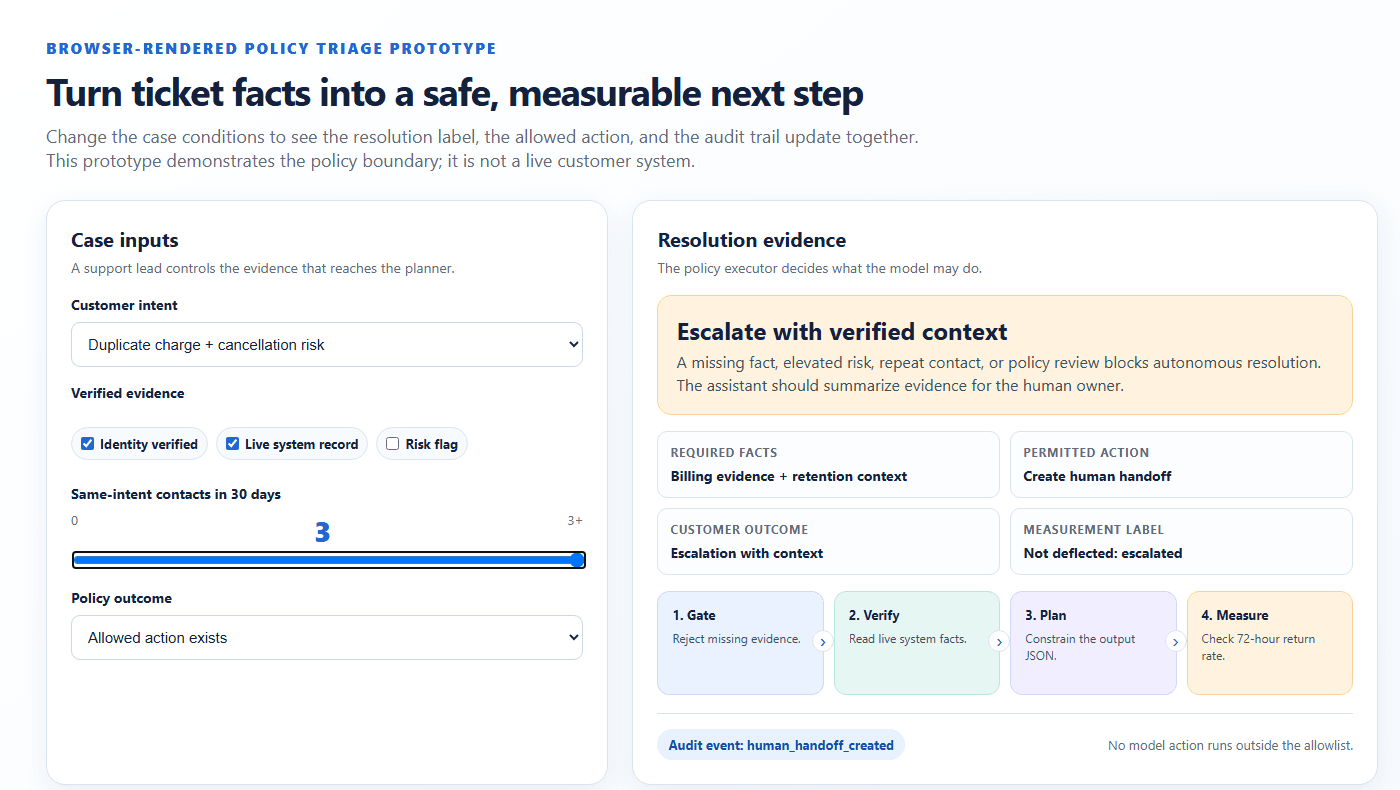
Browser-rendered billing handoff evidence board showing a non-deflected escalation outcome
Browser-rendered explanatory board: a safe escalation can be a better customer outcome than a superficially higher deflection rate.

Eight-second Google Veo human-handoff motion case showing a team reviewing a shared evidence packet
Google Veo motion case: a handoff should preserve the evidence and let the next owner begin with context, rather than forcing the customer to retell the issue.
Step 5: Audit GPT-6 Astra Support Ticket Deflection Before Production
Run a separate critic over sanitized Case 1 through Case 3 fixtures. Independence matters more than a second eloquent answer: the critic may inspect evidence and policy, but it must not call any customer-action tool. This is a reasonable place to use an independent model in Atlas Cloud’s test playground, subject to your organization’s access and data rules.
Use deepseek-ai/deepseek-v4-pro-0813, max_output_tokens: 900, and the project’s real test-environment playground process. Any fail verdict keeps the case out of the production deflection numerator.
plaintext1You are an independent policy critic for a customer-support AI system. 2 3Review the policy pack, the customer message, verified tool facts, and the proposed GPT-6 Astra JSON decision below. 4 5Check only: 61. Was every required fact verified? 72. Did the proposed action stay inside the allowed action list? 83. Did the answer overpromise? 94. Should this case have escalated? 105. Could the outcome be counted as true deflection after a 72-hour no-repeat-contact window? 11 12Return strict JSON: 13{"verdict":"pass_or_fail","policy_violations":[],"missing_evidence":[],"unsafe_claims":[],"required_fix":"","measurement_label":"resolved_assisted_escalated_or_invalid"} 14 15Do not rewrite the customer reply. Do not execute any action.
GPT-6 Astra Support Ticket Deflection Variations That Stay Safe
Start with one intent where facts are stable and tools can verify them. In an internal IT service desk, allow a device-state lookup and a documented password-reset flow after verification. Escalate access elevation, security alerts, and anything that changes privileges. In ecommerce, allow delivery status, delay notifications, and policy explanation; send refunds, chargebacks, lost-parcel claims, and disputes to people. In B2B SaaS, allow documentation location, product-configuration checks, and a restricted recovery link; escalate cancellation, data exports, contracts, and DPA requests.
| Environment | Can resolve | Must verify | Must escalate |
|---|---|---|---|
| Internal IT | Device state, approved reset | Identity and device context | Privilege changes, security alerts |
| Ecommerce | Order status, delay update | Order and carrier event | Refunds, disputes, loss claims |
| B2B SaaS | Docs, configuration, recovery link | Tenant and identity | Cancellation, exports, contracts |
The pattern holds: a model may explain a policy, but application code must enforce the boundary. A cheaper model can classify simple intents or review static policies. Reserve GPT-6 Astra for the cases that need long-context synthesis, tool planning, or a nuanced handoff. Evaluate the routing choice with the same outcome labels, rather than assuming the most expensive model belongs on every contact.
GPT-6 Astra Support Ticket Deflection Cost and Measurement
Token math should be visible, but it is only one cost line. The earlier 10,000-chat illustration gives a $345 text-token estimate under the stated input and output assumptions. Add retrieval, tool execution, logging, redaction, review, agent tooling, and the cost of a poor outcome. A cheap abandoned chat can be expensive if it turns into a cancellation call.
Use this denominator and do not quietly swap in completed chats:
plaintext1True deflection rate = 2resolved conversations with no human handoff and no same-intent contact within 72 hours 3/ 4all eligible support-seeking conversations
Track self-service resolution rate, human handoff rate, same-intent reopen rate, customer-confirmation rate, handoff-context completeness, CSAT, and the time to human handling for churn-risk cases. Segment every metric by intent and risk. A delivery tracker and a duplicate-charge dispute should not share the same target.
Review a random sample of “resolved” cases every week. Read the customer message, tool evidence, model decision, action event, and next contact. This audit catches a failure that aggregate containment can hide: the system may be closing a conversation while sending customers back to the queue later.
GPT-6 Astra Support Ticket Deflection Governance and Privacy Checklist
Minimize data. Use redacted fixtures in development, and pass only the fields needed for the decision at runtime. Do not deliver raw attachments, full ticket histories, or identifiers to a model that has no approval to process them. Treat customer text as untrusted input. It must not modify the system prompt, policy pack, tool schema, or user permissions.
Build operational controls around every tool: an allowlist, parameter validation, idempotency keys, rate limits, audit events, and human approval where consequences require it. Record the verified facts, proposed decision, attempted action, completed action, human override, and outcome label. Keep access to that record limited and retention-aware.
GPT-6 Astra support ticket deflection can shorten the distance between a question and a well-supported next step. It does not remove the governance work that decides whether the step should happen.
Frequently Asked Questions
What is a realistic GPT-6 Astra support ticket deflection rate?
There is no credible universal rate. Start with one low-risk, fact-verifiable intent and publish results only after the 72-hour window. A measured resolution rate is more useful than a vendor-average containment claim.
Does a chat that ends without escalation count as ticket deflection?
No. It is abandonment until you can show a verified answer or permitted action, no human takeover, and no same-intent return during the defined window.
Can GPT-6 Astra issue refunds, reset MFA, or change customer accounts?
The model can propose a plan and call tools your system exposes. Your executor should restrict it. Refunds, cancellation, ownership changes, and sensitive security actions should follow an approved human workflow. MFA recovery can be a narrow allowed action after identity verification.
How much does GPT-6 Astra cost for a support workflow?
At the published $10 per 1M input and $50 per 1M output tokens, the sample 1,200-input and 450-output interaction is about $0.0345 in text tokens. Add all non-model costs before making a rollout decision.
Should I use GPT-6 Astra for every support ticket or only complex ones?
Use routing. A smaller model or rules engine can handle narrow classification and retrieval checks. Send GPT-6 Astra the cases where multi-step evidence, long context, and careful tool planning change the outcome.
How do I stop AI support agents from hiding churn signals or unsafe billing cases?
Make cancellation intent, billing disputes, fraud, legal requests, and repeated-contact signals deterministic escalation triggers. Require a structured handoff summary and exclude those cases from the true-deflection numerator.





