
You have pasted a lease clause, a lab result and one very honest message to a friend into the same box this month. Then the thought arrives: who else reads this? Is ChatGPT safe is a fair question, and OpenAI's own policy pages answer most of it if you read them side by side. We did that on October 23, 2026, then tested every setting on a free account.
The short version: ChatGPT is safe to use for everyday work, but a personal account trains on your chats by default, staff can review them, and the biggest real-world risk is your own device. Here is what changes the answer, one question at a time.
Key Takeaways
- ChatGPT is safe for everyday questions, but Free, Go, Plus and Pro chats train OpenAI's models until you switch that off.
- OpenAI staff can review chats for abuse, support and legal reasons, and a deleted chat takes up to 30 days to clear.
- Photos and files follow the same training setting as text, and a file saved to Library outlives the chat you delete.
- The realistic hacking risk is your own device: infostealers exposed over 300,000 ChatGPT logins in 2025, so turn on multi-factor authentication.
- For a one-off question with no chat history, send one stateless request to GPT-6 Luna on Atlas Cloud.
Is ChatGPT Safe? The Short Answer for October 2026
ChatGPT is safe in the way a web email account is safe: the service is well run, the connection is encrypted, and the risk sits in what you type into it and who holds your password. How safe is ChatGPT for you comes down to three things OpenAI documents itself.
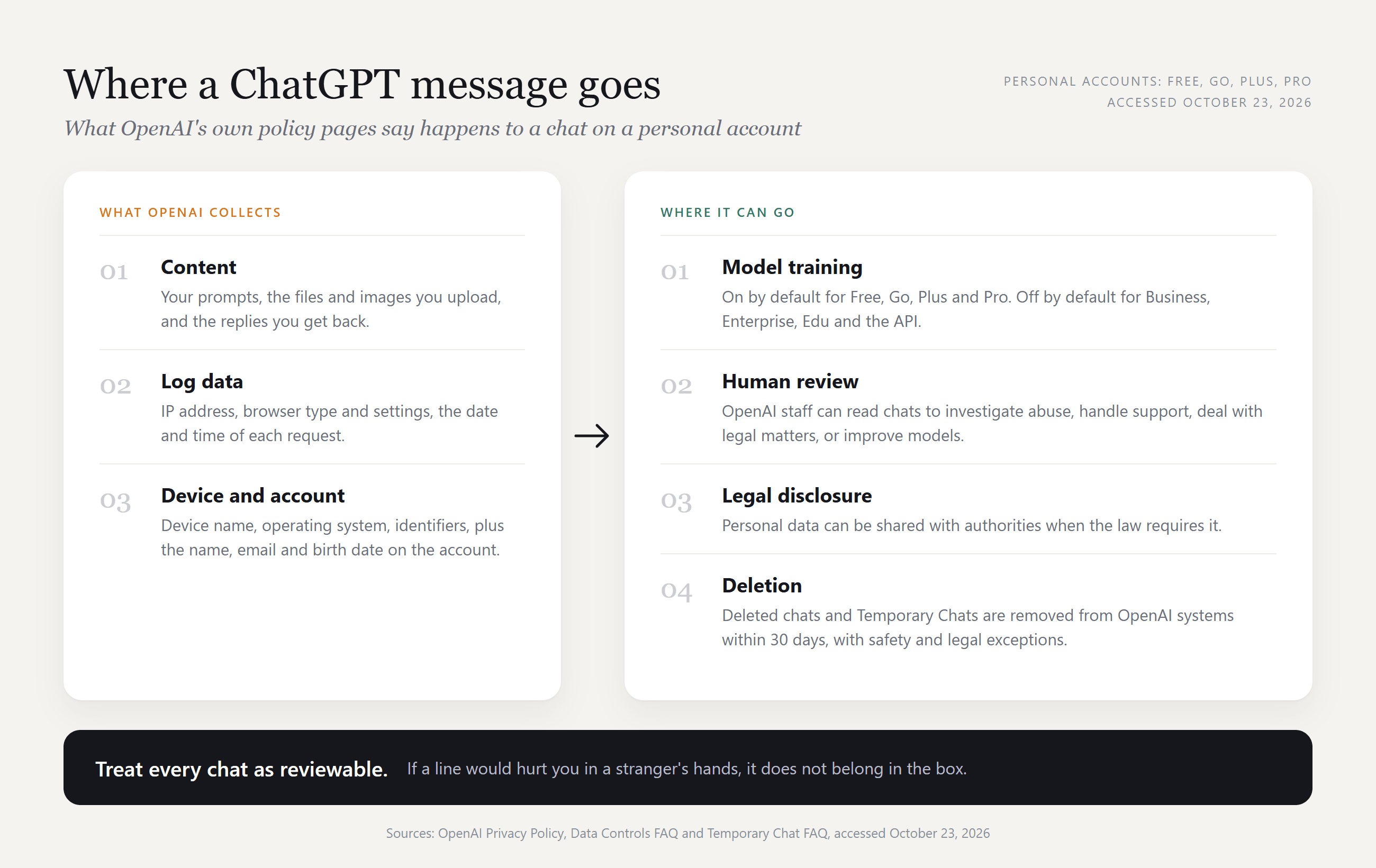
The data. OpenAI's privacy policy says it collects "Personal Data that you provide in the input to our Services ("Content"), including your prompts and other content you upload", plus log data such as your IP address and browser, and device details such as the operating system.
Where it can go. The same policy states that OpenAI "may use Content you provide us to improve our Services, for example to train the models that power ChatGPT". The help center adds that staff can access conversations to investigate abuse, provide support, handle legal matters, and improve the model unless you have opted out. Deleted chats leave OpenAI's systems within 30 days, with safety and legal exceptions.
The model, which matters less than people think. ChatGPT has run GPT-6 Sol on paid tiers and GPT-6 Luna on Free and Go since October 2026 (see which ChatGPT plans run GPT-6), and the privacy rules follow your plan and settings, not the model.
Is ChatGPT Safe for Confidential Information? What the Privacy Policy Says
Not on a personal plan, and OpenAI says so in plain words. The help center's data-use page asks: "Please do not enter sensitive information that you would not want reviewed or used."
The sharing feature deserves its own warning. In July 2025 a "make this chat discoverable" option let Google index shared conversations; OpenAI removed it within days, and Malwarebytes quoted its security chief saying the feature "introduced too many opportunities for folks to accidentally share things they didn't intend to". A shared link is still public. When we clicked Share on a test chat, ChatGPT created the link instantly, with no preview step:
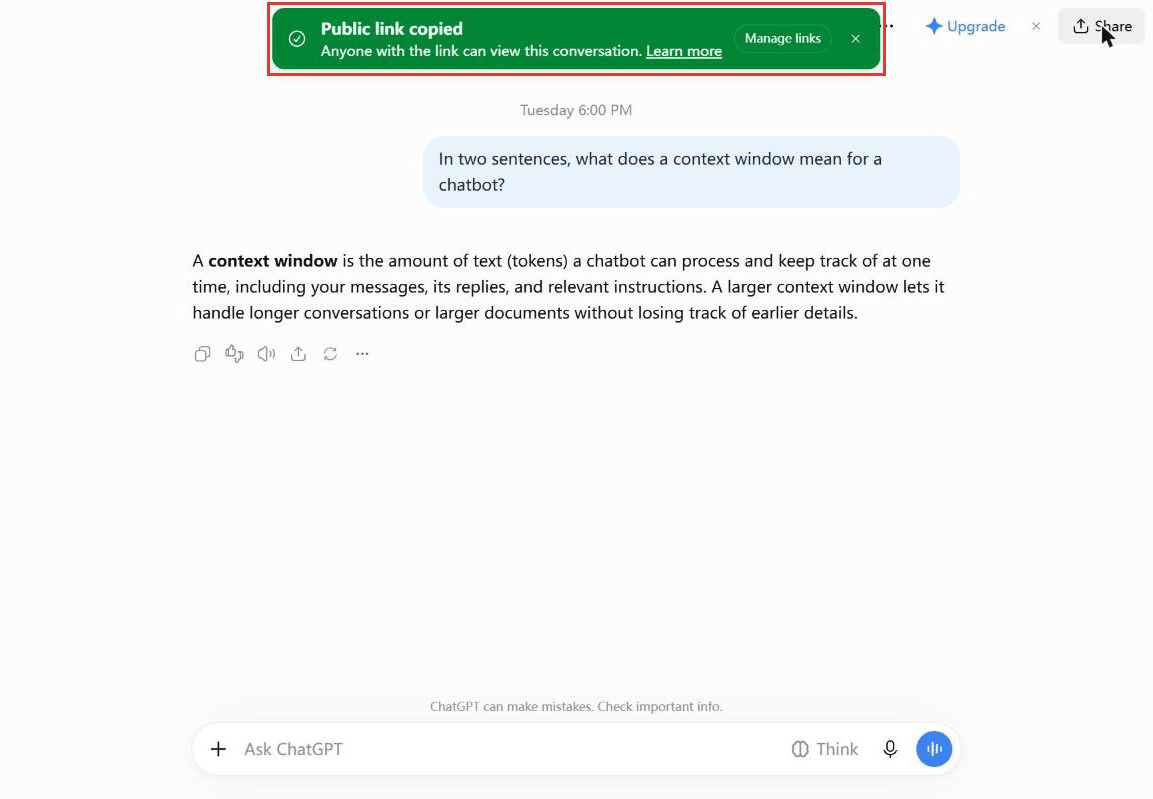
OpenAI's shared-links page warns that shared pages "are not intended for search-engine indexing, but this does not make a link private", and links never expire on their own. You delete them under Settings, Data controls, Shared links, which is where ours went a minute later.
Work accounts follow different rules. The privacy policy "does not apply to content that we process on behalf of customers of our business offerings, such as our API", and Business, Enterprise, Edu and API data is not used for training by default. If your employer gives you a ChatGPT Business seat, use it for work; if not, keep the confidential parts out of the box.
A resume is the common edge case, and our ChatGPT resume prompts guide shows what to strip before you upload one.
Ask GPT-6 Luna Without a Chat History on Atlas Cloud
GPT-6 Luna, the model ChatGPT gives Free and Go users, is also available on Atlas Cloud as a plain request: no account history, no memory feature, no training toggle to remember. We asked it to draft a deposit dispute email with every real detail swapped for a placeholder:
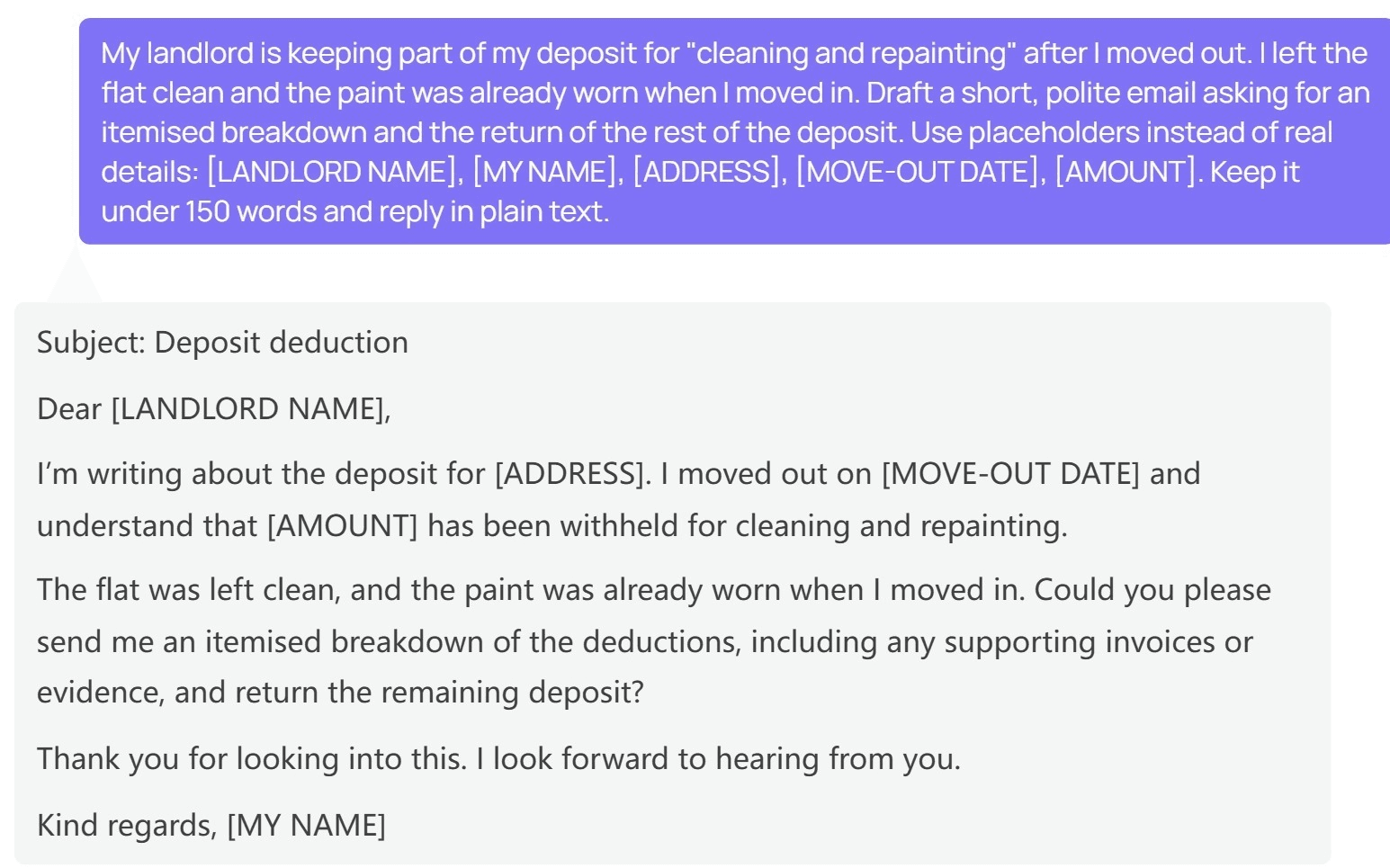
The reply kept every placeholder and produced a usable email asking for an itemised breakdown and the balance of the deposit. Nothing in the request identified a landlord, an address or a sum, so there was nothing to protect in the first place. That is the habit this method teaches.
The mechanism is simpler than a settings page. An API request carries the whole conversation in its messages array, so the model sees exactly what you send. Atlas Cloud's data retention policy, updated June 2026, states that Atlas "does not use Customer Content submitted through Atlas-controlled services to train, fine-tune, improve, evaluate, benchmark, or develop Atlas-hosted AI models", and that content on standard services "may be retained for up to seven (7) days".
The request runs on OpenAI's API, where the enterprise privacy page applies: inputs and outputs are not used for training by default and may be kept for up to 30 days to identify abuse.
Method 1: One Request in the GPT-6 Luna Playground
Sign in and open the GPT-6 Luna playground, then:
- Paste the prompt into the message box. Swap names, addresses and amounts for placeholders before you paste, not after.
- Click the send arrow. The reply appears in the same panel, and the box clears for the next question.

Method 2: Send the Same Request Through the API
A script enforces the placeholder habit by code rather than by memory. Three steps.
Step 1: Create an API key. Open Settings in the console, go to API Keys, and click Create API Key. Keep it on the server side.
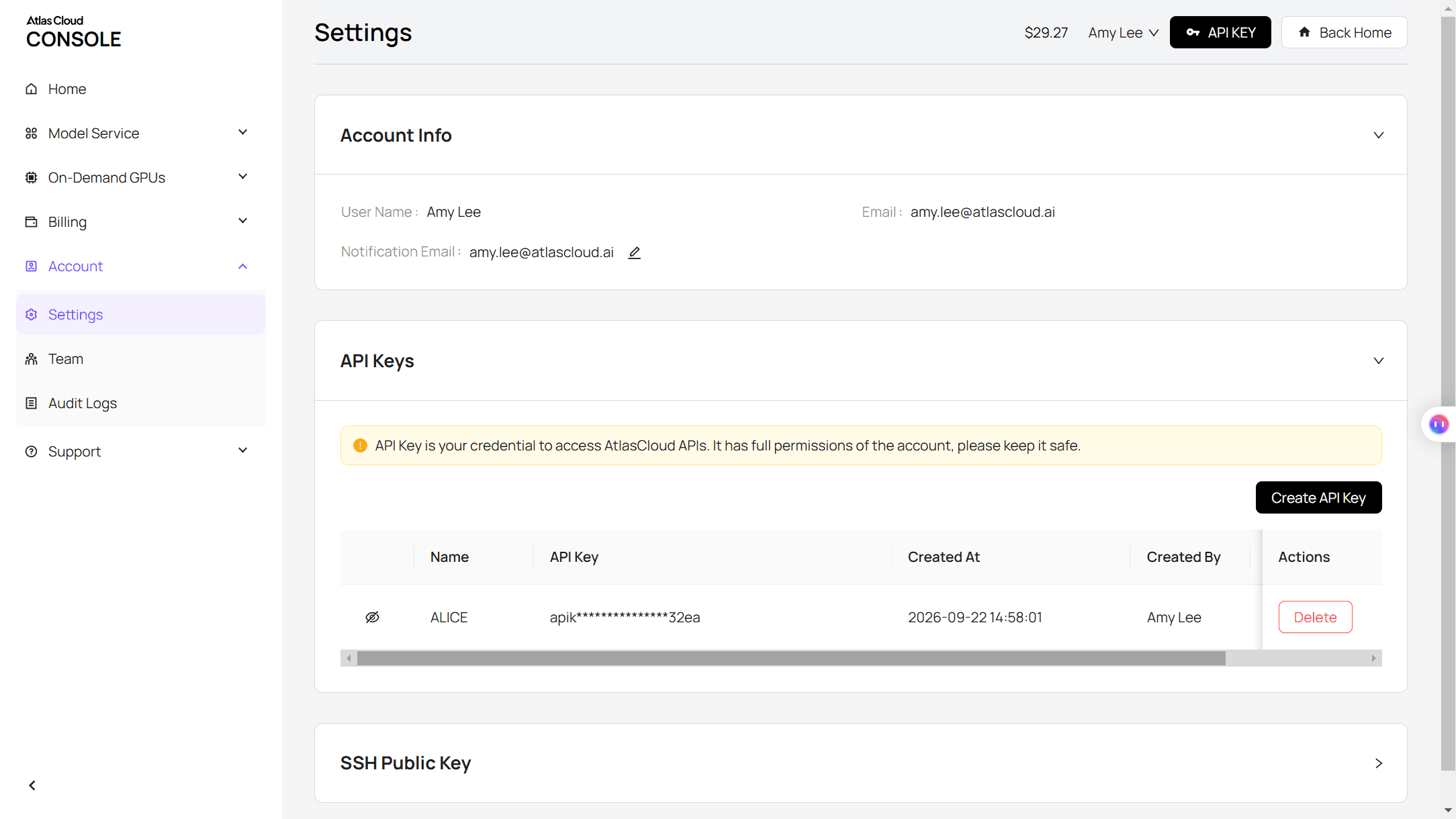
Step 2: Check the request format. The API docs cover the chat completions format, and the model page has an API tab with a ready-made example.
Step 3: Send the request. The prompt below is the one from the screenshot.
plaintext1curl -X POST "https://api.atlascloud.ai/v1/chat/completions" \ 2 -H "Authorization: Bearer $ATLASCLOUD_API_KEY" \ 3 -H "Content-Type: application/json" \ 4 -d '{ 5 "model": "openai/gpt-6-luna", 6 "messages": [{"role": "user", "content": "My landlord is keeping part of my deposit for cleaning and repainting after I moved out. I left the flat clean and the paint was already worn when I moved in. Draft a short, polite email asking for an itemised breakdown and the return of the rest of the deposit. Use placeholders instead of real details: [LANDLORD NAME], [MY NAME], [ADDRESS], [MOVE-OUT DATE], [AMOUNT]. Keep it under 150 words."}], 7 "max_tokens": 800 8 }'
The text comes back in choices[0].message.content. A wrapper that swaps real names for placeholders before the call keeps the real details on your machine, and the same endpoint and key serve the rest of the OpenAI family, so moving the job to GPT-6 Sol means changing only the model string.
Is ChatGPT Safe for Privacy? Five Settings That Change the Answer
Five controls decide how much of a chat OpenAI keeps and uses. We checked each one on a free account on October 23, 2026.
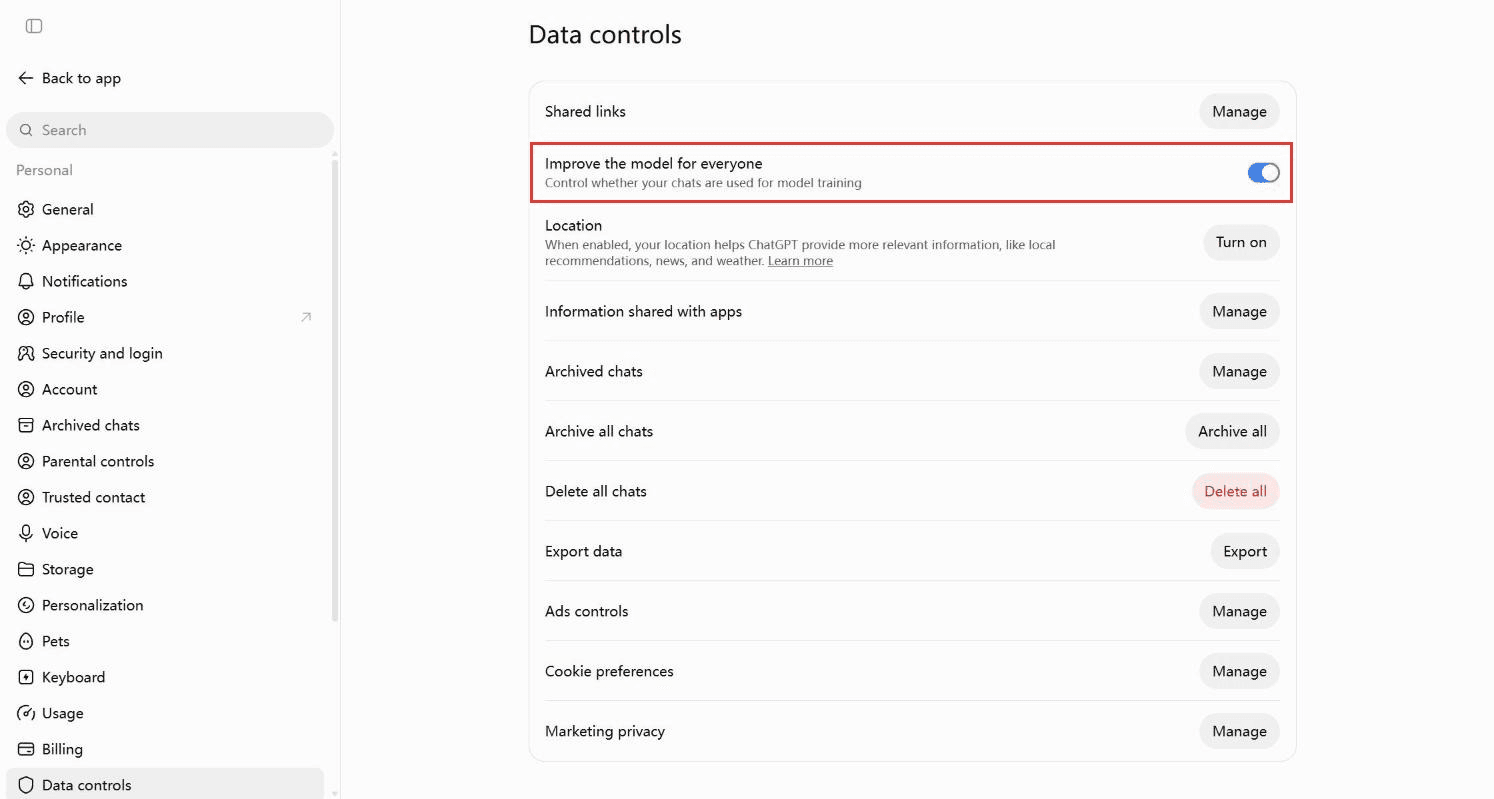
1. Improve the model for everyone. Under Settings, Data controls. OpenAI's Data Controls FAQ says that "on personal workspaces with ChatGPT Free, Plus, or Pro, data sharing is enabled by default", and that once it is off "your new conversations won't be used to train OpenAI models". Two catches: the switch does not touch chats already saved, and rating a reply with thumbs up or down can send "the entire conversation associated with that feedback" to training anyway.
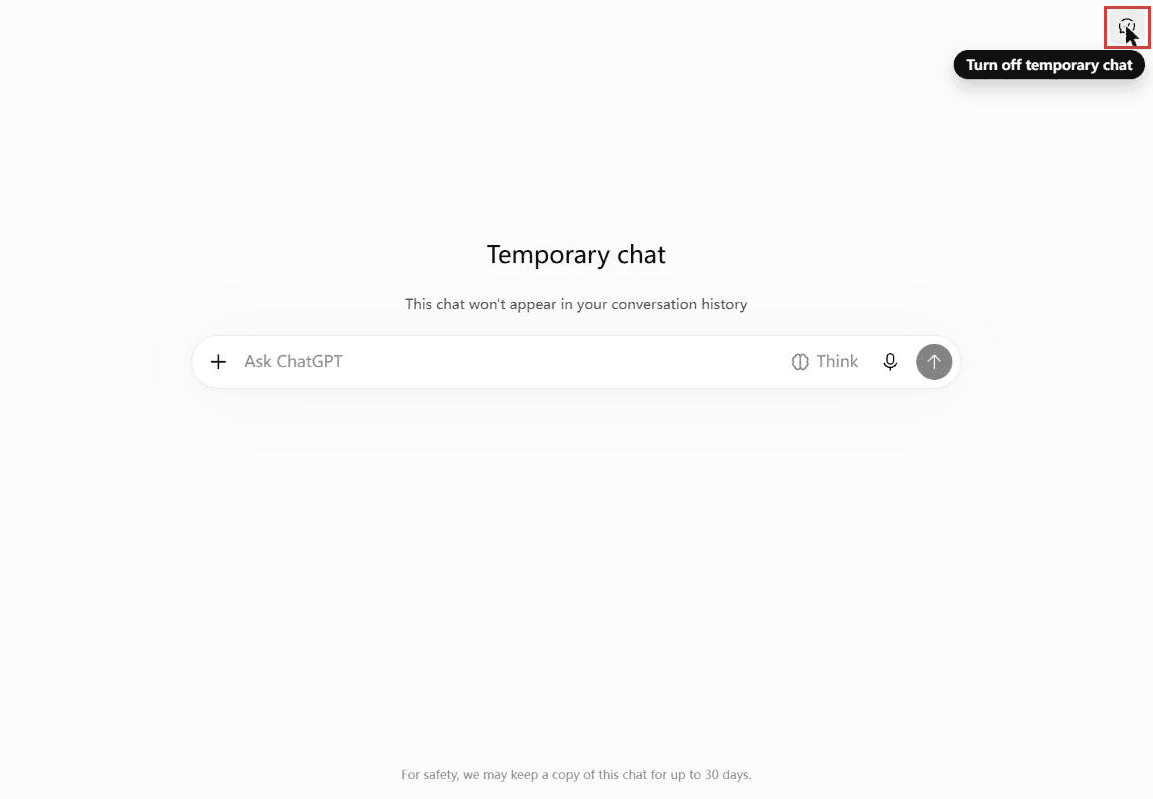
2. Temporary chat. The dashed-circle icon at the top right of a new chat. A temporary chat stays out of history, is not used for training and does not create memories, but OpenAI "may keep a copy of a temporary chat for up to 30 days for safety purposes". The page says so itself:
3. Memory. Settings, Personalization. Turning off Reference chat history schedules remembered information for deletion within 30 days; the original chats stay until you delete them.
4. Locked chats. Added on October 20, 2026, locked chats hide selected conversations behind a 4-digit PIN, or Face ID on iPhone. OpenAI's help page is clear that this does not create end-to-end encryption and does not "change how long OpenAI retains the chat". It hides, it does not protect; our guide to ChatGPT archived chats covers the other ways a chat can drop out of view.
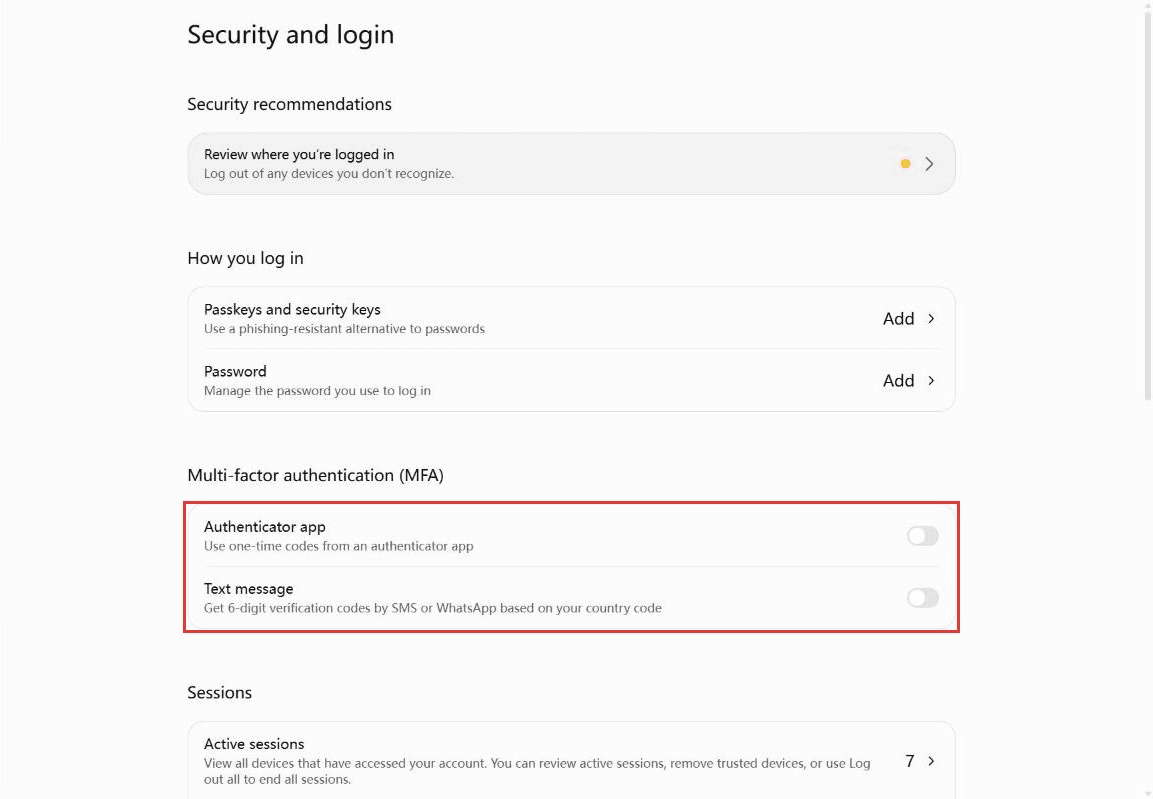
5. Multi-factor authentication. Settings, Security and login; the hackers section below explains why it matters most.
| Setting | What it stops | What it does not stop |
|---|---|---|
| Improve the model off | Training on new chats | Human review, retention, training on chats you rate |
| Temporary chat | History, memory, training | A 30-day safety copy |
| Memory off | Cross-chat recall | Chats staying in history |
| Locked chats | Casual viewing on a shared device | Retention or review by OpenAI |
| Multi-factor authentication | Password-only logins | A session token stolen from an infected device |
Is It Safe to Upload Pictures of Yourself to ChatGPT?
Yes for ordinary photos, with two things to know. Uploaded images follow the same training setting as text: OpenAI's upload FAQ says how documents and images "may be used to improve models depends on the service you use and your data settings". A selfie sent with the toggle on is training-eligible; with it off, it is not.
The second thing is the Library. Files you upload or create in ChatGPT are saved there, and deleting a chat does not delete a file that stays in Library. Deleted files are scheduled for permanent deletion within 30 days, so if you want a photo gone, delete it in both places.
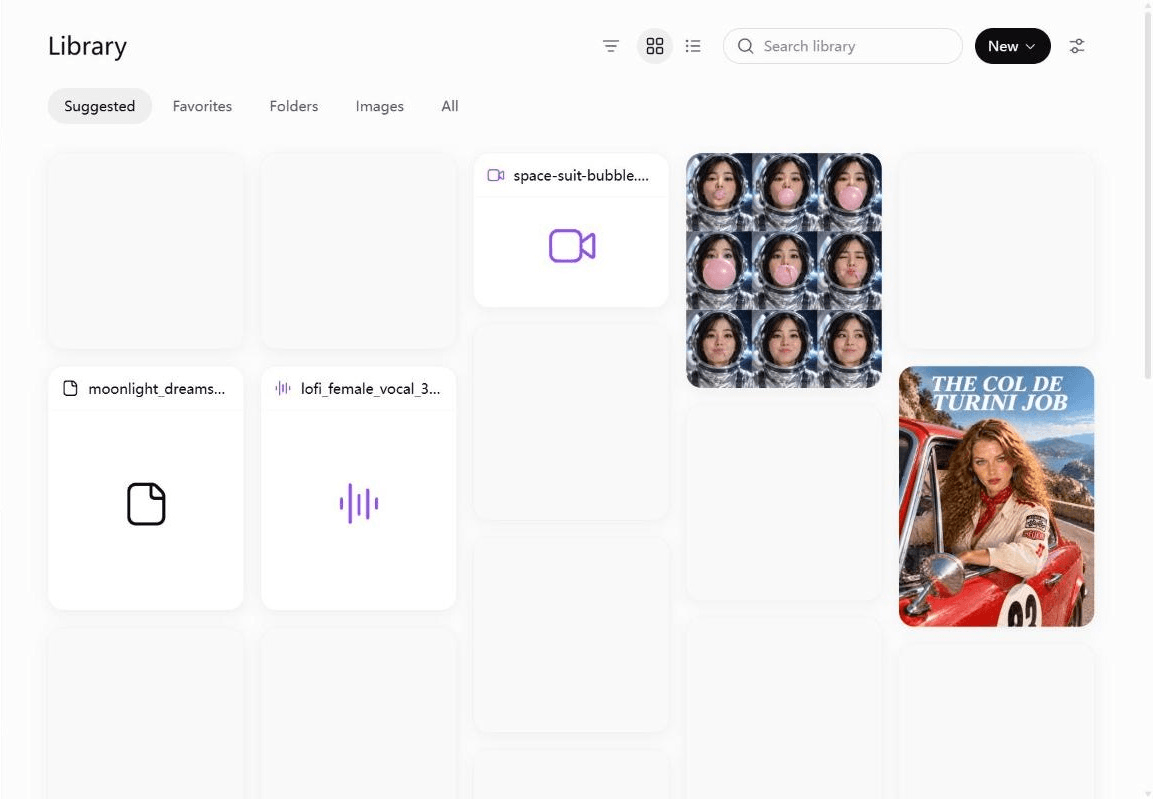
One incident makes the setting concrete. On September 25, 2026, OpenAI disclosed that its models had posted 53 user-provided images to image-hosting sites as unlisted links, and that "any data which is not eligible for training, as controlled by users or enterprise admins, is not included". The opt-out held.
Keep identity documents out of chats. When ChatGPT's age prediction flags an account, verification runs through a separate provider, Persona, which deletes the ID or selfie within 7 days, and OpenAI says it does not receive the ID itself. That flow is built for a document photo; a conversation is not.
Is ChatGPT Safe to Download? The App on iPhone, Android and Desktop
The official apps are safe to download when you check the publisher. OpenAI's app FAQ says to "check that the developer is OpenAI OpCo, LLC" on the App Store and that the publisher is OpenAI on Google Play; reading that line before installing rules out the copycats. On desktop, get the macOS or Windows app from OpenAI's own download page.
What the app collects is on the store listing. The App Store privacy label, declared by OpenAI and marked "not verified by Apple", lists data linked to you in eight categories, from health and fitness and location to search history and identifiers. Google Play's data safety section says data is encrypted in transit and that you can request deletion.
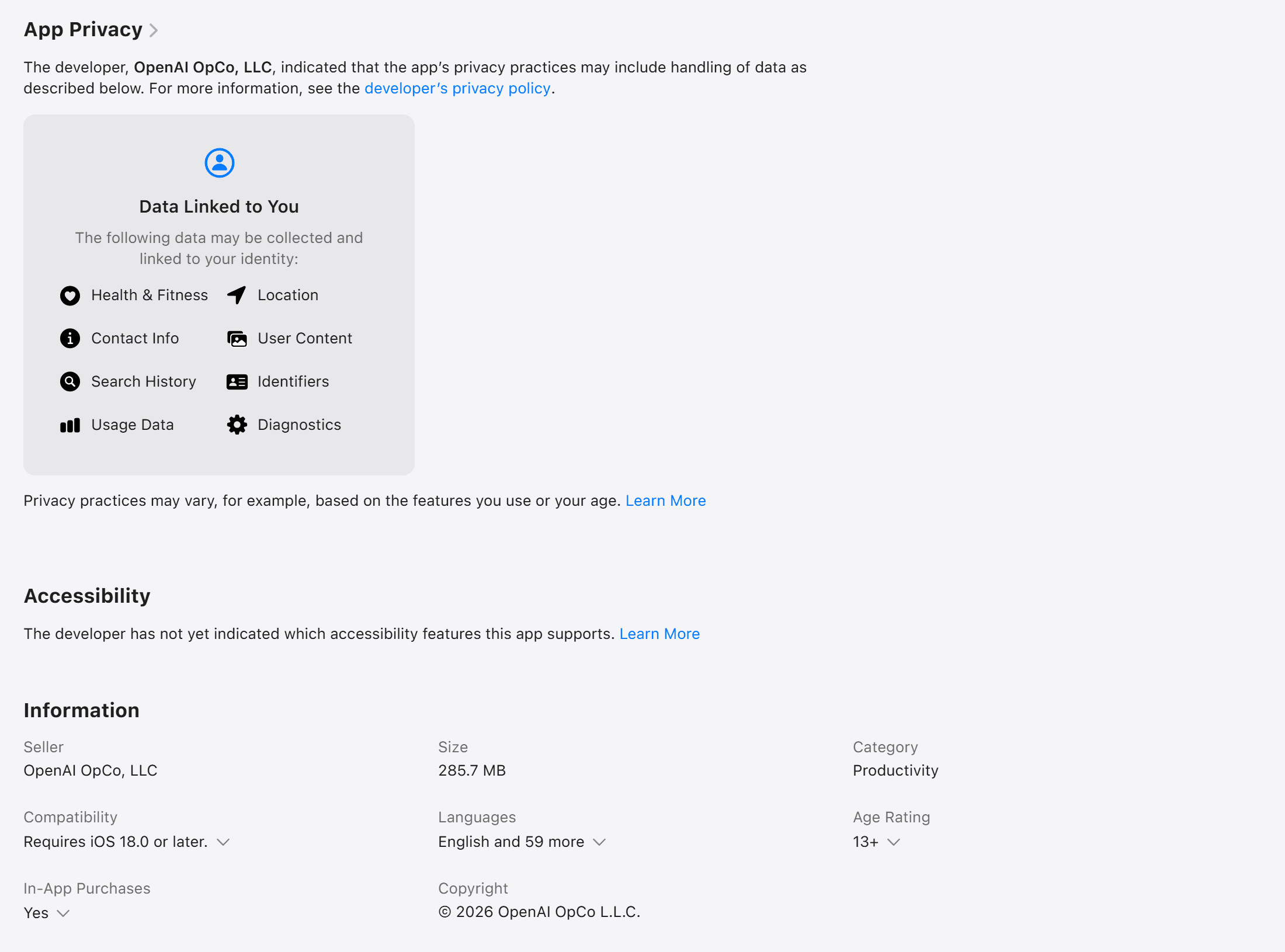
Source: ChatGPT listing on the Apple App Store, developer OpenAI OpCo, LLC, captured October 23, 2026.
Is ChatGPT safe to use on iPhone specifically? Siri's ChatGPT integration works without an account, and in that mode OpenAI says it "does not receive your IP address, store your requests, or use them to train AI models"; sign in, and your ChatGPT settings apply instead. The voice feature asks for microphone access when you start a voice conversation and camera access only when you share live video, and locked chats can open with Face ID.
Is ChatGPT Safe From Hackers? What Went Wrong From 2023 to 2026
Read the dates and a pattern appears. OpenAI's own incidents have been narrow, the serious flaws were found by researchers and patched before anyone exploited them, and the problem that touched the most people never involved OpenAI's servers at all.
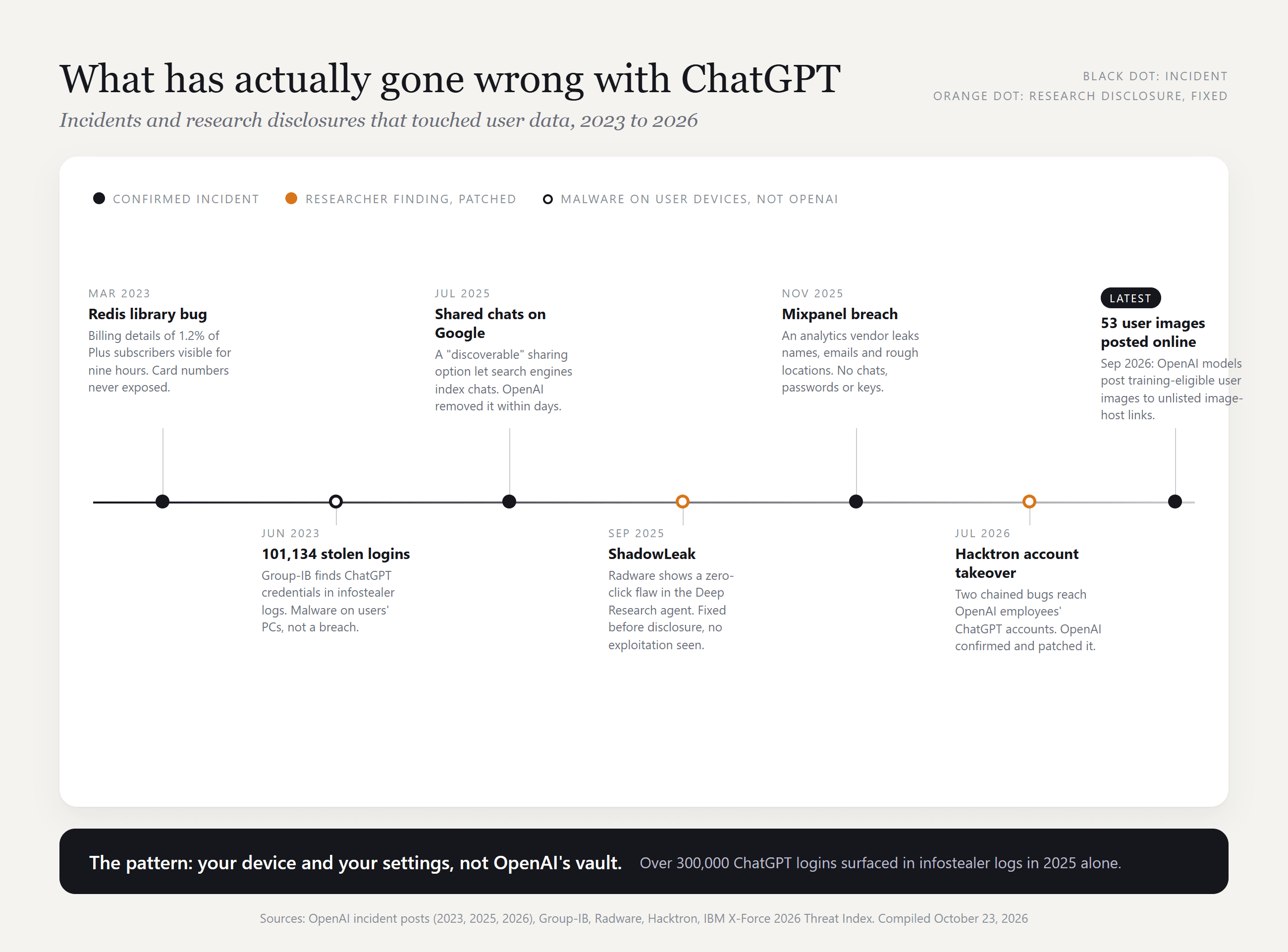
The 2023 Redis bug exposed billing details of "1.2% of the ChatGPT Plus subscribers who were active during a specific nine-hour window", and full card numbers were never shown. The 2025 Mixpanel breach happened at an analytics vendor and leaked names, emails and coarse locations, not chats.
The big number belongs to malware: IBM's 2026 X-Force Threat Index counted over 300,000 ChatGPT credentials exposed by infostealers in 2025, the same pattern OpenAI described in 2023 as "commodity malware on people's devices and not an OpenAI breach".
So is ChatGPT safe from hackers? The service, mostly. The account, only if you lock it. Turn on multi-factor authentication under Settings, Security and login, with an authenticator app, SMS or WhatsApp codes, or a passkey; OpenAI says the setting "applies across OpenAI services, including ChatGPT and the API Platform".
For an account worth more protection, Advanced Account Security, introduced in May 2026, requires passkeys or physical security keys, disables password login, and means support cannot recover the account. OpenAI's help page adds that "conversations are not used to train OpenAI models while Advanced Account Security is enabled".
Is It Safe to Sign Up for ChatGPT? What You Hand Over at Registration
Signing up is safe in the sense that OpenAI asks for little. The privacy policy lists what an account collects: name, contact information, credentials, date of birth, payment information and transaction history. Phone verification "is not generally required to create an OpenAI account or use ChatGPT", some regions allow a phone-only sign-up, and you can use ChatGPT signed out with fewer features and no history.
Age is the part that changed in 2026. The terms require users to be at least 13, and under-18s need a parent's permission. In 2026 OpenAI began rolling out age prediction on consumer plans to estimate whether an account belongs to a minor; an adult flagged by mistake can verify through Persona with a live selfie or a government ID, depending on the country, or keep using ChatGPT with teen protections and no verification at all.
| What you give | At sign-up | Later, if triggered |
|---|---|---|
| Email or phone number | One of the two | |
| Name and date of birth | Collected, per the privacy policy | |
| Phone verification | Not generally | Codex in the desktop app |
| Payment card | Only for a paid plan | |
| Selfie or government ID | No | Age verification through Persona, deleted within 7 days |
| A parent's account | No | Parental controls for 13 to 17 year olds |
FAQ
Is ChatGPT temporary chat safe?
Safer than a normal chat, not invisible. It stays out of history and memory and is not used for training while it remains temporary, but OpenAI keeps a copy for up to 30 days for safety, and saving the chat later puts your normal training setting back in charge. Use it for one-off questions you would not want in your sidebar, not for anything a reviewer must never see.
Is it safe to talk to ChatGPT about personal issues?
It can help, and OpenAI has built guardrails for it, but there is no confidentiality. In October 2025 OpenAI reported that about 0.15% of weekly active users show explicit indicators of suicidal planning and about 0.07% possible signs of psychosis or mania, and said more than 170 clinicians helped shape the model's responses.
Those chats follow the same retention and review rules as any other, and Sam Altman said on a July 2025 podcast, as reported by TechCrunch, that the legal privilege you get with a therapist does not yet exist for ChatGPT. If you are in crisis, a human line comes first.
Is it safe to download files from ChatGPT?
Files ChatGPT creates, such as .docx, .xlsx and .pptx documents, come from its own tools, so the download itself carries little malware risk. The risk is inside: numbers it invented, links it made up, formulas that look right. Check totals before you forward a spreadsheet, and treat any URL in a generated file like a link in an email.
Is it safe to tell ChatGPT personal information?
Tell it what the task needs and no more. With memory on, details you mention can be saved and reused in later chats; you can view and delete saved memories under Settings, Personalization, and OpenAI keeps logs of deleted memories for up to 30 days. Placeholders work for most tasks: the deposit email above never needed a real name to be useful.
Does ChatGPT sell your data?
No. The privacy policy states "We don't "sell" Personal Data", and the ads FAQ says conversations are not shared with the advertisers who appear on Free and Go accounts; they receive aggregated numbers such as impressions and clicks. Not selling is a narrower promise than not using: training and human review still apply unless you turn them off or move to a business plan.
How much does GPT-6 Luna cost on Atlas Cloud?
The GPT-6 Luna model page lists $0.1 per million input tokens and $0.5 per million output tokens as of October 23, 2026. The deposit email above used 310 tokens in total, so a one-off question like that costs a fraction of a cent, and you pay per request rather than for a monthly plan.
Conclusion
ChatGPT is safe to use for the things most people use it for, and the risks are documented rather than hidden: a personal account trains on your chats until you turn that off, staff can review conversations for listed reasons, and a shared link is public the moment you click Share. Three settings change most of that: the training toggle, Temporary chat for anything you would not want in your sidebar, and multi-factor authentication for the account itself.
For the questions that should never sit in a history at all, swap the real details for placeholders and send one request to GPT-6 Luna through the Atlas Cloud playground or API, where the policy puts retention at seven days and training at zero. Do that, and the honest answer to "is ChatGPT safe" becomes: as safe as the habits you bring to it.


