TL;DR
- Same 11-shot prompt, same six reference images, same settings, two generations per model.
- Seedance 2.5 scored highest (8.06 / 10) but cost $17.76 per 30-second run.
- Kling 4.0 came second (7.56) for $6.41 per run, the best value in the test by a wide margin, and the most faithful to my character designs.
- Wan 3.0 came third (7.44) for $7.56 per run, with a great storm and stable characters but the weakest fights. It finished just 0.12 behind Kling, inside my margin of error.
- Fight scenes are still the hardest thing for AI video: the three models averaged 6.5 / 10 on fight impact.
Why I ran this test
Kling 4.0 launched on October 15 with a big promise: up to 30 seconds in a single generation, multi-shot storytelling, multiple references and native audio. Spec sheets are easy to write. I wanted to know what it actually does with a hard brief: several shots, two characters who have to stay on-model, a fight, dialogue, water physics and a punchline.
So I wrote one Halloween short and gave it, unchanged, to Kling 4.0 and to two of its strongest competitors right now, Seedance 2.5 and Wan 3.0. Everything you need to run the same test yourself is below: the assets, the full prompt, the settings and the scoring sheet.
The challenge: "The Last House on the Map"
It's Halloween night. Pal, a party unicorn mascot, goes trick-or-treating at the last house on the map: a lighthouse on a rock in the middle of the sea. The door is opened by the Sea King Keeper, a grumpy sea god who runs the lighthouse. He is not in a giving mood. They fight from the doorway up the spiral staircase to the lamp room at the top, where a rogue wave taller than the lighthouse swallows them both. When the water drains away, the Sea King sighs and drops a single sardine into Pal's candy bucket.
- Length: 30 seconds
- Shots: 11, with hard cuts
- Dialogue: two lines, in English ("Trick or treat?" and "...Trick.")
- What it stresses: multi-shot continuity, character consistency, fight choreography, water physics, lip sync, and comic timing
I picked a fight on purpose. It's the scene type where AI video breaks most visibly: two bodies in contact, fast motion, weapons that like to melt, and characters that drift between cuts.
The assets
Every model got the same six reference images, uploaded in the same order: four locations and two characters.
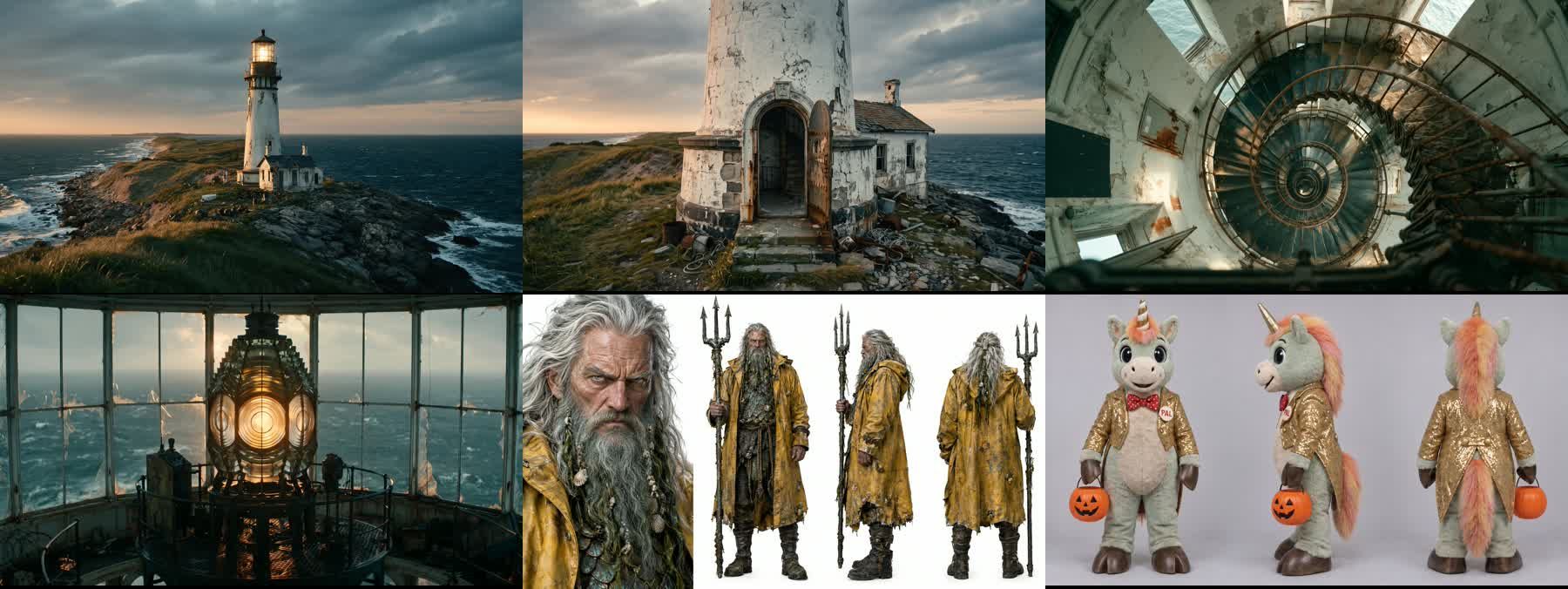
The six reference images. Top: lighthouse exterior, entrance, spiral staircase. Bottom: lamp room, the Sea King Keeper, Pal.
| Reference | Asset | Its job in the prompt |
|---|---|---|
| @Image1 | Lighthouse exterior | The island, the rocks and the sea for the opening aerial shot |
| @Image2 | Lighthouse entrance | The iron door for the knock, the reveal and the first clash |
| @Image3 | Spiral staircase | The location for the close-quarters fight and the aerial fight |
| @Image4 | Lamp room at the top | The final clash, the wave and the sardine ending |
| @Image5 | The Sea King Keeper | Identity lock for the sea god: face, beard, raincoat, armor, trident |
| @Image6 | Pal the Party Unicorn | Identity lock for the unicorn: colors, costume, badge, candy bucket |
Designing original characters
Both characters are original. Pal is a creepy-cute 1990s kids' TV mascot, built as a real person in a plush costume rather than a cartoon, because that "uncanny practical suit" look is scarier on camera. The Sea King Keeper borrows from Greek mythology's Poseidon, which is public domain, and I deliberately pushed him away from any comic-book sea king: he's in his sixties, silver-haired, and wears a yellow fisherman's raincoat over his bronze armor. If you're publishing tests like this, original characters keep you clear of copyright and likeness problems.
Here are the character sheet prompts I used. Generate the front view first, pick the best one, then use it as a reference for the other views.
Pal: turnaround sheet
plaintext1Character turnaround sheet of "Pal the Party Unicorn", a full-body practical mascot costume character from a 1990s children's TV show, photographed for real, not cartoon, not CGI. Faded mint-green plush fur body with a cream-colored belly, sherbet-colored mane and tail in orange, pink and yellow, a gold-and-white spiral striped horn like a candy cane. Wearing a gold sequin tailcoat jacket, a red polka-dot bow tie, and a round pin badge on the chest reading "PAL". Oversized glossy black plastic eyes, a stitched felt smile. Holding an orange plastic jack-o'-lantern candy bucket. 2Three views side by side: front view, side view, back view, full body, same pose, neutral standing. 3Plain light grey studio background, soft even lighting, sharp focus, photorealistic fabric texture, visible plush fibers and sequin reflections, 16:9, character design reference sheet, consistent proportions across all views. 4 5Negative: cartoon, anime, 3D render, CGI, plastic toy, purple dinosaur, pink fur, human face, extra limbs, extra horns, deformed hands, blurry, watermark, text artifacts
The Sea King Keeper: turnaround sheet
plaintext1Character turnaround sheet of "The Sea King Keeper", an original character inspired by the Greek sea god Poseidon, now a grumpy lighthouse keeper. A towering, broad-shouldered man in his 60s, weathered sun-darkened skin with deep wrinkles, short silver-white hair, a long grey-green beard braided with seaweed and tiny shells, pale sea-green eyes, permanently furrowed brow. Wearing a worn yellow fisherman's oilskin raincoat, open to reveal barnacle-crusted bronze scale armor with green patina underneath. Holding a rusted bronze trident covered in barnacles and kelp, with a small oil lantern hanging near the prongs. 2Three views side by side: front view, side view, back view, full body, same neutral standing pose. 3Plain light grey studio background, soft even lighting, photorealistic, cinematic character design reference sheet, detailed textures, 16:9, consistent proportions across all views. 4 5Negative: long black hair, tattoos, young muscular superhero, orange and green scale suit, golden crown, comic book style, cartoon, anime, CGI, deformed hands, extra fingers, blurry, watermark
Height comparison, so the fight keeps both characters at a consistent scale
plaintext1Height comparison reference: "Pal the Party Unicorn" (mint-green plush mascot costume character with gold sequin tailcoat, about 6 feet tall including horn) standing next to "The Sea King Keeper" (towering Poseidon-like lighthouse keeper in a yellow oilskin raincoat over bronze scale armor, about 7 feet tall, holding a trident). Both full body, front view, side by side, plain light grey background, studio lighting, photorealistic, 16:9.
The four locations were generated the same way. All four share one look so they cut together: an old whitewashed lighthouse with peeling paint and rust stains, golden-hour light under heavy grey clouds, and a rough dark sea. That shared sunset light is the reason Kling's version of the night storm came out as an evening.
@Image1: lighthouse exterior
plaintext1Wide establishing photo of an old whitewashed lighthouse standing on a rocky, grassy headland surrounded by a rough dark sea. A small white keeper's cottage with a slate roof is attached to the base of the tower. The lamp at the top is lit with a warm glow. Waves break white against the black rocks along the shore, a long coastline fades into the distance. Golden hour: heavy grey storm clouds overhead, a thin band of warm orange light on the horizon. Elevated three-quarter view, slightly above the headland. Photorealistic, cinematic, 35mm film look, moody, 16:9. No people, no text, no watermark.
@Image2: lighthouse entrance
plaintext1Low-angle photo of the base of the same old whitewashed lighthouse tower, paint peeling and stained with rust and grime. A heavy arched stone doorway sits in the center with a rusted iron door hanging half open, revealing worn stone steps leading up into darkness. To the right, a small weathered white keeper's cottage with a red tile roof and a brick chimney. In front of the door: cracked stone steps, coils of old rope, rusty buckets and scrap metal scattered on wet rocks and wild grass. The sea and a distant coastline behind. Golden hour under heavy grey clouds, warm low sunlight from the horizon. Photorealistic, cinematic, 35mm film look, 16:9. No people, no text, no watermark.
@Image3: spiral staircase
plaintext1Interior of the same old lighthouse tower, looking straight down from the top of a cast-iron spiral staircase that winds down the center of a tall cylindrical shaft, forming a hypnotic spiral. Rusted iron steps and a thin rusty handrail. Curved whitewashed walls with peeling paint and long rust stains, a few small square windows letting in cool daylight and glimpses of the sea, an old framed chart hanging on the wall. Mixed lighting: soft cool light from the windows, warm light from below. Photorealistic, cinematic, 35mm film look, high detail, 16:9. No people, no text, no watermark.
@Image4: lamp room at the top
plaintext1Interior of the lamp room at the top of the same old lighthouse. A huge glowing Fresnel lens with concentric glass rings sits in the center on a black iron pedestal, its warm golden light the main light source. Panoramic iron-framed windows wrap around the whole room, some panes cracked, showing a rough dark ocean with whitecaps under heavy grey clouds and a warm golden-hour glow on the horizon. A circular iron railing and old brass and iron machinery around the base of the lens. Slightly elevated wide shot from the edge of the room. Photorealistic, cinematic, 35mm film look, moody, 16:9. No people, no text, no watermark.
The prompt
The prompt is basically a shot list. Every beat gets a time range, a camera move, the action and the sound. On top of that, a short block of rules tells the model how the shots connect and how a hit should feel. Here is the exact prompt all three models received. For Wan 3.0, the only change is the reference syntax: "Image 1" instead of "@Image1".
The full 30-second prompt
plaintext1A 30-second cinematic Halloween action-comedy short with multiple cuts, photorealistic, shot on 35mm film, 16:9. Stormy night at sea, heavy rain throughout, cold blue moonlight, lightning flashes, a sweeping warm lighthouse beam. 2 3REFERENCES: 4- @Image1: the lighthouse on its rocky island (exterior, island, sea). 5- @Image2: the lighthouse entrance and iron door. 6- @Image3: the spiral staircase inside the lighthouse. 7- @Image4: the gallery platform at the top of the lighthouse. 8- @Image5: "The Sea King Keeper" — keep his face, silver-white hair, seaweed-braided grey-green beard, yellow oilskin raincoat over bronze scale armor, and rusted bronze trident exactly as shown. 9- @Image6: "Pal the Party Unicorn" — a real practical mascot costume character, not cartoon. Keep the mint-green plush fur, sherbet mane, striped horn, gold sequin tailcoat, red polka-dot bow tie and "PAL" badge exactly as shown. Pal carries an orange plastic jack-o'-lantern candy bucket in every shot. 10Both characters must look identical in every shot. Pal's costume is soaked and matted by the rain. The Sea King Keeper is a head taller than Pal, and their proportions never change. 11 12SHOTS: 13[0-3s] Aerial wide shot pushing in fast toward the lighthouse from @Image1. Huge waves smash against the rocks, the lighthouse beam sweeps across the lens, lightning flashes. Sound: thunder, roaring sea, howling wind. 14 15[3-5s] Low tracking shot from behind: Pal from @Image6 walks across the wet black rocks toward screen right, heading for the door from @Image2, candy bucket swinging, rainwater dripping off the sequins. Sound: heavy rain across the stereo field, squelching footsteps. 16 17[5-7s] Close-up: Pal's hoof pounds the iron door three times, each knock shaking rainwater off the metal. Sound: three deep metallic knocks echoing. 18 19[7-10s] Low-angle medium shot: the door is yanked open and slams against the wall. The Sea King Keeper from @Image5 fills the doorway, trident in hand, beard dripping, warm light behind him. Pal tilts its head and says cheerfully in English, in a bright 1990s kids' TV host voice: "Trick or treat?" 20 21[10-12s] Close-up on the Sea King Keeper's face, slowly pushing in. He narrows his eyes, knuckles whitening around the trident, and growls in English, in a deep gravelly voice: "...Trick." 22 23[12-15s] Wide shot, slow motion ramping back to real speed: he lunges with the trident. Pal sidesteps, the prongs graze its mane, slice through a line of raindrops and slam into the door frame, blasting out brick chips. Pal ducks under his arm and dashes inside. He rips the trident free, spins around and charges in after it. Sound: the trident whooshing through the air, a heavy thud as it bites into brick. 24 25[15-19s] Cut on action to the bottom of the spiral staircase from @Image3, close-quarters brawl. Eye-level handheld tracking camera that shakes with the impacts. The Sea King Keeper thrusts three times in a row; Pal parries left and right with its horn, every clash bursting with sparks, each blow knocking Pal back up the steps. The final strike smashes into the iron railing and bends it. Sound: dense, heavy metal clangs echoing through the tower, the groan of bending iron. 26 27[19-22s] Still inside the spiral staircase from @Image3, the fight escalates into Hong Kong wire-work style aerial combat, light, fluid and gravity-defying. The camera rises vertically through the central shaft of the staircase, keeping both characters in frame. 28Beat 1: Pal kicks off the curved brick wall and wall-runs horizontally around the spiral, climbing upward, each step cracking the bricks, candy bucket swinging. 29Beat 2: The Sea King Keeper plants his trident on the iron railing and pole-vaults off it, spinning up to the flight above and landing hard enough to shake the steps, cutting Pal off. 30Beat 3: He sweeps the trident; Pal backflips over the shaft and lands balanced on its hooves on the thin iron railing. Then both leap upward together and smash through the hatch at the top of the stairs. 31Sound: rapid thuds of hooves on the wall, metallic clang of the trident striking the railing, the heavy impact of his landing, wind rushing down through the hatch, then the bang of the hatch bursting open. 32 33[22-24s] Cut on action to the gallery platform from @Image4: they burst out of the hatch and collide head-on in the pouring rain, trident and horn locked together, sparks and rainwater spraying, both silhouetted by lightning. The camera pulls back into an extreme wide shot: behind them a monstrous rogue wave rises higher than the top of the lighthouse and crashes down, swallowing them both. Sound: a piercing scrape of locked metal, thunder, the massive roar of the wave. 34 35[24-27s] Medium shot on the platform: the water drains away, pouring off the edge. Both characters sit slumped against the bent railing, completely soaked, panting, glancing at each other. Sound: only rain, running water and their heavy breathing. 36 37[27-30s] The Sea King Keeper sighs, pulls a single sardine from his raincoat pocket and drops it into Pal's candy bucket. Cut to a close-up of Pal looking down into the bucket as its wide stitched smile slowly fades. Sound: a wet "plop", then a short cheerful 1990s kids' TV jingle sting. 38 39ACTION AND EDITING RULES: 40- Connect every shot with a cut on action: each movement started in one shot finishes in the next. No skipped actions. 41- Pal always moves toward screen right and upward, with the Sea King Keeper chasing from behind. Keep screen direction consistent. 42- Every hit has weight and recoil: sparks, brick chips, water spray, characters knocked back, metal bending. 43- Fight moves must be clear and readable, each with a clear start and landing. No limbs passing through bodies, no warping weapons, no extra limbs. 44 45STYLE AND CONSTRAINTS: 46Deadpan comedy tone: epic action, absurd ending. Realistic water, rain and fabric physics. No subtitles, no on-screen text, no watermark, no background music except the final jingle sting. No extra characters.
What I changed along the way
My first version of the staircase fight was mush: two characters flailing in the same spot. Three changes fixed it, and I now use them on every action prompt:
- Three clear moves in three seconds. Wall-run, pole-vault, backflip. Each move names who does it, what they do and where they land.
- Only one camera move per fight shot. Here, the camera rises straight up the stairwell. The models handle one clear move far better than a combination.
- Write the result of each hit, not "they fight". Sparks, brick chips, water spray, recoil, bending metal. That's what makes a hit read as heavy.
Two more habits that helped: give every reference image exactly one job (a location, or an identity, never both), and connect shots with "cut on action" so a movement that starts in one shot finishes in the next.
How I tested
| Setting | Value |
|---|---|
| Models | Kling 4.0, Seedance 2.5, Wan 3.0 |
| Prompt | Identical for all three (only the reference syntax differs for Wan 3.0) |
| References | The same six images in the same order, all used as references, none as a first frame |
| Duration and format | 30 seconds in a single generation, 16:9, native audio on |
| Output | 1920×1080, 24 fps for all three |
| Generations | Two per model |
| Generation time | About 3 minutes per run for every model (3:05–3:06) |
| Cost per 30-second run | Kling 4.0 $6.41 · Seedance 2.5 $17.76 · Wan 3.0 $7.56 |
| Test date | October 26, 2026 |
A note on picking takes: I generated two clips with each model, and honestly, every single one had its moments. I scored the most complete take from each model. If you're willing to edit, cut the best parts of every take together and your final video will look even better than anything you see here.
The scorecard
I scored every clip on nine categories, ten points each. The overall score is the plain average of all nine.
| Category | What I looked at |
|---|---|
| Image quality and art | Sharpness, lighting, materials (plush, sequins, oilskin, rust), cinematic feel |
| Shot execution | Were all 11 shots made, in the right order and roughly at the right time? |
| Character consistency | Do both characters match their reference sheets, and stay the same across shots? |
| Location fidelity | Do the door, staircase and lamp room match the references? |
| Atmosphere | Did it deliver "stormy night, heavy rain, lightning"? |
| Fight impact | Contact, sparks, debris, recoil, and whether each move is clear and connected |
| Water physics | The opening surf, the rogue wave, the rain |
| Punchline | Does the sardine show up, and does Pal's smile slowly fade? |
| Voice and lip sync | Are both lines said correctly, in sync, with matching sound effects and stereo? |
One person (me) did the scoring, so treat each number as ±0.5.
The results
| Category | Kling 4.0 | Seedance 2.5 | Wan 3.0 |
|---|---|---|---|
| Image quality and art | 8.5 | 9.0 | 8.0 |
| Shot execution | 7.0 | 7.5 | 7.0 |
| Character consistency | 9.0 | 7.5 | 8.5 |
| Location fidelity | 8.0 | 8.0 | 7.5 |
| Atmosphere | 6.0 | 9.0 | 8.0 |
| Fight impact | 6.5 | 7.5 | 5.5 |
| Water physics | 8.5 | 9.0 | 8.5 |
| Punchline | 7.5 | 7.0 | 6.5 |
| Voice and lip sync | 7.0 | 8.0 | 7.5 |
| Overall (average) | 7.56 | 8.06 | 7.44 |
Green marks the top score in each category. Seedance leads by half a point. Kling and Wan are only 0.12 apart, which is inside my ±0.5 margin, so treat them as a tie on quality. The price is what separates them.
Now add the price
| Kling 4.0 | Seedance 2.5 | Wan 3.0 | |
|---|---|---|---|
| Cost per 30-second run | $6.41 | $17.76 | $7.56 |
| Cost for my two runs | $12.82 | $35.52 | $15.12 |
| Overall score per dollar | 1.18 | 0.45 | 0.98 |
Seedance 2.5 beat Kling 4.0 by half a point and cost almost three times as much per run. On points per dollar, Kling 4.0 wins by a mile.
Side by side
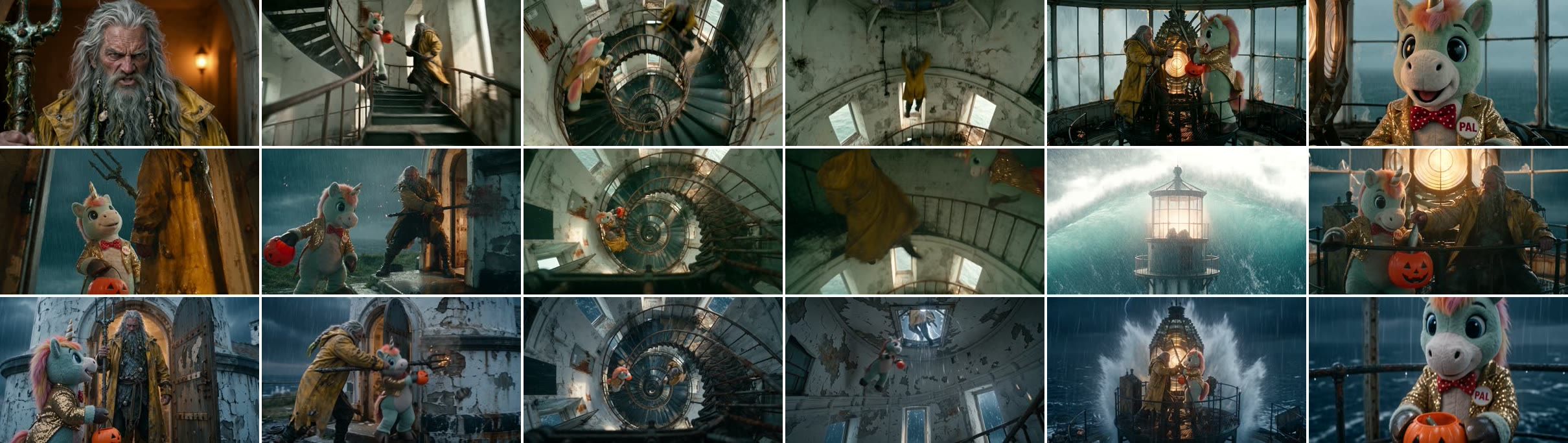
The same moments from each model. Rows: Kling 4.0, Seedance 2.5, Wan 3.0. Columns: 8.5s, 13s, 17s, 20.5s, 23s, 28.5s.
The first thing you notice: Seedance and Wan gave me a storm. Kling gave me a slightly moody afternoon. The reason is in my reference images, which were shot at sunset. When the images and the words disagreed, Kling trusted the images. That cost it the atmosphere score, and it's also exactly why Kling's characters look the most like my designs.
The pacing also differs. At 13 seconds Kling is already in the stairwell while the other two are still fighting at the door. At 23 seconds Kling is still in the lamp room while the others have reached the wave.
Kling 4.0: the most faithful, and the best value
What it did well
- Best character fidelity. The Sea King's face, kelp-braided beard, raincoat and armor, and Pal's mint plush, sequins and "PAL" badge are almost identical to the reference sheets, and they stay that way across shots.
- Fastest editing rhythm. Around 14 cuts in 30 seconds, the most of the three. It feels like a trailer.
- The best aerial moment. The top-down spiral shot with Pal flipping through the stairwell is the closest anyone got to the wire-fu brief, and its wave wrapping the lighthouse has real volume.
- The best punchline. Pal looks down into the bucket and you can see the fish.
- The lowest cost: $6.41 per run.
Where it fell short
- No "stormy night". The opening is an overcast evening with light rain, because it followed the sunset references over the text.
- Soft fight contact. The trident lunge at the door is mostly skipped, the bottom of the stairs plays like a chase, and the lamp-room clash lacks weight.
- Timeline drift. The first half runs about two seconds early, which pushes the wave to 24–27 seconds and squeezes the ending.
- Voices change mid-scene. The characters' voices aren't consistent between lines.
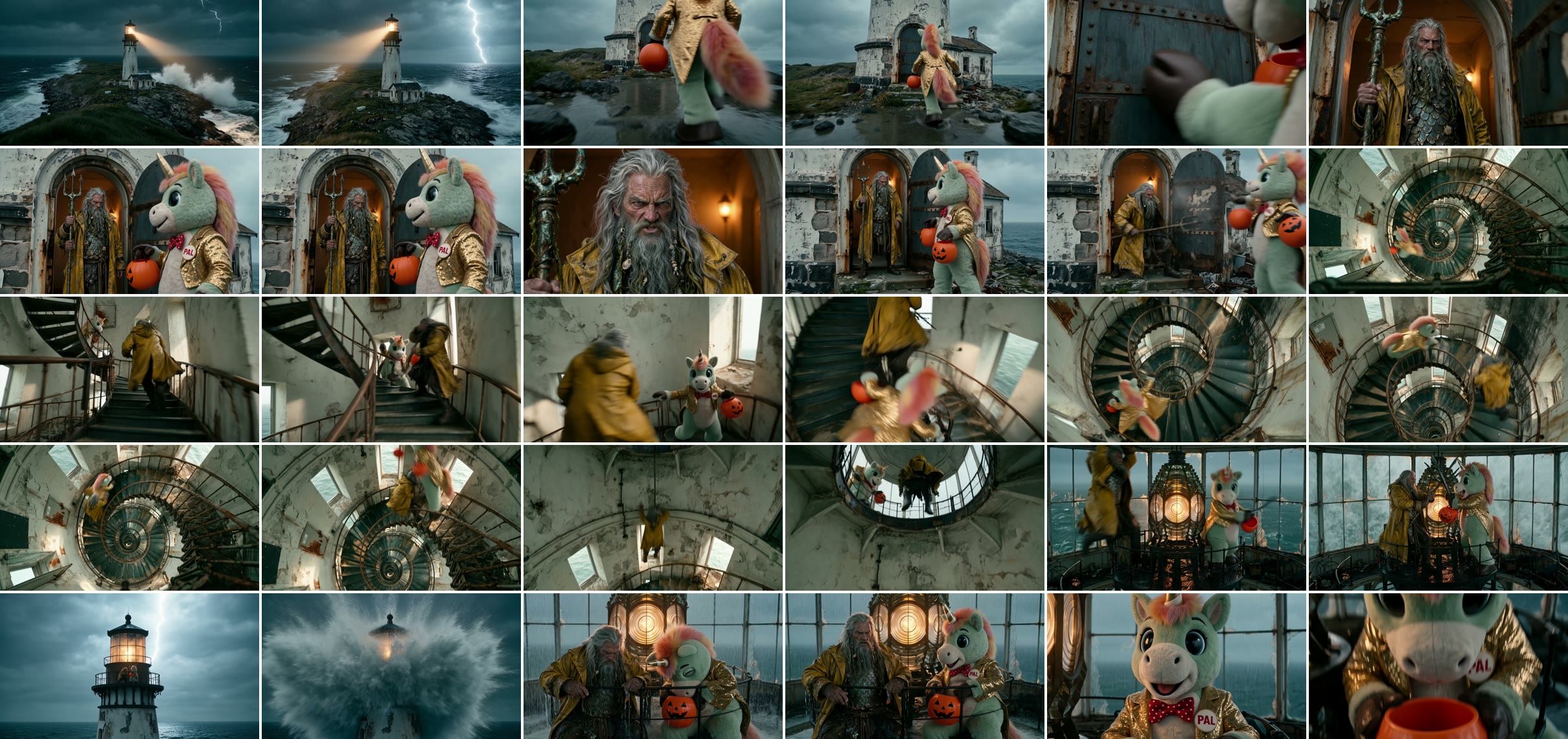
Kling 4.0, one frame per second (0–29s, left to right, top to bottom)
Seedance 2.5: the best-looking clip, at a premium
What it did well
- Best atmosphere and image quality. Night, rain, the warm doorway light and the lighthouse beam are layered like a real film.
- The door fight follows the script. The trident misses, bites into the door frame and blasts out brick chips, as written.
- The most spectacular wave. A curling wall of water rises over the top of the lighthouse with the two silhouettes inside, right on time at 22–24 seconds.
- A clear sardine. You see it in the Sea King's hand and you see it go into the bucket.
Where it fell short
- Pal drifted off-model. Rounder and more cartoonish, closer to a toy pony than my costume character.
- Two fight beats are missing. The close-quarters fight at the bottom of the stairs is replaced by an overhead shot, and the lamp-room clash is skipped.
- No disappointment. Pal keeps smiling through the ending.
- A misread line. The Sea King's "...Trick." comes out as "Trip".
- The highest cost: $17.76 per run.
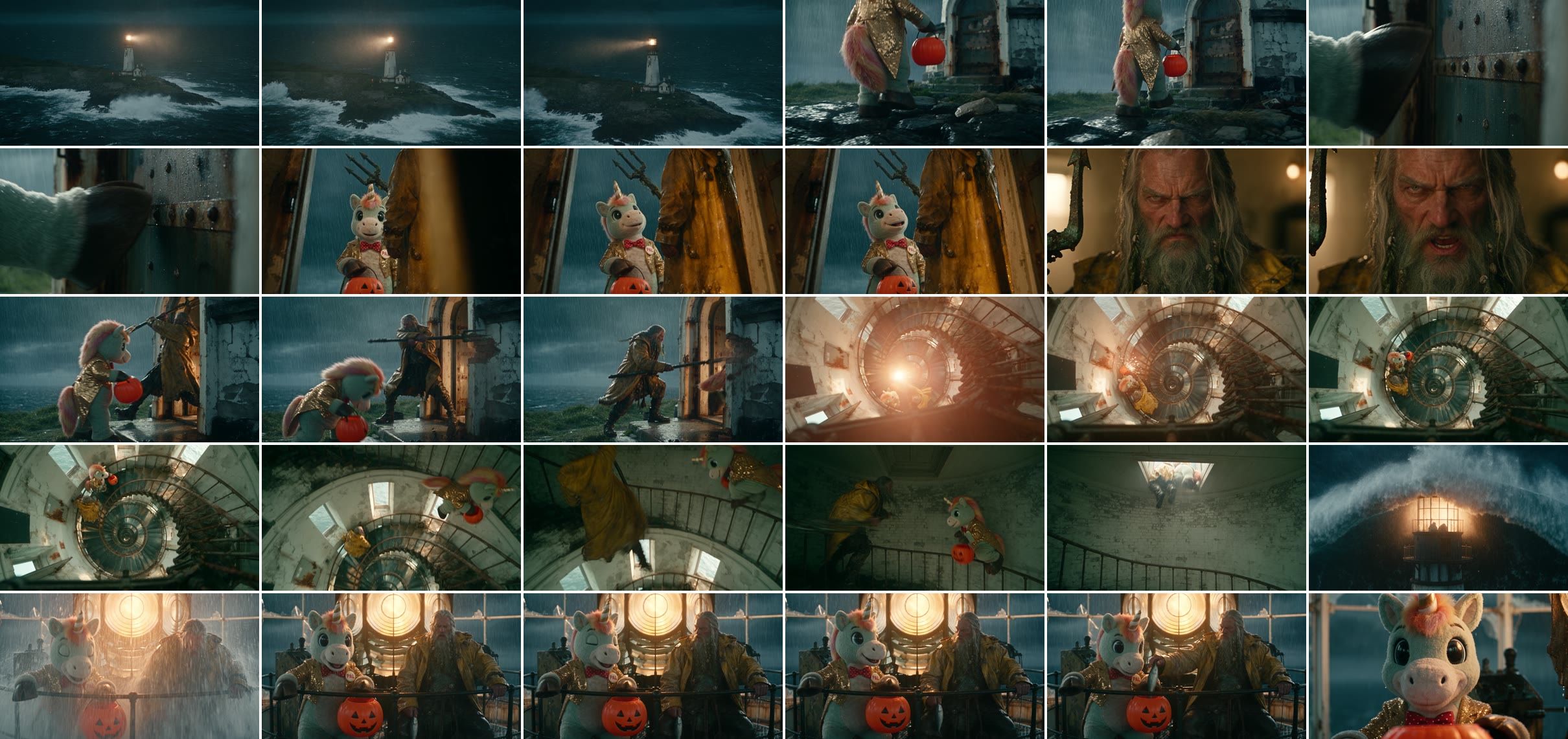
Seedance 2.5, one frame per second (0–29s)
Wan 3.0: great storm, weakest fight
What it did well
- Broad shot coverage. Door clash, stair brawl, overhead spiral, wall-hang, hatch, lamp-room clash with lightning, wave, collapse, sardine: most of the 11 shots have a matching moment.
- Storm delivered. Night, heavy rain and lightning from start to finish.
- Clean dialogue. Both lines are said correctly, in sync, with a consistent voice.
- Stable characters. Both characters stay close to their reference sheets across every location.
Where it fell short
- Weakest fight impact (5.5). Plenty of sparks, but the hits don't land with weight.
- The ending moved outdoors. After the wave they sit on an open-air railing instead of in the lamp room from the reference.
- The punchline flipped. Pal goes from disappointed to delighted, the opposite of the brief.
- A smaller wave. A splash around the lamp room rather than a wall of water crashing down.
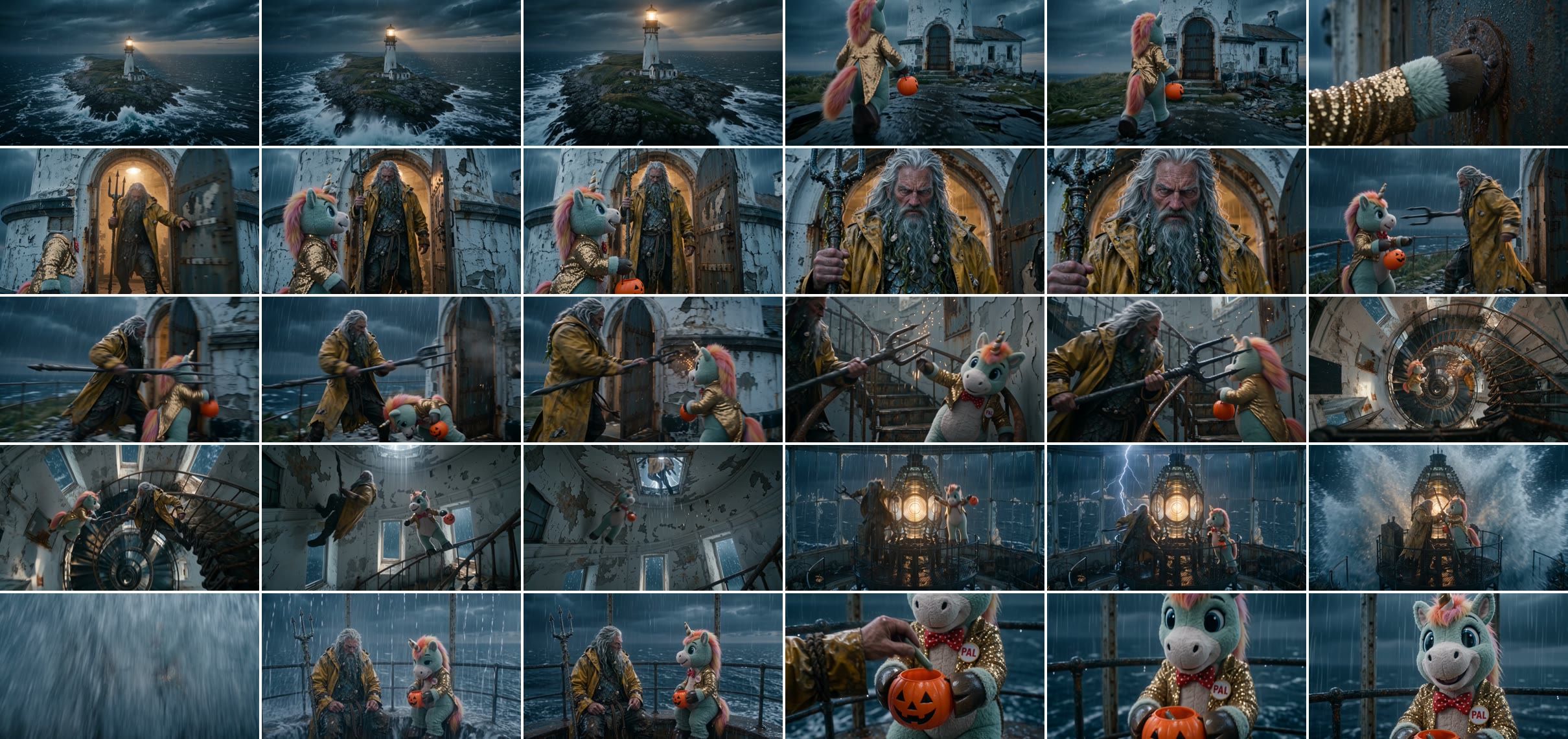
Wan 3.0, one frame per second (0–29s)
The Hall of Shame
Every test has bloopers. These were my favorites:
- Seedance's sea god, staring down a unicorn, growls: "...Trip."
- Kling's characters change voices halfway through the scene. Method acting, I guess.
- I asked for a creepy kids' show mascot. Seedance gave me a toy pony.
- Wan's Pal gets a single sardine for trick-or-treat and is thrilled. Honestly? Respect.
- Kling's "violent storm at night" is a cloudy afternoon.
What I learned
- When the references and the text disagree, the models choose differently. Kling 4.0 follows the images; Seedance and Wan follow the words. If you want the text to win with Kling, make your references match it.
- Eleven shots in 30 seconds forces every model to compress. Kling compressed the door fight, Seedance dropped the stair brawl and the lamp-room clash, and Wan compressed the least.
- Fights are still the hardest category. Fight impact averaged 6.5 across the three models, the lowest of all nine categories, and even the best score was 7.5.
- Small facial turns are a shared weak spot. None of the three fully delivered "the smile slowly fades". Kling came closest by having Pal look down into the bucket.
- Lip sync is solved; line accuracy and voice consistency are the new problems. All three were in sync, but Seedance misread a line and Kling's voices drifted. Only Wan got both right.
- The price gap is bigger than the quality gap. Half a point separates Seedance and Kling. Nearly three times the cost separates them too.
So, is Kling 4.0 worth it?
- Choose Kling 4.0 if your characters need to look exactly like your designs and you're making a lot of clips. It's the best value in this test, and its reference fidelity is the best of the three. Just make sure your reference images already have the lighting and mood you want.
- Choose Seedance 2.5 if you need one hero shot with the best atmosphere and the budget isn't a concern.
- Whatever you choose, plan to generate more than once and edit. Fight scenes in particular still need a human cutting between takes.
Limitations
- Small sample. Two generations per model, one scored. This shows what each model can do with this prompt, not its average or its success rate.
- Sunset references against a night prompt. This conflict was useful for seeing which input each model trusts, but it cost Kling on atmosphere.
- One reviewer. All scores are mine, ±0.5. Your priorities may weight the nine categories differently.
Run it yourself
Everything above is reusable: the character prompts, the six-reference setup, the 11-shot prompt and the nine-category scorecard. Swap in your own characters and locations, keep the shot-list structure, and you'll have a fair comparison of any video models you're considering.
Tell me what I should make these models suffer through next. Happy Halloween, and if a unicorn knocks on your door, just give it the candy.
All characters in this test are original. The video clips in this post are AI-generated.
Try these models on Atlas Cloud
All three models from this test are available on Atlas Cloud. There are two ways to use them:
- Generate on the website. Open a model page, upload your references, paste a prompt and run it. It's the quickest way to repeat this test with your own characters.
- Call the API. Get an API key and call all three models with one key from your own app or pipeline, which makes it easy to batch the same prompt across models.
Model pages:


