You are not searching for another model launch recap. You want to know whether minimax h3 on openrouter can turn a $0.13 per second call into a clip a client, growth team, or indie dev can actually use.
This guide answers that fast: use OpenRouter when you need a unified API route, use a visual playground when you need to see the run, save the output, and compare creative paths. The fastest test is a 5-second clip, not a 15-second gamble.
We will use 3 commercial briefs: a perfume product orbit, a game HUD teaser, and a rainy short-drama dialogue hook. Same H3 family, different failure modes.
Key Takeaways
- OpenRouter lists H3 as
minimax/hailuo-3.- OpenRouter shows H3 from
$0.13/second.- Start with 5s tests before 15s clips.
- Product ads work best from a locked first frame.
- Atlas Cloud helps when you need visual runs and exports.
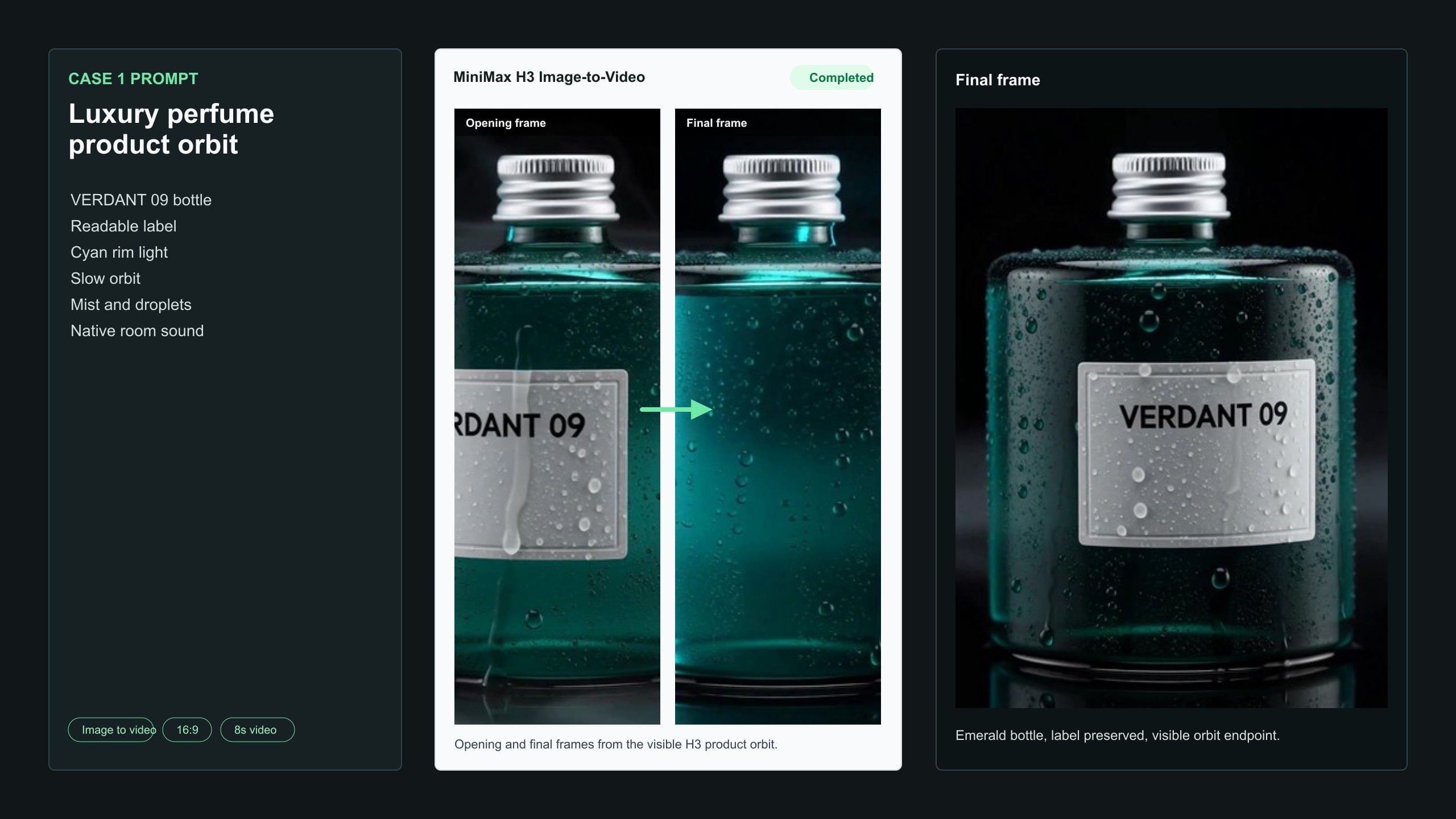
MiniMax H3 on OpenRouter product ad showcase with prompt card, completed run, and perfume orbit result
Showcase: the article's primary product ad case, shown as a prompt card, operated H3 run, and final orbit result.
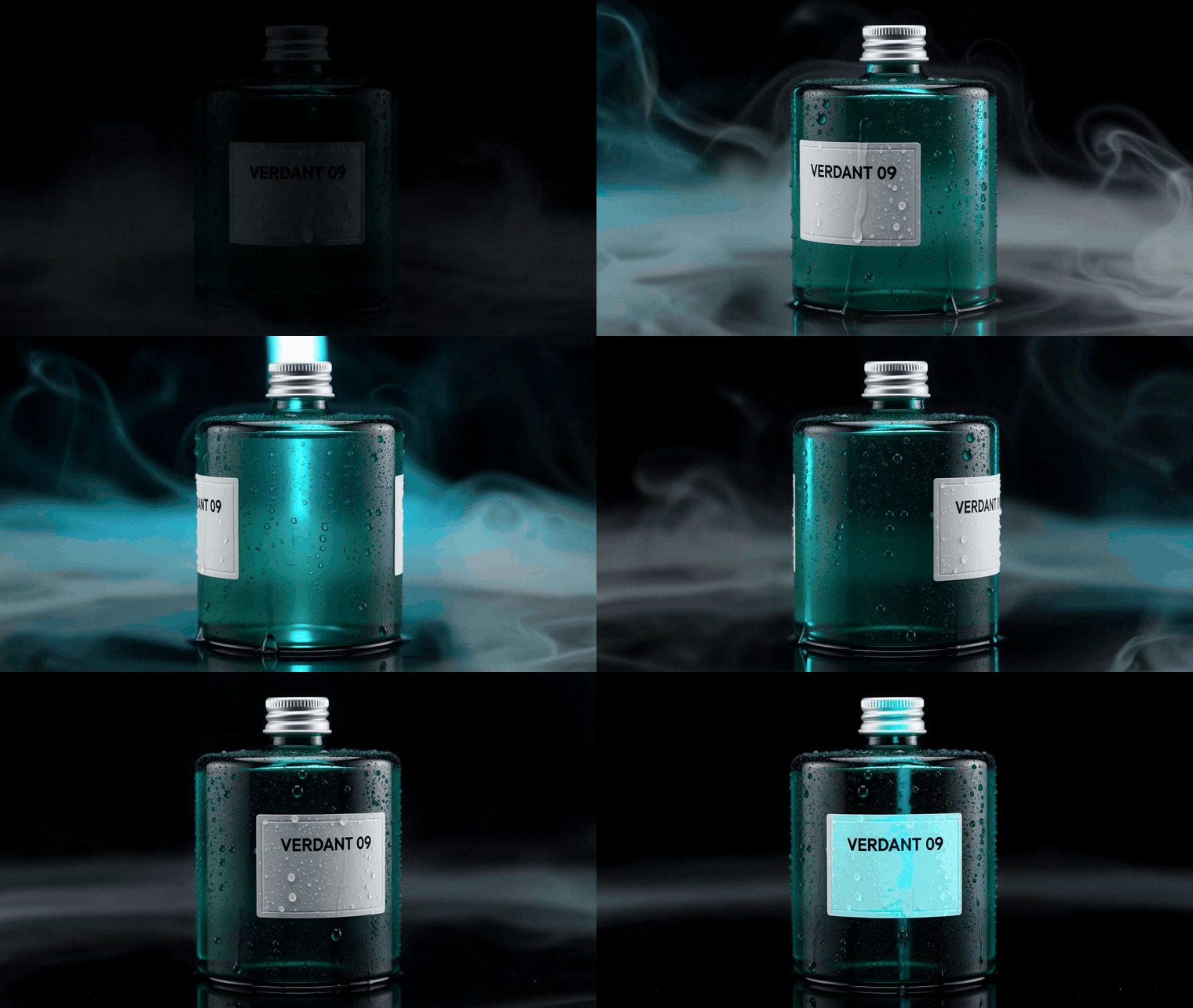
MiniMax H3 product orbit GIF showing the perfume bottle motion result
Delivered 8s product orbit GIF with the perfume bottle visible.
Why MiniMax H3 on OpenRouter Is Hot, and Why First Runs Fail
OpenRouter gives developers a clean way to call H3 through one model slug. Its H3 page lists minimax/hailuo-3, price from $0.13/second, MiniMax as provider, and a July 29, 2026 release date (OpenRouter H3 model page, August 2026).
MiniMax's own launch post explains why the model has attention: H3 accepts context across text, images, video, and audio, generates native stereo sound, supports up to 15s at 2K, and targets advertising, ecommerce, UI/UX, gaming, and other commercial workflows (MiniMax H3 launch post, July 2026).
The first run usually fails for ordinary reasons:
| Failure | Why It Happens | Fix |
|---|---|---|
| Garbled product label | The video prompt asks H3 to invent and preserve text at once | Generate a first frame first |
| Product shape drifts | The model has no visual anchor | Use image-to-video with preservation language |
| 15s clip feels random | The brief contains too many shots | Test 5s, then extend |
| Audio feels generic | The prompt only says "cinematic sound" | Write exact sound events |
| UI text breaks | The prompt asks for too many labels | Limit text to 3 readable elements |
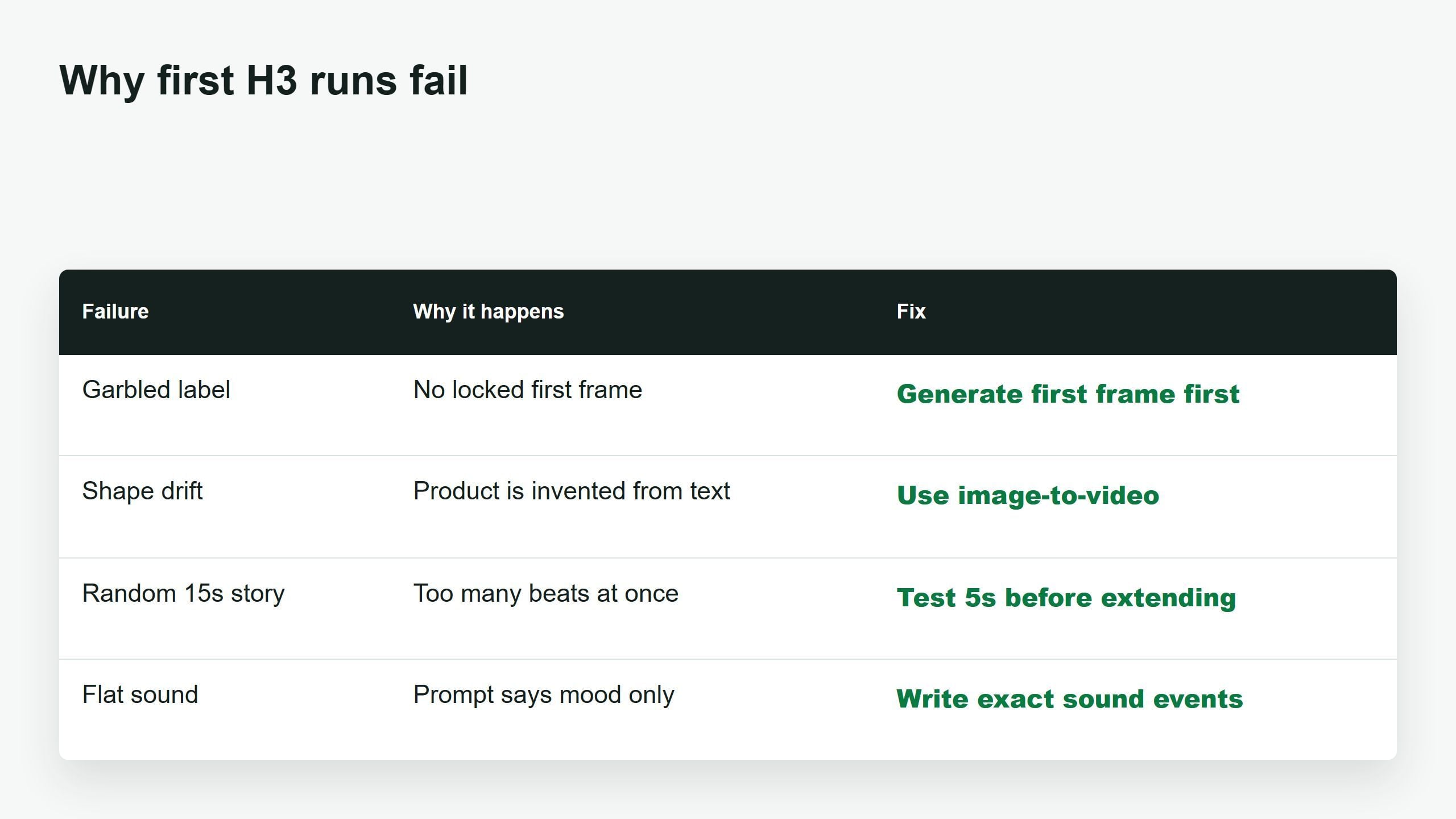
MiniMax H3 on OpenRouter failure map table with common problems and fixes
A browser-rendered failure map for MiniMax H3 prompt debugging.
MiniMax H3 Workflow: OpenRouter API, Atlas Cloud Playground, and Prices
OpenRouter is useful for API routing. For this article's operated screenshots and media checks, the demos run in one browser tab on Atlas Cloud model pages, where the model page, prompt box, run status, output, and adjacent creative models are visible in the same workflow.
Use OpenRouter for integration. Use a visual playground when your question is "did this prompt actually produce a usable clip?"
| Route | Best for | What to watch |
|---|---|---|
| OpenRouter minimax/hailuo-3 | Unified API calls and quick integration | Confirm provider availability before batch runs |
| MiniMax official API or app | Full official surface | Check current account and regional terms |
| Local open weights | Research and experiments | Hardware, license, and local resolution limits |
| Atlas Cloud H3 pages | Visual testing, model screenshots, and creative comparison | Check the model quote before batch runs |
| Model | Job in This Article | Current Price Signal |
|---|---|---|
| MiniMax H3 Text-to-Video | Game HUD and dialogue cases | From $0.1/SEC on Atlas models/all |
| MiniMax H3 Image-to-Video | Product orbit from first frame | From $0.1/SEC on Atlas models/all |
| MiniMax H3 Reference-to-Video | Optional consistency tests | From $0.1/SEC on Atlas models/all |
| GPT Image 2 Text-to-Image | Product first frame | From $0.009/PIC on Atlas catalog pages |
How to Use MiniMax H3 on OpenRouter: 3 Reproducible Cases
Step 1: Pick the H3 route and confirm settings
If you are coding against OpenRouter, call the H3 slug there. If you need a visual proof run, open the Atlas Cloud model library, find the H3 page you need, and check the live quote before running.
For the primary demo, use:
Plain1Confirm the route before running: MiniMax H3 Image-to-Video, 5 seconds, 16:9, highest available resolution, native audio default. Use this as a short proof run before trying a 15-second ad.
Settings: MiniMax H3 Image-to-Video, set the duration slider to 5s, 16:9, highest committed resolution, native audio on or default, MP4 output. In this run, the delivered file was 8s.
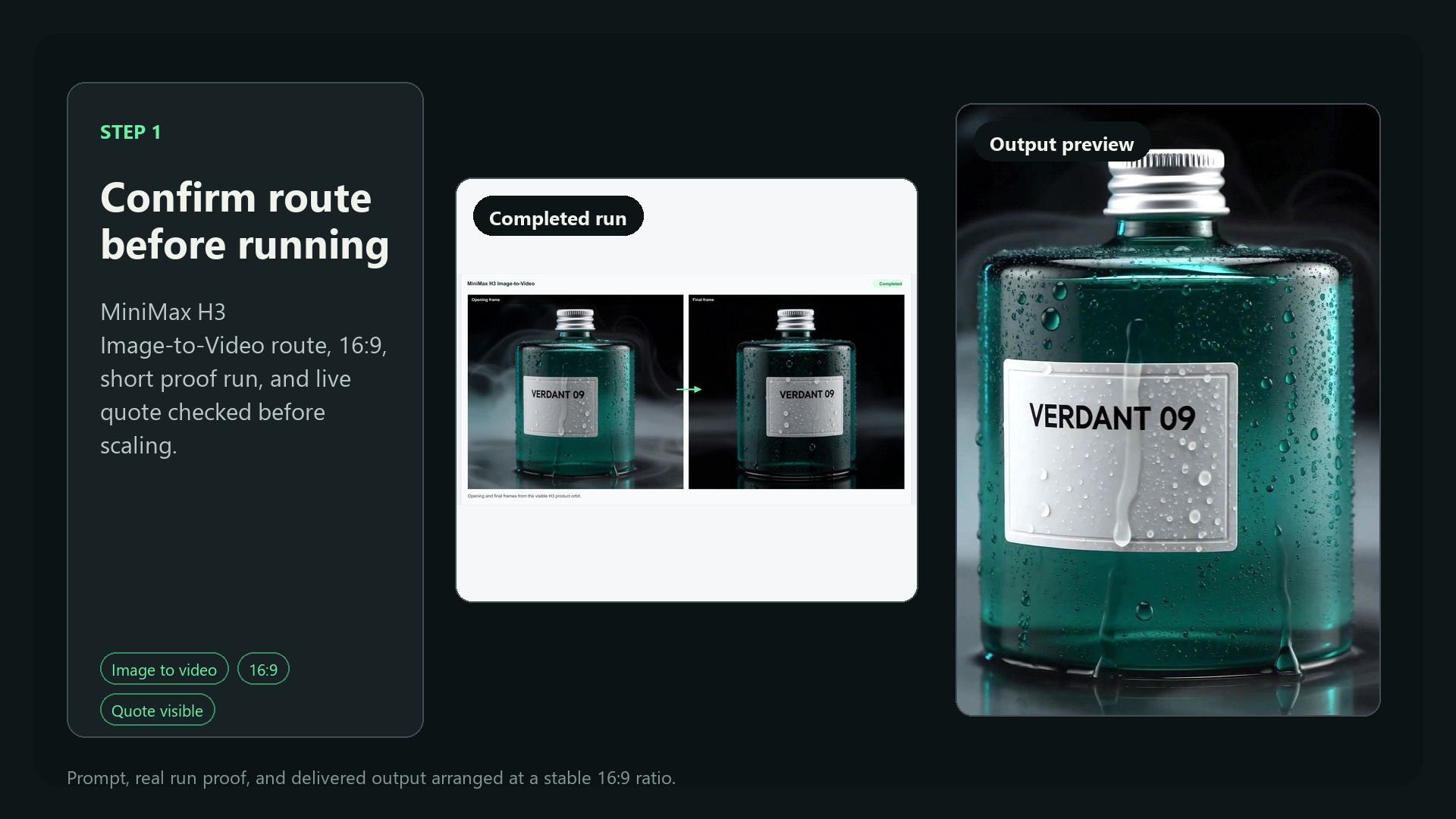
MiniMax H3 Image-to-Video settings completed on Atlas Cloud playground
Step 1: MiniMax H3 model settings checked before the product run.
Step 2: Generate the first frame for Case 1
For a product ad, do not ask the video model to invent the bottle and preserve the label in the same run. Make the first frame first with GPT Image 2 text-to-image on Atlas Cloud.
Plain1Create a premium product hero frame for a fictional perfume bottle named "VERDANT 09". A deep emerald glass bottle stands centered on a glossy black acrylic surface, with a clean readable label that says "VERDANT 09" and small subtext "botanical extrait". Fine water droplets on the glass, soft mist behind the bottle, one narrow cyan rim light on the left edge, warm amber reflection on the right edge, realistic studio photography, 85mm product lens, shallow depth of field, no extra text, no hands, no people.
Settings: GPT Image 2, quality high, 16:9, highest available resolution.
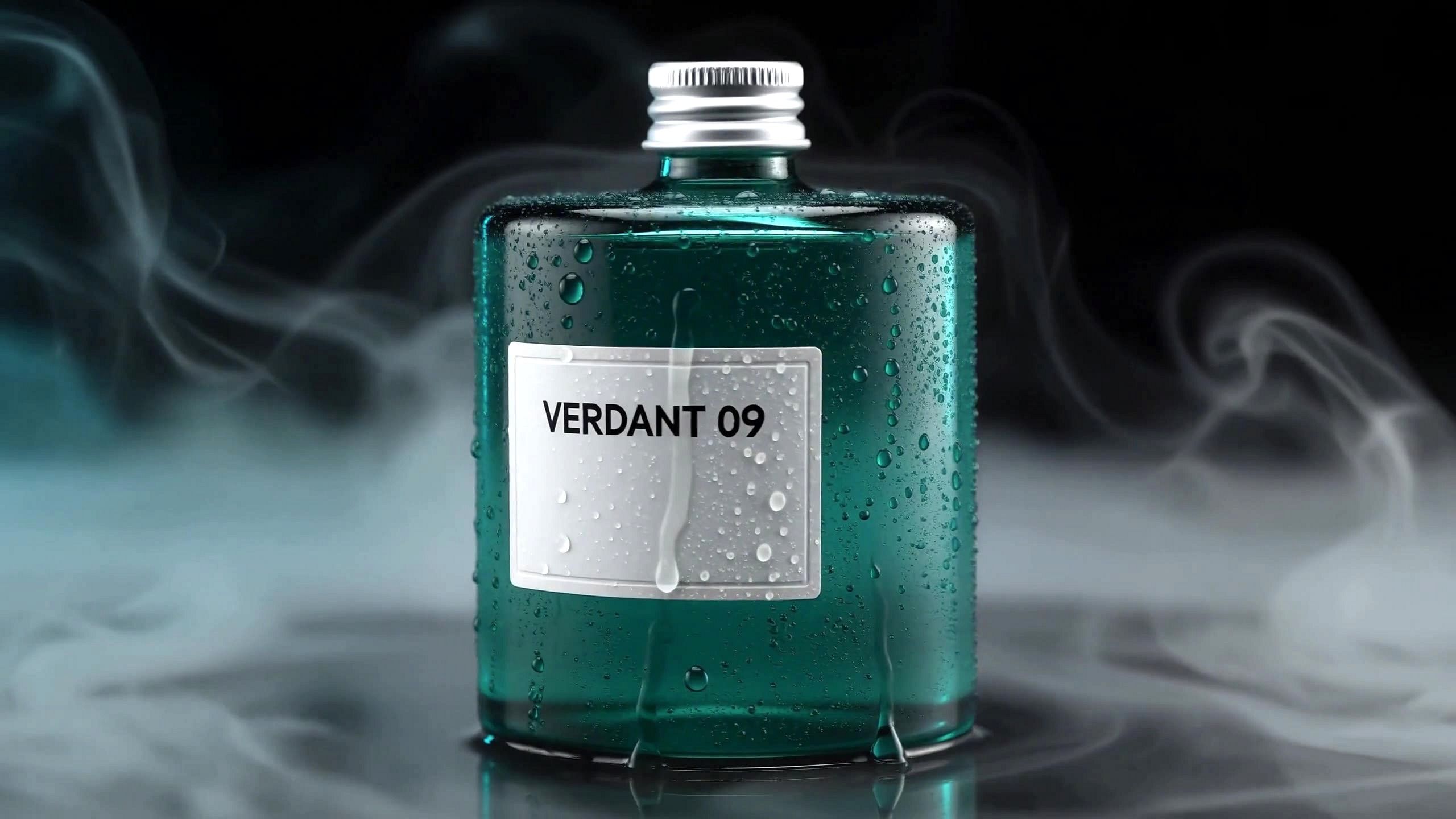
GPT Image 2 first frame for MiniMax H3 product orbit with VERDANT 09 perfume bottle
Step 2 result: the locked first frame for the H3 image-to-video run.
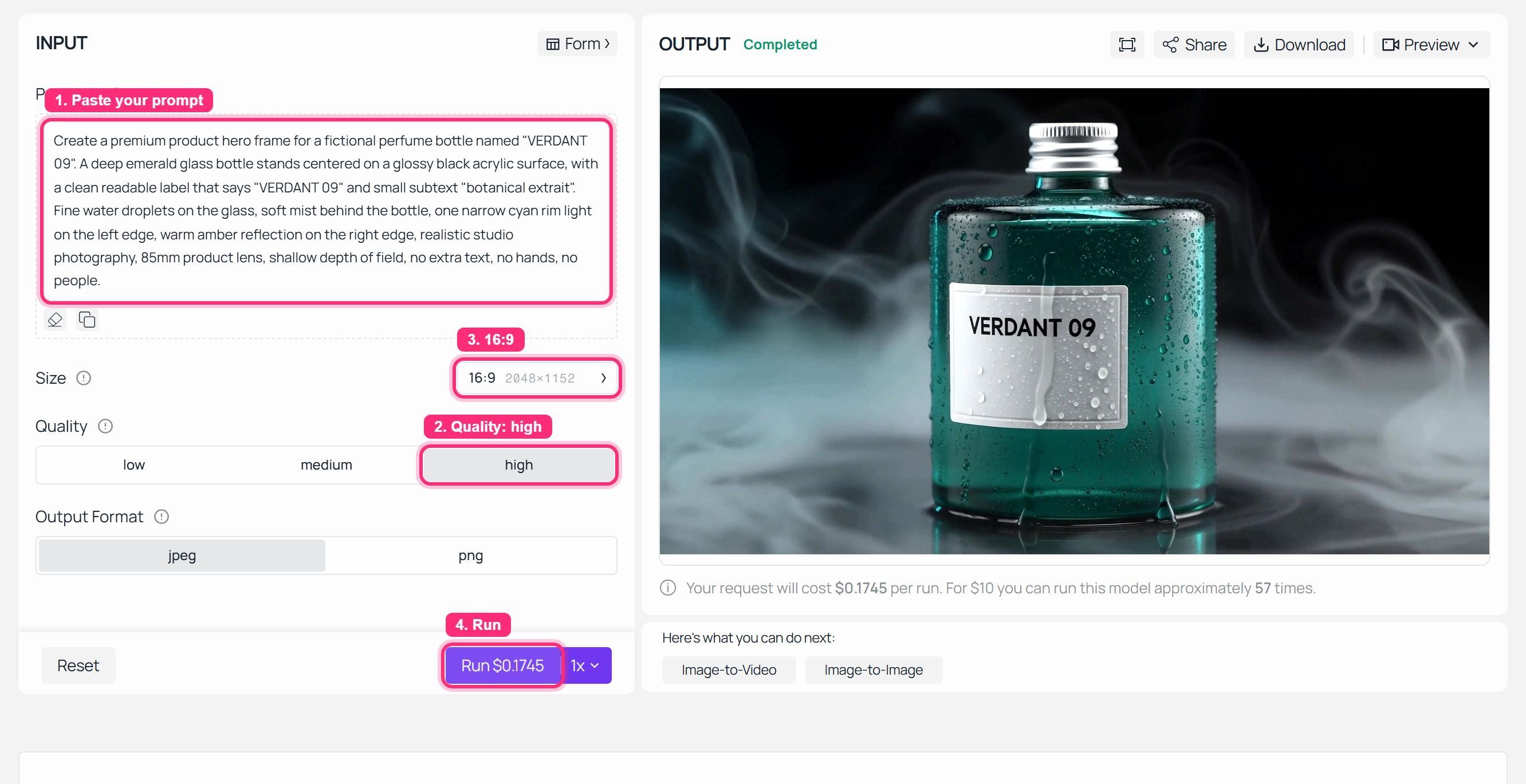
GPT Image 2 run completed on Atlas Cloud playground for the MiniMax H3 first frame workflow
Step 2 proof: GPT Image 2 completed run with the first frame visible in output.
Step 3: Animate Case 1 with MiniMax H3 Image-to-Video
Upload the first frame into MiniMax H3 Image-to-Video. Keep the prompt narrow: one object, one camera move, one light effect, one ending frame.
Plain1Use Image 1 as the exact opening frame. Preserve the bottle shape, cap, emerald glass color, label position, and all readable text on the label. The bottle stays centered while the camera performs a slow clockwise orbit at label height, moving from a front view to a three-quarter view and back to a clean front-facing hero angle by the final second. A thin cyan light sweep travels across the glass from left to right. Mist drifts softly behind the bottle, and tiny water droplets catch the light. Keep the label "VERDANT 09" sharp whenever it faces camera. Sound: a soft glass tap at the start, subtle room tone, and a gentle mist hiss. No music, no voice, no extra text.
Settings: MiniMax H3 Image-to-Video, set the duration slider to 5s, 16:9, highest committed resolution for a quick proof run, native audio default. This run delivered an 8s file.
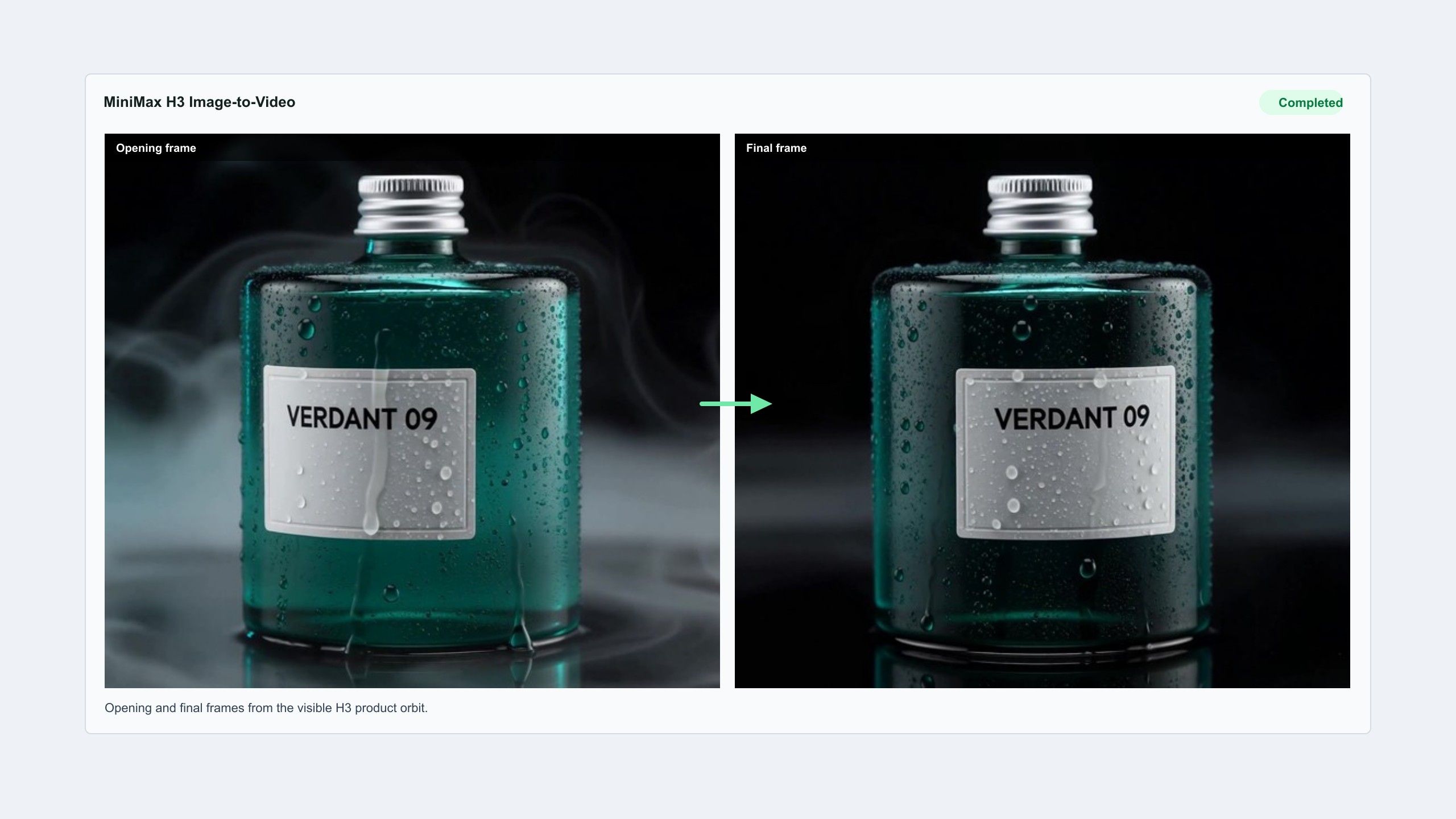
MiniMax H3 Image-to-Video product orbit run card with visible opening and final frames
Step 3 proof card: the opening and final frames stay visible enough to judge product identity , label stability, and camera movement.
Step 4: Run Case 2, FPS game HUD teaser
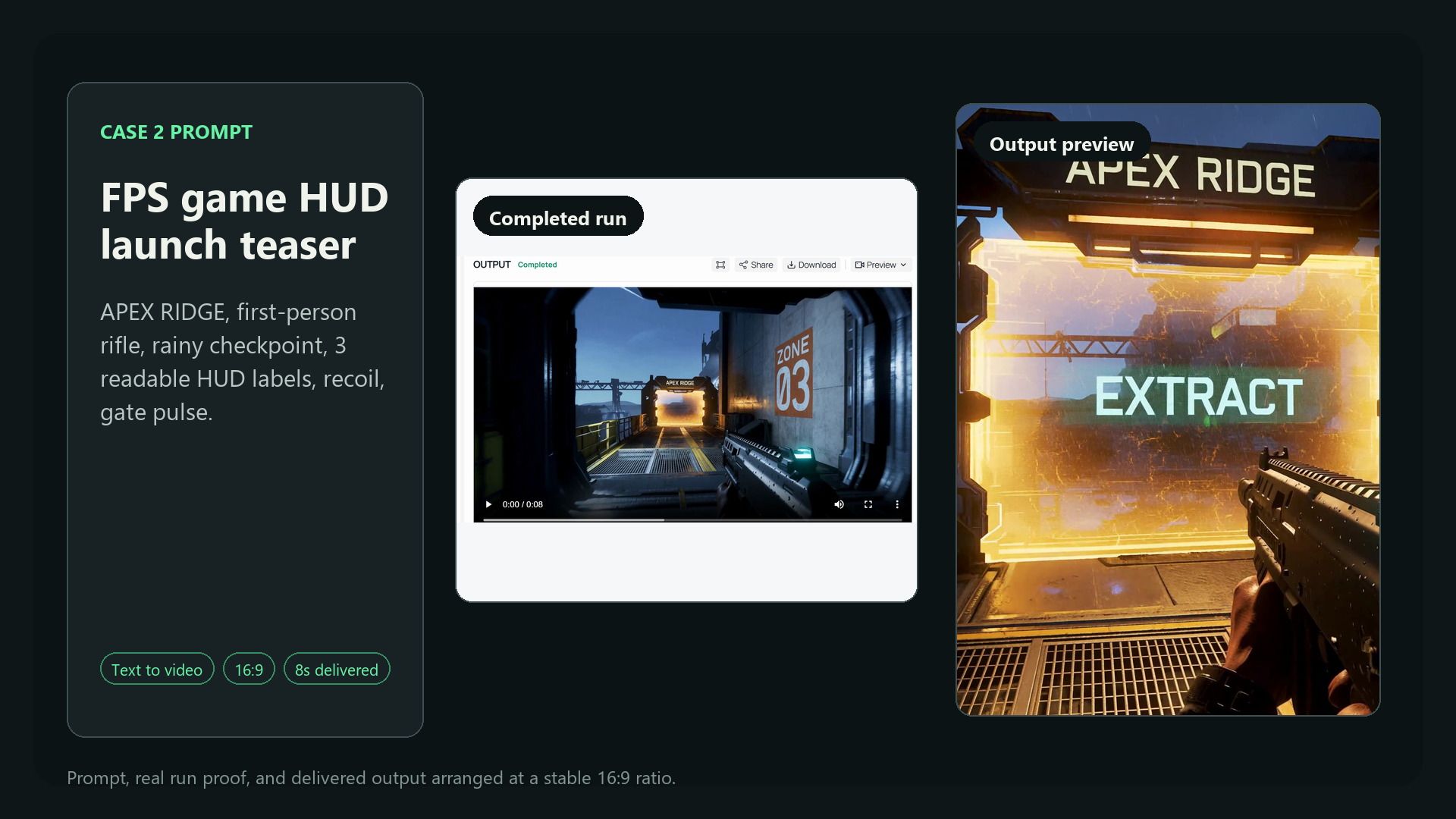
The game case checks text-to-video, readable in-world text, recoil timing, and short action. Use MiniMax H3 Text-to-Video, and keep UI text to 3 strings. The first full prompt timed out in this run, so the completed screenshot uses the shorter retry prompt shown after it.
Plain1Create a 5-second 16:9 realistic game teaser that looks like captured gameplay from a fictional sci-fi extraction shooter called "APEX RIDGE". First-person camera, both hands holding a compact futuristic rifle, walking through a rain-slick industrial checkpoint at blue hour. A clean HUD is visible with only three readable text elements: "APEX RIDGE", "ZONE 03", and "EXTRACT". The crosshair sweeps slowly left, pauses on a glowing gate, fires two controlled shots with brief recoil, then stabilizes on the gate as the word "EXTRACT" pulses once. Keep all text clean and readable. Sound: wet footsteps, distant alarm hum, two sharp suppressed shots, subtle electronic UI beeps. No extra captions, no logo distortions.
Settings: MiniMax H3 Text-to-Video, set the duration slider to 5s, 16:9, highest committed resolution for a quick proof run. This run delivered an 8s file.
Retry prompt used for the completed screenshot:
Plain1Create a short 16:9 sci-fi extraction shooter gameplay teaser for a fictional game called APEX RIDGE. First-person camera, compact futuristic rifle, rain-slick industrial checkpoint at blue hour. The camera walks forward, pans left to a glowing gate, fires two controlled shots with recoil, then settles on the gate as EXTRACT pulses once in the HUD. Keep only three readable text elements: APEX RIDGE, ZONE 03, EXTRACT. Sound: wet footsteps, distant alarm hum, two suppressed shots, subtle UI beeps.
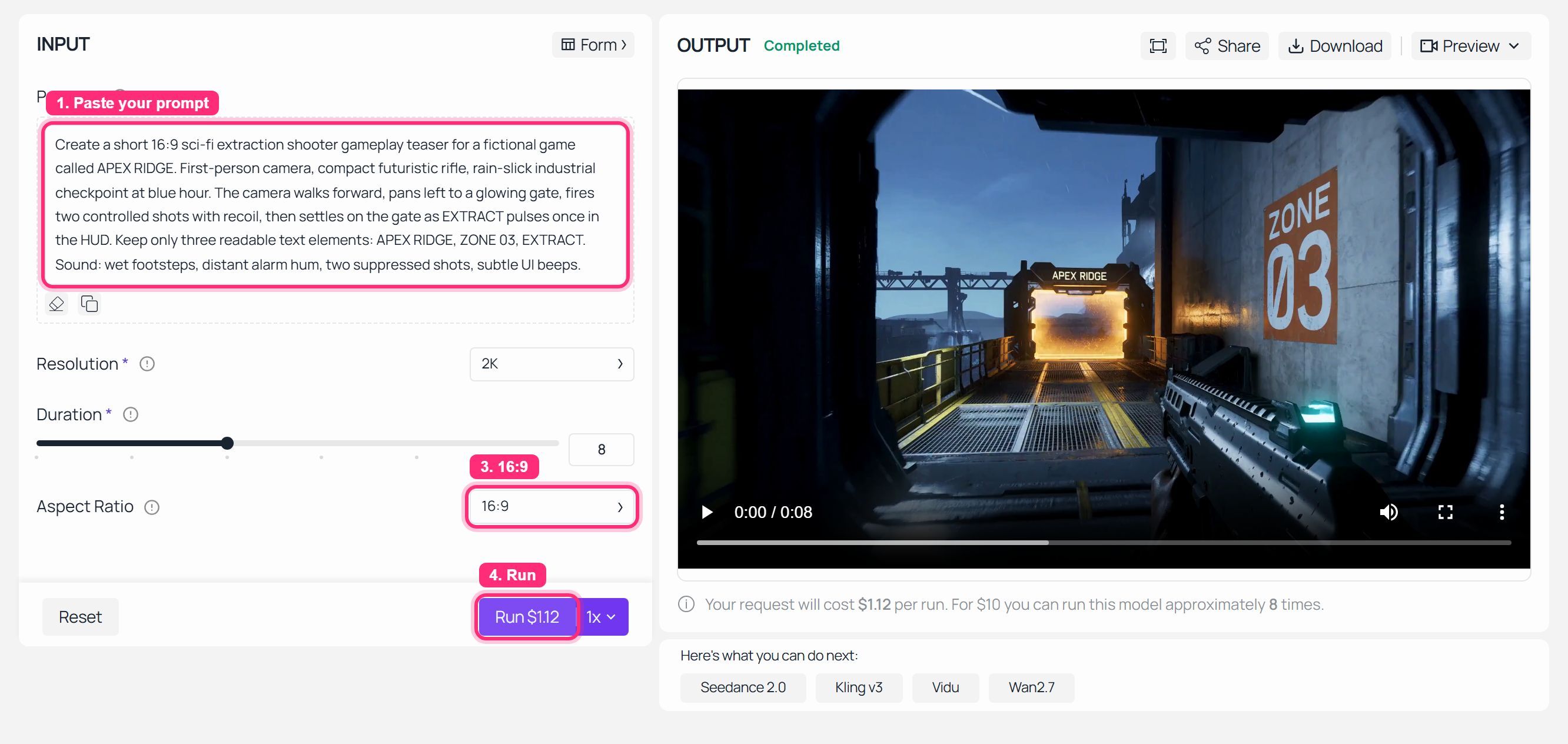
MiniMax H3 Text-to-Video completed FPS game HUD run on Atlas Cloud playground
Step 4 proof: H3 text-to-video run completed for the game HUD case.
MiniMax H3 on OpenRouter game HUD case card with prompt, completed run, and output preview
Case 2 card: prompt summary, completed run proof, and final game HUD motion preview.
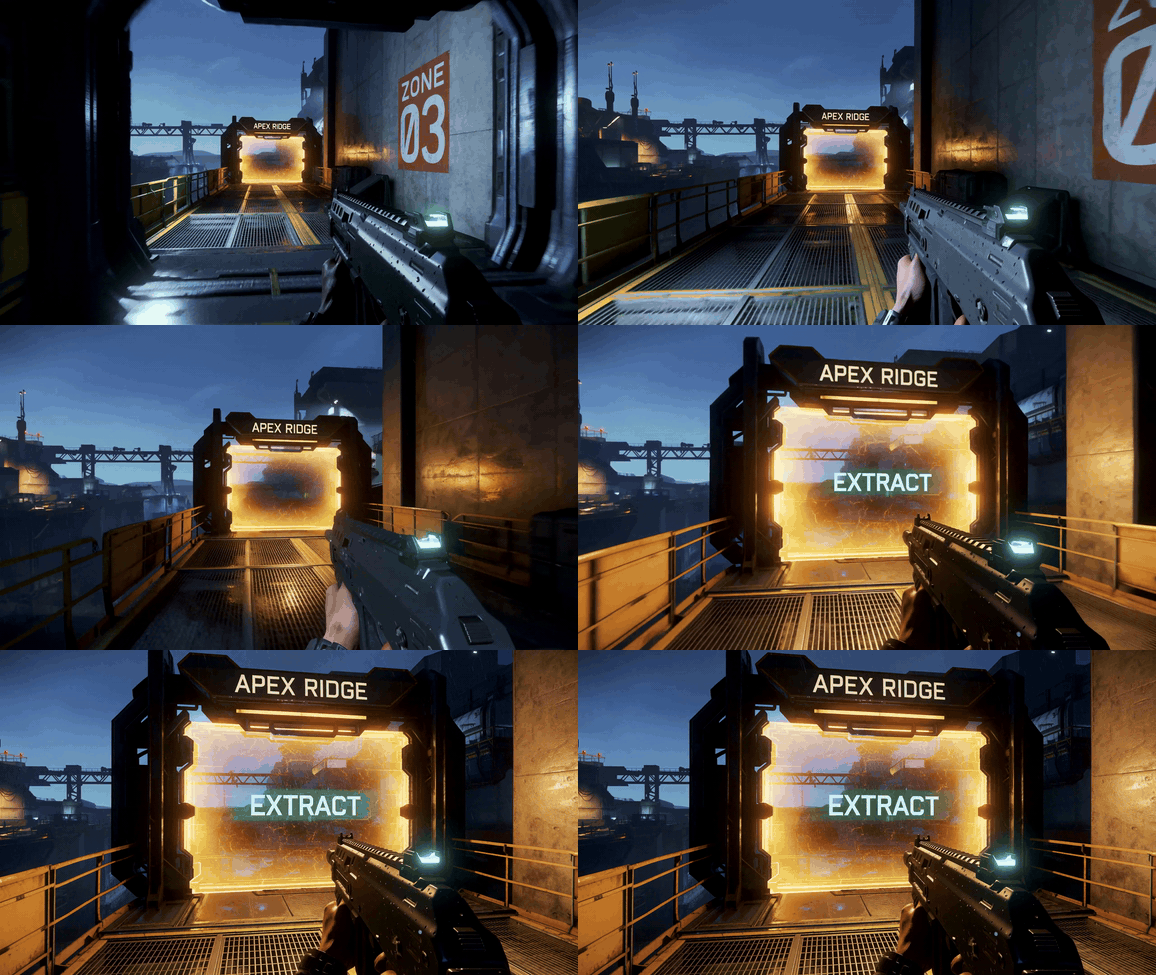
MiniMax H3 game HUD GIF showing the APEX RIDGE teaser motion
Silent GIF preview of the delivered 8s game HUD case, focused on camera movement, recoil, and the EXTRACT pulse.
Step 5: Run Case 3, rainy courier dialogue scene
H3's audio matters most in dialogue clips, so the final article keeps this one as a real video. For a feed ad, switch the same prompt to 9:16 after the 16:9 proof works.
Plain1Create a 5-second cinematic 16:9 night market dialogue scene. A courier in a dark green raincoat walks toward camera through light rain, red lantern reflections on the wet street, steam rising from food stalls behind her. The camera tracks backward at chest height with natural handheld movement. At second 3, she stops under a striped awning, looks directly into camera, and says in a low urgent voice: "We leave before dawn." End on a tight close-up with a scooter passing behind her in soft focus. Sound: rain on fabric, distant scooters, crowd murmur, one short line of dialogue, no music.
Settings: MiniMax H3 Text-to-Video, set the duration slider to 5s, 16:9 for this article's visual system, or 9:16 for TikTok and Reels after the test passes. This run delivered an 8s file.
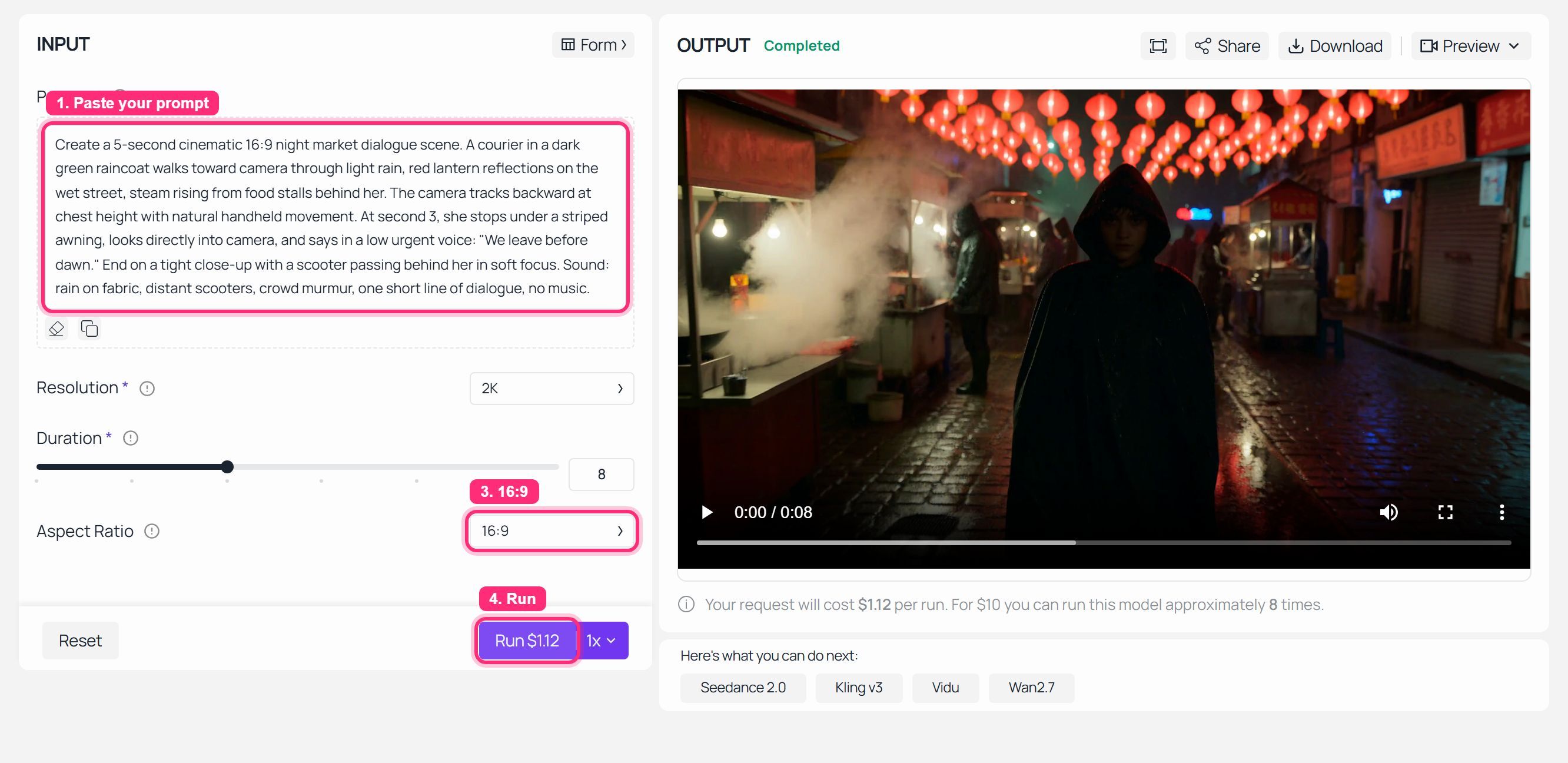
MiniMax H3 Text-to-Video completed rainy courier dialogue run on Atlas Cloud playground
Step 5 proof: H3 text-to-video run completed for the rainy courier dialogue case.
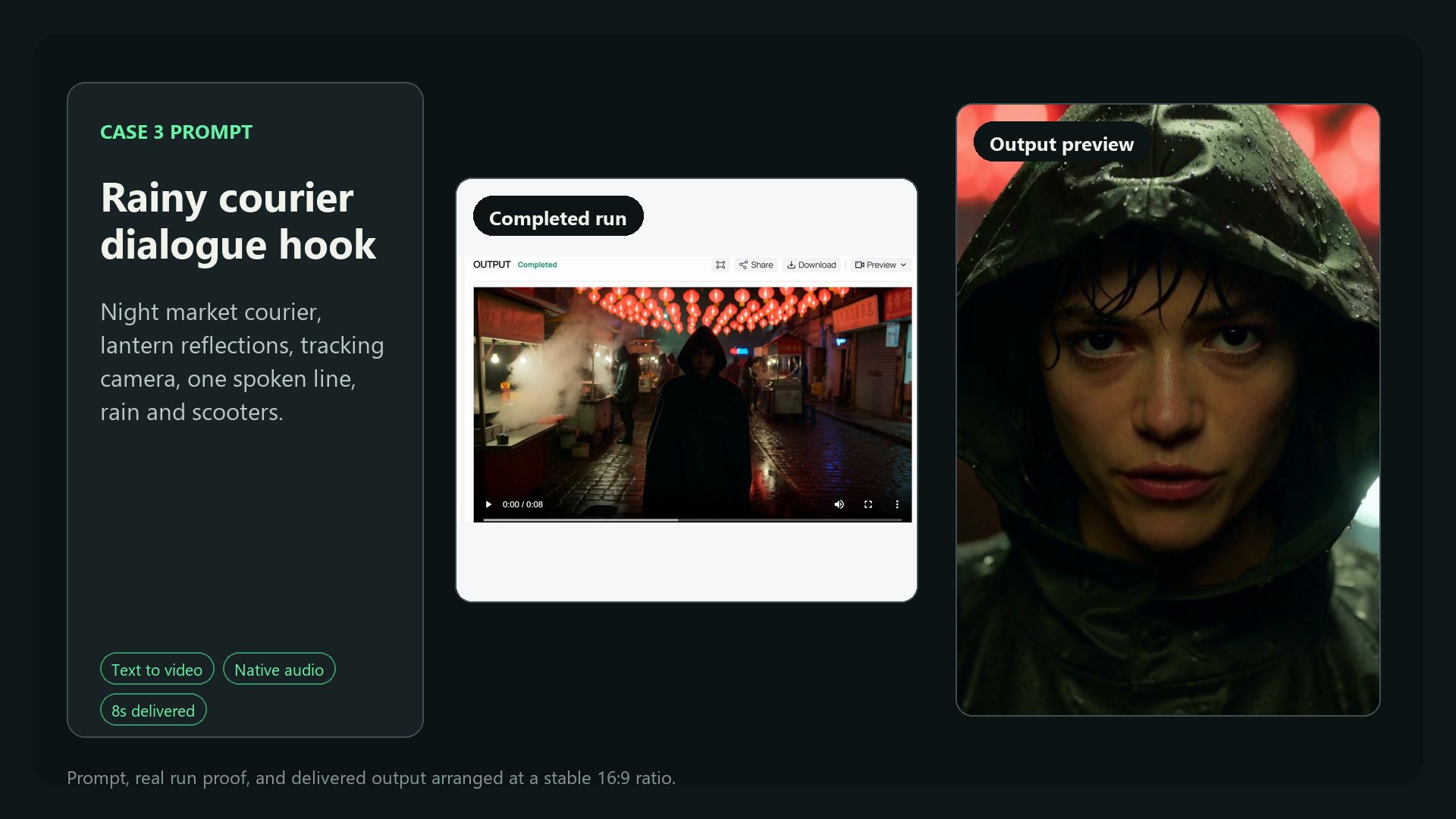
MiniMax H3 on OpenRouter rainy courier dialogue case card with prompt, completed run, and output preview
Case 3 card: prompt summary, completed run proof, and the dialogue-scene output preview.
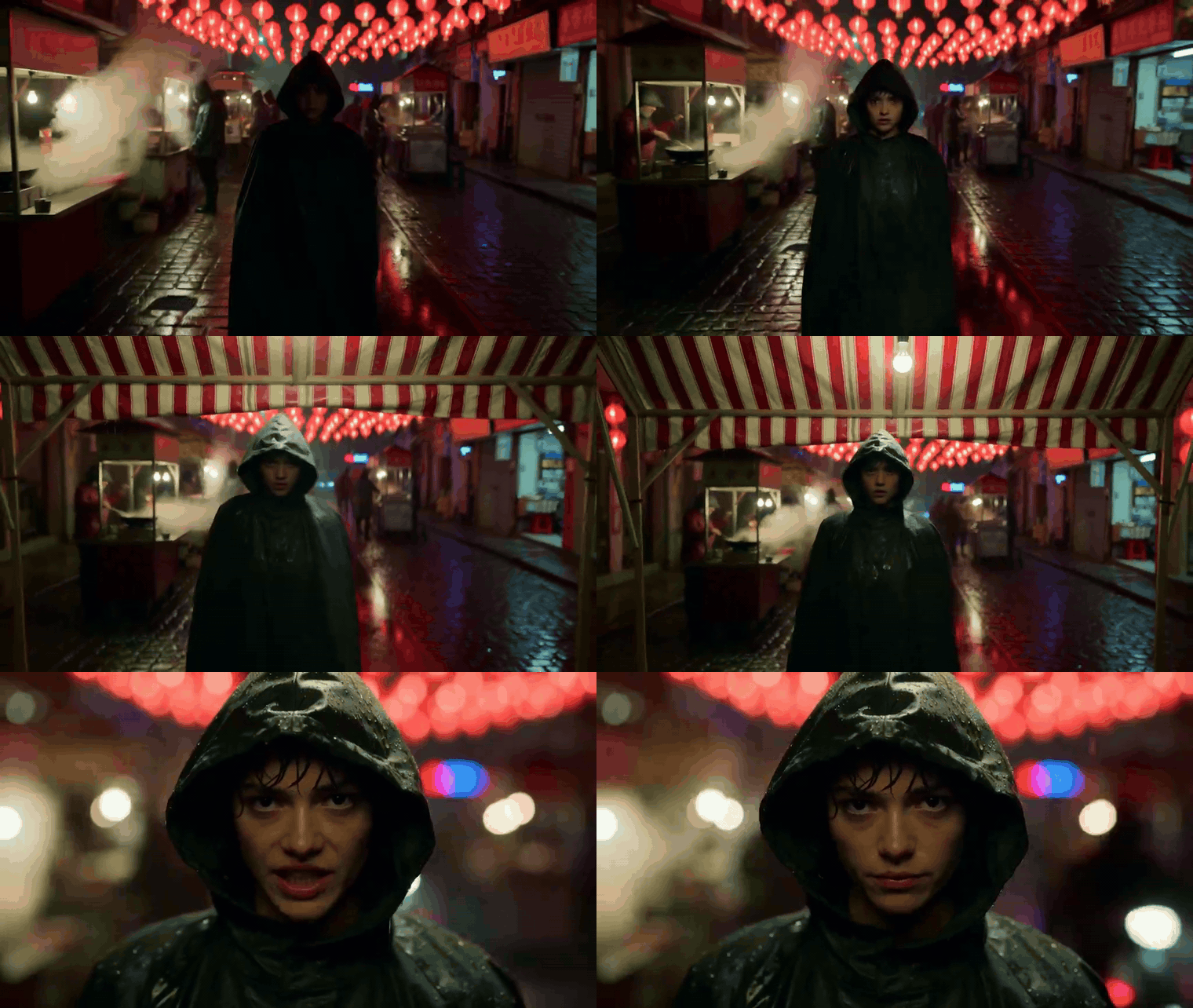
MiniMax H3 rainy courier GIF showing the dialogue scene motion
Case 3 GIF preview of the delivered 8s dialogue-scene motion.
Step 6: Save the cost, result, and retry decision
After each run, write down the route, duration, resolution, actual quote, output file, and retry call. If text fails, go back to the first-frame step. If motion fails, reduce the prompt to one action, one camera move, and one ending frame. If audio fails, describe concrete sounds, not just mood.
Plain1Log this run: route, model page, duration, ratio, resolution, quote, output file, and retry decision. If the label fails, rebuild the first frame. If the motion fails, simplify the action. If the sound fails, write exact sound events.
Settings: Use the same model settings from the run being reviewed. Do not change the next run until you know which variable failed.
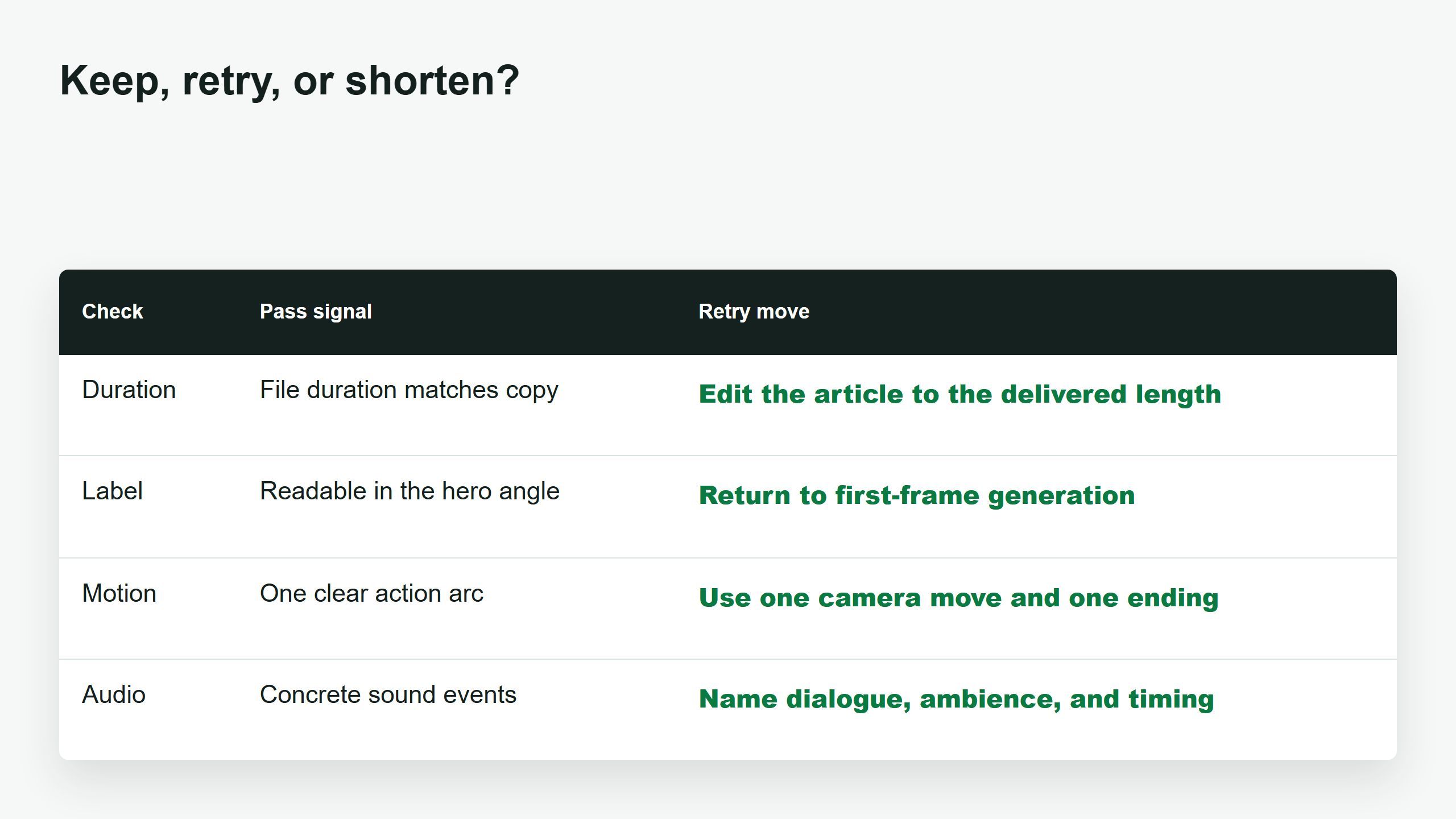
MiniMax H3 on OpenRouter cost and retry checklist for prompt testing
Step 6: a browser-rendered QA checklist for deciding whether to keep, retry, or shorten the H3 prompt.
MiniMax H3 Prompt Variations Worth Trying
Once the 5s proof works, try these variations:
| Variation | Input Needed | Best Use |
|---|---|---|
| Reference-to-video character consistency | Character image plus scene prompt | Founder ads, short drama, UGC-style spokespeople |
| First-frame plus last-frame transition | Two locked images | Packaging reveal, before/after, product transformation |
| Motion transfer test | A legal short reference clip | Dance, sport, gesture, camera rhythm |
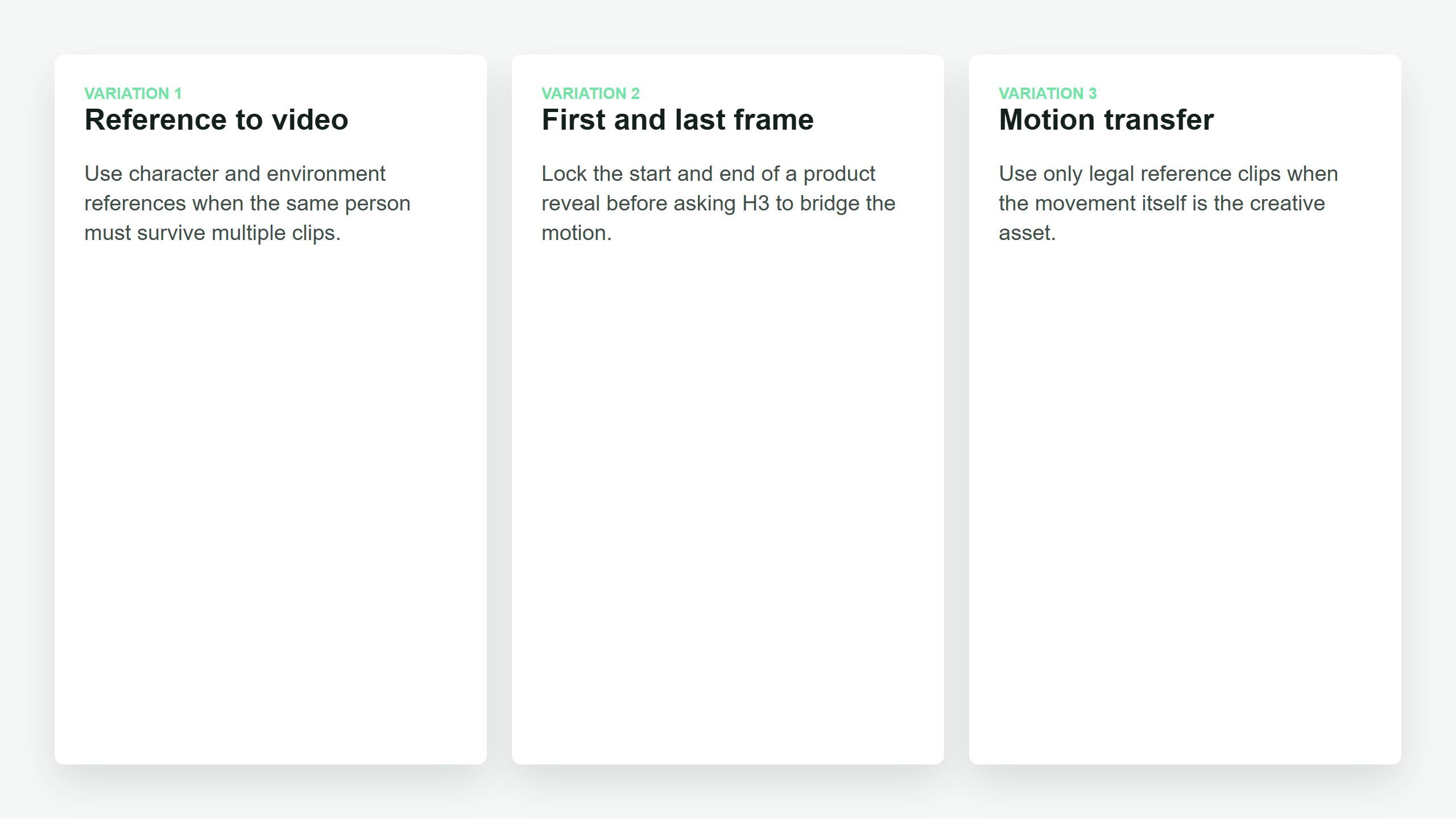
MiniMax H3 on OpenRouter variation grid showing reference-to-video, first-frame transitions, and motion transfer ideas
Variation grid : 3 ways to extend the same H3 workflow after the first 5s tests pass.
MiniMax H3 on OpenRouter Cost: What a Real Test Batch Costs
OpenRouter currently lists H3 from $0.13/second, plus reference image pricing after the first 5 free images on its H3 page. Atlas Cloud's current catalog signal for MiniMax H3 Text-to-Video, Image-to-Video, and Reference-to-Video is from $0.1/SEC, while GPT Image 2 text-to-image appears from $0.009/PIC.
Treat these as floor estimates. The live model page or API usage result is the only number that matters before a real batch.
| Test Batch | OpenRouter Listed Floor | Atlas Cloud Listed Floor | Practical Note |
|---|---|---|---|
| 1 x 5s H3 video | ~$0.65 | ~$0.50 | Best first test |
| 3 x 5s cases | ~$1.95 | ~$1.50 | Good demo batch, before first-frame images |
| 1 x 15s video | ~$1.95 | ~$1.50 | Run only after a 5s prompt works |
MiniMax H3 Legal and License Notes
This is a practical note, not legal advice. Hugging Face lists MiniMax-H3 with image-text-to-video, video-to-video, synchronized audio-video, and related tags, and shows the license as the MiniMax H3 Community License Agreement (Hugging Face MiniMax-H3 model card, August 2026).
Before commercial use, check 4 things:
- You have rights to every reference image, video, and audio file.
- You are not misusing a real person's likeness, voice, brand, or trademark.
- Your OpenRouter, MiniMax, and Atlas Cloud terms match the route you use.
- You do not treat hosted API use and local open weights as the same compliance case.
Use this checklist near the end of any minimax h3 on openrouter test batch, before you send outputs to paid media, clients, or a public app.
Frequently Asked Questions
What is MiniMax H3 on OpenRouter?
It is MiniMax's H3 video model exposed through OpenRouter under the model slug minimax/hailuo-3.
What is the MiniMax H3 OpenRouter model slug?
Use minimax/hailuo-3. Check the live OpenRouter model page before deploying because provider availability can change.
How much does MiniMax H3 cost on OpenRouter?
OpenRouter currently lists H3 from $0.13/second. A 5s test starts around $0.65 before any route-specific extras.
Does MiniMax H3 generate audio?
Yes. H3 is designed for native audiovisual output, so write dialogue, ambience, and sound effects directly into the prompt.
Can MiniMax H3 on OpenRouter do image-to-video?
Yes. The strongest commercial workflow is often first-frame generation, then H3 image-to-video for motion.
Is MiniMax H3 open source or open weights?
Use the phrase "open weights" carefully. The Hugging Face page lists MiniMax-H3 under the MiniMax H3 Community License Agreement, so review the license before local use.





