

The creator wants a night-market action shot by tomorrow. Your product manager asks for a 5-second ad before lunch. The client asks whether a tiny dialogue scene can speak clean English without drifting lips. That is where minimax h3 vs kling ai stops being a model-name debate and becomes a production call.
Most comparisons collapse into a spec sheet. Creators do not choose video models that way. They choose after a prompt gives them a usable ad, a stable action shot, or a believable talking scene.
The short answer: test MiniMax H3 when prompt fidelity, readable text, native stereo audio, or multiple references matter. Test Kling AI when the shot leans into physical motion, multilingual lip-sync, higher-tier drafting, or 4K options. Run the same prompt first, then spend on the winner.
Key takeaways
- MiniMax H3 is strongest to test for text, references, and native audio.
- Kling AI is strongest to test for motion-heavy and 4K work.
- The right model changes by shot type.
- A 5s proof keeps failed 15s finals cheap.
- One shared playground makes same-prompt testing faster.
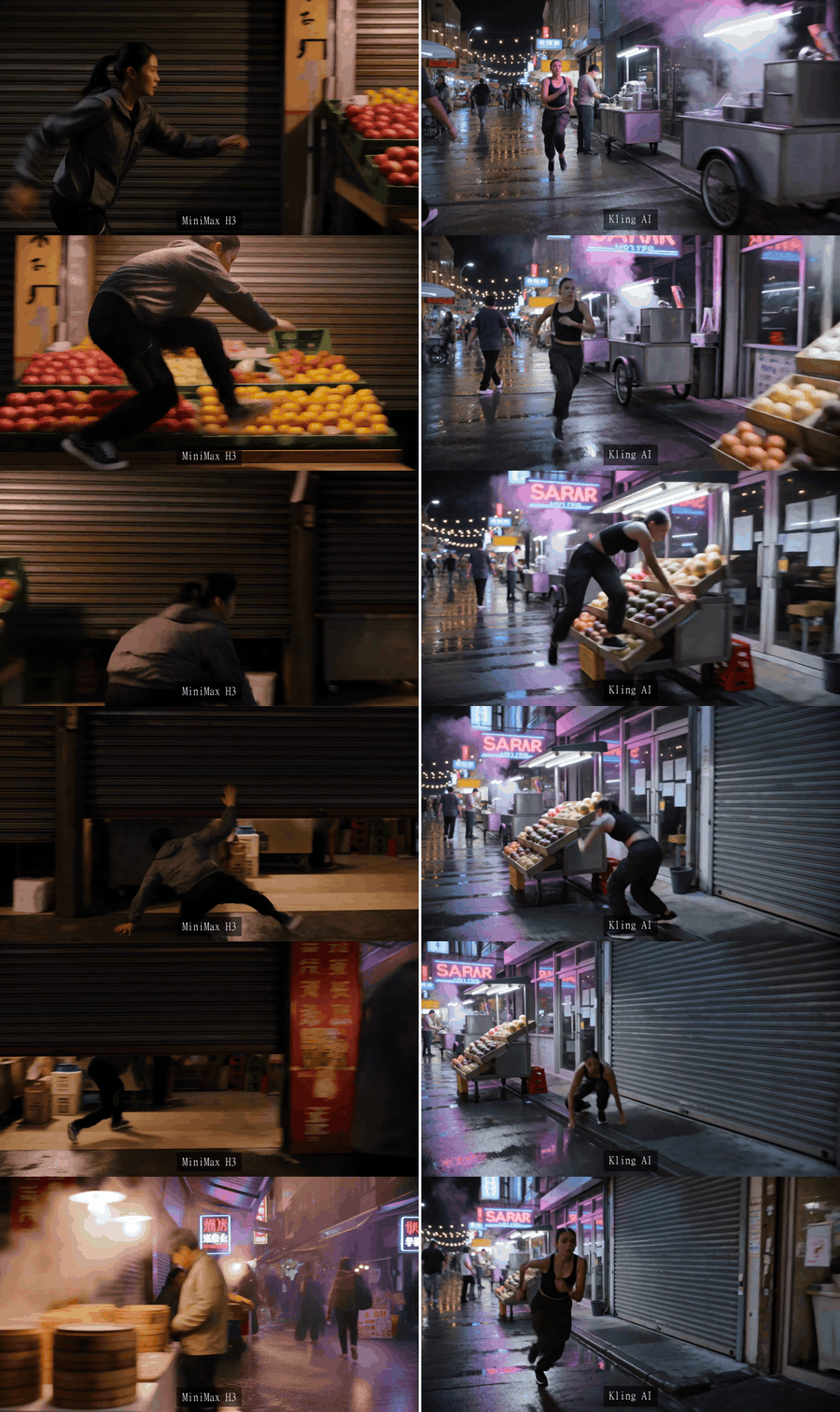
MiniMax H3 vs Kling AI action motion comparison GIF with a night-market freerunner prompt
Showcase case 1: the same 5-second night-market freerunner prompt rendered as a side-by-side MiniMax H3 vs Kling AI motion comparison. Shown as a silent GIF; source files carry native audio where generated.
Why MiniMax H3 vs Kling AI Is Hot, and Why Tests Fail
MiniMax H3 arrived on July 31, 2026 as a general-purpose multimodal video model. MiniMax says H3 reads text, images, video, and audio as unified context, and can generate video with native stereo sound up to 15 seconds at 2K resolution (MiniMax Research, July 2026). Its open-source announcement adds concrete input limits: up to 9 images, 3 video clips, 3 audio clips, and 12 files total for the omni-reference variant.
Kling AI 3.0 launched earlier, on February 5, 2026. Kuaishou describes the 3.0 series as a multimodal video system with native audio across multiple languages, stronger consistency, text-to-video, image-to-video, reference-to-video, in-video editing, and duration up to 15 seconds (Kuaishou Technology, February 2026).
That overlap is why the search is hot. Both models promise native audio. Both aim at commercial video. Both can take creators beyond a silent moving picture. The useful question is narrower: which model should a creator try first for this specific shot?
Most MiniMax H3 vs Kling AI tests fail for boring reasons:
- The tester changes the prompt between models, then calls the output a comparison.
- The article grades official demos instead of a prompt a marketer could paste.
- Text-to-video, image-to-video, and reference-to-video get mixed together.
- Settings are missing, so readers cannot reproduce the result.
- A still frame gets used to judge a video model, hiding motion and audio failures.
For 2026 video work, the real fan-out queries are practical: MiniMax H3 vs Kling AI price, MiniMax H3 vs Kling AI text-to-video, MiniMax H3 vs Kling AI image-to-video, native audio, lip-sync, product ads, readable packaging, and character consistency. This article answers those with 3 same-prompt cases.
MiniMax H3 vs Kling AI Workflow Overview and Price Table
Use Atlas Cloud's model library as a neutral testing bench: open the MiniMax H3 page, run the prompt, open the Kling page, run the same prompt, then compare the delivered clips before scaling a batch. The value is not a louder claim. It is the simple fact that the creator can keep one account, one browser workflow, and one cost worksheet while switching models.
Prices below were checked against Atlas Cloud model pages on August 27, 2026. Treat them as a live quote, not permanent promo copy.
| Model | Best use | Input mode | Duration | Resolution signal | Audio | Current Atlas price signal |
|---|---|---|---|---|---|---|
| MiniMax H3 Text-to-Video | Product ads, prompt fidelity, audio tests | Text | 5-15s | up to 2K | Native stereo | From $0.10/sec |
| MiniMax H3 Image-to-Video | First-frame product or storyboard motion | Image + prompt | 5-10s on page schema | up to 2K | Native stereo | From $0.10/sec |
| MiniMax H3 Reference-to-Video | Character, product, voice, or style reference | References + prompt | 5-15s | up to 2K | Native stereo | From $0.10/sec |
| Kling v3.0 Pro Text-to-Video | Motion-heavy shots and dialogue drafts | Text | 3-15s | 1080p tier | Native audio | $0.112/sec to $0.095/sec, 15% off |
| Kling v3.0 4K Text-to-Video | Final high-resolution delivery checks | Text or image | up to 15s | 4K tier | Native audio | $0.42/sec to $0.357/sec, 15% off |
| Kling Video O3 Pro Reference-to-Video | Reference-driven character and voice tests | References + prompt | 3-15s | Pro tier | Native audio options | $0.112/sec to $0.095/sec, 15% off |
One public benchmark also explains why a single winner claim would be shallow. Megaton's August 2026 v-benchmark snapshot lists Kling 3 Pro at rank 4 and MiniMax Hailuo 03 at rank 5, with Kling ahead on human fidelity and physics, while H3 is ahead on prompt adherence and text fidelity (Megaton, August 2026). That matches the production pattern: H3 deserves a close look when words and references must survive; Kling deserves a close look when bodies, camera moves, and action physics drive the shot.
Step 1: MiniMax H3 vs Kling AI Setup on Atlas Cloud
Open the model library, search MiniMax H3, then open Text-to-Video for a prompt-only proof. In a second tab, search Kling 3.0 and open Kling v3.0 Pro Text-to-Video. Keep the prompt, duration, ratio, output count, and audio choice aligned.
For the setup step, the "prompt" is the search phrase you use to find both model families:
text1MiniMax H3 Kling 3.0 2
Pick these proof settings before spending on longer finals. In this operated run, Kling delivered about 5.04-second clips. The H3 source clips came back as 8 seconds even though the prompt and slider targeted 5 seconds, so the published comparison assets use the first 5 seconds and the actual spend report below counts H3 as 8 seconds per run.
| Setting | Pick |
|---|---|
| Ratio | 16:9 |
| Duration | 5s proof |
| Resolution | Highest available for the selected model |
| Outputs | 1 |
| Audio | Default or native audio on |
| Prompt language | English |
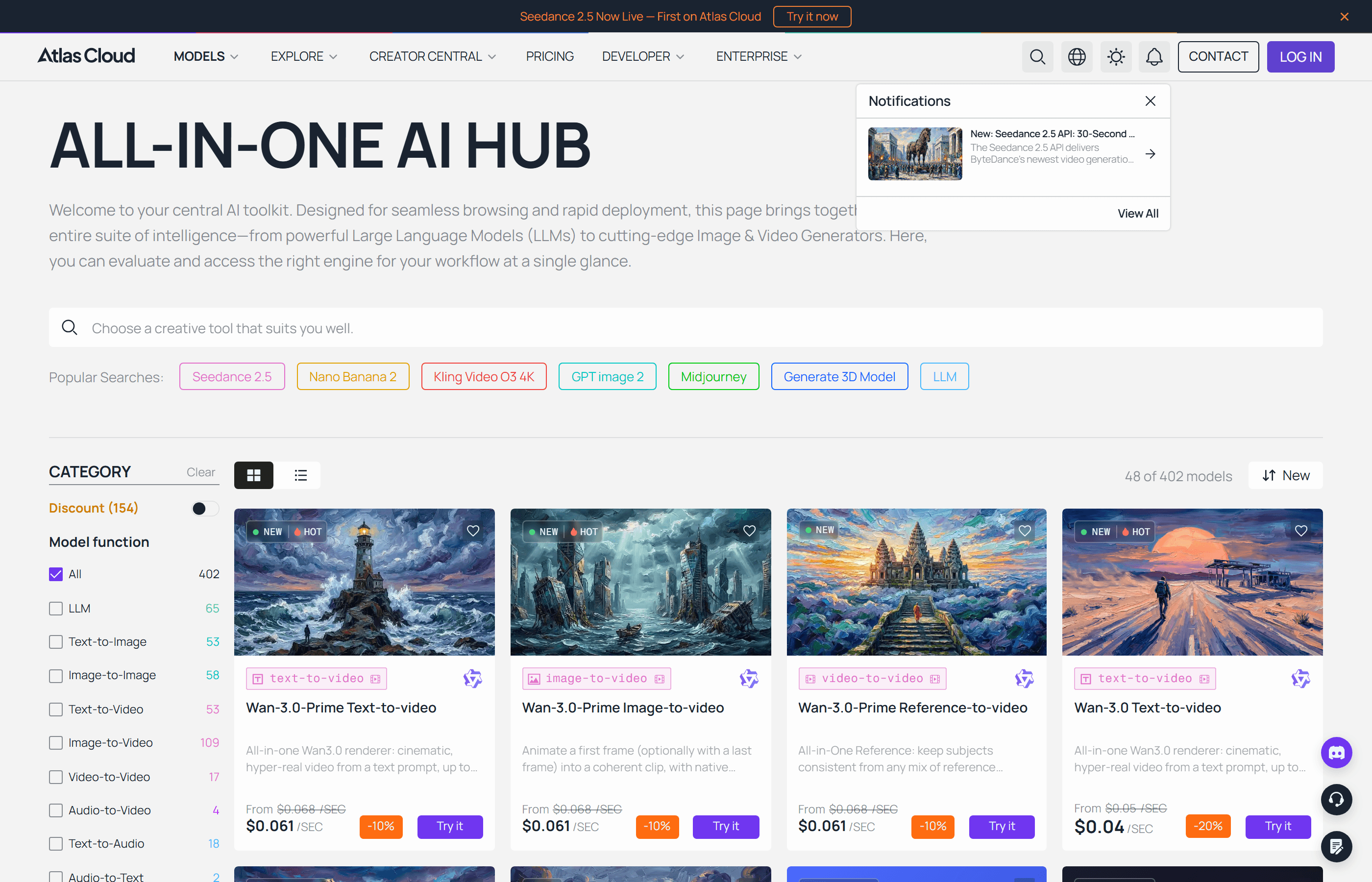
Atlas Cloud model library search screenshot showing MiniMax H3 and Kling AI models for the same-prompt workflow
Step 1: one model library search keeps the MiniMax H3 vs Kling AI setup in the same browser workflow.
Step 2: MiniMax H3 vs Kling AI Action Motion Prompt
Start with motion because it is the part of video generation that screenshots cannot measure. Kling AI often attracts creators who care about running, jumping, camera tracking, and physical continuity, so this first case gives both models a fair action problem.
text1A 5-second 16:9 continuous action shot, no hard cuts. A female free-runner sprints through a crowded neon night market in light rain. The camera tracks beside her at waist height as she vaults over a fruit stall, slides under a half-closed metal shutter, then lands and keeps running toward the camera. Steam from food carts, wet pavement reflections, grounded physics, natural body mechanics, clear face for the first two seconds, no slow-motion, no text. Native audio: footsteps splashing, market ambience, a short metal shutter rattle, distant traffic. 2
Pick 16:9, target 5 seconds where the control commits, highest available resolution, 1 output, and native audio on where available. Rerun only for severe failure, such as a missing vault, a hard cut that breaks the test, or a character body that collapses. In this run, the H3 source delivered 8 seconds, then the side-by-side GIF was trimmed to the first 5 seconds.
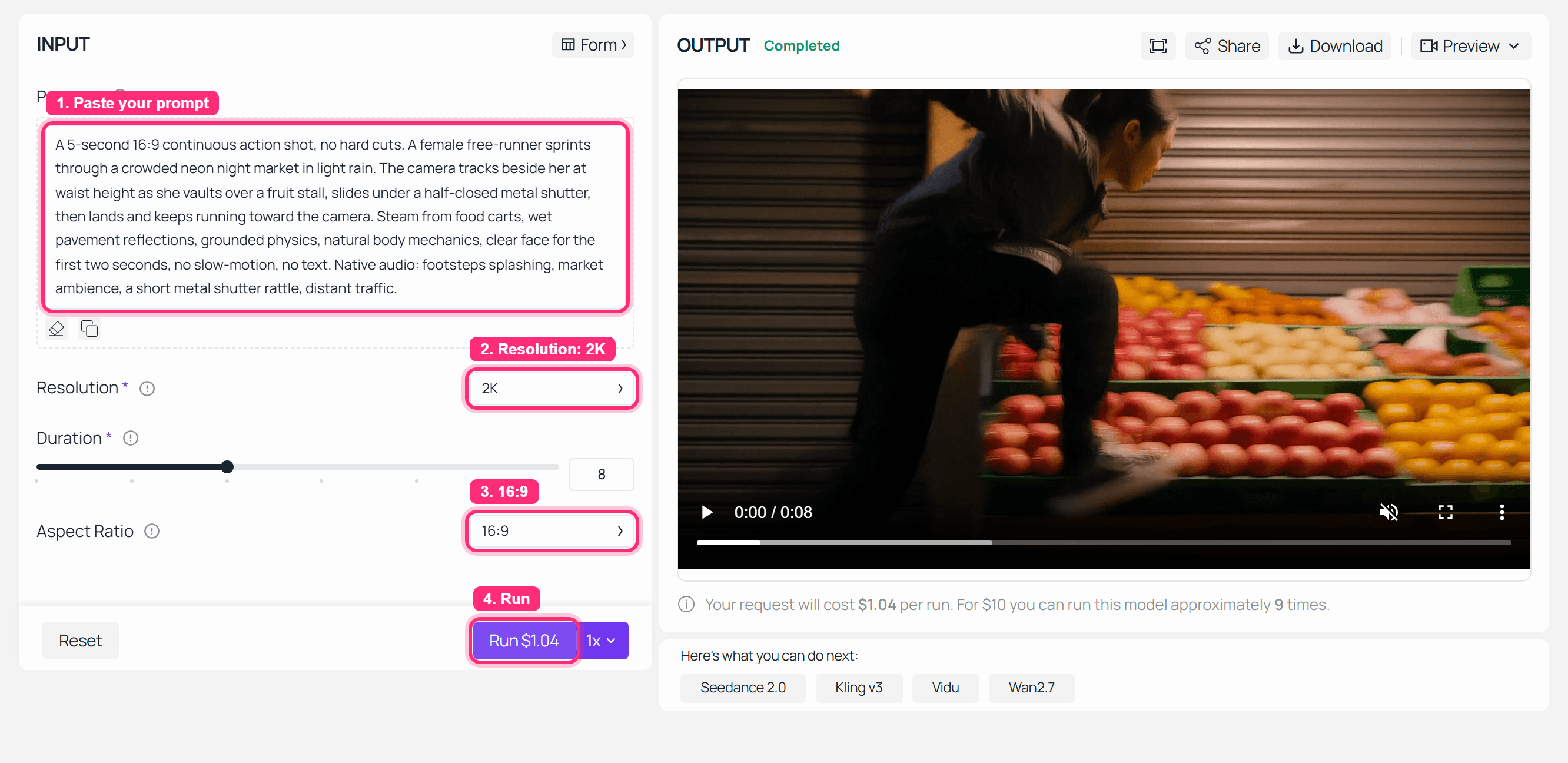
MiniMax H3 completed action motion playground run on Atlas Cloud for the freerunner prompt
Step 2A: MiniMax H3 action run completed for the night-market freerunner test.
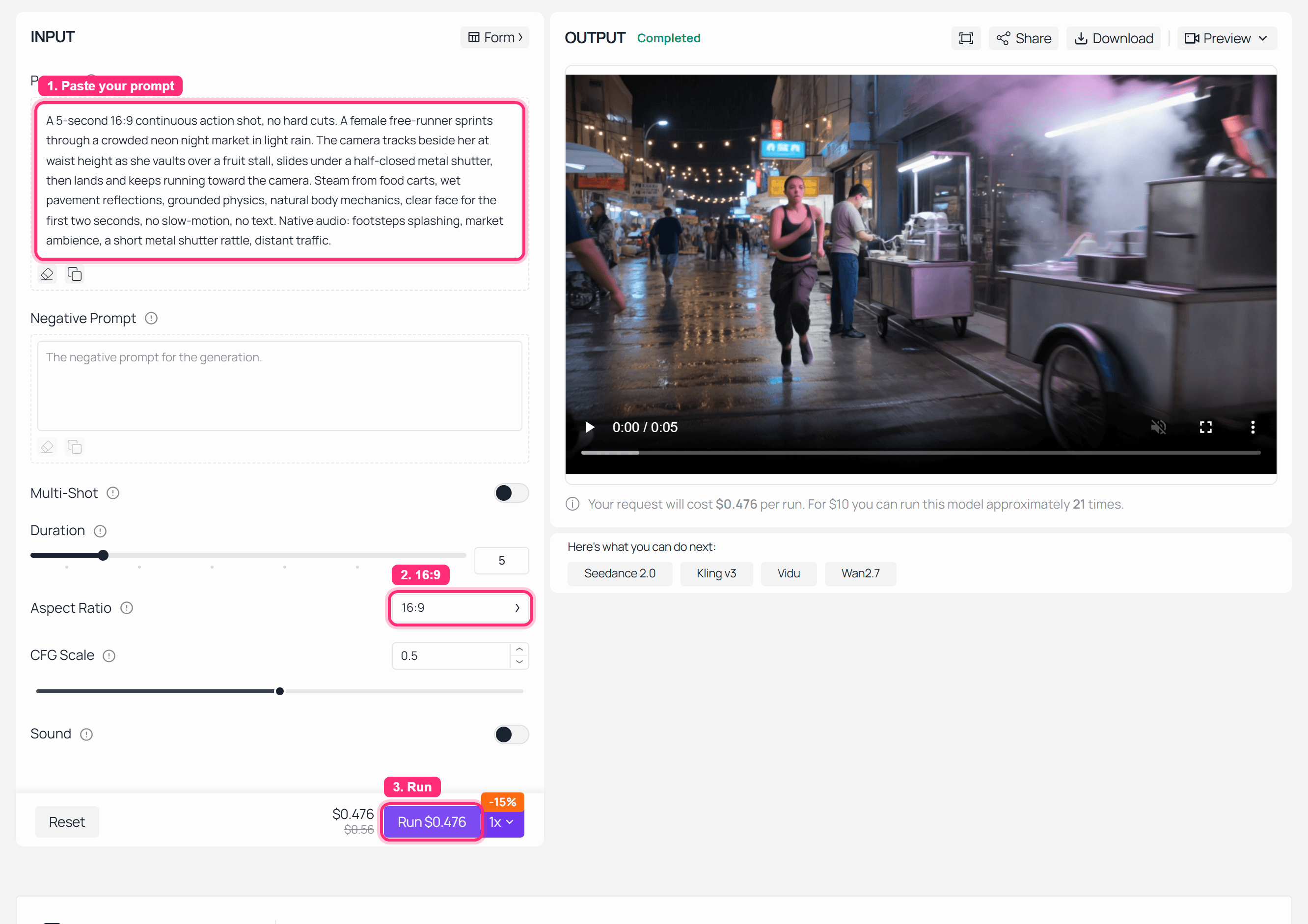
Kling AI completed action motion playground run on Atlas Cloud for the freerunner prompt
Step 2B: Kling AI action run completed for the same freerunner motion test.
Judge whether the runner completes the action inside 5 seconds. Then check camera continuity, crowd stability, and whether the sound feels attached to movement rather than pasted on top. If a model turns the vault into a blur but keeps the face crisp, it still may be wrong for this shot.
Step 3: MiniMax H3 vs Kling AI Product Ad Prompt
The second case moves from body mechanics to commercial control. A product ad reveals 3 common advertising failures fast: unreadable packaging, object morphing, and hand contact that never quite touches the product. Use MiniMax H3 Text-to-Video and Kling v3.0 Pro Text-to-Video with the same text.
text1A 5-second 16:9 cinematic product ad for a small skincare bottle on a wet stone counter at sunrise. The label text must read exactly "LUMA SERUM" in clean black letters. A hand enters from the right, rotates the bottle slightly, and sets it beside a glass dropper. Warm morning light passes through steam in the background. Camera starts in a close three-quarter product view, slides slowly left, then settles on the readable label. Realistic reflections, no extra text, no logo distortion. Native audio: soft room tone, a tiny glass tap when the bottle touches the counter, gentle morning ambience. 2
Pick 16:9, target 5 seconds where the control commits, highest available resolution, 1 output, and native audio on if the page exposes the toggle. For a campaign test, judge the delivered clip on label readability first. In this run, the H3 source delivered 8 seconds, then the side-by-side GIF was trimmed to the first 5 seconds for a like-for-like comparison. A beautiful bottle with broken text is still a failed ad.
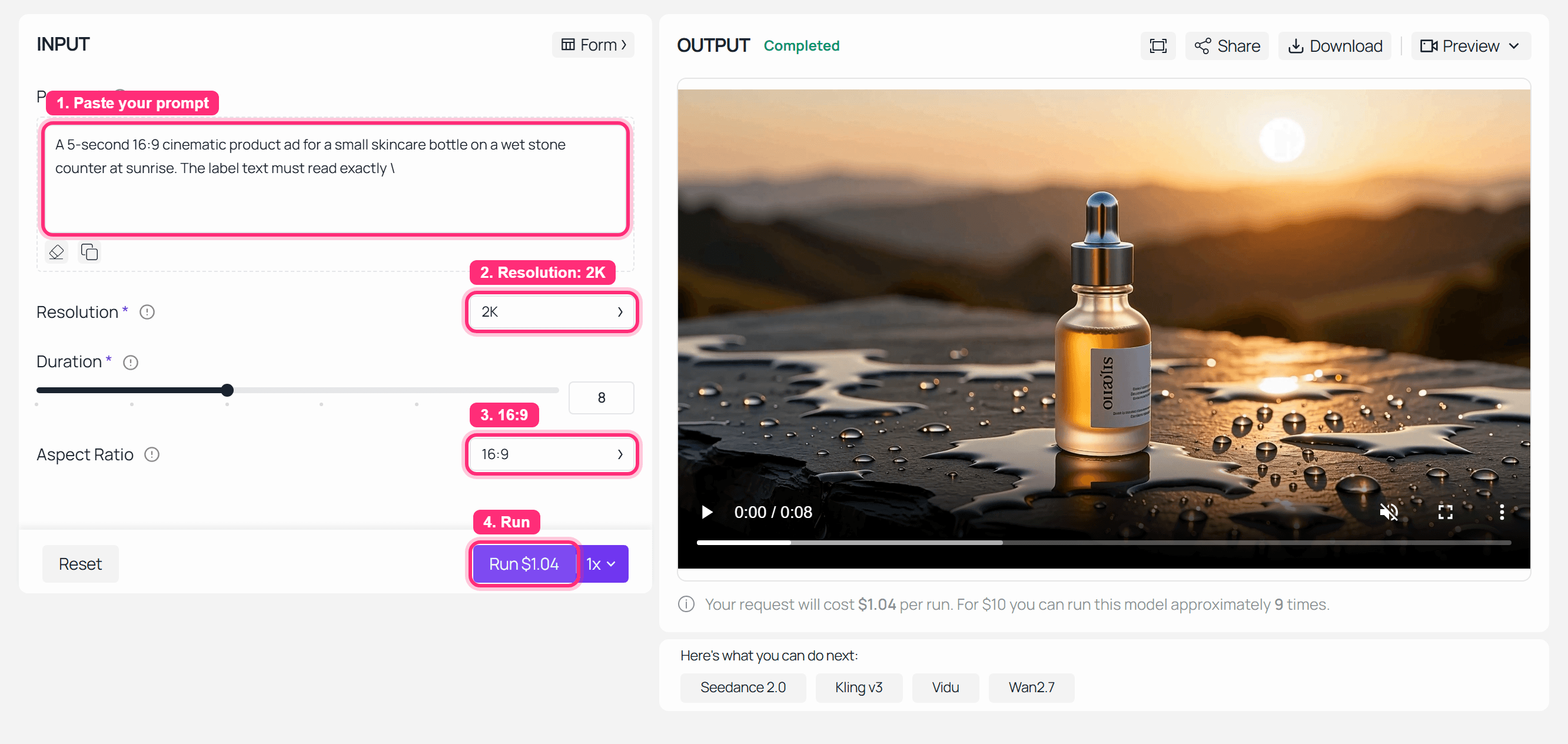
MiniMax H3 completed product ad playground run on Atlas Cloud for the LUMA SERUM prompt
Step 3A: MiniMax H3 product ad run completed with the LUMA SERUM same-prompt test.
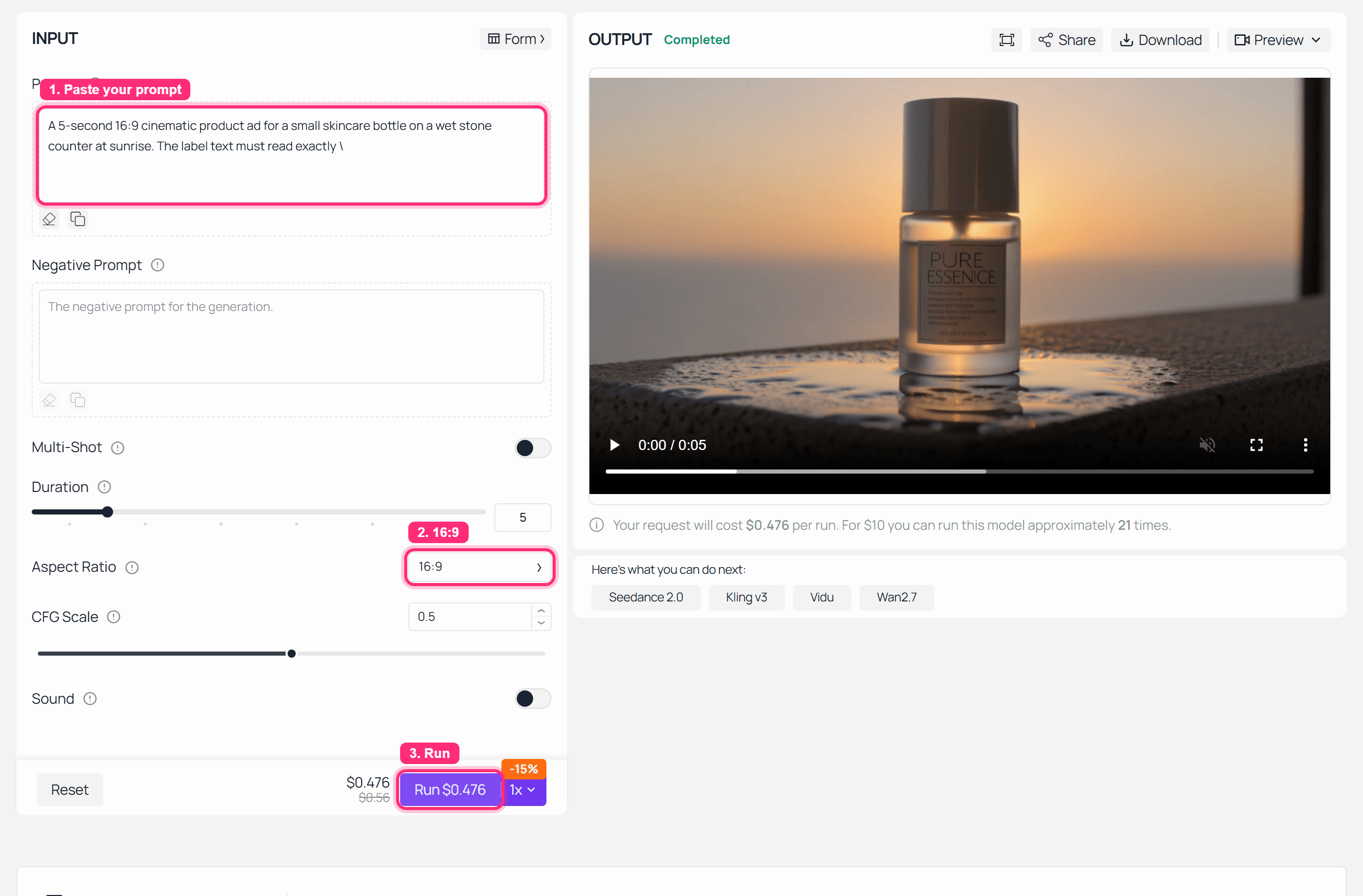
Kling AI completed product ad playground run on Atlas Cloud for the LUMA SERUM prompt
Step 3B: Kling AI product ad run completed with the same LUMA SERUM prompt and proof settings.
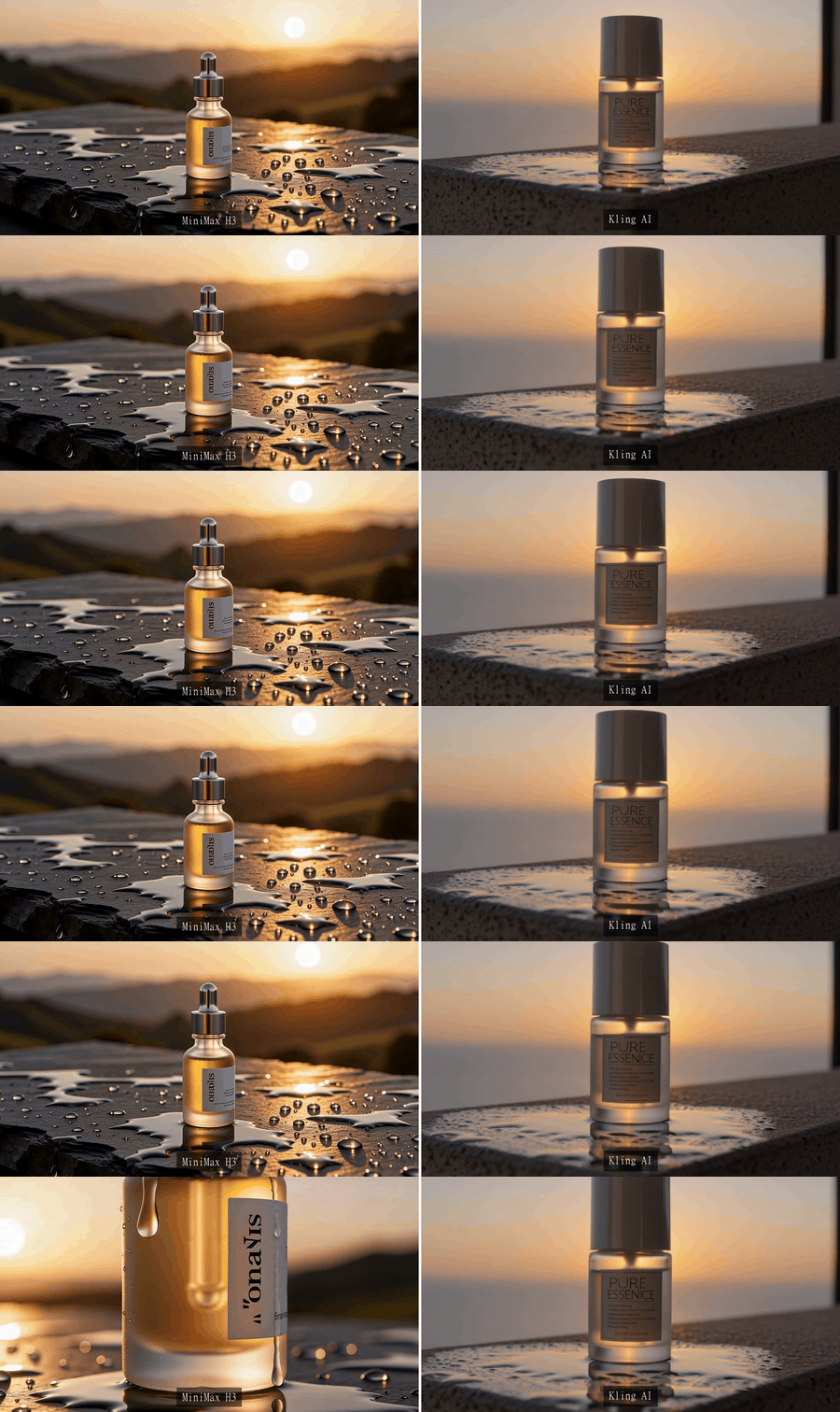
MiniMax H3 vs Kling AI product ad comparison GIF showing the same skincare prompt rendered side by side
Case 2: the same 5-second product ad prompt rendered as a side-by-side MiniMax H3 vs Kling AI comparison. Shown as a silent GIF; the source clips carry native audio.
In review, watch 5 things in order: label readability, product shape stability, hand-object contact, whether audio supports the moment, and whether the model adds unwanted text. For product launch work, choose the output that makes the package usable before you judge the cinematic look.
Step 4: MiniMax H3 vs Kling AI Dialogue Prompt
The third case is deliberately short and unforgiving. Two characters, 2 lines, no subtitles. This tests speaker assignment, lip-sync, expression realism, and whether the quoted dialogue survives.
text1A 5-second 16:9 realistic office microdrama with two characters at a small startup table. Character A, a tired product manager in a blue shirt, looks at a laptop and says, "The demo is in two hours." Character B, a calm designer in a green sweater, smiles and says, "Then we keep only the shot that sells." The camera starts over the laptop screen, racks focus to their faces, then ends on both characters nodding. Natural mouth movement, clear speaker turns, no subtitles, no extra text, realistic office lighting. Native audio: quiet keyboard taps, soft room tone, clean English dialogue. 2
Pick 16:9, target 5 seconds where the control commits, highest available resolution, 1 output, and native audio on. Avoid subtitles, because subtitles can hide a weak lip-sync result. In this run, the H3 source delivered 8 seconds, then the side-by-side video was trimmed to the first 5 seconds. For Kling, the broader model family is documented around multilingual speech and speaker control, so this is the shot where the audio setting matters.
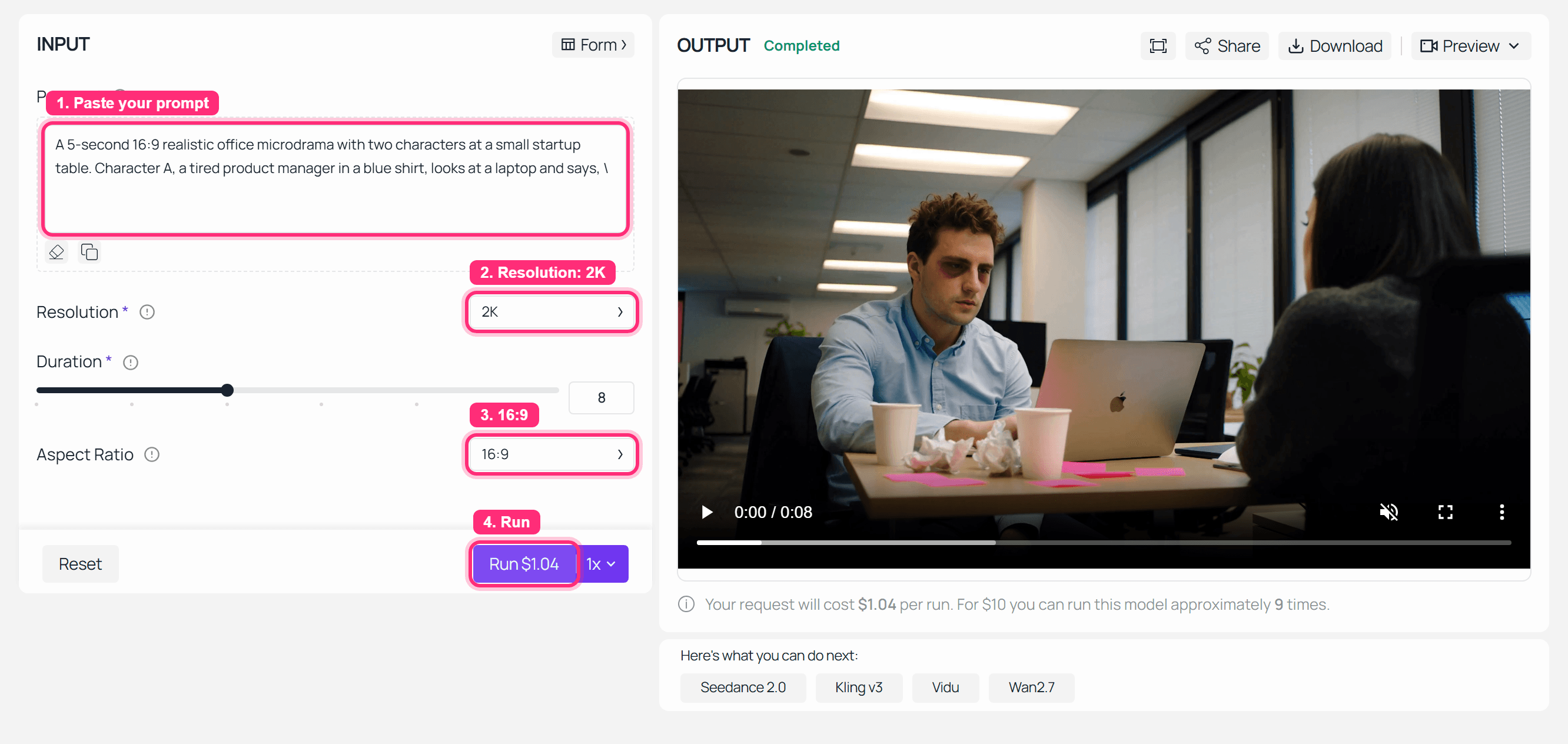
MiniMax H3 completed dialogue playground run on Atlas Cloud for the two-character office microdrama prompt
Step 4A: MiniMax H3 dialogue run completed for the two-character office microdrama test.
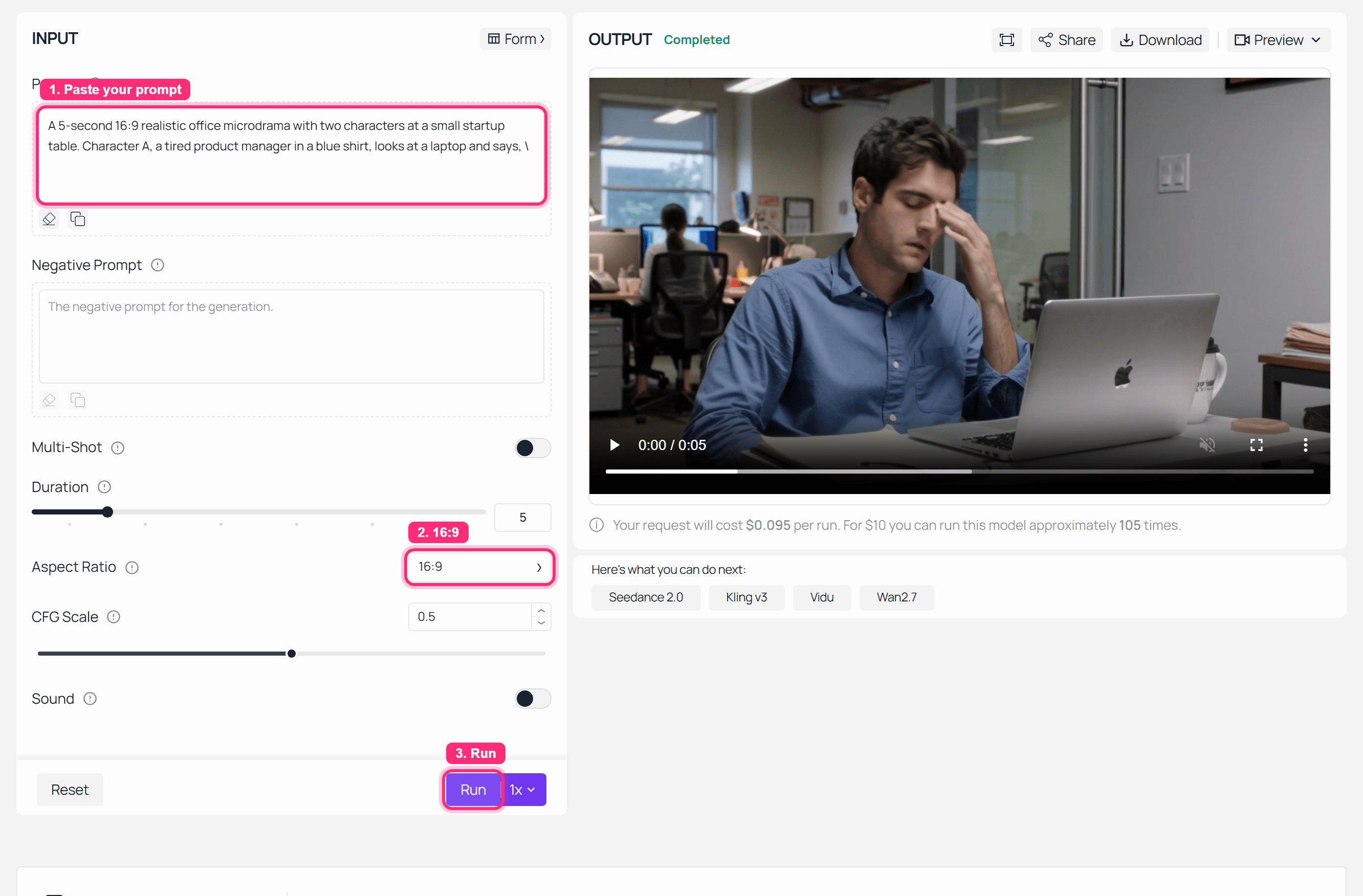
Kling AI completed dialogue playground run on Atlas Cloud for the two-character office microdrama prompt
Step 4B: Kling AI dialogue run completed for the same office microdrama prompt.
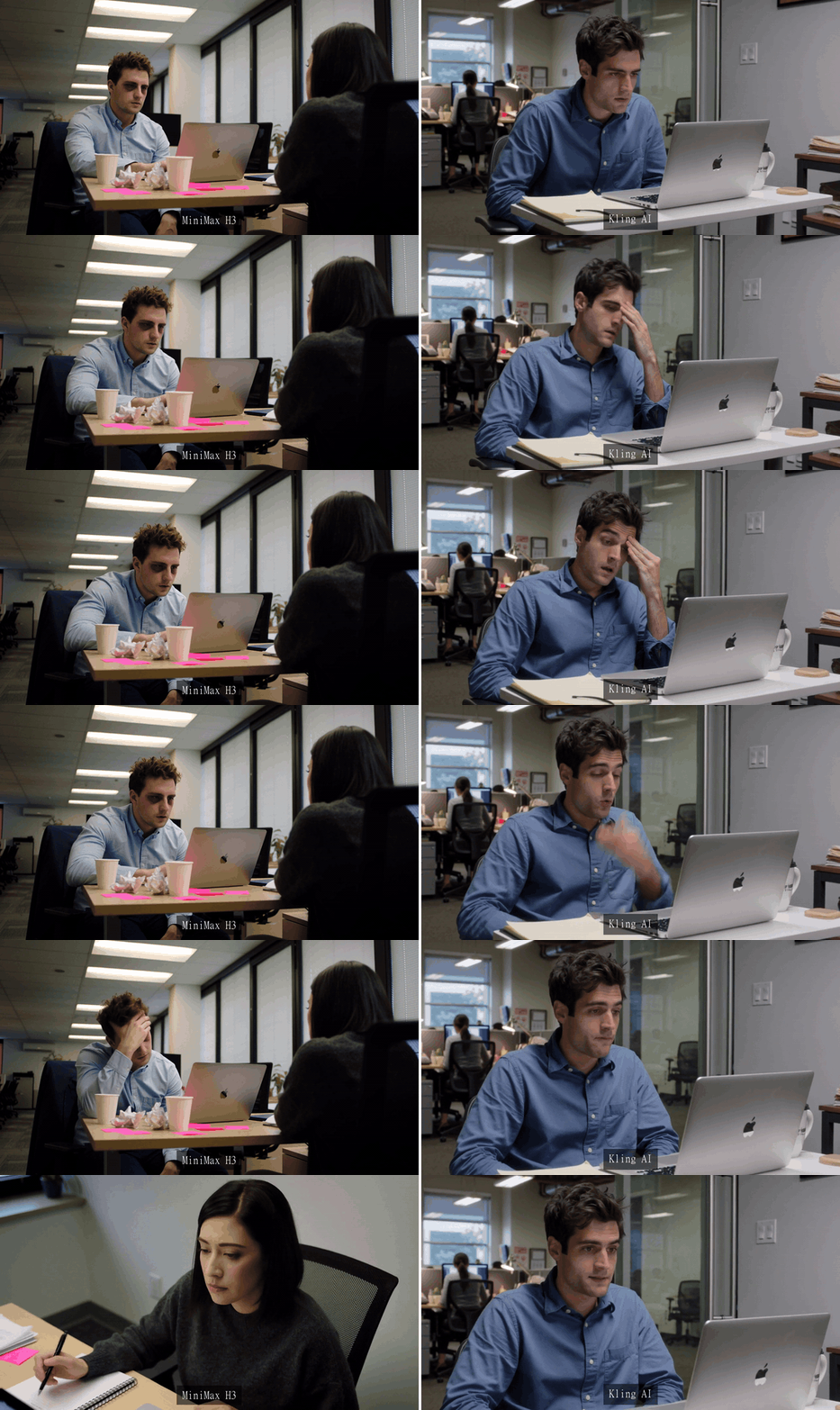
MiniMax H3 vs Kling AI dialogue comparison GIF showing the same two-character office microdrama prompt side by side
Case 3: this silent MiniMax H3 vs Kling AI dialogue GIF keeps the side-by-side motion readable. For audio scoring, use the raw source files: in this capture, the H3 source clip carried AAC stereo audio, while the saved Kling source file exposed no audio stream.
For dialogue, the visual winner is not always the production winner. Listen for speaker order, clipped words, invented extra speech, room tone, and whether the mouths open on the right phrases. Also verify that the downloaded asset actually contains an audio stream before you score the model on sound. A model that looks slightly less glossy but preserves both lines can be the smarter choice for an ad read.
Step 5: MiniMax H3 vs Kling AI Result Review Checklist
After the 3 proof runs, fill out a review table before buying longer versions. This keeps the choice tied to the shot, not to model fandom.
text1Review the finished 5-second proof. Keep the same prompt, same model version, same ratio, and same duration in your notes. Mark each row usable, needs rerun, or reject. 2
Use the same proof settings from the earlier steps: 16:9, 5 seconds, highest available resolution, 1 output, and native audio on where exposed. Do not scale to 10 or 15 seconds until the 5-second proof passes the rows that matter for that job.
| Prompt requirement | H3 result | Kling result | Production decision |
|---|---|---|---|
| Readable product text | Check whether "LUMA SERUM" survives | Check whether extra letters appear | Product ad chooses the cleaner label |
| Hand/object interaction | Check contact and bottle shape | Check contact and object drift | Rerun if the hand floats or melts |
| Fast motion | Check sprint, vault, slide, landing | Check sprint, vault, slide, landing | Action cut chooses completed motion |
| Physics | Check body weight and stall impact | Check body weight and shutter timing | Reject if motion feels weightless |
| Face stability | Check first 2 seconds of runner | Check first 2 seconds of runner | Pick the clip with fewer identity jumps |
| Native audio | Listen for room tone and effects | Listen for attached effects | Keep the clip whose sound matches motion |
| Dialogue | Check both quoted lines | Check both quoted lines | Dialogue cut chooses cleaner speaker timing |
| Cost for 5s | About $0.50 if 5s commits; this H3 run delivered 8s | About $0.475 at $0.095/sec Pro discount | Proof first |
| Cost for 10s | About $1.00 | About $0.95 | Scale only after proof passes |
| Best next action | Use reference or image mode if text fails | Try Pro, O3, or 4K only if needed | Spend on the shot type, not the logo |
This checklist also helps developers building automated video pipelines. Save prompt, model ID, date, duration, and output URL for every proof. That record matters when a campaign manager asks why one version shipped and another stayed in drafts.
MiniMax H3 vs Kling AI Cost: 5s Proof Before 15s Final
The cheapest useful workflow is simple: run a short proof, review the exact failure mode, then scale the winning prompt. If a duration control returns a longer file, cost the delivered seconds rather than the prompt text. A 15-second final that fails on text, lips, or physics costs 3 times the proof and teaches the same lesson too late.
| Model | Price/sec used for worksheet | 5s proof | 10s cut | 15s final | Notes |
|---|---|---|---|---|---|
| MiniMax H3 | $0.10 | $0.50 | $1.00 | $1.50 | Use for prompt fidelity, references, product text, and native audio tests |
| Kling v3.0 Pro discounted | $0.095 | $0.475 | $0.95 | $1.425 | Use for motion-heavy drafts and dialogue checks |
| Kling v3.0 4K discounted | $0.357 | $1.785 | $3.57 | $5.355 | Use after a lower-tier proof earns the upgrade |
These are worksheet numbers from the live Atlas price signals checked in August 2026. The final bill depends on the exact model page, tier, resolution, duration, and any active discount. For a new campaign, check the model page again before running a batch.
For real campaigns, branch the same-prompt test into 3 practical variations:
- UGC product hook: switch to 9:16 and ask one creator to hold the product while speaking one line.
- App demo teaser: use a real UI screenshot as the first frame, then prompt a 5-second scroll or tap motion. Do not ask an image model to fake the UI.
- Localized ad version: keep the scene, translate the dialogue to Spanish or Japanese, and test lip-sync with the same speaker order.
Keep the legal review boring and strict. Use your own product images, licensed music and sound, and approved likenesses. Do not create misleading endorsements by real people. For paid ads, keep the prompt, model, date, settings, and output record. Human-review logos, package text, faces, and claims before launch.
By the end of a MiniMax H3 vs Kling AI proof run, the answer should be practical: product ad, action shot, dialogue clip, or batch pipeline. The model name matters less than the failure you can afford to catch at 5 seconds.
Frequently Asked Questions
Is MiniMax H3 the same as Hailuo 3.0?
MiniMax H3 is the model name MiniMax uses for its 2026 general-purpose multimodal video model. Many creators also refer to it as Hailuo 03 or Hailuo 3.0 because Hailuo is MiniMax's video product family.
Is MiniMax H3 better than Kling AI for video generation?
No universal answer is useful. In this MiniMax H3 vs Kling AI workflow, test H3 first for text fidelity, product references, and native audio. Test Kling first for action motion, human fidelity, dialogue timing, and 4K delivery options. The right choice depends on the shot.
Does MiniMax H3 generate audio?
Yes. MiniMax describes H3 as generating native stereo audio with video. Its open-source notes list 32 kHz stereo output and stable dialogue support across 11 languages.
Does Kling AI support native audio and lip-sync?
Yes. Kuaishou's Kling 3.0 release describes native audio across languages, dialects, and accents, plus multi-character dialogue control and speaker order.
Which is cheaper, MiniMax H3 or Kling AI?
At the time of this check, MiniMax H3 starts from $0.10/sec on Atlas Cloud. Kling v3.0 Pro shows $0.112/sec discounted to $0.095/sec, while Kling 4K is higher at $0.357/sec after discount. Check the live page before a batch.
Can I test MiniMax H3 and Kling AI on Atlas Cloud?
Yes. Atlas Cloud lists MiniMax H3 and the Kling API family in the same model library, so creators can run same-prompt proofs without juggling separate vendor accounts.





