

A long context window can make a model look affordable until an agent rereads files and generates several rounds of output. Muse Wonder API pricing is $4 per million uncached input tokens, $0.20 per million cached input tokens, and $20 per million output tokens. Meta lists a 1M-token context window, but that is a capacity limit, not a flat fee. Rates below were checked against Meta’s live pages on October 15, 2026.
Key Takeaways
- Standard Muse Wonder API rates are $4 input, $0.20 cached input, and $20 output per million tokens.
- A request with 100K input and 10K output tokens costs about $0.60 when input is uncached.
- A 1M-token context window does not mean every call bills for 1M tokens.
- Muse Wonder Full has no published API token price; Meta lists it in qualifying Muse Code subscription plans.
Muse Wonder API Pricing at a Glance
| Usage item | Price in USD | How to read it |
|---|---|---|
| Input tokens | $4.00 / 1M | Standard Muse Wonder API mode |
| Cached input tokens | $0.20 / 1M | Applies to input matching an eligible cached prefix |
| Output tokens | $20.00 / 1M | Billed separately from input |
| Context window | 1M tokens | Maximum context capacity, not a prepaid allowance |
These are Meta’s published Standard mode rates for muse-wonder-1.0. The pricing page says Muse Wonder has no Model API Contributor mode. Prices are in US dollars and can change, so confirm the live page before you ship or approve a budget. (Muse Wonder model page, checked October 15, 2026; Meta pricing and rate limits, checked October 15, 2026)
How Much Does a Muse Wonder API Call Cost?
Estimate token charges with this formula:
(uncached input tokens × $4 ÷ 1,000,000) + (cached input tokens × $0.20 ÷ 1,000,000) + (output tokens × $20 ÷ 1,000,000)
For a concrete estimate, count tokens across the whole task. An agent that reads context, calls a tool, and continues with another model request can incur input and output charges on each request.
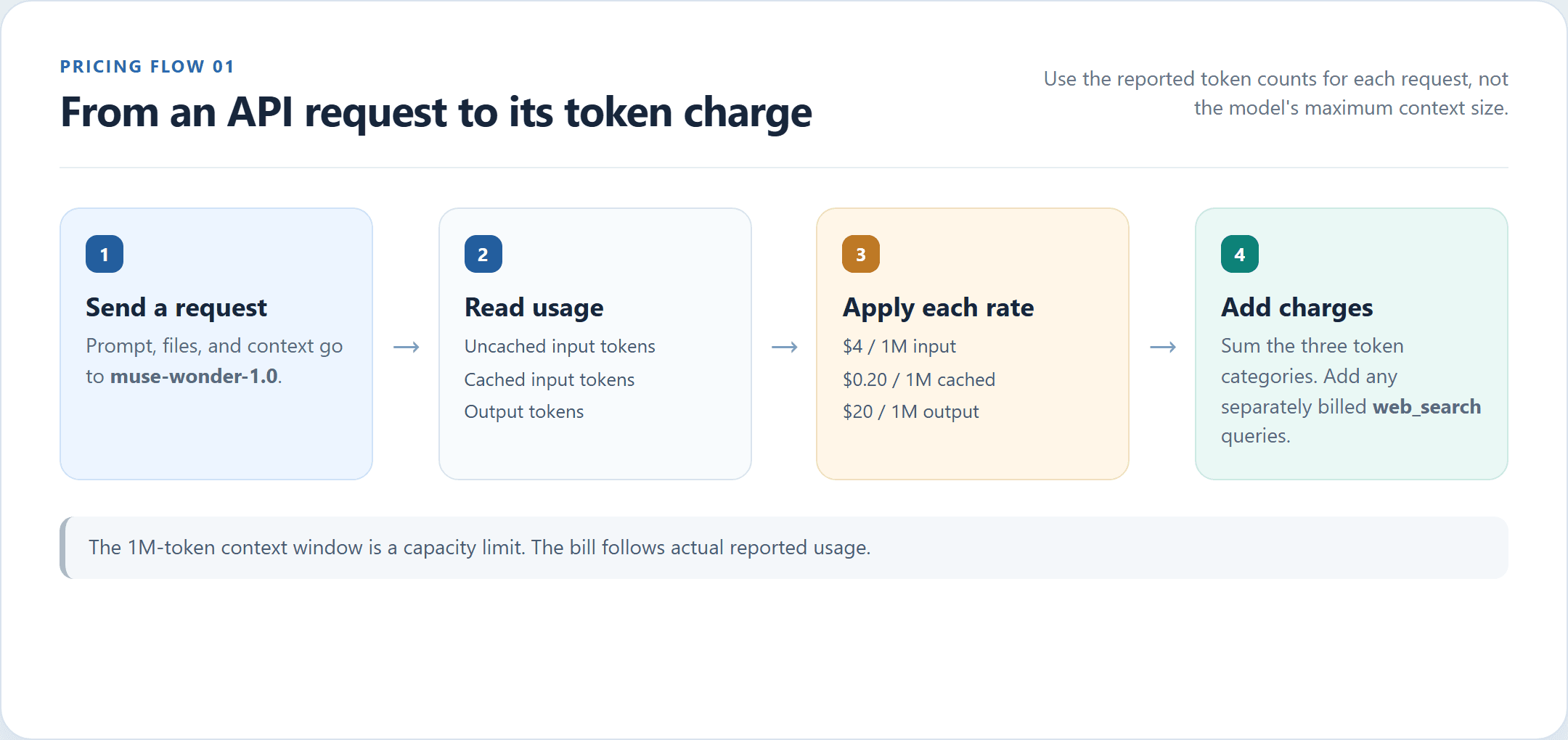
Flowchart showing a Muse Wonder API request, reported token usage, separate token rates, and total charges
| Example workload | Uncached input | Cached input | Output | Estimated token charge |
|---|---|---|---|---|
| Small request | 100K | 0 | 10K | $0.60 |
| Larger request | 1M | 0 | 100K | $6.00 |
| Reused-context request | 100K | 900K | 100K | $2.58 |
The first row is (100,000 × $4 ÷ 1,000,000) + (10,000 × $20 ÷ 1,000,000) = $0.40 + $0.20. In the third row, 900K of the 1M input tokens qualify for cached-input billing: $0.40 + $0.18 + $2.00 = $2.58. If that same 1M input were all uncached, its token charge with 100K output would be $6. These are illustrative calculations, not average request sizes or measured benchmarks.
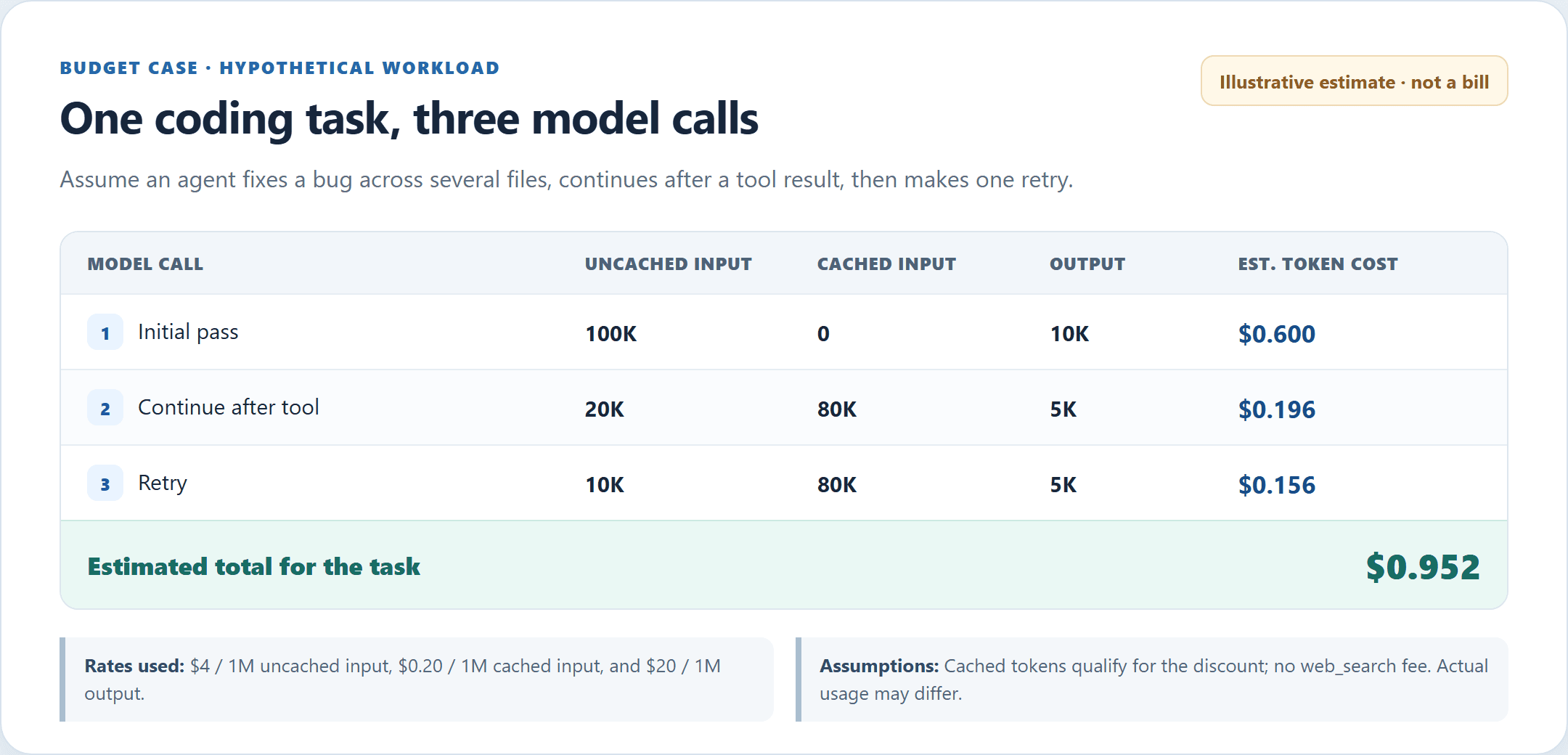 Illustrative Muse Wonder API budget case for three model calls; not a measured bill
Meta says cached pricing applies when part of the prompt matches a cached prefix. Check the response’s cached_tokens usage field instead of assuming repeated text was discounted. It also says there is no long-context premium: the context window’s size does not determine the bill; the billed input and output do. (Meta pricing and rate limits)
What Changes the Muse Wonder API Bill?
A single user-facing task can produce multiple billable requests. Include each model turn when you estimate agent costs.
- Tool loops and retries: Count each continuation, failed attempt, and retry in your sample. Their tokens add to the task total.
- Repeated context: A repeated prefix can qualify for cached input pricing, but only usage reporting confirms how many tokens were cached.
- Generated output: Long code changes, explanations, and intermediate reasoning can add output tokens. Track the API’s reported usage rather than estimating from visible answer length alone.
- Web search grounding: Meta lists a separate fee of $2.50 per 1,000 search queries, added to token charges when the
web_searchtool is used. - Rate limits: The official pricing page also publishes request and token limits. Check them alongside price if your service needs predictable throughput.
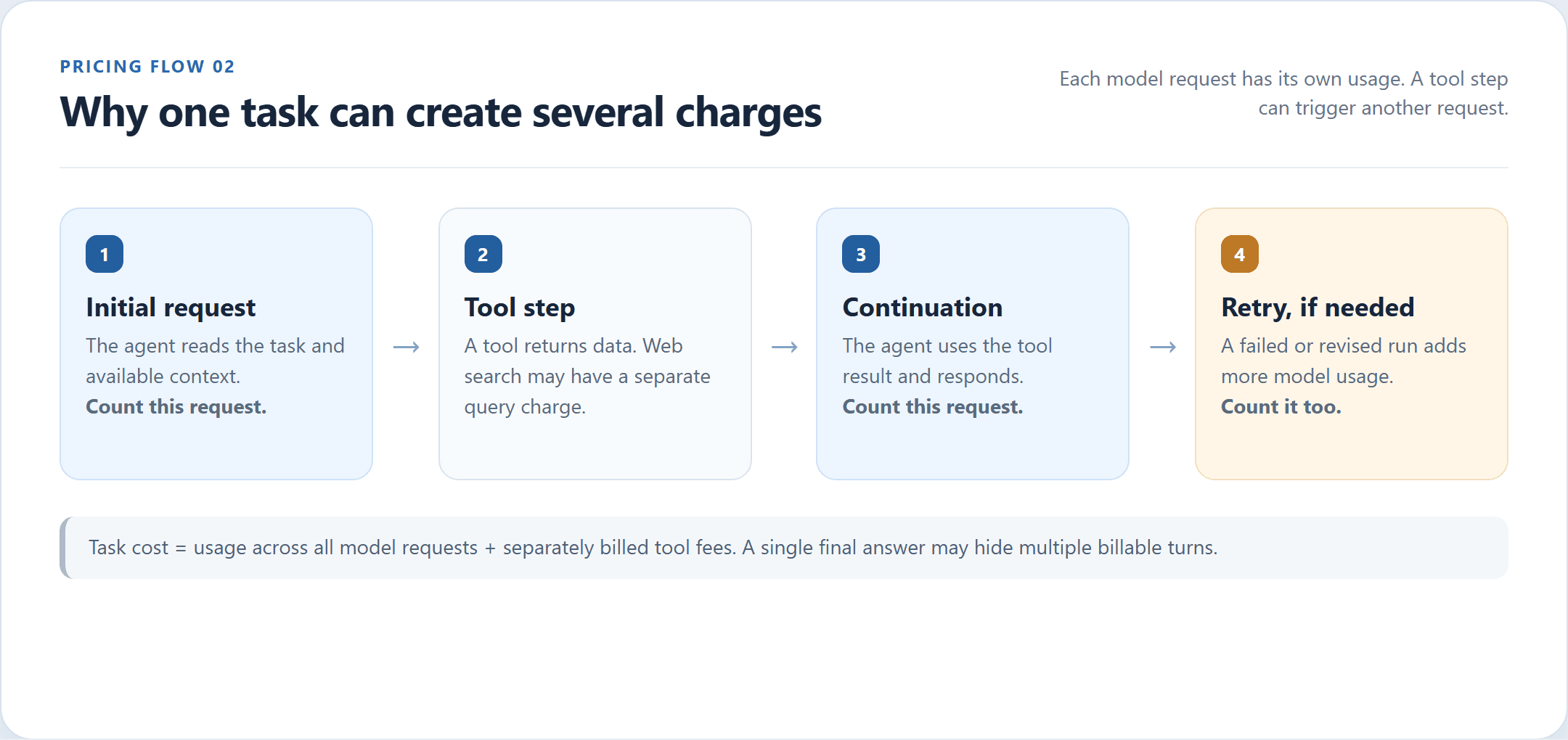 Flowchart showing how an initial request, tool step, continuation, and optional retry contribute to one task cost
The short version for budgeting is to capture real usage from representative tasks. A context limit tells you what may fit in a request; the usage fields tell you what was billed.
Muse Wonder vs. Muse Wonder Full: API or Subscription?
Muse Wonder and Muse Wonder Full are separate availability options. Meta’s model documentation says setting Muse Wonder’s reasoning effort to max does not select Muse Wonder Full. (Meta models documentation)
| Option | Where it is available | Billing | A fit when |
|---|---|---|---|
| Muse Wonder | Meta Model API and Muse Code | API usage by token; Muse Code access follows its own billing or plan terms | You are integrating a model into software or want metered API usage |
| Muse Wonder Full | Muse Code on Power Usage or Maximum Usage plans | Subscription access; Meta publishes no API token rates for Full | You use Muse Code and your plan includes Full |
Meta currently lists Muse Code Power Usage at $50 per month and Maximum Usage at $200 per month. Subscription access and usage limits are product-plan terms, so check Meta’s current plan page before comparing a subscription with an API forecast. A subscription fee is not an equivalent token price unless the provider publishes a conversion.
Muse Wonder API Pricing vs. Muse Code Plans
Choose the billing path based on where the work runs.
- Use the API estimate when Muse Wonder needs to run inside your application, service, or agent. Multiply expected uncached input, cached input, and output by their separate rates, then add search query fees when applicable.
- Review Muse Code’s plan terms when you want to work in Meta’s coding product. Confirm which plan provides the model access you need and the current usage limits.
- Measure before projecting if you only expect a small number of API calls. Run representative tasks and record input, cached input, output, and search usage.
- Keep the units separate. Do not convert a monthly subscription into an API token rate without published equivalent usage data.
This makes an API-vs-subscription comparison more useful than a simple break-even guess: API charges track measured usage, while a subscription grants access under plan-specific limits.
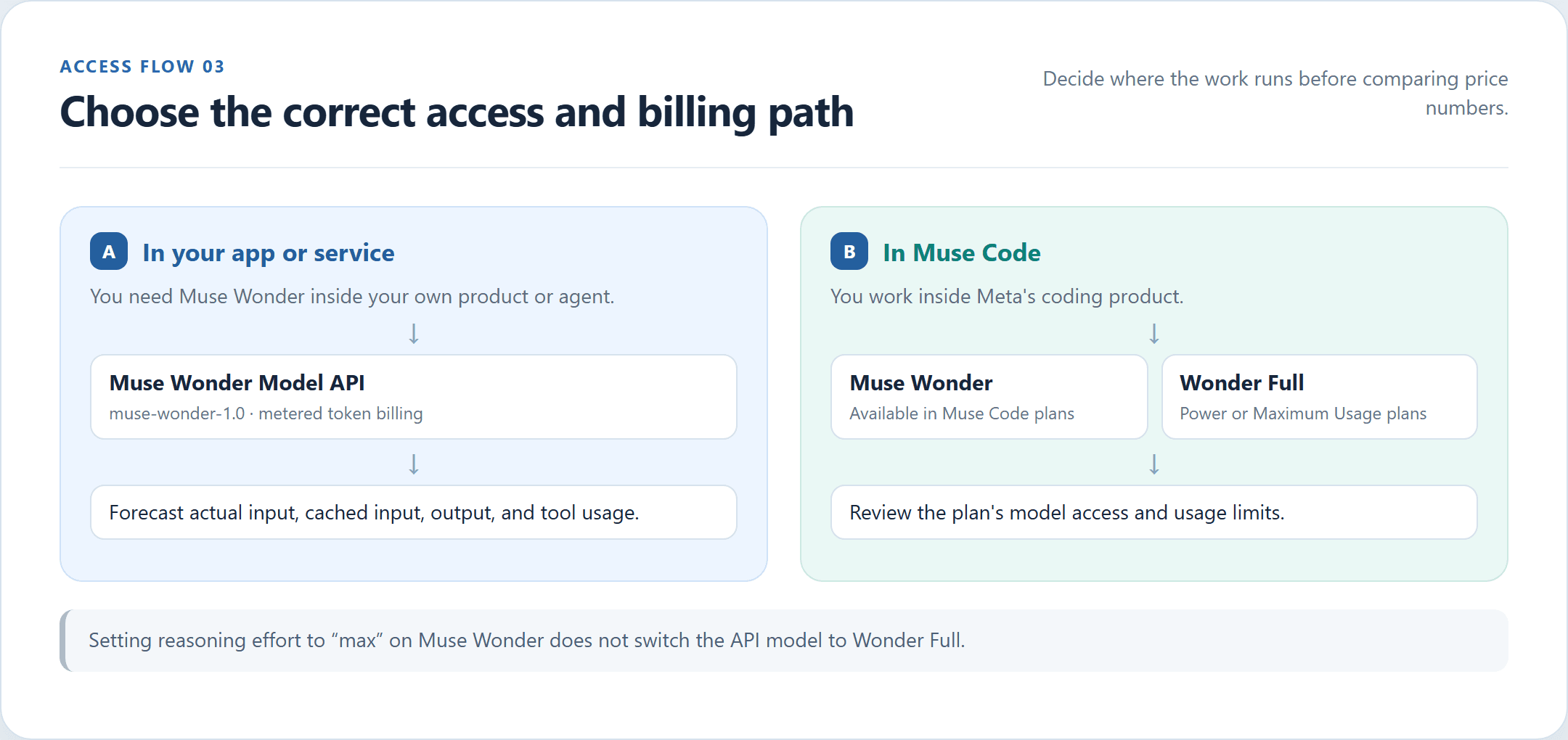 Flowchart choosing Muse Wonder Model API for an app or Muse Code for coding work, with Wonder Full plan access
A Muse Wonder API Budgeting Checklist
| Step | Record or decide | Why it matters |
|---|---|---|
| 1. Sample tasks | Choose 10–20 representative requests | Captures ordinary and difficult jobs |
| 2. Measure usage | Log input, cached input, and output tokens per request | Uses billed units instead of word-count guesses |
| 3. Include agent activity | Add tool turns, retries, and continued runs | Represents the complete task, not only its final answer |
| 4. Model scenarios | Calculate low, typical, and high monthly volumes | Makes uncertainty visible before launch |
| 5. Reconcile | Compare estimates with actual usage and billing | Corrects assumptions about cache hits and output size |
| 6. Recheck limits | Verify live prices, rate limits, and preview status | Keeps the budget current as access changes |
For each scenario, multiply the request mix by your expected monthly task count. Keep search-query charges as a separate line so they do not disappear inside the token estimate.
Comparing Other Model APIs
Muse Wonder was absent from the model listings on Atlas Cloud when checked for this article, so this page makes no claim that the platform offers it or sets its price. If your project also needs to compare other language, image, or video models in one catalog, browse the model directory and confirm each model’s live detail page. Atlas Cloud may be useful when your workload spans those other model types; it is not a Muse Wonder API access route.
Muse Wonder API Pricing FAQs
How much does Muse Wonder API cost per million tokens?
Meta lists $4 per million uncached input tokens, $0.20 per million cached input tokens, and $20 per million output tokens in Standard mode. Check Meta’s current pricing page before deployment.
How much would 100K input tokens and 10K output tokens cost?
If all 100K input tokens are uncached, the estimate is $0.40 input plus $0.20 output, or $0.60 total.
What is the cached input price for Muse Wonder?
The published rate is $0.20 per million cached input tokens. It applies to tokens from a prompt prefix that qualifies for caching. Confirm the actual cached count in the response usage data.
Can I access Muse Wonder Full through the API?
Meta’s model documentation lists Muse Wonder Full as unavailable through the Model API. It is available in Muse Code on Power Usage and Maximum Usage plans.
Is Muse Wonder API included in a Muse Code subscription?
Muse Code plan access and Model API usage are separate billing paths. Meta says Muse Wonder is available in Muse Code plans, while API calls are billed by token. Check the current plan terms for limits and access details.
Does Muse Wonder have a free or Contributor API tier?
Meta’s pricing page lists no Contributor mode for Muse Wonder on the Model API. The page does not list a free Muse Wonder API tier. Verify current access terms with Meta before building a budget around a trial or promotion.
Muse Wonder API pricing becomes easier to forecast once a real task sample replaces assumptions about context size. Measure the three token categories, count grounding queries separately, and compare the result with current provider terms before release.


