

A benchmark lead can look decisive until the same model misses a requirement on the next run. A useful muse wonder reliability test asks a narrower question: does the model complete your task, to your standard, repeatedly, under the same conditions?
Early evidence is mixed because the tests measure different things. One launch-day task set gave standard Muse Wonder a very high score after one run per task. Another evaluation found strengths in research analysis alongside weaker survey design, sales claims, and slide layout. Neither result proves how consistently it will handle your codebase or agent workflow.
Key takeaways
- Treat launch benchmarks as capability signals, not production guarantees.
- Muse Wonder and Muse Wonder Full are separate variants. Keep their results separate.
- Measure pass rate, repeatability, completion, and recovery as different outcomes.
- Start with 10 to 20 real tasks, freeze the setup, and repeat important tasks at least three times.
- Choose a threshold based on the cost of a wrong answer and your human review process.
Is Muse Wonder reliable? The short answer
The evidence available as of October 15, 2026 supports a task-by-task evaluation, not a universal reliability verdict. Muse Wonder performed well on some early checks, while other runs exposed errors or presentation work that still needed review. The studies differ in prompts, reasoning settings, graders, sample sizes, and number of attempts.
(Meta, October 12, 2026) says Muse Wonder and Muse Wonder Full are built for professional and personal agent tasks, with features it calls Active Memory and Active Focus. Those are product claims about intended behavior. A claim that a model can recover from errors is a reason to test recovery in your own workflow, not proof that it will recover reliably.
Keep standard Wonder separate from Wonder Full. Meta lists standard Muse Wonder for its Model API and Muse Code, while Full is offered through Muse Code subscriptions. Running standard Wonder at a higher reasoning setting does not make it Full.
For a decision you can defend, test the exact variant and route you intend to deploy. Count a task as successful only when it meets a written acceptance rule and its result can be checked.
What a Muse Wonder reliability test should measure
Accuracy and consistency are different
A pass rate measures how many attempts meet a defined rubric. Consistency measures whether repeated runs of the same task produce acceptable outcomes each time. A model can have a high pass rate while still varying in ways that matter to your workflow.
Track four dimensions separately:
| Measure | What to record | Example check |
|---|---|---|
| Accuracy | Attempts that pass the rubric | Does the extracted total match the source document? |
| Consistency | Whether repeated attempts pass and agree | Do three runs preserve the same required constraints? |
| Completion quality | Whether every requested deliverable is present | Are all files, citations, and requested fields included? |
| Recovery | Whether the run resumes correctly after a fault | Does it report a tool failure, retry safely, then verify the final state? |
A response that sounds complete is not necessarily complete. A code change needs tests; a research summary needs traceable sources; an agent run needs evidence that its final action happened.
Separate model failures from workflow failures
Record enough context to tell a model error from a serving or tool problem. At minimum, log the model variant and version, reasoning setting, prompt, tool configuration, date, run time, token or task cost, and raw output.
Classify failures before scoring them:
- Model: incorrect fact, bad reasoning, or missed requirement.
- Tool: failed API call, invalid tool arguments, or wrong result from an external system.
- Serving: timeout, interruption, or unavailable endpoint.
- Evaluation: unclear rubric or a check that cannot distinguish acceptable from unacceptable work.
If you combine all four into one failure rate, you will not know what to fix.
What current Muse Wonder tests show
Meta's published benchmark comparisons are vendor evidence about benchmark performance. They are not the same as an independently run workflow evaluation. Independent tests also have limits: a small public task set, one attempt, a particular model route, or a human preference rating answers only a narrow question.
The table below separates the evidence by source and scope. It is a guide to what each result can support, not a combined score.
| Evidence source | What it tested | Date and setup | What it can tell you | Main limit |
|---|---|---|---|---|
| Meta announcement and model materials | Capability benchmarks and intended agent features | Announced October 12, 2026; vendor-reported comparisons | Which capabilities Meta emphasizes and which variants it released | Vendor testing does not establish repeatability in your workflow |
| (Spring Prompt, October 13, 2026) | Surveys, product listings, slides, ad planning, chess, and visual search | October 13; standard API model, generally medium reasoning; public tasks | Performance varied by task; some evaluations included repeated product-listing runs | Most tasks were small samples; many results were one run per task; not a coding or Muse Code test |
| (Quantslant, October 12, 2026) | 23 tasks spanning agents, coding, writing, reasoning, and one long document | October 12; standard model via OpenRouter, low reasoning; one run per task | The model passed that defined task set at a high rate under that setup | A single run cannot measure run-to-run consistency; results close to 100% need task-level inspection |
| Community posts | Individual coding, agent, and benchmark reactions | Launch-period posts; self-selected users and tasks | Useful leads for what to test next | Anecdotes and votes are not measured pass rates |
The source contrast matters. Quantslant reported 99.7% across its 23-task set, with one run per task and a low reasoning setting. It also noted one failed unit test in a number-to-words coding task. That result is evidence about that particular suite, not evidence that 99.7% of everyday tasks will pass or that repeated runs will agree.
Spring Prompt reported a more varied picture for standard Wonder at API defaults on October 13. Its research analysis score was 93.6/100 across nine public tasks, while only three of nine survey plans passed all checks. For product listings, the share deemed reliably publish-ready across three repeats was 66.1% for factual briefs and 51.8% for sales briefs. Five of six slide decks needed layout fixes, and one was judged presentable. These are separate measures with separate denominators, not pieces of one overall score.
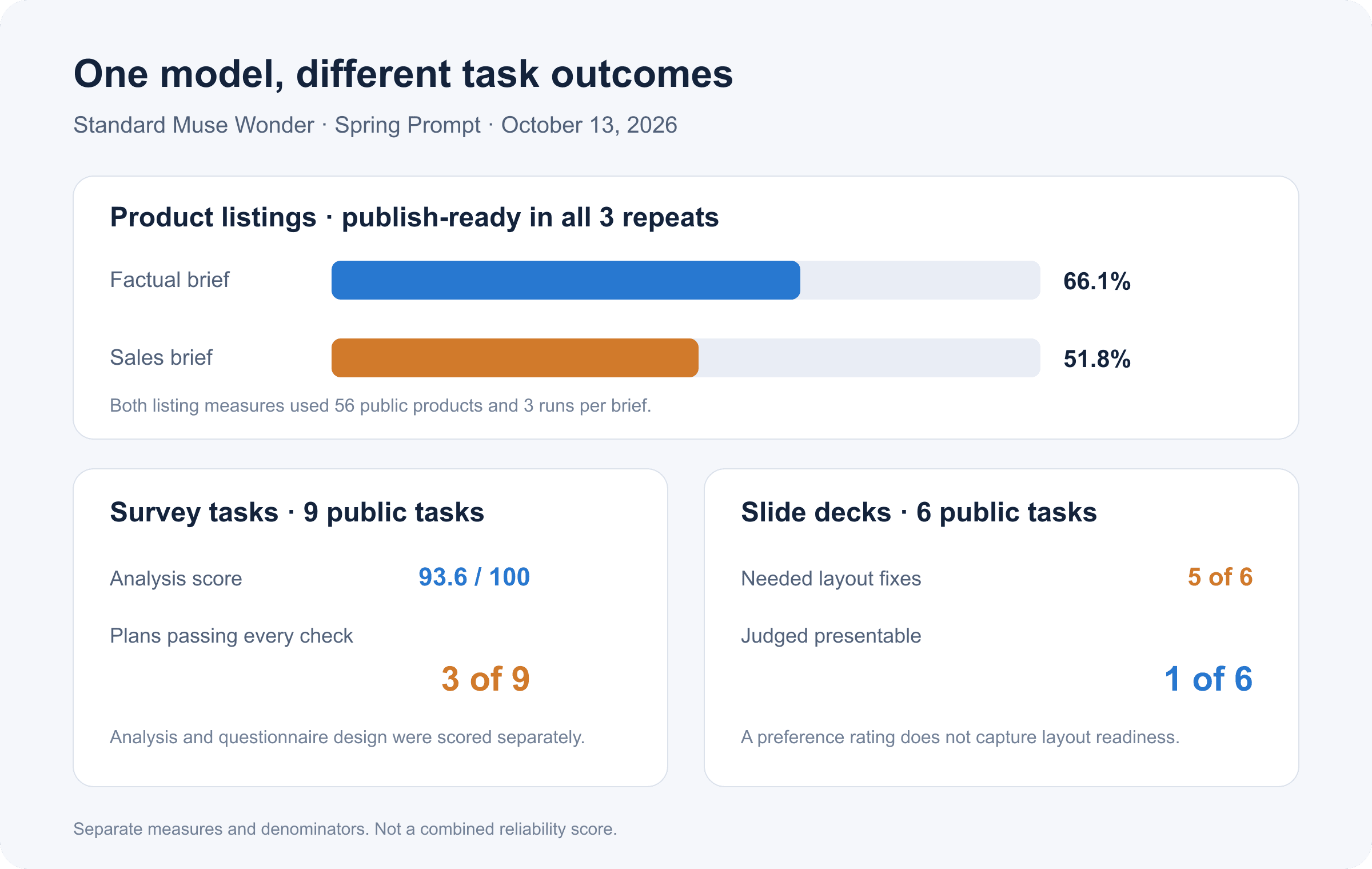
Spring Prompt's October 13, 2026 standard Muse Wonder results: repeat-tested listing pass rates, survey analysis and deck review outcomes
Independent task results from one evaluation. Measures use different denominators and are shown separately, not combined into a score.
Spring Prompt's tests did not measure coding, persistent memory, or Muse Code. Its comparison therefore cannot settle whether Wonder is reliable for coding or whether Full performs better. It does show why a single broad label hides important task differences.
Meta's launch article says standard Muse Wonder is available through the Meta Model API and Muse Code, while Wonder Full is available to Muse Code subscribers. It describes Active Memory and Active Focus as features for retaining useful details and continuing work through errors. Those descriptions help define test cases, but the launch article is not an independent repeated-run study.
For coding and 3D build claims discussed in launch-week community threads, treat posts as hypotheses. Turn a specific complaint into a reproducible task and verify the output. Do not convert comments or upvotes into a success rate.
How to run a repeatable Muse Wonder reliability test
1. Build a small task set from real work
Choose 10 to 20 tasks your team actually expects the model to handle. Split them into categories such as coding, factual extraction, instruction following, long context, and tool use. Prefer tasks with objective tests, reference answers, or a clear rubric.
Include realistic edge cases: missing input, conflicting requirements, an unavailable tool, and a task that should trigger a clarification question. Keep sensitive or regulated data out unless your approved process permits it.
2. Freeze the prompt, model, and settings
Write down the exact prompt and system instructions. Record the model name and version, reasoning level, tools, context supplied, date, and any time limit. Do not compare standard Wonder with Full as if they were the same model.
A useful test prompt can ask the model to show its evidence and identify untestable requirements:
Read the attached specification and implementation. Return only: (1) each requirement marked PASS, FAIL, or NOT TESTABLE; (2) the exact evidence for each status; (3) any missing requirement; (4) a minimal reproducible test for every FAIL. Do not claim a test passed unless you can point to its output.
This is an evaluation input, not a guarantee that the model will follow it. Score the resulting answer and verify any claimed test output independently.
3. Repeat tasks and score every attempt
Run each high-impact task at least three times with the same setup. If budget only allows one attempt, label the result an initial sample rather than a consistency result. Preserve each raw response; do not report only the best one.
Use a row for every attempt. Keep the acceptance rule stable across runs.
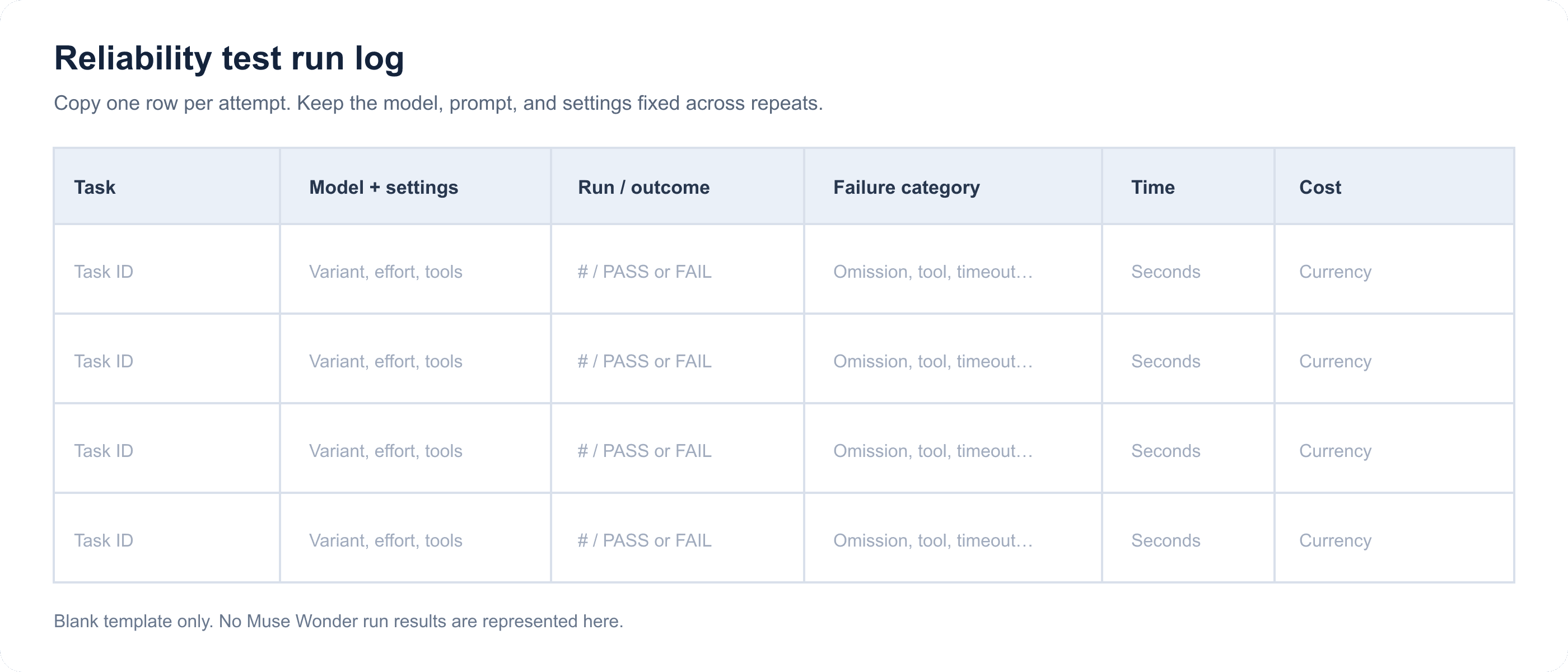
Blank Muse Wonder reliability test log showing fields for task, model, run, outcome, error, time, and cost
Reusable blank record template. Fill one row per attempt; it contains no measured Muse Wonder results.
4. Keep a failure log and verify recovery
Use specific categories: factual error, omission, failed code test, tool error, timeout, unsupported completion claim, or format mismatch. For multi-step work, note where the run stopped and whether a retry repeated completed actions or verified the final state.
An agent that says “done” without evidence has not passed a completion check. Require a test result, saved file, source citation, or verified state that matches the task.
5. Set a decision threshold around failure cost
There is no useful universal pass-rate cutoff. A draft that a person checks line by line has a different risk profile from a database migration or an automated payment.
Set the threshold from three factors:
- How harmful or expensive is a wrong result?
- Can a person catch the error before it affects anyone?
- Does the workflow fail safely, with a clear stop and audit trail?
For low-risk drafts, review may be enough. For code changes, finance, legal, health, or actions that affect users, use stronger tests and independent verification. Do not let a high average conceal one severe failure mode.
Muse Wonder reliability by task type
Coding and multi-step builds
Run the repository's actual test suite and check the requested behavior. Score requirement coverage, regression failures, and whether the model's claimed changes match the files and test output. A convincing screen recording or explanation is not a substitute for an executable check.
The early Quantslant suite included four coding tasks and reported 15 of 16 unit tests passing on one number-to-words task. That is a small, single-run signal. Spring Prompt explicitly did not test coding, so its findings should not be used to generalize about coding-agent reliability.
Research and factual extraction
Use a source packet or reference answers that your reviewer can inspect. Check each factual claim against a primary source, and track invented citations and incorrect attribution separately from general answer quality.
Spring Prompt's survey analysis was a relative strength in its small evaluation, but survey question design was weaker. A high analysis score should not silently certify the survey instrument or the sources behind a new research task.
Long-context and agent workflows
Check whether the model retains every constraint, uses each tool correctly, and verifies the final state. Test interruption recovery deliberately: stop a run after a known step, then see whether it resumes from a checkpoint or repeats a side effect.
Meta's announcement describes memory and recovery capabilities, but the public early evaluations cited here do not establish long-run consistency for persistent memory or agent recovery. Measure those behaviors directly before relying on them.
Muse Wonder vs. Muse Wonder Full: keep evidence separate
Muse Wonder and Muse Wonder Full are distinct variants. Meta's launch information describes separate access routes, and independent API tests of standard Wonder do not become Full results just because the reasoning setting changes.
| Comparison question | What the available evidence supports |
|---|---|
| Is Full the same as standard Wonder at maximum reasoning? | No. Treat them as distinct variants and record the exact name. |
| Did the cited Spring Prompt API evaluation test Full? | No. It tested standard Wonder; Full was outside that comparison. |
| Can the cited standard API numbers rank Full? | No. They do not test Full. |
| What would make a fair comparison? | Same task set, scoring rubric, date window, tool access, and documented settings, with repeats for both variants. |
A fair comparison starts with paired tasks and matched conditions. If access routes impose different prompts, tools, or billing, document those differences and call the comparison exploratory.
Cost, access, and where to test Muse Wonder
Compare cost per accepted task, not just the listed price per token. Long prompts, retries, reasoning tokens, tool calls, timeouts, and human review all change the cost of a usable result. Quantslant reported standard Wonder's token rates as $4 per million input tokens and $20 per million output tokens on October 12, 2026, and its own 23-task run cost $0.64. That is one reported route and workload, not a universal task price.
Meta's current launch announcement lists standard Wonder through the Meta Model API and Muse Code, and Full through Muse Code subscriptions. Confirm access, regional eligibility, and current billing in the official interface before budgeting.
Start at Atlas Cloud for a broader view of its developer platform. As of October 15, 2026, I could not confirm Muse Wonder in the model catalog, so this article does not present Atlas Cloud as an execution route for this model. If your team is comparing other models already listed there, the Atlas Cloud model library can help you identify candidates to run against the same task set.
The useful outcome of a Muse Wonder reliability test is a deployment decision tied to evidence: which task passed, how often it passed, what it cost, and what review remains necessary.
Frequently Asked Questions
Is Muse Wonder reliable for coding?
Early launch tests provide only a small coding sample. Quantslant reported four coding tasks, with a unit-test miss in one task, while Spring Prompt did not test coding. Run repository tests on your own tasks and repeat important ones before making a coding workflow decision.
How do I test Muse Wonder reliability myself?
Use a fixed set of real tasks, preserve the exact model and prompt settings, define pass criteria in advance, and retain every output. Repeat important tasks and verify results with tests or source documents.
How many times should I repeat each Muse Wonder task?
Use at least three runs for high-impact tasks as an initial consistency check. Three attempts remain a small sample, so expand the set when errors are costly or the outputs vary.
What is the difference between Muse Wonder and Muse Wonder Full?
They are separate model variants with different availability routes. Do not treat standard Wonder at maximum reasoning as Full, or transfer results between them without a matched test.
Can I trust Meta's Muse Wonder benchmark scores?
Use them as vendor-reported capability evidence and read the benchmark setup. They do not prove consistent performance across your prompts, tools, and repeated runs.
Is Muse Wonder available on Atlas Cloud?
I could not verify it in Atlas Cloud's model catalog as of October 15, 2026. Check the live catalog before choosing an execution provider.


