Three days after Nano Banana 2.1 shipped, YouTube already had seven videos pitting it against GPT Image 2.5, and the two scoreboards those videos quote do not agree. Arena's crowd votes put OpenAI's Sunburst and Flare first and second on every image board, with Google's new model fourth to sixth. Google's own model card shows 2.1 winning every test it publishes. Both are true, and the reason is simpler than it looks: they are not scoring the same race.
This nano banana 2.1 vs gpt image 2.5 comparison reads both scoreboards for what they actually compare, then runs the same four briefs through Nano Banana 2.1, GPT Image 2.5 Flare and GPT Image 2.5 Sunburst on one platform, one attempt each. We scored every round against the written brief first and called a tie when all three met it, because the brief is what a client signs off on.
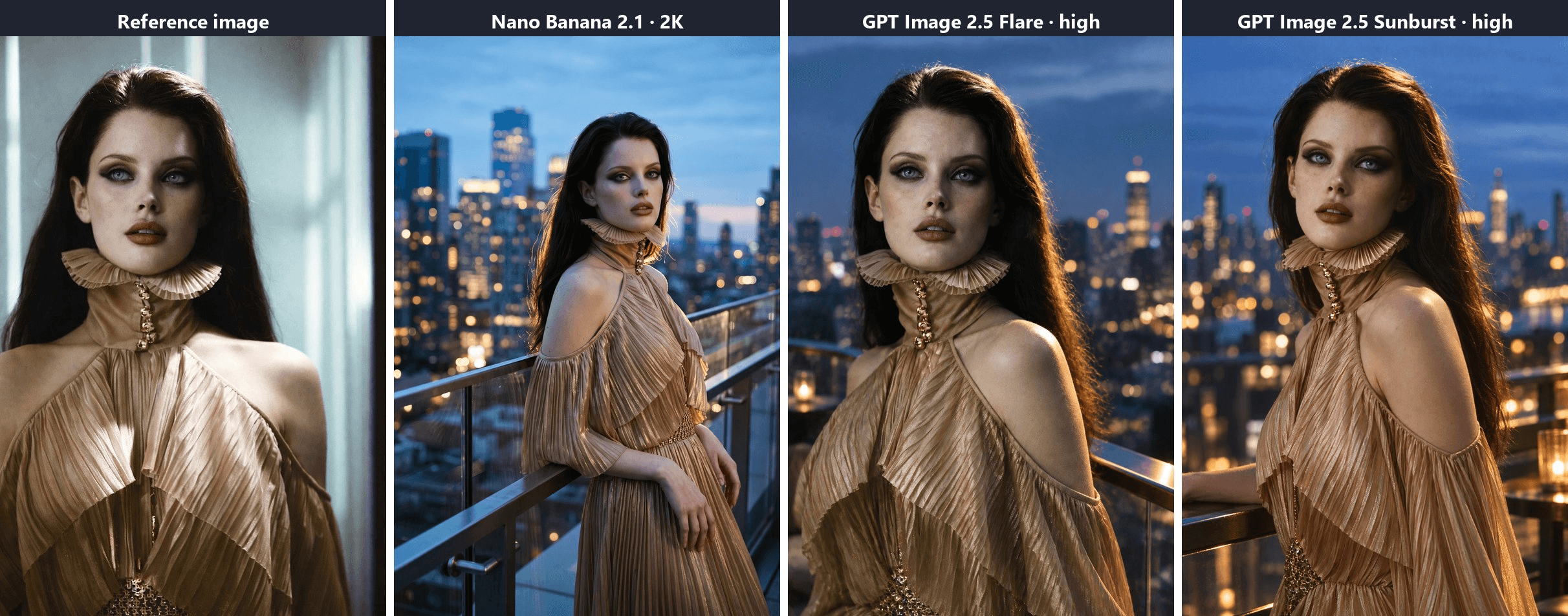
One reference image and one prompt sent to the edit endpoints of Nano Banana 2.1 at 2K and GPT Image 2.5 Flare and Sunburst at high quality, all on Atlas Cloud on October 9, 2026, first attempt each .
Key Takeaways
- Nano Banana 2.1 won the poster round by keeping thebriefedA2 portrait layout.
- 2.1 took or shared three of four rounds, more than either GPT Image 2.5 variant.
- On Arena, 2.1 is Google's top-ranked image model, with GPT Image 2.5 ranked higher.
- Nano Banana 2.1 adds search grounding, three thinking levels and 14-image reference fusion.
- One Atlas Cloud API key runs Nano Banana 2.1 models and GPT Image 2.5 alike.
Nano Banana 2.1 vs GPT Image 2.5 on the Arena Text to Image Leaderboard
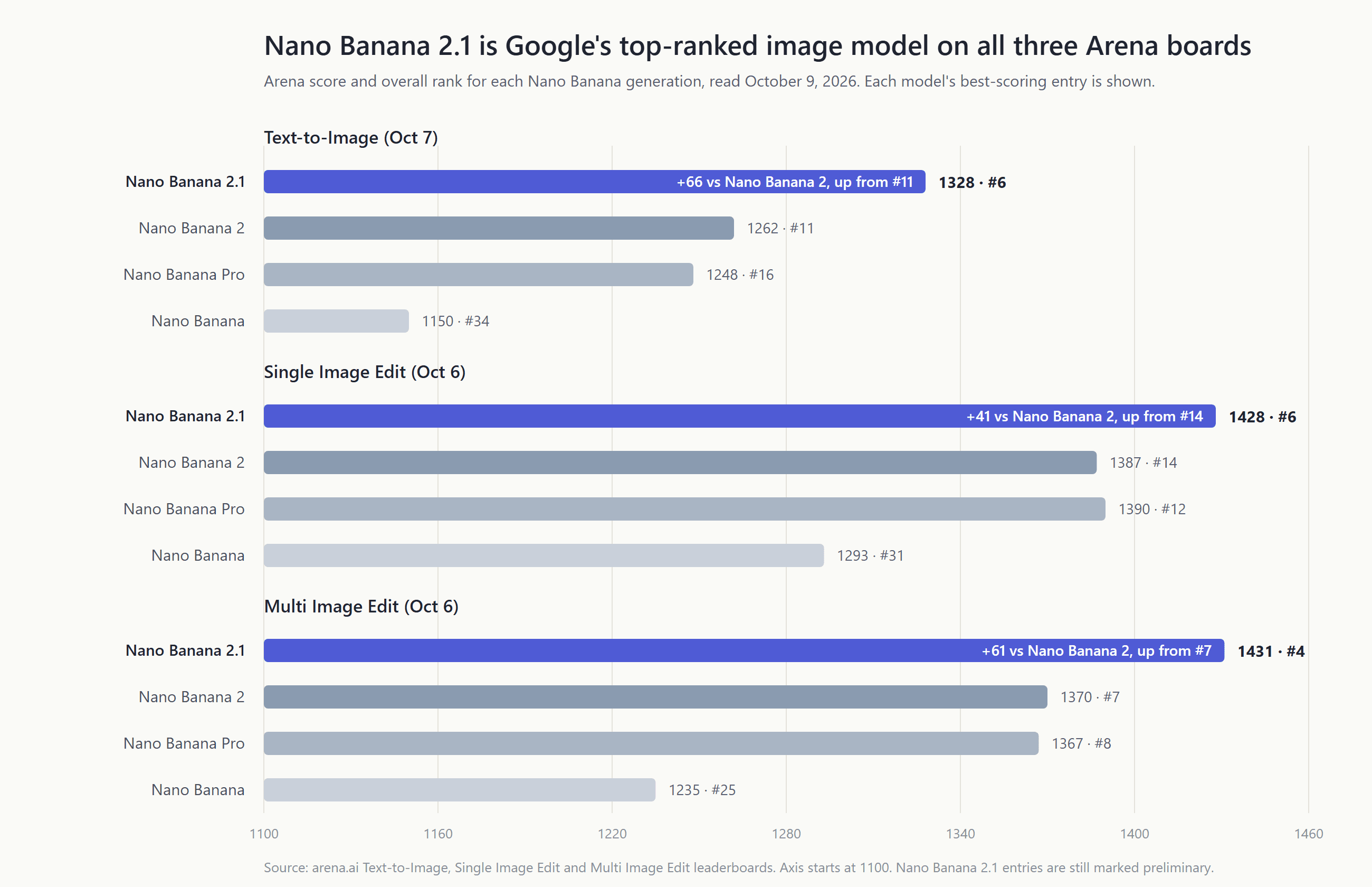
Arena welcomed Nano Banana 2.1 on October 6 with three numbers: fourth in Multi-Image Edit with 1431 points, fifth in Text-to-Image with 1328, sixth in Image Edit with 1428. A day later the Text-to-Image board listed the model sixth, after a preliminary Grok entry slotted in above it. The score did not move.
GPT Image 2.5 Sunburst leads the text-to-image board at 1425 and Flare follows at 1398. On single-image edit the pair posts 1524 and 1481 against 1428 for 2.1. On multi-image edit it is 1527 and 1476 against 1431.
Those gaps come with a sample-size caveat. The OpenAI pair launched on September 8 and Nano Banana 2.1 on October 6, and the vote counts show it: on the text-to-image board 2.1 has 5,310 votes against 17,752 for Sunburst. All three entries are still marked preliminary, so the numbers will move.
The Nano Banana 2.1 model card tells a different story because every table compares four Google models: 2.1 with thinking, 2.1 without thinking, Nano Banana 2 and Nano Banana Pro. On overall text-to-image preference the thinking version scores 1050 against 990 for Nano Banana 2 and 935 for Pro. There is no OpenAI column.
On the part the two scoreboards share, Arena backs Google up. Nano Banana 2.1 is the highest-ranked Google image model on all three boards, 41 to 66 points above Nano Banana 2 and 38 to 80 points above Nano Banana Pro's best entry.
What the model card leaves out is the OpenAI pair, and that is the matchup the YouTube crowd went after.
By October 9 we counted six videos that put only these two models head to head, and three more that added a third model. Paul J Lipsky's test, which also brings in Nano Banana 2 and Nano Banana Pro, had passed 38,000 views by then. Joseph Martin ran six tests, character consistency and reference images among them.
Wanderson Jackson ran thirteen rounds against Sunburst and found 2.1 faster and more literal, while Sunburst held brand details tighter. Those are impressions, so the rounds below run in one place with the settings written down, picking up where our GPT Image 2.5 vs Nano Banana 2 test left off with the previous Google model.
How to Run Nano Banana 2.1 and GPT Image 2.5 Side by Side on Atlas Cloud
Both families live on Atlas Cloud: Nano Banana 2.1 with text-to-image, edit and reference-to-image endpoints, and the GPT Image 2.5 family with Flare and Sunburst, each offering text-to-image and edit. One account, one balance, one request shape. The pair below came out of two browser tabs a few minutes apart.
Method 1: Same Prompt in Two Playgrounds
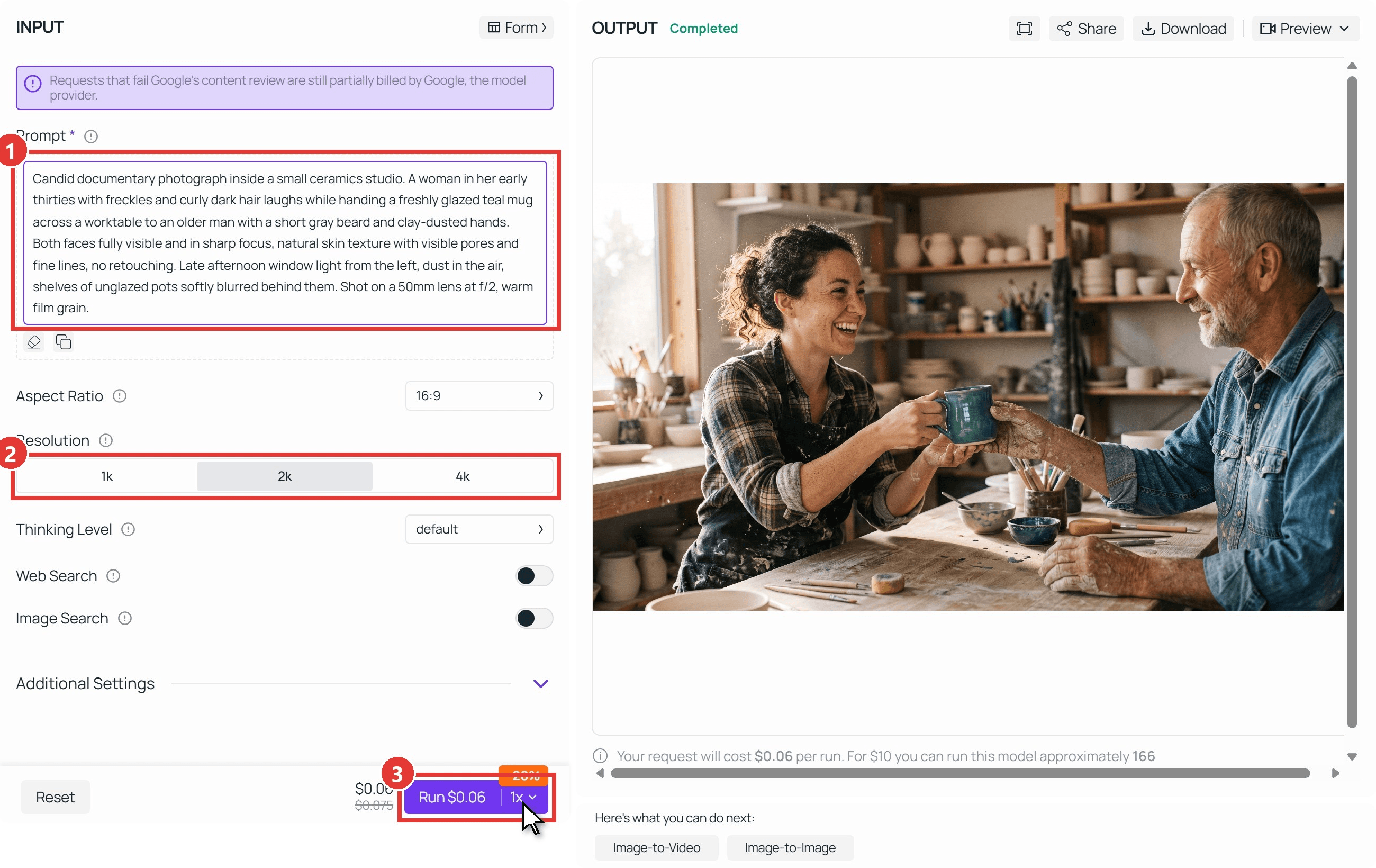
Open the Nano Banana 2.1 text-to-image playground and sign in.
- Paste the prompt. Write any words that must appear in the image exactly as they should read, capitals included.
- Pick a resolution. The buttons read 1k, 2k and 4k, the aspect ratio picker sits above them, and the Run button updates its price as you switch.
- Press Run. The OUTPUT panel shows a Completed label when the image lands, and the Request History tab keeps the full-size file.
Then open the GPT Image 2.5 Sunburst playground, or the Flare one, and paste the same prompt. Quality is a dropdown from low to max that defaults to low. Size is a preset list from 1024x1024 up to 3840x2160 with a Custom option, and the width and height fields are locked to the preset's ratio until you click the lock icon between them. For the first three rounds below we used high quality at 2048x1152, which keeps 16:9 at a 2,048-pixel width.
Method 2: One API Key, Two Model Strings
Step 1: Get your API key. Create a key in the Atlas Cloud console and keep it in an environment variable.
Step 2: Check the API docs. Endpoints, parameters and authentication live in the API documentation.
Step 3: Make your first request. Submit the Nano Banana 2.1 job:
plaintext1curl -X POST https://api.atlascloud.ai/api/v1/model/generateImage \ 2 -H "Content-Type: application/json" \ 3 -H "Authorization: Bearer $ATLASCLOUD_API_KEY" \ 4 -d '{ 5 "model": "google/nano-banana-2.1/text-to-image", 6 "prompt": "Studio product photograph of a frosted amber glass dropper bottle of face serum on wet black slate, white label reading TIDELINE, VITAMIN C SERUM, 30 ML / 1 FL OZ", 7 "aspect_ratio": "16:9", 8 "resolution": "2k" 9 }'
Poll the prediction ID until the status reads completed:
plaintext1curl https://api.atlascloud.ai/api/v1/model/prediction/<prediction_id> \ 2 -H "Authorization: Bearer $ATLASCLOUD_API_KEY"
To send the same brief to OpenAI's model, change the model string to openai/gpt-image-2.5-sunburst/text-to-image or openai/gpt-image-2.5-flare/text-to-image, drop the aspect ratio and resolution fields, and set quality to high and size to 2048x1152 instead. The endpoint, the header, the key and the polling loop stay the same, which is what one API is for.
Nano Banana 2.1 vs GPT Image 2.5 Text Rendering
Round one is an infographic poster with 26 words of specified copy, including a line of small print that models love to mangle.
plaintext1A clean A2 infographic poster pinned to a cork board in a bright office, photographed straight on. Headline at the top in bold black sans-serif: CITY BIKE REPORT 2026. Below it, three large statistics in a row, each with a short label underneath: 48% CYCLE TO WORK, 12 MIN AVERAGE TRIP, 310 KM OF NEW LANES. At the bottom a small gray footer line: Published by the Harbor Street Transit Office, October 2026. Flat navy and amber color blocks, one simple bicycle icon, generous white space, no other words anywhere on the poster. Photorealistic matte print texture, soft daylight.
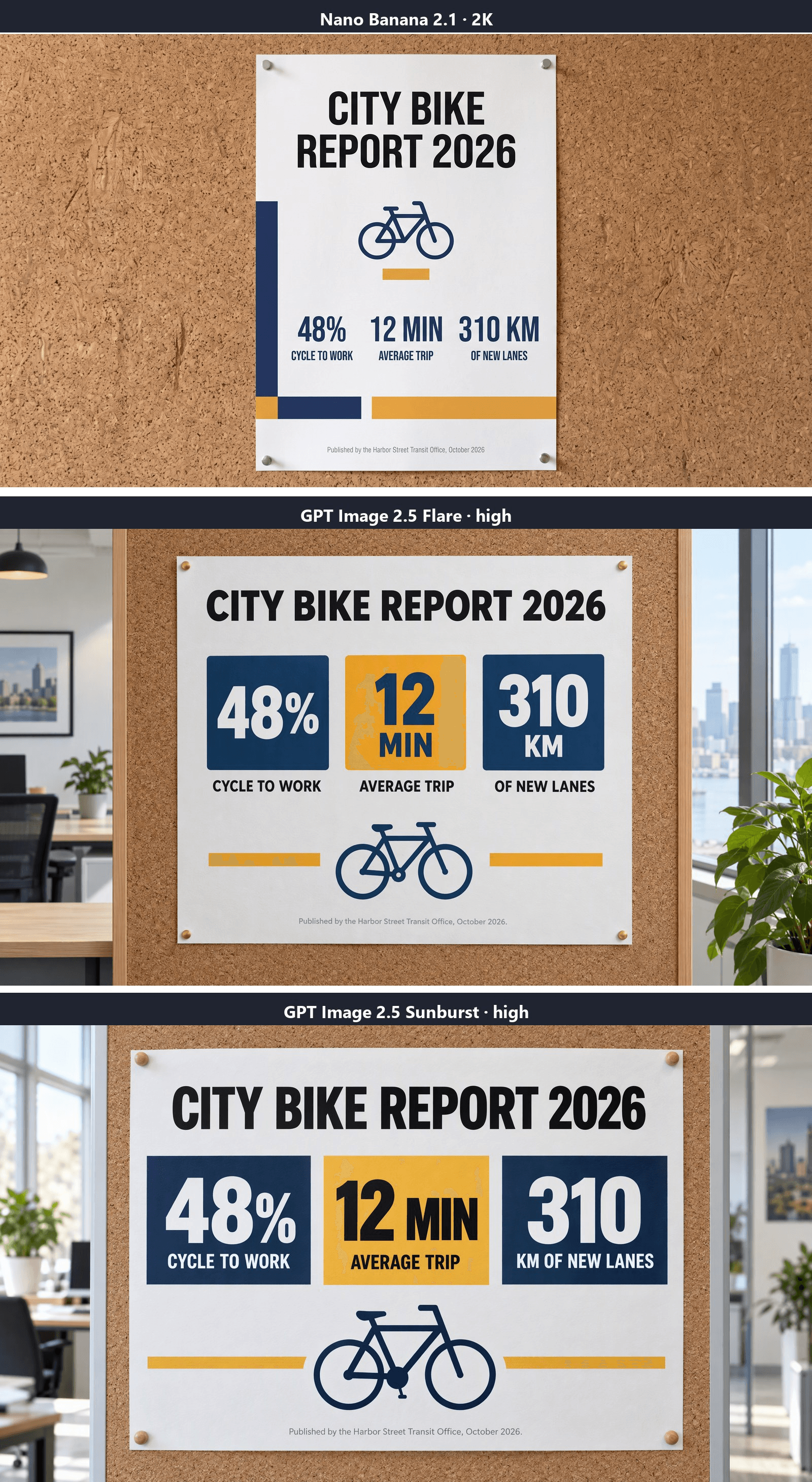
All three rendered every word, down to the comma and the month. Nano Banana 2.1 matched the footer character for character, while Flare and Sunburst each added a full stop the prompt did not have.
The bigger difference is layout. Nano Banana 2.1 read "A2 poster" and "generous white space" literally: a portrait sheet, one icon, a thin footer, lots of air.
Flare and Sunburst both built a landscape poster that fills the frame, put the statistics into solid navy and amber blocks, and composed an office around the cork board. Those are handsome posters, but less of what the prompt asked for. If your brief is a specification, 2.1 followed it more closely here. If your brief is a mood, the OpenAI pair did more design work unasked.
GPT Image 2.5 Sunburst vs Nano Banana 2.1 Product Photo
Round two is the everyday e-commerce brief: one product, one label with three lines of type, studio lighting and a reflection.
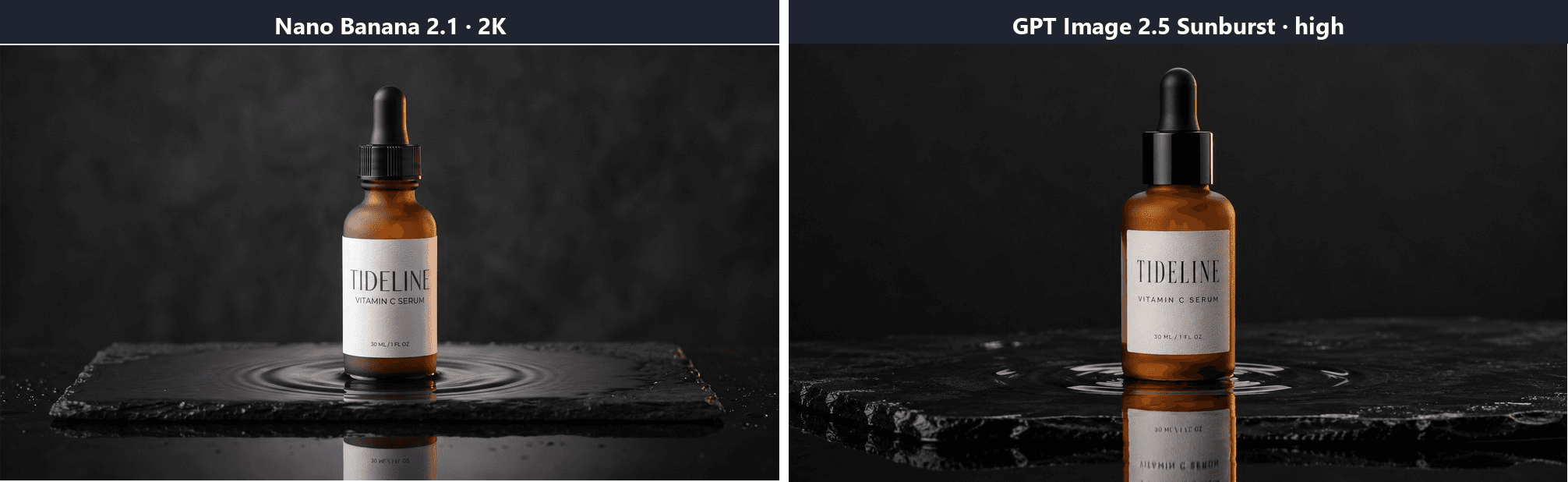
plaintext1Studio product photograph of a frosted amber glass dropper bottle of face serum standing on a wet black slate slab, one soft ripple of water around the base. The white label reads TIDELINE in tall serif capitals, below it in smaller type VITAMIN C SERUM, and at the bottom 30 ML / 1 FL OZ. Soft overhead key light, a thin warm rim light on the right edge, a clean mirror reflection in the slate, shallow depth of field, dark charcoal backdrop, nothing else in frame. Commercial cosmetics advertising photography.
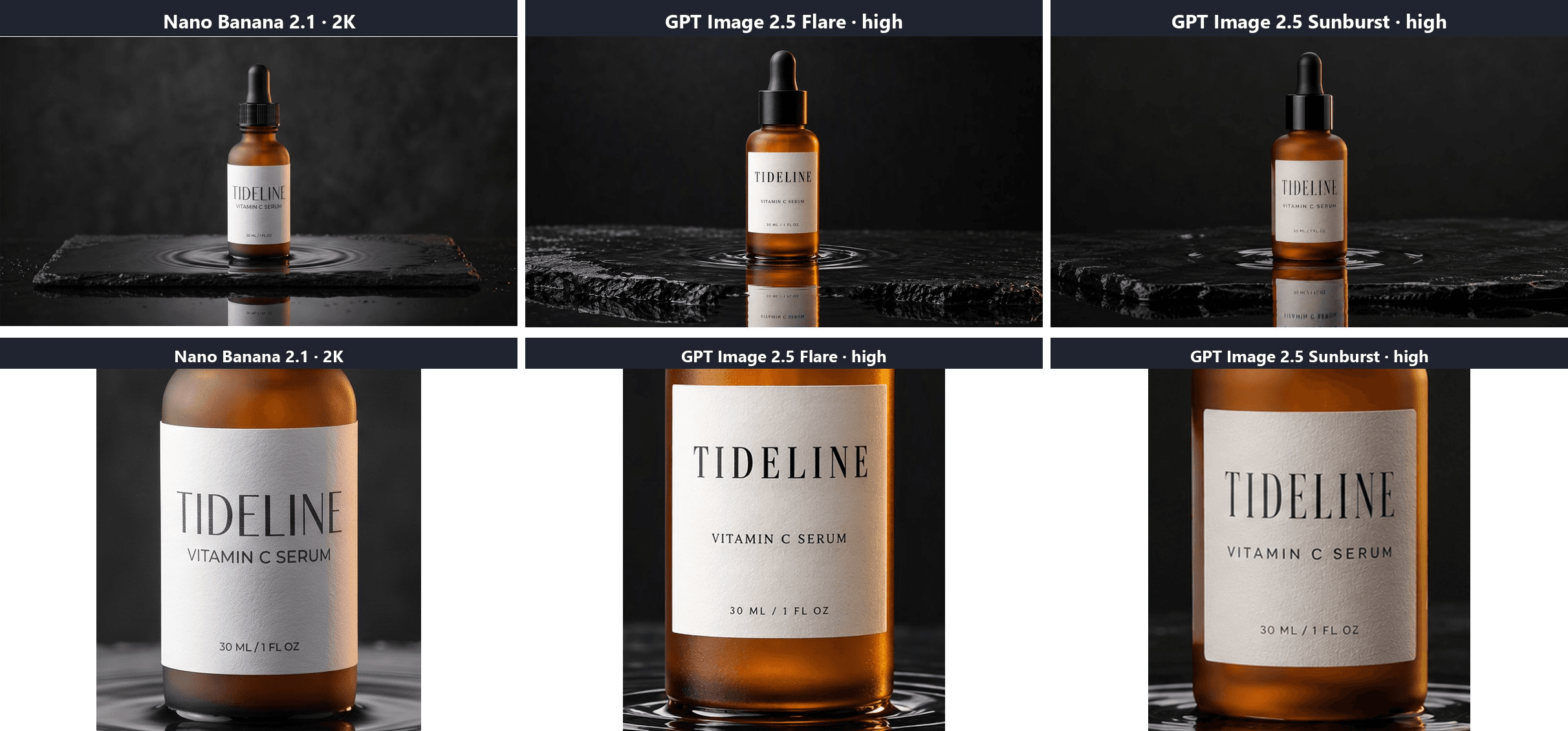
Again, three clean labels, with no doubled letters and no smudged small type, which is the usual failure in this brief.
Look closer and the three split on taste rather than accuracy. Nano Banana 2.1 drew the widest ripple, a set of rings spreading out across the slab, gave the slate the most rock texture and set the bottle against a grained charcoal backdrop. Flare went darker and higher in contrast. Sunburst set TIDELINE in a tall, high-contrast serif and traced the rim light along the right edge of the bottle.
All three deliver the brief's checklist: the frosted amber glass, the three lines of type, the ripple, the mirror reflection and the dark backdrop. That makes the round a tie, and the right pick is whichever mood matches the rest of the campaign.
Nano Banana vs ChatGPT Images 2.5 on Faces and Skin
People who compare Nano Banana vs ChatGPT usually mean ChatGPT Images 2.5, whose API counterparts are Flare and Sunburst, so a Nano Banana 2.1 vs ChatGPT Images 2.5 faces test means testing those two. Round three is a candid two-person scene with explicit instructions about skin, pores and a lens.
plaintext1Candid documentary photograph inside a small ceramics studio. A woman in her early thirties with freckles and curly dark hair laughs while handing a freshly glazed teal mug across a worktable to an older man with a short gray beard and clay-dusted hands. Both faces fully visible and in sharp focus, natural skin texture with visible pores and fine lines, no retouching. Late afternoon window light from the left, dust in the air, shelves of unglazed pots softly blurred behind them. Shot on a 50mm lens at f/2, warm film grain.
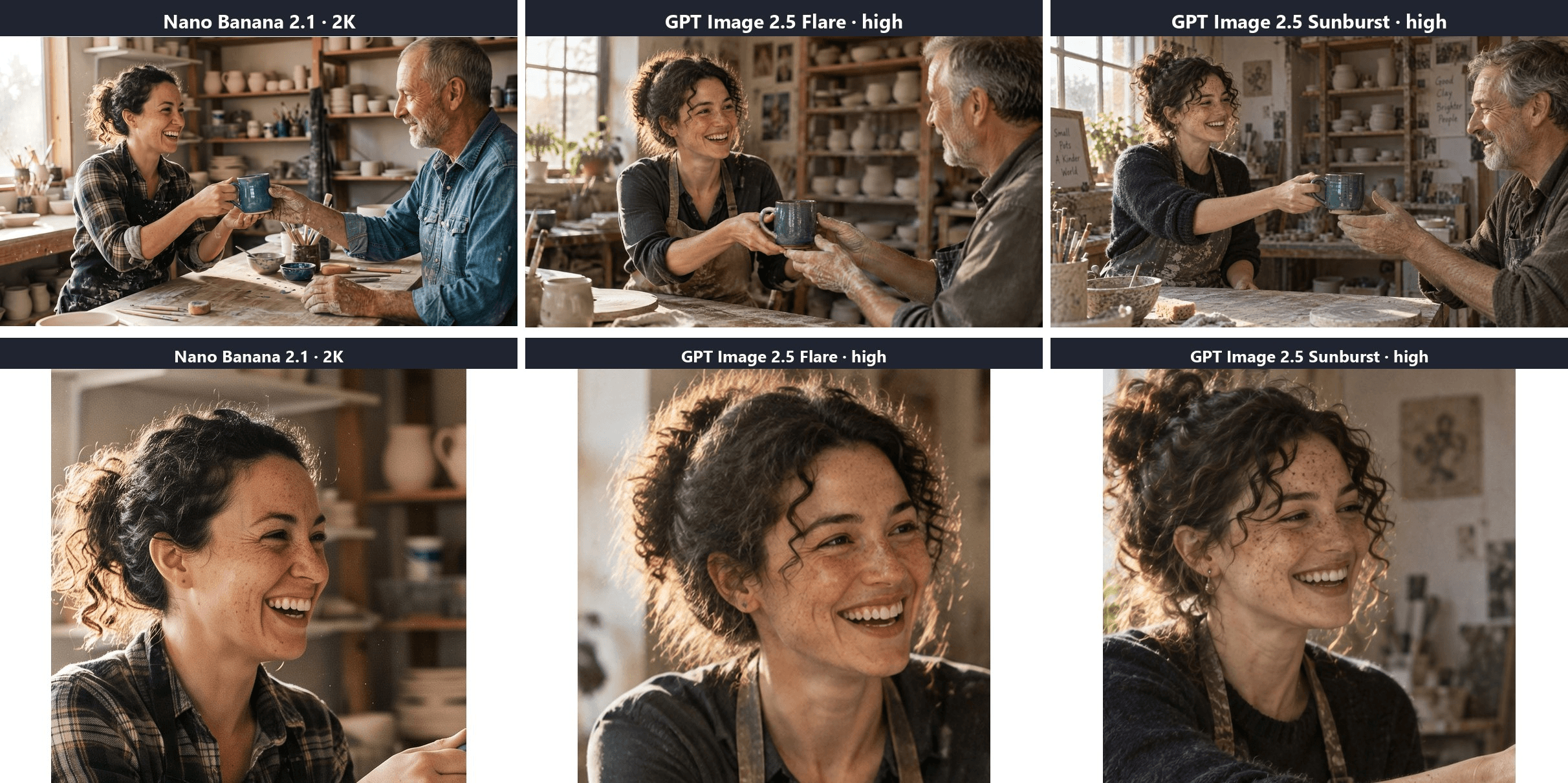
All three got the scene, the window light from the left and the handoff across the worktable. Nano Banana 2.1 framed the widest: both people fully in frame, the older man in profile with his whole head visible, clay on both of his hands, and the bowls and tools of a working table in front of them.
Flare moved in closer and produced the most textured skin, with pores, a few fine lines and backlit flyaway hair, and its tighter frame trims the top of the man's head. Sunburst pushed the freckles hardest and added the most texture to the sweater and apron.
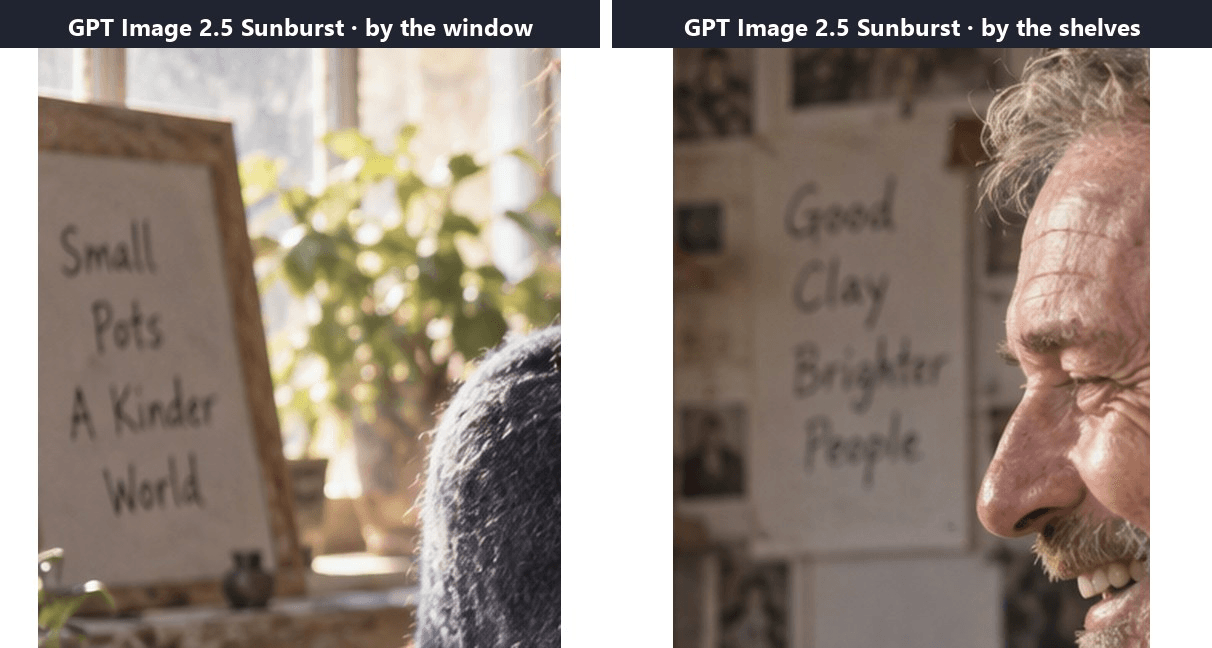
Sunburst also added something nobody asked for. Two hand-lettered signs appeared in the studio, one by the window reading "Small Pots, A Kinder World" and another by the shelves reading "Good Clay, Brighter People".
The prompt mentions no text at all, and that kind of invented detail forces a retake when the image has to pass a brand review. Nano Banana 2.1 and Flare both delivered the brief without additions, so the round is a tie between them: 2.1 for the full scene, Flare for the skin close-up.
Nano Banana 2.1 vs GPT Image 2.5 With One Reference Portrait
Round four keeps the person and changes everything around her, which is what a character consistency request asks for. All three edit endpoints got the same portrait of a woman in a pleated gold high-collar dress and one paragraph of instructions. Nano Banana 2.1 ran at 2K in 2:3, and both GPT Image 2.5 variants ran at high quality and 1360x2048, a 2:3 frame with the same 2,048-pixel long edge as the earlier rounds.
plaintext1Use the woman in the reference image. Keep her face, eyes, hair, makeup and the pleated gold high-collar dress exactly as they are. Place her at the rail of a rooftop bar at blue hour, city lights softly blurred behind her, a thin warm rim light on her hair from the right, three-quarter view, looking just past the camera. Fashion editorial photograph, natural skin texture, no retouching.
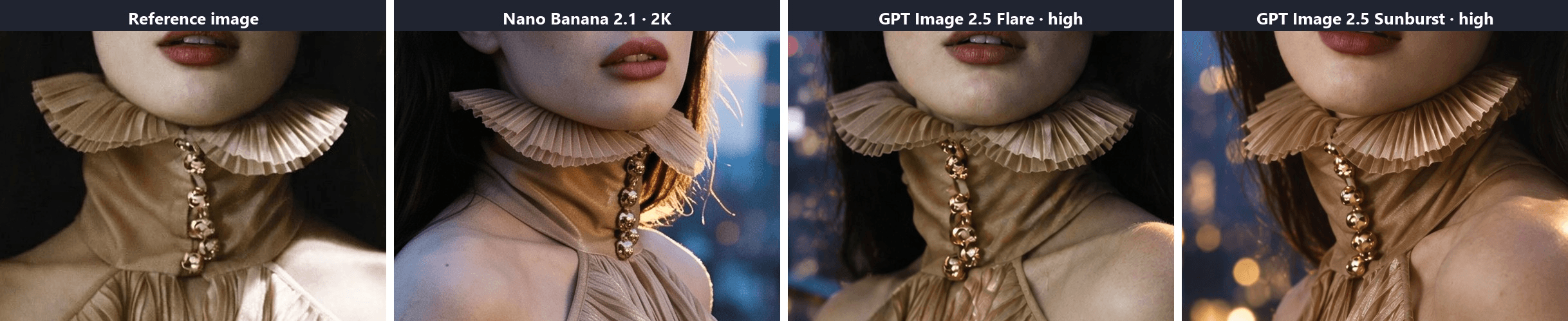
The full frames are at the top of this article, and the crops above show what all three carried over: the ruffled collar, the column of gold buttons, the smoky eye and the brick-red lip. What separated them was how far each model moved her.
Nano Banana 2.1 restaged the most. It pulled back to show her from head to knee, leaning on a glass rail, continued the dress into a long pleated gown with the beaded belt at the waist, laid a band of pink dusk over the skyline and put the warm rim light along her hair. If the shot has to sell the whole outfit, this is the frame.
Sunburst read the brief most literally: a three-quarter turn, one arm on the rail, the rim light along the right side of her hair and a bokeh skyline with the lanterns of a bar behind her. Flare kept the reference's straight-on pose and framing, so it reads as the original portrait on a new background.
Sunburst takes the round on the letter of the brief. For a campaign that needs one face across many shots, Nano Banana 2.1 accepts up to 14 reference images and is documented to hold up to four characters consistent, so sending two or three angles of the same model gives it more to lock onto than a single portrait.
GPT Image 2.5 vs Nano Banana 2.1 Scorecard: Which One to Use
| Round | Nano Banana 2.1 | GPT Image 2.5 Flare | GPT Image 2.5 Sunburst | Pick |
|---|---|---|---|---|
| Text rendering (poster) | All words exact, the only portrait sheet with the white space as briefed | All words correct plus an extra full stop, landscape layout | All words correct plus an extra full stop, landscape layout | Nano Banana 2.1 |
| Product photo (label) | Label correct, widest ripple, most slate texture | Label correct, dark high-contrast slate | Label correct, tall high-contrast serif, rim light on the bottle edge | Tie |
| Faces and skin | Both people fully in frame, nothing added | Most textured skin, tighter frame | Strong texture, two unrequested text signs | Tie, 2.1 and Flare |
| Reference portrait | Widest restage, long pleated gown, rim light on hair | Original straight-on pose kept | Three-quarter turn, arm on the rail, bar lights | Sunburst |
Four rounds, four attempts, no reruns, so treat this as a sample rather than a verdict on every prompt. Within that sample Nano Banana 2.1 took or shared three of the four rounds, more than either GPT Image 2.5 variant. The OpenAI pair earned its points on surface finish and on the letter of the reference brief.
Pick Nano Banana 2.1 when the brief is a layout spec or a scene that has to come back as written, when you need up to 14 reference images fused into one frame, when search grounding matters for a real product or place, or when you are generating in volume at 1K and 2K.
Pick GPT Image 2.5 when a client will inspect a product surface up close, when you want the model to add design ideas of its own, or when an edit has to follow a separate mask file.
GPT Image 2.5 Flare vs Sunburst in These Rounds
OpenAI's launch post describes Flare as the default choice for most applications and Sunburst as the variant for premium visual workflows that benefit from tighter control across edits, with longer generation times.
In our rounds they differed in temperament. Sunburst produced the high-contrast label serif, the more dramatic poster and the most literal reference portrait, then invented signage in the studio scene. Flare produced the most textured skin and the more restrained studio scene, and it kept the reference pose as it was. Our Flare and Sunburst comparison runs five campaign briefs through both.
Frequently Asked Questions
Is Nano Banana 2.1 better than GPT Image 2.5?
It depends on what you score. On Arena's crowd votes GPT Image 2.5 Sunburst and Flare rank higher on all three image boards.
In our four rounds Nano Banana 2.1 took or shared three, and it won the poster outright as the only model that kept the layout the brief described. If your work starts from a written spec, a fixed layout or a stack of reference images, try 2.1 first, and if a client will judge mostly on surface polish, run GPT Image 2.5 next to it.
Why does Arena rank GPT Image 2.5 above Nano Banana 2.1 when Google says 2.1 wins?
Because Google's model card only compares Google models. Its tables show Nano Banana 2.1 ahead of Nano Banana 2 and Nano Banana Pro, and Arena's boards agree with that ordering. Arena also includes OpenAI, and there the GPT Image 2.5 pair scores 45 to 97 points higher than 2.1.
Which is cheaper per image, Nano Banana 2.1 or GPT Image 2.5?
At the time of writing, the Atlas Cloud playgrounds priced a 2K Nano Banana 2.1 image at $0.06 and a 1K image at $0.04, while a high-quality 2048x1152 image from either Flare or Sunburst estimated at roughly $0.038 before the run. Both families showed a 20 percent discount on their list prices, with no end date on the page. At low quality and 1024x768 the Flare estimate dropped to under a cent.
Edits ran closer together: $0.061 for a 2K Nano Banana 2.1 edit with one reference image against roughly $0.078 for a Flare edit at 2048x1152 and high quality. OpenAI bills both of its variants at the same token rates, so Sunburst's extra time is not an extra line on the invoice. For the full Nano Banana 2.1 price breakdown by tier, see our Nano Banana 2.1 launch guide.
How many reference images can each model take?
Nano Banana 2.1 fuses up to 14 reference images and is documented to hold up to 4 characters and 10 objects consistent across them. The GPT Image 2.5 edit endpoints accept up to 16 reference images in one request, plus an optional mask whose transparent pixels mark the region to replace. If your workflow is a mood board with a dozen inputs, both qualify. If it is a masked retouch, the GPT Image 2.5 edit endpoint exposes that control directly.
Is Nano Banana better than ChatGPT for image generation?
It depends on which app you open. In the Gemini app, Google's image generation page lists Nano Banana 2 for the Free plan and keeps Nano Banana 2.1 for Google AI Pro, Plus and Ultra subscribers, while OpenAI began rolling ChatGPT Images 2.5 out to every ChatGPT tier on September 8, 2026. So a free user comparing the two apps today is comparing an older Google model with OpenAI's newest one.
At the model level, the rounds above favor Nano Banana 2.1 on following a written brief and GPT Image 2.5 on surface finish.
Is ChatGPT Images 2.5 the same model as GPT Image 2.5 Flare?
OpenAI began rolling ChatGPT Images 2.5 out to all ChatGPT, ChatGPT Work and Codex users on September 8, 2026, and introduced Flare and Sunburst as two separate API models the same day. In the app you see one model. In the API you choose between a faster variant and a slower, more precise one. OpenAI does not say which variant runs inside ChatGPT, and the rounds in this article used the API models.
Conclusion
Google's card ranks only Google's models and puts Nano Banana 2.1 on top of its own family. Arena ranks everyone and puts GPT Image 2.5 Sunburst and Flare ahead on voter preference, with far fewer votes behind 2.1 so far. Our four rounds added a third view: three clean spellers, with Nano Banana 2.1 taking or sharing three rounds because it delivered what each brief described, and the OpenAI pair earning its points on finish.





