The investigator answers the hotel telephone. The woman beside him expects news about her missing sister. His next sentence makes her realize she may be part of a bargain.
A useful Seedance 2.5 Flash short drama cliffhanger gives viewers enough evidence to understand what changed, then cuts before the characters can settle it. A mysterious location helps establish pressure. The final action or admission gives that pressure a direction.
This guide uses The Last Check-In, an original mystery set inside a deserted hotel during a rainstorm. Five generated clips explore a reassuring ending, a betrayal, a next-episode continuation, and two alternatives built around physical action and evidence. The prompts below let you adapt the same structure to your own short drama.
Key takeaways
- Give each character a reason to enter the scene and something they would rather conceal.
- End on information that changes a relationship or forces a decision.
- Carry the actual frame, prop state, and screen direction into the next clip.
- Answer the previous episode's central question before introducing another problem.
What a Seedance 2.5 Flash Short Drama Cliffhanger Needs
Lena's sister disappeared at a coastal hotel. Adrian investigated the disappearance and closed the case. When Lena receives her sister's old brass key, she persuades him to return to the hotel with her. She believes they are working toward the same goal.
That belief gives the ending something to overturn. If Adrian were introduced as an obvious captor, a threatening telephone call would confirm what viewers already suspected. Presenting him as a reluctant helper makes his private motive matter.
The setting also has a job. Rain presses against the windows; covered furniture suggests interrupted use; the reception counter puts evidence between the characters; a corded telephone connects them to someone outside the frame. Each detail can influence an action. Adding an unrelated shadow or unexplained scream would give viewers another problem to decode before they understand this one.
Short suspense can begin with an ordinary interaction becoming difficult to trust. A reception desk gives Lena a place to present evidence and Adrian a plausible reason to answer the telephone. The rain and covered furniture establish isolation while the counter keeps the key visible between them. Those familiar details let the betrayal change the meaning of a place viewers already understand.
Choose the Settings Around the Scene
The current Seedance 2.5 Flash Text-to-Video model page lists 4-30-second duration choices, native 480p and 720p output, multiple aspect ratios, and synchronized audio. For this dialogue-heavy example, allow 25 seconds for the question, reply, telephone, admission, and reaction. A shorter request would require fewer words or fewer beats.
You can set up the exercise on Atlas Cloud. Use Seedance 2.5 Flash Text-to-Video for A and B, then Seedance 2.5 Flash Image-to-Video for C, D, and E. Keep the original downloads beside the prompts you submit.
| Clip | Dramatic purpose | Model | Requested length | Delivered picture |
|---|---|---|---|---|
| A | Give Lena reassuring news | Seedance 2.5 Flash Text-to-Video | 25 seconds | 1280 x 720, 24 fps |
| B | Reveal Adrian's separate bargain | Seedance 2.5 Flash Text-to-Video | 25 seconds | 1280 x 720, 24 fps |
| C | Explain his motive and redirect attention | Seedance 2.5 Flash Image-to-Video | 25 seconds | 1280 x 720, 24 fps |
| D | Explore a physical change in trust | Seedance 2.5 Flash Image-to-Video | 10 seconds | 1280 x 720, 24 fps |
| E | Reveal a second ribboned key | Seedance 2.5 Flash Image-to-Video | 10 seconds | 1280 x 720, 24 fps |
The examples are horizontal. For a vertical series, select the intended ratio when establishing your first scene, then check that the close-ups, counter, and important hand movements remain readable in that composition. Cropping a finished wide shot can remove the evidence that makes a reaction understandable.
Build the Seedance 2.5 Flash Cliffhanger Around One Betrayal
The central change in The Last Check-In is Adrian's position in Lena's story. At first, he is the person who might help her reopen a case. By the ending, she has reason to ask what he needs from her.
The key makes that change physical. Lena places it between them to demand an explanation. After the telephone conversation, her hand returns to it. The object has moved from shared evidence toward something she should keep under her control.
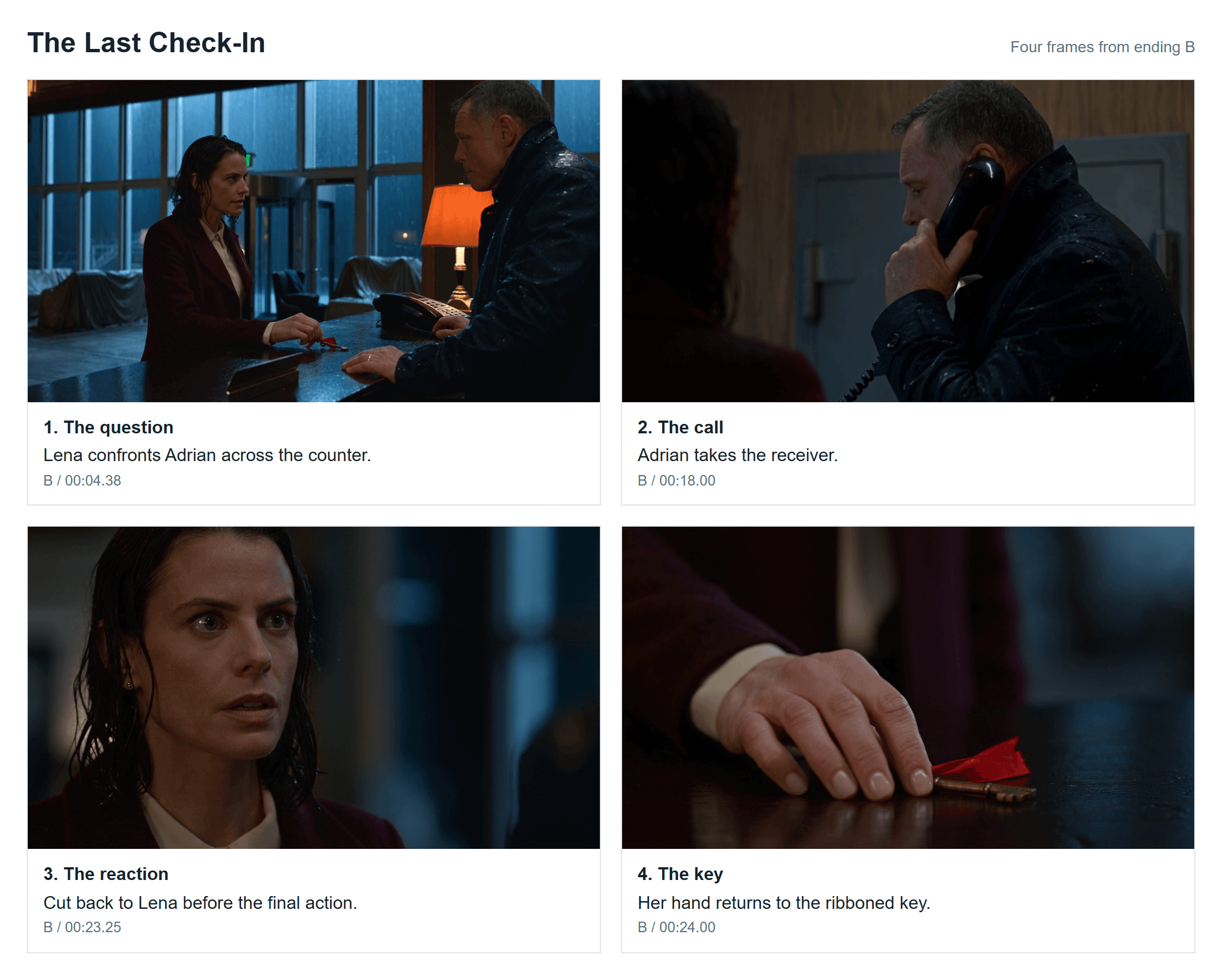
Clip B, in sequence: the confrontation, the call, Lena's reaction, and the key. These are extracted frames from the generated video.
Write the final admission before deciding how many shots you need. The line in B's brief is: "I brought her, just like you asked. Now tell me where you're keeping my son." It introduces a bargain and a personal cost. Adrian may be dangerous to Lena while also acting under pressure himself.
That creates several questions, but one should lead the next episode: why did he agree to bring her? The missing sister remains the larger mystery. You do not need to explain the hotel owner's history, the son's disappearance, and everything behind the basement door in the same ending.
| Intended beat | Information supplied | Character behavior | What remains open |
|---|---|---|---|
| Lena presents the key | The closed case has new evidence | She demands an explanation | Who sent it? |
| Adrian denies sending it | Their return may have another organizer | He tries to contain the conversation | Who knew they were coming? |
| The telephone rings | Someone can contact them here | Adrian takes the call | Who is on the line? |
| His bargain is revealed | Lena's arrival has value to someone | She becomes protective of the key | What will Adrian do next? |
The dialogue works through conflicting intentions. Lena wants the truth about her sister; Adrian wants information about his son. A reply can answer the surface question while concealing the speaker's purpose. That gives a short exchange more weight without requiring a speech full of background information.
Use restrained reactions. If Lena immediately accuses Adrian of every possible crime, she spends the uncertainty the ending has just created. Her attention shifting to the key leaves room for the audience to draw a conclusion before she acts on it.
Generate Two Seedance 2.5 Flash Endings and Compare Them
Keep the Setup, Change the Final Meaning
Versions A and B share Lena, Adrian, the returned key, and the hotel reception. Both begin with the same confrontation. The final telephone exchange changes what Lena expects from the next scene.
For a new run, use Seedance 2.5 Flash Text-to-Video (bytedance/seedance-2.5-flash/text-to-video), request 25 seconds at 720p, choose your delivery ratio, keep audio enabled, and export MP4. The 16:9 instruction below matches the delivered examples. Confirm the visible controls before submitting.
These are two independently generated takes. Use them to compare story design and the questions each ending leaves behind. When you want closer visual matching between alternatives, establish an accepted image first and use the same image for both branches.
P1 / A: give the immediate search a reassuring answer
plaintext1Create a 25-second photorealistic horizontal 16:9 mystery-thriller scene with synchronized English dialogue. The deserted reception lobby of a once-elegant coastal hotel during a heavy nighttime rainstorm. Rain streaks the tall windows. A practical amber desk lamp illuminates the dark wooden reception counter. Covered furniture recedes into the background. A closed gray steel basement door stands behind the counter. The main entrance is visible on the opposite side of the lobby. Use restrained cinematic realism, natural skin texture, warm foreground light against cold blue rainlight, and subtle handheld movement. Keep the space physically coherent. Exactly two adults are visible. Lena, early thirties, has shoulder-length dark hair damp from the rain and wears a burgundy coat over a cream blouse. She stands screen left. Adrian, mid-forties, has short graying hair and wears a rain-darkened navy coat over a pale shirt. He stands screen right. Lena's sister disappeared at this hotel. Adrian investigated the disappearance and closed the case. Lena recently received her sister's old brass key with a faded red ribbon. She believes Adrian has accompanied her to help reopen the investigation. 2 30–6 seconds: Begin in a medium two-shot at the reception counter. Lena places the brass key on the counter between them without covering it. She looks directly at Adrian and says, controlled but accusatory: "My sister vanished here. You closed her case. Why send me her key now?" Slowly move closer while keeping both characters readable. 4 56–12 seconds: Cut over Lena's shoulder toward Adrian. He looks at the key before meeting her eyes. Adrian says quietly: "I didn't send it. Nobody was supposed to know we were coming." His concern feels real, but he avoids explaining more. 6 712–16 seconds: The black corded telephone on the counter rings sharply. Show the telephone, then Adrian's reaction. He reaches for the receiver. Lena watches him. 8 916–23 seconds: Adrian lifts the receiver and listens briefly. His tense posture gradually relaxes. He turns toward Lena, still holding the receiver, and says: "It's the search team. They found her alive. She's on her way to the hospital." His relief is restrained and believable. Do not make the caller audible. 10 1123–25 seconds: Cut to Lena. She grips the edge of the counter as she absorbs the news, then releases a held breath. Adrian gestures toward the main entrance, inviting her to leave for the hospital. End with both preparing to leave together. The brass key remains on the counter. 12 13Audio: Heavy rain outside, faint room ambience, one telephone ringing sequence, receiver handling, and only the specified dialogue. Clear natural speech with distinct voices. No music. No additional visible people, ghosts, flashbacks, subtitles, readable documents, readable signs, logos, narration, or extra dialogue. No sudden screaming or exaggerated facial acting.
A: the reassuring-ending version of the hotel confrontation.
P2 / B: turn the helper into part of a bargain
plaintext1Create a 25-second photorealistic horizontal 16:9 mystery-thriller scene with synchronized English dialogue. The deserted reception lobby of a once-elegant coastal hotel during a heavy nighttime rainstorm. Rain streaks the tall windows. A practical amber desk lamp illuminates the dark wooden reception counter. Covered furniture recedes into the background. A closed gray steel basement door stands behind the counter. The main entrance is visible on the opposite side of the lobby. Use restrained cinematic realism, natural skin texture, warm foreground light against cold blue rainlight, and subtle handheld movement. Keep the space physically coherent. Exactly two adults are visible. Lena, early thirties, has shoulder-length dark hair damp from the rain and wears a burgundy coat over a cream blouse. She stands screen left. Adrian, mid-forties, has short graying hair and wears a rain-darkened navy coat over a pale shirt. He stands screen right. Lena's sister disappeared at this hotel. Adrian investigated the disappearance and closed the case. Lena recently received her sister's old brass key with a faded red ribbon. She believes Adrian has accompanied her to help reopen the investigation. Adrian is concealing a personal reason for bringing her here. 2 30–6 seconds: Begin in a medium two-shot at the reception counter. Lena places the brass key on the counter between them without covering it. She looks directly at Adrian and says, controlled but accusatory: "My sister vanished here. You closed her case. Why send me her key now?" Slowly move closer while keeping both characters readable. 4 56–12 seconds: Cut over Lena's shoulder toward Adrian. He looks at the key before meeting her eyes. Adrian says quietly: "I didn't send it. Nobody was supposed to know we were coming." His concern feels real, but he avoids explaining more. 6 712–16 seconds: The black corded telephone on the counter rings sharply. Show the telephone, then Adrian's immediate reaction. He reaches for it with the familiarity of someone who has been expecting this call. Lena notices his lack of surprise. 8 916–23 seconds: Adrian lifts the receiver and turns slightly away from Lena. He says into the receiver in a low, urgent voice: "I brought her, just like you asked. Now tell me where you're keeping my son." Do not let Lena speak over him. Do not make the caller audible. 10 1123–25 seconds: Cut to Lena. Her expression changes from suspicion to the realization that she has been brought here as part of a bargain. She quietly takes the brass key back from the counter. End in a clear medium two-shot with Adrian still holding the receiver and Lena holding the key. Keep the closed basement door visible behind them. Cut before Adrian explains or Lena confronts him. 12 13Audio: Heavy rain outside, faint room ambience, one telephone ringing sequence, receiver handling, and only the specified dialogue. Clear natural speech with distinct voices. No music. No additional visible people, ghosts, flashbacks, subtitles, readable documents, readable signs, logos, narration, or extra dialogue. No sudden screaming or exaggerated facial acting.
B: the telephone conversation redirects Lena's attention toward Adrian and the key.
Give the two versions a simple comprehension check. After A, ask what Lena is likely to do next. After B, ask what viewers now want Adrian to explain. The answers tell you whether the ending communicates a specific situation. They do not establish a measured improvement in retention.
Listen to the delivered files before approving subtitles. Check speaker assignment, extra words, and the pause after the final admission. Then watch without sound and follow the physical evidence. The dialogue supplies the bargain; the key gives Lena a visible response to it.
Continue the Seedance 2.5 Flash Cliffhanger into the Next Episode
Choose the input from the video you intend to continue. For C, the selected image comes from B's final two-person composition. Lena is on the left, her fingers at the ribboned key; Adrian occupies the right foreground at the telephone. The wet coats and blue-lit windows establish the moment the continuation inherits.
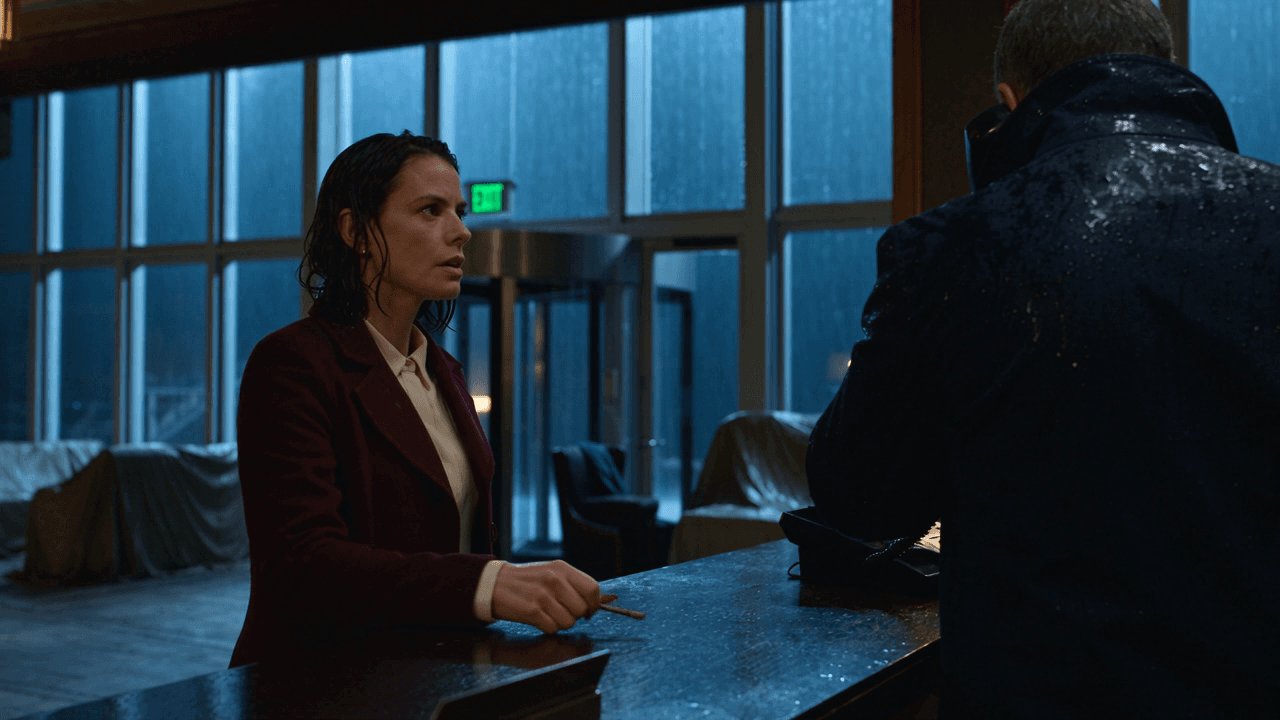
The selected B frame used to prepare the continuation. Keep the key, telephone, clothing, and screen direction in the next brief.
Use Seedance 2.5 Flash Image-to-Video (bytedance/seedance-2.5-flash/image-to-video). For this scene, request 25 seconds, 720p, MP4, audio enabled, and adaptive ratio. The Seedance 2.5 Flash Image-to-Video model page states that this mode follows the input image's aspect ratio. Inspect the image before submitting it.
The next scene should answer why Adrian made the bargain. His son gives the betrayal a motive. Lena's reply then names what the arrangement means for her: she may have been brought here to open something rather than to find her sister. Keeping the key lets her retain a small amount of control.
P3 / C: explain the bargain, then turn toward the basement
plaintext1Create a 25-second photorealistic mystery-thriller continuation. Use the uploaded image as the exact opening composition, not as a loose style reference. Preserve the rain-soaked hotel reception, dark counter, cold blue rainlight, covered furniture, amber practical lighting, black corded telephone, and brass key with a red ribbon. Keep the horizontal composition inherited from the image. Lena is screen left, wearing a burgundy coat over a cream blouse, with wet dark hair. Adrian is screen right, wearing a dark navy raincoat, with very short graying hair. His back is toward the camera at the opening. Do not swap their sides or put them on the same side of the counter. This begins immediately after the telephone bargain. Lena has heard that Adrian brought her here in exchange for information about his missing son. Her fingers are around the brass key at counter level; do not start with an empty hand or a key already hidden in her coat. Adrian has just been using the telephone. 2 30–4 seconds: Hold the uploaded composition. Adrian finishes placing the receiver onto its base, then turns his head and upper body toward Lena. Lena deliberately lifts the key away from the counter and keeps it close to her body. She watches him instead of looking toward the entrance. 4 54–11 seconds: Cut to a medium view of Adrian across the counter. He says, ashamed but urgent: "The owner has my son. He said your sister left something in the basement." He glances toward the closed gray steel service door behind his side of the counter. Use the same door design and position as in the preceding scene; reveal it through the reverse angle, not by changing the lobby layout. 6 711–18 seconds: Reverse toward Lena. She says quietly: "So you didn't bring me here to find her. You brought me to open it." She keeps the key. Her anger is controlled, and she does not cry or scream. 8 918–22 seconds: Return to a medium two-shot. Adrian moves half a step back on his own side of the counter and says: "Then keep the key. Don't let me take it." His expression conveys shame and divided loyalty. 10 1122–25 seconds: A metallic lock clicks from the other side of the closed steel door. Only after the click do they turn toward it. Cut to the same door's lever slowly lowering from inside. The door remains shut. End before anyone speaks or the door opens. 12 13Audio: continuous rain, the specified clear English dialogue, quiet receiver handling, one lock click and the moving lever. Distinct adult voices, no overlapping speech, no music, no caller dialogue. Exactly two visible adults. No visitor, ghost, flashback, subtitles, text overlays, new keys, extra dialogue, or decorative camera movement. Preserve Lena's possession of the key after she lifts it. Prioritize readable cause and reaction over frame-exact timing.
C: Lena holds onto the key as the conversation shifts from Adrian's motive toward what is behind the closed door.
Carry a Decision Across the Cut
The key should mean something different after the telephone call. At the start of B, Lena presents it to obtain an answer. In C, she keeps it close while questioning Adrian's purpose. Carrying that decision across the boundary helps the next scene feel like a consequence of the last one.
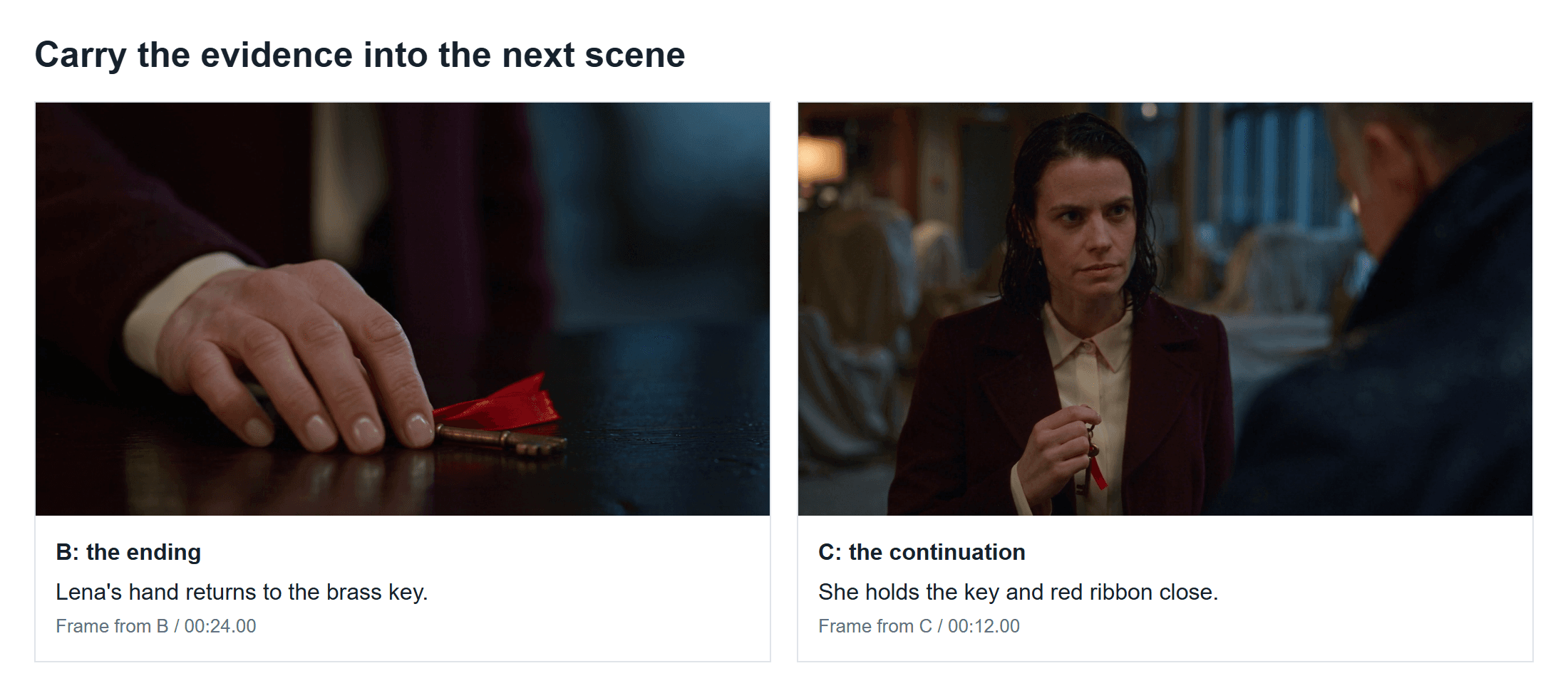
Track who controls the evidence. The key links the accusation in B to Lena's guarded position in C.
Keep a continuity note beside your selected frame: which person stands on each side of the counter, where the receiver is, which hand holds the key, and what each person can see. Update the note from the accepted file rather than from memory of the prompt.
A still image supplies visual information. When a character is turned away, a later reverse angle has to reveal more of their appearance. Compare that view against earlier shots before accepting the cut. Check speech and room tone separately; a matching frame alone cannot guarantee a matching voice.
The next question should follow from the answer you have just supplied. Adrian's son explains why he would cooperate with someone else's demand. The basement redirects the investigation toward something Lena can choose to open or refuse. The script can withhold what is inside while still giving her a concrete decision.
Five Seedance 2.5 Flash Cliffhanger Patterns You Can Adapt
Choose a mechanism that fits the preceding scene. An ending can expose a bargain, change control of an object, impose a deadline, reveal a hidden relationship, or interrupt a choice. Combining all five in one final exchange makes it harder to identify the question the next episode owes.
| Pattern | What changes | Question carried forward | Adaptable final beat |
|---|---|---|---|
| The compromised helper | The investigator has another obligation | Will he protect Lena or finish the bargain? | He asks the caller for his son's location after confirming Lena's arrival. |
| Control of evidence | Lena keeps the object someone needs | What does the key open? | Her hand closes around the ribboned key before he can reach it. |
| A new deadline | The search has a closing window | Can they act before access disappears? | He tells her the basement will be sealed before morning. |
| A hidden relationship | The missing person knew more about the location | What was the sister doing here? | He admits that the owner was expecting her sister that night. |
| An interrupted decision | Someone acts before Lena has chosen | Who is directing the encounter? | A lock moves beyond the closed door while both wait outside. |
Only use the deadline if your series outline can explain who set it and what missing it would cost. Give the hidden relationship an earlier clue, so the reveal changes an existing assumption. The physical interruption needs a clear view of the action before the characters react to it.
For a dialogue-free branch, select an earlier B frame with both faces, the counter, telephone, and key visible. This returns to the confrontation before the call. The brief below explores what happens when Adrian moves toward a door while Lena becomes more guarded.
P4 / D: an alternative ending built around action
Use Seedance 2.5 Flash Image-to-Video, request 10 seconds at 720p, keep the input ratio adaptive, and disable generated audio for a silent version. The image is an earlier moment from B, separate from C's next-episode handoff.
plaintext1Create a 10-second silent photorealistic alternative ending. Use the uploaded image as the exact opening composition. Preserve the two adults, their faces, wet hair, clothing, the dark reception counter, brass key with red ribbon, black telephone, amber table lamp, cold blue rainlight, covered furniture, and glass hotel entrance visible behind Lena. Preserve the source image's horizontal composition. Lena remains on the left in her burgundy coat and cream blouse. Adrian remains on the right in his dark raincoat. They begin on opposite sides of the counter. This is a separate branch before the telephone call. The receiver stays on its base throughout. Communicate a change in trust through physical behavior alone. 2 30–3 seconds: Begin from the uploaded composition. Lena lifts the brass key off the counter. Adrian watches the key rather than meeting her eyes. She glances toward the glass entrance behind her as if considering leaving, but remains behind her side of the counter. 4 53–7 seconds: Cut wider while preserving the room geography. Adrian moves around the visible end of the counter, passes through the open lobby space and reaches the existing glass entrance. He deliberately turns the entrance's small interior thumb-turn deadbolt to lock it. Show one simple readable hand movement, with his body not hiding the lock. Do not make him walk through the counter, teleport, or lock the gray basement door instead. 6 77–10 seconds: Cut toward Lena from the entrance side. She has seen him lock the exit. She stops, closes her hand around the key, and moves one step back along her own side of the counter. Adrian turns toward her from beside the locked entrance, leaving distance between them. End before he explains or approaches her. 8 9Natural continuous movement, coherent eyelines, restrained expressions, and clear changes in viewpoint. Exactly two adults. No grabbing, fighting, subtitles, added people, extra keys, new doors, dialogue, music, sound, or zoom-only motion. The glass entrance is already present in the input image; preserve it.
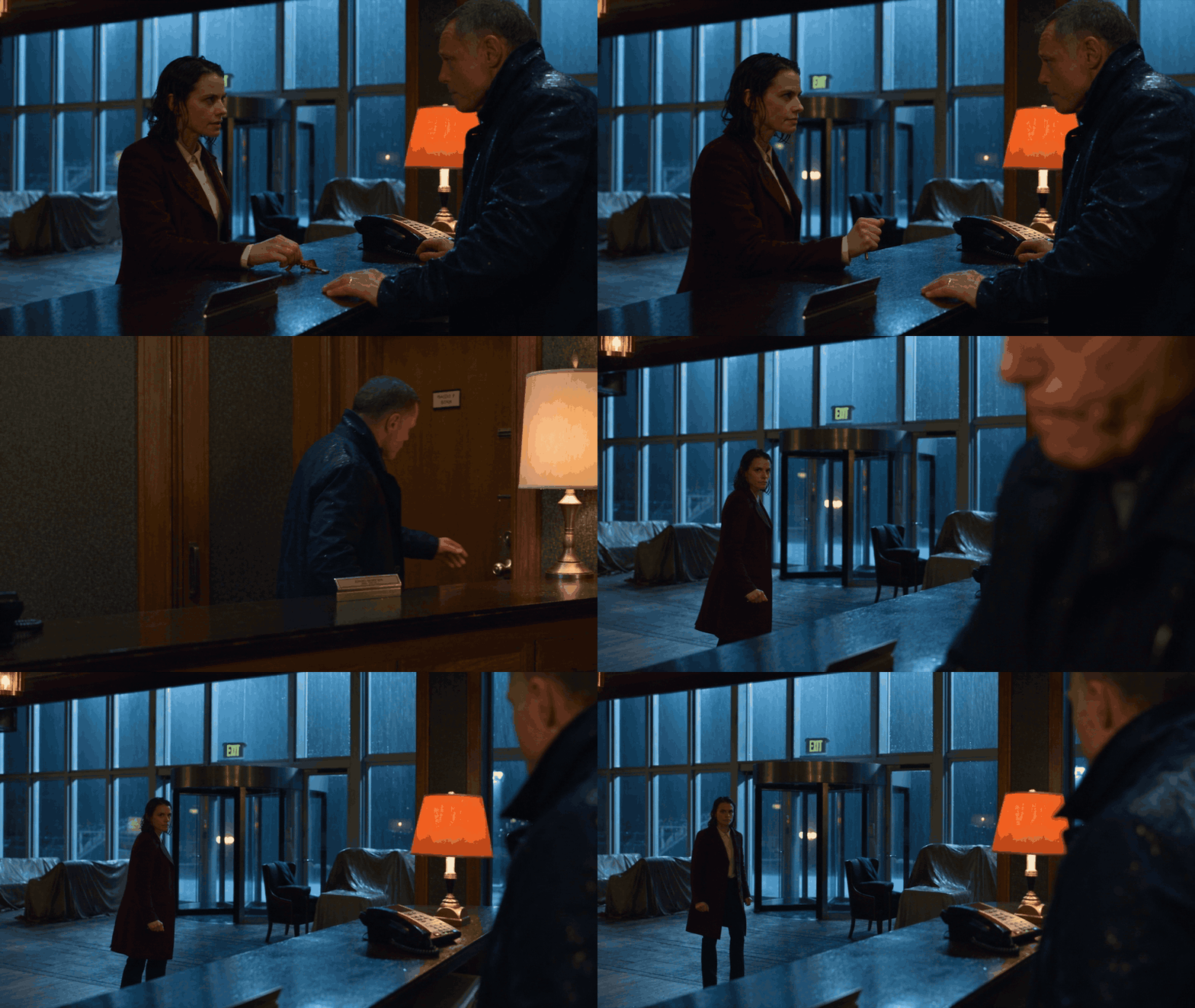
D: Lena keeps the key while Adrian moves away from the counter. The final composition puts more distance between them. The silent GIF makes their movement and eyelines the focus.
Watch the characters' decisions rather than relying on an anxious expression. A hand moving toward evidence, a deliberate turn away, and a person stopping mid-exit can communicate a relationship changing. Let viewers register the action before cutting to the reaction.
For a new variation, decide privately what Adrian intends. He might be protecting a secret, trying to prevent an interruption, or preparing to complete the bargain. The audience can wait for his explanation, but the writer needs an answer so that the next scene follows a coherent choice.
P5 / E: let a second key change the question
Return to the earlier counter confrontation for another independent ending. Lena offers the key as evidence; Adrian answers by producing one of his own. The visual reveal gives viewers a specific connection to investigate without requiring another line of explanation.
Use the same earlier B reference image as P4. Select Seedance 2.5 Flash Image-to-Video, 10 seconds, 720p, adaptive ratio, and audio disabled. Keep both keys in a readable close-up before returning to Lena's reaction.
plaintext1A photorealistic 10-second silent mystery-thriller alternative ending. Use the uploaded image as the exact opening composition. Preserve Lena on screen left in her burgundy coat and cream blouse, Adrian on screen right in his wet dark navy coat, their faces and wet hair, the reception counter, black corded telephone, amber desk lamp, covered furniture, and cold blue rainlight. Keep the input image's horizontal composition. Lena's brass key with a short red ribbon begins on the counter under her fingertips. 2 30–3 seconds: In the opening medium two-shot, Lena slowly slides her ribboned brass key into the empty space between them, then withdraws her hand. Adrian looks down at it. He does not pick it up. Both remain on their original sides of the counter. 4 53–6 seconds: Cut to a closer three-quarter view of Adrian and the counter. He reaches into his coat pocket, takes out a second brass key with an identical short red ribbon, and deliberately places it beside Lena's key. Her original key stays where she left it. His expression is controlled; this is an intentional disclosure. 6 76–8 seconds: Cut to a clean close-up of the counter. Exactly two separate brass keys lie side by side, each with its own red ribbon, with a visible gap between them. Adrian's hand withdraws. Hold long enough to recognize the matching pair. Do not merge, replace, or multiply the keys. 8 98–10 seconds: Cut back to Lena's face with Adrian at the edge of the composition. She looks from the two keys to him. Her expression changes from accusation to alarm as she realizes he already had a matching key. Adrian holds her gaze without explaining. End before either person moves toward a door. 10 11Restrained acting, natural hand movement, consistent eyelines, and smooth cuts. Keep the same warm amber light against cold rainlight. The suspense comes from the matching keys and Lena's recognition. No readable engravings, subtitles, text overlays, extra people, new locations, door-locking action, violence, dialogue, music, or sound. Keep the telephone receiver on its base throughout.
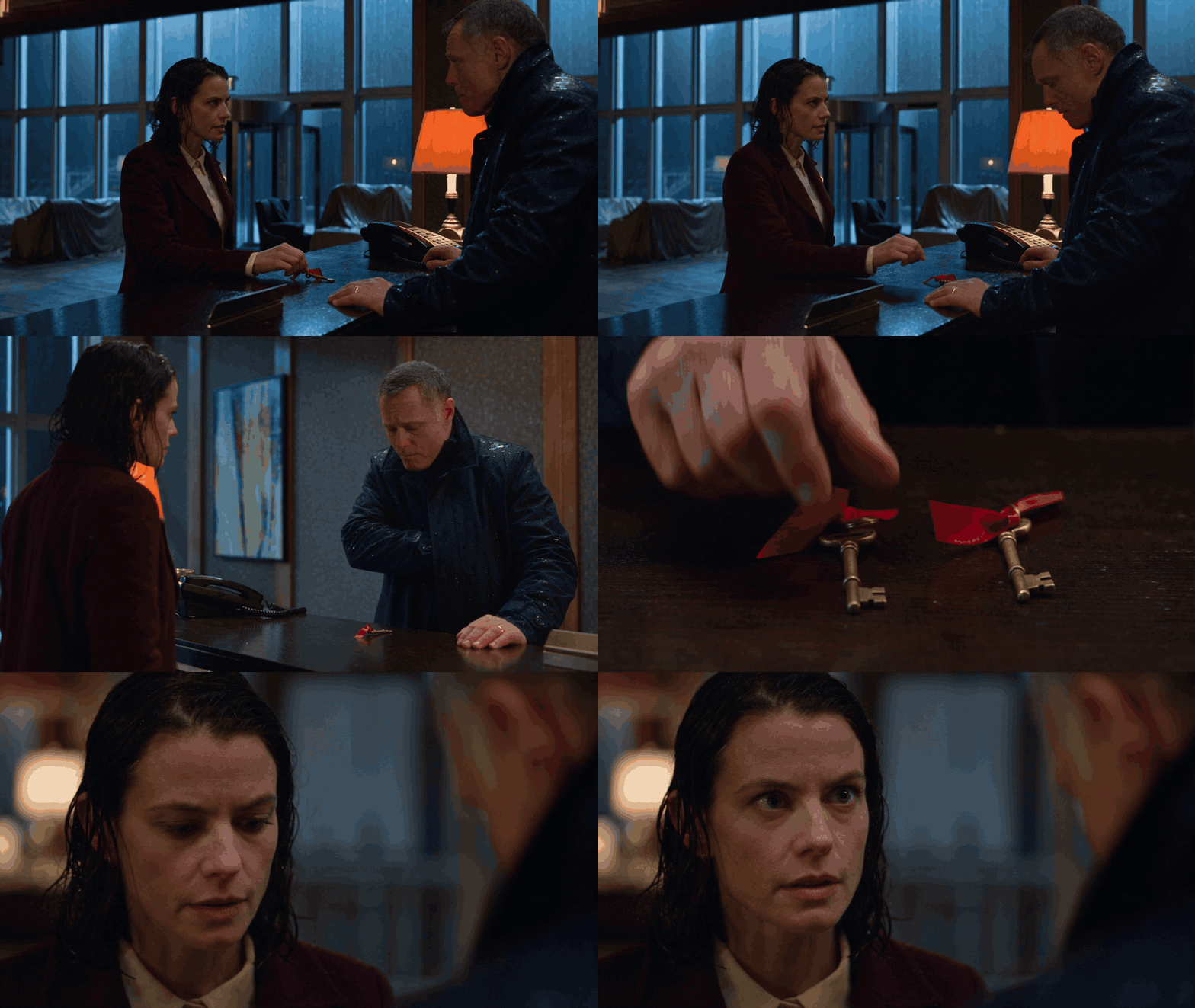
E: Adrian places a second ribboned key beside Lena's. The close-up gives her subsequent look toward him a concrete cause.
The two keys suggest a connection the scene has not explained. Viewers can ask where Adrian obtained his key and what he has kept from Lena. Hold the pair long enough to recognize it, then end on her attention shifting back to him. The next scene can investigate that connection while the larger search for her sister continues.
Finish the Seedance 2.5 Flash Cut Without Explaining Away the Mystery
Approve the story before polishing captions or color. Identify the new fact, the visible response, and the question the next opening will answer. If all you can describe is a worried face, review whether the scene contains enough evidence for viewers to understand that worry.
Give each prompt a clear progression: the character's immediate goal, the action that changes the situation, and the response that ends the scene. Allocate time for dialogue, camera changes, and physical movement. Review the delivered performance before choosing exact edit points.
| Review pass | Follow | Practical decision |
|---|---|---|
| Dialogue | Speaker identity, wording, pace, and pauses | Approve the actual line before writing subtitles |
| Silent viewing | Hands, evidence, eyelines, and movement | Keep the cause and response understandable |
| Episode boundary | Clothing, positions, key, and telephone | Choose the shot that carries the same scene state forward |
| Ending | The last useful admission or action | Cut after viewers can register it, before an explanation removes the question |
Place subtitles after checking the spoken wording. Keep them away from the key and the hand that controls it. A close-up may leave room below a face while a counter shot needs that same area for evidence. Test the placement at the size viewers will actually watch.
Preserve the source composition when comparing these clips. For a vertical delivery, establish new framing deliberately, with the important object and reaction inside the crop. Do not assume that a centered crop contains everything the wide shot communicates.
Keep the full takes for review. The three longer dialogue scenes remain playable videos with posters. The two short, nonverbal alternatives are looping GIFs that each include the complete scene. Review each scene as a unit rather than presenting isolated fragments as separate generations.
Budget around usable endings. Divide total generation spend, including rejected takes, by the number you accept. A hypothetical 100 credits spent for two usable endings means 50 credits per usable ending. Check the current model directory and your selected configuration's quote before starting another batch; the example arithmetic is not a production invoice.
Set a retry limit and change one consequential requirement at a time. If an exchange is crowded, shorten the speech or remove a cut before adding more instructions. If a prop matters, keep it visible at the moment control changes. Record the prompt, requested settings, selected input, and final filename so another editor can continue from the same state.
For your own Seedance 2.5 Flash short drama cliffhanger, begin with one relationship the audience understands. Give a character a reason to conceal something. Let the final beat expose just enough of that reason to make the next decision unavoidable.
Frequently Asked Questions
Can I build a cliffhanger with only one visible character?
Yes. Give the character a pressure viewers can identify: a telephone call, an object that should not be present, or a sound from a known location. Establish the source before the reaction. Keep the character's next decision readable, even if the person creating the pressure stays offscreen. An unseen caller can matter through what the visible character says and does.
Does every episode need the same kind of cliffhanger?
Vary the mechanism as the story develops. A concealed bargain can lead to a difficult choice, then a deadline or a discovery. Resolve enough earlier questions for viewers to update their understanding of the characters. Keep a short list of open questions in your outline and decide which one the next opening will settle.
Can I reuse these prompts in another language?
Translate the dramatic intention as well as the words. Read each line aloud and allow time for the reaction it causes. A longer translation can crowd out the key movement or the final look. Review pronunciation, speaker assignment, and subtitle timing with a fluent listener. Separately generated clips also need a voice-continuity check, even when their visual references match.
How can I keep the same characters across episodes?
Start the next clip from a clear frame of the accepted scene. Restate the visible clothing, screen positions, lighting, and important props, then describe only the action that follows. Check the first reverse angle against the earlier character views. Review voices separately, because carrying a still image forward does not establish identical speech or vocal delivery.
How much dialogue should I put in a 25-second scene?
Read the lines aloud at the pace the characters would actually use. Leave room for the telephone, a glance, and the final physical response. If the speech fills the entire duration, shorten an explanation or remove a line before adding more camera instructions. The audience needs time to connect the new information with the character's decision.