

The singing dog ai bathroom clip works because its star behaves like a performer rather than a pet being groomed. A fluffy animal stands in a white bathtub with a towel around its waist, points a hair dryer at its fur, brushes its head, and throws its muzzle upward for a dramatic operatic note. It briefly catches the camera watching, then finishes with a diva-like flourish. First, look at three short online examples. Then follow the production plan for an original 16:9 image and a longer landscape video made for this guide.
Key takeaways
- The visual joke depends on four readable actions: blow-dry, brush, sing upward with closed eyes, and recover for a final flourish.
- Online dog and cat examples show the short vertical format; our original example uses a wider 16:9 frame and more than 20 seconds of changing action.
- Treat the bath scene as fiction. Generate the pet performance, use original audio, and label realistic AI video when posting.
What is the singing dog AI bathroom trend?
In this version of the singing pet meme, the bathroom is a tiny opera house. The animal stands upright in a white tub, wrapped in a bath towel, with a hair dryer in one front paw and a brush in the other. Its ears and fur flutter in the imagined airflow. The mouth opens for a broad, sustained note while the head rises and the eyes close. A small glance at the camera interrupts the performance before a final, grand gesture. A dog is the usual subject, but a cat can play the same role.
The format is a sequence, not just an image of an animal with an open mouth. The dryer establishes the ordinary bath-time setting. Brushing adds a second piece of business. The operatic voice turns routine grooming into a stage performance. The glance acknowledges the audience. The final paw gesture gives the sketch an ending. If any of those beats is hidden by a tight crop or replaced by an unrelated dance, the video becomes a generic singing-pet clip.
The first two online cases below are short, vertical social examples; the third is a wider variation. Their GIF versions are silent so we can compare the visible performance directly. A GIF cannot prove that a mouth perfectly matches a note. When making your own video, judge the picture and the audio together, especially whether the wide mouth and raised head coincide with a sustained vocal phrase.
Online example 1: the dog bath-time solo
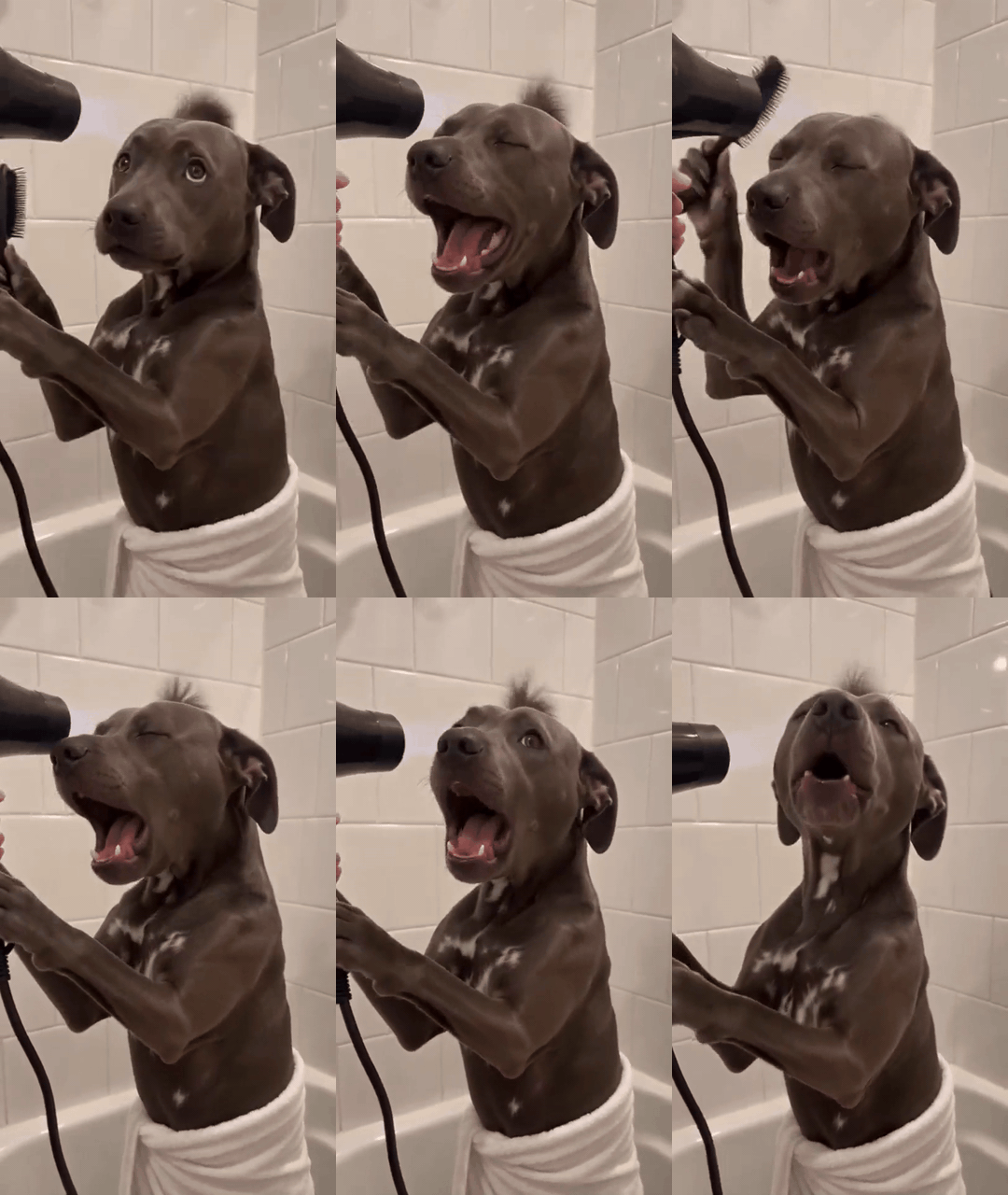
Online example, shown as a silent GIF. Watch the alternation between the dryer, brushing, and the upward singing pose.
The dog example makes the props legible early. The hair dryer occupies one side of the frame, the brush moves across the fur, and the face stays large enough to read. The musical performance is communicated visually by the open muzzle, closed eyes, and tipped-back head. Notice how the pet briefly faces the viewer between the longer upward poses. That look stops the action from becoming one continuous held note.
Online example 2: the cat variation
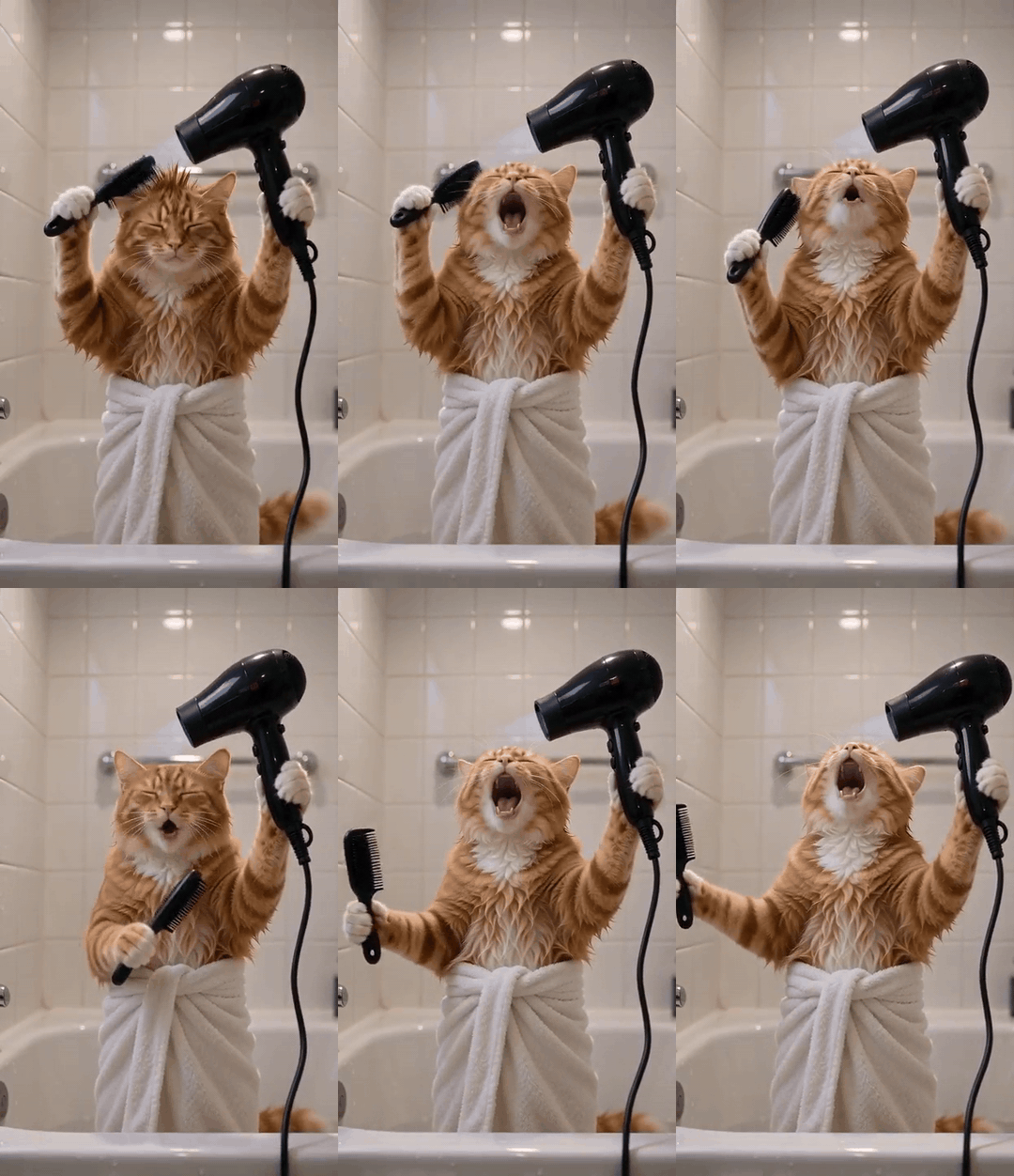
Online example, shown as a silent GIF. The cat changes the body language while keeping the same bath-time concert structure.
The cat version shows what can vary. A different face and fur texture change the expression, and the final forepaw extension reads more like a theatrical curtain call. The useful constant is the relation between setup and payoff: grooming gestures remain visible before the animal commits to the large note. That is why a good prompt describes individual beats instead of merely asking for “a pet singing opera.”
Online example 3: the wider schnauzer solo
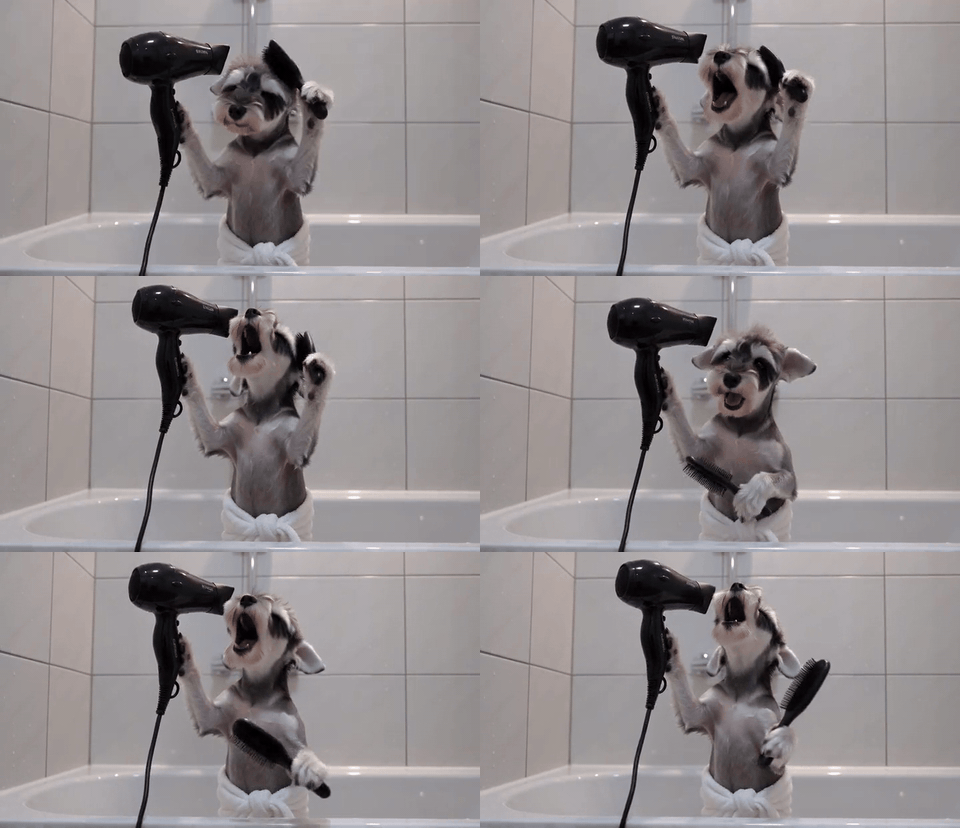
Online example, shown as a silent GIF. The wider view keeps the dryer and brush in frame as the dog lifts its muzzle for the large note.
This version changes the framing as well as the breed. The schnauzer holds the dryer high while the other paw moves the brush away from its face. Its open mouth and raised head remain the center of attention, but the extra space makes the final outward brush gesture easier to see. It shows how the same short bath-time performance can read in a landscape composition.
| Beat | Visual evidence in the short examples | Risk in a generated remake |
|---|---|---|
| Bath-time setup | White tub, towel, dryer, brush | Props merge, float, or disappear |
| Preparation | Airflow and brushing visibly affect fur | Pet holds both tools without using either |
| High note | Mouth opens as the head lifts and eyes close | Open mouth appears as a pant or a bark |
| Camera glance | Eyes briefly return to the lens | The pet never acknowledges the viewer |
| Finale | Paw or head flourish concludes the phrase | Video ends on a static close-up |
Why do singing-pet clips look convincing or fall apart?
The hard part is coordinating the animal, props, mouth, and sound. A model can draw a pleasing still of a dog in a towel yet struggle once the dog must use two tools and sing. If the same front paw holds the dryer and then magically holds the brush, the continuity breaks. If the dryer nozzle points away from the fur while the coat blows in another direction, the airflow has no visual cause. If the mouth opens long before the note, the performance resembles random panting.
Give each prop a role. Keep one dark hair dryer in the animal's right front paw and one broad brush in its left. Let the dryer point toward the head fur, not toward the camera. Let the brush touch the top or side of the head, then move away before the finale. The towel should stay wrapped around the waist, not transform into a robe. A single pet, one tub, two tools, and a stable bathroom are enough. More bathroom accessories only create more objects that can change shape between frames.
For expression, separate three mouth states: half-open while preparing, very wide for the sustained vowel, and briefly relaxed during the camera glance. The head rise and closed eyes should happen with the big note. The glance should be quick and deliberate, as if the singer notices an audience member. Then the dog can raise its muzzle again and extend a paw in the last phrase. The contrast between earnest singing and a knowing look is what makes the small sketch feel performed.
Audio needs its own review. Ask for an original, wordless operatic tenor-style vocal using open vowel sounds rather than a named song or imitation of a specific singer. Add soft bathroom reverb, a low hair-dryer hum, and a light brush sound. The vocal should have a short breath or break before the glance, followed by a rising final phrase. Native audio generation may interpret “opera” as background music rather than a dog vocal, so play the result with sound before publishing. A silent clip with a wide-open mouth does not demonstrate the same effect.
Planning the original 16:9 landscape case
The first two online examples are narrow social clips; the third demonstrates a wider version. Our original image and video deliberately use 16:9 landscape. The wider frame gives each prop a stable location and leaves space for the animal's final paw movement. It also makes the white tub and tiled walls visible enough to establish the setting without a separate establishing shot. The trade-off is that the pet may appear too small, so keep the singer near the center and use medium and medium-close framing rather than a distant room view.
We use a fictional fluffy dog, not a real pet's likeness. The first image is the continuity anchor for the longer video. It should show the full head, both front paws, the towel around the waist, the white tub, and the two separate grooming tools. A three-quarter view can work, but the face must remain visible because the camera glance and high note carry the joke. The tub should look dry or only lightly damp; the scene is an invented performance, not practical instructions for using an electrical dryer in water.
Create the 16:9 starting frame in Atlas Cloud's Seedream image playground. The prompt below is the visual starting point. It anchors the pet and bathroom before any singing motion is requested.
plaintext116:9 landscape, realistic playful film still of one fictional fluffy cream-colored dog standing upright on its hind legs inside a clean white bathtub in a bright tiled bathroom. A white bath towel is securely wrapped around the dog's waist. Its natural canine face, ears, muzzle, and fur remain recognizable. The right front paw holds one black hair dryer pointed toward the head fur; the left front paw holds one blue hairbrush beside the ear. Full head, both forepaws, towel, and tub rim clearly visible. The dog is poised to sing, mouth slightly open, eyes toward the dryer. Soft daylight, a mirror and pale tiles in the background, clear space on both sides for later arm movement. No other animals, no people, no splashing water, no text, no logos, no watermark.
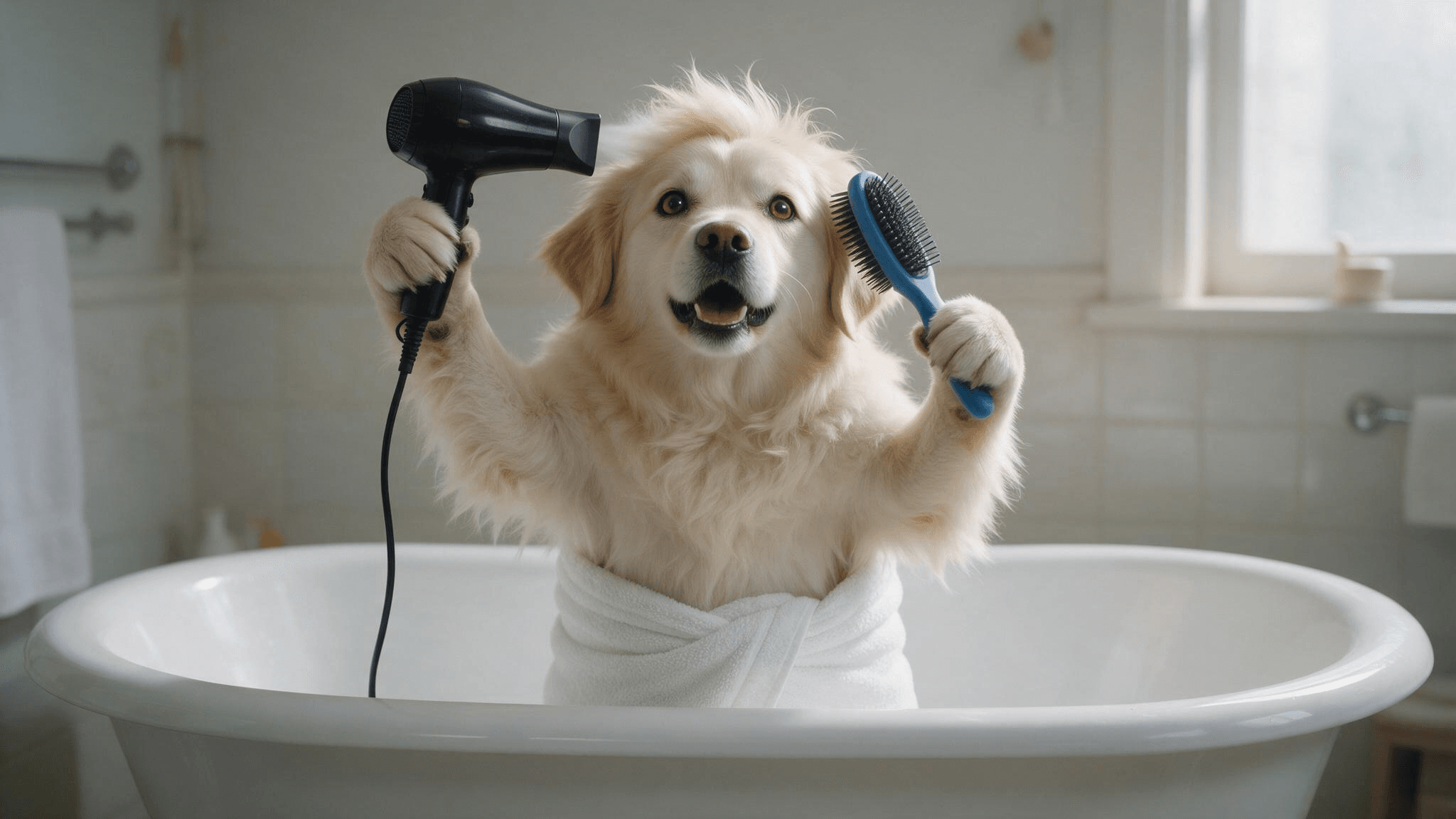
Original 16:9 AI-generated starting image. It establishes the towel, tub, dryer, brush, and dog before animation.
The video plan uses Atlas Cloud's Seedance image-to-video playground with the image as its first frame. Leave Aspect Ratio on Auto to follow the image's 16:9 shape, set the duration to 26 seconds, and select 720p. The longer duration should buy additional action, not an extra ten seconds of the same open-mouth pose. The beat sheet below allocates time to the grooming setup, first vocal phrase, camera glance, and finale.
The completed Atlas Cloud Seedance 2.5 run shows the dog motion prompt and selected first frame beside its 26-second video preview. The run uses 720p resolution and Auto aspect ratio, following the 16:9 first frame.
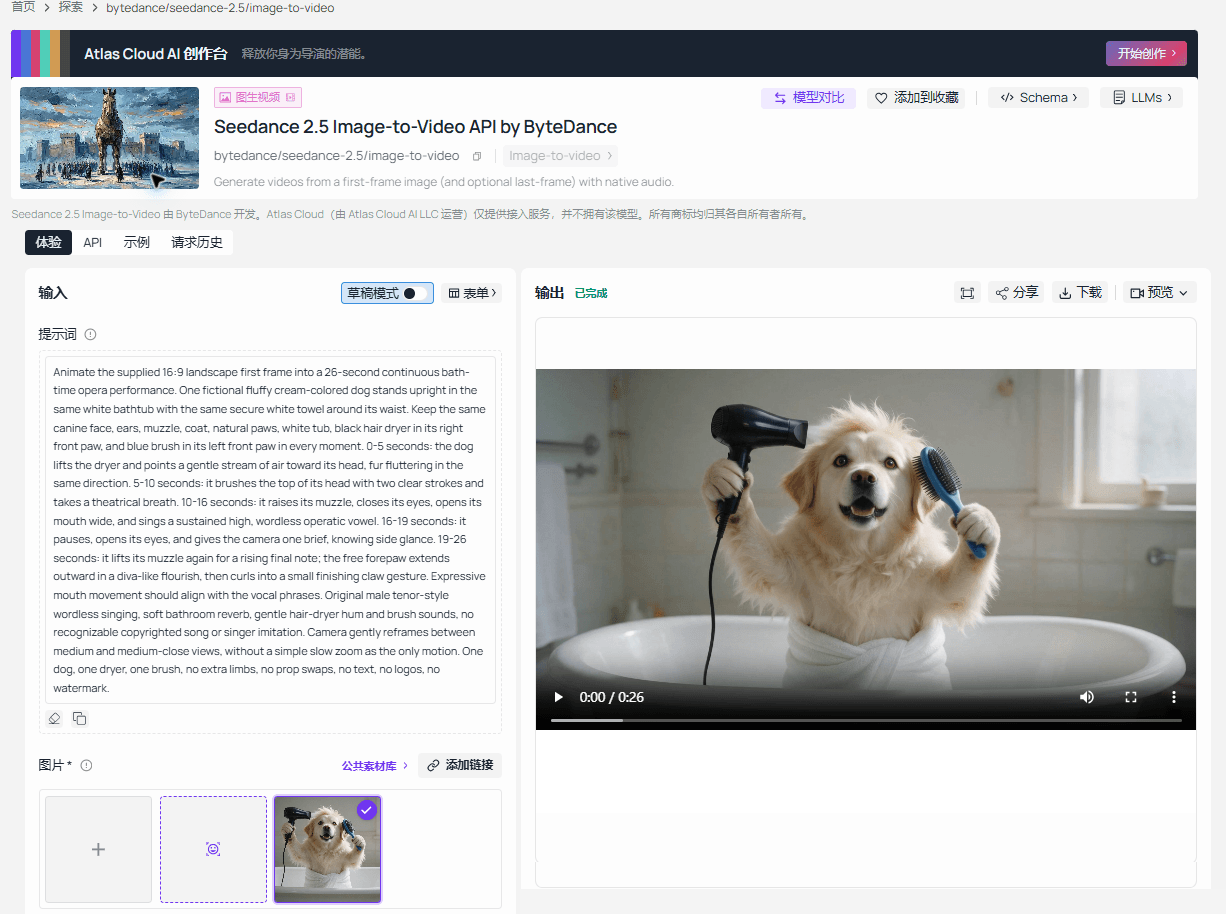
The video plan uses Atlas Cloud's Seedance image-to-video playground with the image as its first frame. Choose 16:9 for the output and request a run longer than 20 seconds. A longer duration should buy additional action, not an extra ten seconds of the same open-mouth pose. The beat sheet below allocates time to the grooming setup, first vocal phrase, camera glance, and finale.
| Time | Picture and performance | Audio cue |
|---|---|---|
| 0–5 s | Dog raises the dryer and turns the head into a gentle airflow; fur shifts | Soft dryer hum and room tone |
| 5–10 s | Other paw makes two visible brush strokes; dog takes a theatrical breath | Brush sound, vocal preparation |
| 10–16 s | Eyes close, muzzle lifts, mouth opens for a long, high operatic vowel | Sustained original tenor-style phrase |
| 16–19 s | Dog pauses, opens its eyes, and gives the camera a brief sideways look | Short breath or momentary break |
| 19–24+ s | Head rises again; free forepaw fans outward, then makes a small claw-like flourish as the towel remains secure | Rising final note with bathroom reverb |
The corresponding motion prompt needs to describe both picture and sound. Keep the dog the same size and coat color across the whole take. It may perform an exaggerated human-like stage gesture, but its face and paws should still read as canine. A model might invent fingers to hold the brush; explicitly ask for natural paws that grip props in a stylized way. Avoid multiple cuts that place the dryer in a different paw at each angle.
plaintext1Animate the supplied 16:9 landscape first frame into a 26-second continuous bath-time opera performance. One fictional fluffy cream-colored dog stands upright in the same white bathtub with the same secure white towel around its waist. Keep the same canine face, ears, muzzle, coat, natural paws, white tub, black hair dryer in its right front paw, and blue brush in its left front paw in every moment. 0-5 seconds: the dog lifts the dryer and points a gentle stream of air toward its head, fur fluttering in the same direction. 5-10 seconds: it brushes the top of its head with two clear strokes and takes a theatrical breath. 10-16 seconds: it raises its muzzle, closes its eyes, opens its mouth wide, and sings a sustained high, wordless operatic vowel. 16-19 seconds: it pauses, opens its eyes, and gives the camera one brief, knowing side glance. 19-26 seconds: it lifts its muzzle again for a rising final note; the free forepaw extends outward in a diva-like flourish, then curls into a small finishing claw gesture. Expressive mouth movement should align with the vocal phrases. Original male tenor-style wordless singing, soft bathroom reverb, gentle hair-dryer hum and brush sounds, no recognizable copyrighted song or singer imitation. Camera gently reframes between medium and medium-close views, without a simple slow zoom as the only motion. One dog, one dryer, one brush, no extra limbs, no prop swaps, no text, no logos, no watermark.
Our original 16:9 singing dog video
Original 16:9 AI-generated case. Play with sound to assess the operatic phrase as well as the dryer, brush, glance, and final paw movement.
The finished take runs for about 26 seconds at 16:9. It shows the brush reaching the head early, a wide-mouthed, eyes-closed singing pose in the middle, a short direct look at the viewer, and a raised-paw finale. The brush is lowered to the tub rim after its first visible stroke, so the requested second stroke and continuous brush-in-paw continuity did not fully survive generation. The dryer, towel, dog, and bathroom remain recognizable. This is a useful distinction between the prompt and the result, not a detail to hide behind a still frame.
For quality control, pause on the brush stroke and the glance as well as on the highest note. Check whether the brush actually meets fur, whether the dryer remains in the same paw, whether the mouth changes shape with the vocal phrase, and whether the animal's coat and towel stay consistent. A pretty still frame cannot answer those motion questions. The last seconds should resolve the performance with an action and vocal finish, rather than fading out midway through a note.
Sound, posting, and the real-pet boundary
The singing is the point of this example, so the original belongs in a playable video with audio, even if a shorter excerpt could be made into a GIF. Online GIFs are useful for comparing gestures; the original video demonstrates how movement and sound work together. If you use a social sound when posting, select it from the platform's licensed library where available. The downloadable original case here asks for new, wordless singing rather than embedding someone else's recording.
Do not reproduce the scene with a real animal holding a powered dryer in a bathtub. It is a fictional visual gag. For actual grooming, the American Kennel Club's drying guidance describes towel-drying first and introducing a dog dryer gently, at a distance and away from the face and ears. The article's AI prompt is for generating imagery, not for handling a pet.
When a realistic synthetic pet performance is uploaded, label it as AI-generated. TikTok's AI-generated content guidance explains its creator label for realistic generated video. A clear description also stops viewers from mistaking the bathroom performance for something the pet physically did.
FAQ
Can I use a cat instead of a dog?
Yes. Keep the tub, towel, two-tool setup, high note, glance, and finale, but describe the cat's own ears, whiskers, paws, and coat. The online cat GIF shows that the performance structure survives the subject change. Avoid asking for a dog body with a cat face.
Does the pet have to be filmed in a real bathroom?
No. A clear pet photo can be used as a visual reference, or the whole scene can be fictional. The original case here uses a generated dog and generated bathroom. That is more controllable than trying to stage the visual gag with an actual animal.
Why use 16:9 when many online examples are vertical?
The requested landscape version has more horizontal room for the dryer, brush, tub rim, and final forepaw extension. It also suits a video player or desktop article. Keep the dog large enough that the mouth and eye movements still read at a glance.
How long should the singing dog AI video be?
The online examples are compact social clips. This original case is planned beyond 20 seconds so it can show preparation, a first sustained note, a short camera reaction, and a final phrase. Use time for different actions. A longer frozen pose is not a stronger version of the trend.
What should I fix first if a generation fails?
Check the sequence before fine detail: are the dryer and brush both used, does the head rise with the long note, is there a visible camera glance, and is there a final gesture? Next check prop continuity, paw anatomy, towel stability, and audio. A clip that only sings but never brushes or looks at the camera misses the particular bath-time sketch.


