

Traditional storyboarding forces growth teams into a painful trade-off: spend 5 to 10 days sketching scene lists and scripting transitions, or launch a rushed text-only promo that fails to convert. Wan 3.0 eliminates this visual pre-production phase by turning slide decks, financial reports, and live landing pages directly into structured, continuous video cuts.
Instead of replacing creative oversight, Wan 3.0 automates static structural mapping. Marketers input source files, and the multimodal engine extracts visual hierarchies to build multi-shot rough cuts natively.
| Core Capability | Technical Benchmark | Storyboard Impact |
| Document Processing | Up to 50 pages / 100MB per file | Replaces visual keyframing |
| Render Engine | Native 30-second continuous scenes | Automates shot transition timing |
| Multimodal Inputs | Omni Reference (PDF、Docx、PPTX and more) | Maps visual layout directly to video frames |
| Audio-Visual Sync | Integrated text-to-speech visual alignment | Cuts separate voiceover timing passes |
While standard industry reviews focus purely on base text-to-video capabilities, they fail to test how AI handles dense financial tables and complex slide deck structures. This deep dive evaluates real-world structural parsing across multi-column formats—showing you exactly how to convert static corporate collateral into instant video drafts while maintaining full directional control over your final brand messaging.
Key Takeaways: Can Wan 3.0 Replace Storyboarding by Converting PPTs and PDFs Directly into Marketing Videos?
For standardized assets, but no for full creative control.
- Pre-Production Acceleration: Wan 3.0 turns slides, PDFs, and web pages into multi-shot video drafts in under 45 minutes. Think of it as a speed-boost for rough cuts—not a full replacement for human creative direction.
- Smarter Layout Reading: Instead of guessing from raw text, Wan 3.0 reads bounding boxes, font sizes, and web elements to match camera motion and scene cuts with your original design.
- Technical Boundaries: Rapid motion transitions can trigger minor OCR character shifts or chart label blur, making native renders ideal for high-tempo social teasers rather than final typography-heavy deliverables.
- The Hybrid Workflow Solution: The highest-ROI pipeline pairs Wan 3.0 to render dynamic 3D backgrounds, UI lighting, and shot pacing with human post-production to layer 100% crisp vector logos and verified text overlays.
How Wan 3.0 Redefines the Marketing Pre-Production Pipeline
Marketing leads regularly waste a full working week waiting for agency designers to hand over static sketch boards before a single frame of footage gets rendered. Wan 3.0 fixes this operational lag by serving as an AI storyboarding replacement. Using its Omni Reference multimodal engine, the model ingests text blocks, slide layouts, and embedded charts to construct synchronized multi-shot video cuts in under 45 minutes.
Wan 3.0 eliminates manual storyboarding for standardized assets like product decks and whitepapers, acting as an effective AI storyboarding replacement. Using its Omni Reference multimodal engine, the model ingests text blocks, slide layouts, and embedded charts to construct synchronized multi-shot video cuts automatically.
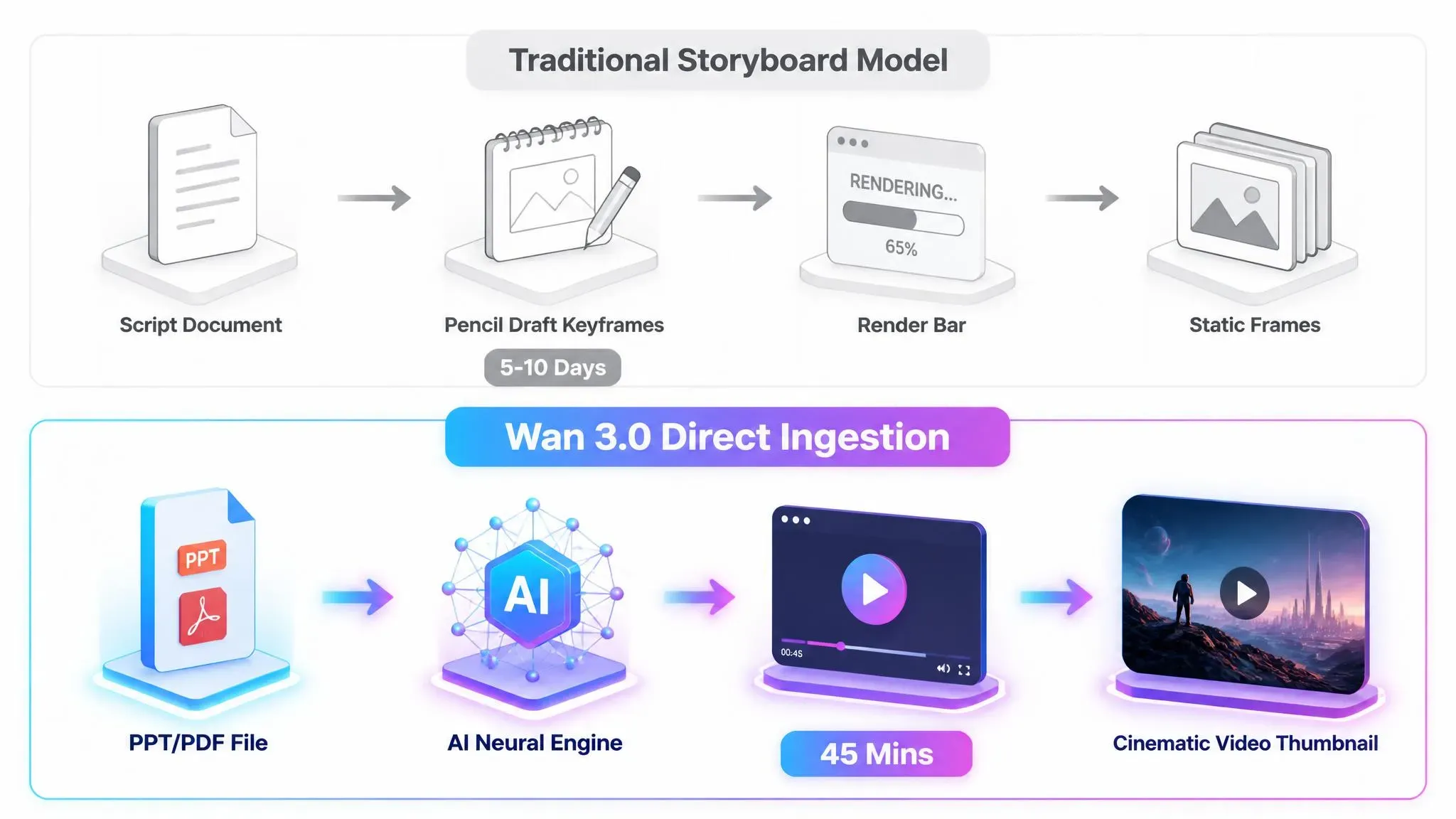
This integration shifts the modern marketing video pipeline away from drawing individual visual boards. Instead of sketching scene directions, creative leads act as directors who evaluate auto-generated cuts.
Production Speed & Workflow Impact
- Turnaround Speed: Reduces initial draft delivery times from days to under one hour.
- Direct Asset Ingestion: Extracts slide titles and main text blocks to set automatic camera movement boundaries.
- PPT to Video Efficiency: Cuts manual scene planning passes by using slide hierarchy as the visual script.
- Creative Scope: Shifts human output from keyframe sketching to selective brand polish and narrative directing.
Wan 3.0 maps native visual elements (such as slide deck headers, bullet point order, and side-by-side product comparisons) directly to continuous scene transitions. This direct conversion lets growth teams skip manual storyboard setup while preserving strict messaging alignment.
How Wan 3.0 Processes Corporate Formats into Video Scenes
Copy-pasting thirty slides into individual text prompts often results in mismatched visual transitions, garbled charts, and hours spent manually setting clip timestamps. Wan 3.0 bypasses manual script input by analyzing structural visual elements directly from uploaded files.
Under the hood, Wan 3.0 document parsing relies on multimodal spatial recognition rather than basic text extraction. When users upload a presentation or whitepaper, the engine reads visual hierarchy cues like font weights, bounding box locations, slide order, and image placement. It constructs a visual layout tree that dictates temporal video beats. Slide titles map directly to shot cuts, while supporting bullet points determine camera movement and scene pacing. For web pages, the engine parses DOM trees and layout styling to convert hero headers into visual hooks followed by sequential product feature renders.
| Input Format | Wan 3.0 Mapping | Eliminated Step | Best Use Case |
| PPT / Keynote | Slide titles map to shot cuts; bullet points drive scene action | Manual keyframing & shot listing | Pitch deck promos, product launches |
| Financial PDFs | Summaries build story arcs; tables trigger animated callouts | Scriptwriting & layout design | Earnings recaps, annual highlights |
| Live Web URLs | Hero headers build hooks; UI features map to product demos | Web asset isolation & sketching | SaaS promos, e-commerce ad reels |
Key Structural Considerations for Optimal Ingestion
- Temporal Boundaries: The engine treats each slide or DOM section as a distinct temporal boundary. Clear H1/H2 header formatting directly improves focal point tracking without manual prompt reformatting.
- Data-to-Visual Translation: Static financial tables are automatically converted into animated callouts rather than dropped, provided table boundaries are visually uncluttered.
- Context Preservation: Preserving native visual alignment ensures consistent brand styling and lighting across single-pass frame transitions.
Storyboarding vs. Direct Ingestion: Production ROI and Time-to-Asset Benchmark
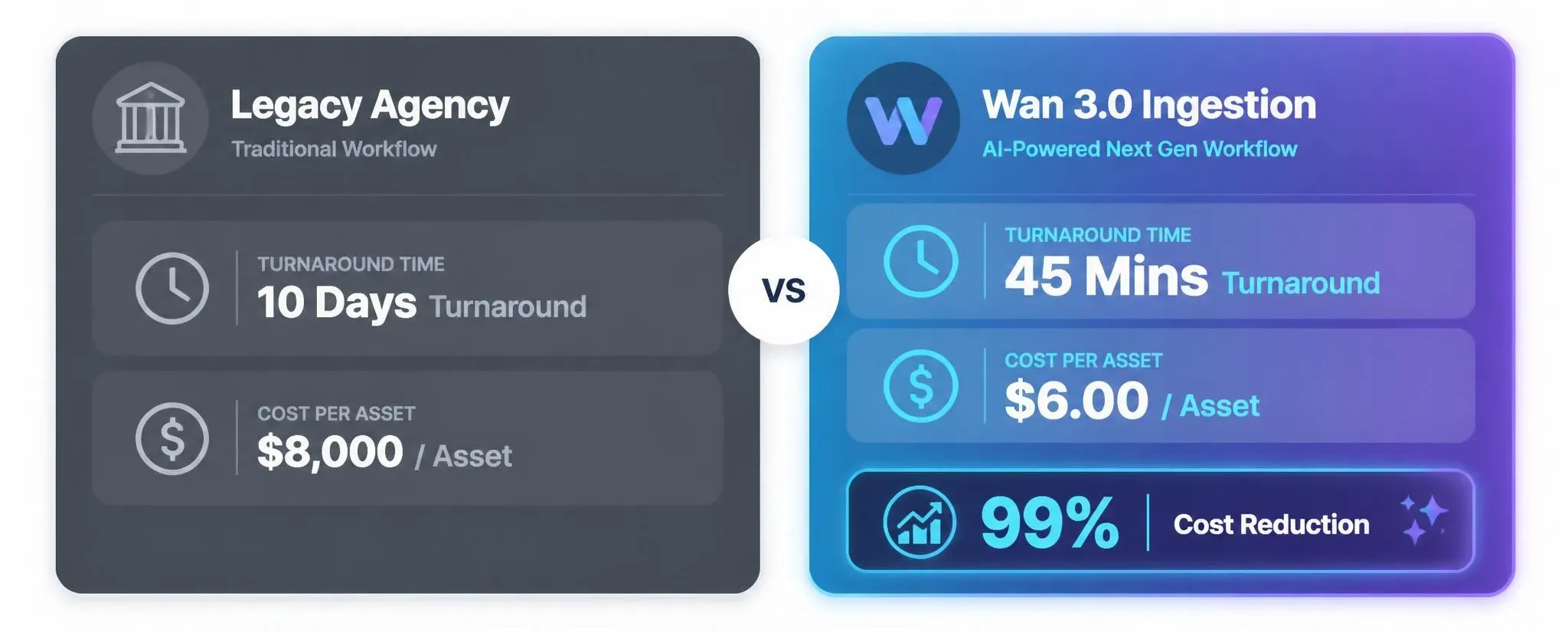
Waiting a week for an agency storyboard only to discover the visual rendering diverges from your product deck wastes both marketing budget and campaign momentum. Agency pipelines demand up to ten days of copywriting, keyframe sketching, and sign-off rounds before rendering a single second of footage.
Transitioning to automated file ingestion alters these financial and temporal allocations entirely, shifting creative output from manual drawing to strategic direction.
| Performance & Cost Metric | Traditional Agency Pipeline | Wan 3.0 Direct Ingestion | Operational Impact |
| Turnaround Time | 5 to 10 working days | 15 to 45 minutes | Enables same-day campaign iteration |
| Estimated Cost | $3,000 – $8,000 per asset | ~$6.00 per 30s render ($0.20/s) | Slashes production overhead by >90% |
| Human Labor Input | 25 to 40 design/copy hours | 1 to 2 hours prompt polish | Reallocates hours to brand compliance |
| Clip Assembly | Manual keyframing & clip stitching | Native single-pass multi-shot render | Eliminates visual jumps & flickering |
Reducing Artifacts via Single-Pass Generation
Speed alone is a misleading benchmark. First-generation engines relied on stitching multiple 4-second renders—a process that destroys spatial continuity, causing unstable character proportions, lighting flicker, and harsh visual jump-cuts.
Using a native 30-second generation engine solves this clip-assembly bottleneck. Wan 3.0 renders continuous camera motion, scene pacing, and integrated audio in a single generation pass, maintaining spatial lighting and asset scale across the full take.
Reallocating Creative Hours for Scaled Testing
- Direct ingestion eliminates the manual keyframing trap. Instead of dedicating 70% of pre-production time to drawing static visual boards, creative leads redirect their focus toward three high-value levers:
- Document Pre-Formatting: Structuring H1/H2 slide tags and landing page DOM containers for clean parser mapping.
- Omni Reference Tuning: Refining lighting cues, camera direction, and aesthetic styles within the model interface.
- Brand Compliance: Auditing auto-generated drafts to verify exact logo placement and narrative alignment.
Video creation becomes a quick weekly testing flywheel instead of a quarterly campaign bottleneck thanks organizational change.
Where Document-to-Video Succeeds: High-Value Corporate Use Cases
Companies accumulate vast libraries of presentation decks and whitepapers, but high production costs keep them from ever being adapted into video. Direct document ingestion unlocks high ROI precisely where structural collateral already exists and only needs visual activation.
Note:
All video benchmarks in this article are generated using Wan 3.0 Reference-to-Video via Atlas Cloud
Resolution: 480p | Duration: 5s | Cost: $0.20 per run
PPT Pitch Decks to Animated Investor Promos
Converting investor presentations into pitch teasers usually means manually rebuilding slide graphics inside video editing software. Wan 3.0 parses slide decks to generate an automated explainer video in minutes, extracting headline keyframes, slide transitions, and embedded bullet points. The model matches slide hierarchy to camera moves, keeping core brand styling intact while adding dynamic background depth and text-to-speech timing. Teams can turn 12-slide pitch decks into 30-second cinematic teasers ready for investor outreach emails or social channels without re-engaging external agencies.
Real-World Benchmark: Animating Slide Charts with Wan 3.0
To test automated pitch deck-to-video conversion, I fed a multi-slide presentation into Wan 3.0 to generate a fast 5-second teaser highlighting core product solutions, data visualizations, and the execution roadmap.
What Worked: Clean Pacing & Slide Fidelity
- Tight Multi-Slide Rhythm: The 5-second runtime flows smoothly across three distinct deck sections (Solution architecture \rightarro\rightarro\rightarro Stacked data chart \rightarro\rightarro\rightarro Future roadmap timeline), capturing the overall narrative arc without dragging.
- Immaculate Brand Consistency: The model successfully preserved the clean corporate color scheme, orange accent capsules, and vector layout geometry from the original presentation slides.
- Crisp Data Rendering: The multi-series horizontal bar chart transitioned cleanly into view, rendering the series breakdowns and axis values with high clarity.
The Trade-Offs: Brief Transition Blur
- Whip-Pan Artifacts: Rapid movement between the solution cards and the data chart introduced a split-second motion softness during the transition frame.
Pro Tip: Multi-slide pitch teasers are phenomenal for grabbing investor attention in cold outreach emails or social feeds. Use Wan 3.0 to render the dynamic multi-slide transitions and visual rhythm, then pair it with a voiceover or clean post-production audio track to drive the core narrative home.
Complex Financial Reports (PDF) to Video Summaries
Dense 50-page financial statements contain valuable market data, but text-heavy PDFs suffer from minimal engagement on public channels. Using Wan 3.0 for financial report analysis video production allows corporate communications teams to feed raw PDFs directly into the ingestion engine. The parser isolates executive summaries and key performance indicators, turning static data tables into animated chart overlays and kinetic callouts. This approach lets investor relations teams produce quarterly earnings videos within an hour of filings going public, maximizing reach across financial social feeds.
Real-World Benchmark: Multi-Page PDF Teaser Reel with Wan 3.0
To test high-tempo social video production, I fed three disparate PDF pages—a text header, a data table, and an executive team showcase—into Wan 3.0 to generate a 5-second multi-page sweep.
What Worked: High-Impact Motion & UI Overlay
- Seamless Multi-Page Pacing: The model delivered a tight 5-second sequence, executing smooth camera whip-pans across three pages: Header → Bar Chart → Executive Cards, without layout collapse.
- Dynamic Chart & Kinetic Callouts: The static teal bar chart on Page 7 animated smoothly with a left-to-right fill effect, accompanied by a glowing floating UI callout badge on the key metric.
- Modern Mockup Styling: The closing frame automatically wrapped the team roster into a sleek, rounded tablet card mockup with subtle glassmorphism shadows.
The Trade-Offs: Micro-Detail Hallucinations
- Text Masking in Opening Frame: The translucent frosted glass overlay in the first frame partially clipped the word "SOLUTIONS," slightly reducing headline legibility.
- OCR Character Shifts: During the fast-paced closing transition, secondary team names experienced minor character distortion, e.g., "Adam Fletcher" rendered as "Adam Artm".
Pro Tip: Multi-page 5-second sweeps are exceptionally high-converting for social feeds and email hooks. For high-stakes investor communications, run Wan 3.0 to generate the dynamic 3D transitions and UI lighting, then overlay vector text and verified nameplates in post-production.
E-Commerce & SaaS Landing Pages to Kinetic Ad Reels
Building social ad reels from web pages traditionally requires screen recording tools, manual web asset extraction, and timeline editing. As a corporate promotion video AI pipeline, Wan 3.0 ingests active web URLs, scans layout containers, and converts landing page structures into multi-shot ad cuts. In SaaS product demo AI workflows, the engine highlights product hero headers, feature lists, and interface screenshots into a continuous 30-second promo reel.
Real-World Benchmark: Multi-Shot Kinetic Ad Reel for SaaS Landing Pages
To test high-converting B2B social ads and product launch teasers, I fed the Atlas Cloud landing page into Wan 3.0 to generate a 10-second multi-shot kinetic video featuring 4 distinct cinematic beats.
What Worked: High-Density SaaS Motion & UI Aesthetics
- Dynamic Multi-Shot Pacing: The drag typical of single-shot clips was eliminated by dividing the 10-second runtime into four separate micro-shots (Hero Hook → Ecosystem Matrix → Developer Workflow → Enterprise Closing).
- Immersive Dark-Mode Cyberpunk UI: subtle grid background, neon glow effects, and floating HUD glassmorphism cards that are typical of modern AI developer platforms were perfectly reproduced.
- Complex UI Depth Rendering: Mid-shot developer components, such as the ComfyUI integration panels, exhibited high spatial fidelity with floating feature badges popping up organically.
The Trade-Offs: Subtitle Character Drift
- Fast-Paced Typography Distortion: Due to the high-density frame transitions, minor typographic hallucinations occurred on secondary subheadings, e.g., specific sub-labels rendering temporary placeholder characters.
- Rapid Motion Blending: Extremely fast whip-pans between the ecosystem logo wall and developer modules resulted in a brief 1-frame motion softness.
Pro Tip: Multi-shot kinetic reels are powerhouse conversion drivers for SaaS hero sections and social ads. For mission-critical brand campaigns, leverage Wan 3.0 to render the hyper-realistic dark-mode 3D background and UI transitions, then layer 100% crisp vector typography and logo badges in post-production.
Technical Limits: Why High-Concept Ads Still Need Human Storyboards
Feeding a 40-page pitch deck into an automated pipeline often ends in frustration: chart axis labels collide, corporate logos distort during camera pans, and critical statistical figures disappear into visual noise. While direct ingestion accelerates rapid rough cuts, strict technical boundaries prevent it from replacing human-led storyboarding on flagship brand campaigns.
Key Operational and Render Boundaries
Understanding Wan 3.0 limitations requires evaluating where generative video engines fail on graphic precision and narrative control.
| Technical Boundary | Model Manifestation | Production Impact | Required Human Oversight |
| Graphic & Typography Precision | AI visual hallucinations on chart axes, distorted hex colors, merged legend labels | Corrupts data accuracy and breaks brand identity in AI video | Post-render vector graphic and text overlay replacements |
| Narrative Blocking & Pacing | Inability to track multi-character spatial logic across continuous cuts | Fails at complex narrative storytelling and subtle emotional beats | Manual shot-by-shot keyframing and directional blocking |
| Context Compression | Hard file caps of 100MB or 50 pages forced into a 30-second window | Yields 0.6 seconds of screen time per page, skipping key details | Pre-cleaning inputs to isolate priority narrative beats |
| Safety & Moderation Filtering | Integrated AI video moderation flags false-positive terms or trademarked assets | Blocks or alters specific corporate campaign renders unexpectedly | Content pre-auditing and prompt compliance adjustments |
Vector Precision and Brand Safeguards
Generative models process images as pixel distributions rather than scalable vector shapes. When parsing financial slides, Wan 3.0 frequently triggers AI visual hallucinations, misreading gridlines or collapsing multi-line chart legends into merged text strings. Protecting brand identity in AI video requires human designers to apply crisp vector typography, verified hex colors, and exact numeric callouts after video generation.
Complex Narrative Storytelling and Emotional Blocking
Cinematic commercials depend on precise visual grammar, including deliberate eye contact, spatial character relationships, and continuous motion tracking across scene cuts. Document parsing cannot infer subtle human emotions or manage multi-character spatial alignment. For high-stakes promotional films that demand complex narrative storytelling, manual storyboards remain necessary to establish camera angles and acting beats before rendering.
File Caps, Context Overload, and Moderation Controls
Document processing operates under hard limits of 100MB and 50 pages per job. The engine skips important supporting data when a 50-page PDF is compressed into a single run, allocating just 0.6 seconds of video time per page. Marketers must manually trim and reformat files beforehand. Furthermore, enterprise campaigns must account for automated AI video moderation filters, which can trigger unexpected generation refusals when processing sensitive corporate terms or proprietary product names.
The Modern Hybrid Workflow: How Marketing Teams Should Structure Pre-Production
Most video production teams waste up to 60 percent of their render budget re-generating full 30-second clips just to fix a single distorted logo or bad camera angle. Adopting a hybrid storyboarding pipeline solves this inefficiency by pairing human editorial control with automated file parsing. This document to video step-by-step guide outlines how growth teams can structure pre-production for reliable results.
The 4-Step Production Blueprint
Step 1: Document Pre-Formatting
Clean raw files before uploading. Strip out footers, page numbers, and secondary bullet points from slides or PDFs. Highlighting primary H1 and H2 headers guides the parser to recognize key visual beats, ensuring the engine maps scene transitions to major narrative shifts.
Step 2: Dual-Input Prompting via Omni Reference
Execute precise Wan 3.0 prompt structuring by feeding source documents alongside visual style references. Using dual-input conditioning allows creative leads to lock style parameters, such as a cinematic 3D render with a minimalist corporate aesthetic and steady camera movement, while text elements dictate shot sequence.
Step 3: Rapid Rough-Cut Iteration
Generate an initial 30-second multi-shot pass to act as a live preview board. Evaluating this rough cut allows creative teams to test visual pacing, camera speed, and shot transitions across scenes in minutes rather than waiting days for manual storyboard approvals.
Step 4: Targeted Segment Polishing
Avoid re-rendering entire sequences to correct minor visual glitches. Apply local micro-editing to isolated 2-second segments to touch up typography, adjust lighting, or correct logo placement without resetting the underlying scene seed.
Document-to-video engines like Wan 3.0 aren't about eliminating human visual directors—they are about removing the operational lag between static collateral and dynamic video execution. By letting multimodal AI handle structural keyframing while human editors focus on input pre-formatting and post-render brand polish, growth teams can transform stagnant corporate libraries into scalable video assets in hours instead of weeks.





