

A creator types the perfect brawl prompt: wet alley, two stunt performers, one clean kick, one believable reaction. The still frame looks intense. Then the clip plays, and the Wan 3.0 fight scene feels just a little slippery.
That does not make Wan 3.0 a weak video model. The more useful answer is sharper: realistic fight scenes punish every AI video system because the viewer can feel contact, weight, timing, and camera continuity instantly.
Wan 3.0 can be strong for dialogue-led scenes, candid moments, atmospheric long takes, raw handheld movement, and stylized anime action. Realistic fight choreography asks for a different kind of discipline.
Key takeaways
- Wan 3.0 is viable for action, with the right shot type.
- Realistic action exposes contact and body-weight errors fast.
- Anime action gives AI more room to hide transitions.
- MiniMax H3 is worth testing on controlled short action shots.
- Compare full clips, reroll counts, and prompt discipline.
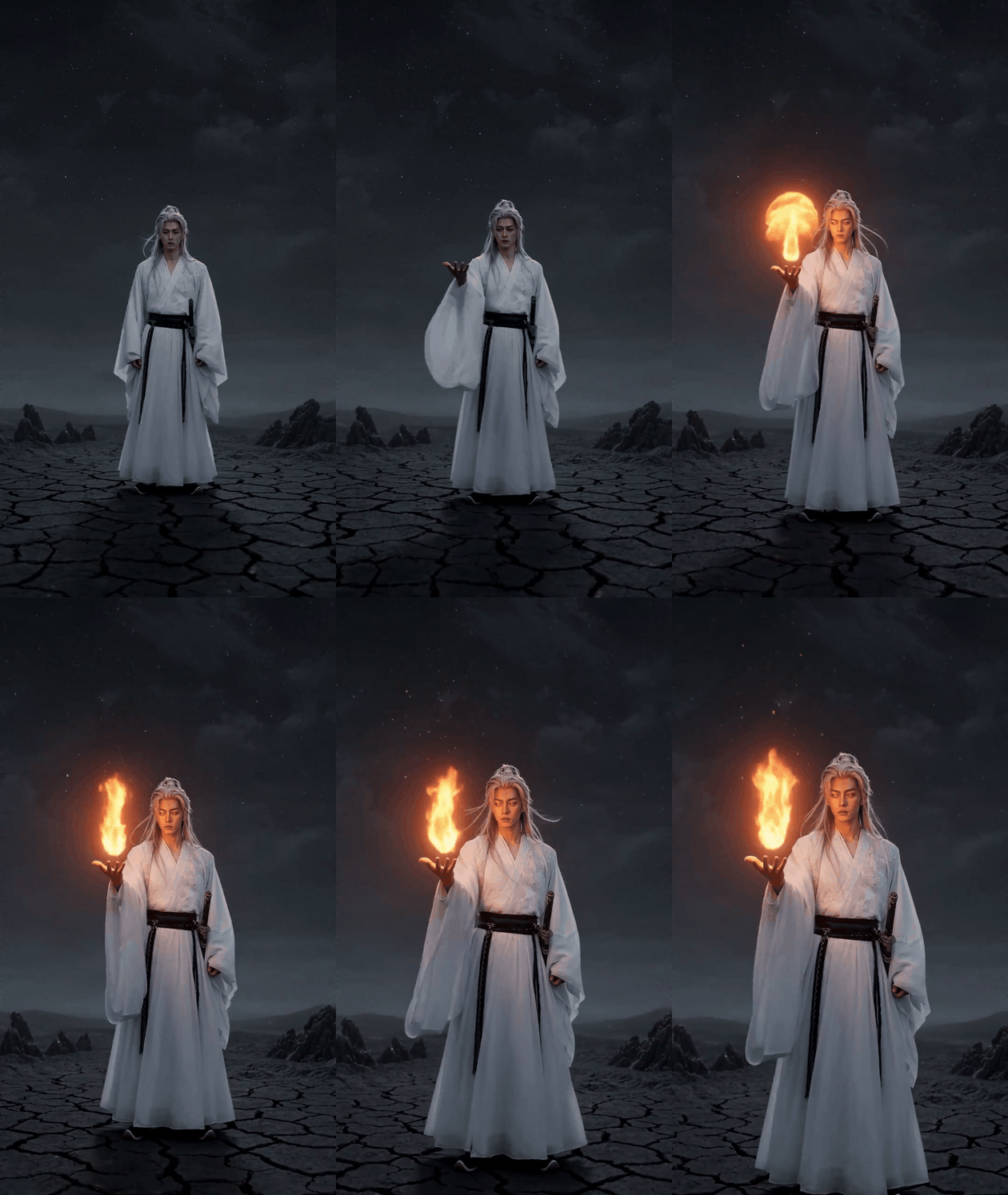
Wan 3.0 anime fight showcase clip with flame action transfer
Showcase: a local Wan 3.0 handbook clip used as a stylized action reference. It shows energy effects and motion transfer, the kind of action language that can survive as a silent GIF .
Why Wan 3.0 Fight Scene Attempts Fail in Realism
Recent creator feedback is useful as a directional signal, while staying careful. Some posts praise Wan 3.0 for conversational scenes, candid movement, and raw camera energy, then flag precise dynamic fight scenes as less reliable for series work. Treat those posts as reference material, not as a lab benchmark.
A separate comparison article tested Seedance 2.5, MiniMax H3, and Wan 3 on prompts including an anime fight, object physics, and facial expression changes. Its takeaway was mixed: Wan handled movement and water effects well in the anime fight, while H3 showed issues such as slower motion and disappearing weapons in that particular run (Generative AI Pub, Aug 2026).
The official Wan 3.0 materials describe longer native video, multi-reference input, editing, realism, sound, and broad multimodal workflows (AlibabaCloud Wan3.0 GitHub, Aug 2026). Those features matter. They do not erase the special difficulty of physical combat.
Realistic fight choreography AI video breaks when any of these go soft:
- Contact points: a fist passes near a jaw instead of landing.
- Occlusion: one arm hides behind a torso and comes back wrong.
- Limbs: elbows, wrists, knees, and ankles bend into impossible shapes.
- Inertia: a heavy hit causes a light reaction, or no reaction.
- Timing: block, strike, and recoil miss the same beat.
- Weapon continuity: a baton, knife, staff, or spear changes length.
- Camera continuity: the shot cuts or drifts to avoid the hard contact.
Anime fight prompts forgive more. Speed lines, sparks, shockwaves, stylized smears, and impossible jumps belong to the language. The clip can feel exciting even when the exact hit geometry is loose.
The mythic fight clip below is a better control for that idea than a realistic street brawl. The bodies, scale, and effects are intentionally stylized, so the viewer judges impact, silhouette, and rhythm before strict real-world contact physics.
Stylized fight control: this Wan 3.0 handbook clip leans into mythic scale and animated impact, which makes it useful for comparing anime-style action against realistic fight choreography.
AI Video Fight Scene Workflow on Atlas Cloud
The practical workflow is simple: run the same prompt across models in one browser tab, save raw outputs first, then judge full clips. On Atlas Cloud, you can open Wan 3.0 and MiniMax H3 pages without rebuilding a pipeline for each test.
Use Wan 3.0 on Atlas Cloud when the shot needs longer atmospheric continuity, dialogue/candid pacing, or stylized action. Add MiniMax H3 video generation to the same test when the shot is short, controlled, and action-heavy.
Prices below are catalog starting points checked from Atlas Cloud model pages on August 26, 2026. The final quote beside the Run button is the source of truth because duration, resolution, account discounts, and model route can change.
| Model | Job in this article | Starting price shown | Best test shot |
|---|---|---|---|
| Wan-3.0 Text-to-video | Longer action, atmosphere, anime-style motion | From $0.05/sec | 5s to 8s prompt-only fight tests |
| Wan-3.0 Prime Text-to-video | Higher-end Wan 3.0 route | From $0.068/sec | Quality pass after the cheap prompt wins |
| MiniMax H3 Text-to-video | Short comparison run | From $0.1/sec | Tight fight beats and controlled rerolls |
Step 1: Run a Wan 3.0 Realistic Action Prompt
Start with one realistic fight prompt that forces contact, recoil, and spatial continuity. Keep it short enough to review frame by frame.
Plain1Two trained stunt performers in a rain-slick city alley at night. One throws a right hook, the other blocks with the forearm, counters with a low body kick, and both fighters visibly shift weight after contact. Keep the full bodies in frame, no teleporting, no extra limbs, no disappearing hands, grounded footwork, handheld side-tracking camera, 5 seconds, cinematic realism. 2
Pick Wan-3.0 Text-to-video. Use 16:9, 720p if available for a fast test, and 5 seconds. Save the raw clip before judging a screenshot.
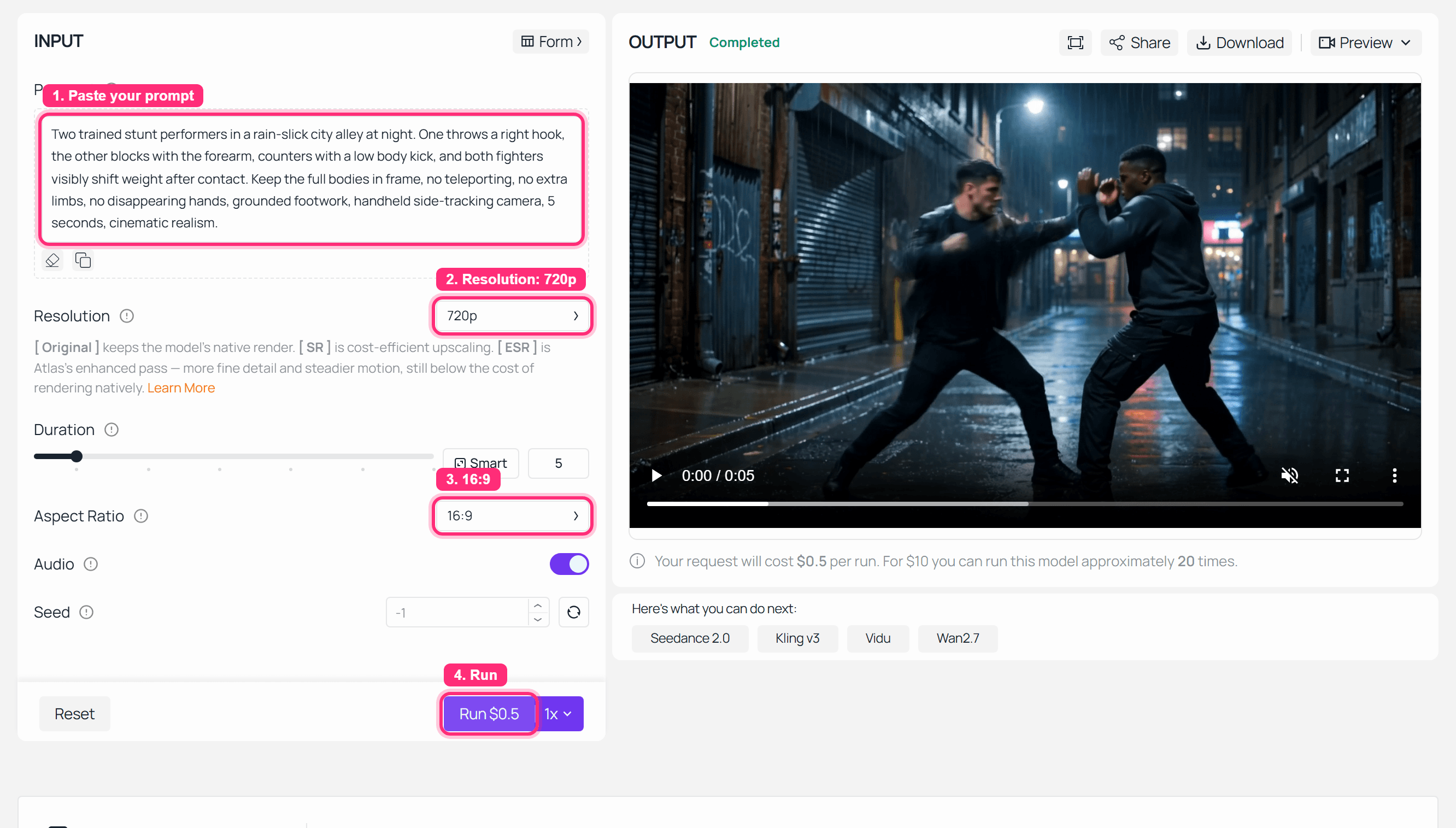
Wan 3.0 realistic action playground screenshot with completed fight prompt
Wan 3.0 Text-to-video on Atlas Cloud: prompt entered, 16:9 action settings selected, and the completed output visible on the right.
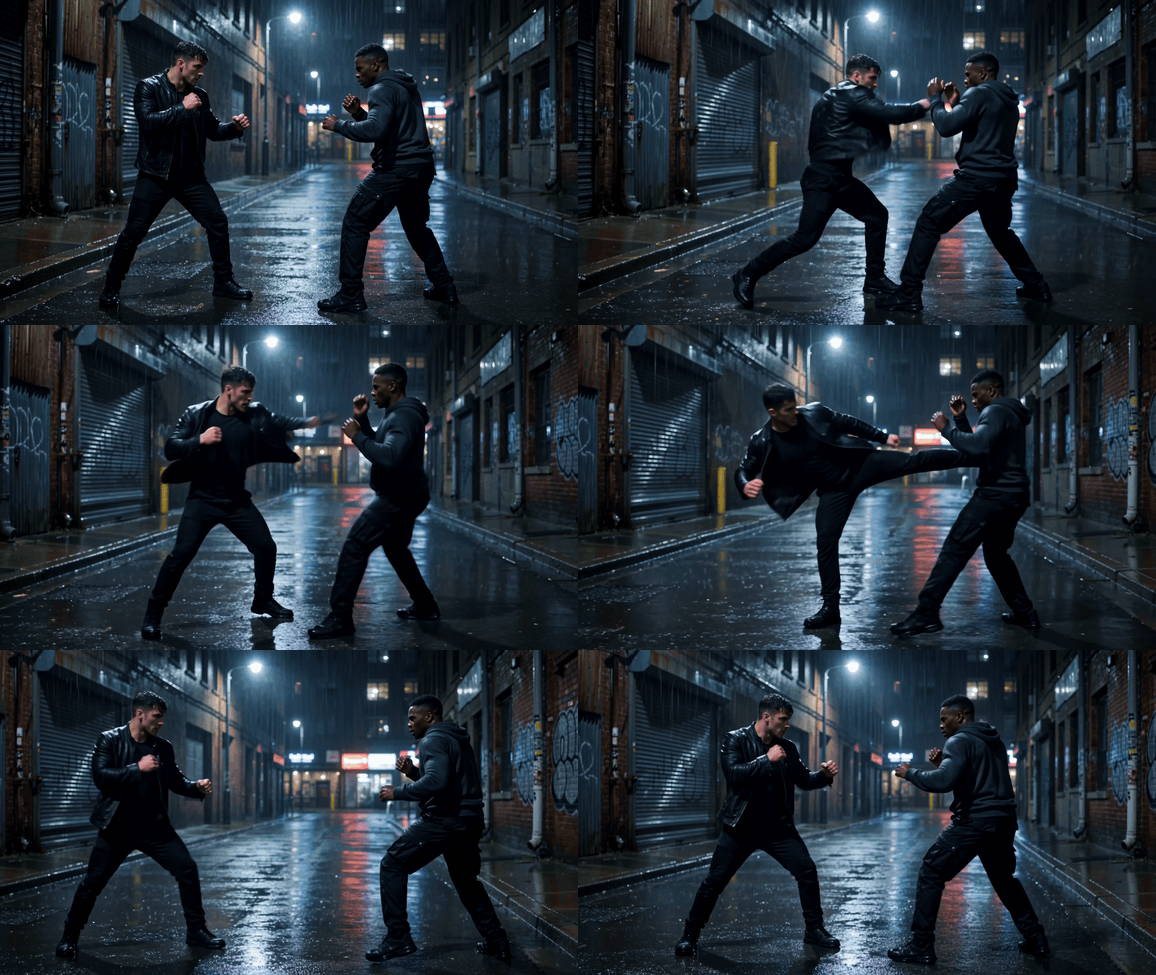
Wan 3.0 realistic action GIF showing a rainy alley fight test
Case 2: the Wan 3.0 realistic action output. Review it as motion, not as a thumbnail. Watch the block, counter-kick, weight shift, and camera path.
Step 2: Run the Same Wan 3.0 vs MiniMax H3 Prompt
Now paste the exact same prompt into MiniMax H3. Do not make the H3 prompt easier. Same prompt and same aspect ratio. If a model commits a different minimum duration, keep the real delivered duration in your notes.
Plain1Two trained stunt performers in a rain-slick city alley at night. One throws a right hook, the other blocks with the forearm, counters with a low body kick, and both fighters visibly shift weight after contact. Keep the full bodies in frame, no teleporting, no extra limbs, no disappearing hands, grounded footwork, handheld side-tracking camera, 5 seconds, cinematic realism. 2
Pick MiniMax H3 Text-to-video. Use 16:9 and the shortest available duration near 5 seconds. If the playground delivers 8 seconds, note it as an 8-second H3 run instead of rewriting history. Keep the raw file even if the first run looks rough.
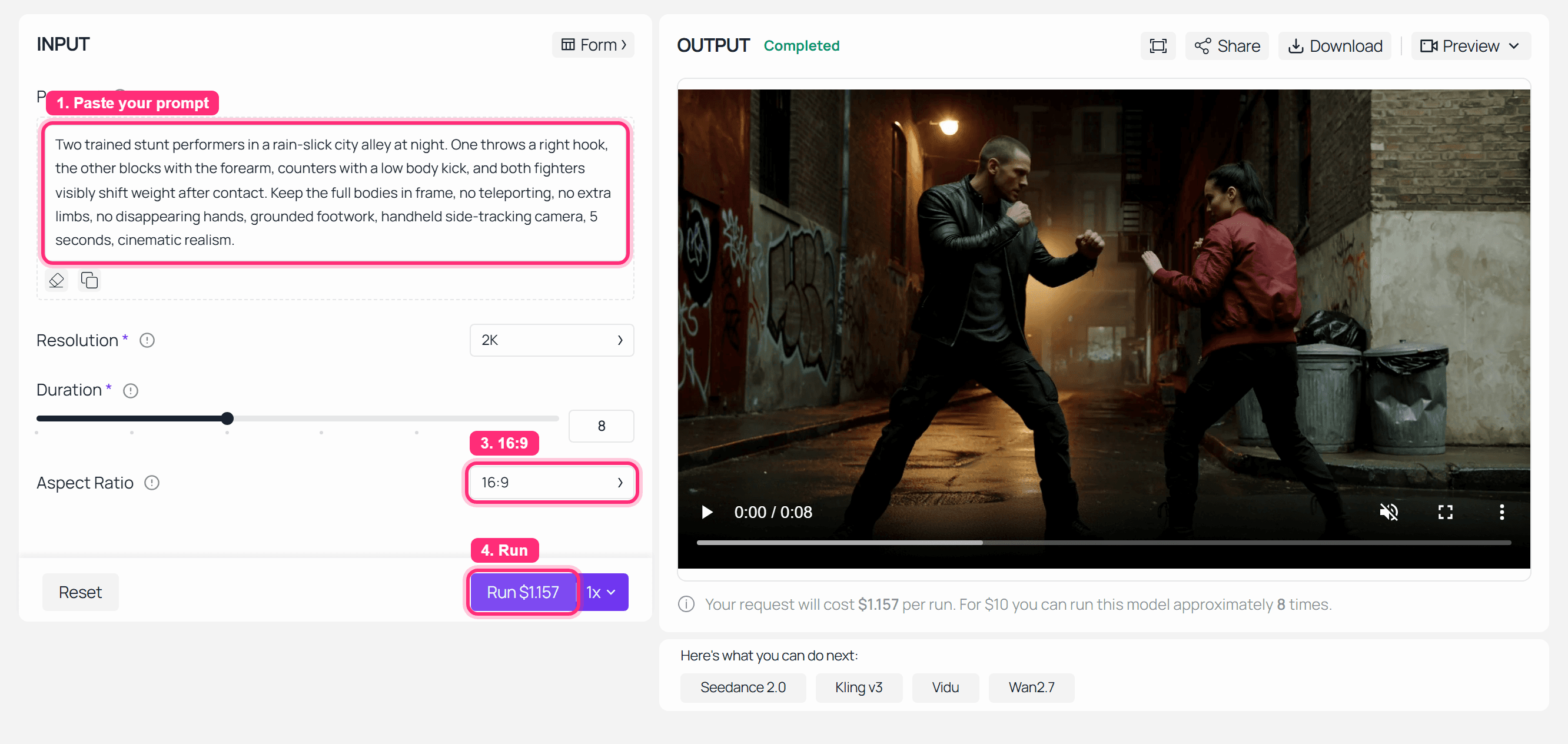
MiniMax H3 realistic action playground screenshot with completed fight prompt
MiniMax H3 on Atlas Cloud: the same realistic fight prompt is used so the comparison stays fair.
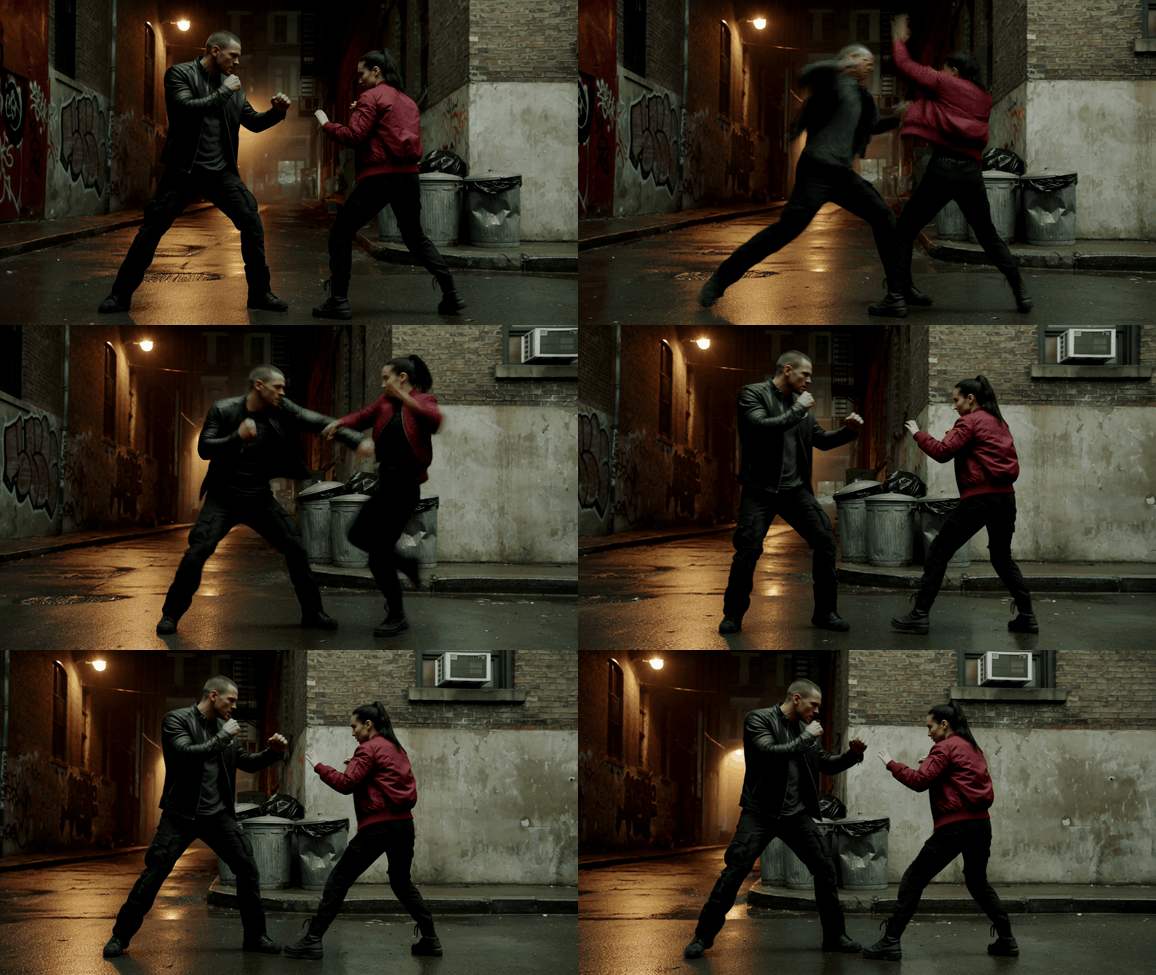
MiniMax H3 realistic action GIF showing the same alley fight test
Case 3: the MiniMax H3 realistic action output. Compare body contact, weapon-free limb continuity, and how many rerolls it takes to get a usable take.
Step 3: Score Anime Fight and Realistic Fight Choreography AI Video
Run one stylized control after the realism test. This separates a model that can sell action energy from a model that can sell grounded contact.
Plain1Anime-style rooftop duel in heavy rain. A white-haired swordsman dodges a red-haired spear fighter, slides across wet tiles, counterattacks, and ends on a blocked strike that sends a clean shockwave through the rain. Keep character designs consistent, readable silhouettes, dynamic camera orbit, speed ramps, stylized sparks, 5 seconds, 16:9. 2
Pick Wan 3.0 first for the anime fight control, then decide whether H3 needs the same rerun. Use the same duration and aspect ratio. Score the full video with the matrix below.
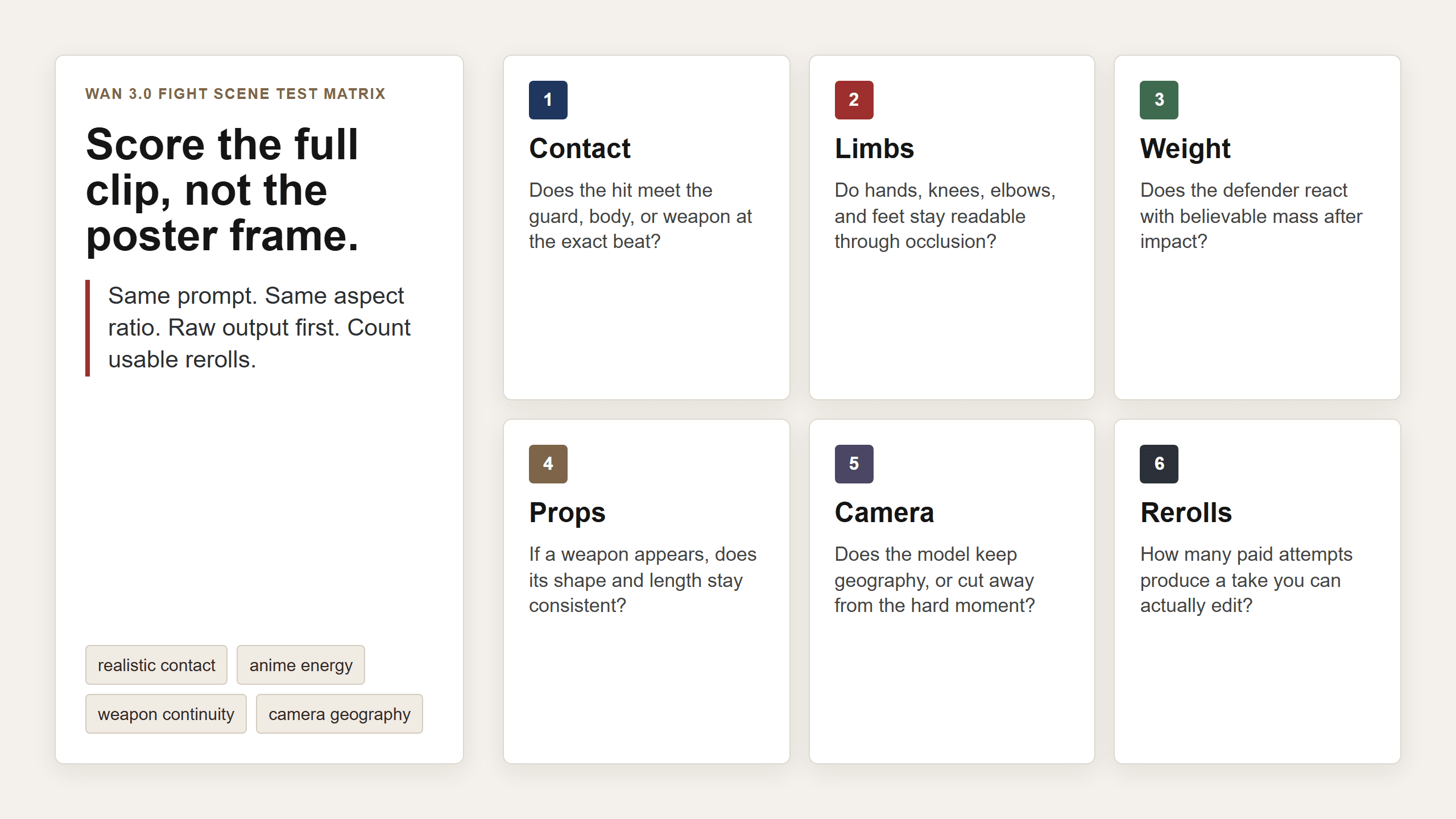
AI video action realism matrix comparing realistic fight and anime fight criteria
Case 4: the scoring matrix for Wan 3.0 anime fight tests and realistic action tests. This is the repeatable checklist, not a beauty contest.
Cost Notes for Wan 3.0 vs MiniMax H3 Testing
Budget by attempts, not by one perfect clip. A fight scene can need 3 to 8 rerolls because the failure may appear only after the hit lands.
A practical first pass:
| Test | Duration | Runs | What you learn |
|---|---|---|---|
| Realistic contact | 5s | 3 per model | Contact, limbs, reaction timing |
| Anime fight | 5s | 2 per model | Energy, silhouettes, camera rhythm |
| Weapon/contact control | 5s | 3 per model | Prop continuity and occlusion |
Do not judge from the poster frame. Watch the full clip once at normal speed, once paused on contact, and once for camera drift. Track the reroll count beside each model. The useful output is not just the prettiest clip; it is the model that gives usable motion for your exact shot type with the fewest paid attempts.
For Atlas Cloud links, use the live model page and the quote shown at run time. The public model catalog is where you should recheck prices before a larger batch.
Frequently Asked Questions
Is Wan 3.0 bad at fight scenes?
No. Wan 3.0 can make usable fight-adjacent shots, stylized action, and atmospheric movement. The weak spot is precise realistic contact, where small errors in hands, knees, recoil, or timing become visible.
Why does a Wan 3.0 realistic action shot fail more often than anime action?
Realistic action has strict physics expectations. A punch must meet a face or guard, the defender must react with weight, and the camera must preserve geography. Anime action can use speed ramps, sparks, smears, and shockwaves to make looser motion feel intentional.
How should I test Wan 3.0 vs MiniMax H3?
Use the same prompt, same duration, same aspect ratio, and same review sheet. Save raw outputs, count rerolls, and review full clips. Then choose by shot type rather than declaring one universal winner.
What should I check in an AI video fight scene first?
Check contact, limbs, body mass, timing, weapon or prop continuity, camera continuity, and whether the model hides the hard moment with a cut. A clean poster frame can still become a broken motion clip.
When should I use Wan 3.0 fight scene prompts in production?
Use a Wan 3.0 fight scene prompt when you want atmosphere, tension, anime-style action, or a longer dramatic setup. For grounded close-contact choreography, test Wan 3.0 against a more controlled short-action workflow and route the shot by results.





