Latest update: Wan 3.0 is now live as of August 24, 2026.
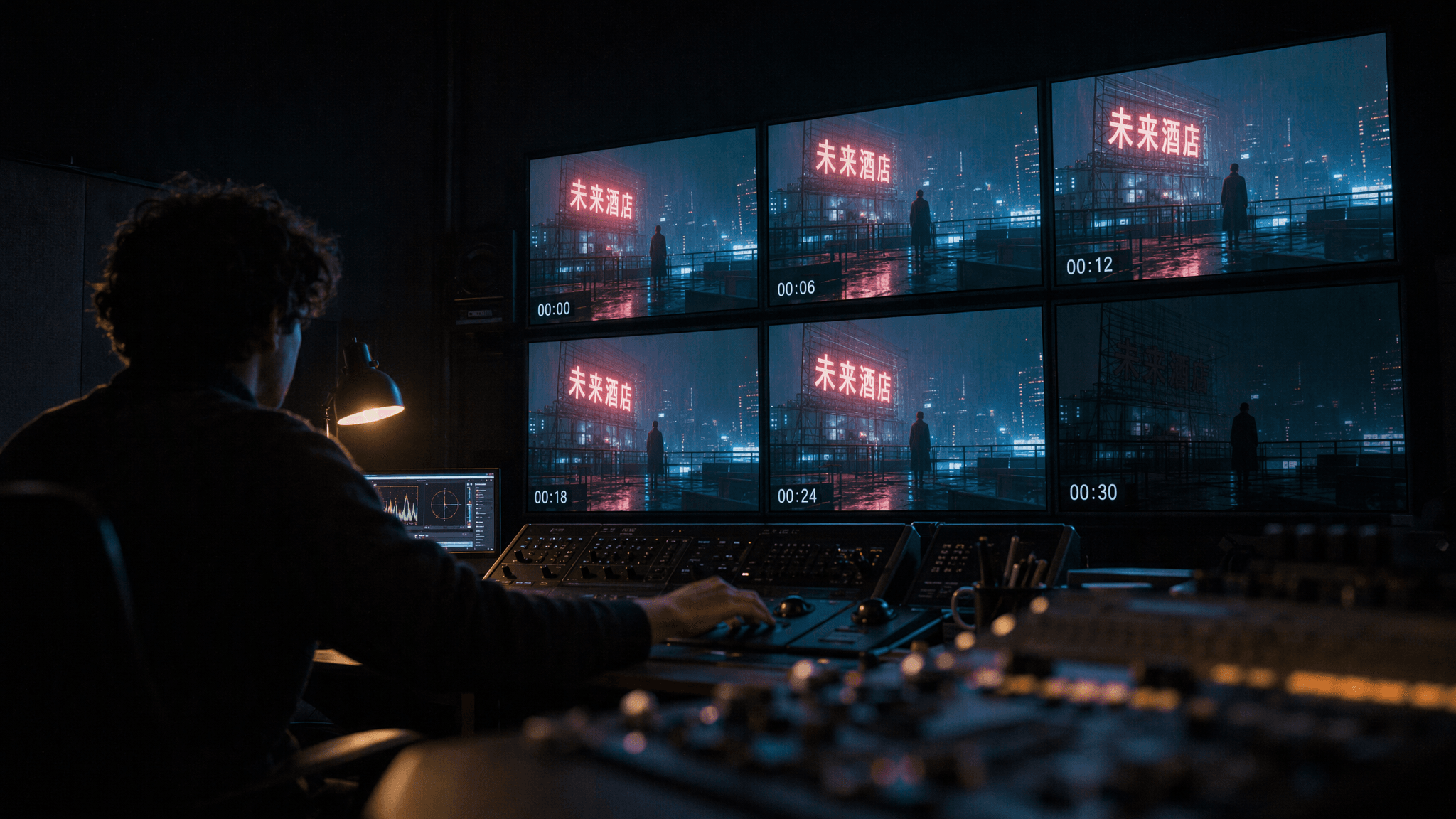
A colour-grading suite wall showing the same rainy rooftop shot at timecodes from 00:00 to 00:30
Thirty seconds of one continuous take, laid out across a timeline. Getting there is the whole story.
The day Wan 3.0 Preview went into public beta, I went looking for its spec sheet. The first page of results told me it does native 4K, that it ships under Apache 2.0, and that it has a "six-camera AI director mode." Six different sites, same claims, and not one of them linked to a primary source.
So I opened Alibaba's own model page. 480P, 720P, 1080P. No 4K. Then I hit the Hugging Face API directly and pulled every repository under the Wan-AI organization. The newest one is Wan2.2-Animate-2, pushed the same day Wan 3.0 launched. There is no 3.0 anything.
Then I did the part nobody else is doing. Wan 3.0's headline is 30 seconds of continuous video in a single pass, and I do not have access to it, so I tried to reproduce that result with the models I can actually call today. I failed. The way I failed turned out to be the most useful thing in this article.
Key takeaways
- Wan 3.0 Preview entered public beta on August 6, 2026. Model ID
wan3.0-video, gated behind an application on Alibaba Cloud Model Studio and Qwen Cloud. It is not open signup. - The real specs: up to 30 seconds in a single pass, 480P/720P/1080P, at $0.05/$0.10/$0.20 per output second.
- There is no 4K and there are no open weights. I queried the Hugging Face API for every repo under
Wan-AI. Nothing above Wan 2.2 exists as a download. - The rate limits are the real bottleneck: 2 concurrent requests, 30 RPM, 50 queued async tasks.
- You cannot fake the 30-second one-take with Wan 2.7. Three undocumented limits cap the longest genuinely continuous clip at 15 seconds, and chaining a second continuation makes the model loop backwards instead of forwards.
The 15-Second Wall: What Wan 3.0 Preview Is Really Selling
Here is the best result I could get. Fifteen unbroken seconds at 1080P: a push in on a neon sign, a vendor closing up a rooftop coffee stall in the rain, then a crane down to the wet street and a taxi. One continuous generated file, no editing, generated audio.
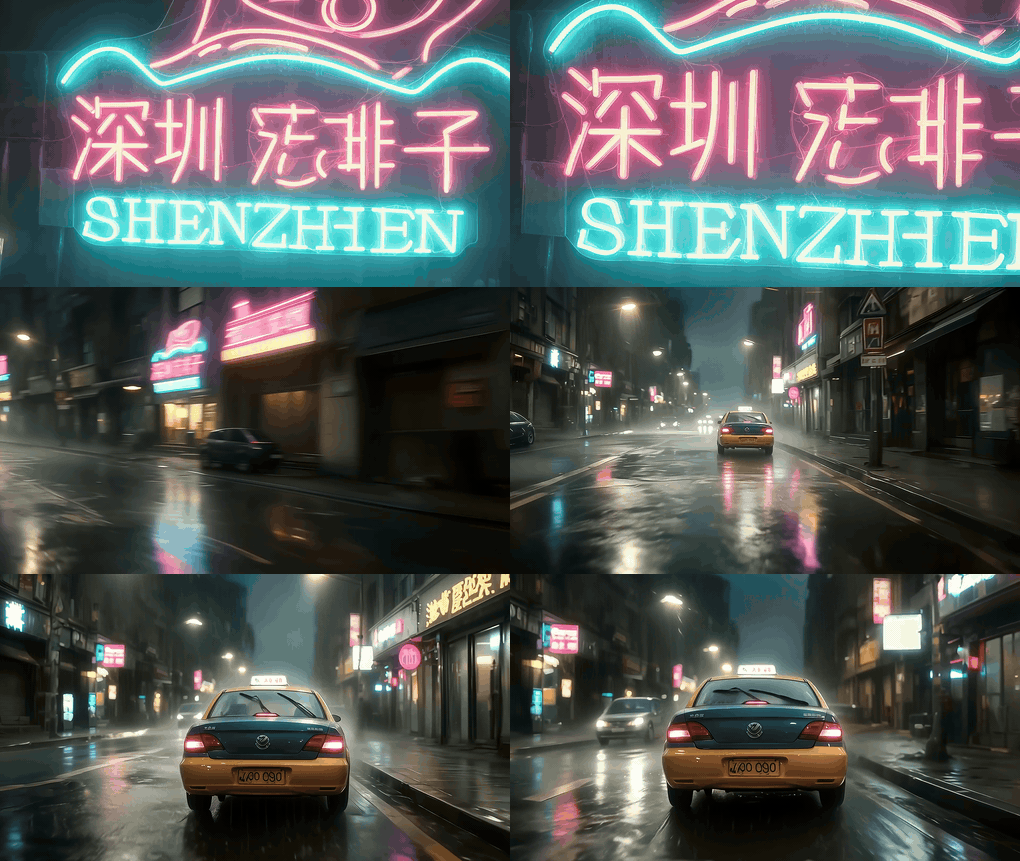
Fifteen seconds of continuous Wan 2.7 video: neon sign, rooftop vendor, crane down to a rainy street and a taxi
The longest genuinely continuous clip the Wan 2.7 family produced for me: 15 seconds, 1080P, one file. Shown here as a silent GIF; the delivered file carries 44.1kHz stereo audio.
That is good. It is also exactly half of what Wan 3.0 claims to do in one call, and 15 seconds is where the ceiling is welded shut. Everything below is how I found the weld.
Why Every Wan 3.0 Preview Spec Sheet You Read Is Probably Wrong
Two things make this launch unusually noisy. First, 30 seconds in a single generation pass is a genuine first for the family. Wan2.7-Video tops out at 15 seconds and most mainstream video models sit between 5 and 15 (TNGlobal, August 2026). Second, Wan 3.0 takes reference inputs nobody else takes: alongside text, image, audio and video it accepts doc, xls, ppt, pdf and md files plus web pages, so a slide deck becomes a video (AlphaSignal, August 2026).
That combination produced an enormous amount of coverage from sites that never opened the documentation. Here is every widely circulated claim, checked against the primary source.
Table A: Wan 3.0 Preview spec check
| Circulating claim | What the primary source says | Verdict |
|---|---|---|
| 30 seconds in one generation pass | Confirmed, versus 2 to 15s in Wan 2.7 | ✅ Real |
| Native 4K output | Official resolutions are 480P, 720P and 1080P only | ❌ False |
| Apache 2.0 open weights | No Wan 3.0 repository exists under Wan-AI on Hugging Face | ❌ False |
| Document-to-video (PDF, PPT, XLS) | Confirmed as a reference input type | ✅ Real |
| "Six-camera AI director mode" | Appears in no Alibaba documentation | ❌ Unsupported |
| "12-language lip sync with identity lock" | Appears in no Alibaba documentation | ❌ Unsupported |
| $0.05 / $0.10 / $0.20 per second | Confirmed for 480P / 720P / 1080P | ✅ Real |
| Open to everyone | Application-gated on Model Studio and Qwen Cloud | ⚠️ Beta, invite required |
The pricing and rate limits come straight from the model page: 2 concurrent requests, 30 requests per minute, and a 50-task async queue (QwenCloud, August 2026). That concurrency number gets almost no coverage and it is the most important line on the page. Two parallel jobs, each taking minutes, is fine for a launch demo. It is not a pipeline.
Now the question the open-source community actually cares about. Wan 2.1 and Wan 2.2 shipped downloadable checkpoints. Wan 2.5 promised weights that never landed, Wan 2.6 was fully closed, and Wan 2.7 stayed API-only. I checked whether 3.0 breaks the streak by querying the Hugging Face API for every model under the Wan-AI organization, sorted by creation date. The three newest repositories are all Wan2.2-Animate-2 variants created on August 6, 2026, the same day Wan 3.0 launched. The most-downloaded repo is still Wan2.2-TI2V-5B-Diffusers at roughly 179,000 downloads in the last 30 days (Hugging Face, August 2026).
So the answer is no, and Wan 2.2 remains the open-weight ceiling. If your plan involved running this locally or fine-tuning it, there is nothing to run.
Try the live model on Atlas Cloud: open Wan 3.0 Text-to-Video on Atlas Cloud.
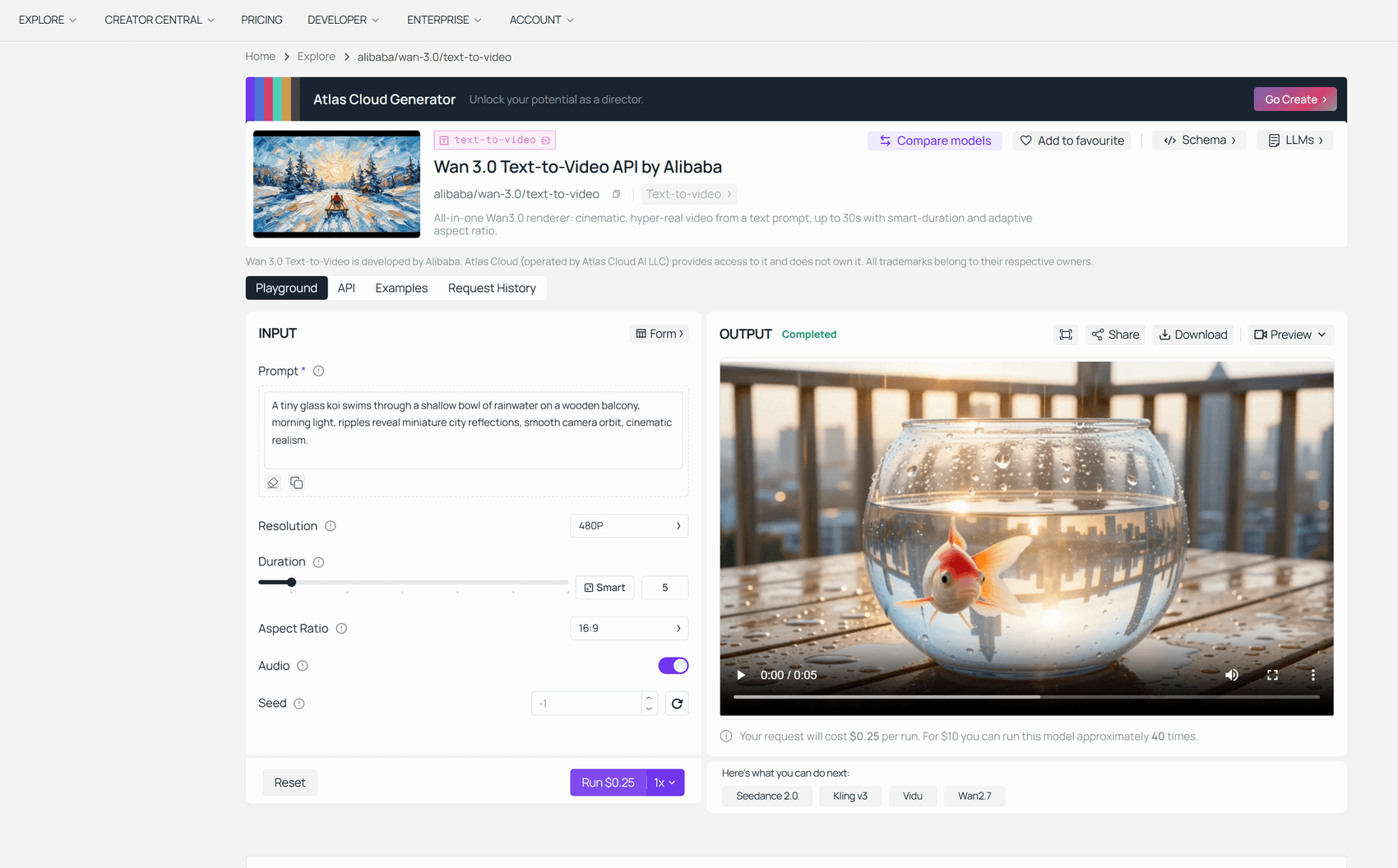
A real Atlas Cloud Wan 3.0 Text-to-Video playground run: the prompt is shown on the left, and the completed generated clip appears on the right.
The Wan 3.0 Preview Stack: What You Can Actually Run Today
The situation splits cleanly. Wan 3.0 sits behind an application form with a two-job concurrency cap. Everything before it, Wan 2.7 back through 2.2, is callable immediately on one API key, alongside Seedance and Kling for cross-model comparison. Everything in this article was run that way, in one browser tab.
Prices below came from the Atlas Cloud model catalogue on August 10, 2026, not from any blog post.
Table B: Wan 3.0 Preview versus what is on the shelf
| Model | Longest single pass | Resolutions | Access | Concurrency | Listed price per second |
|---|---|---|---|---|---|
| Wan 3.0 Preview | 30s | 480P / 720P / 1080P | Application required | 2 | $0.05 / $0.10 / $0.20 |
| Wan 2.7 text-to-video | 15s | 720P / 1080P / 1080P-SR / 1440P-SR | Open | Standard | from $0.10 |
| Wan 2.7 image-to-video | 15s | 720P / 1080P | Open | Standard | from $0.10 |
| Wan 2.6 text-to-video | 15s | 720p / 1080p | Open | Standard | $0.07 (30% off $0.10) |
| Wan 2.5 text-to-video | 10s | 720p / 1080p | Open | Standard | $0.035 (30% off $0.05) |
| Wan 2.2 image-to-video | 10s | 480p / 720p | Open, weights downloadable | Standard | $0.03 |
| Seedance 2.5 text-to-video | 30s | 480p / 720p | Open | Standard | from $0.134 |
| Kling v3.0 Pro text-to-video | 15s | Model default | Open | Standard | $0.095 (15% off $0.112) |
Discounts are live as of August 2026 and time-limited, so check the model page before budgeting against them.
Two things fall out of that table. Wan 3.0's 30-second single pass is not unique any more: Seedance 2.5 already accepts a duration of 4 to 30 seconds in one call, just capped at 720p. And Wan 2.7 is the only row offering 1440P-SR, a super-resolution tier billed at 80% of native 1080P per its own schema, which Wan 3.0 does not have.
What Wan 3.0 has that nothing else does is 30 seconds at 1080P in one pass, plus document reference inputs. Wan 3.0 has a placeholder page on Atlas Cloud marked Coming Soon, so it lands on the same key when it ships. Until then, here is exactly how far the older models get you.
Wan 3.0 Preview Tutorial Step 1: Write the One-Take Brief
The brief carries over between generations, so write it once. Wan 3.0 rewards long, timecoded shot descriptions, and Wan 2.7 accepts the same structure inside a 5,000-character prompt limit.
The template that works: Shot [timecode] + subject action + camera move + light + ambient audio. Declare the take is continuous in the first line, and describe the sound bed explicitly, because Wan 2.7 generates audio natively and will invent something unhelpful if you leave it blank.
I picked a rainy night rooftop coffee stall on purpose. It stress-tests four things that usually break at once: sustained camera movement, face consistency over time, wet neon reflections, and a continuous ambient audio bed.
textCopy
text11BEAT 1 (0-10s): Slow dolly-in from a flickering pink-and-cyan neon sign toward a 22young female vendor wiping down a steel counter on a rooftop coffee stall. 33BEAT 2 (10-15s): The camera cranes down over the rooftop edge to the wet street 44below, gliding toward a taxi idling at the curb. 55Constant: heavy rain, neon palette, 35mm anamorphic, film grain, no cuts. 66
That is the plan, not the prompt. The prompts you paste are below.
Step 2: Generate the Opening at 1080P
Open the Wan 2.7 text-to-video page and paste Beat 1, written out in full.
textCopy
text11Continuous single take, no cuts. A rainy night rooftop coffee stall in Shenzhen. 22Shot [0-4s]: Slow dolly-in from a flickering pink-and-cyan neon sign toward a 33young female vendor wiping down a steel counter, rain streaking through the neon 44glow, steam rising from a kettle. 55Shot [4-10s]: The camera settles at chest height as she looks up and half-smiles, 66shallow depth of field, wet reflections on the counter, raindrops visible against 77the dark sky behind her. 88Audio: steady rain, distant traffic hum, the clink of a ceramic cup. 99Cinematic, anamorphic, 35mm, high dynamic range, fine film grain. 1010
Settings: Resolution 1080P, Aspect ratio 16:9, Duration 10, Prompt extend OFF.
Prompt extend is on by default and it rewrites your prompt before generation, which quietly destroys timecoded shot control. Turn it off whenever the shot breakdown is the point.
Set duration to 10 rather than the 15-second maximum. That is not a cost decision, and the reason only becomes visible in Step 3.
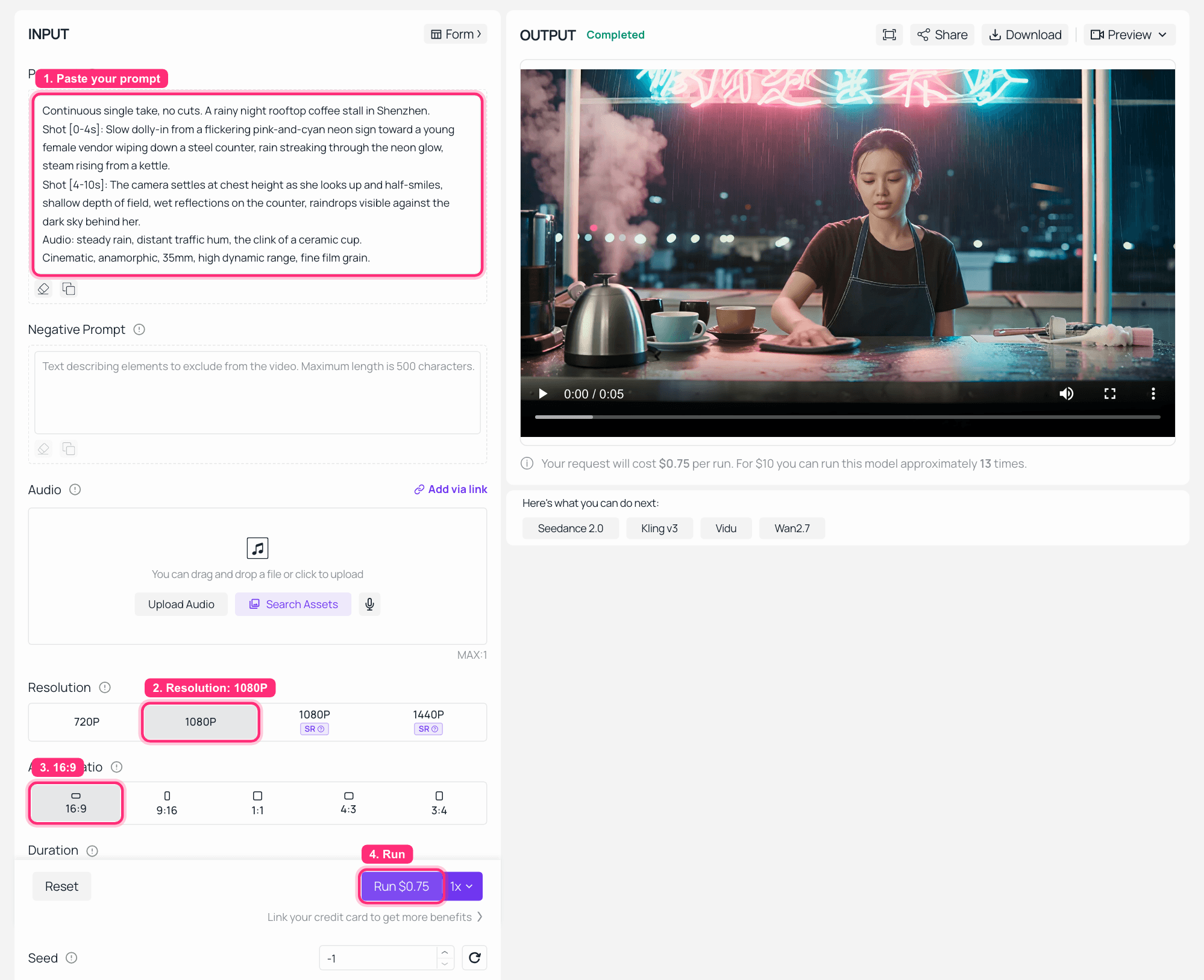
Wan 2.7 text-to-video on Atlas Cloud, run completed, 1080P output visible in the OUTPUT panel
Step 2 in the playground: prompt pasted, 1080P, 16:9, run completed with the result on the right. Note the Run button quote of $0.75 for a five-second 1080P job, which works out to $0.15 per second rather than the catalogue's "from $0.10".
Step 3: Continue It, and Watch Where It Breaks
Wan 2.7's image-to-video endpoint has a video-continuation mode that takes an existing clip and keeps shooting. Take your Step 2 output URL, put it in the video field, set Duration to 15, and paste Beat 2:
textCopy
text11Continue the same unbroken take with identical camera language and lighting. 22The crane-down continues past the rooftop edge to street level, the camera 33gliding forward through the rain toward a taxi idling at the curb, wipers 44sweeping. Keep the rain intensity, neon colour palette, film grain and ambient 55audio identical to the source clip. No cut, no fade, no scene change. 66
That produces the 15-second clip at the top of this article. Now the three limits I hit, none of which are in the docs.
One: the source clip must be 2 to 10 seconds. That is why Step 2 is capped at 10. Generate a 15-second opening and you cannot extend it at all, because a 15-second file is not a legal input.
Two: the requested duration must exceed the source duration. Feed a 10-second clip and ask for 10 seconds and the API rejects it outright: first_clip duration (10s after trim) must be less than the requested duration (10s). So the output contains the source, and the most you can gain in one pass is 5 seconds.
Three: it does not preserve your source clip. This is the one that matters. Below, the top row is the original 10-second clip at 5s and 9.9s. The bottom row is the continuation output at those same two timecodes.
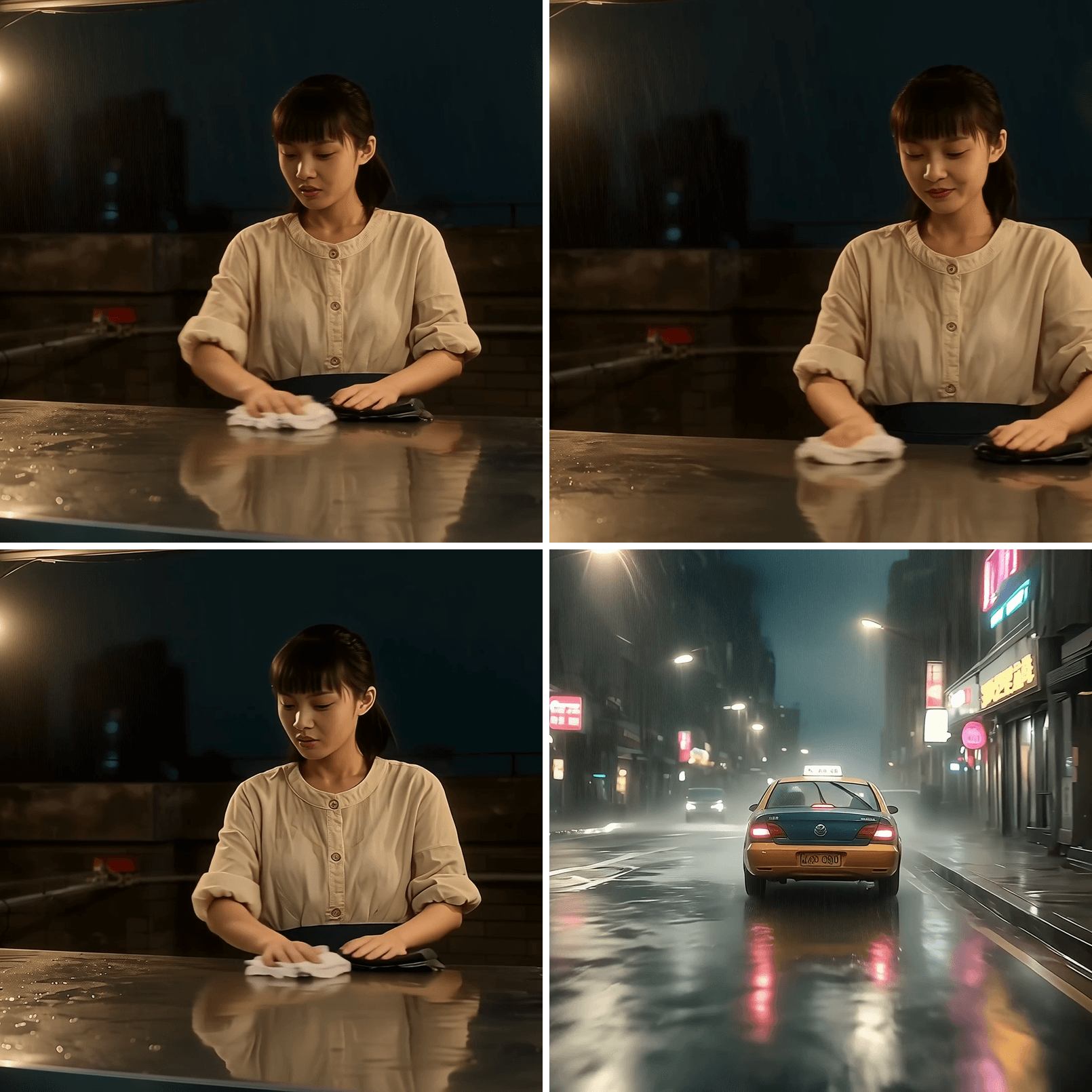
Four frames comparing the source clip and the continuation output at 5 seconds and 9.9 seconds
Top row: the source clip at 5s and 9.9s. Bottom row: the continuation output at the same timecodes. At 5s they match. By 9.9s the source is still on the vendor while the continuation has already cut to the street, because it recompressed the source into roughly its first six seconds and spent the rest on new material.
So continuation is not concatenation. It re-renders your clip faster to make room, and the last few seconds of your original performance are simply gone.
Which raises the obvious idea: chain it. Feed the 15-second result back in and ask for another 15. I tried. Here is what came back.
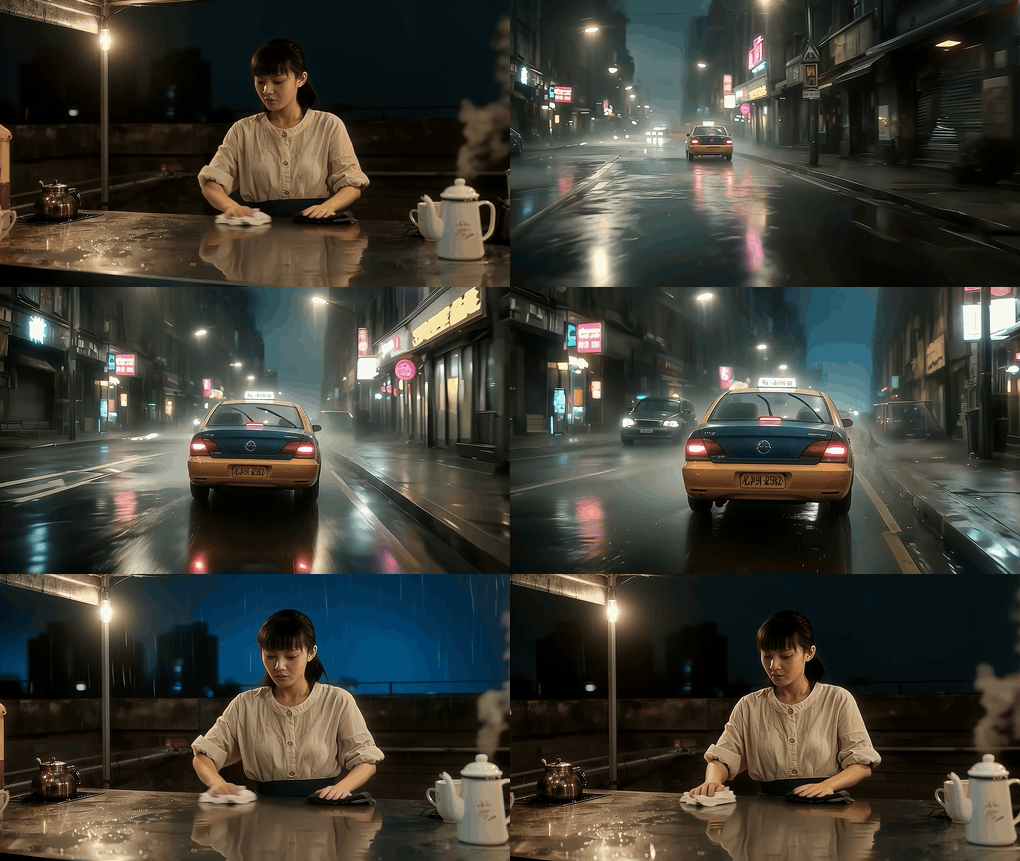
A chained second continuation that drifts back to the rooftop vendor instead of advancing the scene
The second continuation pass. It replays the street and taxi, then loops back to the rooftop vendor from the very beginning of the sequence instead of moving forward. Chaining does not accumulate.
That is the wall. The output cap is 15 seconds, the input cap is 10, and the second link in the chain runs backwards. Fifteen seconds of genuinely continuous footage is the ceiling for this model family. Anything longer is a cut, not a take, and cuts are exactly what a 30-second single pass exists to eliminate.
One disclosure: the playground capture for this continuation step failed three times because the page's preset reference image kept hijacking the run, so Step 3 was executed through the API rather than the playground UI. The prompt, settings and outputs above are all from that real run.
What 30 Seconds of Wan 3.0 Preview Actually Costs
The Run button in Step 2 quoted $0.75 for a five-second 1080P job. That is $0.15 per second, not the $0.10 the catalogue lists, because the listed figure is a floor and billing scales with resolution. Always trust the quote over the card.
At that real rate, my 15 seconds of continuous footage cost $1.50 for the 10-second opening plus $2.25 for the continuation, so $3.75 for 15 delivered seconds.
Table C: what 30 seconds costs, five ways
| Path | Calculation | Total | What you actually get |
|---|---|---|---|
| Wan 3.0 Preview, 1080P | $0.20 × 30 | $6.00 | 30s continuous, one pass, no seams |
| Wan 3.0 Preview, 720P | $0.10 × 30 | $3.00 | 30s continuous at 720P |
| Wan 3.0 Preview, 480P | $0.05 × 30 | $1.50 | 30s continuous at 480P |
| Wan 2.7, opening plus continuation | $0.15 × 25 billed | $3.75 | 15s only. Cannot reach 30. |
| Seedance 2.5, 480p | from $0.134 × 30 | ~$4.05 | 30s continuous, capped at 720p |
Read the fourth row again. Producing 15 continuous seconds on Wan 2.7 cost more than Wan 3.0 charges for 30 continuous seconds at 720P. The workaround is not the cheap option, it is the expensive one that also does not work.
One caveat on the Seedance row: its listed rate is the 480p floor and the model bills by pixel area, so 720p runs roughly 2.25 times that number in practice.
On licensing, be careful. Wan 3.0 is in beta, so commercial terms come from the Alibaba Cloud service agreement you accept at application time rather than any model licence, and they can change before general availability. With no published weights, local deployment and fine-tuning are not options. Confirm attribution and watermarking requirements against your own account terms before shipping client work.
Frequently Asked Questions
Is Wan 3.0 Preview available to everyone yet?
No. It entered public beta on August 6, 2026, but access is application-gated through Alibaba Cloud Model Studio and Qwen Cloud. Approved accounts get 2 concurrent requests, 30 RPM and a 50-task async queue, which is sized for evaluation rather than production.
Is Wan 3.0 Preview open source, and where are the weights?
There are none. Querying the Hugging Face API for every repository under the Wan-AI organization returns nothing above Wan 2.2. The three newest repos, all Wan2.2-Animate-2 variants, were created on the same day Wan 3.0 launched. Wan 2.2 remains the open-weight ceiling.
Does Wan 3.0 Preview really do native 4K?
No. The official documentation lists 480P, 720P and 1080P. The 4K claim comes from aggregator sites citing each other rather than the primary source, and it contradicts Alibaba's own pricing table, which has exactly three resolution tiers.
How much does a 30-second Wan 3.0 Preview video cost?
At 1080P, $0.20 per output second gives $6.00 for 30 seconds. At 720P it is $3.00 and at 480P it is $1.50. For comparison, 15 continuous seconds on Wan 2.7 at 1080P cost me $3.75 at the real billed rate.
Can I generate a 30-second one-take today without Wan 3.0 Preview access?
Not with Wan 2.7. Its continuation mode caps output at 15 seconds, only accepts source clips of 10 seconds or less, and loops backwards when chained. Seedance 2.5 will do 4 to 30 seconds in a single pass, but only up to 720p.
Wan 3.0 Preview versus Wan 2.7: is it worth waiting for?
If you need one continuous shot longer than 15 seconds, or document and webpage reference inputs, yes, and there is no workaround. For anything at 15 seconds or under, Wan 2.7 is more practical right now, because a 2-request concurrency cap makes batch work slower on 3.0 than on the model it replaces.





