

The remote is already in her hand. Your spot has about three seconds before her thumb moves, and nothing you planned for second twenty matters if it does.
This guide answers what makes a good TV ad with four elements: an opening that earns those first three seconds, one message, the product on screen early, and an ending that asks for one action. Rather than describe the difference, we wrote two briefs for the same canned drink, one that follows all four elements and one that breaks all four, and rendered both as 30-second spots from the same product photo and the same model.
The creative deserves that attention. NCSolutions' 2023 analysis of its purchase data found that "creative quality is responsible for almost half (49%) of the incremental sales driven by advertising." Each section below takes one element and shows the two spots side by side.
Key Takeaways
- A good TV ad opens on an action in its first three seconds, never on a logo card.
- Give each spot one message. Kantar's ad database shows a single message outperforms several.
- Show the product early. Cadbury could hide its bar because the brand was a century old; a new drink cannot.
- Endonone action the viewer can take, said in the voiceover and shown on screen.
- Render the same product from two briefs in TVC Maker to see every element side by side.
What Makes a Good TV Ad in 30 Seconds
A good TV ad does four things, and each one has a place on the clock. Something happens in the first three seconds. The product is in frame before the viewer has decided whether to stay. The voiceover carries one claim, repeated rather than extended. The last three seconds tell the viewer what to do next.
Google and Kantar's ABCD research across YouTube campaigns put a number on getting the fundamentals right: ads that followed the framework showed a 30% lift in short-term sales likelihood and a 17% lift in long-term brand contribution, as Think with Google reported in April 2022. Its letters stand for Attract, Brand, Connect and Direct, and the four elements below cover the same ground.
To test the four elements on a real render, we invented a drink. Marlow Yuzu is a fictional sparkling soda in a pale-yellow can. Brief A follows all four elements. Brief B breaks all four in the ways first drafts usually do: it opens on a logo card, stacks three claims into the voiceover, holds the can back past the halfway mark, and fades out on a sunset with no ask.
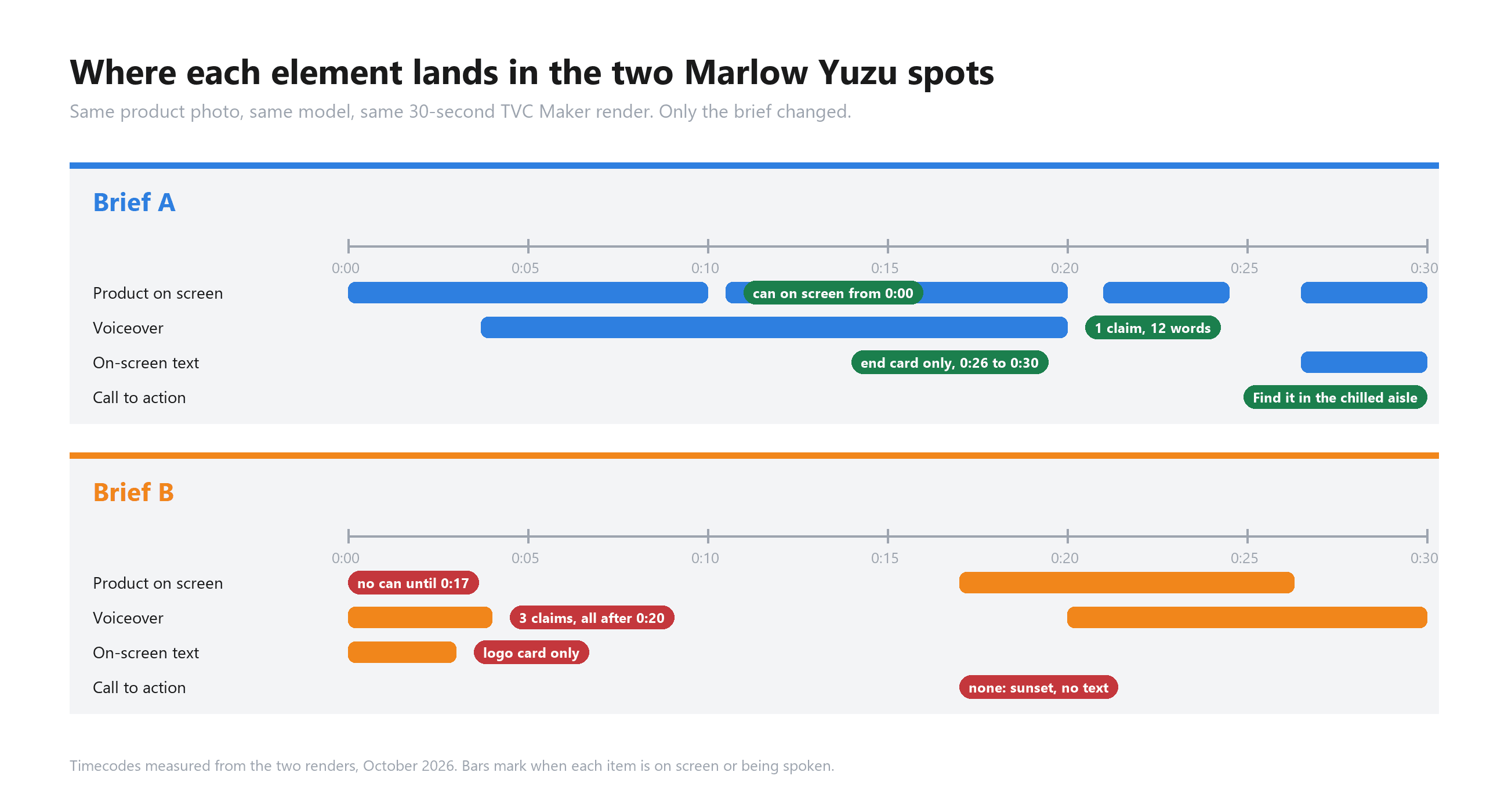
Both briefs went through the same workflow with the same can photo and the same model photo. Here is where the two spots put each element on the timeline:
How We Tested the Four Elements With TVC Maker
On Atlas Cloud, the TVC Maker workflow takes one product photo and a written brief and renders a multi-shot commercial with voiceover, music and ambient sound.
That made it the right instrument for this test: the only variable between the two spots is the brief.
Here is the spot from Brief A, rendered at 30 seconds in 16:9:
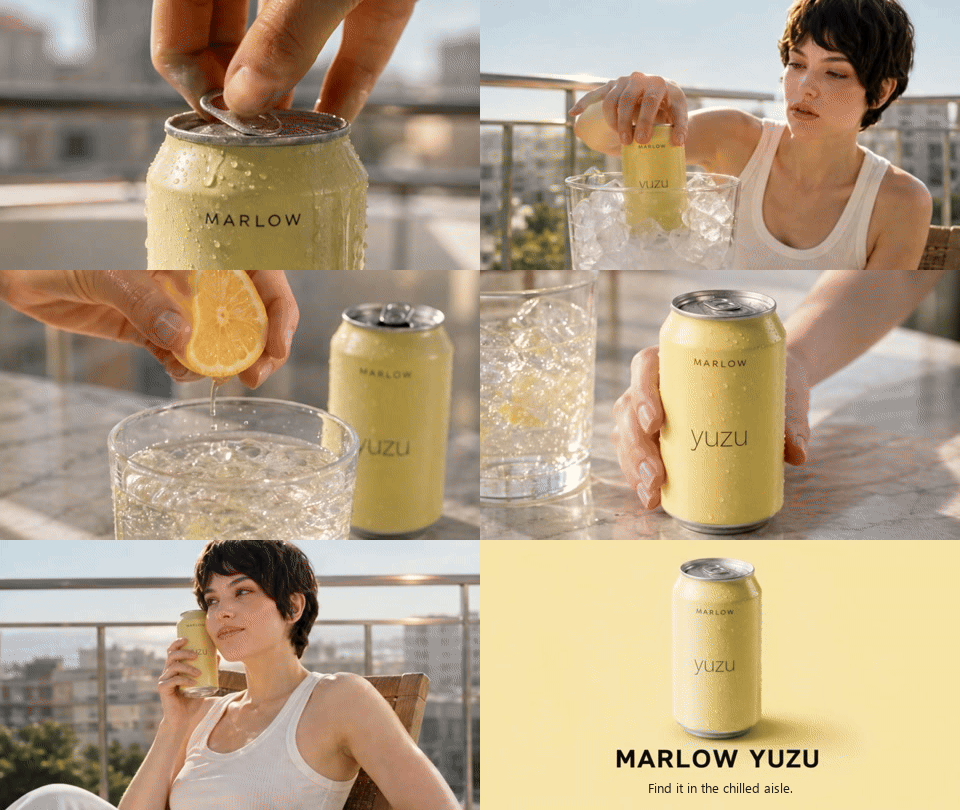
Highlights from the Brief A spot, shown as a GIF without sound. In the full render the voiceover starts at 0:03, after the fizz, and reads the quoted line word for word.
Three inputs made that spot: a studio photo of the can, a photo of the model, and this brief. The numbered shots do the job of a storyboard, and the quoted line is the entire voiceover.
plaintext1Brand: Marlow, a sparkling soft drink label. Product: Marlow Yuzu, a slim pale-yellow can of sparkling yuzu soda. One message: real yuzu, nothing fake. Audience: adults 25 to 40 who want a sharp cold drink instead of sugary cola. Tone: bright, crisp, late-afternoon summer light, quick cuts, realistic. The woman from the model photo wears a white sleeveless top and never holds a phone. 2Shots: 1) extreme close-up, the can's tab cracks open and fizz bursts over the rim, condensation beads sliding down the pale-yellow label; 2) she lifts the can from an ice bucket on a sunny balcony table and takes a long sip, eyes closing, visible relief from the heat; 3) macro, a yuzu half squeezed over a glass, the juice meeting the bubbles; 4) close-up of the can label reading MARLOW and yuzu as she sets it down on the table; 5) she leans back in the balcony chair, the cold can pressed to her cheek, a small smile; 6) end card, the can alone on a pale-yellow background with bold text MARLOW YUZU and a second line Find it in the chilled aisle. 3Voiceover, warm female voice, starting after the fizz at about 0:03: "Real yuzu. Nothing fake. Marlow Yuzu. Find it in the chilled aisle." 4Text on screen: only in shot 6.
Brief B kept the brand, the product, the audience and the model photo, and changed four things: shot 1 became a logo card with no product, the can moved to shot 5, the voiceover grew to three claims (real juice, forty percent less sugar than cola, a recyclable can), and shot 6 became an empty beach at sunset with no text.
If you prefer to draft in a two-column script before turning it into a brief, our commercial script template covers the format and the word budget.
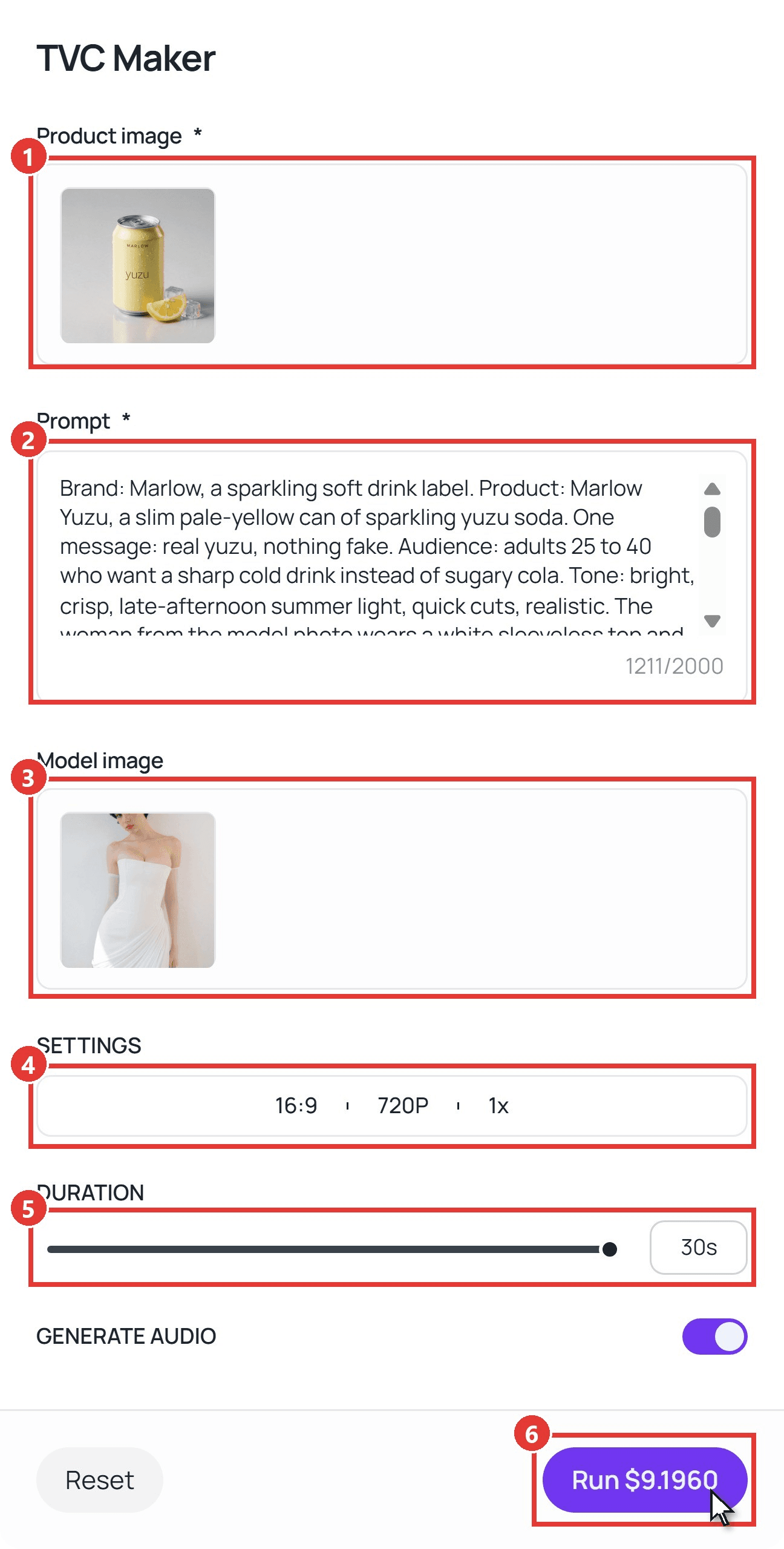
Filling in the form takes six steps, in this order:
- Upload one clean shot of the product in Productimage. The label, the color and any printed text follow this photo.
- Paste the brief into Prompt. Brief A used about 1,200 of the 2,000 characters.
- Add a Modelimage if the spot needs one face throughout. We used the same photo for both briefs so the comparison stays fair.
- Open SETTINGS and choose 16:9 for TV and YouTube or 9:16 for vertical placements, then pick the resolution.
- Drag DURATION to the spot length, anywhere from 4 to 30 seconds.
- Leave Generate audio on and click Run.
The First Three Seconds of a TV Ad Decide Who Keeps Watching
Nobody decides to watch a commercial. They decide not to leave, and they decide fast. Facebook's research with Nielsen on video ads in its own feed found that "up to 47% of the value in a video campaign was delivered in the first three seconds." That figure comes from feed video, where leaving costs a flick of the thumb, but the habit it describes follows people to the sofa.
Television has its own version of the number. Kantar's February 2026 study of Super Bowl ads lists early brand presence, within two seconds, among the drivers of strong performance.
Brief A opens on the tab cracking and fizz bursting over the rim. The sound does the work before anyone speaks, and the pale-yellow can is already the subject of the frame. Brief B opens on the word MARLOW fading in over a plain background. A name means nothing to someone who has never bought the drink, and for the next few seconds the spot is asking for patience it has not earned.
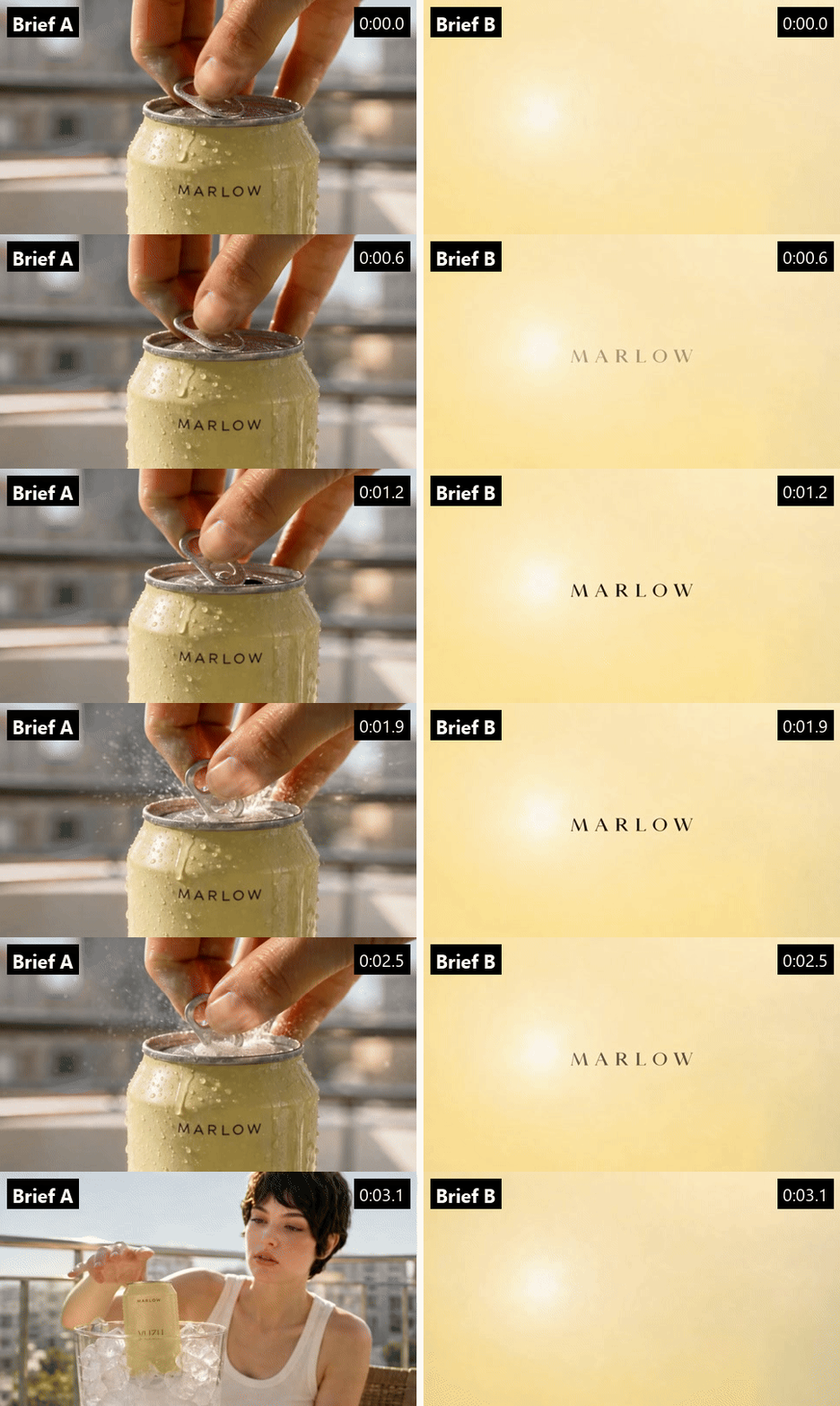
The first three seconds of each spot , played side by side. Brief A has already shown the product and a sound cue; Brief B has shown a name.
One Message, Said Once
A 30-second spot can carry one idea cleanly. Kantar's Link database of US TV ads supports that with a chart headed "One message in an ad has much more impact than multiple," and the accompanying explanation is blunt: "Too many messages can dilute communication as our brains can only really think about 3-4 things at once." A commercial competes with the room, the phone and the next ad, so the real budget is closer to one.
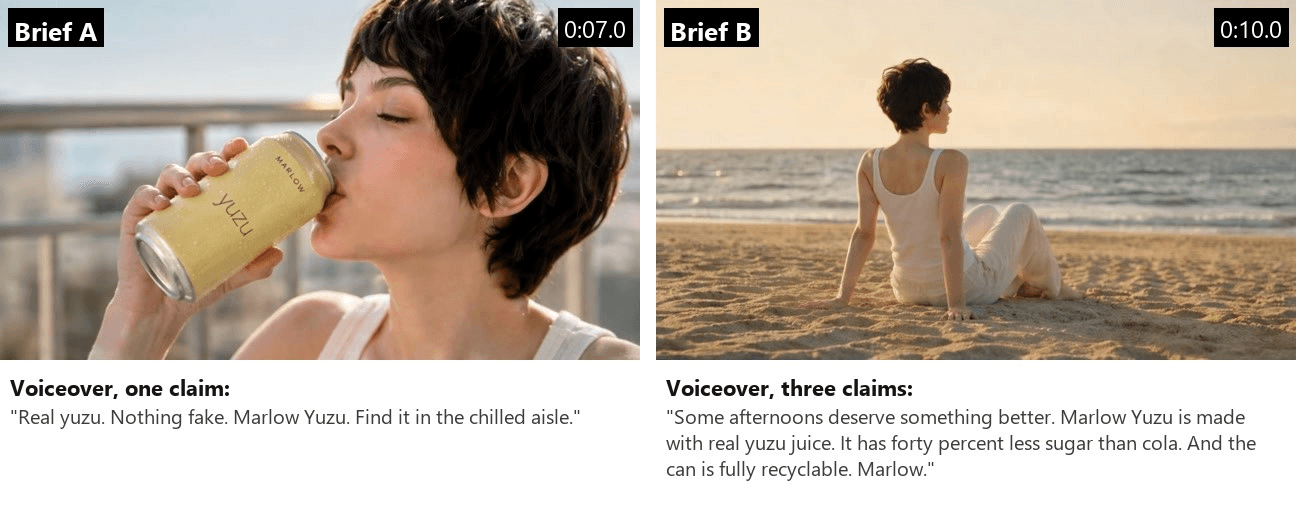
Brief A's voiceover is twelve words: "Real yuzu. Nothing fake. Marlow Yuzu. Find it in the chilled aisle." One claim, the name, one instruction. Brief B's voiceover runs to three claims in a row: real juice, forty percent less sugar than cola, a recyclable can. Each is a reasonable thing to say about a drink. Together they cancel out, because a viewer who half-listened can repeat none of them.
The render shows what that does to the clock: after the opening line, the three claims only fit between 0:20 and 0:30, so the spot spends two thirds of its length on mood and the last third talking fast.
Show the Product Early in the Ad, Not in the Last Frame
The older guidance is still the clearest. Ipsos advised advertisers in 2006 to introduce the brand shots during the first 10 to 15 seconds of an ad, and its 2022 work on digital video found that a brand cue in the opening moment raised brand attention by 13% for in-feed ads. Google's ABCD research says the same thing in three words: brand early, often and richly.
The reason is not loyalty. A viewer who sees a can in the first second files everything that follows under that can. A viewer who sees a beach for twenty seconds files the spot under beaches, and when the can finally arrives it has to overwrite a memory that has already formed.
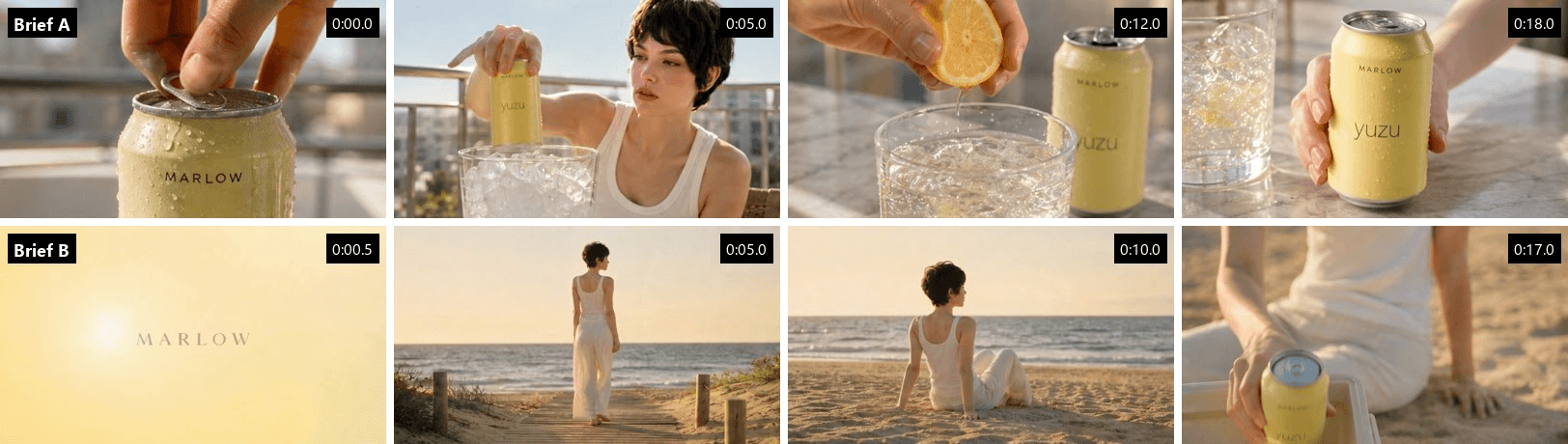
Brief A shows the can at 0:00 and keeps coming back to it. Brief B holds it back until shot five, which in the render lands at 0:17, more than halfway through the spot.
End the Commercial on One Action
The last three seconds are what the viewer carries into whatever they do next. Think with Google tested this on television with Dyson: spots that ended with a prompt to search for the Dyson V6 generated 1.4 times the searches of the control spots, and in the five minutes after an airing, 24% of all searches could be traced to that prompt. The ask was one line, said once, shown once.
Brief A ends on a packshot with two lines of text, MARLOW YUZU and Find it in the chilled aisle, the same words the voiceover has already said once. Brief B ends on a wide sunset over an empty beach with the brand name spoken and nothing on screen. It looks like the end of a film. It gives the viewer nothing to do.
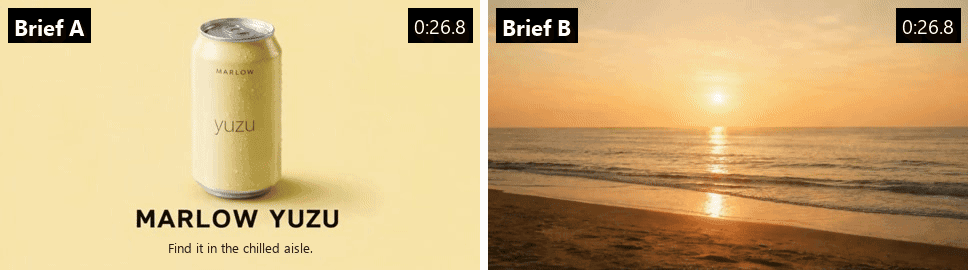
The final three seconds of each spot. Only one of them tells the viewer what to do next.
TV Commercial Examples That Get These Elements Right
The four elements are not a recent invention. These four TV commercial examples each prove a different one, and each has a documented result rather than a reputation.
| Spot | Year | Element it proves | Documented result |
|---|---|---|---|
| Ritz, Super Bowl spot in 15- and 30-second cuts | 2025 | The first seconds | Kantar lists early brand presence within two seconds and product-forward storytelling across the first 10 seconds as its drivers; the 15-second cut matched the 30 on brand lift (Kantar, February 2026) |
| Snickers, "You're Not You When You're Hungry" | 2010 | One message | Sales up 15.9% in one year, with share gains in 56 of the 58 markets it ran in (IPA case study, 2012) |
| Cadbury, "Gorilla" | 2007 | The brand-early exception | Dairy Milk value sales up 5.0% year on year in the month it broke (IPA paper, 2008); voted Britain's favourite TV ad with 26% of the vote (British Arrows poll, 2026) |
| Dyson, TV spots ending with a search prompt | Test campaign | The ending | 1.4 times the searches of the control spots; 24% of searches in the five minutes after an airing traced to the prompt (Think with Google case study) |
Snickers is the cleanest case for one message. The campaign launched during the 2010 Super Bowl with a single idea that every later spot repeated in a new setting, and the IPA case study credits it with "increasing sales by 15.9% in one year" worldwide. Nothing about the hunger joke needed a second claim.
Gorilla seems to break the rules, which is why it belongs here. As Cadbury's Lee Rolston told D&AD, "There was no chocolate in the ad." The bar appears only in the closing frames. Watch the opening again, though: the film starts on Cadbury purple with the "glass and a half" production card, so the brand's colour and its oldest line are on screen before the gorilla moves.
Cadbury could afford to hold the product because the brand was already a century old. A new drink cannot, and Brief B is what that gamble looks like without the century.
FAQ
Is a 15-second TV ad as effective as a 30-second one?
Often, yes. Kantar's February 2026 study of Super Bowl advertising found 15-second ads matching 30-second spots on brand lift. The catch is that a 15 has room for one of everything: one action to open on, one claim, one product shot that lingers and one ask. Write the 30 first and cut the 15 from it, so both versions carry the same message.
How many times should the brand appear in a good TV ad?
None of the studies above sets a count; what they agree on is timing. After the first appearance, each return to the product should bring a new action. Brief A shows the can in four of six shots and says the name twice, and nothing reads as repetition because each return adds something: the yuzu squeeze, the label set down, the cold can on her cheek.
Does a TV ad made with AI need a disclosure?
It depends on where it runs. Broadcast rules differ by country, and several ad platforms now ask advertisers to label synthetic or altered content. Our guide to AI-generated ads walks through the platform rules and the brands that have already disclosed.
What is the difference between a good TV ad and a good online video ad?
The four elements are the same. Online, a skip button or a feed makes leaving free, which is why the research on the first three seconds mostly comes from digital video. TV keeps the viewer a little longer, so one message and an early product shot carry more of the weight.
Conclusion
Good spots are mostly discipline. Open on something happening, show the product before the viewer has drifted, say one thing, and end by asking for one action. The two Marlow Yuzu renders came from the same photo, the same model and the same workflow, and the only difference between the spot that works and the one that drifts is the brief.
If you are writing a commercial this week, write Brief A's structure first and argue with it later. Then render it, watch the first three seconds with the sound off and the last three with your eyes on the screen, and you will know what makes a good TV ad before anyone else has to tell you.





