Nothing ruins a session faster than blowing 300 credits on a 5-second clip—only to have it glitch halfway through. ByteDance hasn't dropped the official Seedance 2.5 price tag just yet, but analyzing current Seedance 2.0 baselines gives us a pretty clear picture of what to expect.
Seedance 2.5 Price Breakdown at a Glance
| Channel / Access Route | Target Audience | Pricing Structure / Rate | Estimated Cost (5s / 30s Clip) | Data Source | Key Highlights |
| Dreamina (Global) | Web Creators / Individuals | Free Daily Credits + Subscription ($15–$70/mo) | ~$0.24–$0.42 (5s) / ~$3.50-$18.00 (30s) | Estimated based on Seedance 2.0 web tiers | Includes automatic free daily credit refreshes |
| Volcano Engine API | Developers & Agencies | Console Rates: $0.09–$0.21/s (Text/Image); higher with video input | ~$0.47 – $1.06 (5s) / ~$2.82 – $6.30+ (30s Pure Gen) | Converted from Volcano Engine Console token rates for Doubao Seedance 2.5 | Scaled by resolution (480p/720p) and input video duration |
| Third-Party Aggregators | Occasional Users / Testers | Pay-as-you-go / Trial points | Multi-tier trial options | Platform trial & aggregator baselines | Good for testing without recurring fees |
Key Takeaways:
- Official Status: As of late July 2026, ByteDance has officially announced Seedance 2.5 on Dreamina and ecosystem platforms, though API access remains in pre-release mode. However, early console listings on Volcano Engine provide concrete baseline metrics for standard vs. video-conditioned rendering.
- Estimated Credit Burn: Extrapolating from Seedance 2.0 baselines, expect a generation burn of 15–70 credits per second depending on resolution (480p up to native 4K).
- Real-World Cost: Standard 5-second API renders run ~$0.47 to $1.06 for text/image inputs, scaling up to $4.45 for video-conditioned workflows.
- Risk-Free Testing: Free daily bonus credits on Dreamina refresh automatically every 24 hours, allowing creators to test basic prompt workflows without entering credit card details.
Note: Exact credit consumption is expected to match or slightly exceed Seedance 2.0 levels. Always verify live figures on Dreamina before locking in production budgets.
Seedance 2.5 Pricing Baseline: Web Subscription Tiers & Credit Packages
Subscribing to an AI platform only to watch your monthly credit balance vanish after rendering four test clips is a constant headache for video creators. Analyzing the Dreamina pricing tiers helps prevent unexpected budget overruns when upgrading to a Seedance 2.5 monthly subscription.
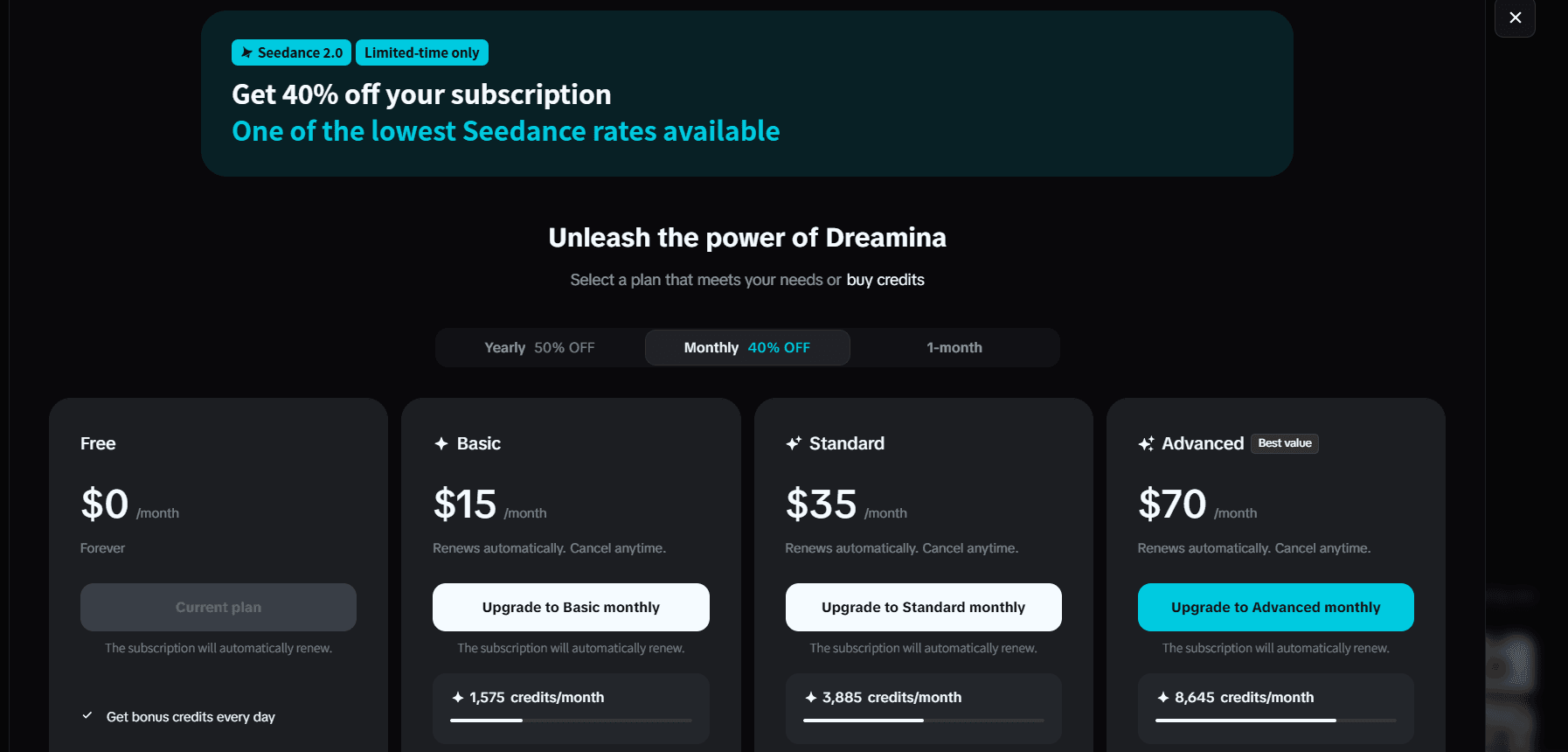
Expected Dreamina & Jimeng Subscription Breakdown
ByteDance distributes web access through Dreamina internationally and Jimeng in China. Based on current platform benchmarks, paid plans scale across three main tiers:
| Tier Level | Estimated Price | Monthly Credits | Estimated Output Capacity (5s, 720p) |
| Basic | ~$15 / month | ~1,575 credits | ~26 clips (Up to 52 clips on Mini) |
| Standard | ~$35 / month | ~3,885 credits | ~64 clips (Up to 129 clips on Mini) |
| Advanced | ~$70 / month | ~8,645 credits | ~144 clips (Up to 288 clips on Mini) |
When evaluating a Jimeng annual vs monthly plan, annual billing usually reduces net subscription fees by 20% to 30%, effectively expanding your active video generation quota.
The Credit Math Behind Generation Lengths
The effective credit cost per clip scales rapidly based on duration, resolution tier, and asset inputs:
- 5-Second Clip (720p Standard): ~50 to 60 credits (Down to 30 credits on Mini)
- 10-Second Clip (1080p High-Res): ~300 credits (30 credits/sec baseline)
- 30-Second Native Clip (4K Cinematic): ~2,100+ credits (70 credits/sec heavy compute load)
Render length and resolution are not the sole cost drivers. Incorporating custom reference video inputs alters the formula (e.g., adding a 3s reference video shifts billing to a combined duration rate), while heavy prompt parameters or multi-reference inputs increase processing overhead before diffusion rendering even begins.
Pricing Note:
All credit consumption rates, resolution multipliers, and clip capacity estimations in this section are calculated using verified Seedance 2.0 / Dreamina live platform rates as a baseline. Seedance 2.5 actual credit burn may differ or see a slight increment depending on newly introduced architectural compute demands.
Volcano Engine API Cost Projections: Developer & High-Volume Pricing
Building automated video pipelines only to face an unexpected four-figure cloud rendering bill at the end of the month is an engineer's nightmare. Integrating a Seedance 2.5 API price model requires careful tracking of how programmatic billing scales compared to consumer web tiers.
Volcano Engine & Ecosystem Rate Benchmarks
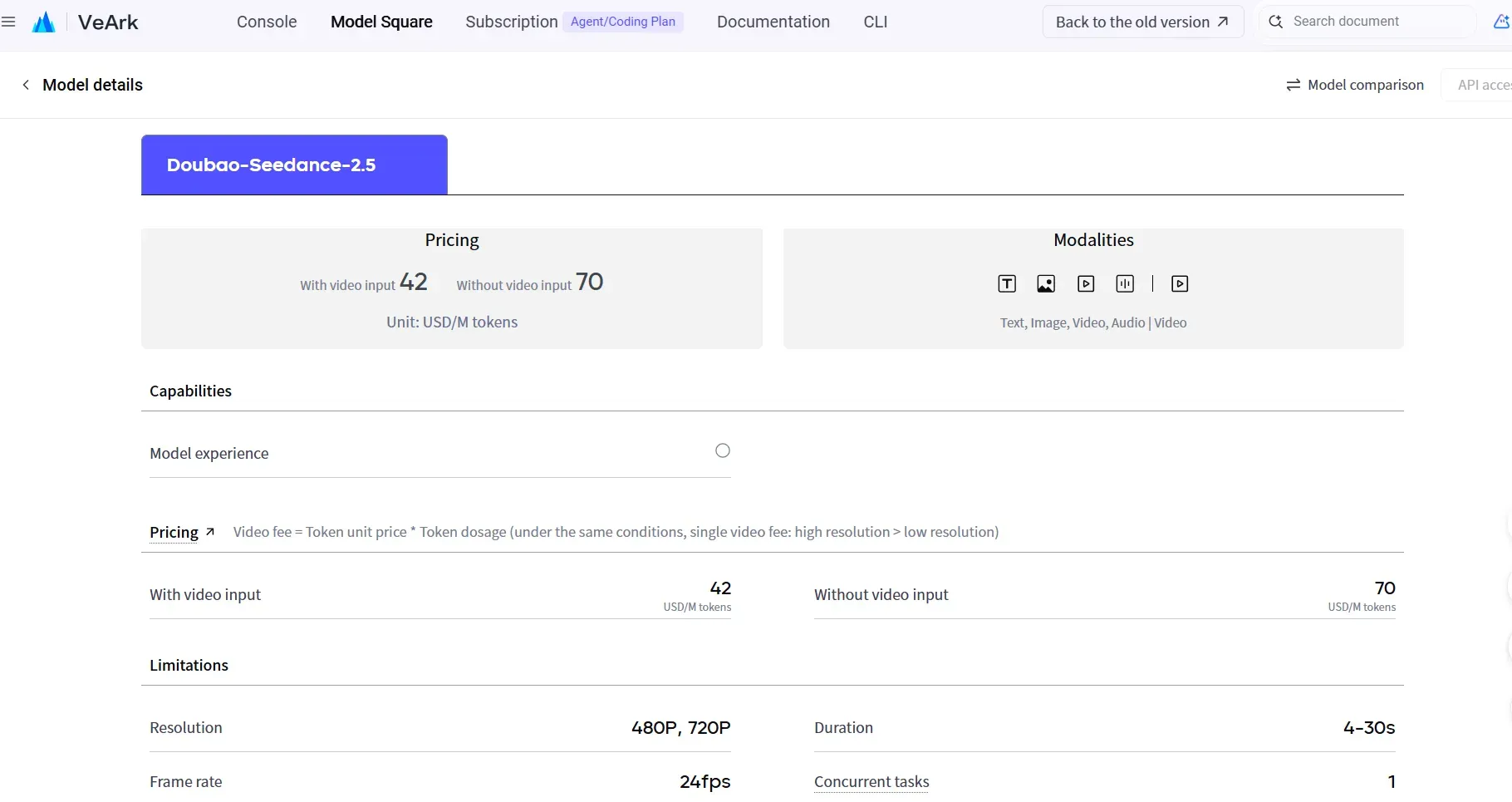
ByteDance processes developer requests through Volcano Engine (Volcengine in China, BytePlus globally). Official rate cards charge by token consumption or output seconds, with base prices scaling directly by resolution and input complexity:
| API Input Mode | Resolution | Output Length | Official Price USD Cost (5s Clip) | Key Use Case / Notes |
| Without Video Input | 480p | 5s | ~$0.47 | Text/Image-to-Video draft rendering |
| Without Video Input | 720p | 5s | ~$1.06 | Standard HD production renders |
| With Video Input (2s–30s input) | 480p | 5s | ~$0.51 – $1.98 | Video editing/extension (price scales with input length) |
| With Video Input (2s–30s input) | 720p | 5s | ~$1.14 – $4.45 | High-res video conditioning & multi-reference editing |
Factors Inflating Programmatic Video Rendering Cost
Output resolution and video conditioning are the primary variables governing overall API expenditure. Developer pipelines must account for two distinct pricing models:
- Fixed Second-Based Pricing (No Video Input): Both image/text-to-video operate at a steady pace per second. 720p increases to $0.21/s, while 480p remains at $0.09/s. A typical 5-second 720p costs $1.06.
- The Input Video Penalty (2s–30s Reference Inputs): Passing reference video into the API for video-to-video or extension workflows triggers dynamic pricing based on your input length. At 720p, a 5-second output costs $1.14 with a short 2–4 second reference clip, but hits $4.45 if you feed it a full 30-second input video. That is nearly a 4x price jump for the exact same 5-second output.
Cost Optimization Tip: Setting up pre-processing pipelines to trim input reference videos to under 4 seconds before making API calls significantly reduces dynamic compute surcharges, keeping your overall programmatic video rendering cost within budget. If you're building programmatic rendering pipelines, check out our guide on automated Seedance 2.5 API integration workflows for cost-efficient batch processing.
Compute Variables That Drain Credits: 4K, 30-Second Clips, and Multi-Reference Processing
Hitting the render button only to watch 800+ credits disappear on a single attempt is a primary pain point for video creators. Hardware compute requirements do not scale linearly; advanced generation parameters quickly compound overall Seedance 2.5 credit drain.
The Technical Drivers Behind High Credit Drain
Understanding why credits vanish requires looking at the GPU rendering stack. Multi-pass diffusion steps and heavy temporal cross-attention layers demand massive memory allocations:
- Render Resolution Multiplier: Moving from 720p to 1080p quadruples pixel data. Outputting native 4K with 10-bit color requires up to 4x higher compute, directly multiplying your native 4K compute cost.
- Temporal Continuity Across 30 Seconds: Standard 5-second outputs handle short camera movements. Generating a continuous 30-second scene without motion drift or visual degradation requires persistent temporal self-attention across hundreds of frames.
- Multi-Asset Reference Conditioning: Feeding up to 50 control assets—such as face models, motion paths, and depth maps—adds a steep character consistency reference cost during the initial diffusion passes. Learn how to optimize your reference prompts in our step-by-step guide on maintaining character consistency in Seedance 2.5.
Estimated Credit Consumption Matrix
| Generation Configuration | Estimated Credit Cost | Relative Multiplier | Primary Cost Driver |
| 5-second / 720p (Text-to-Video) | ~90 - 100 credits | 1x Baseline | Base draft generation |
| 10-second / 1080p (Image-to-Video) | ~300 - 360 credits | ~5x - 6x Baseline | High-res frame processing |
| 30-second / Native 4K (Multi-Reference) | ~2,100 - 2,500+ credits | ~35x - 40x Baseline | Heavy temporal self-attention & 4K GPU memory load |
So, how many credits does a 30-second 4K video take in Seedance 2.5? Expect a base 30-second clip credit price of roughly 2000 to 2500+ credits per attempt depending on reference complexity. Running low-resolution drafts before committing to final 4K renders remains the most effective way to protect your balance.
Note: Estimations are calculated using official Seedance 2.0 rate baselines (60 credits/5s for 720p vs. 70 credits/sec for 4K).
Free Options & Budget Hacks: Free Credits, and Trial Access
Running out of generation credits mid-project forces a hard stop on creative momentum. Fortunately, testing Seedance models does not require immediate payment details.
Legitimate Free Credit Channels
ByteDance and ecosystem partner platforms provide multiple no-cost options:
| Channel / Method | Distribution Type | Typical Free Allowance | Conditions & Expiration Notes |
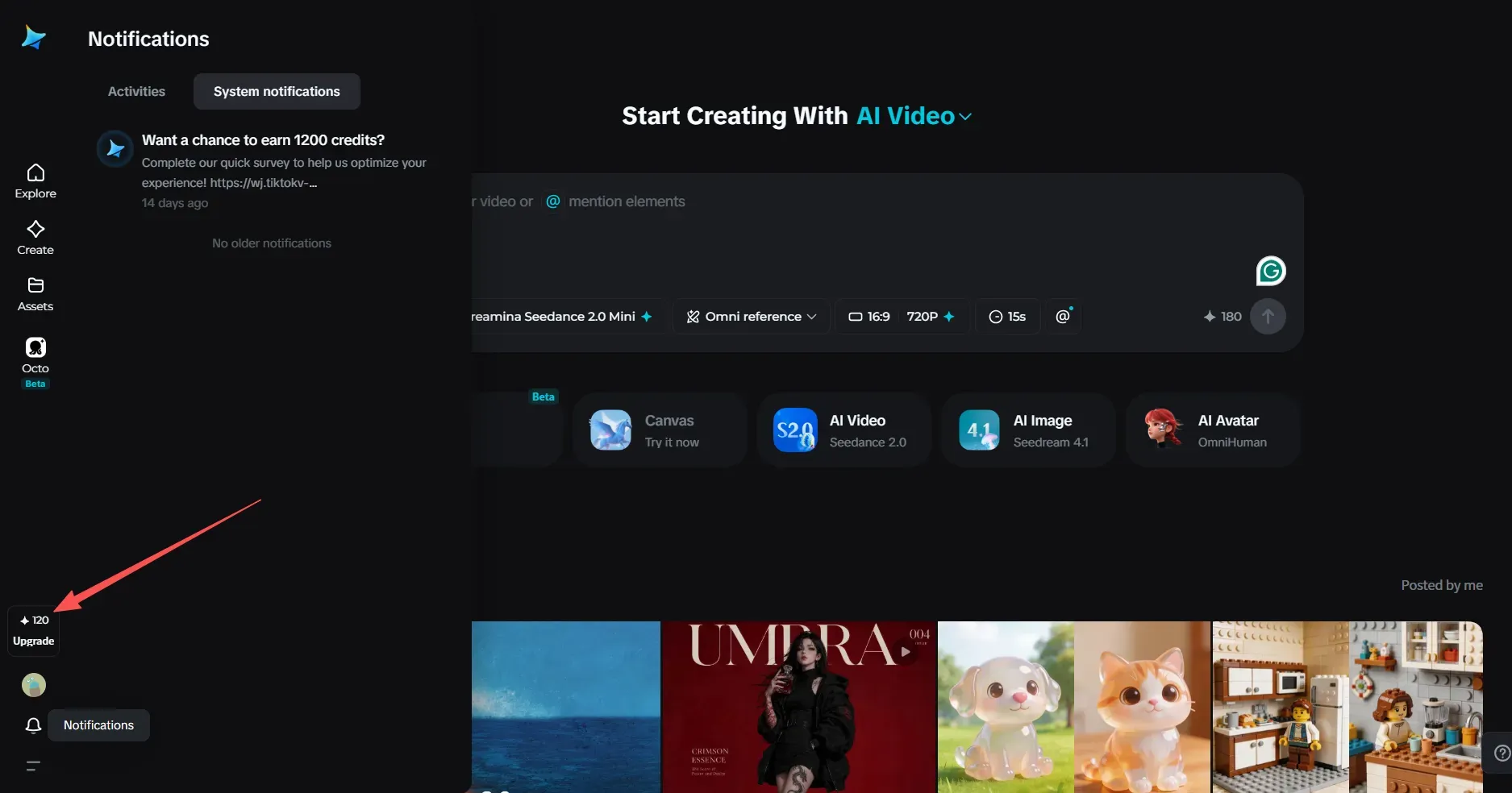
| Dreamina Free Tier | Automatic Daily Bonus | ~60 – 120 free credits / day | Granted automatically under the "Get bonus credits every day" policy; non-cumulative daily allowance. |
| Survey & Community Tasks | In-App System Notifications | 1,200+ bonus credits | Reward-based surveys (e.g., official TikTok/ByteDance feedback forms) sent directly to user notifications. |
| Third-Party Aggregators | Trial Registrations | ~10 – 130 trial points | Task-based rewards on partner hubs like EaseMate or OpenArt. |
How Free Credits Work on Dreamina (No Check-Ins Required)
Under Dreamina's Free Plan ($0/month), you don't need to hunt for a daily check-in button. The platform automatically manages your daily allowance:
- Daily Allowance (~120 Credits/Day): Refreshes automatically every 24 hours. Since unused credits reset rather than stack, be sure to run your draft renders before the next refresh cycle.
- One-Time Credit Drops: Keep an eye on your notification tab. Completing brief official surveys can net you up to 1,200 bonus credits in one go—giving you plenty of fuel for complex renders.
Note: You can fully test Seedance for free without entering a credit card. Your daily ~120 credit allowance provides enough headroom to generate 1 to 2 standard 5-second 720p preview drafts (~60 credits each) every single day at zero cost.
Strategic Workflows to Preserve Credit Balances
To avoid wasting Seedance free credits, apply these credit-preservation steps:
- Leverage Draft Mode: Render prompts initially at 5-second 720p draft settings (~60 credits) to inspect composition before launching 30-second 4K renders.
- Batch Prompt Refinements: Adjust camera angles and text modifiers on static reference images first rather than re-running full video generations.
- Third-Party Aggregators: Use platform trials like EaseMate to test multi-reference prompts without draining primary account balances.
Pro Tip: If you're managing free quotas within the CapCut/Dreamina ecosystem, pairing this draft-first approach with daily automated refreshes ensures a continuous pipeline for routine content production.
Commercial ROI Analysis: Is the Seedance 2.5 Price Worth It for Businesses?
Dropping $5,000 on a traditional 30-second studio ad—only for it to bomb on TikTok—is a brutal way to learn how fast creative fatigue sets in. Standard agency shoots routinely eat up $1,500 to $15,000 per asset. Moving to a hybrid AI video pipeline completely changes the cost structure, letting you test ideas at a fraction of the price.
Traditional Agency vs. Seedance 2.5 Cost Comparison
According to performance marketing metrics from Motion Labs, hybrid workflows—pairing human creative direction with AI rendering—yield a 4.1x average ROAS while slashing baseline production overhead.
| Production Metric | Traditional Agency Shoot | Seedance 2.5 Automated Pipeline | Primary Impact / Efficiency Advantage |
| 30s Ad Unit Cost | $1,500 – $5,000+ per video | ~$10 – $35 per finalized ad | Up to 98% reduction in direct asset creation costs |
| Production Timeline | 2 to 4 weeks | 15 to 30 minutes | Instant campaign deployment & real-time scaling |
| A/B Creative Hook Variants | $300 – $500+ per extra edit pass | ~$1.50 – $5.00 per hook iteration | High-volume testing (20+ hooks/week vs. 2) |
| Average ROAS Impact | 3.8x (Human-Only Baseline) | 4.1x (Hybrid AI + Human Direction) | Higher performance through rapid creative testing |
Note: Seedance pipeline estimates factor in 3 to 5 iteration passes per finalized 30-second unit using standard 1080p/4K multi-reference rendering rates.
Maximizing Agency Margins and Prompt Efficiency
Evaluating Seedance 2.5 commercial ROI reveals that the true cost saving lies in creative iteration speed. Reducing your e-commerce video ad cost allows media buyers to test 20 video hooks per week instead of two.
To achieve agency video budget optimization, teams must reduce costly prompt rerolls. Locking character consistency references, camera paths, and lighting parameters in JSON prompt templates keeps the net cost per ad generation predictable while preserving profit margins.
Final Verdict & Live Pricing Update Tracker
Wasting time on the wrong plan tier destroys production output faster than a broken prompt. Selecting the best Seedance 2.5 plan comes down to matching your monthly output volume and API requirements with platform credit consumption.
Recommended Plan Matrix by User Profile
| User Category | Key Operational Needs | Recommended Tier | Estimated Monthly Cost |
| Hobbyist / Explorer | Occasional 5s clips, basic prompts | Free Daily Credits | $0 / month |
| Daily Content Creator | Regular 720p/1080p clips, consistent posts | Dreamina Pro Tier (~3,885+ credits) | ~$19.99 to $35 / month |
| E-Commerce & Agencies | 30s native 4K, 50-asset reference consistency | Dreamina Advanced Tier (~8,645 credits) | ~$70 to $82 / month |
| Enterprise / Developers | Automated programmatic video pipelines | Volcano Engine API (Pay-as-you-go) | Usage-based ($0.09 - $0.21+/sbased on console listings) |
Knowing which Seedance tier to buy eliminates unnecessary overhead. Agencies and developers requiring programmatic pipelines should skip consumer subscriptions and integrate directly via Volcano Engine API endpoints.
Status: Officially Announced / API in Pre-Release Mode
Last Verified: July 31, 2026
Notice: ByteDance has officially launched Seedance 2.5 on web platforms, though global public API rate cards are awaiting final commercial release. Benchmarks in this guide reflect early rate structures extracted from the Volcano Engine console ($0.09/s–$0.21/s base, up to $4.45/5s for video inputs) alongside web subscription baselines.