Search "grok face swap" and the results are a mess of unofficial tutorials, copycat apps with names like grokimagine.ai, and a long trail of news stories about deepfakes. None of it comes from xAI. Grok Imagine, the actual product, has no button, template, or documented feature named Face Swap, and nothing in its release history suggests it ever did.
What it does have is a general-purpose image editor that takes a photo and a sentence, and that gap between "no dedicated tool" and "the model can clearly do it anyway" is exactly what pulled xAI into a year of regulatory letters, a European Commission proceeding, and lawsuits brought on behalf of real children. This piece covers what Grok Imagine's edit endpoint actually does, what happened when people pointed it at real people's faces, and how the same underlying model runs on Atlas Cloud today with a narrower, consent-gated alternative sitting right next to it.
Key Takeaways
- Grok Imagine's own template gallery lists 23 named tools as of July 2026. None of them is called "Face Swap." Identity swaps happen through free-text prompts on the general edit endpoint, not a labeled feature.
- A five-month escalation starting with the app's August 2025 launch and peaking in a January 2026 mass "undressing" wave led Ofcom, the European Commission, and California's Attorney General to all open formal action against X in the same month.
- xAI's current Acceptable Use Policy, effective June 26, 2026, specifically names "undressing or nudifying real persons" as a banned category, alongside a mandatory, non-removable watermark on every output.
- Atlas Cloud runs the same edit model directly (xai/grok-imagine-image-quality/edit), next to a purpose-built atlascloud/face-swap-image endpoint that asks for consent on the model page itself.
- For a single swap with no API key and no per-run charge, Atlas Cloud's free AI face swap tool runs the same source-face-to-target-image pairing right.
The Real Story Behind Grok's Missing Face Swap Button
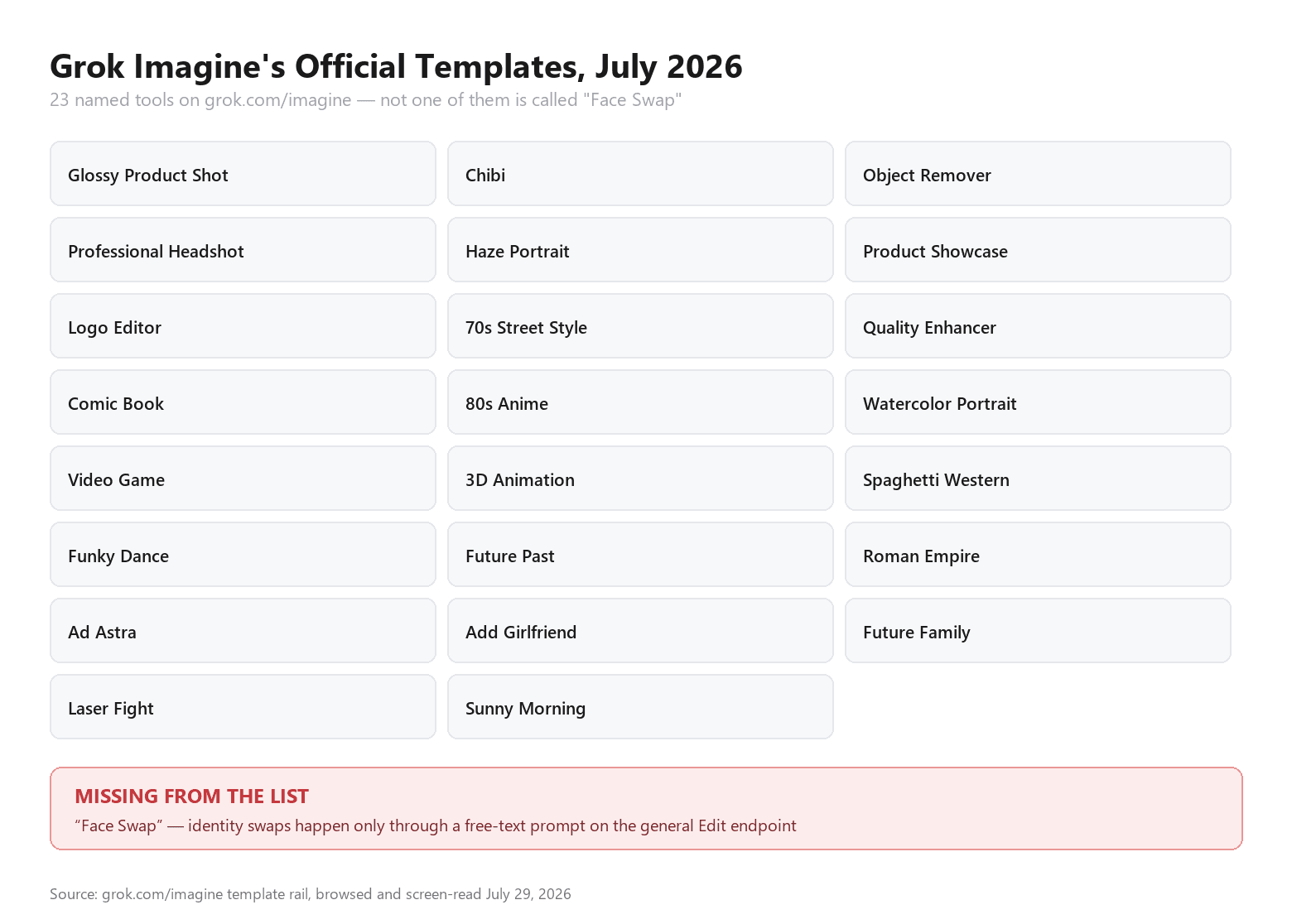
Source: grok.com/imagine template rail, browsed and recorded July 29, 2026.
We opened Grok Imagine's editor directly to check this rather than take anyone's word for it. The featured-templates rail lists Glossy Product Shot, Chibi, Object Remover, Professional Headshot, Haze Portrait, Product Showcase, Logo Editor, 70s Street Style, Quality Enhancer, Comic Book, 80s Anime, Watercolor Portrait, Video Game, 3D Animation, Spaghetti Western, Funky Dance, Future Past, Roman Empire, Ad Astra, Add Girlfriend, Future Family, Laser Fight, and Sunny Morning. Twenty-three named tools, and identity swapping isn't one of them.
All names pulled from grok.com/imagine, July 29, 2026.
What sits underneath all of them is a single upload-and-prompt interface: attach a photo, type an instruction, pick image or video mode. There's no mask tool, no two-slot "source face / target face" layout like a dedicated swap app would have. If someone gets a face-swap result out of Grok Imagine, they typed something like "put this person's face onto this photo" into that same general box, and the model, built on an architecture xAI calls Aurora, did the rest.
That distinction matters more than it sounds. A labeled feature comes with a defined input, a defined output, and usually a review process before ship. A capability that emerges from a general-purpose editor doesn't get any of that scrutiny by default, and the difference showed up fast once people started testing it on real, identifiable faces.
Inside Grok Imagine: The Aurora Model Behind the Edits
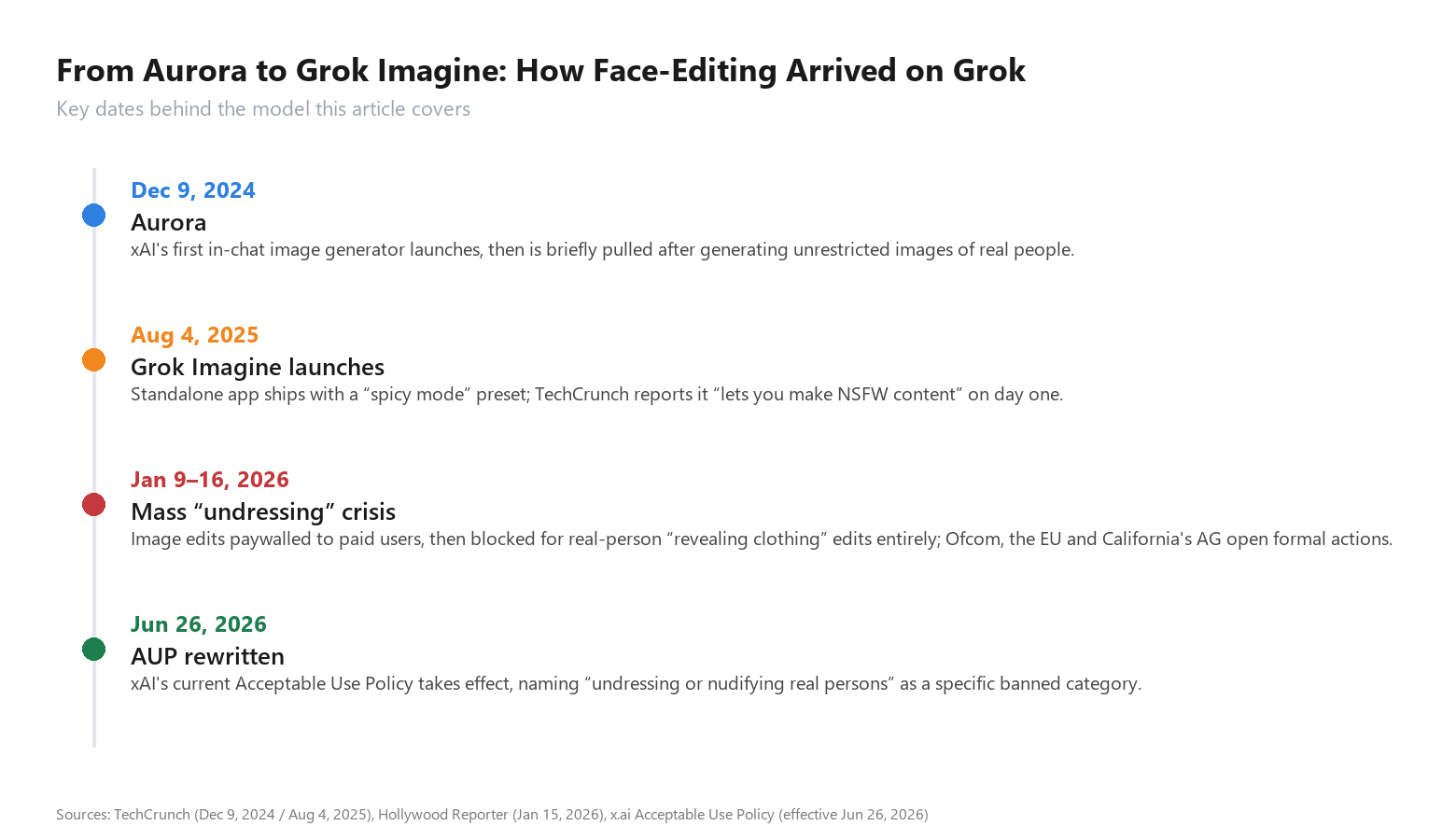
Sources: TechCrunch, Hollywood Reporter, and x.ai's Acceptable Use Policy.
The edit variant used for identity work today, xai/grok-imagine-image-quality/edit, is described on its own Atlas Cloud model page as running on that same Aurora foundation, which the page credits with unusually strong facial consistency and texture accuracy compared to diffusion-based competitors. The model accepts a prompt plus one or more image_urls, with a documented multi-image syntax, <IMAGE_0>, <IMAGE_1>, for telling it which reference does what. No mask required, up to eight reference images, output at 1K or 2K resolution.
A separate, newer preview called Grok Imagine Video 1.5 gets described in coverage as keeping "the same face, body, and identity locked" across a generated clip. That's a single-subject consistency feature for animating one person smoothly through a video, not a tool for putting one person's face onto someone else's body. It's easy to see how the two get blurred in casual conversation about what Grok can do.
Running Grok Imagine's Edit API on Atlas Cloud
Both tiers of the edit model, the standard xai/grok-imagine-image/edit and the higher-fidelity xai/grok-imagine-image-quality/edit, run on Atlas Cloud alongside more than 300 other models, including the xAI model family and the dedicated Grok Imagine Edit playground. One account and one API key cover both tiers, so testing the cheaper option before committing to the higher-fidelity one is a matter of switching a model string, not signing up twice.
Method 1: Run It Directly in the Playground
- Create an Atlas Cloud account and open the Edit model page.
- Upload a target image (up to eight reference images are accepted) and write a prompt describing the edit, using <IMAGE_0> and <IMAGE_1> to point at specific uploads when more than one is involved.
- Set resolution to 1K or 2K and pick how many candidate outputs to generate, from one to four.
- Click Run. At the default 1K, auto-aspect setting, the playground quoted us $0.06 per run when we tested it; switching to 2K raised that to $0.08.
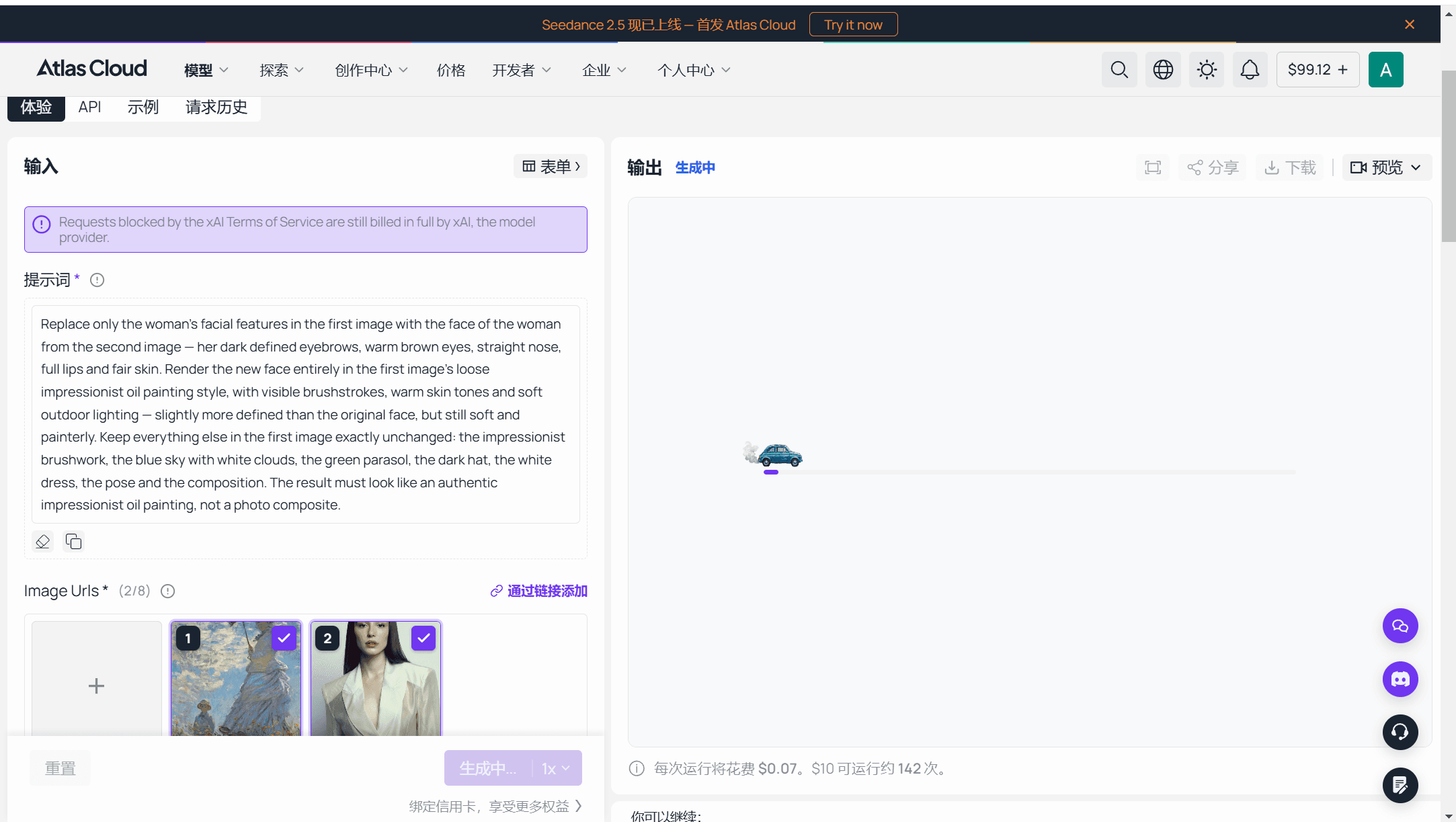
Method 2: Call the API Directly
Step 1: Get an API key. Log into the Atlas Cloud console and generate a key from the dashboard.
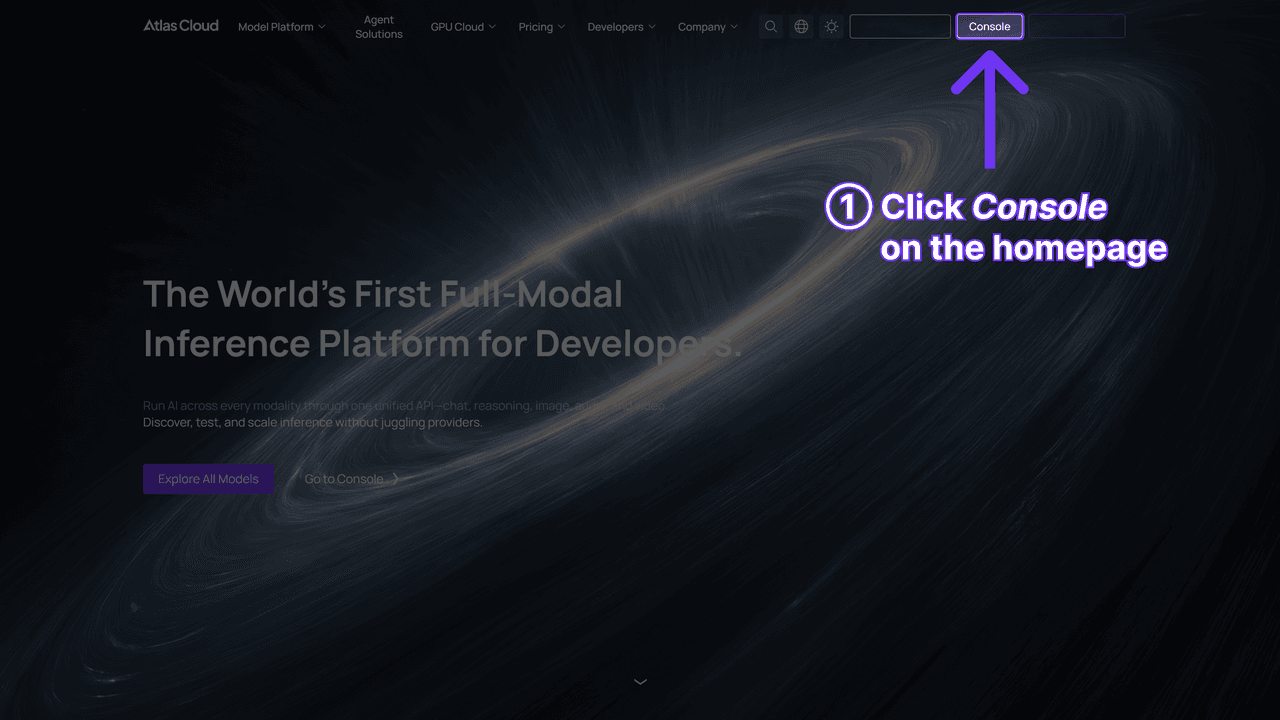
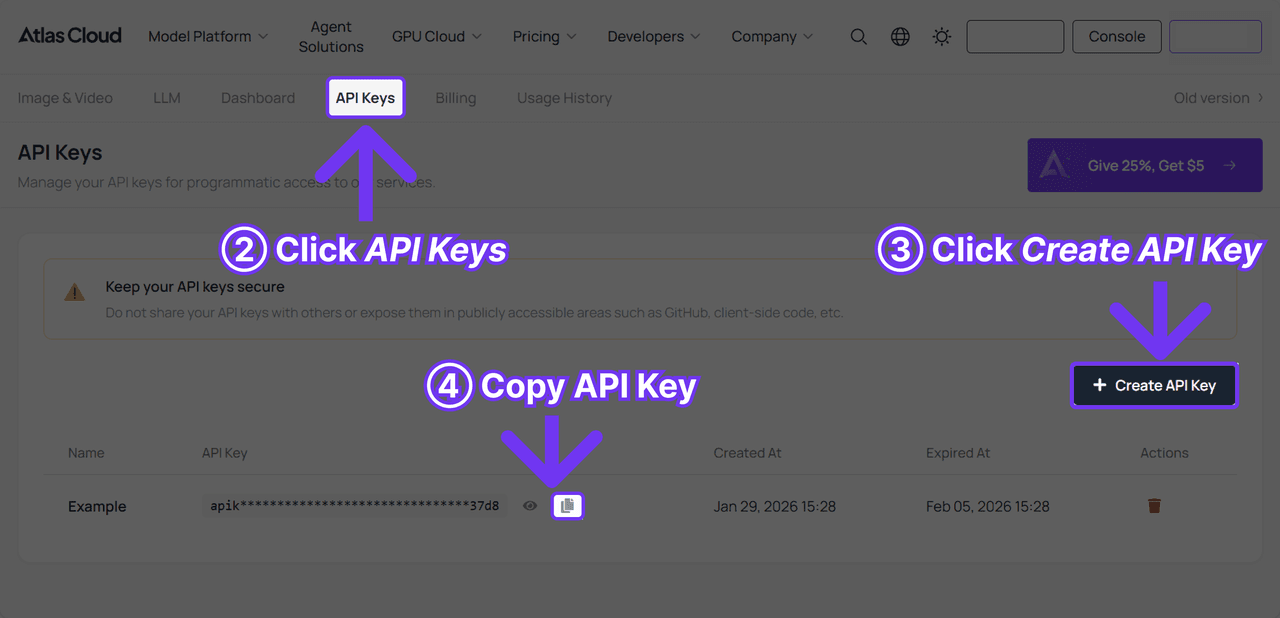
Step 2: Check the request schema. The API docs cover authentication and the shared generateImage endpoint used across every image model on the platform.
Step 3: Send the request.
Bash1curl -X POST https://api.atlascloud.ai/api/v1/model/generateImage \ 2 -H "Authorization: Bearer $ATLASCLOUD_API_KEY" \ 3 -H "Content-Type: application/json" \ 4 -d '{ 5 "model": "xai/grok-imagine-image-quality/edit", 6 "prompt": "Replace the face in <IMAGE_0> with the face from <IMAGE_1>. Keep the pose, clothing, background and lighting unchanged.", 7 "image_urls": ["https://your-cdn.com/target-photo.jpg", "https://your-cdn.com/source-face.jpg"], 8 "num_images": 1, 9 "resolution": "2k" 10 }'
Generation runs asynchronously. The response returns a prediction ID, which gets polled until the job completes:
Bash1curl https://api.atlascloud.ai/api/v1/model/prediction/<PREDICTION_ID> \ 2 -H "Authorization: Bearer $ATLASCLOUD_API_KEY"
The same key, the same two endpoints, and the same polling pattern work across every model on Atlas Cloud, so a pipeline built around Grok Imagine can add Seedream, Nano Banana, or GPT Image 2 later by changing one string in the request body.
Nothing in that request schema restricts what the prompt or reference photos can contain. That openness is exactly what turned this same edit capability into xAI's biggest liability, covered next.
Method 3: Try Seedream 5.0 Pro Edit Instead
Not every identity edit needs to land on Grok specifically. Since Grok Imagine's edit endpoint is a general-purpose model rather than one tuned for keeping a face intact, Atlas Cloud also runs Seedream 5.0 Pro Edit, ByteDance's multi-reference editing model, built specifically to hold identity, lighting and color tone steady across up to ten reference images. As an example, upload a public-domain reproduction of Monet's 1875 painting Woman with a Parasol as one reference and an AI-generated fictional face as a second, then prompt it with:
Replace the woman's face in the painting reference with the face from the portrait reference. Keep her exact pose, the parasol, her dress, the grass, the sky, and the painting's original brushwork, lighting and color palette completely unchanged.
Pricing scales with settings: the model lists from $0.036 per run at its base 20%-off rate, but a two-reference-image run at the size used below priced out at $0.0744, discounted from $0.093.
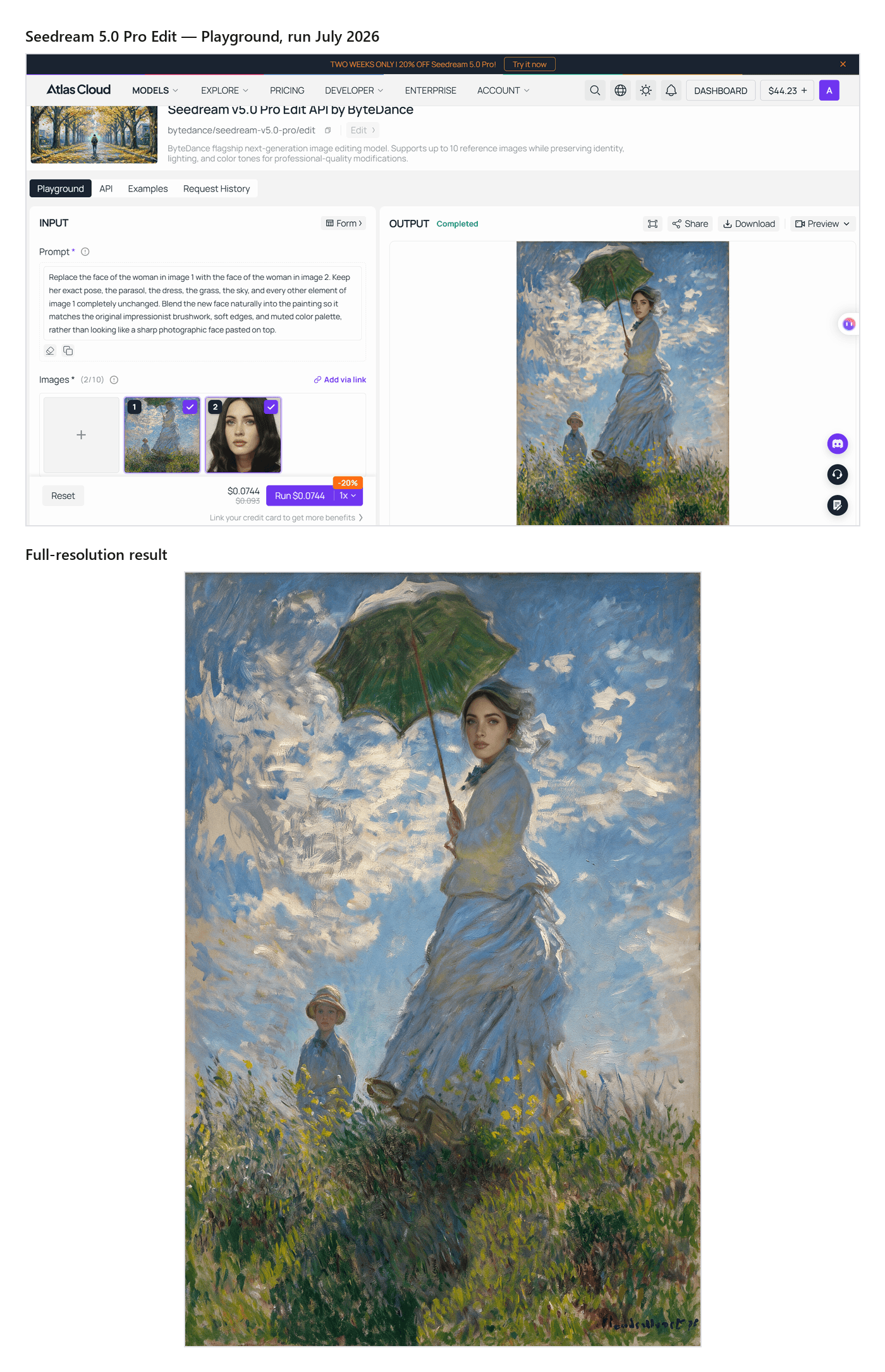
Generated with bytedance/seedream-v5.0-pro/edit on Atlas Cloud, July 2026. Painting reference is a public-domain reproduction of Monet's 1875 original; the face reference is AI-generated, not a real person.
The identity transfer itself worked cleanly: correct lighting, correct angle, no visible seam. The stylistic request didn't fully land, though. The prompt explicitly asked the new face to blend into the impressionist brushwork, and it reads instead as noticeably smoother and more photographic than the loose paint strokes around it.
Nothing in Grok Imagine's edit endpoint restricts what the prompt or reference photos can contain. That openness is exactly what turned this same edit capability into xAI's biggest liability, covered next.
Method 4: Try the Free Swap Face Tool
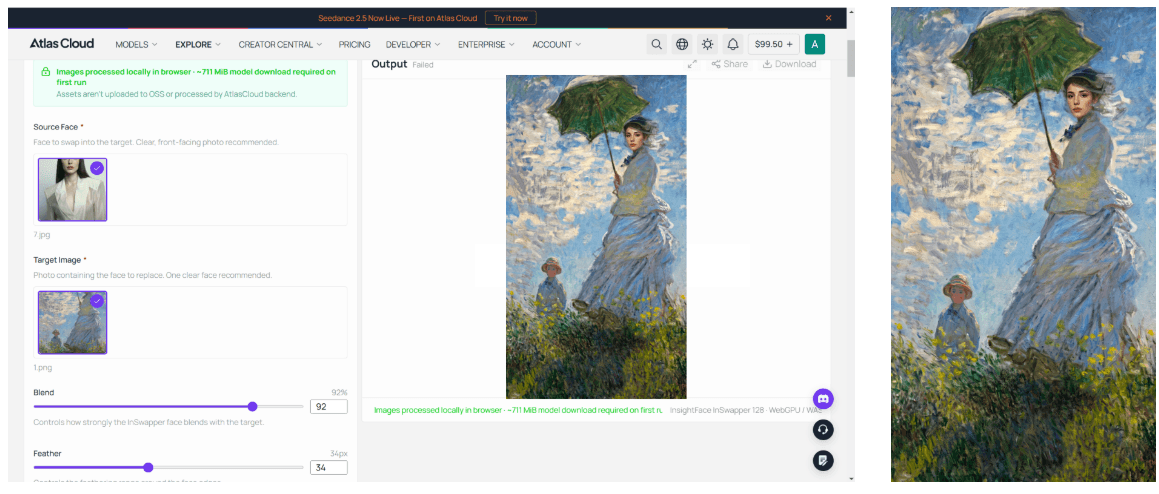
Neither of the above needs an API key or a per-run charge if the job is a single, one-off swap. Atlas Cloud also runs a free AI face swap tool, labeled "Free · No charge" on the page itself, with its FAQ confirming the swap runs with no usage cap and no watermark on the finished image. The layout mirrors the paid atlascloud/face-swap-image endpoint: a source face slot and a target image slot, plus Blend and Feather sliders for controlling how tightly the new face sits against the target.
As an example, upload a front-facing fictional face as the source and a famous painting as the target. The tool maps 468 points across both faces and hands back a finished PNG in about 8 seconds.
Why Face Swap Became Grok's Most Dangerous Prompt
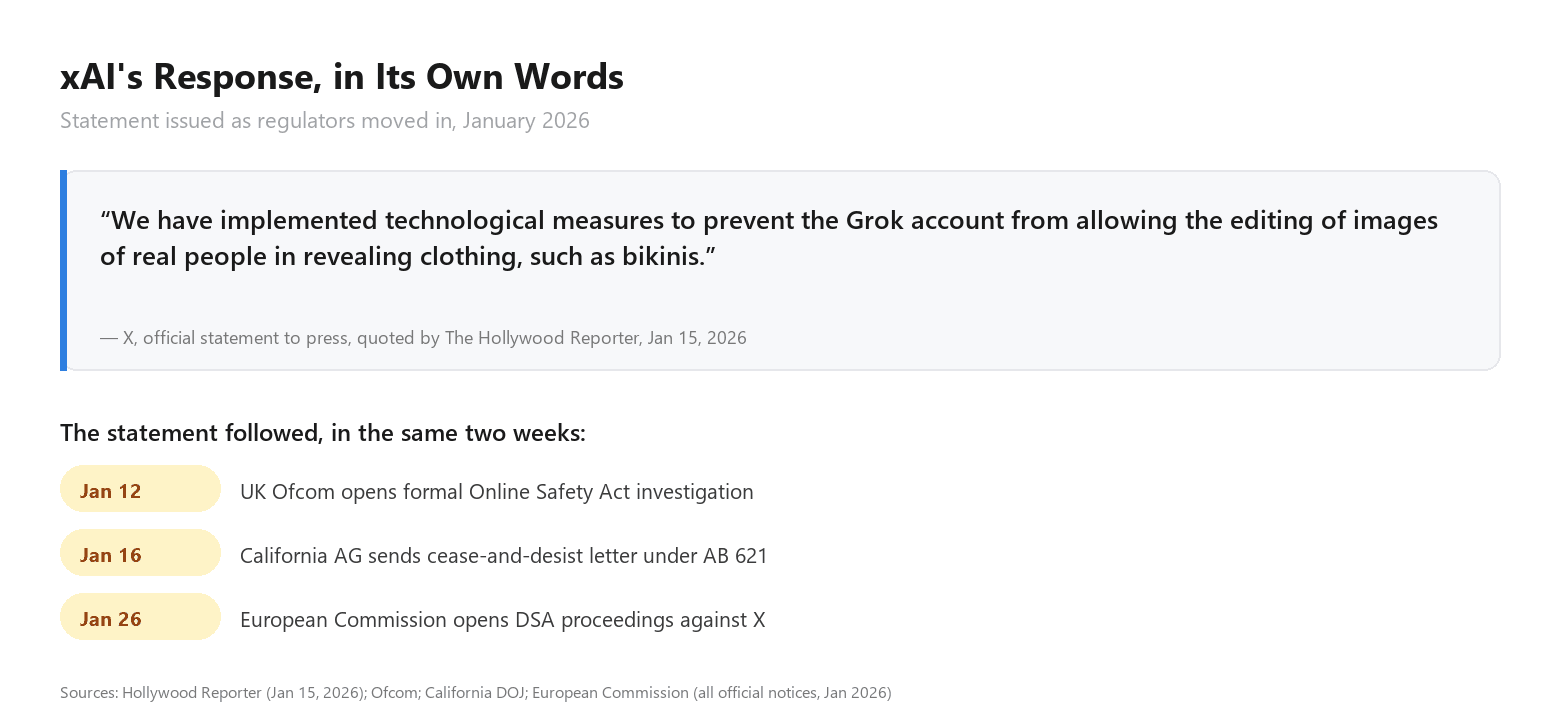
Governments moved within days of each other. India's technology ministry issued a formal notice on January 3. Indonesia blocked Grok access entirely on January 10, Malaysia followed a day later, both lifting the blocks within about two weeks once xAI gave written assurances. The UK's Ofcom opened an investigation under the Online Safety Act on January 12, warning of a fine up to £18 million or 10% of global revenue. Late on January 14, X posted a public statement, later quoted by The Hollywood Reporter:
Sources: The Hollywood Reporter, Ofcom, California DOJ, European Commission.
Two days later, California's Attorney General sent xAI a cease-and-desist letter invoking, among other statutes, the state's civil deepfake law. Press coverage at the time called it the first major enforcement action under California's new AB 621, which allows statutory damages up to $250,000 for a malicious violation. On January 26, the European Commission opened formal proceedings against X under the Digital Services Act, folding Grok's rollout into an existing investigation and ordering X to preserve internal records through the end of 2026.
Litigation followed the regulatory pressure. A putative class action, Jane Doe v. xAI Corp., was filed in the Northern District of California in late January, alleging over 4 million images generated in the December-January window with roughly 41% containing sexual imagery of women. Ashley St. Clair, the mother of one of Elon Musk's children, sued separately over deepfakes she says were generated from a childhood photo of her; xAI countersued the same day over a contract dispute. In March, a group of Tennessee teenagers, later joined by plaintiffs from Wyoming and Wisconsin, sued xAI and Stability AI over content allegedly generated from real children's photos. In July, xAI itself sued a South Carolina man, already arrested by state authorities in March, for allegedly rewording prompts repeatedly to bypass safeguards.
| Case | Filed | Court | Core allegation |
|---|---|---|---|
| Jane Doe v. xAI Corp. | Jan 23, 2026 | N.D. California | Class action over ~4.4M images, ~41% sexual imagery of women |
| Ashley St. Clair v. xAI | Jan 15, 2026 | NY state, removed to S.D.N.Y. | Sexual deepfakes generated from a childhood photo |
| xAI v. St. Clair (countersuit) | Jan 15, 2026 | N.D. Texas | Alleged breach of a user-agreement forum clause |
| Minors v. xAI / Stability AI | Mar 16, 2026 | N.D. California | Content allegedly generated from real children's photos |
| xAI v. Harwood | Jul 15, 2026 | N.D. Texas | xAI sues a user over alleged repeated safeguard bypass |
By South Korea's Google Play listing, the practical fallout is still visible: the X app's age rating there was raised from 16+ to 19+ in June 2026, a change local reporting tied directly to Grok's image tools. Ofcom's investigation, as of its most recent public update, hadn't reached a provisional decision. None of this reads as a closed chapter, and it's the direct reason the current policy reads the way it does.
The policy xAI points to today is its Acceptable Use Policy, effective June 26, 2026, which we read directly rather than take on faith given how central it is to this story. It prohibits, in its own wording, "undressing or nudifying real persons, or otherwise altering a real person's image or likeness to depict them in an intimate or sexual context," and separately bans "deceptively impersonating a real person." xAI's own FAQ goes further on the categories it treats as absolute: certain content is "never permitted, regardless of your settings or subscription," and "cannot be disabled," naming child sexual abuse material and non-consensual intimate imagery specifically. Suspected CSAM gets reported to the National Center for Missing and Exploited Children.
| Category | Status | Source |
|---|---|---|
| CSAM / sexual content involving minors | Never permitted, cannot be disabled | docs.x.ai/grok/faq |
| Non-consensual intimate imagery | Never permitted, cannot be disabled | docs.x.ai/grok/faq |
| Undressing or nudifying real persons | Prohibited under the AUP | x.ai Acceptable Use Policy |
| Deceptive impersonation of a real person | Prohibited under the AUP | x.ai Acceptable Use Policy |
| Removing or altering the Grok watermark | Prohibited under the AUP | x.ai Acceptable Use Policy |
Every image and video Grok generates carries a watermark that xAI's FAQ says has "no setting to remove," and stripping or altering it is itself a policy violation, separate from whatever the underlying image depicts. Taken together, the written policy is thorough. The gap this whole episode exposed is between what a policy says on paper and what a general-purpose editor actually stops in practice before public pressure forces a technical fix, and that gap is worth remembering every time a prompt gets close to a real person's likeness.
Grok Imagine Edit vs Atlas Cloud's Dedicated Face Swap Tools
Grok Imagine's edit endpoint and Atlas Cloud's own atlascloud/face-swap-image model solve overlapping problems in different ways. The product pages themselves show it as plainly as the price lists do.
| Grok Imagine Image Edit | Grok Imagine Image Quality Edit | Atlas Cloud Face Swap (Image) | |
|---|---|---|---|
| Endpoint | xai/grok-imagine-image/edit | xai/grok-imagine-image-quality/edit | atlascloud/face-swap-image |
| Input | Prompt + up to 8 reference images | Prompt + up to 8 reference images | Two fixed slots: Source Face, Target Image |
| Built for identity swaps | No, general-purpose editor | No, general-purpose editor | Yes, purpose-built |
| Consent language on the model page | Not present | Not present | "Obtain consent from the people depicted" |
| Verified playground price | $0.022 per run (1K, auto) | $0.06 per run (1K), $0.08 per run (2K) | $0.096 per run (auto size) |
| Output resolution | 1K / 2K | 1K / 2K | Auto, 1K, 1.5K, 2K, 3K |
The Grok models ask for a sentence and reward creativity: change the outfit, swap the background, restyle the whole scene, put one face where another was, all through the same box. That's the same open-ended flexibility this piece has already covered. To see what that difference actually looks like rather than just read about it, we ran the identical identity swap through both models, the same fictional face and the same "Doge" meme photograph already tried for free with Method 4 above.
Original template:

Widely circulated meme photograph, originally of a Shiba Inu named Kabosu.
Grok Imagine Image Quality Edit result:
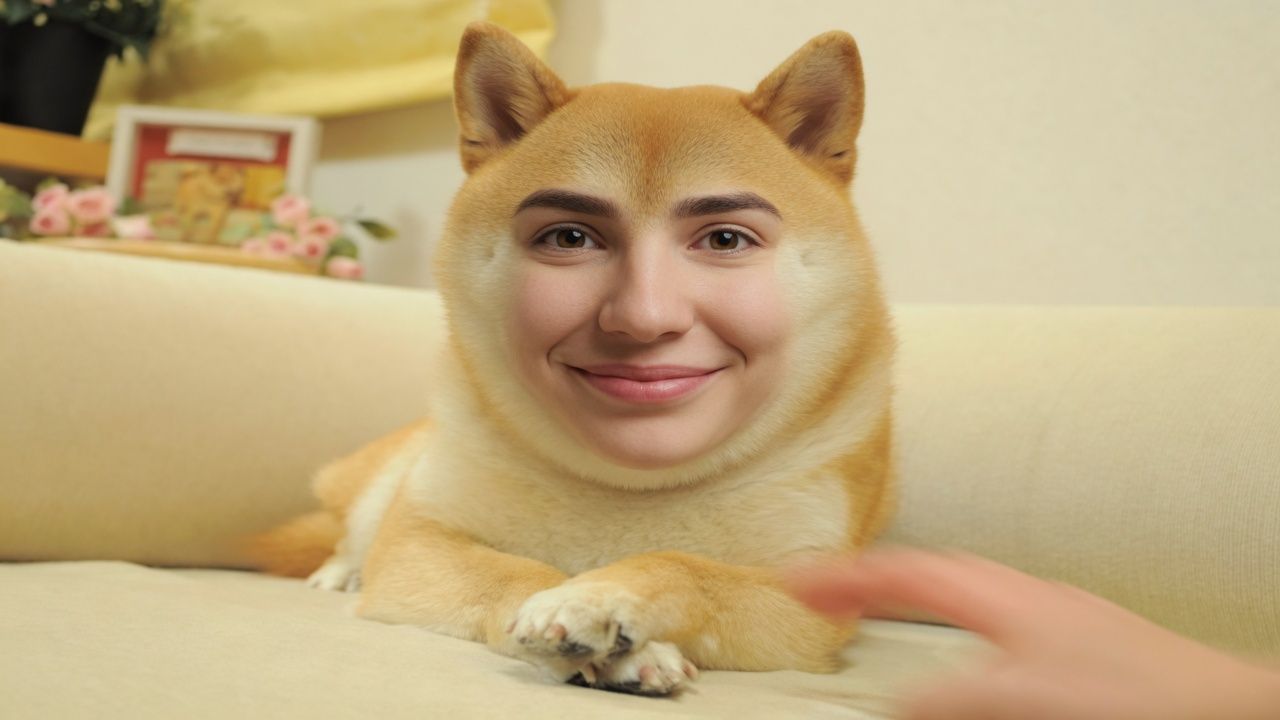
Generated via xai/ grok-imagine-image-quality /edit on Atlas Cloud, July 2026.
Atlas Cloud Face Swap result:
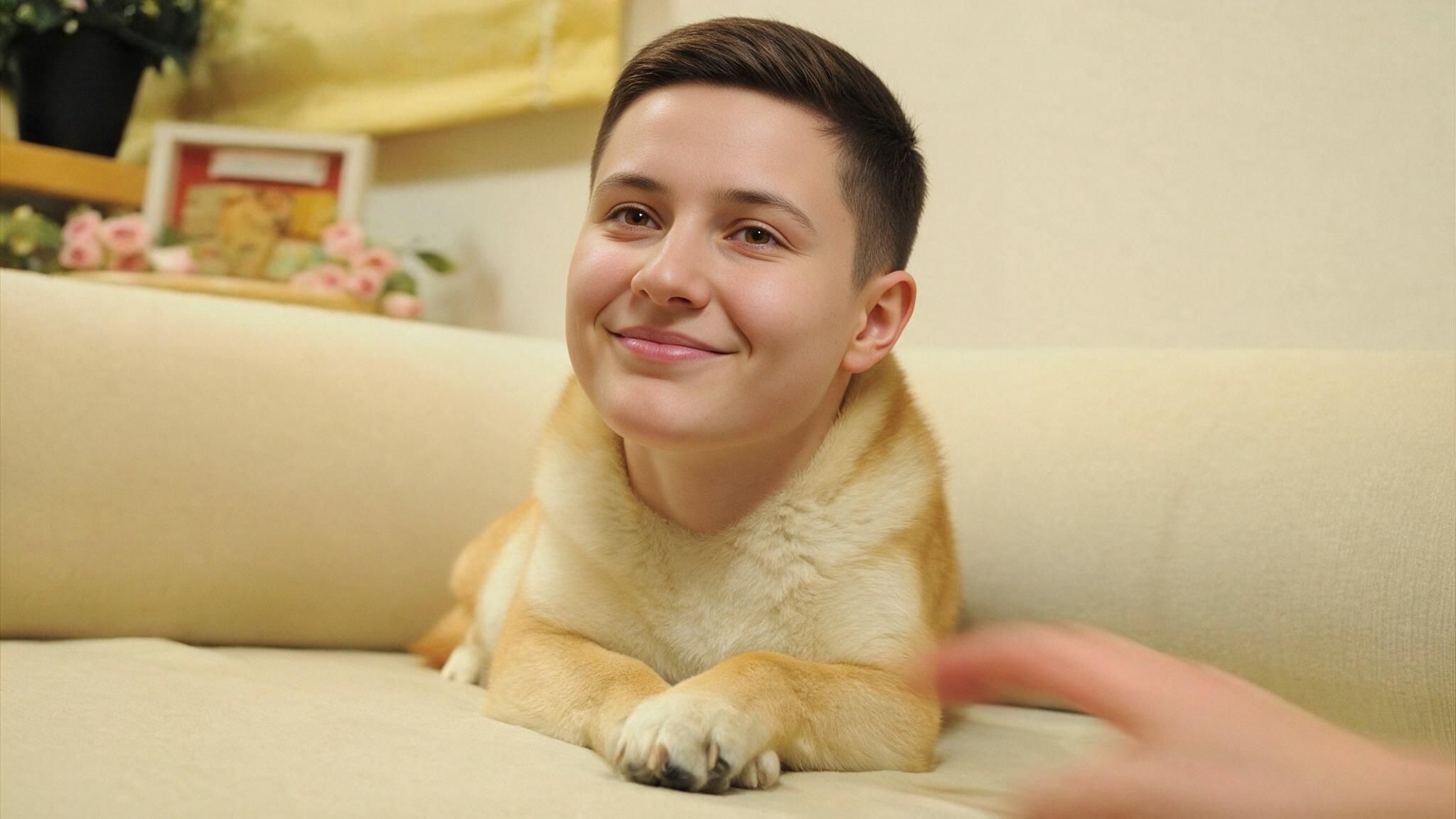
Generated via atlascloud/ face-swap-image on Atlas Cloud, July 2026.
The two outputs diverge exactly along the line the spec sheet predicts. Grok's edit endpoint blended the fictional face into the dog's face structure: the ears, the fur outline, and the general head shape all survived, and the eyes, nose, and mouth read as human without the model treating the rest of the head as fair game. Atlas Cloud's Face Swap tool, one of the tools listed on Atlas Cloud's AI tools hub, did something categorically different: it replaced the entire head, ears included, leaving only the fur at the shoulders as a reminder of the original photo. One is a prompt-driven blend that keeps whatever the instructions don't explicitly change. The other is a fixed swap that treats the whole head as the thing being replaced, and it states its consent expectation directly on the page. The paid API version runs at $0.096 per default run, before a single credit is spent, and its video counterpart, atlascloud/face-swap-video, extends the same full-replacement approach to footage from $1.30 per run at 1080P in our test. The same hub also carries the free browser version covered in Method 4, for anyone who wants this exact mechanism without touching a credit balance at all.
Prompting Grok Imagine for Safer Face Edits
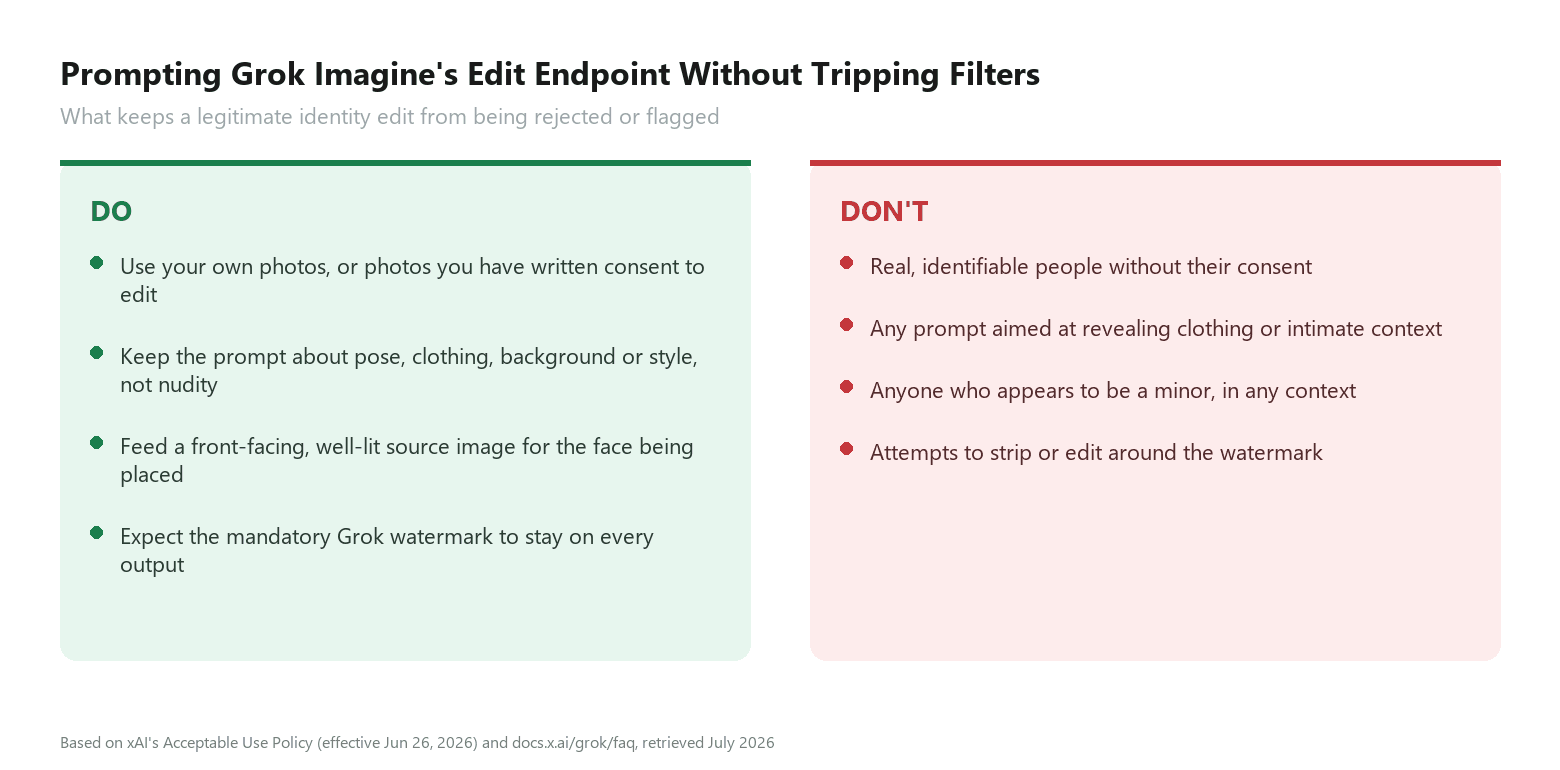
Based on xAI's Acceptable Use Policy and docs.x.ai/grok/faq.
A few habits keep a legitimate edit from turning into a rejected request or, worse, a violation of xAI's own terms.
- Only edit photos you have the right to use. That means your own photos or images with explicit consent from the people in them, full stop. This isn't optional guidance; it's the exact line xAI's policy draws, and Atlas Cloud's face-swap tools state it on the model page for the same reason.
- Write the prompt around pose, clothing, background, and style, never nudity or intimate context. The Quality tier's strength is realistic lighting and texture, which is exactly why prompts drifting toward exposed skin get flagged, sometimes inconsistently, per TechCrunch's own testing.
- Feed a clear, front-facing source image. Editing models fill in what they can't see. A blurry or angled reference produces a face that technically fits the prompt but doesn't actually match the person.
- Use the <IMAGE_0> / <IMAGE_1> tags when more than one photo is involved. Without them, the model has to guess which upload is the source and which is the target, and a guess is where an unwanted result comes from.
- Expect the watermark to stay. It's not a bug to work around. Removing it is a separate policy violation on top of whatever the image itself contains.
Frequently Asked Questions
Does Grok have a face swap feature?
No. Grok Imagine's own template gallery lists 23 named tools as of July 2026, and Face Swap isn't one of them. Identity swaps happen when someone uploads a reference photo and writes a prompt describing the swap on the general edit endpoint, not through a dedicated, labeled feature.
How do you face swap using Grok Imagine's Edit API?
Upload the images you want to combine, then write a prompt using the <IMAGE_0> and <IMAGE_1> tags to specify which reference supplies the face and which supplies the scene, for example "replace the face in <IMAGE_0> with the face from <IMAGE_1>, keep everything else unchanged." Both the standard xai/grok-imagine-image/edit and the higher-fidelity xai/grok-imagine-image-quality/edit accept the same syntax.
Why did regulators crack down on Grok's face-swapping capability?
A mass "undressing" wave in December 2025 and January 2026 saw Grok's editing tool used at scale on real people's photos, prompting formal investigations from the UK's Ofcom and the European Commission, a cease-and-desist letter from California's Attorney General, and multiple lawsuits. xAI responded by paywalling image editing to paid subscribers and then blocking real-person "revealing clothing" edits for everyone.
Is it illegal to face swap someone without their consent?
It can be, and the law has moved fast on this specific point. California's AB 621 allows statutory damages up to $250,000 per violation for non-consensual deepfake pornography, and the federal TAKE IT DOWN Act requires platforms to remove reported non-consensual intimate images, including AI-generated ones, on request. This isn't legal advice, but both xAI's Acceptable Use Policy and Atlas Cloud's face-swap model pages ask for consent from the people depicted for exactly this reason.
Does Grok watermark face-swapped images?
Yes. xAI's own FAQ states there is "no setting to remove the watermark" from Grok-generated images or video, and altering or stripping it is itself a policy violation separate from the image's content.
What's the cheapest way to run Grok Imagine's edit model?
The standard xai/grok-imagine-image/edit tier, priced at $0.022 per run at 1K resolution with auto aspect ratio in our test. The higher-fidelity xai/grok-imagine-image-quality/edit runs $0.06 at 1K and $0.08 at 2K, trading a few cents for stronger facial consistency and sharper detail.
Is Atlas Cloud's dedicated Face Swap tool a better fit than Grok Imagine Edit for identity swaps?
For a job that's specifically about putting one person's face onto another image, yes, it's the more predictable option. atlascloud/face-swap-image takes a fixed source-face and target-image pair rather than an open-ended prompt, states its consent requirement directly on the page, and runs at $0.096 per default run. Grok Imagine's edit endpoint is the better choice when the job is broader than identity, restyling a whole scene, changing an outfit, compositing multiple references, where its natural-language flexibility earns its keep.
Conclusion
The honest answer to "does Grok have a face swap feature" is that it never needed one. A general-purpose editor that understands a prompt like "swap this face" can do the job without a dedicated button, and that same flexibility is what let things go wrong at a scale that pulled in regulators on three continents within a single month. xAI's current policy is specific about what it bans now, the watermark stays on every output, and the API itself runs the same way it always has on Atlas Cloud, one key, a prompt, and a pair of reference images. What changed is how much scrutiny that combination deserves before pointing it at someone else's face.





