The dishwasher died on a Saturday, the client note you owe is three days late, and the guest list for your sister's wedding is still a spreadsheet. Three problems, three letters, and the same blank page every time.
An AI apology letter is the first of eight letter types on one free form, and the other seven use the same four fields: what kind of letter, who it is for, what tone, and a few sentences of key points. Each draft takes about 30 seconds.
This guide walks through all eight, shows what to type into the key points for each, and adds the rules the form cannot know on its own: what apology researchers found actually works, what the FTC wants in a complaint letter, how a printed business letter is laid out, and how far ahead an invitation should go out.
Key Takeaways
- One form covers the eight letter types on the menu: apology, complaint, cover, thank-you, resignation, recommendation, invitation, and congratulations. Four fields, one Run button.
- An AI apology letter lands when the key points name the mistake and the fix. Apology research ranks acknowledgment of responsibility first and an offer of repair second.
- A complaint letter should carry the FTC checklist: account or order number, dates, the remedy you want, and a reply-by date. Full card numbers stay out of any AI tool.
- The output is plain text in greeting, body, sign-off shape. The sender address, date, and inside address of a printed business letter are yours to add.
- For a professional email, keep the same form, pick Concise, and put a subject line and a word cap in the key points.
One Formal Letter Generator, Eight Letter Types on the Menu
Atlas Cloud hosts language, image, and video models behind one account, and its AI Tools collection turns a few everyday jobs into single-screen pages. The Free AI Letter Writer is the page this article is about. It is one form, and the Letter Type menu on it holds eight options, in this order: Thank-you letter, Cover letter, Apology letter, Invitation, Resignation letter, Recommendation, Complaint, Congratulations.
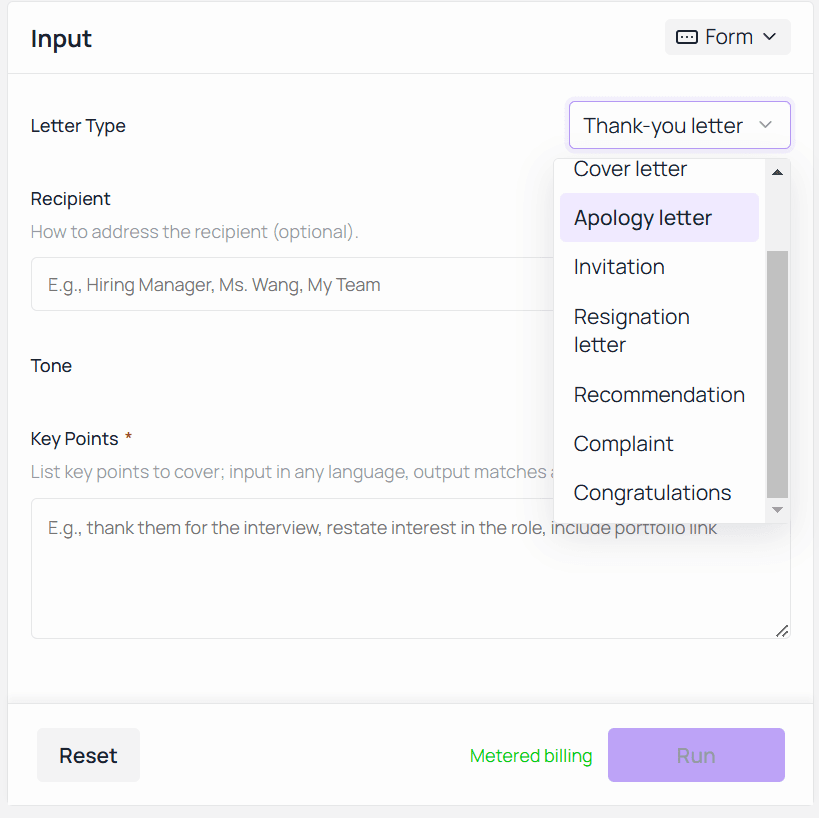
The other three fields are short. Recipient is an optional line the page labels "How to address the recipient". Tone is a menu with Professional, Friendly, Heartwarming, Sincere, and Concise. Key Points is the one required box, and its hint reads "List key points to cover; input in any language, output matches automatically". Using it goes like this:
- Sign in. The page shows "Please log in to AtlasCloud before using this tool." until you do.
- Set the four fields: Letter Type, Recipient, Tone, Key Points.
- Press Run. The page says "A complete draft is ready in about 30 seconds".
- Read the draft once, copy it, and paste it wherever the letter is going.
What comes back is described on the page as "clean plain text with nothing added": a greeting, body paragraphs, and a sign-off, which the page files under a card called Complete Letter Format. That is the middle of a letter.
A printed business letter has more parts than that. Purdue OWL's business letter guide lists eight, in block format, with the whole page left-justified and single-spaced except for a blank line between paragraphs. The table shows which parts the draft supplies and which you add before printing.
| Part of a business letter (Purdue OWL order) | In the generated draft? | For a printed formal letter |
|---|---|---|
| Sender's address | No | Type your address, without your name, above the date |
| Date | No | Add the full date under your address |
| Inside address | No | Recipient's name, title, and postal address |
| Salutation | Yes | Check the name; use a job title if you do not know the reader's gender |
| Body | Yes | Trim anything the key points did not ask for |
| Closing | Yes | Leave four lines for a signature above your typed name |
| Enclosures | No | List attached documents by name |
| Typist initials | No | Skip unless someone else typed the letter for you |
The eight letter types below all come out of this same box. What changes is the key points, and that is where the rest of this guide spends its time.
AI Apology Letter: Name the Mistake, Offer the Fix
The apology is a tempting letter to hand off, and an easy one for a machine to get wrong. A vague apology reads as no apology, and a generator fed "say sorry for the delay" will produce exactly that.
There is research on what a working apology contains. In a 2016 study published in Negotiation and Conflict Management Research, Roy Lewicki of Ohio State and two co-authors tested six components across two studies of 333 adults and 422 undergraduates. The university's summary of the study lists them as expression of regret, explanation of what went wrong, acknowledgment of responsibility, declaration of repentance, offer of repair, and request for forgiveness.
Lewicki's verdict on the ranking: "the most important component is an acknowledgment of responsibility. Say it is your fault, that you made a mistake". An offer of repair came second. And at the bottom: "The least effective element of an apology is a request for forgiveness."
The form knows none of this. The key points have to carry it. Here is a brief for a late client deliverable, mapped to the six components.
| Apology component (Lewicki et al.) | The key points sentence that carries it |
|---|---|
| Acknowledgment of responsibility | This was my scheduling error, not the team's. |
| Offer of repair | We will deliver the remaining social templates by September 12 at no extra charge. |
| Explanation of what went wrong | We delivered the brand guidelines two days after the agreed date of September 2, 2026, which delayed her team's launch review. |
| Declaration of repentance | I will send weekly status updates until the project closes. |
| Expression of regret | Open with a plain apology for the delay. |
| Request for forgiveness | Leave it out. |
Tone matters as much here as in any of the eight. Sincere fits a personal or client apology. Professional fits a letter that may be forwarded to a legal or HR reader. Friendly softens the acknowledgment sentence, and that sentence is the one doing the work.
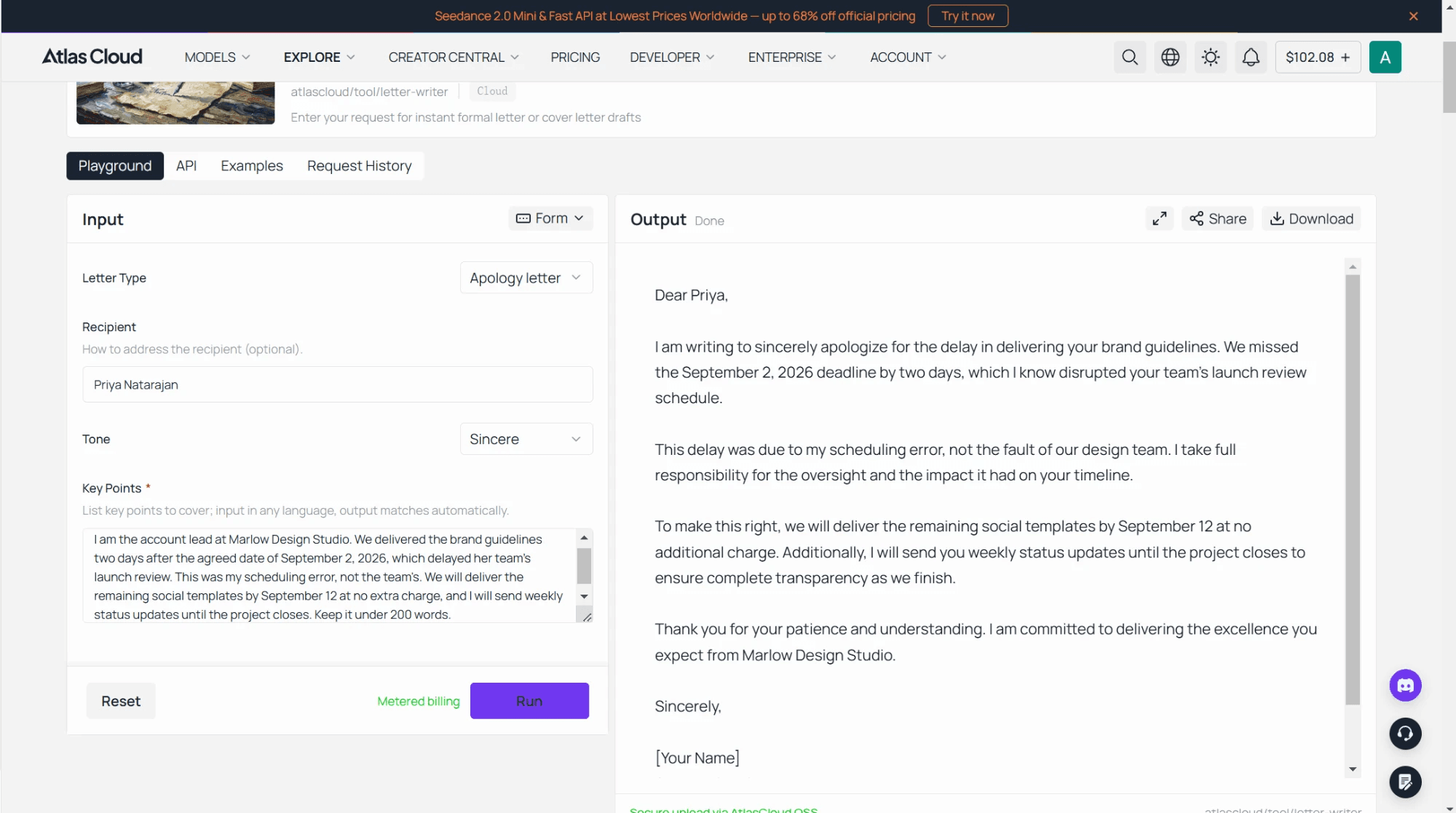
Those same five sentences, typed into a chat window with "write an apology letter" in front of them, make a workable ChatGPT apology letter prompt. The result differs less than you might expect, because the sentences do the work in both places. What differs is who structures the request: the form's menus fix the letter type and tone for you, while a chat prompt leaves both to your wording.
One more difference sits outside the letter. OpenAI's help center states that content from its consumer ChatGPT products may be used to train models by default, with an opt-out in the data controls settings, while business and API accounts are excluded by default. A client's name and a project date are mild, but it is worth knowing where they go.
AI Complaint Letter With the FTC Checklist in the Key Points
The complaint letter is the apology's mirror. Someone else made the mistake, and you want a specific remedy by a specific date. An AI complaint letter is only as strong as the facts you give it, and the US Federal Trade Commission has already written the checklist.
The FTC's sample complaint letter page, dated November 2023, tells you to "Include your account number, if you have an account with the business, and the related transaction number. Give the product name and its serial or model number. State the date and place you bought the product or service".
Its sample letter ends with a deadline: "I will wait until [give a date] before I contact a consumer protection agency or get other help." On tone, the same page is direct: "Be polite and reasonable in your letter. The person who will read it probably didn't cause the problem, but may be very helpful in resolving it." Professional is the tone that matches.
Every item on that list becomes a line in the key points. The table uses a broken dishwasher as the example.
| FTC sample letter element | Your key points line |
|---|---|
| Product name, serial or model number | Northgate dishwasher, model ND-450 |
| Date and place of purchase | Bought August 14, 2026, from the Northgate online store |
| Account or transaction number | Order number ending in 7731 |
| What went wrong, with dates | Stopped draining on August 29; support calls on September 1 and 3 gave no repair date |
| What you want | Repair or replacement under the one-year warranty within 14 days |
| Your deadline | I will wait until September 26, 2026 before contacting a consumer protection agency |
| Documents enclosed | Copies of the receipt and the two call reference numbers |
Notice the order number in that brief ends in four digits. That is deliberate. A complaint letter generator, like any AI tool, is a third party, and a full account or card number does not need to pass through it. Type the last four digits, then write the full number into your printed copy by hand if the company asks for it.
The same page from the FTC says to keep a copy and send the letter by certified mail with a return receipt, which is also the paper trail you will want if the deadline passes.
Card disputes have their own clock. The FTC's guidance on the Fair Credit Billing Act says a written dispute has to reach the card issuer within 60 days after the first bill with the error was sent, and it has to go to the address for billing inquiries rather than the payment address.
Once it arrives, the issuer has 30 days to acknowledge it in writing and 90 days to resolve it. Put the billing date in your key points so the draft shows you are inside the window.
Cover Letter Drafts: What the Form Does Without Your Résumé
A complaint asks a stranger for a remedy. A cover letter asks a stranger for an interview, and the two letters share a rule: the specific version wins.
In a ResumeGo field experiment, 7,287 fictitious applications went out to job boards between July 2019 and January 2020, and applications with a cover letter tailored to the posting drew a 53% higher callback rate than applications with no letter. In a separate ResumeGo survey of 236 recruiters and hiring managers, 87% said they read cover letters.
Here is the honest limit of the Cover letter option on this form. It does not read your résumé and it does not read the job posting. There is no upload field. The tailoring the experiment rewarded happens in the key points, and the simplest way to do it is three lines from the posting matched to three facts about you.
| Line from the posting | Your key points sentence |
|---|---|
| "3+ years managing paid social campaigns" | I have run paid social for two consumer brands for four years, most recently a product launch that reached its signup target three weeks early. |
| "Comfortable presenting to senior stakeholders" | I present monthly results to a board of five and write the pre-read. |
| "Experience with lifecycle email" | I rebuilt a welcome series that lifted second-purchase rate; I can share the numbers in an interview. |
Add the job title and where you saw the posting as the first line, and one sentence on why this company, and the brief is complete. Professional is the tone. Put "keep it under 300 words" at the end so the draft fits one page. A cover letter that runs longer than that is asking a recruiter for time it has not earned yet.
Thank-You Letter in Under 100 Words
The cover letter gets you into the room. The thank-you letter is what you send when you walk out of it, and it should be the shortest of the eight.
In a 2017 Robert Half survey of more than 300 US HR managers, 80% said they take thank-you messages into account when deciding who to hire, and the same survey found that only 24% of applicants were sending them. A short note within a day or two is a low bar that most people still do not clear.
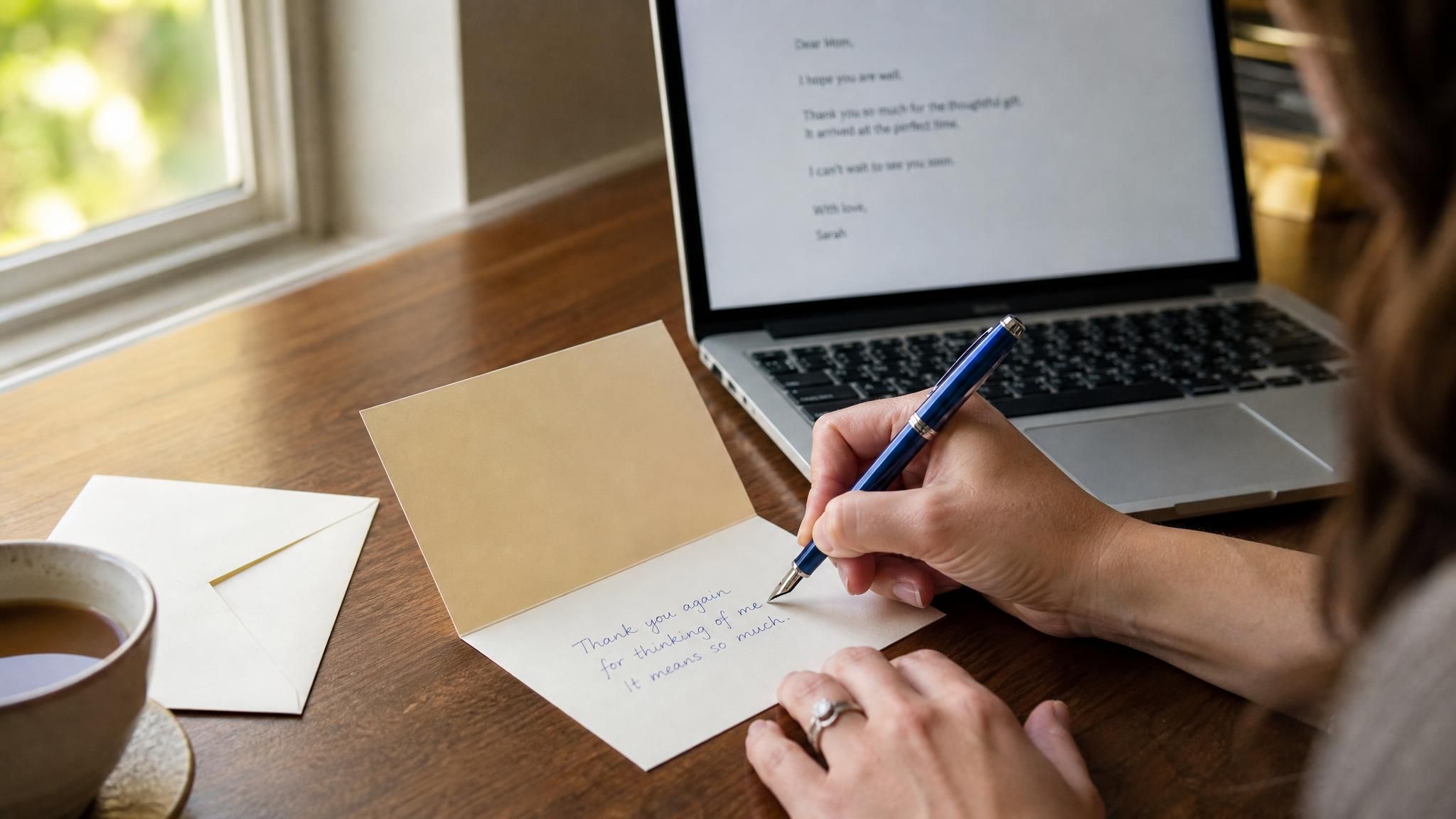
The key points for an interview thank-you are three sentences: the role and the date, one specific thing from the conversation you found useful, and one line that confirms your interest or a next step. For a gift or a favor, swap the first line for what the gift was and how you are using it. Tone is Professional for interviews and Heartwarming for anything personal.
Length is a key point too. The tool page puts it plainly: "A phrase like keep it under 200 words gives you a draft that fits the occasion." For a thank-you, make it 100.
Resignation Letter: Three Facts and a Last Day
Thank-you letters close interviews. Resignation letters close jobs, and there are a lot of them: US Bureau of Labor Statistics data put quits at 3.1 million in July 2026 alone. The Resignation letter option on the form needs very little from you, because the letter itself has one job. It tells HR who is leaving, when, and that the handover is covered.
| Goes in the key points | Stays out of the letter |
|---|---|
| Your role and company, in one sentence | Your reason for leaving |
| Your last working day, as a full date | Your new employer or start date |
| One handover offer, such as documenting open accounts | Pay, counteroffers, or grievances |
Professional or Concise is the tone. If the draft comes back with a sentence explaining why you are leaving, delete it; the key points did not ask for one. The last working day is the line to check before you type it, because it has to respect whatever notice period your contract sets. For notice rules, final paychecks, and five situation-specific briefs, the resignation letter guide covers the same form in depth.
Recommendation Letter: Facts About Someone Else
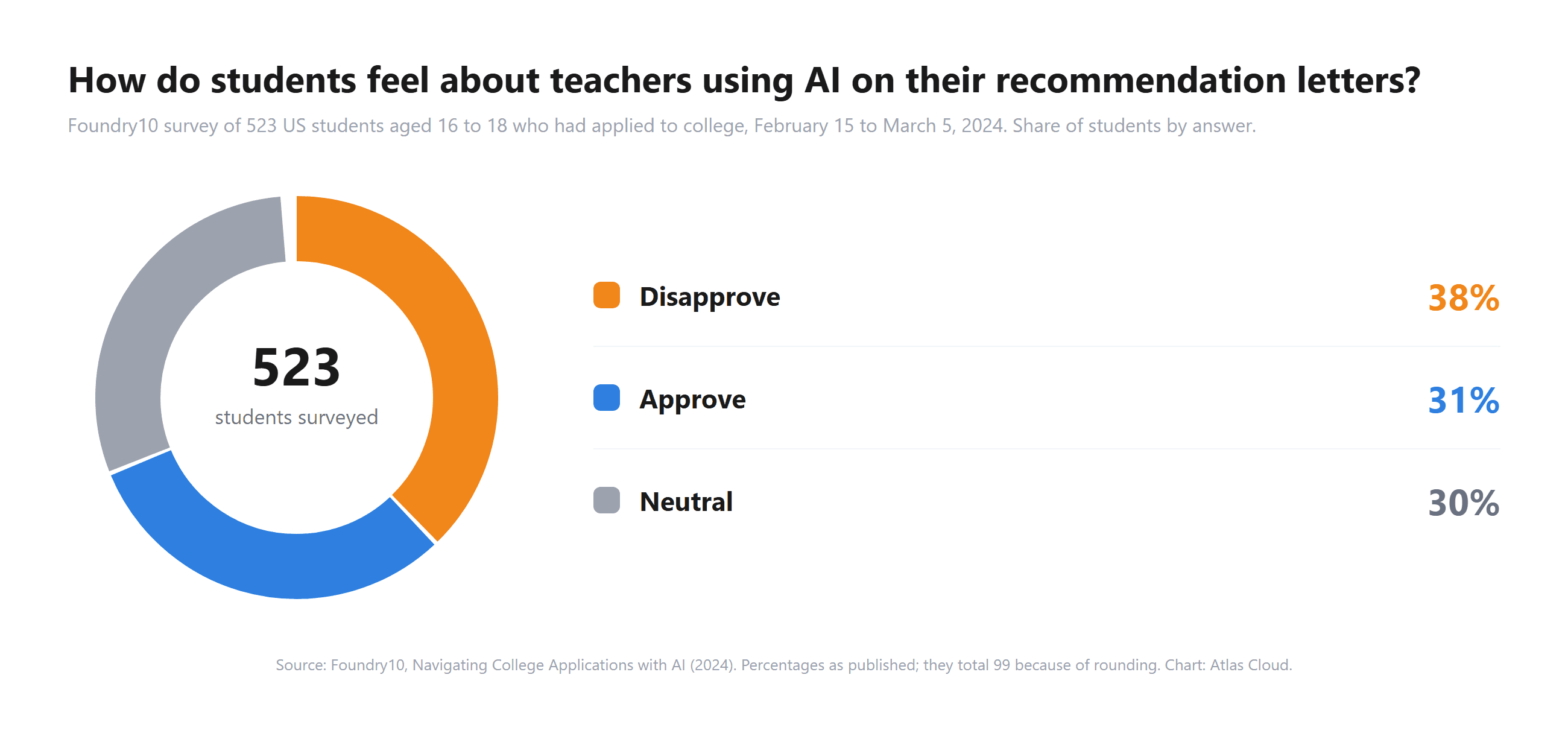
Seven of the eight letters are about you. The recommendation is about someone else, and that changes what you are allowed to type. It is also the type where AI use has already been measured. In Foundry10's 2024 survey of 425 US high school teachers, about 31% said they had used generative AI to help write college recommendation letters. The students being written about were less sure.
The rule for the key points is simple. Type what the candidate gave you and what you saw yourself: the position or program they are applying for, the role they had with you and for how long, one or two specific things they did, and the qualities those things showed.
Grades, health, family circumstances, and anything you learned in confidence stay out, whether or not they would make the letter stronger. Pick Recommendation as the type and Professional as the tone.
Whether to tell the candidate is a separate question, and one group of academic physicians has answered it in print. A 2025 article in Academic Medicine describes its authors informing candidates that they use generative AI to draft, and adding a closing line stating that the signer reviewed and checked every AI-generated portion for accuracy. A sentence like that costs nothing and answers the question before it is asked.
Invitation Letter: Date, Place, Reply-By
From letters about people to letters about dates. An invitation is a letter where timing matters as much as wording, and the Emily Post Institute keeps a table for it.
Its invitation timing guidance gives 3 to 6 weeks for a formal dinner, a few days to 3 weeks for an informal one, and 1 to 4 weeks for a cocktail party. The same institute's wedding planning checklist puts wedding invitations in the mail six to eight weeks before the date.
| Occasion | Send it (Emily Post) | The key points must carry |
|---|---|---|
| Formal dinner | 3 to 6 weeks ahead | Date, time, address, dress code, reply-by date, how to reply |
| Informal dinner | A few days to 3 weeks ahead | Date, time, address, what to bring, how to reply |
| Cocktail party | 1 to 4 weeks ahead | Date, start and end time, address, reply-by date |
| Wedding | 6 to 8 weeks ahead | Names of the couple, date, time, ceremony and reception addresses, reply-by date, how to reply |
Choose Invitation as the type. Friendly suits a party, Heartwarming suits a wedding, and Professional suits a business event. Whatever the occasion, put the reply-by date and the way to reply as the last key point, because a draft that ends without them leaves the reader with nothing to do.
Congratulations Letter That Names the Achievement
The invitation goes out before your event. The congratulations letter goes out after someone else's, and the failure mode is the same as the apology: a generic one reads as no letter at all. "Congratulations on your achievement" is a greeting card. "Congratulations on making partner after the Hollis merger, which I know took two years of your weekends" is a letter.
Three key points do it. Name the achievement in the words the person would use (the title, the degree, the award). Add one detail that shows you were paying attention. Say what you wish for them next. Friendly is the tone for a promotion or a new job; Heartwarming for a wedding, a birth, or a graduation.
The tool page files this type under a card for personal notes, and its own framing is worth quoting: "Some words are hard to find, whether it is thanks, congratulations, or condolences. A warm draft from the free AI letter writer gives you a starting point to make your own before you send it." Take that literally. Read the draft, then replace at least one sentence with a memory only you have.
Professional Email Writer AI: Same Form, Shorter Output
Here is the thing about the eight letter types: many of them go out as email rather than on paper, and email is where the time goes. Microsoft's 2023 Work Trend Index, based on 31,000 workers in 31 markets, found that "the average employee spends 57% of their time communicating (in meetings, email, and chat) and 43% creating", and that "the heaviest email users (top 25%) spend 8.8 hours a week on email".
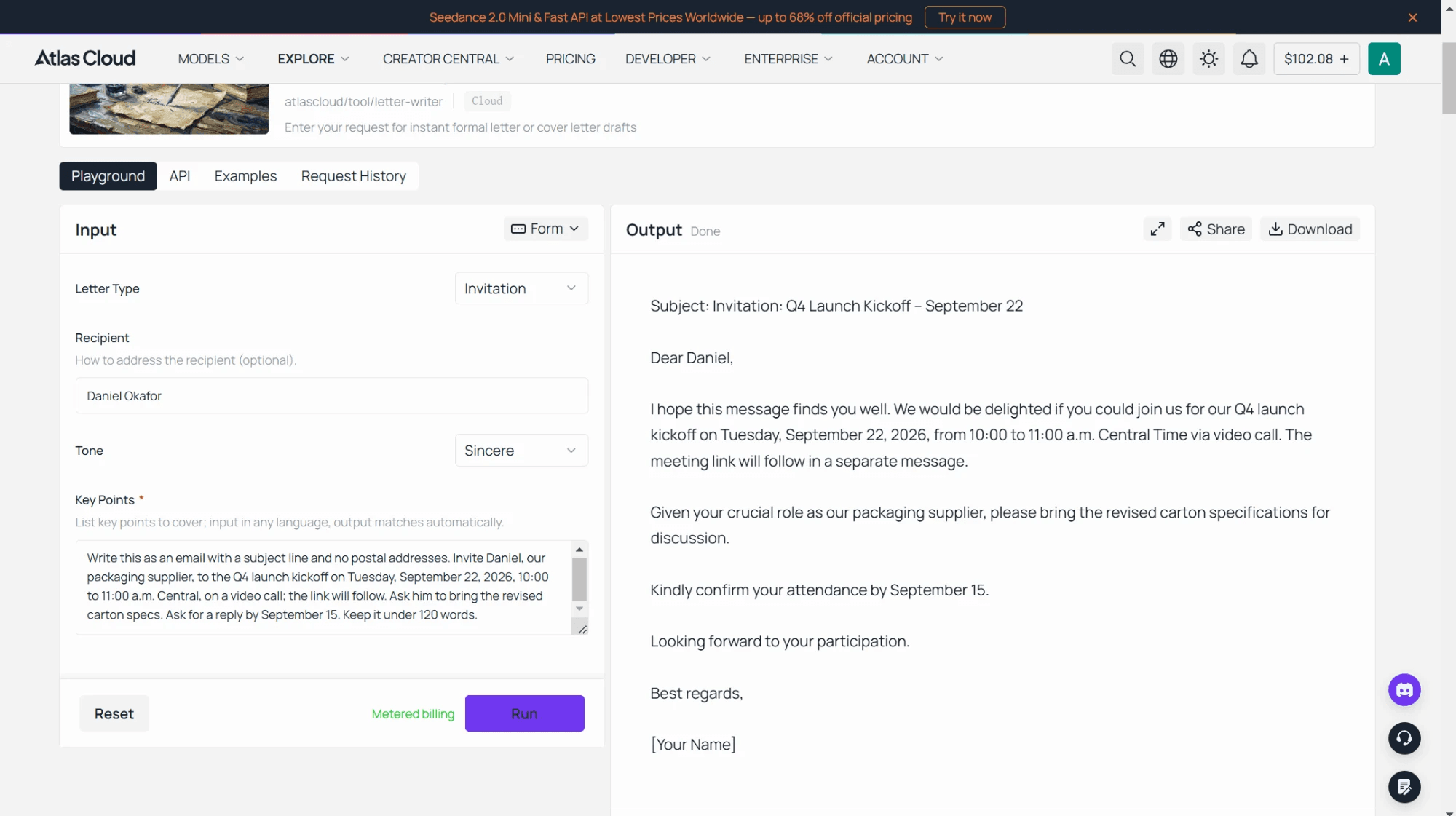
There is no Email option on the Letter Type menu. The form still works as a professional email writer AI when the key points carry three instructions the letter types do not assume: write this as an email with a subject line, keep it under a stated word count, and leave out postal addresses. Concise is the tone.
The type you pick is whichever letter the email actually is. A meeting invitation is an Invitation. A note to a supplier about a late shipment is a Complaint. A follow-up after a call is a Thank-you letter.
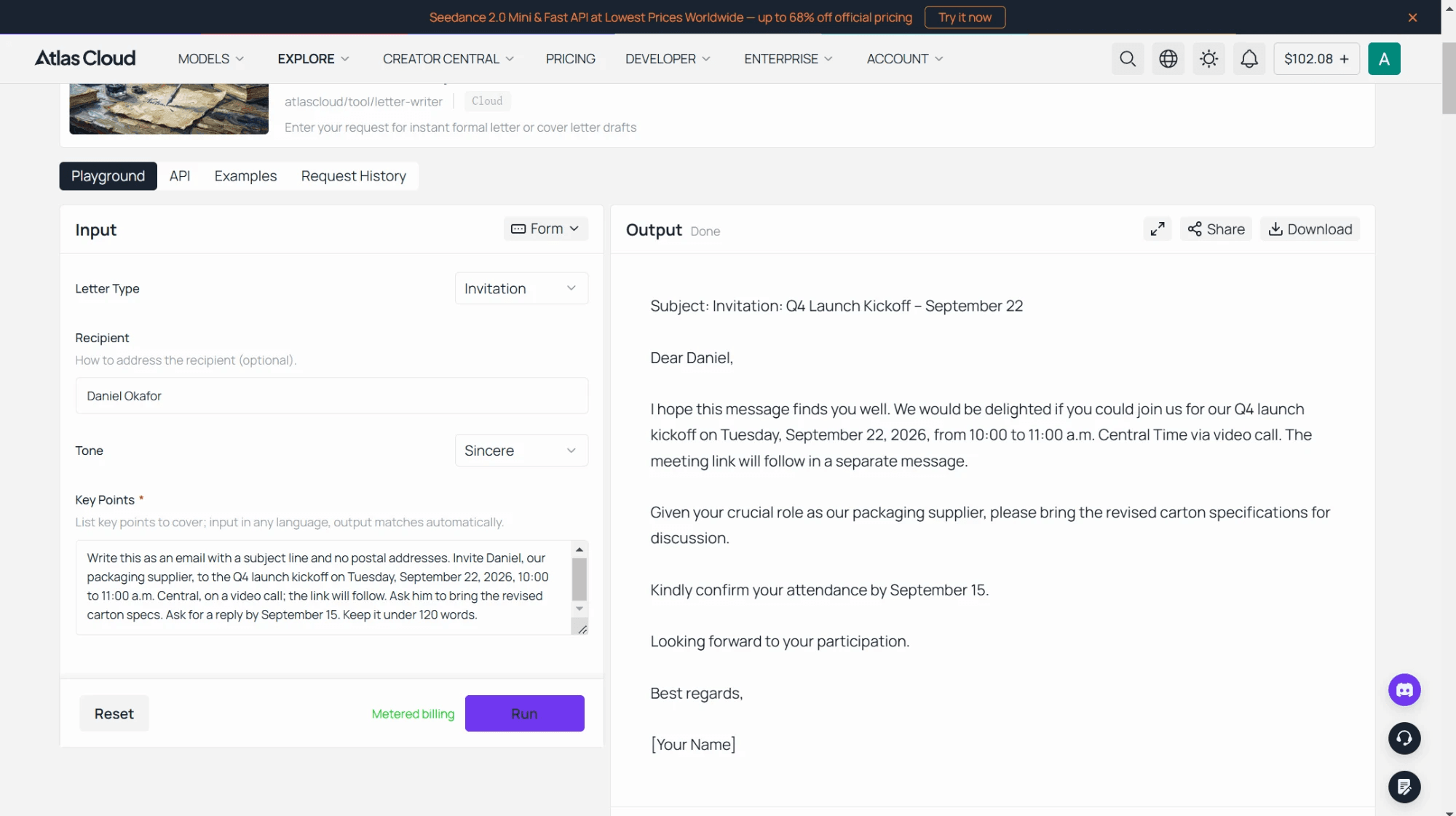
If you set out to write a professional email with AI and landed on a letter tool, this is the whole workaround. The letter shape and the email shape share a greeting, a body, and a sign-off. Everything the table in the first section told you to add for a printed letter is what you leave off for an email, and the subject line takes its place.
Frequently Asked Questions
Is the AI apology letter generator free?
You sign in first. The tool page's own answer is "Yes. Sign in and the AI letter generator, free to try, is ready to go." The AI Tools index page adds that "Each eligible user gets one free trial of the tools below."
After that first letter, generating more draws on credits added to your Atlas Cloud account, and a Metered billing label beside the Run button makes that visible. There is no watermark on the output; the page's FAQ answers that question with a plain "No."
Can ChatGPT write an apology letter?
Yes. Give it the same five or six sentences you would put in the key points: what went wrong, that it was your fault, what you will do to fix it, and what changes afterward. The form saves you from writing the framing around those sentences and fixes the tone from a menu.
If you use a consumer ChatGPT account, check the data controls setting that governs whether your conversations are used for training, and keep other people's names out of the prompt where you can.
Can AI write a complaint letter to a landlord or a company?
Yes, with the Complaint option. For a company, the FTC list covered above is the brief: product, dates, order number, the remedy you want, and your deadline. The same lines work as a ChatGPT complaint letter prompt if you would rather type into a chat window.
For a landlord, add the clause of your lease the problem falls under, the dates you reported it, and the date by which you expect a repair. Keep the tone Professional even if you are angry. Send it in a way that leaves a record. None of this is legal advice, and a letter is the first step rather than the last.
Can the formal letter generator AI add sender and recipient addresses?
The draft comes back as a greeting, body paragraphs, and a sign-off. For a printed letter, add your address, the date, and the recipient's name and address above the greeting yourself, in the block format order shown in the table in the first section. You can also type both addresses into the key points and check whether the draft includes them, then move them to the top if it does.
Can I write a professional email with this AI letter writer?
Yes. There is no Email type, so pick the letter type that matches what the email does and set the tone to Concise. Ask for a subject line and a word cap in the key points, as the email section above shows. The output is plain text, so it pastes straight into a mail client.
Does the AI letter writer work in languages other than English?
The hint under the Key Points box says input in any language is accepted and the output matches it. Type your key points in the language you want the letter in and the draft follows.
What letters are not on the menu?
Condolence letters, letters of intent, and character references for a tenant have no option of their own. Key Points is free text, so name the letter you need in its first line ("This is a condolence letter to a colleague whose father died") and choose the closest type. Read the first paragraph of the draft to confirm it followed your line rather than the menu label, and edit the greeting if it did not.
Conclusion
The dishwasher, the late client note, and the wedding list from the start of this article are three different letters that come out of the same four fields. What separates a usable draft from a generic one is the key points box: the acknowledgment and the repair for an apology, the FTC's dates and numbers for a complaint, a full date for a resignation, only what you witnessed for a recommendation, a reply-by line for an invitation. Everything the letter will be judged on comes from you.
Start with the letter you actually owe this week. If it is an AI apology letter, write the sentence that says it was your fault before anything else, add the fix and the date, and let the form handle the rest. Copy the draft, read it once as the recipient would, and change one line so it sounds like you.





