The request lands on a Sunday night. A former analyst you liked is applying to graduate school, the deadline is nine days out, and the application needs a letter from you. You know exactly what you think of this person. Getting that onto one formal page is the part that eats the evening.
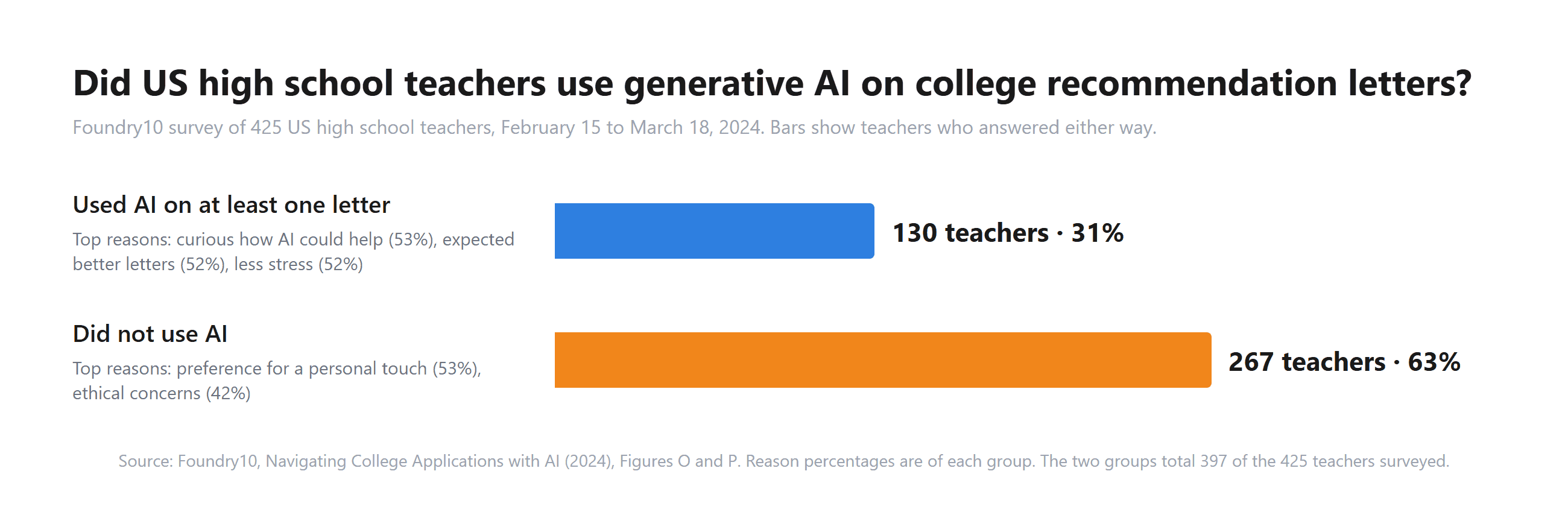
You are not alone in reaching for software. In a 2024 Foundry10 survey of 425 US high school teachers, about 31% said they had used generative AI on at least one college recommendation letter. An AI letter of recommendation can go from four short fields to a formatted draft in about 30 seconds.
This guide shows the form to fill, then runs the same brief through a dedicated generator and through ChatGPT so you can read both letters. It also takes on two questions that matter more than the prompt: what you may paste about another person, and whether you tell anyone the draft came from a machine.

Key Takeaways
- Four fields are enough input for an AI letter of recommendation that reads as yours: the letter type, the recipient, a tone, and one paragraph of specific key points.
- Atlas Cloud'sFree AI Letter Writerreturns a formatted recommendation letter in about 30 seconds, with one free run after you sign in.
- Same brief, two tools: both letters kept every fact we typed and both added about seven character claims we never supplied, so the fact check is the same job either way.
- About 31% of 425 US high school teachers surveyed in 2024 had already used generative AIona college recommendation letter. Whether you disclose it is a decision to make before you sign.
- A student's grades, health details, or full identifying record never go into a public chatbot. Consumer ChatGPT plans can use your chats for training unless you switch that setting off.
Generate an AI Letter of Recommendation in About 30 Seconds With Atlas Cloud
Atlas Cloud runs a hosted catalog of language, image, and video models behind one account. Its AI Tools collection wraps a handful of everyday jobs into single-screen pages, and the Free AI Letter Writer is the one built for tonight's letter.
Choose Recommendation from the Letter Type menu, write who the letter is addressed to, pick a tone, type your key points, and press Run. The page puts the wait at about 30 seconds, and the letter arrives complete: greeting, body paragraphs in order, sign-off.
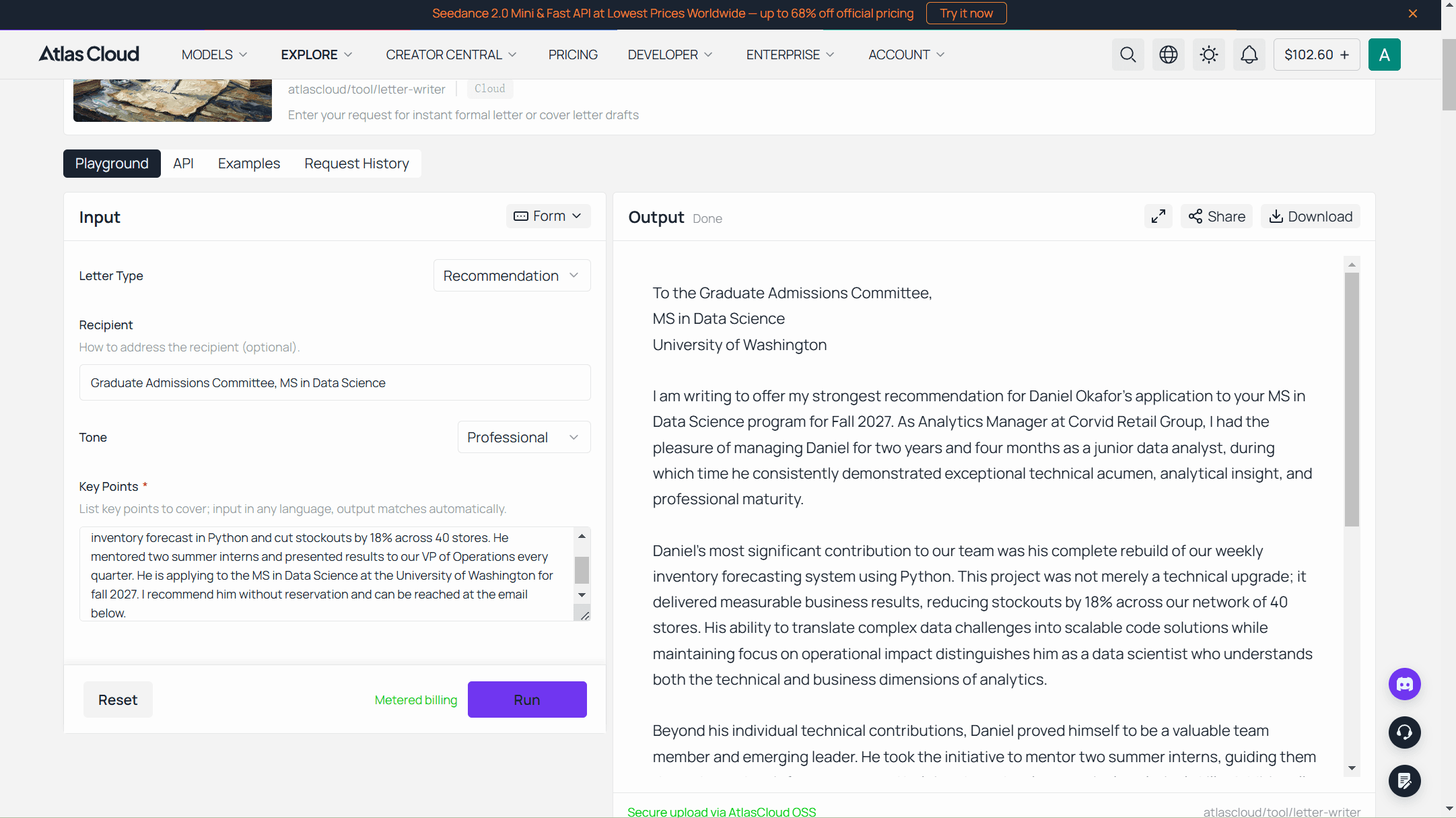
The names above are fictional. Swap in yours and the brief still works, because the structure is what the tool needs:
plaintext1I am [your name], [your title] at [organization]. I [supervised / taught / worked alongside] [candidate] for [duration] as [their role]. 2[One specific achievement with a number or a named outcome.] 3[A second achievement that shows a different strength.] 4[The exact program, job, scholarship, or tenancy they are applying for, and the start date if you know it.] 5I recommend [them] [without reservation / strongly / for this role], and I can be reached at [contact line].
Five sentences. Each one turns into something the reader can check, which is the difference between a letter that helps and a letter that fills a slot.
Here is the letter that came back from the brief in the screenshot, exactly as generated:
To the Graduate Admissions Committee,
MS in Data Science
University of Washington
I am writing to offer my strongest recommendation for Daniel Okafor's application to your MS in Data Science program for Fall 2027. As Analytics Manager at Corvid Retail Group, I had the pleasure of managing Daniel for two years and four months as a junior data analyst, during which time he consistently demonstrated exceptional technical acumen, analytical insight, and professional maturity.
Daniel's most significant contribution to our team was his complete rebuild of our weekly inventory forecasting system using Python. This project was not merely a technical upgrade; it delivered measurable business results, reducing stockouts by 18% across our network of 40 stores. His ability to translate complex data challenges into scalable code solutions while maintaining focus on operational impact distinguishes him as a data scientist who understands both the technical and business dimensions of analytics.
Beyond his individual technical contributions, Daniel proved himself to be a valuable team member and emerging leader. He took the initiative to mentor two summer interns, guiding them through our data infrastructure and helping them develop practical analytical skills. Additionally, his quarterly presentations to our VP of Operations showcased his ability to communicate technical findings to senior leadership clearly and persuasively—a critical skill for any data science professional.
Daniel combines rigorous analytical capabilities with genuine intellectual curiosity and collaborative spirit. I am confident that he will bring the same dedication, technical excellence, and leadership to your graduate program that he demonstrated at Corvid Retail Group.
I recommend him without reservation for admission to your MS in Data Science program. Please feel free to contact me at the email below should you require any additional information.
Sincerely,
Priya Natarajan
Analytics Manager
Corvid Retail Group
[Email Address]
Letter of Recommendation Generator Steps: Fill Four Fields, Run, Copy
- Set the letter type and recipient. Open the Letter Type menu and choose Recommendation. In Recipient, write how the letter should address its reader: a committee name, a hiring manager, or a person's name and title. The field is optional.
- Pick a tone and write the key points. Tone offers Professional, Friendly, Heartwarming, Sincere, and Concise. Professional fits admissions offices and employers. Sincere or Heartwarming suits a scholarship or a mentee you know well. Key Points is the required field, and the hint under it says you can type in any language and the output matches automatically.
- Run, read, copy. Press Run. When the letter appears, read it once against your key points, then copy the text into your own document or email. The output is plain text with nothing added, so what you copy is what you send.
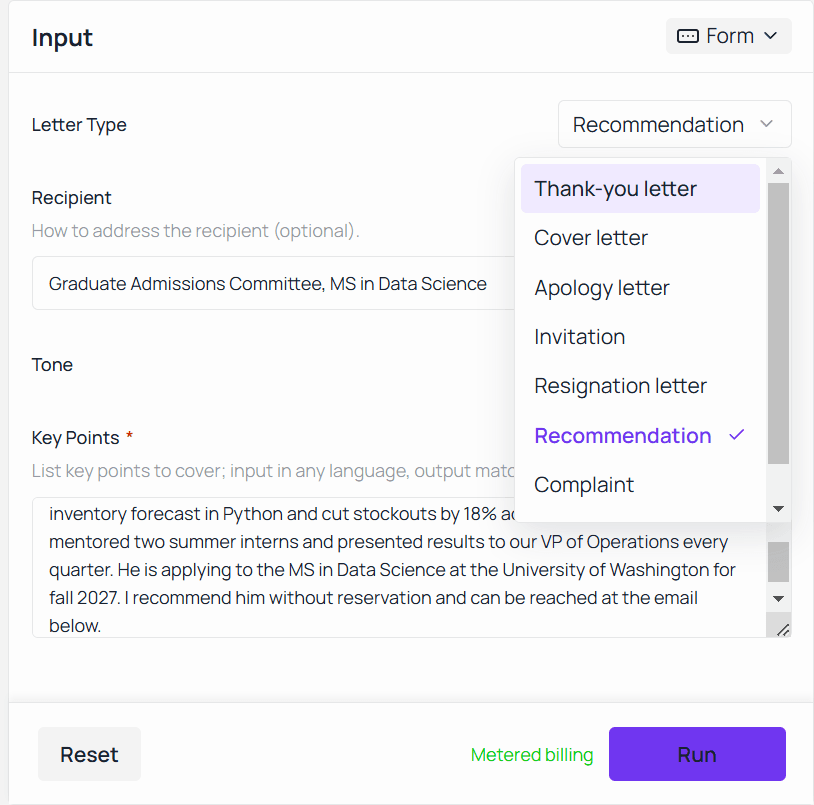
You need to be signed in to run the tool. The page says so before you start, and the Run button carries a metered billing label, which only matters after your first letter (see the FAQ).
AI Letter of Recommendation Generator vs ChatGPT: Same Brief, Two Letters
For many people the first instinct is a chat window, and a ChatGPT letter of recommendation is a reasonable place to start. So we gave ChatGPT the identical brief: a new chat, the default model, custom instructions off, and the Key Points paragraph above pasted in with one line asking for a complete letter addressed to the same committee.
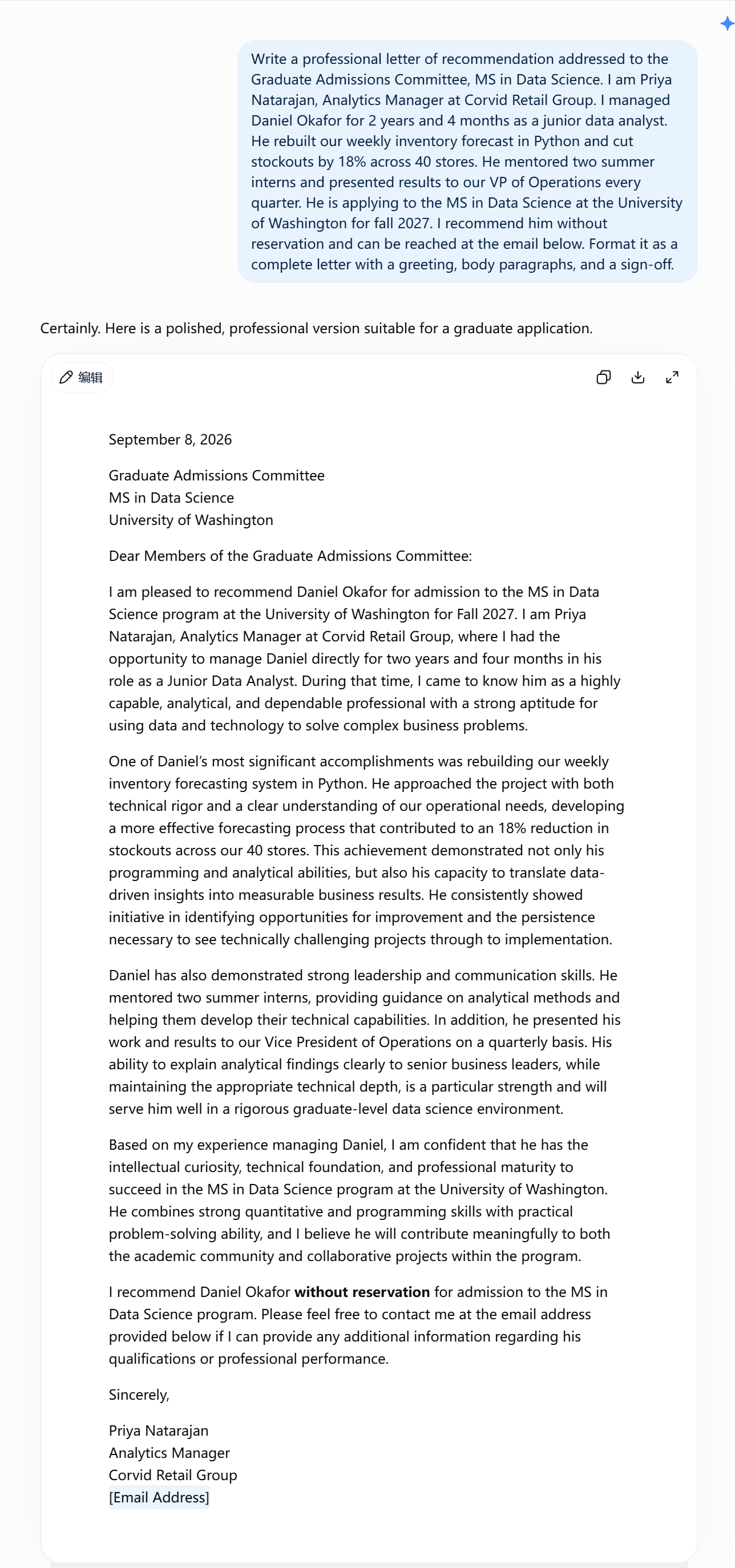
Read the two letters side by side and check the same five things in each. The table is filled from the two screenshots above and from nothing else.
| What to check | Atlas Cloud Free AI Letter Writer | ChatGPT |
|---|---|---|
| Word count | 293 in total, 271 between the address block and sign-off, in 5 body paragraphs | 389 in total, 359 between greeting and sign-off, in 5 body paragraphs |
| Facts in the letter that were not in the brief | 7 character claims with no basis in the brief (exceptional technical acumen, initiative, guidance through our data infrastructure, intellectual curiosity, collaborative spirit, and two more); the junior data analyst relabeled a data scientist in one clause; the 18% figure kept as a direct reduction | 7 character claims with no basis in the brief (initiative, persistence, guidance on analytical methods, intellectual curiosity, professional maturity, and two more); the 18% cut softened to contributed to |
| Hedging phrases such as I believe or it seems | 0 (the closing uses I am confident, an assertion rather than a hedge) | 1 (I believe he will contribute meaningfully) |
| Greeting, dated header, and sign-off present | Address block doubles as the greeting (To the Graduate Admissions Committee); no date line; Sincerely, name, title, organization, and an [Email Address] placeholder; plain text with no Markdown | Yes: dated header, three-line address block, greeting, Sincerely, name, title, organization, and an [Email Address] placeholder; the phrase without reservation came back wrapped in Markdown bold |
| Follow-up questions or options offered before writing | None; a form has no back-and-forth | None; it wrote the letter in one pass (Free plan, default model, custom instructions off) |
The two letters agree more than the two tools would like. Both run five body paragraphs at a similar length (271 and 359 words). Both keep every fact the brief supplied: the name, the two years and four months, the 18% and the 40 stores, the two interns, the quarterly presentations, the program and the start term. And both pad those facts with about seven character claims the brief never made. Initiative, intellectual curiosity, and professional maturity appear in each letter, and Priya typed none of them.
The differences sit in the trimmings. ChatGPT added a date line, softened the 18% cut to a contribution, hedged once with I believe, and wrapped without reservation in Markdown bold that would need stripping. The form output has no date line and no Markdown, keeps the 18% as a direct reduction, and hedges nowhere, but it promotes a junior data analyst to a data scientist in one clause. ChatGPT wrote a letter in one pass with no questions; the form cannot ask any.
So neither draft is signable as it stands, and the edit is the same on both: cut the seven character claims or replace each one with a moment you saw. What the form saved was the prompt-writing and the formatting cleanup. What it did not save was the fact check, and no tool in this test did.
The second row decides whether a draft is usable. A letter that says the candidate led a cross-functional team when your brief said nothing of the kind is one you cannot sign, whichever tool produced it.
The ChatGPT Reference Letter Prompt That Matches the Form
If you would rather stay in a chat window, the four form fields translate into four sentences. A ChatGPT reference letter prompt that carries the same information looks like this:
plaintext1Write a [tone] letter of recommendation addressed to [recipient]. 2[Paste your key points paragraph: who you are, how long you worked with the candidate and in what capacity, two specific achievements, the target opportunity, the strength of your recommendation.] 3Format it as a complete letter with a greeting, body paragraphs, and a sign-off. Do not add achievements, adjectives, or details that are not in my notes.
| Form field | Prompt sentence that replaces it |
|---|---|
| Letter Type | Write a letter of recommendation |
| Recipient | addressed to [committee, manager, or landlord] |
| Tone | a single tone word, stated once: professional, warm, concise |
| Key Points | Your paragraph, pasted as written |
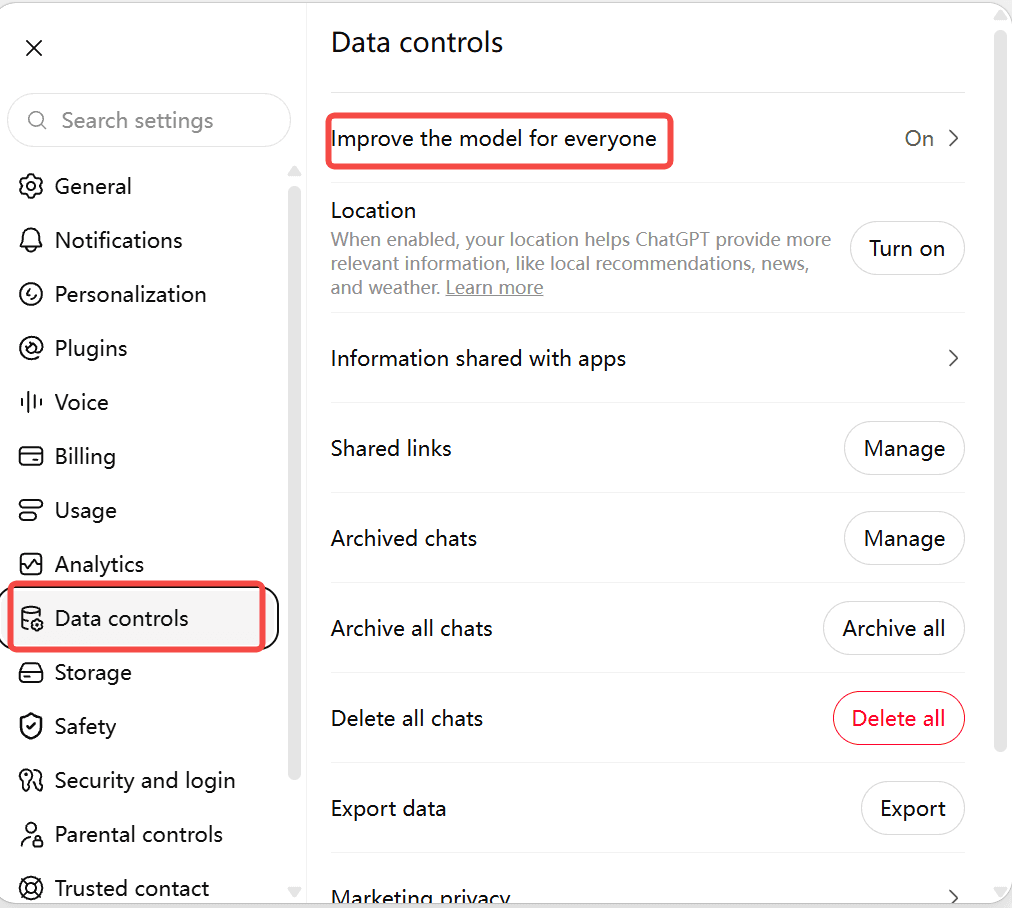
The last line of the prompt does by instruction what the form does by design: it keeps the model inside your facts. One more difference to keep in mind before you paste anything about a real person into a chat window: on consumer ChatGPT plans, that conversation can be used to train future models unless you have turned the setting off. The next two sections cover what to type and what to keep out.
What to Type Into a Letter of Recommendation AI So the Draft Sounds Like You
A letter of recommendation AI writes from what it is given and from nothing else. The brief in the first section works because each sentence maps to a part of the letter admissions offices and hiring managers expect to read.
| Key point you type | Where it lands in the letter | Why the reader needs it |
|---|---|---|
| Your name, title, organization | Opening paragraph, first sentence | Establishes who is vouching and from what vantage point |
| How long and in what capacity you knew the candidate | Opening paragraph | Tells the reader how much weight your view carries |
| An achievement with a number (18% fewer stockouts across 40 stores) | First body paragraph | Verifiable evidence rather than adjectives |
| A second achievement showing a different strength (mentoring, presenting) | Second body paragraph | Rounds out the picture beyond one skill |
| The exact program or role, with a start date | Closing paragraph | Shows the letter was written for this application |
| Strength of recommendation and a contact line | Closing sentence | Readers scan for the wording; without reservation reads stronger than strongly |
Now the opposite case. We ran the same form with the Key Points box reduced to a single line: a former employee named Daniel is applying to grad school, please write a recommendation letter.
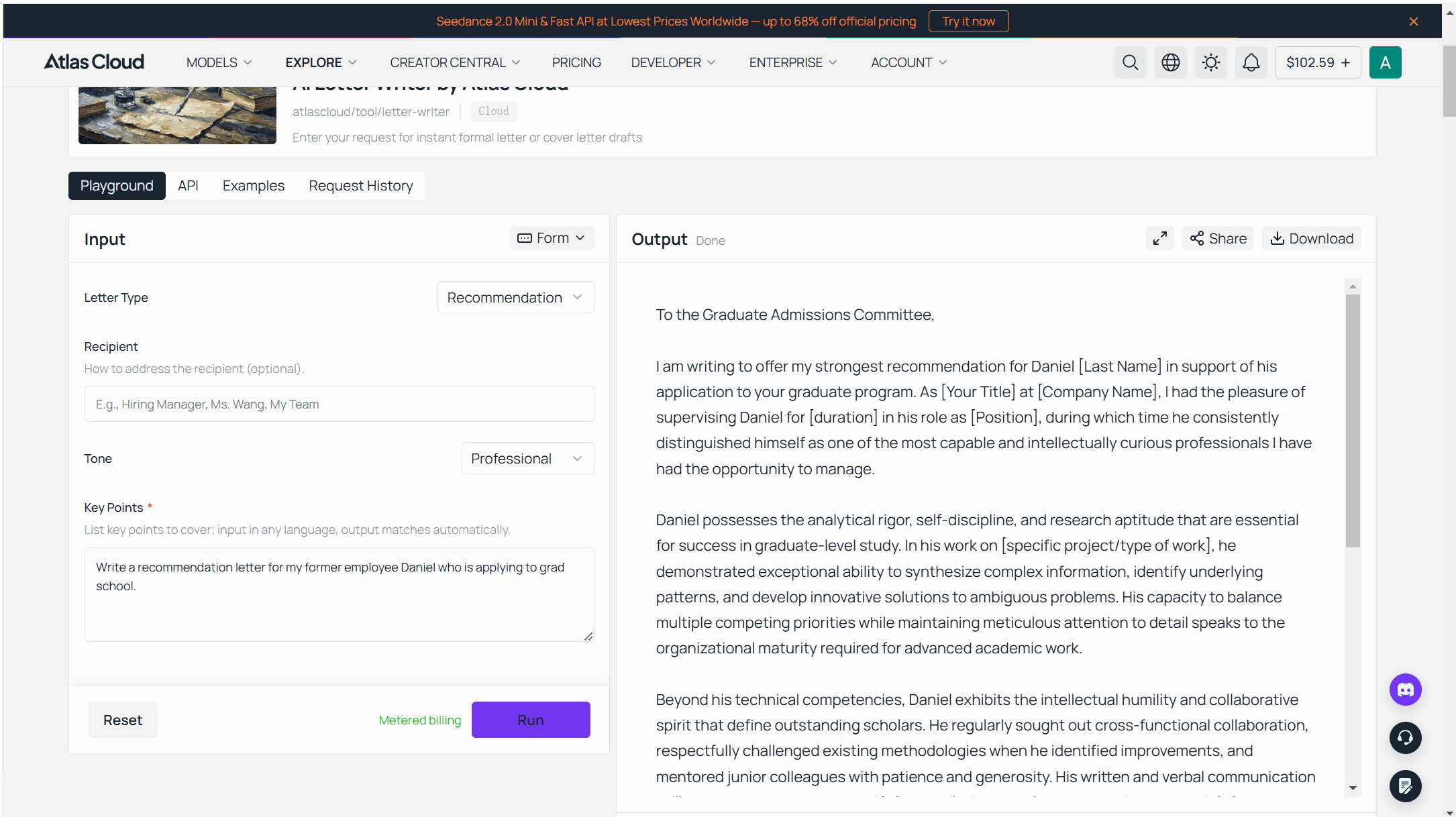
The one-line brief came back as a 300-word letter with 12 bracketed blanks, from [Last Name] and [duration] to [specific project/type of work] and [phone number]. Around the blanks the tool filled in a person: analytical rigor, intellectual humility, remarkable growth, a rare gift for translating complex concepts. It also invented conduct. One sentence reads:
He regularly sought out cross-functional collaboration, respectfully challenged existing methodologies when he identified improvements, and mentored junior colleagues with patience and generosity.
The brief said nothing about collaboration, methodologies, or junior colleagues. The letter also closed with the highest recommendation without reservation, a verdict the brief never gave. A reader who has seen a hundred of these will recognize the phrasing.
The tool did not fail here. It did what any writer would do with one line of information: it wrote a letter that could be about anyone. The fix is upstream, in the five sentences you type.
Three inputs are worth the extra minute even when you are in a hurry: a number, a moment, and a comparison. A number (18%, 40 stores, two interns) survives skimming. A moment (the quarterly presentation to the VP) gives the letter a scene the reader remembers. A comparison (the strongest analyst I have managed in six years) tells them where the candidate sits in your experience. Type any one of these and the letter stops sounding like a template.
What Never Belongs in an AI Reference Letter Brief
Everything in the brief above is about a fictional person. A real AI reference letter draws on a real one, and that person did not sign up for their details to be typed into a text box. Three sets of rules apply.
Education records. In the US, FERPA treats a student's grades, transcripts, and test scores as education records. When a student invites a teacher through the Common App, the first question in the FERPA Release Authorization asks them to grant the high school permission to release requested records. The second asks whether they waive their right to read the recommendations.
The regulation behind that second question, 34 CFR 99.12, lets a college keep confidential admission letters from a student who has waived the right to see them. The waiver counts only if the school "does not require the waiver as a condition for admission" and it is "made in writing and signed by the student, regardless of age."
The practical point for a recommender: the letter is confidential from the student, and it is still governed by the law. As a rule, a GPA or a disciplinary record goes into your brief only if the student's release covers it, and it never goes into a public chatbot at all.
The chatbot's own terms. OpenAI's help center states that for its services for individuals "we may use your content to train our models," while "by default, we do not train on any inputs or outputs from our products for business users, including ChatGPT Business, ChatGPT Enterprise, and the API."
The switch for personal accounts sits under Settings, then Data Controls, and is labeled Improve the model for everyone. Turn it off and, according to the same help center, conversations still appear in your history but are not used to train ChatGPT. That is the minimum before you type a student's name into a chat window, and there is a case for stopping short of the name anyway.
What the people who read these letters say. In an AAMC report from January 2026 on AI-drafted residency letters, Dana Dunleavy, the association's senior director of admissions and selection research and development, put the line plainly: "We don't want to see people uploading someone's Facebook profile into an AI tool and saying, 'Go write about this person.'"
Ronald Rodriguez of the University of Texas Health Science Center at San Antonio, who drafts his own letters with AI, told the same reporter that "anything you put into ChatGPT or Claude or Gemini is the property of those companies." Treat that as a working assumption rather than a legal ruling, and the table below follows from it.
| Fine to type | Keep out of the brief |
|---|---|
| Your own name, title, and organization | The candidate's full legal name |
| Duration and nature of the working relationship | Grades, GPA, class rank, or test scores unless the student's release covers them |
| Achievements you observed directly, with numbers | Health, disability, or family circumstances, even when they explain a gap |
| The target program, role, or tenancy | Immigration or visa status, date of birth, home address |
| Your overall judgment and how strongly you endorse | Salary, disciplinary history, or anything a third party told you in confidence |
The name swap in the first row is the habit that changes most. Write D. or the candidate in the brief, generate, then replace it in your document. The letter reads identically and the chat log never held a name. Edutopia's guidance for teachers and counselors, published in September 2025, makes the same recommendation: do not paste students' names or family information into the tool.
Recommendation Letter Generator Key Points for 6 Situations
The four fields stay the same across situations. What changes is which key points the reader is checking for, and that is where a recommendation letter generator earns or loses its keep. The same rows apply if you call the tool a reference letter generator. In US usage the two names cover the same document, and the FAQ below sorts out the UK meaning.
| Situation | Who asks for it | What the reader checks | Key points to type | Tone |
|---|---|---|---|---|
| College or graduate admission | The applicant, through a portal such as the Common App | Academic readiness, curiosity, how the applicant compares with peers you have taught | Course or project, one piece of work by name, a comparison with past students, the program applied to | Professional |
| Employment reference | A hiring manager or HR, sometimes the candidate | Whether the person did the job, how they worked with others, whether you would rehire | Role and dates, one measurable result, one example of teamwork, your rehire view | Professional or Concise |
| Scholarship or fellowship | The applicant | Fit with the award's stated criteria (service, leadership, need, field) | The award's named criteria and one story per criterion; financial context only if the applicant asked you to include it | Sincere |
| Rental or landlord reference | The applicant, occasionally the new landlord | Paid on time, cared for the property, caused no complaints | Tenancy dates, payment record, condition at move-out, whether you would rent to them again | Concise |
| Character reference for immigration or court | The applicant or their lawyer | How long you have known the person, in what capacity, specific conduct you witnessed | Relationship and years known, two concrete examples of conduct, your contact details for verification | Sincere |
| Volunteer or community role | The applicant or the organization | Reliability, commitment, how they treated the people served | Hours or duration, one specific contribution, an example of how they handled a hard moment | Heartwarming or Sincere |
Two of these deserve a word beyond the table. An employment reference in the UK runs under different expectations from a US recommendation: government guidance says an employer does not usually have to give one, and any reference it does give must be fair and accurate. If you are writing for a colleague who has just handed in their resignation letter, keep the reference to what you observed and can defend. Warmth is welcome. Invention is not.
The immigration and court row is where a generator should do the least. Lawyers may supply a format they need followed, and the letter carries your name into a legal proceeding, so type the facts, generate, then hand the draft to whoever asked for it before you sign anything.
Should You Disclose That an AI Wrote the Letter of Recommendation?
The honest answer is that the rules have not caught up with the practice. The Foundry10 survey behind the 31% figure in the opening also found the two camps talking past each other. Among the 130 teachers who had used AI on a letter, 53% were curious how the tools could help, 52% expected better letters, and 52% wanted less stress. Among the 267 who had not, 53% preferred a personal touch and 42% cited ethical concerns.
The students in the same study were split three ways on whether a teacher using AI for a recommendation letter is acceptable: 38% said no, 31% said yes, 30% stayed neutral.
Academic medicine has put its practice in writing. A 2025 article in Academic Medicine describes its authors' practice when they agree to write a letter: "we also inform the candidate that we currently use genAI to assist in all our writing to streamline the process, correct grammar, and mitigate bias but that we guarantee the content and assertions will be ours alone."
Their letters close with a line that does the disclosure for them: "All AI-generated portions have been reviewed and checked for accuracy by me as the undersigned."
The AAMC report quoted earlier records the same move in an individual voice. Lisa Daniels Torrisi of Emory advises faculty to tell students and institutions when they use AI, and offered a sentence to do it with: "I use AI to assist in writing all my letters of recommendation and do so because I believe it creates a better reflection of my thoughts on each applicant."
Can readers tell anyway? Less often than they think. A 2023 study in AEM Education and Training asked 32 academic physicians to sort 16 promotion letters, eight written by people and eight by AI. Mean accuracy was 59.4%, and letters the reviewers merely suspected were human-written were rated higher for quality and persuasiveness. Readers cannot reliably catch an AI draft, so the safeguard has to be yours: disclose where the setting calls for it, and review every line.
If your institution or the requesting organization has a policy, follow it. If it has none, the Emory sentence and the Academic Medicine closing line are two forms already in use. Whichever you choose, say it before you sign, and before anyone asks.
Edit the AI Letter of Recommendation Before You Sign It
Signing is the moment the draft becomes yours, and nothing in the four fields changes that. Five checks take under 10 minutes and catch what readers notice.
- Every fact traces to your brief. Read the letter with your key points beside it. Anything the letter asserts that you did not type gets deleted, however flattering.
- One observed moment survives. If the draft has none, add two sentences you could only write because you were there: the meeting, the deadline, the question the candidate asked.
- The strength matches your view. The phrases without reservation and I recommend are read as different verdicts. Make sure the closing says what you would say on the phone.
- Hedges and filler go. Cut I believe, it is my opinion that, and any sentence that restates the previous one. The draft gets shorter and reads more confident.
- Format for the reader. Date, your title and organization at the top, the recipient line as they specified, a signature, and one page. If a portal asks for a PDF, export it from your own letterhead document.
Frequently Asked Questions
Is the AI letter of recommendation generator free?
You can try the Free AI Letter Writer free once after you sign in. The tool page puts it this way: "Yes, you can try it free once you sign in. When you are ready for more letters, adding credits to your Atlas Cloud account keeps the drafts coming." The output is plain text with no watermark, and the page says the drafts are yours to use for personal, academic, and business purposes.
Can I use a letter of recommendation generator without logging in?
Not this one. The page asks you to log in to Atlas Cloud before using the tool, and the sign-in is what gives each eligible user the one free run.
What is the difference between a reference letter and a letter of recommendation?
In US usage they are largely interchangeable, and career centers tend to draw the line by purpose: a letter of recommendation is written for one specific opportunity and argues for the candidate, while a reference letter gives a general account of character or work history and may accompany a list of people an employer can call. In the UK, a reference usually means the employer's reference covered in the situations table above.
The generator handles both. The difference is in the key points you type.
Can ChatGPT write a reference letter?
Yes. Paste the same four pieces of information the form asks for, as shown in the prompt section above, and ask for a complete letter. Before you do, check that Improve the model for everyone is switched off under Data Controls if you are on a personal plan, and keep the candidate's full name and any education records out of the chat.
Can colleges tell if a letter of recommendation was written by AI?
Not reliably. In the 2023 study described above, experienced academic reviewers told AI-written letters from human ones only a little better than a coin toss. What readers do notice is a letter with no specifics. A generic draft reads as generic whether a person or a model wrote it, which is why the key points matter more than the tool.
Do I have to waive my FERPA rights to get a letter of recommendation?
A school cannot make it a condition of admission; the FERPA section above quotes the regulation. That said, the Common App's own FERPA guide notes that some recommenders may only write a letter if you have waived, so ask your counselor or teacher what they expect before you answer the question.
Should the applicant draft the letter with AI and ask the recommender to sign?
Only if the recommender asks for a draft, and even then the recommender should treat it as a brief rather than a letter. The person who signs is vouching for every sentence. A cleaner version of the same shortcut: the applicant sends the recommender a five-sentence brief in the format above, and the recommender runs it, edits it, and signs it.
Conclusion
The blank page was never the hard part of a recommendation. The hard part is deciding what you think of someone and putting it in words a stranger can check. Four fields and 30 seconds remove the first obstacle and do nothing about the second. The brief you type, the details you keep out of it, and the sentence about how the letter was made carry more weight than the choice between a form and a chat window.
Run the brief, read the draft against your notes, cut what you did not say, add the moment only you saw, decide on disclosure, and sign. Done that way, an AI letter of recommendation is exactly what it should be: your judgment, typed faster.





