

Every platform in this category promises the same thing: feed it a product, get back a video that looks like a customer filmed it. What actually separates the best-rated platforms for quick UGC product ad videos is the workflow. Some turn a product URL into a finished ad in one pass. Others make you write a script, cast an actor, and pick a voice before anything renders. We ranked 10 platforms on that gap alone: what you put in, how many steps stand between input and export, and what each vendor's own pages say about speed and cost. Every spec below comes from the vendor's site, checked in August 2026.

Key Takeaways
- The real speed gap is at the input step: platforms that accept a product URL or a single photo promise finished ads in minutes, while script-and-actor platforms trade speed for control.
- Subscriptions bundle convenience; model platforms like Atlas Cloud price per clip instead, which wins once you generate in volume or irregular bursts.
- Free plans differ widely: some vendors offer standing free credits, others only paid trials, and one lists no free route at all.
- Free plans differ widely, from standing credits to paid-only trials; the fastest way to judge the format is to generate a voiced UGC product ad free on your own product.
- Newer video models generate speech and sound in the same pass as the footage, which takes a separate voiceover step out of the pipeline entirely.
What Are UGC Product Ads, and Why Speed Decides Who Wins
UGC product ads are paid ads styled after user-generated content: handheld framing, casual lighting, a person talking to their phone about a product. Brands buy the style because it reads as a recommendation rather than a commercial. The AI version of this replaces the hired creator with generated footage, and the term you will increasingly see alongside it is UGC product asset ads: ads generated directly from product assets, meaning the photos, pages, and clips a store already has, with no shoot at all.
That second term is where speed enters. If a platform can work from assets you already own, production time collapses from days to minutes. If it cannot, you are back to writing scripts and directing avatars, which is faster than a film crew but slower than a paste-and-generate flow. Ad accounts burn through creative quickly, and a hook that works this week is stale next week. The platforms below are ranked with that clock in mind.
Quick Comparison: The Best AI UGC Video Tools for Ecommerce Brands
Here is the whole field in one view before the tool-by-tool breakdown.
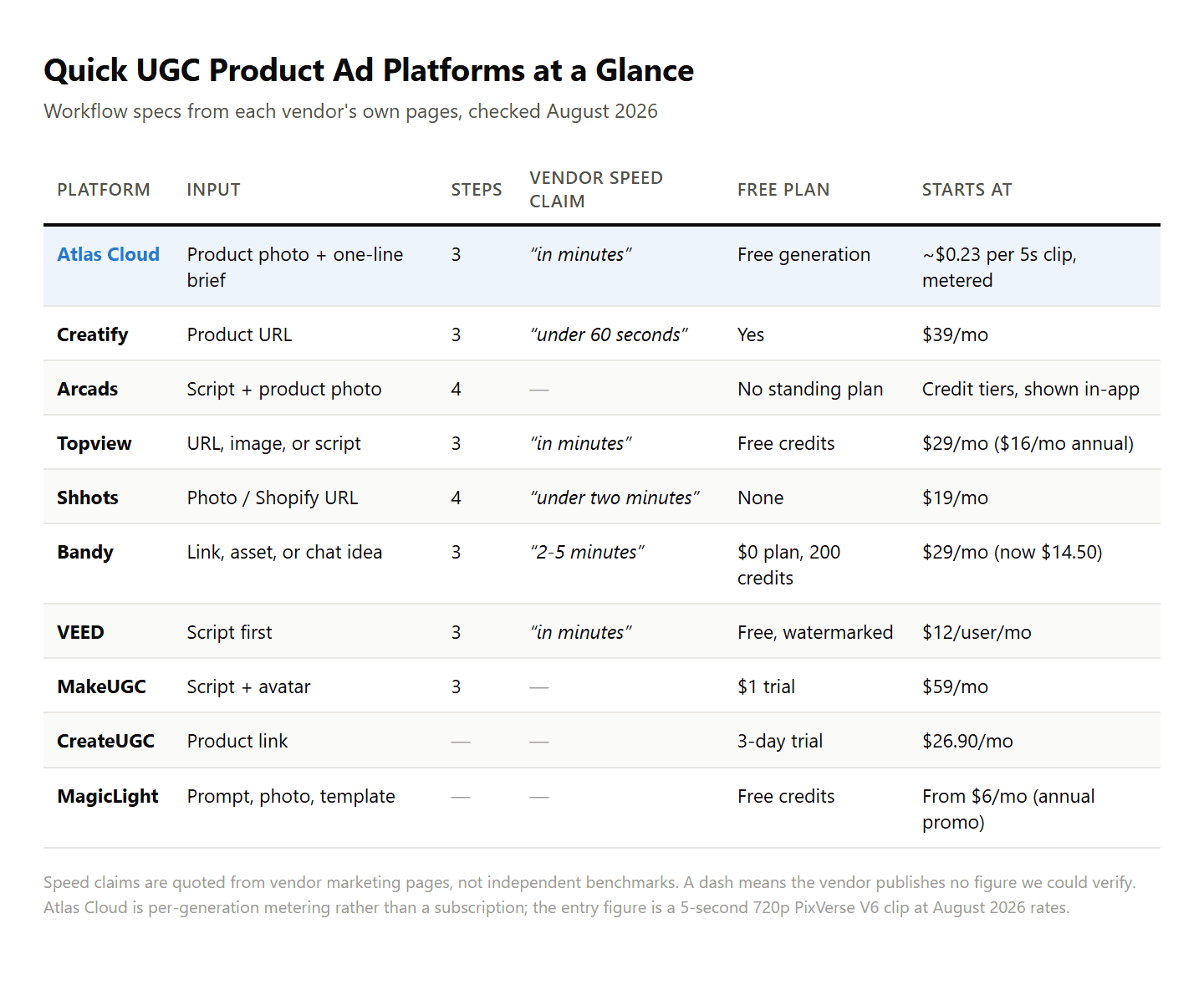
Two patterns are worth pulling out of that chart. First, only a few vendors put an actual number on generation speed; the rest say "in minutes" and leave it there, so treat a missing number as information in itself. Second, the cheapest monthly plan is not the cheapest cost per video once you divide credits by output, which is why the cost section near the end does that math.
How We Ranked These UGC Product Ads Platforms
The yardstick is how quickly a product asset becomes an ad you can actually run, and keeps becoming one at ad-account volume. That breaks into three measurable things. What the platform accepts as input, since a product URL beats a script you have to write. How many steps its own onboarding lists between input and export. And what stands between one export and a live campaign that needs fifty more, meaning watermarks, commercial rights, and whether the flow repeats without manual reassembly. That last one matters because an ad account never needs just one video, and time lost to re-clicking forms is production time too.
To keep this list honest, two things this article deliberately does not rank. It does not judge how lifelike each vendor's avatars look or how well lips sync, which is a separate comparison about digital humans. And it does not benchmark raw video model quality or per-second model pricing across the industry, which is a story about foundation models rather than ad workflows. Here, the workflow is the product.
1. Atlas Cloud: One Free Tool From Product Photo to Quick UGC Ad
dDJuVOVAQKk
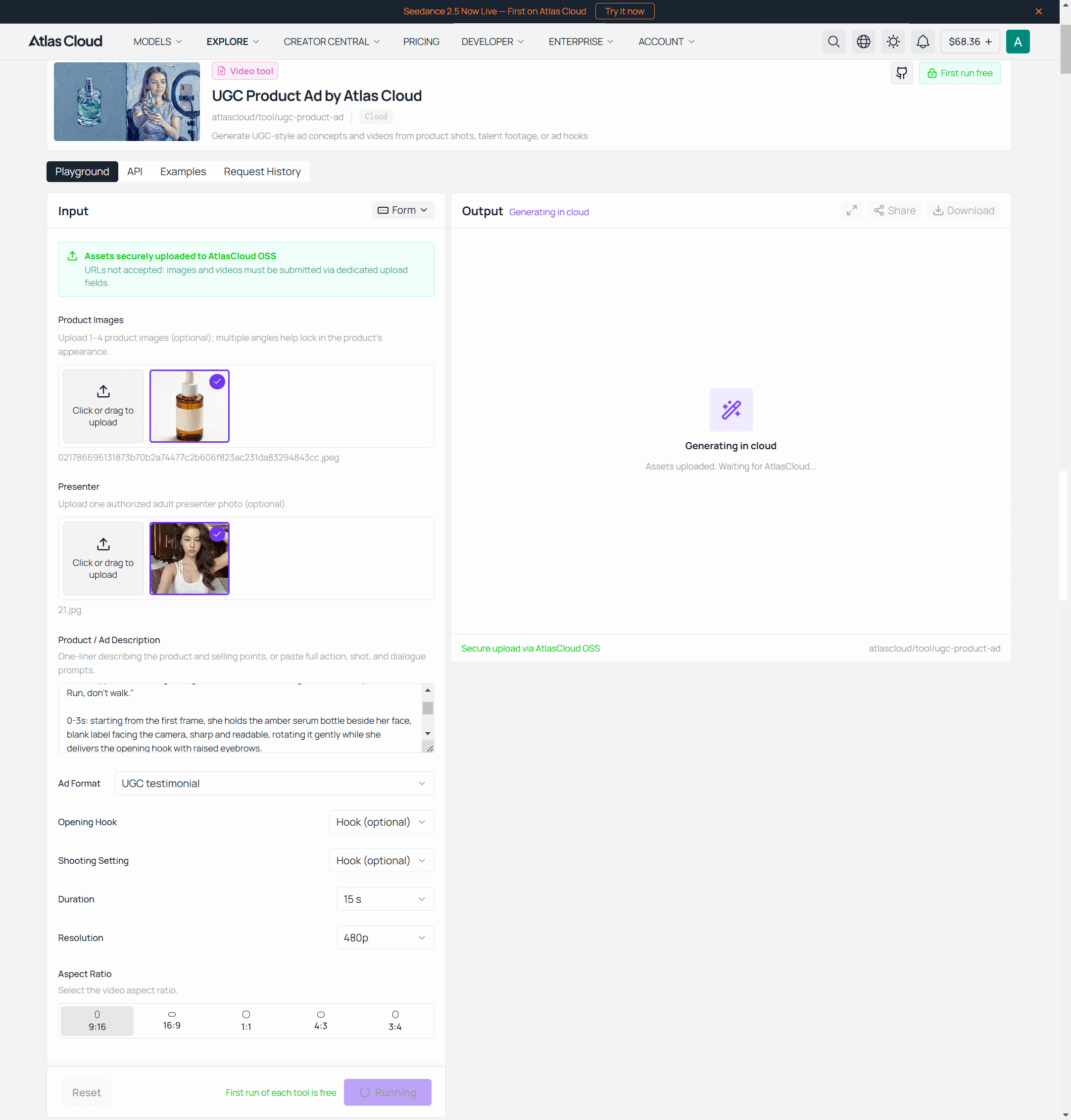
Atlas Cloud hosts the image and video models this whole category runs on, and its free UGC Product Ad tool packages them into the shortest brief you will fill out on this list: one line about your product, up to four product photos, generate.
Everything else is a menu, not a blank page. You pick from 16 ad formats, 11 opening hooks, and 11 scene settings, choose 4 to 15 seconds of length, and set the aspect ratio, 9:16 for TikTok and Reels or 1:1 for in-feed placements. If you want the ad fronted by a specific person, you can add their photo; otherwise the tool casts for you. The output arrives as a voiced clip with natural speech and matching lip movement, so there is no separate voiceover or sync step, and a free generation covers the whole flow end to end.
Asset prep lives one click away in the same AI tools collection: apparel sellers can put any garment on a model photo with the free Change Clothes AI tool before the video step, so even the product shot itself does not need a shoot.
Why it stands out: The hook and scene menus replace the two jobs that slow every first-timer down, scripting and art direction, while the inputs stay things a store already owns. And because the tool sits on a model platform rather than a subscription product, the same account keeps working when you outgrow it: generation is priced per clip, and the pipeline behind it builds a first frame from the product photo, then animates it on Seedance 2.5 image-to-video, which is open in the playground directly for teams that want more control over that step
Best for: Ecommerce sellers who want a finished, voiced UGC ad from assets they already have, without committing to a monthly plan, and teams that want their free test and their eventual volume pricing to live on the same platform.
The honest trade: depth beyond the menus means working with the models directly, not browsing an avatar library with hundreds of faces. If casting from a large actor roster is the feature you care about most, the tools below compete on exactly that. Here is how they compare.
2. Creatify: Fastest Route From Product URL to Finished Ad
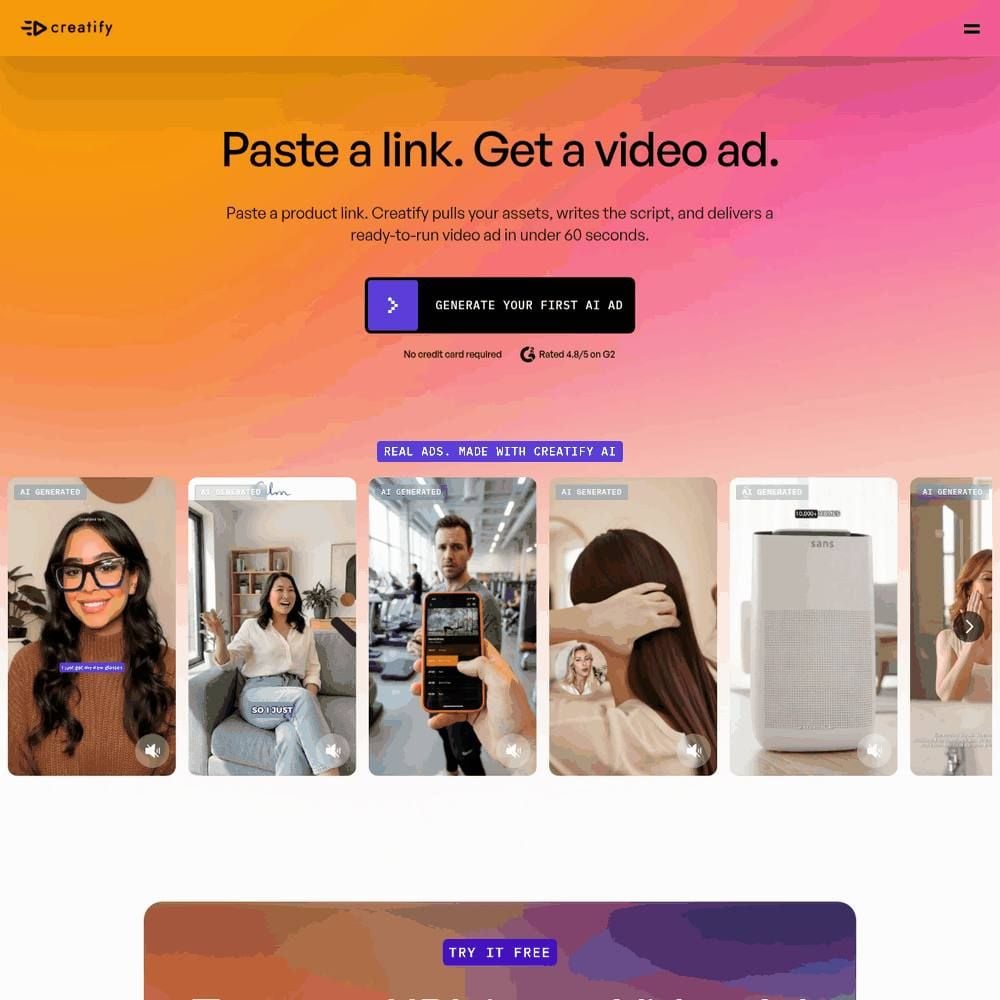
Creatify is the purest version of the paste-and-generate promise. Its flow is three steps by its own count: paste a product URL, choose an avatar, generate and customize. The platform scrapes the product page for details and selling points, writes the script itself, and assembles the ad. Its URL-to-video page claims a ready-to-run video "in under 60 seconds," while its UGC landing page says "in minutes"; both are vendor claims, but even the cautious one is fast.
Why it stands out: The input requires nothing you do not already have. A live product page is the entire brief, and batch mode turns one link into dozens of variants for hook testing. An API and MCP integration are there when volume outgrows the dashboard.
Best for: Ecommerce brands that want the shortest possible path from catalog to ad account, and media buyers who test many hooks per product.
Pricing: There is a free plan for trying the flow. Paid starts at $39 per month for 100 credits, and by the vendor's own rate of 5 credits per 15 seconds of video, that is roughly 20 short clips a month. Watermark removal is a paid feature.
3. Arcads: Script-First Control for Ad Teams
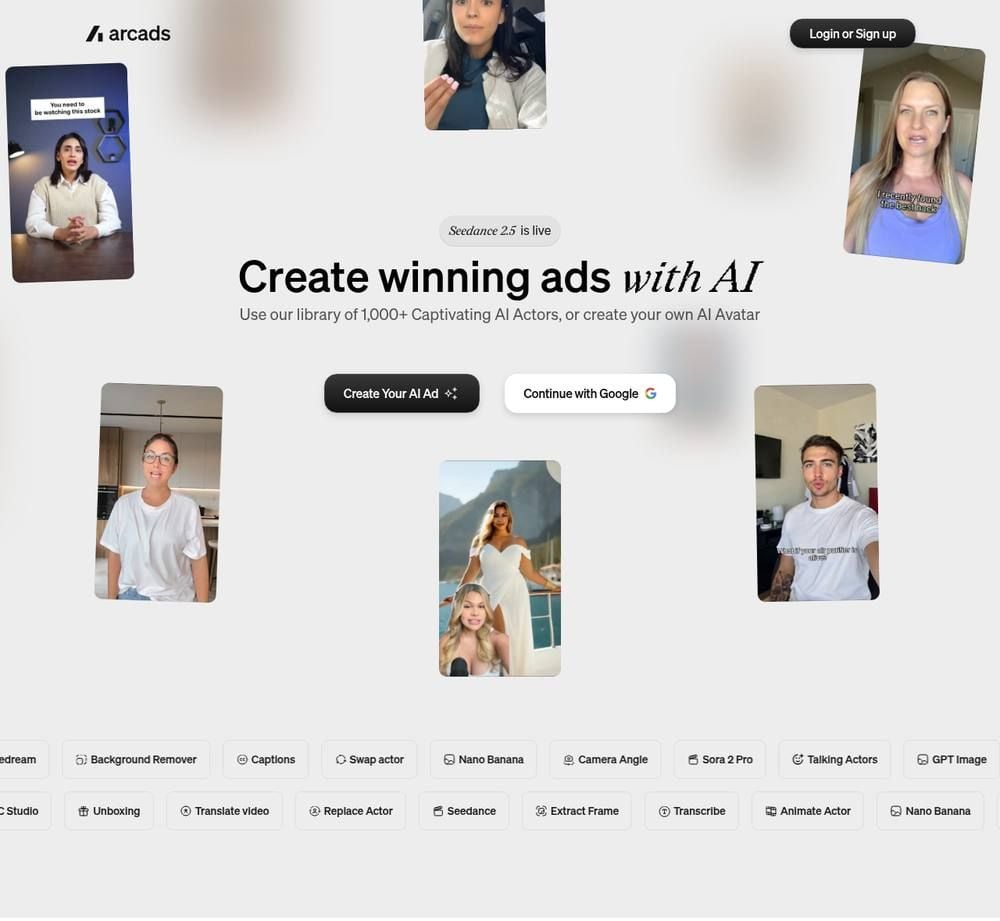
Arcads flips the input. Instead of a product link, you start from a script, cast one of its AI actors, pick a voice, and generate; its help center lists the talking-actor flow as four steps. Products appear by uploading a product photo, which the actor can hold or unbox. That is more decisions before the first render, and Arcads publishes no generation-time claim at all, so it sits behind the URL-first tools on pure speed.
What it gives back is repeatability. Its Workflows feature chains steps into one automated run, and the official example is one script rendered across 10 actors in 2 languages, 20 clips in a single pass. For an ad team that already writes scripts and thinks in variant grids, that is the feature that matters.
Why it stands out: Batch structure. One approved script becomes a matrix of actors, languages, and hooks without manual reassembly, and an API extends the same idea into code.
Best for: Performance marketing teams with dedicated creative testing, where scripts are an asset and volume per script is the bottleneck.
Pricing: Arcads does not publish dollar prices on its public site; plans are named tiers with monthly credit pools shown inside the platform, and talking-actor video meters at 800 credits per minute per actor. No standing free video plan is listed, though time-limited trial promotions do show up on its site.
4. Topview: Product Avatar for Demos That Need Hands
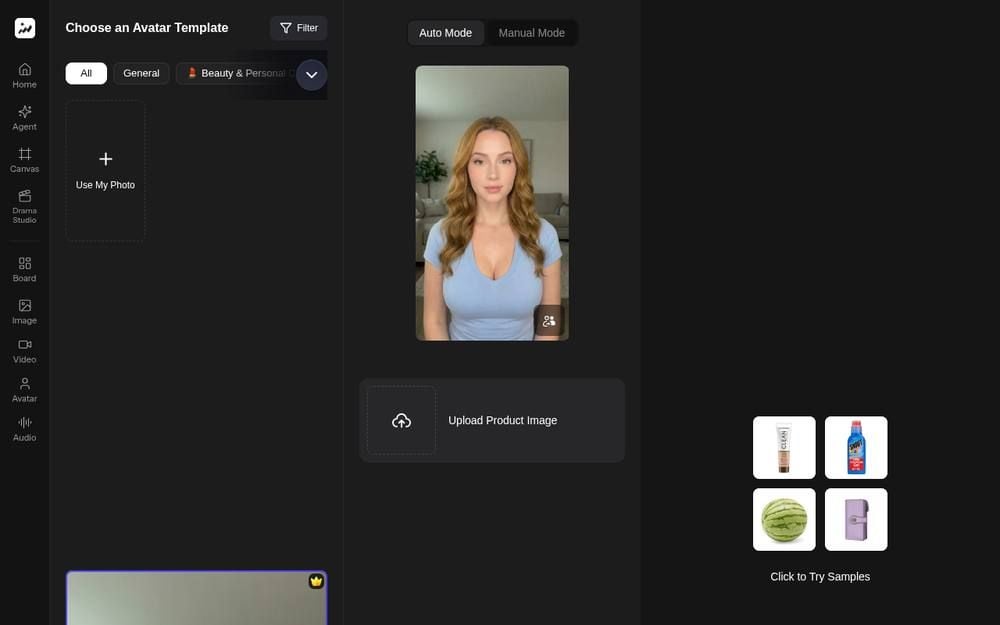
Topview has grown into a broader AI video agent platform, and its UGC line accepts a product link, image, or script. The piece that earns it this spot is Product Avatar, which its page bills as generating a presenter that can actually hold and point to your product, built from a product photo or link in three steps: provide the product, pick an avatar and generate the holding shot, then add script and voice and export.
That matters for a specific class of product ads. A serum, a gadget, a kitchen tool, anything where the ad has to physically demonstrate the item, is exactly where generated UGC tends to fall apart. Aiming a dedicated feature at that gap is a real workflow answer.
Why it stands out: The product-in-hand shot comes from the generator itself rather than from compositing, and the same platform covers script, voice, and export so the demo stays in one place.
Best for: Physical products whose ads live or die on demonstration, and sellers localizing one demo into several markets.
Pricing: A free credit allowance lets you test the flow. Paid plans start at $29 per month, or a listed $16 per month on annual billing, with credits metered against generated video length. Its pricing table mentions watermark-free exports, though the page does not pin that clearly to specific tiers, so confirm on checkout.
5. Shhots: Shopify Catalogs to UGC Ads in Bulk
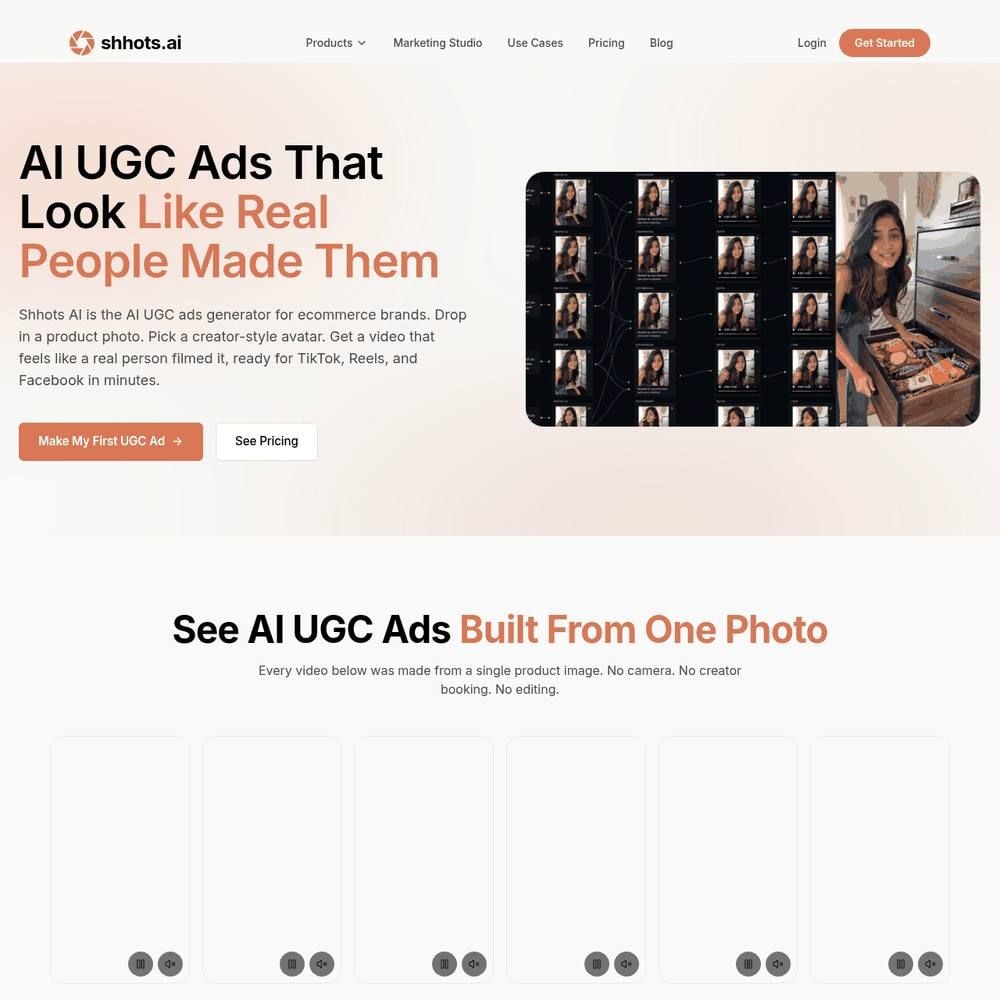
Shhots is built around one input: a single product photo, or a pasted Shopify product URL. Its UGC page lists four steps: upload the photo, pick the ad intent, set controls, generate. It is also unusually specific about time, claiming a render "in under two minutes" and that most users ship 10 ad variations in under 30 minutes. Those are vendor numbers, but publishing them at all separates it from the "in minutes" crowd.
Why it stands out: Store integration. It plugs into a Shopify catalog and generates ads in bulk across products, and every plan exports without watermark and with a full commercial license, so nothing sits between an export and a live campaign.
Best for: Shopify and DTC operators who want ad coverage across a whole catalog rather than one hero product.
Pricing: Plans start at $19 per month for 2,000 credits, which by its own rate of 551 credits per 10-second ad is about 3 clips; the $49 tier is where per-month volume gets realistic. There is no free plan, which the vendor attributes to rendering costs.
6. Bandy: The Conversational Budget Pick
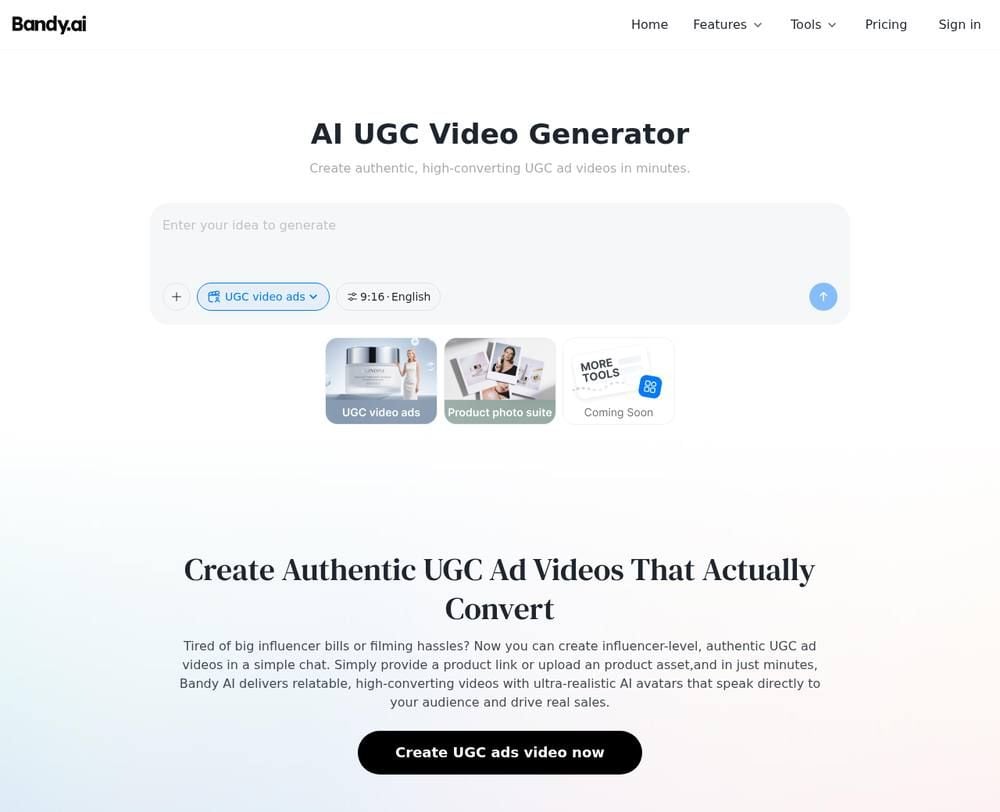
Bandy calls itself an ecommerce creative agent and runs the whole flow as a conversation: give it a product link, an asset upload, or a plain-text idea, refine in chat, download. Three steps by its own onboarding. And it backs the chat pitch with unusually concrete numbers, stating that images arrive in under 30 seconds and videos typically take 2 to 5 minutes.
Why it stands out: The standing $0 plan with monthly credits makes it the lowest-friction way on this list to see AI UGC output on your own product before spending anything, and its pages lean hard into variant volume, pitching dozens of UGC ad variants per batch.
Best for: First-time testers and small stores that want to validate the format on a real product before committing to a monthly plan.
Pricing: The free tier includes 200 credits. The Lite plan lists at $29 per month, currently discounted to $14.50, with watermark-free outputs starting on paid tiers. Per-video credit consumption is not published, so test on the free tier before sizing a plan.
4 More Top-Rated UGC Video Makers for Social Ads
VEED approaches UGC from its editor: generate an avatar clip from a script in three steps, then add product footage and CTAs in the timeline. Strong if editing is already your workflow; the product asset enters late, so it is not a paste-and-done flow. Free exports carry a watermark at 720p, and paid starts at $12 per user per month.
MakeUGC is a script-and-avatar generator with HD to 4K export and a batch mode on its mid tier. It publishes no generation-time claim and no standing free plan; entry is a $1 trial, then plans from $59 per month for 500 credits, with unused credits expiring monthly.
CreateUGC targets dropshippers, generating UGC-style ads from a product link with a 3-day, 3-video trial and plans from $26.90 per month for 10 videos. Its FAQ names the models under the hood, Google Veo 3, Kling, and Seedance 2.0, a useful reminder that packaged tools and model platforms draw from the same well.
MagicLight runs UGC generation as one tool among several, from prompts, photos, or 7 preset templates, with free starter credits and paid listed from $6 per month on a promotional annual rate. Fine for casual volume; thin on ecommerce-specific inputs like product URLs.
Which Platform Fits Your Ecommerce Brand
Match the tool to the bottleneck, not the other way around. The best-rated platforms for quick UGC product ad videos each earn that rating on a different job, and picking by rank instead of by fit is how teams end up paying for features they never open.
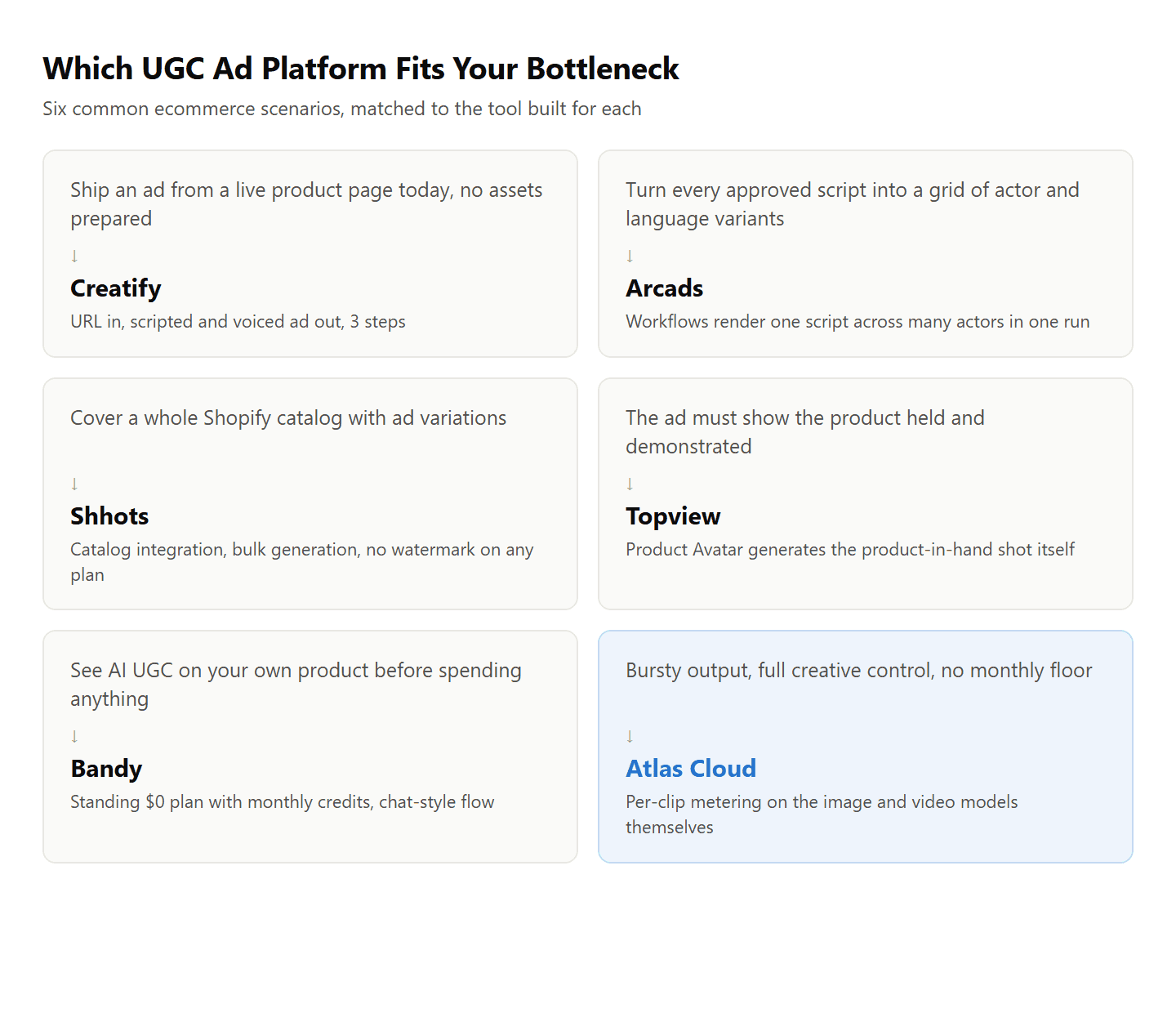
If your bottleneck is getting anything live today from a product page, Creatify's URL flow is the shortest path. If it is variant volume against scripts you already write, Arcads' workflow grid does that job. Shopify catalogs point to Shhots, product-in-hand demos to Topview, and a zero-budget first test to Bandy. And if the bottleneck is that subscriptions never quite fit how unevenly you produce, the per-clip pipeline on Atlas Cloud is the one built for bursts.
One more filter: check who owns the output. Commercial terms range from full ownership on every plan to non-exclusive licenses, and that clause matters more for ads than for any other content you generate.
What Quick UGC Product Ad Videos Actually Cost
Question is: what does one finished clip cost once the plan math settles?
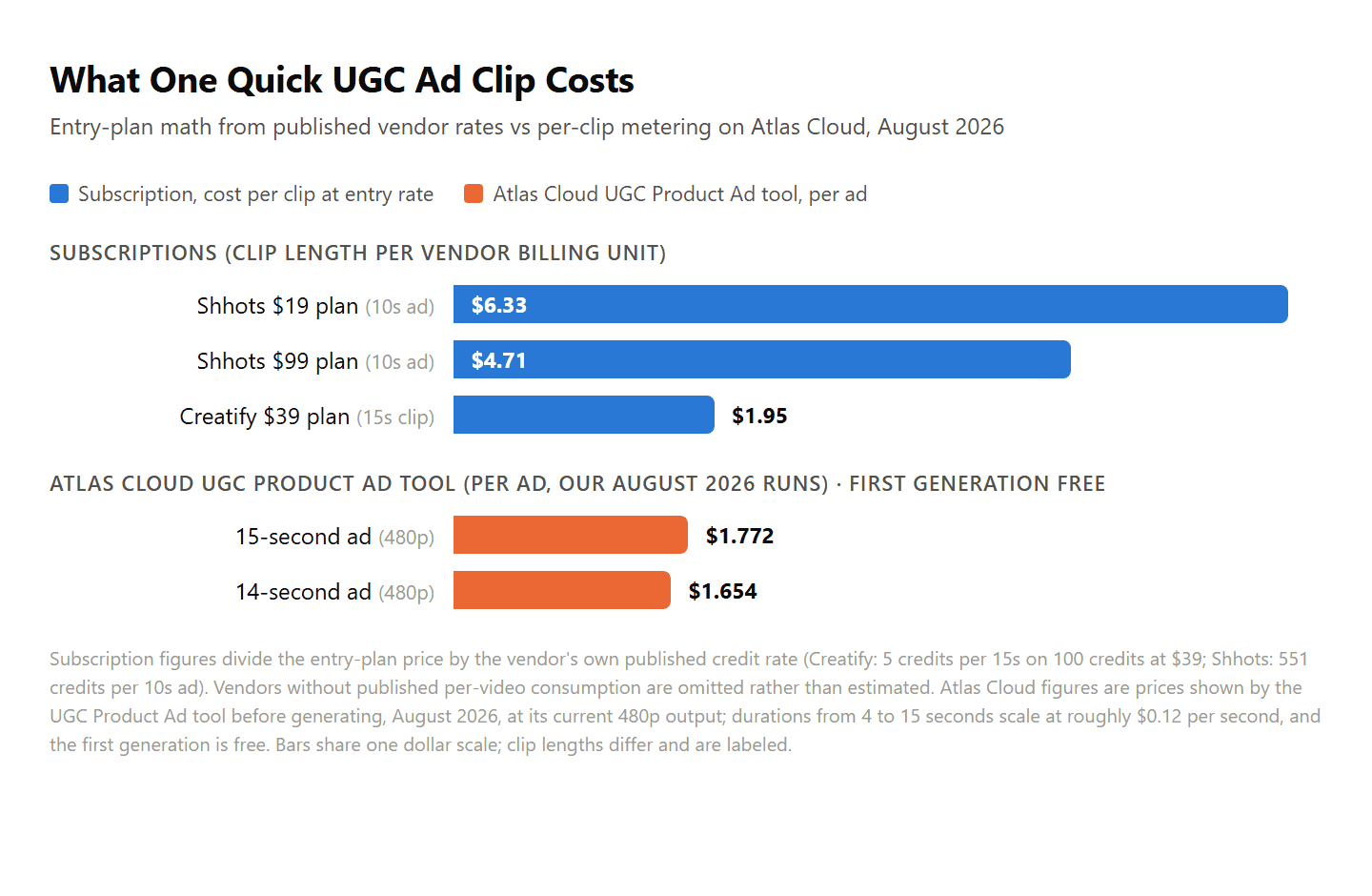
On the subscription side, vendor rates work out to $1.95 per 15-second clip on Creatify's $39 plan and $6.33 per 10-second ad on Shhots' $19 plan, $4.71 on its $99 tier. Vendors without published per-video rates are left off the chart rather than estimated.
The Atlas Cloud UGC Product Ad tool starts free, then meters per ad from a $19 top-up with no monthly fee, showing the exact price before you generate. Our August 2026 runs priced a 15-second ad at $1.772, about $0.12 per second at its current 480p output. That undercuts Creatify at the same length and sits under a third of Shhots' rate for an even shorter clip, though brands shipping steady volume that needs 1080p masters can still justify a subscription.
What Do Ecommerce Sellers Say About AI UGC Product Ads?
The liveliest seller debate we found runs in a Shopify Community thread that stayed active from late 2025 into mid-2026. The skeptics' case is blunt: a synthetic face presented as a happy customer is manufactured trust, close cousin to a fake review, with brand and legal risk attached if audiences feel deceived.
The other side of the thread is more pragmatic than promotional. Several sellers draw a line between AI product footage, which they treat as fair game, and fake testimonials, which they avoid. Others note that disclosure defuses most of the ethical objection, and one recurring argument holds that traditional UGC ads were already scripted and paid for, so the AI version is not uniquely artificial. For small brands, the thread's pro-AI voices frame it as the only way to afford creative testing at all.
The practical takeaway for this list: the workflow you pick is also a positioning choice. Product-asset ads that show the item in use carry less of this baggage than synthetic-person testimonials, which is worth weighing alongside speed and price.
Frequently Asked Questions
What is the best AI UGC video tool for a small ecommerce brand?
Start with free routes: Atlas Cloud's UGC Product Ad tool generates a voiced ad from a product photo free, and Bandy's free tier and Creatify's free plan both produce watchable output on a real product. From there, Atlas Cloud meters per clip with no subscription... Pick whichever matches your input: a product URL for Creatify, a photo for Bandy, a photo plus a one-line brief on Atlas Cloud.
How much does one quick UGC product ad video cost?
Through subscriptions, published vendor rates work out to roughly $2 to $6 per short clip on entry plans. Per-clip on Atlas Cloud, as of August 2026, a 5-second 720p generation spans $0.23 on PixVerse V6 to $1.51 on Seedance 2.5, plus $0.045 if you generate the first frame. Prices change, so check the model pages for current numbers.
What is the best UGC video software for ad campaign testing?
The one that multiplies variants fastest at your bottleneck. Arcads renders one script across 10 actors in 2 languages in a single run, Creatify's batch mode turns one product link into dozens of hook variants, and the Atlas Cloud UGC Product Ad tool meters per ad, so a testing budget is not locked into a monthly plan. Pick by the variable you test most: actors, hooks, or formats.
What is the best UGC video software for Google Ads?
Google's video placements mix horizontal and vertical, so export ratios decide this one. The Atlas Cloud UGC Product Ad tool lists 16:9 among its five aspect ratios alongside 9:16, Shhots exports up to 4K in ratios including 16:9 and 1.91:1, and Creatify adapts output across 9:16, 16:9, and 1:1. Generate the same ad in both orientations before uploading a campaign.
What are the top AI platforms for creating UGC brand videos?
Ranked by workflow in this comparison: Atlas Cloud for a free product-photo-to-voiced-ad tool with per-clip pricing behind it, Creatify for URL-to-ad speed, Arcads for script-driven variant grids, Topview for product-in-hand demos, Shhots for Shopify catalogs, and Bandy for a standing free tier. The comparison chart near the top of this page puts all 10 side by side.
Can I make UGC product ads without a real creator?
Yes, that is this entire category. URL-first tools generate presenter, script, and footage from a product page; asset-first pipelines animate your product photos directly. The open question is disclosure: rules on labeling synthetic content differ by ad channel and keep changing, so review the current policy of each platform you run on before scaling.
What is the difference between UGC product ads and UGC product asset ads?
UGC product ads describes the format, paid ads styled like customer-shot content. UGC product asset ads describes the production route, generating those ads directly from existing product assets such as catalog photos and product pages instead of filming anything new. Most platforms on this list support both; the asset route is the faster of the two.
Conclusion
Ranked by workflow alone, the field sorts cleanly. Creatify owns the shortest packaged path, Shhots and Bandy put real numbers on speed, Arcads and Topview trade a slower start for batch depth and product-in-hand demos, and the four smaller tools cover editor-first and budget niches. Atlas Cloud sits at the top because it covers both ends of that field: a free tool that turns a product photo and a one-line brief into a voiced ad today, and per-clip model pricing underneath it for the day your volume outgrows every subscription tier.
Whichever route fits, the same rule holds. Judge the best-rated platforms for quick UGC product ad videos by the distance between the assets you already have and an ad you can ship today, because that distance, not the demo reel, is what you will live with every week.





