Ask AI for a summary

Open the free Gemini app today and ask for Carbon. You won't find it. On November 10, 2026, Google released Gemini 4 Carbon, its strongest model so far, and put it behind two doors: the paid Gemini API and the Google AI Ultra plan.
This guide covers what Carbon is, the routes that reach it right now, and how it differs from Gemini 4 Argon. It also covers the question many readers are searching for: when free and AI Pro users might get it. Every claim comes from Google's own pages or Artificial Analysis, checked on November 11.
Key Takeaways
- Gemini 4 Carbon reached paid API developers and Google AI Ultra subscribers on November 10, 2026.
- The free Gemini plan, AI Plus, AI Pro and the Gemini API free tier do not include Carbon.
- Google has given no date for Pro or free access, and Argon itself still skips the free plan.
- Google pitches Carbon at long multi-step coding and research, and keeps Argon as the pick for most work.
- Gemini 4 Argon runs pay-as-you-go with one key on Atlas Cloud's Gemini API page.
What Is Gemini 4 Carbon? Release Date and What It's Built For
Gemini 4 Carbon is a Gemini 4 model that spends more thinking tokens per turn than Argon. Google's model card puts it plainly: Carbon "is based on Gemini 4 Argon." The extra thinking goes into exploring hypotheses, reasoning longer and running verification loops before it answers.
It reached the public in two steps.
| Date (2026) | What happened | Who could use Carbon |
|---|---|---|
| October 28 | Google announced Carbon and opened it through the Fairwind Program | Verified cybersecurity defenders |
| November 10 | General release, announced on Google's blog | Paid API developers, enterprises, Google AI Ultra subscribers, scientists in Google's research program |
| November 30 | Last day of the launch pricing on the Gemini API | Same as above |
Google's own line on the split is useful: "Argon remains the ideal choice for the majority of software engineering and knowledge work." Carbon is for the jobs that strain a model, such as complex multi-step debugging and open-ended scientific research. Expect slower, longer answers in exchange.
Who Can Use Gemini 4 Carbon Right Now
Carbon shows up across Google's products, but neither the free app plan nor the free API tier includes it. Here is each access route as of November 11, 2026, taken from Google's subscription page, API pricing page and launch post, plus two coding tools that now offer it.
| Where you use it | Carbon included? | What you get instead |
|---|---|---|
| Gemini app, free plan | No | Flash-Lite model |
| Google AI Plus | No | Flash model |
| Google AI Pro | No | Gemini 4 Argon |
| Google AI Ultra | Yes, rolling out since Nov 10 | Carbon in the Gemini app, AI Mode in Search and Google Antigravity |
| Gemini API, free tier | No | Gemini 3.8 Flash and other free-tier models |
| Gemini API, paid tier | Yes | Carbon in AI Studio and Android Studio |
| Gemini for business | Yes | Carbon via the API or the model drop-down |
| Cursor | Yes, billed separately | Carbon in the model picker, charged at Google's API rates outside Cursor's plan usage |
| GitHub Copilot Pro+, Max, Business, Enterprise | Yes, rolling out since Nov 10 | Carbon in the model picker, billed at Google's list pricing |
| Google's program for scientists | Yes | Six months of free Antigravity access, now extended to Carbon |
| Fairwind Program | Yes | A cyber-focused Carbon for verified defenders |
Two details trip people up. The API pricing page says it directly: "Gemini 4 Carbon is not available on the Free tier." And in AI Mode, Google limits Carbon to select countries, so an Ultra plan alone may not be enough everywhere.
Outside Google, Cursor and GitHub Copilot both offer Carbon, and neither makes it free. Cursor bills it from prepaid credit and runs it with a 200k context window by default, with 1M as the maximum. GitHub's November 10 changelog doesn't list Copilot Free or Pro among the plans that get it.
The research program is the free route Google advertises. Google opened applications for 10,000 scientists to use Argon in Antigravity for six months at no charge. Current and future participants now get Carbon too.
When Will Free and AI Pro Users Get Gemini 4 Carbon?
Google hasn't said. The launch post, model card and subscription page give no timeline for Pro or free users. Any date you see elsewhere is a guess.
The closest guide is how Argon has moved so far:
| Access tier | Gemini 4 Argon | Gemini 4 Carbon |
|---|---|---|
| Limited early access | Not covered here | Fairwind defenders, Oct 28 |
| Paid Gemini API | Available | Available since Nov 10 |
| Google AI Ultra | Available since Oct 13 | Rolling out since Nov 10 |
| Google AI Pro | Available since Oct 13 | No date announced |
| Free Gemini plan | Not included as of Nov 11 | No date announced |
| Gemini API free tier | Not included as of Nov 11 | Not included as of Nov 11 |
Four weeks after reaching Pro, Argon still hasn't come to the free plan or the free API tier. Free users today get Flash-Lite in the app. So Carbon reaching the free plan soon would break the pattern Google has set with Argon. Pro is the likelier next step, but that is our read, not an announcement.
Gemini 4 Carbon vs Argon
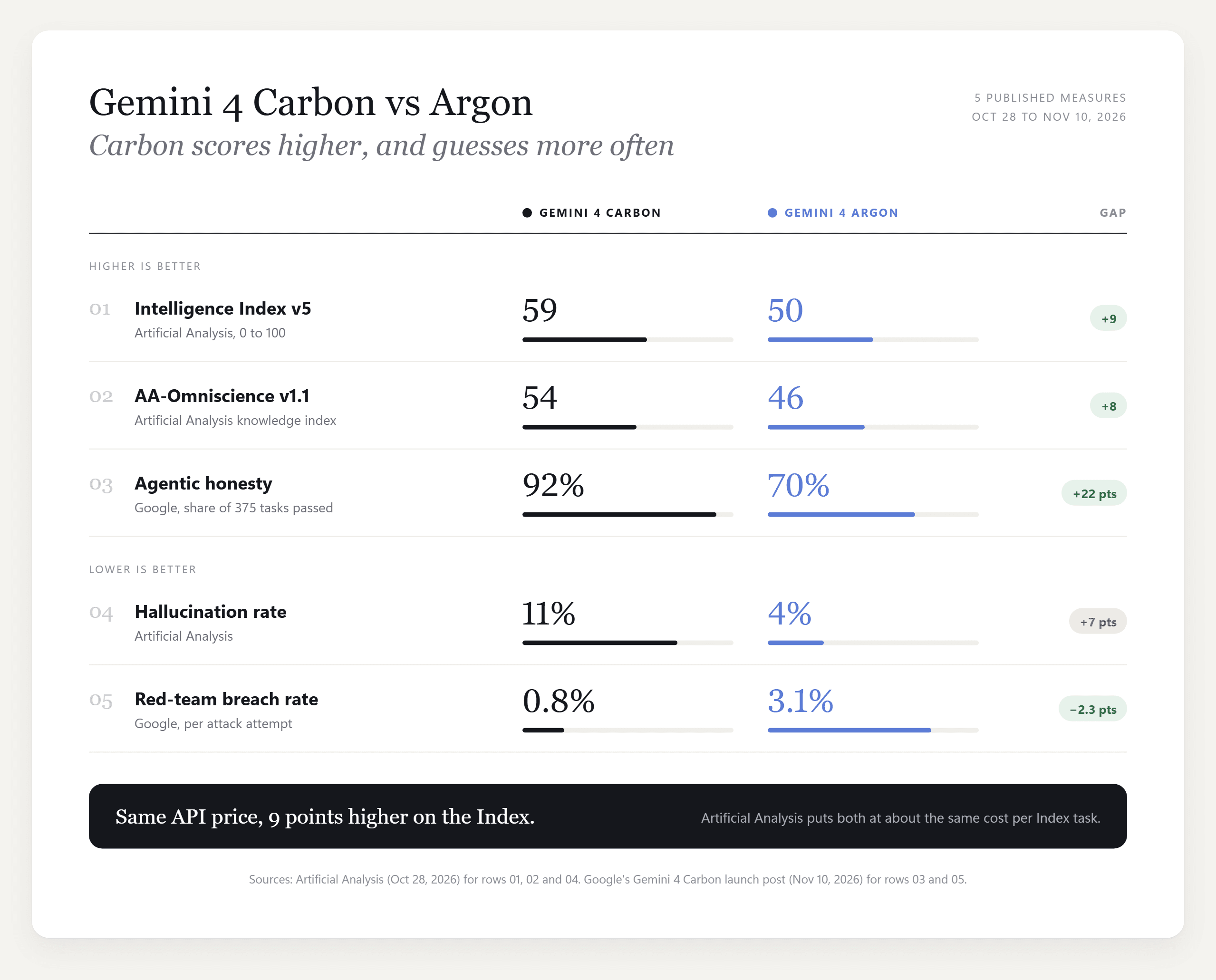
Argon and Carbon share the same base, the same API price and the same 1M-token window. The difference is how hard each one thinks. That shows up in the numbers.
| Gemini 4 Carbon | Gemini 4 Argon | |
|---|---|---|
| Google's pitch | Hardest multi-step coding, open-ended research, cybersecurity | Most software engineering and knowledge work |
| Thinking per turn | More tokens, longer verification loops | Fewer tokens, faster replies |
| Intelligence Index v5 (Artificial Analysis) | 59, ranked #1 | 50 |
| AA-Omniscience v1.1 | 54 | 46 |
| Hallucination rate (Artificial Analysis) | 11% | 4% |
| Agentic honesty, 375 tasks (Google) | 92% passed | 70% passed |
| Red-team breach rate per attempt (Google) | 0.8% | 3.1% |
| Consumer plans | Google AI Ultra | Google AI Pro and Ultra |
One number cuts against Carbon. Artificial Analysis found its hallucination rate rose from 4% to 11%, even as accuracy climbed 10 points to 58%. That is still the second lowest of any model it tracks, behind only Argon. Carbon answers more questions correctly and also guesses more often when it doesn't know.
Cost per task barely moves. At standard pricing, Artificial Analysis puts Carbon's cost per Index task in line with Argon's while scoring 9 points higher. On those tasks at least, picking Carbon on the API raised quality without raising the bill much.
For quick chat, Argon's faster replies still win. If you want to see how Argon handles everyday prompts, our Gemini vs ChatGPT test runs it on coding, writing and study tasks.
Gemini 4 Carbon Benchmarks and What Google Built With It
Google's November 10 post gives rankings rather than a full score table. Some figures come from Google and some from Artificial Analysis, so this table marks who measured what.
| Benchmark | Gemini 4 Carbon result | Reported by |
|---|---|---|
| CursorBench 4.0, Perplexity WANDR, Zapier AutomationBench | #1 on all three, at more than 2x lower cost per task than the next best external model | |
| Multimodal Knowledge Agent (MKA) | #2, at more than 6x lower average cost per task than #1 | Google, with Artificial Analysis |
| SEC-bench Pro, ExploitGym, CWE-bench v1 | Leads on finding, exploiting and patching vulnerabilities (Fairwind version) | |
| Intelligence Index v5 | 59, #1 | Artificial Analysis |
| Coding Agent Index | 59, behind Claude Code with Claude Opus 5.5 at 62 | Artificial Analysis |
| Terminal-Bench 4.0 | 64%, ranked second | Artificial Analysis |
The launch post leans on long projects more than scores. Google says Carbon helped prove properties of the code behind the Signal protocol in Lean, through a new framework called AlphaProof Code. On 7 low-homolog protein families from the CASP17 blind test set, it retrieved 40 times more related sequences on average.
HubX says Carbon fixed 16 real bugs in a 14,000-test codebase at a 94% resolution rate with zero regressions. Wiz used it to find zero-day flaws in two major SaaS providers in under two hours.
The security results are the most specific. In Project Fortify, Google's internal system for scanning, triaging and fixing flaws, Carbon hit 100% recall on scanning and 95% precision on triage in an internal benchmark. On open-source repositories, Google reports over 25% better recall than Argon. And SentinelOne says that in a kernel-driver test where every model found the same core bugs, Carbon for cyber found four more verified vulnerabilities.
The /swarm Preview in Google Antigravity
One of Google's showcase demos is a 3D game. Google says a team of Carbon-led agents built an open-world browser game in which you ride a bike around its Mountain View campus as a pelican. Another team rebuilt Google's Platform 37 office as a 906,000-triangle Three.js model from seven public planning PDFs, over 10 overnight runs.
Both ran on /swarm, a preview feature in Google Antigravity that turns one prompt into a team of agents. Per the Antigravity team's November 10 post, the parts work like this:
| Part of /swarm | What it does |
|---|---|
| Coordinator agent | Takes your prompt and starts parallel worker agents |
| Worker agents | Each works in its own git worktree, so code changes don't collide |
| Adversarial verifier | Runs tests and challenges each diff before it lands |
| Shared message board | An append-only feed the agents post to; idle agents wait at zero token cost |
| Swarm UI | Board, member roster and a replayable graph timeline in the sidebar; /swarm board or Alt+S in the CLI |
Each agent can use a different model. Google suggests giving Carbon the roles that need the deepest reasoning, like architectural design, coordination and auditing, and pairing it with faster, lighter models for the parallel work.
Gemini 4 Carbon API Specs for Developers
If you're on the paid tier, these are the details that change your code. They come from Google Cloud's model page and the Gemini 4 Carbon model card.
| Spec | Gemini 4 Carbon |
|---|---|
| Model ID | gemini-4-carbon; Google Cloud also lists gemini-4-carbon-cyber-permissive |
| Token limit | 1,048,576, shared by input and output |
| Output per segment | 65,536 tokens streaming, 32,768 non-streaming; long decodes extend output toward the full limit |
| Inputs | Text, image, audio, video, PDF, Office and OpenDocument files |
| Output | Text |
| Thinking levels | LOW, MEDIUM (default), HIGH |
| Sampling | Custom temperature, top_p and top_k values are ignored |
| Context caching | Implicit only, 4,096-token minimum |
| Tools | Search and Maps grounding, code execution, function calling, URL context, computer use |
| Knowledge cutoff | March 2026 |
Two of these will break existing Gemini code. Requests that set a thinking budget, or a thinking level of MINIMAL, return an HTTP 400 error. And since Google ignores temperature on Carbon, prompts that relied on low temperature for steady output need another way to stay consistent, such as structured output.
Thinking tokens are billed as output, and Carbon uses more of them than Argon. Start on MEDIUM and move to HIGH only for tasks that fail on the default.
FAQ
How much does Gemini 4 Carbon cost?
Gemini 4 Carbon pricing on the Gemini API is $2 per million input tokens and $10 per million output tokens through November 30, 2026. From December 1 it doubles to $4 and $20, per Google's API pricing page. Argon follows the same schedule.
In the Gemini app, Carbon comes with Google AI Ultra, which starts at $99.99 a month in the US, with a $199.99 tier for 20 times AI Pro's limits. Prices checked November 11, 2026.
Is Gemini 4 Carbon free in Google AI Studio?
No. Google AI Ultra subscribers can try it in AI Studio, and developers can call it on the paid API tier. The free API tier doesn't include Carbon or Argon. Free-tier developers can still use Gemini 3.8 Flash at no charge.
Is Gemini 4 Carbon better than Claude Opus 5.5?
It depends on the task. Artificial Analysis ranks Carbon first on its Intelligence Index v5 and gives it 54 on AA-Omniscience against Opus 5.5's 48. On its Coding Agent Index, Claude Code with Opus 5.5 still leads, 62 to 59.
Why did Google release Gemini 4 Carbon to cyber defenders first?
Google called it a deliberate rollout. Its October 28 announcement said Google was taking part in the U.S. government's voluntary pre-release testing. Carbon went to a subset of cyber defenders through the Fairwind Program first, while Google kept working on guardrails before opening it to developers and consumers.
For the wider release, Google describes safeguards meant to keep stronger defensive reasoning from turning into offensive risk. In its tests, those safeguards blocked 99% of attack trajectories from an adaptive red-teaming agent.
Can I use Gemini 4 Argon without a Google subscription?
Yes. Atlas Cloud serves Gemini 4 Argon pay-as-you-go at $1.6 per million input tokens and $8 per million output tokens as of November 11, 2026. You can test it in the Gemini 4 Argon playground or call it with the same API key you use for other models.
Conclusion
Carbon is a real step up for long, hard work. It tops the Artificial Analysis index and posts strong cyber results, at roughly Argon's cost per task. Outside Google's programs for scientists and defenders, it is also a paid model for now. If you're on the free plan or AI Pro, nothing Google has published says when that changes.
So match the model to the job. Use Argon for everyday coding and writing, and save Gemini 4 Carbon for long multi-step tasks, where the extra thinking pays off. Check back after December 1, when the launch pricing ends, to see how the price changes the math.


