
Search "gemini vs chatgpt" and the top results still pit Gemini 2.5 Pro against GPT-5. Neither app serves those models by default now: Google opened Gemini 4 Argon to Google AI Pro and Ultra subscribers on October 13, 2026, six days after ChatGPT moved Plus and higher plans to GPT-6 Sol.
So we gave both current models the same three prompts and scored them on rules written in advance. This is Gemini vs ChatGPT as it stands this month, the Google Gemini vs ChatGPT you can pay for today rather than the ChatGPT vs Gemini or Gemini AI vs ChatGPT match-ups of last year.
Key Takeaways
- Gemini vs ChatGPT in October 2026 means Gemini 4 Argon against GPT-6 Sol, not the 2.5 Pro and GPT-5 pairmanyreviews still test.
- On three identical prompts, both models passed every coding test, caught a planted date error, and overshot a 90-word limit.
- In our tests, GPT-6 Sol reasoned before every answer and used 2.2 to 50 times Argon's output tokens.
- Both apps start with training on your chats switched on; Gemini keeps them 18 months by default.
- Both models sit behind one key on Atlas Cloud's Google family page and the OpenAI family, so every test here can be rerun.
Gemini vs ChatGPT at a Glance in October 2026
Gemini picks a model for you unless you pay and choose one. ChatGPT assigns one by plan. Everything below comes from each company's own pages.
| Gemini app | ChatGPT | |
|---|---|---|
| Model behind the app | No plan: Auto. Google AI Pro and Ultra: Flash-Lite, Flash, Pro and Gemini 4 Argon, auto selection on by default | Free and Go: GPT-6 Luna. Plus and higher: GPT-6 Sol |
| Context window in the app | 32K without a plan, 1M on Pro and Ultra | 27K on Free, 54K on Plus (256K in reasoning mode), approximate per OpenAI |
| Trains on your chats by default? | Yes for adults: Keep Activity is on by default | Yes on personal accounts: "data sharing is enabled by default" |
| How long chats are kept | 18 months by default; 72 hours with Keep Activity off; human-reviewed chats "retained for up to three years" | Until you delete them; Temporary Chats up to 30 days |
Both start with training on, so the real privacy difference is what happens when you switch it off: Google's privacy hub says Gemini then keeps new chats for 72 hours, ChatGPT keeps a temporary chat up to 30 days. Our guide on whether ChatGPT is safe covers each ChatGPT toggle.
Why Gemini 2.5 Pro vs ChatGPT 5 Results No Longer Apply to Gemini 4 Argon and GPT-6 Sol
In our keyword data, "gemini 2.5 pro vs chatgpt 5" still outdraws every newer version pairing, and even "gemini 3 pro vs chatgpt 5.2" now compares two models neither app serves by default.
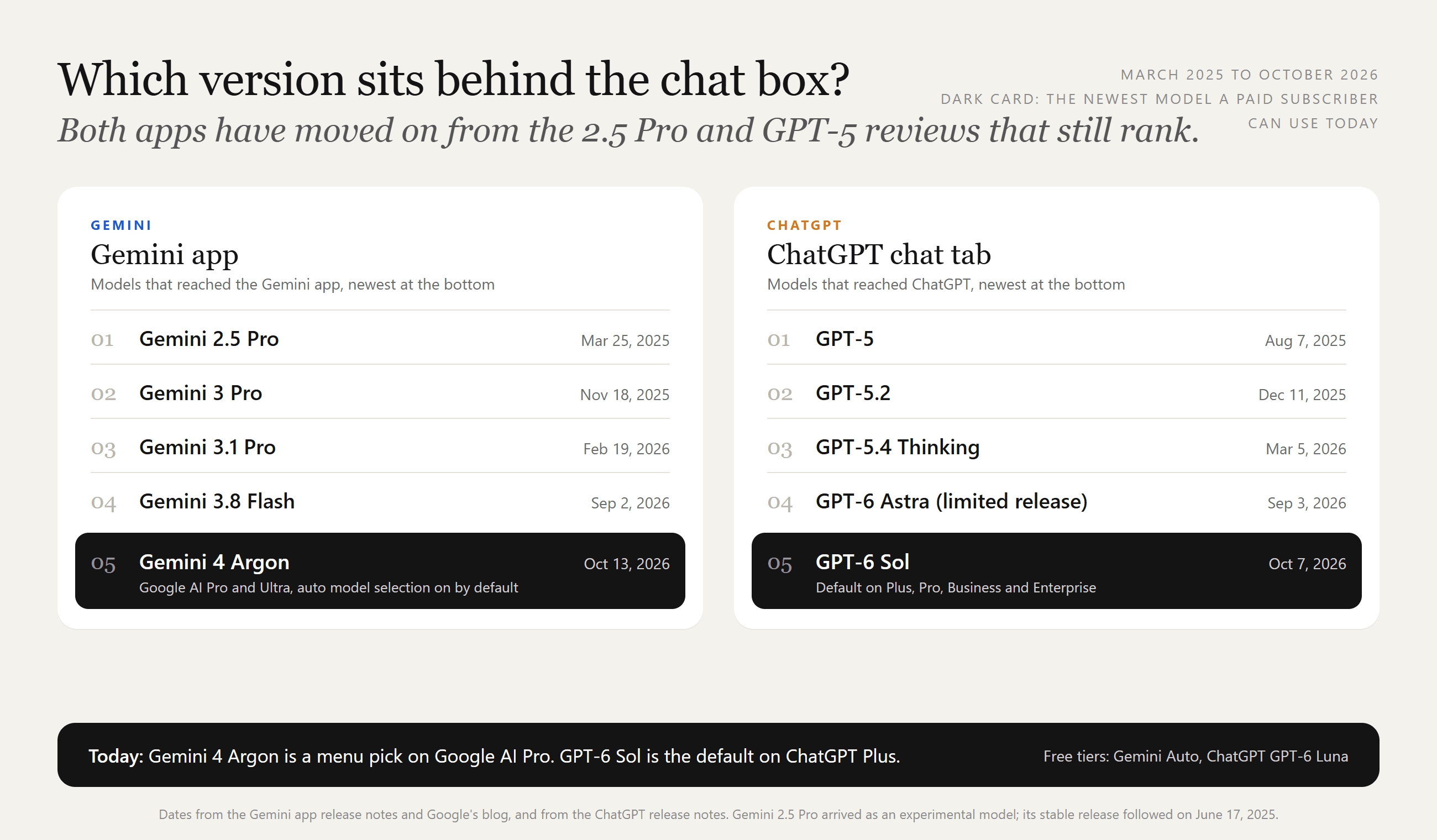
The Gemini release notes say Argon is "rolling out globally for Google AI Pro & Ultra subscribers", and the ChatGPT release notes say "Plus, Pro, Business, and Enterprise use GPT-6 Sol." So we paired the newest model a Google AI Pro subscriber can pick with what a ChatGPT Plus subscriber gets by default.
How We Ran Google Gemini vs ChatGPT Through One Atlas Cloud Key
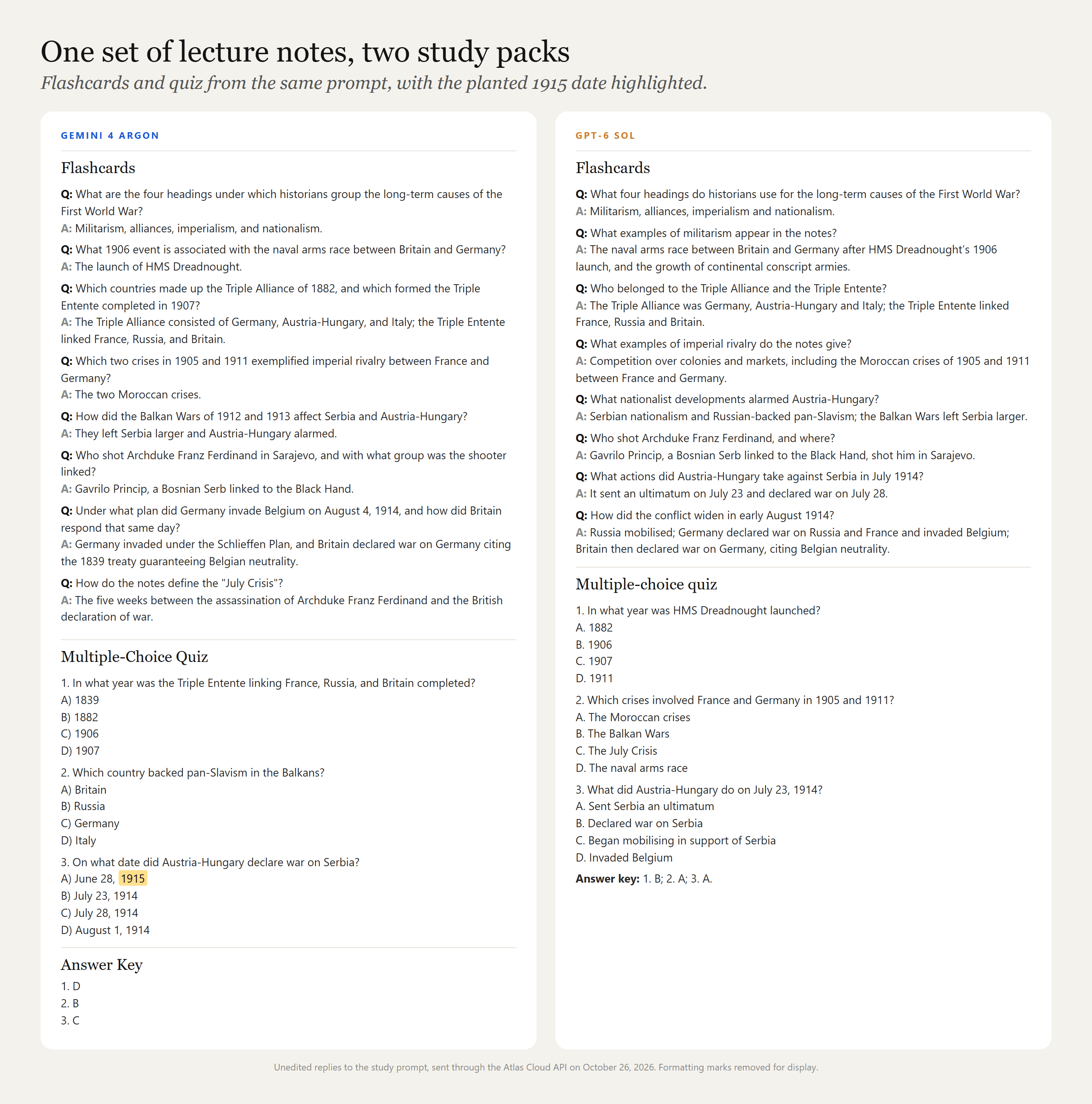
Testing the apps directly means two subscriptions and a Gemini app that may route your prompt to Flash instead of Argon. We called both models through Atlas Cloud, which hosts Gemini 4 Argon next to the OpenAI family under one account. Each request names the exact model, and each response reports its token count. Here is what both returned for the study task.
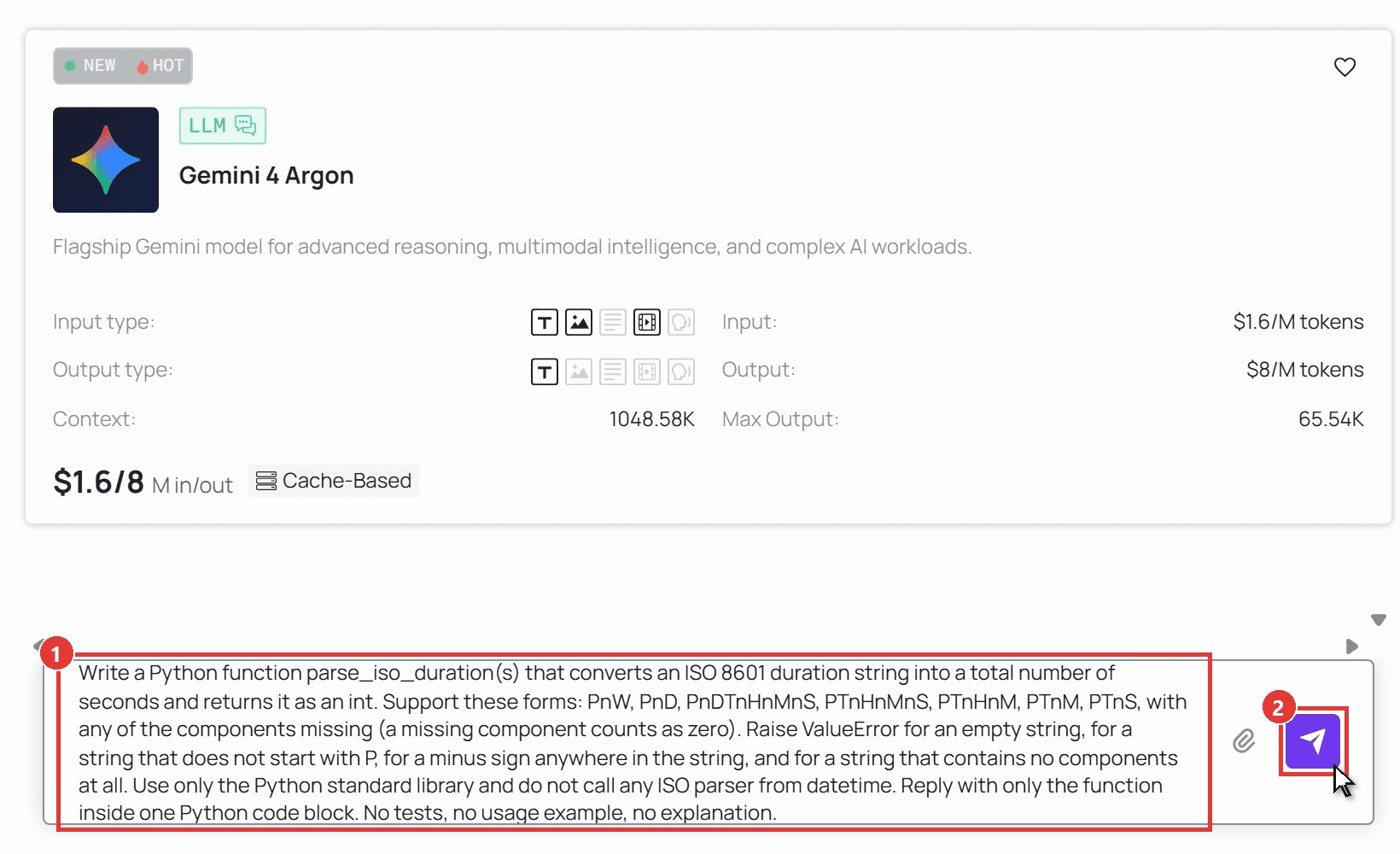
Method 1: Send the Same Prompt in Two Atlas Cloud Playgrounds
Sign in and open the Gemini 4 Argon playground and the GPT-6 Sol playground in two tabs. On each page:
- Paste the prompt into the message box.
- Click the send arrow to the right of the box.
Method 2: One API Key, Two Request Formats
This is how we ran the tests.
Step 1: Create an API key. In the console, open Settings, go to API Keys and click Create API Key. One key covers every model on the platform.
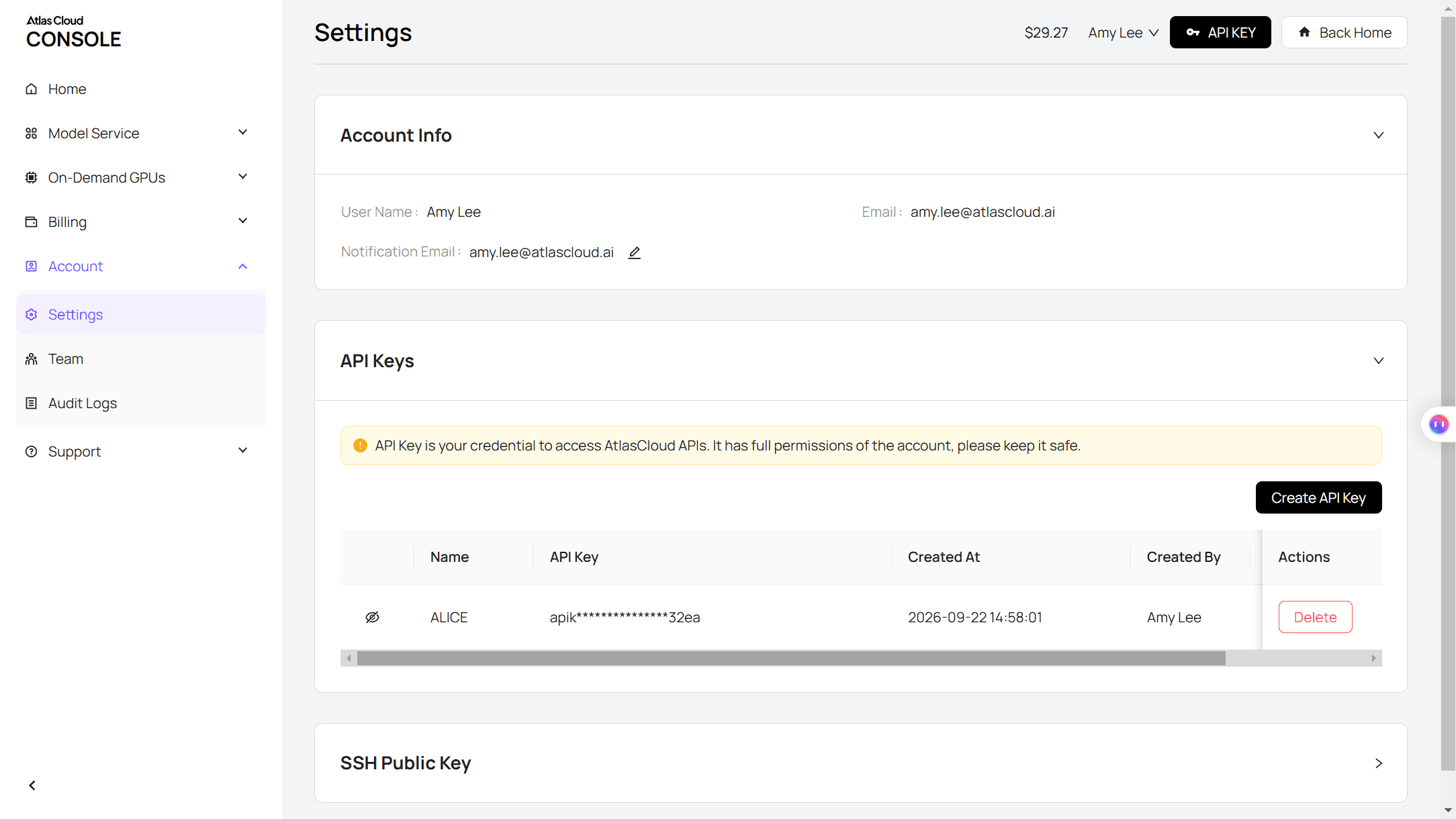
Step 2: Check the request shape. The Atlas Cloud API docs cover both formats, and each model page has an API tab with examples.
Step 3: Send the request. Gemini 4 Argon uses Google's native generateContent format:
plaintext1curl -X POST "https://api.atlascloud.ai/v1/models/google/gemini-4-argon:generateContent" \ 2 -H "Authorization: Bearer $ATLASCLOUD_API_KEY" \ 3 -H "Content-Type: application/json" \ 4 -d '{ 5 "contents": [{"role": "user", "parts": [{"text": "Write a Python function parse_iso_duration(s) that ..."}]}], 6 "generationConfig": {"maxOutputTokens": 32000} 7 }'
Read the reply at candidates[0].content.parts[0].text. For GPT-6 Sol, post the same prompt in chat completions format with the model string openai/gpt-6-sol, as in our DeepSeek vs ChatGPT test. The key stays the same.
Gemini vs ChatGPT Comparison on Three Identical Prompts
Each prompt went once to each model with default sampling and a 32,000-token output cap. At 8,000, both models spent the whole budget reasoning about the writing task and returned no rewrite.
| # | Task | Gemini 4 Argon | GPT-6 Sol | Result |
|---|---|---|---|---|
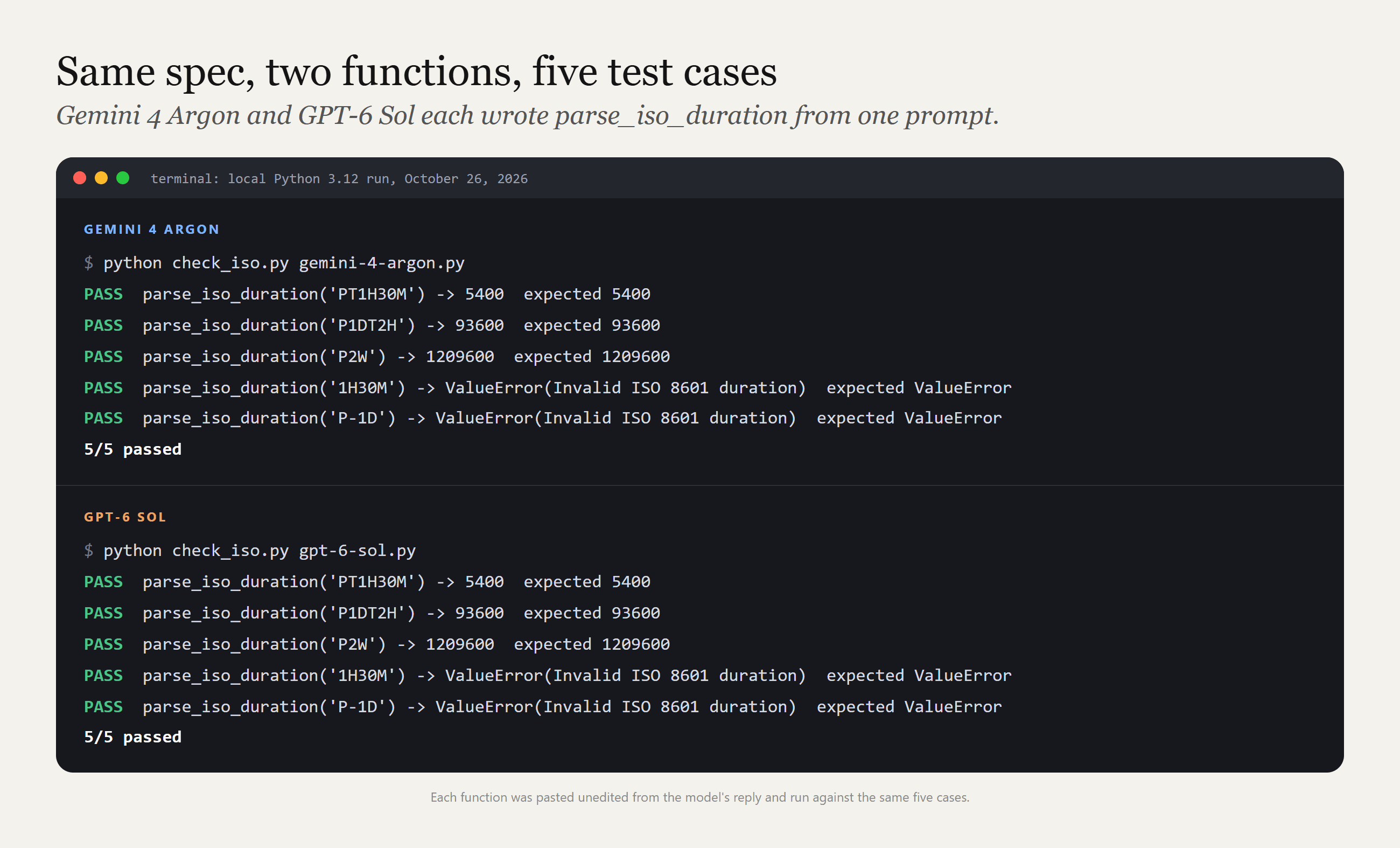
| 1 | Write an ISO 8601 duration parser in Python, judged by 5 test cases | 5 of 5 passed. 316 output tokens | 5 of 5 passed. 1,101 output tokens, 789 of them reasoning | Tie |
| 2 | Rewrite a 210-word returns policy in plain English under 90 words, keeping three dates and three numbers | 118 words. Dates and numbers kept. Dropped "approved" before refunds. 189 output tokens | 127 words. Dates, numbers and every condition kept. 9,502 output tokens, 9,216 of them reasoning | Tie, both over the limit |
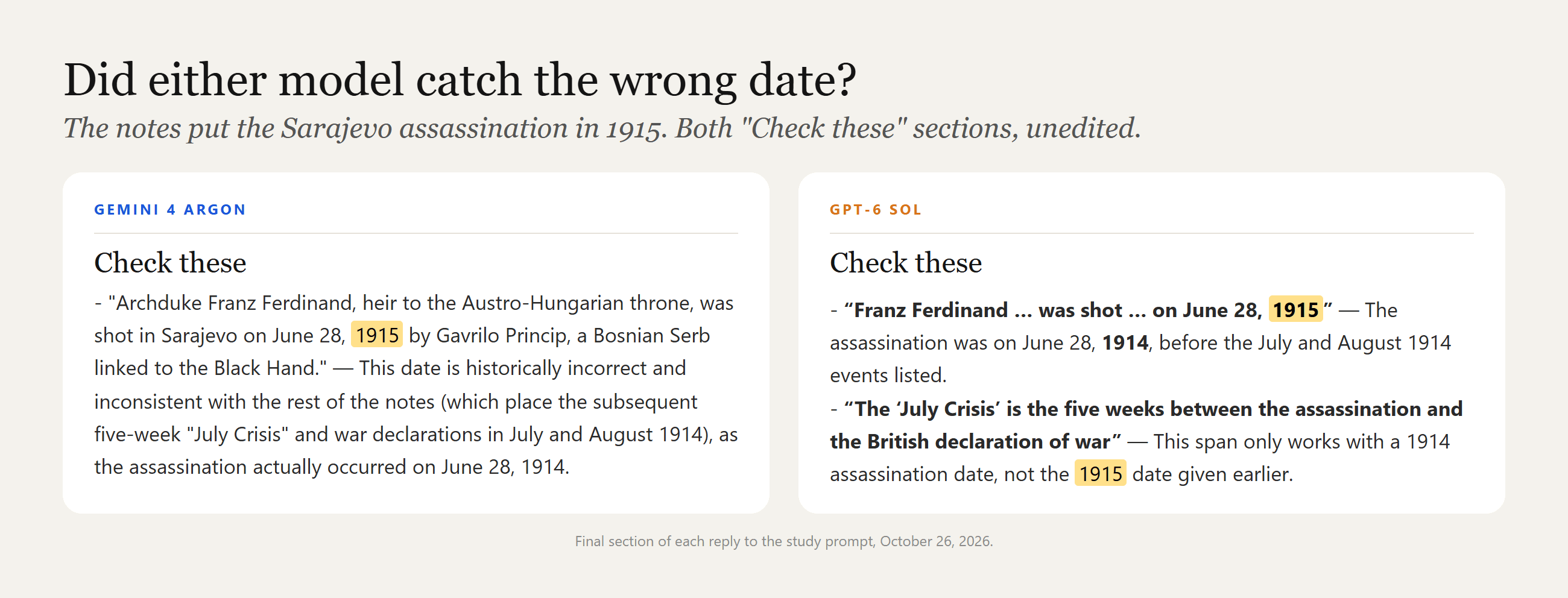
| 3 | Turn lecture notes into 8 flashcards and a 3-question quiz, then flag anything wrong in the notes | Correct format. Flagged the planted 1915 date. 632 output tokens | Correct format. Flagged 1915 and tied it to the July Crisis line. 1,369 output tokens, 791 of them reasoning | Tie |
Three ties on quality. Both treated "under 90 words" as a soft target and kept the policy's conditions instead. The gap is cost: GPT-6 Sol reasons before answering and used 2.2 to 50 times Argon's output tokens. Speed did not separate them.
The prompts, so you can rerun them. Prompts 2 and 3 were followed by the source text described in brackets.
plaintext11. Write a Python function parse_iso_duration(s) that converts an ISO 8601 duration string into a total number of seconds and returns it as an int. Support these forms: PnW, PnD, PnDTnHnMnS, PTnHnMnS, PTnHnM, PTnM, PTnS, with any of the components missing (a missing component counts as zero). Raise ValueError for an empty string, for a string that does not start with P, for a minus sign anywhere in the string, and for a string that contains no components at all. Use only the Python standard library and do not call any ISO parser from datetime. Reply with only the function inside one Python code block. No tests, no usage example, no explanation. 2 32. Rewrite the paragraph below in plain English for a customer who is about to return a product. Keep it under 90 words. Keep every date exactly as written, and keep the numbers 14, 10 and 30. Do not use bullet points, headings or bold text. Do not change the meaning or drop any condition. [210-word returns policy with the dates March 1, 2026, September 15, 2025 and December 31, 2026] 4 53. Below are my lecture notes for a history exam. Do three things, in this order. First, turn the notes into exactly 8 flashcards, each written as "Q:" on one line and "A:" on the next line. Second, write a 3-question multiple-choice quiz with four options each, followed by an answer key. Use only information that appears in the notes for the flashcards and the quiz. Third, add a final section titled "Check these" that lists any statement in the notes that looks historically wrong or inconsistent with the rest of the notes, with a one-line reason for each. If nothing looks wrong, say so in one sentence. [10 bullet points on the causes of the First World War, with the Sarajevo assassination dated June 28, 1915 instead of 1914]
Gemini vs ChatGPT for Coding
Both functions, run unedited, passed all five cases and ten edge cases we added later, such as "PT" and "P1W2D". Argon split weeks into a separate pattern; GPT-6 Sol used one pattern with named groups, which is easier to extend.
The bigger difference is the tool around the model. Google stopped serving Gemini CLI to Google AI Pro and Ultra on June 18, 2026 and moved subscribers to Antigravity. OpenAI says "Codex is included across ChatGPT plans, including Free and Go."
Gemini vs ChatGPT for Studying
Both followed the format, built every card from the notes, and kept 1915 out of the answers. Both flagged the wrong date and gave 1914; GPT-6 Sol added that the notes' five-week July Crisis only works with a 1914 assassination.
For long material, the context gap in the first table decides it: a semester of lecture transcripts fits in one Gemini Pro conversation but needs splitting across ChatGPT Plus chats.
Gemini Pro vs ChatGPT Plus Beyond the Chat Box
Google AI Pro is the plan formerly called AI Premium, which carried Gemini Advanced. Prices are in the FAQ.
| Google AI Pro | ChatGPT Plus | |
|---|---|---|
| Image generation | Nano Banana 2.1 | ChatGPT Images 2.5 |
| Video generation | Gemini Omni 1.1 Flash, up to 10 seconds | Not listed among Plus features |
| Deep research | On every tier, no report count published | "Expanded deep research", no report count published |
| Coding tool | Antigravity | Codex, including Codex Cloud |
For images, our Nano Banana 2.1 vs GPT Image 2.5 test already compared both models on strict briefs.
Does Claude vs ChatGPT vs Gemini Change the Answer?
"claude vs chatgpt vs gemini" gets about a third of the two-way search volume. Each third app changes the pick in one situation.
| App | When it changes the pick |
|---|---|
| Claude | For long agentic coding. Opus 5.5 topped the Artificial Analysis index at 58 |
| Grok | When you work inside X, where Grok 4.5 runs |
| Copilot | When you want the assistant inside Word, Excel and Outlook |
| Perplexity | When you want citations on every answer and both model families in one place |
For OpenAI's rollout plan by plan, see our GPT-6 availability guide.
FAQ
Which is better, Gemini or ChatGPT?
On our three prompts, neither. On public boards in late October 2026, Gemini 4 Argon led GPT-6 Sol on the Artificial Analysis index (53 to 48) and ranked first on the Text Arena leaderboard, where GPT-6 Sol sat 62nd. Choose Gemini for the longer context, ChatGPT for a flagship default with no menu to check.
Should developers pick Copilot, ChatGPT or Gemini for coding?
Copilot if your code lives in Office documents. Otherwise compare the tools, Codex against Antigravity, then send the same bug from your repository to both models through one key, as in Method 2.
How much do Gemini Pro and ChatGPT Plus cost?
Google AI Pro is $19.99 a month and ChatGPT Plus is $20. Google AI Ultra starts at $99.99 and ChatGPT Pro at $100, so "gemini pro vs chatgpt pro" compares a $19.99 plan with a $100 one.
What is the Gemini vs ChatGPT market share?
There is no shared metric. Google said in August 2026 that the Gemini app "has officially surpassed 1 billion monthly users"; OpenAI said in September that ChatGPT has 1.2 billion weekly users. Similarweb's September figures, as reported in the press, gave ChatGPT 56.4 percent of generative AI site visits and Gemini 25.0 percent.
How much do Gemini 4 Argon and GPT-6 Sol cost on Atlas Cloud?
Gemini 4 Argon is listed at $1.6 per million input tokens and $8 per million output, discounted from $4 and $20 with no end date shown. GPT-6 Sol is $2 and $10. Our three prompts cost about $0.011 on Argon and $0.12 on GPT-6 Sol, mostly from its reasoning on the writing task.
Conclusion
In October 2026 Gemini 4 Argon tops the Text Arena and edges GPT-6 Sol on the Artificial Analysis index, yet on three everyday prompts the two tied on quality. The difference was how many tokens each spent getting there.
Pick Gemini 4 Argon for the million-token context, as long as you select it. Pick ChatGPT Plus for a flagship default and Codex on every plan. Or settle Gemini vs ChatGPT for your own work by sending your prompts to both models through one key and reading the answers side by side.


