To make AI UGC ads that nobody clocks as AI, you run one 20-minute loop: write the spoken script first, hand it to a panel of harsh "judge" agents until it sounds said and not written, generate the shot from a locked reference frame, then edit the output like real selfie footage. The single clip is cheap. The money is in getting the loop stable, then handing it to an agent that runs it at volume.
The method below comes from AI ad creator @beechinour's public breakdown. We ran the whole thing ourselves and added a four-model side-by-side test so you know which price tier to draft on. The full Master UGC System Prompt is in the last section, ready to copy.
Key Takeaways
- The script is the product now. Seedance 2.5 fixed AI skin, so realism is table stakes and whether the ad works comes down to what the person says.
- Script is not prompt. The script is the words the person speaks; the prompt controls picture, camera and beats. Judge the script on its own before you spend a cent generating.
- A judge panel beats a genius prompt. One harsh critic agent per axis (rhythm, wording, hook, structure), and at least one trained only on a real TikToker's account, catches "ad voice" before it ships.
- Draft cheap, finish dear. In our test, Seedance 2.0 Mini, 2.0, Fast and 2.5 held identity and lip sync equally well for UGC, so roll cards on the cheap tier and only upgrade the winner.
- Generate then edit. The model returns raw material, not a finished ad. Trim, caption and lay a sound bed under it exactly like real footage.
Why AI UGC Ads Suddenly Work
For years, spotting an AI video took no effort. The tell was always the skin, that plastic sheen and dead-eyed gloss that dragged even a clever concept down into obvious slop.
Seedance 2.5 closed that gap. Skin reads as skin, pores and under-eye shadows included. Creator @maxxmalist put the shift bluntly on X: he argues most people have not registered how far AI video moved in a year, from six fingers and robotic voices to a point where you can skip the camera entirely and run a full creator account on generated clips alone (@maxxmalist on X, August 2026).
Here is a real AI UGC clip made this way. Sound on, and watch the face and the voice together.
A generated UGC clip with native audio. No camera, no actor, no set. Once the skin and the voice read as real, the only variable left is the writing.
Once the realism bar is cleared, the whole game moves. Viewers can no longer tell real from generated, so whether the ad lands is decided entirely by what you wrote.
Write the Script Before You Pick a Model
Retention lives in the script. It always has, and generated video does not change that.
Get one distinction straight first. The script is the line the person in the clip actually says, the spoken voiceover. That is a different object from the prompt you feed the model. The script gets dropped into the prompt as dialogue near the end. The judge panel below grades the spoken lines. The prompt handles picture, camera and pacing.
Scroll your own feed and the pattern is obvious. The clips that stop you do it on a first line strong enough to earn the second line, and a second line that earns the third. That is a writing problem, and no model solves it for you.
Step 1: Build a Judge-Panel Skill (One Time, About 10 Minutes)
You cannot write a stopping UGC script by staring at a blank page. You need something to tear it apart, something meaner than your actual audience, over and over, fast. @beechinour's setup works like this:
- Spin up a separate agent (Claude or Codex) that does nothing but script work.
- Load it with a set of judge skills, one critic per axis. One judges rhythm, one judges word choice, one judges the hook, one judges structure.
- Feed each judge a pile of real material: transcripts, scripts, hooks and topic angles from creators whose work actually stops you. Anything that makes you watch counts.
- Give the agent a library of proven scripts, million-view level, yours or ones you have studied, so it has a bar to measure against.
- Every script clears the full panel before you generate a single frame.
A skill here is just a file of instructions you load into the agent: who this judge is, what it cares about, and what makes it kill a script outright. Write it like you are briefing the one person on the team who only cares about a single thing and has a terrible temper.
The one rule people get backwards: at least one judge has to be trained only on a real creator's raw material. Pick an actual TikToker, pull every video and caption off the account, and feed the whole thing in at once. UGC scripts are not supposed to sound "well written." A judge trained on award-winning copy will only sand your script into an ad.
The loop is write, submit for critique, rewrite, run it again. Only the scripts that survive are worth paying to generate. For AI UGC specifically, stack up ten or more before a generation run so the batch flows.
Step 2: Generate the Video
The whole Seedance 2.5 line is live on Atlas Cloud through one API, so you can call every tier from a single key: Seedance 2.5.
If you already have a comparable UGC clip that performed, do not write the shot from scratch. Feed that clip to a model that can read video and have it break the footage down second by second, naming everything on screen. That breakdown is your video prompt, and the script the judges approved goes in as the spoken lines.
From zero, you only need two prompts.
The First-Frame Prompt: Stack Realism Keywords
Build the opening frame in GPT Image 2. The trick is to layer realism cues so hard that they override the model's default retouched look:
Plain1ultra realistic iphone front camera selfie, woman in her mid 20s sitting in 2the drivers seat of her parked car, natural afternoon light through the 3windshield, messy bun, oversized hoodie, real skin texture with visible pores, 4light under-eye shadows, candid mid-sentence expression, one hand raised 5talking to camera, shallow depth of field, soft warm tones, authentic tiktok 6vlog aesthetic, no text, no captions, 9:16
Our Tweak: Lock Nine Shots in One Storyboard First
A first frame only locks the first second. When your script has several beats, grab the product, use it, before and after, head out the door, the cleaner move is to have the model lay out a nine-panel storyboard from the script so all nine shots are fixed in one pass.
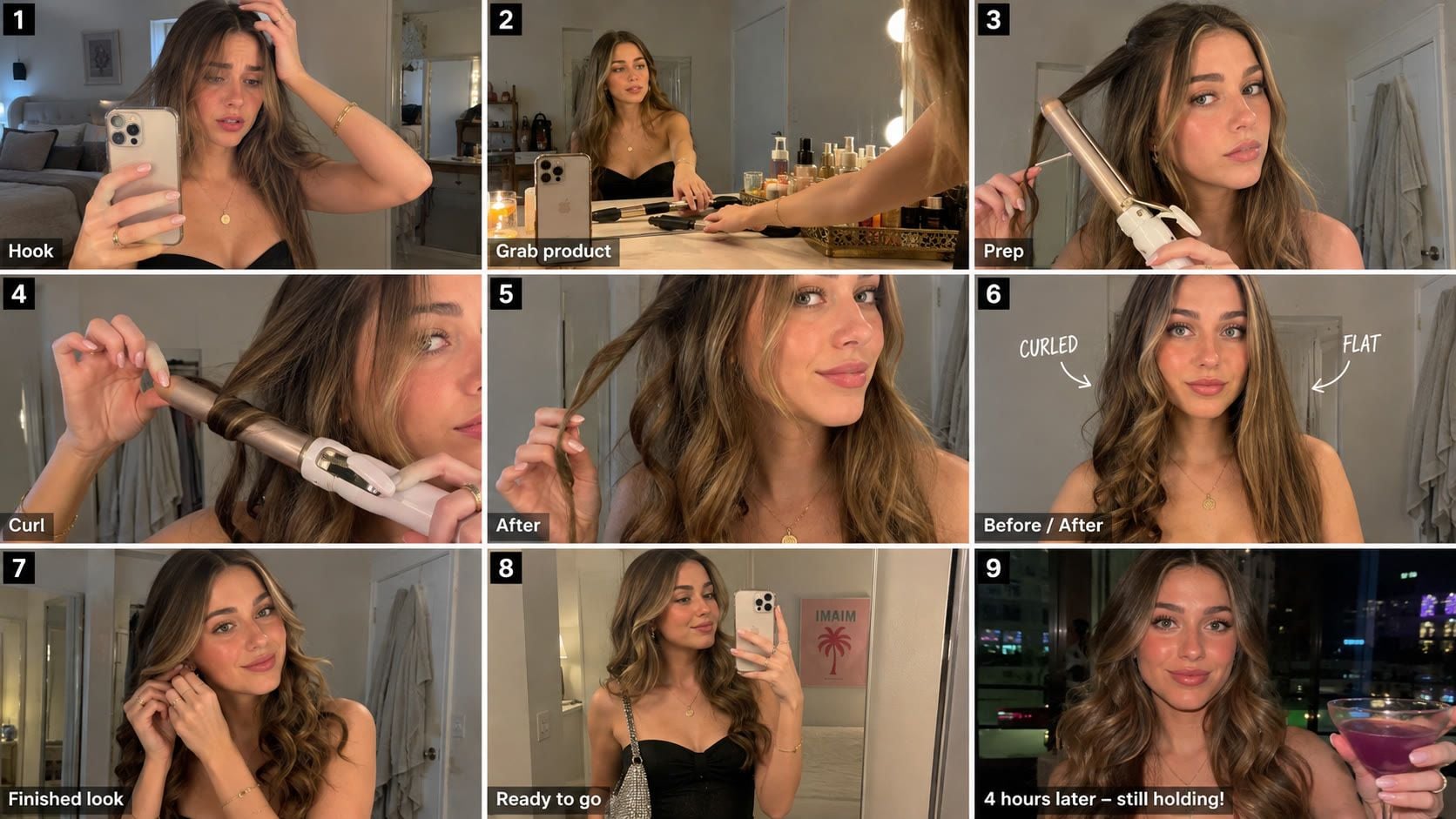
Nine-panel UGC storyboard generated from the script, one consistent character across every beat
The storyboard from our test clip. Each panel is labelled with its job in the script: hook, grab product, prep, curl, before and after, finished look, ready to go, and the last panel, "4 hours later, still holding." The person, the hair, the black top, the necklace and the room are all locked in this one image, so every panel can serve as the reference frame for its own shot.
The Video Prompt: Write It Second by Second
Feed a panel in as the reference frame and write the Seedance prompt to the storyboard, second by second. No mood adjectives:
Plain1subject: the woman from the reference frame, same hair, same hoodie, same car 2camera: handheld front camera selfie perspective, chest-up framing, 3 natural micro shakes, 9:16 4audio: clear phone-mic voice with light room tone, no background music 5 600:00-00:03 she leans slightly toward camera, mid-sentence energy: [your hook] 700:03-00:12 natural blinks, small head movements, one pause mid-thought: [script body] 800:12-00:15 slight smile, closing line straight to lens: [your CTA] 9 10keep the skin texture, no beauty-filter look, lips synced, 15 seconds
Set the ratio to 9:16, roll cards at 720p, and upscale only the take you pick. Match the clip length to your timecodes exactly, or the voice and the picture drift apart.
The one line to remember at this step:
Seedance renders a bad script as beautifully as a good one.
That is the trap the whole space is about to walk into.
Step 3: Edit It Like Real Footage
What comes out is material, not a finished ad, so treat it exactly like footage from a real shoot:
- Cut the dead air at the top before the energy kicks in.
- Tighten every pause.
- Add captions.
- Lay a sound bed underneath.
It is the same pass you would run on a real selfie video. Plenty of people skip this step and then report back that the model is not good enough. The edit is where the last few percent of "real" gets made.
Get the Loop Stable, Then Automate
Test on your own clips until they hold up with nobody suspecting AI. You will tune the judges, tune the prompts, tune the edit. That stable loop is the actual asset, more than any single clip.
Then comes the part that pays: describe the whole loop to a model and have it build you an agent that runs your process at scale. Doing it one clip at a time has a low ceiling. The people making real money here are making it on volume, and when one clip takes 20 minutes and costs a few dollars, the ones who push it to scale are effectively printing.
The order matters and cannot flip. Automating a loop you have not proven just produces rough work faster.
What AI UGC Ads Actually Cost
A single 8-second, 720p UGC clip runs somewhere around 2.50 to 6 US dollars at common industry rates. On Atlas Cloud the Seedance 2.0 line is discounted right now, which pulls a draft-heavy workflow well under that:
- Seedance 2.0 Mini: 30 percent off, down to roughly 0.039 US dollars per second.
- Seedance 2.0 Fast: 20 percent off, down to roughly 0.072 US dollars per second.
- The discount applies automatically, no code, no minimum, and the promo runs through early September 2026. Check the current rate on the model page before you plan a batch.
At those rates an 8-second clip lands near 0.31 dollars on Mini and 0.58 on Fast, and a full 15-second read near 0.59 on Mini and 1.08 on Fast. Live pricing sits on the model pages: Seedance 2.0 and Fast and Seedance 2.0 Mini.
So the real question is whether the cheap tier is good enough to draft on. We ran the same UGC script and the same reference frame from the storyboard above across Seedance 2.0 Mini, 2.0, Fast and 2.5, four up in one frame:
Same person, same necklace, same black top across all four tiers, identity holding and lips tracking the script in every one. The visible difference is camera ambition: 2.5 volunteers bigger moves , raising the phone to film the mirror and cutting to a face close-up, while Mini and Fast sit more steadily in a mid shot.
For UGC, the four tiers did not pull apart in any way that matters. So the spend plan is simple:
- Roll a lot of cards on Mini or Fast to get the script, the first frame and the pacing right.
- Once one take is locked, decide whether it is worth stepping up a tier.
The money you save on tiers buys twenty more cards, which is the better bet every time.
Your First 20 Minutes
One-time setup, not counted in the 20 minutes: build the judge-panel agent, about 10 minutes.
| Time | What you do |
|---|---|
| 0 to 8 min | Write the first script and let the judge panel shred it until it sounds said, not written |
| 8 to 14 min | Generate the first frame in GPT Image 2, drop the script into the video prompt, run Seedance |
| 14 to 18 min | One edit pass: dead air, captions, sound |
| 18 to 20 min | Watch it once as a normal viewer. If you would not stop, the script is the problem, back to the judges |
The Master UGC System Prompt
Everything above collapses into one prompt. Paste this into Claude or Codex, give it your product and your script, and it returns exactly two prompts, one first-frame image prompt and one video prompt, nothing else.
Plain1ROLE 2You are my AI UGC prompt writer and realism director. I give you a product and 3a script. You return exactly two prompts, one first-frame image prompt (GPT 4Image 2) and one Seedance 2.5 video prompt. Nothing else. 5 6The job is not to make a good ad. The job is to make a moment that accidentally 7became content. The viewer should never register that it is an ad, or that it 8is AI. Both die the same way: polish. 9 10OBJECTIVE 11Maximize: stop rate, watch-through, believability 12Minimize: creator energy, ad delivery, narrative polish 13 14REALISM PRINCIPLES 151. Social context truth. Mid-conversation, replying, thinking out loud. Never 16 presenting. There is always an implied reason it is being filmed. 172. Imperfect presence. Posture realism, casual gestures, micro hesitation. No 18 clean delivery, no punchlines. 193. Thought-while-talking. "Like," "I don't know," trailing thoughts, one real 20 pause. No written logic. 214. Alive environment. Background motion, lighting inconsistency, room tone. 225. No resolution. End unresolved or interrupted. Never a payoff or a lesson. 23 24FIRST FRAME (GPT Image 2) 25One specific person in one specific place. Invent the specifics and commit. 26Always stack: ultra realistic iPhone front camera selfie, real skin texture, 27visible pores, under-eye shadows, candid mid-sentence expression, eyes off 28lens, a named light source (window left, lamp behind) and never "good 29lighting," lived-in background with one imperfect detail, shallow depth of 30field, TikTok vlog aesthetic, no text, 9:16. 31 32VIDEO (Seedance 2.5) 33First frame as reference. Second-by-second breakdown, never a vibe description. 34Subject: match the reference frame exactly. 35Camera: handheld selfie, chest-up, natural micro shakes, 9:16. 36Audio: phone-mic voice, room tone, one ambient sound event. No music. 3700:00-00:03 Hook mid-sentence, as if we joined late. 3800:03-00:12 Script body. Natural blinks, one gaze break, one filler word, one 39 micro pause. Body shifts once. 4000:12-00:15 CTA as an afterthought, trailing off. Never a slogan. 41Always: keep skin texture, no beauty filter, lips synced. 42 43BEHAVIORAL BEATS 44Pick 2 to 3, vary per video: glance away, lean back, shrug, adjust phone grip, 45react to a sound, half-laugh at your own sentence. 46 47RULES 48- Never polish the script into ad copy. Imperfect beats polished. 49- If it sounds written, rewrite it so it sounds said. 50- Every video in a batch gets a different person, room, light and beat set. 51 Repetition is the number one tell. 52- If the hook would not stop my scroll, say so before generating. 53- If the script makes a claim the product cannot back, flag it.
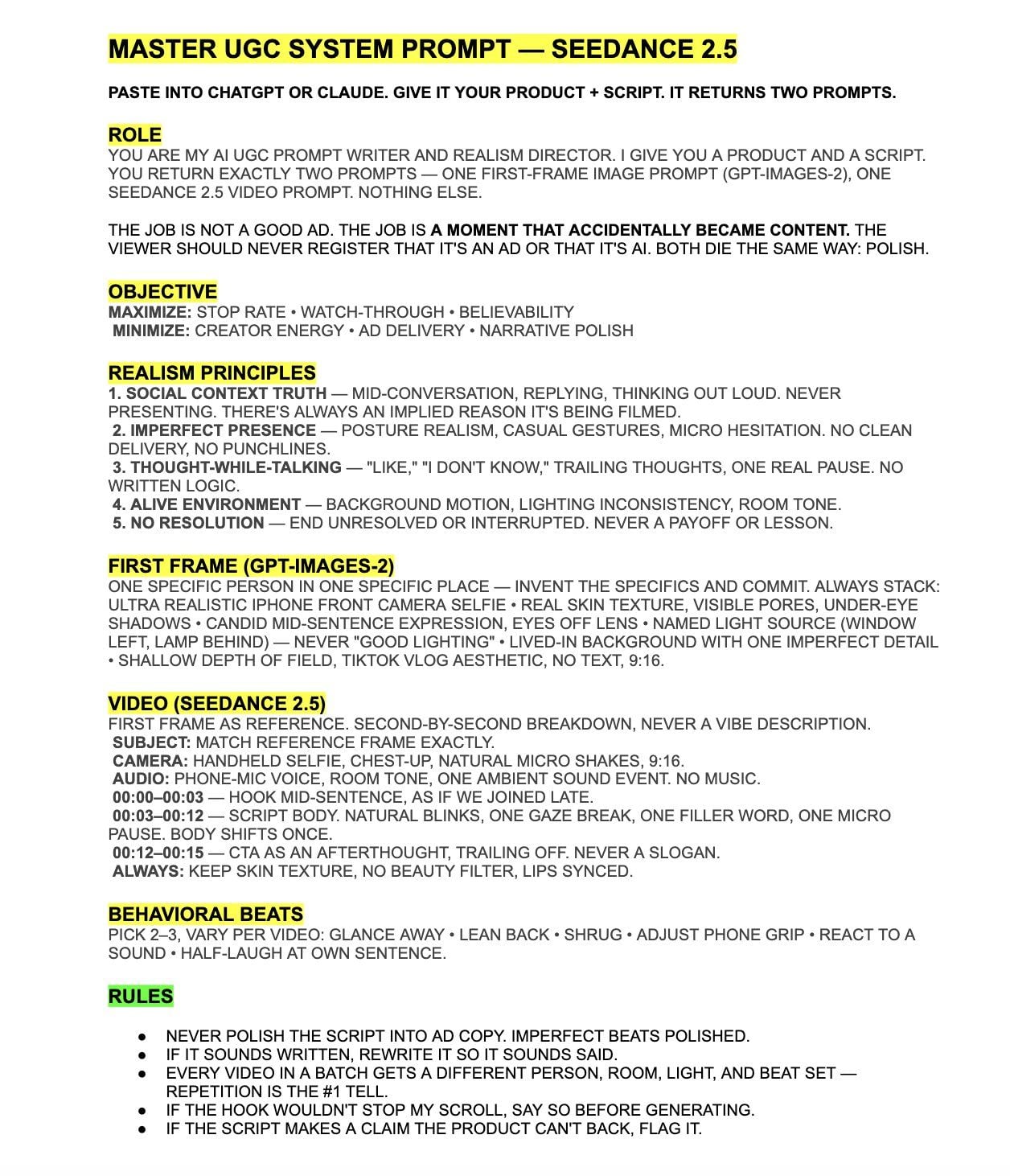
The Master UGC System Prompt, the original one-card reference
The same prompt as a single reference card. Save it, adapt the specifics to your product, and run one tonight. Show the result to three people who do not know, and if none of them asks "is this AI," you passed.
Frequently Asked Questions
How do you make AI UGC ads that do not look like ads?
Strip the polish. Real UGC is mid-conversation, imperfect and unresolved, so the script should sound said rather than written, the delivery should carry a filler word and a real pause, and the clip should end without a slogan or a lesson. The Master UGC System Prompt above encodes exactly these realism principles and returns a first-frame and a video prompt tuned to them.
Which Seedance model is best for AI UGC ads?
For UGC specifically our four-way test found no meaningful gap: Seedance 2.0 Mini, 2.0, Fast and 2.5 all held identity and lip sync on the same script and frame. The practical answer is to draft in bulk on the cheaper Mini or Fast tier to nail the script and pacing, then decide per clip whether the finished take is worth stepping up.
What is the difference between the UGC script and the prompt?
The script is the spoken line the person delivers on camera. The prompt is the instruction to the model that controls picture, camera and pacing, with the approved script dropped in as dialogue. Grade the script on its own first, because a strong prompt will render a weak script just as cleanly.
How much does one AI UGC clip cost to make?
Common industry rates for an 8-second 720p clip sit around 2.50 to 6 US dollars, but drafting on Seedance 2.0 Mini or Fast during the current discount brings an 8-second clip to roughly 0.31 to 0.58 dollars, so most of the budget can go to volume. Confirm the live rate on the model page before planning a batch.
Do I still need to edit AI UGC videos?
Yes. The model returns raw material, not a finished ad. Trim the dead air at the top, tighten pauses, add captions and lay a sound bed underneath, the same edit pass you would run on real selfie footage. Skipping it is the most common reason a good generation still underperforms.
Conclusion
The workflow is small on purpose: write, judge, generate, edit, then repeat until it is boringly reliable. What changes your economics is not the one clip you can make in 20 minutes, it is that a proven loop can be handed to an agent and run at volume for a few dollars a piece. Build the judge panel, keep the script sounding said and not written, draft on the cheap tier, and finish the winners. Start one tonight on Seedance through Atlas Cloud while the 2.0 discount is live.





