You drop a photo on Adobe's background remover and the page asks you to sign in before anything happens. Or the upload bounces, because the file came off a camera instead of a phone.
Neither is a glitch, and Adobe documents both. Free background removal in Firefly runs on an Adobe account plus a daily allowance, while the help page for photo quick actions stops the import at 40 MB and 4k x 4k. What people search for as the Adobe background remover is three tools sharing one name, and each of them stops somewhere different.
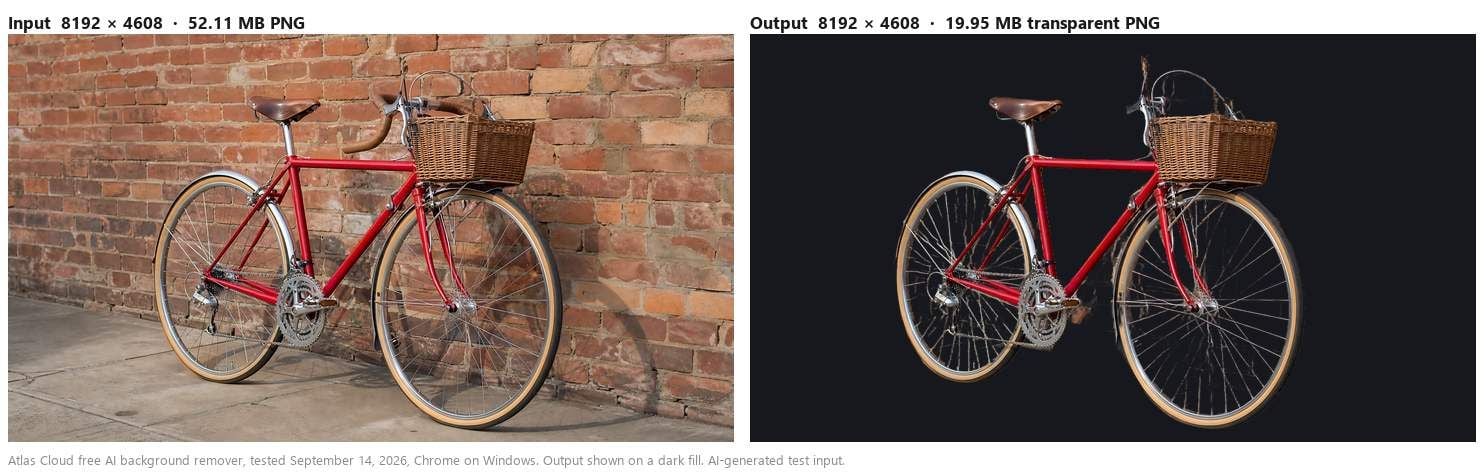
This article lines those stopping points up against a browser tool we fed an 8192×4608 photo. The file came back at 8192×4608 with no account involved. Adobe keeps ground the free tool cannot touch, and that gets its own section further down.

Key Takeaways
- Adobe's help page for photo quick actions stops the import at 40 MB and 4k x 4k. The Express editor path accepts files up to 65MP.
- Adobe's Firefly page says free background removal needs an Adobe account and runs on free daily generations.
- A transparent PNG out of Adobe Express takes two extra moves: set the background to No fill, then pick Transparent PNG at download.
- Our 8192×4608 test file, 37.75 MP, came back at full size from the free AI background remover on Atlas Cloud, with no account and no watermark.
- Adobe holds on to prompt-driven background replacement, video and enterprise batch. The free tool leaves a haze inside fine mesh such as bicycle spokes.
Is the Adobe Background Remover Free? Adobe's Own Answer
It is free with two conditions, and Adobe states both in plain language.
The first condition is an account. Adobe's Firefly background remover page answers the question in its FAQ: "Yes, you can remove backgrounds in Adobe Firefly for free with an Adobe account." The walkthrough on the same page opens with "log in to Adobe Firefly with your Adobe ID or create a free account if you don't have one." We read that page on September 14, 2026.
The second is volume. Adobe's wording: "Free users get free daily generations in Adobe Firefly that they can use to remove backgrounds," and "You can unlock unlimited use of this feature with a paid Adobe Firefly plan." No number is attached to that daily allowance anywhere on the page, so you find out where it ends by hitting it.
| What Adobe offers free | Adobe's wording | What it means before you upload |
|---|---|---|
| The tool itself | "remove backgrounds in Adobe Firefly for free with an Adobe account" | An email, a password, and a session that follows you |
| How much of it | "free daily generations" | A counter you cannot see, refilling the next day |
| Removing the ceiling | "unlimited use of this feature with a paid Adobe Firefly plan" | Volume work sits on the paid side |
Adobe Help Center's page for the Adobe Express Free plan lists what a free membership covers: templates, "4,000+ fonts from the Adobe Fonts collection," "Standard photo, video, and document editing tools," social scheduling and a Stock library, with 5GB of storage and 10 days of version history.
Background Remover is not named among them. The Firefly page stays the clearer answer on price, and the answer it gives is an account plus a count.
Worth saying out loud: none of this makes Adobe's tool bad. It does mean the answer to "is it free" shifts depending on which Adobe surface you land on, and there are three of them.
Adobe Express Remove Background: Three Entry Points, Three Rulebooks
Search for Adobe and background removal and you land on one of three surfaces. They share a brand and almost nothing else.
Inside the Express editor, removal is a panel button. Adobe Help Center's article "Remove background from images" puts it at "In the left Image panel, select Remove Background," with a companion line for undoing it: "To restore the background, select the image and select Remove Background again."
Files reaching that editor follow the upload limits on the "Minimum image requirements" page: "Desktop web: 80MB" and a "Maximum image resolution" of "65MP (For example, 8K x 8K or 16K x 4K)." 65MP is the highest pixel ceiling Adobe publishes for this feature anywhere.
Photo quick actions are the single-purpose pages, the ones that take a file without opening a project. Adobe's "Photo quick action file requirements" page covers Remove background among others, and its ceiling sits lower: "Maximum file size 40 MB" and "Maximum resolution at import 4k x 4k."
That same table lists supported files as "JPG, PNG, and SVG" while listing supported formats as ".jpg, .png, .bmp." The two lines do not agree with each other.
The Firefly page is the free public entrance. Its upload box reads "File must be JPEG (JPG), PNG, or WEBP and up to 40MB." Scroll to the FAQ on that same page and the number changes: "The Adobe Firefly background remover accepts JPEG, PNG, and WEBP files up to 100MB." One page, two caps, nothing saying which one the server enforces.
| Entry point | File size ceiling | Pixel ceiling | Source |
|---|---|---|---|
| Express editor upload | 80MB on desktop web | 65MP | Adobe Help Center, "Minimum image requirements" |
| Photo quick action | 40 MB | 4k x 4k at import | Adobe Help Center, "Photo quick action file requirements" |
| Firefly background remover page | 40MB in the upload box, 100MB in the FAQ | Not stated | Adobe's Firefly background remover page |
One more line on the quick action page catches anyone who cares about privacy: "Private mode is not supported for both desktop and mobile web browsers like Safari and Firefox." An incognito window is not a supported way to run it.
The 4k x 4k Ceiling on Photo Quick Actions
Adobe writes 4k and leaves it there. The term covers two common widths and the page defines neither, so the honest reading is a range. At 3840 the ceiling works out to 14.7 megapixels. At 4096 it works out to 16.8.
Either number sits under what a current camera produces. Run the arithmetic on files people actually have:
| File | Long edge | Megapixels | Past the 4k import line? |
|---|---|---|---|
| 12 MP phone photo, 4032 × 3024 | 4032 | 12.19 | Past 3840, under 4096 |
| 24 MP camera file, 6000 × 4000 | 6000 | 24.00 | Past it either way |
| Our 4000 × 2250 test file | 4000 | 9.00 | Past 3840, under 4096 |
| Our 6000 × 3375 test file | 6000 | 20.25 | Past it either way |
A standard 12 MP phone photo already brushes the line on its long edge. Anything shot on a mirrorless body clears it comfortably. Knowing which of the three doors you are walking through saves you ten minutes on a cutout that was never going to import.
The Adobe Background Remover Alternative: No Adobe ID, No Daily Count
Atlas Cloud keeps a short shelf of browser tools that open and run without a sign-in screen. The free AI background remover is the one that stands in for the Adobe feature. Disclosure: Atlas Cloud publishes this article and operates that tool.
Drop the file in, press Run Free, download the PNG. Here is the largest file we handed it and what came back.
No plan picker sits in front of that run. No email, no confirmation link, no counter ticking down in the corner.
The model loads into the browser tab and works there, which is also why one of our runs finished after we cut the network. That test is written up in our Canva comparison, where it lands against a tool whose help page tells you to check your connection.
What this tool does not do is pretend to be a design suite. It cuts one image per run and hands back a PNG. Everything after that happens in whatever editor you already use, Adobe Express included.
The 4K Ceiling vs a 37 MP Test File
We ran one photo at three sizes on September 10, 2026, then the bicycle file on September 14, all in Chrome on Windows, and measured what came back.
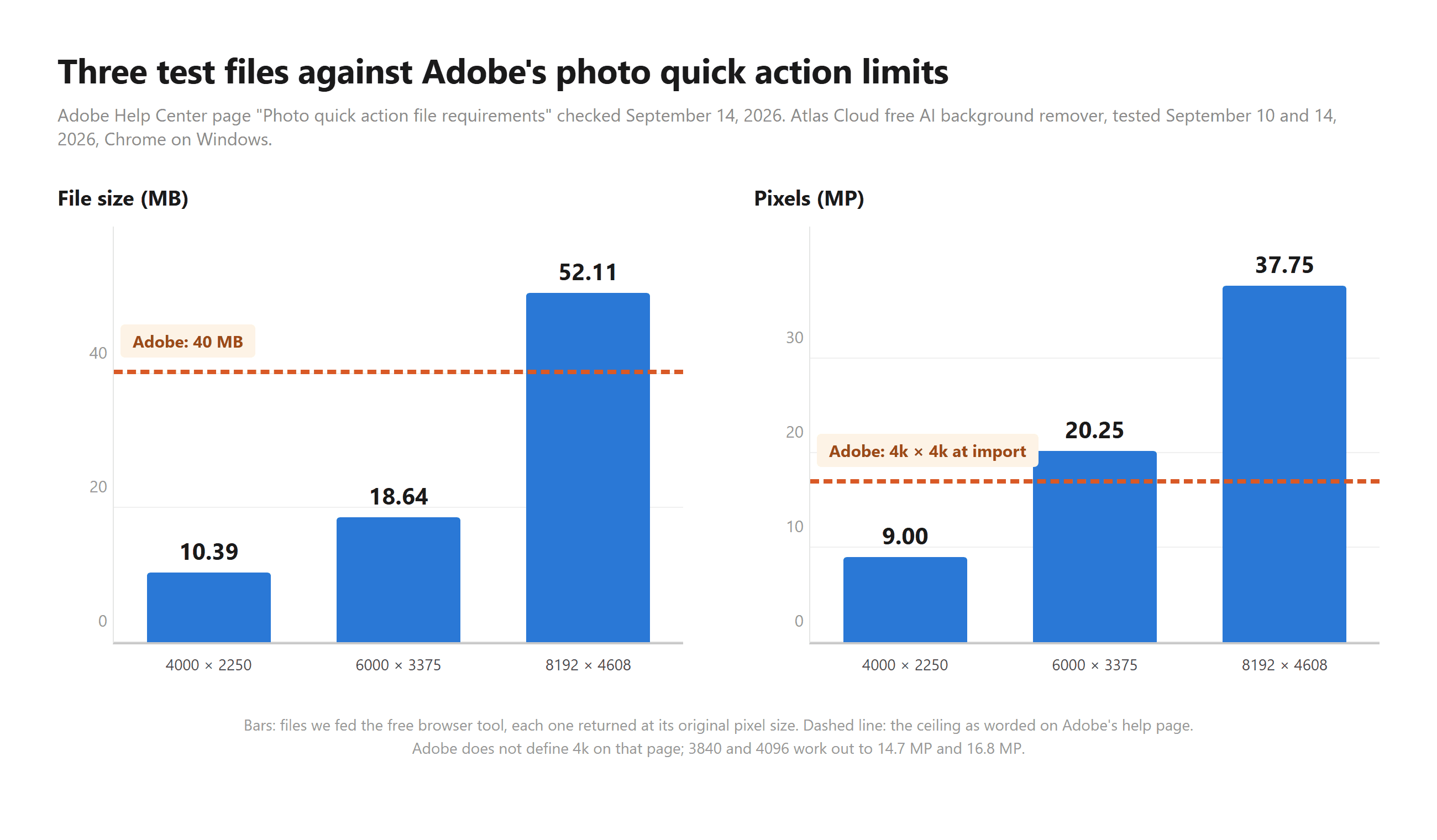
The 4000 × 2250 input, 9.00 MP and 10.39 MB, came back at 4000 × 2250 and 3.71 MB. The 6000 × 3375 input, 20.25 MP and 18.64 MB, came back at 6000 × 3375 and 7.22 MB. The bicycle, 8192 × 4608 at 37.75 MP and 52.11 MB going in, came back at 8192 × 4608 as a 19.95 MB transparent PNG. Nothing shrank on the way out.
Look at which limit bites first. The two smaller files sit under the 40 MB that Adobe's quick action page allows, so weight was never their problem, the long edge was. The bicycle misses on both counts at once, and it would still be inside the 65MP the Express editor accepts, which is the split this article keeps returning to.
Cut quality held across the range as well. On the three sizes of that one photo, fully transparent pixels landed between 79.25% and 79.27% of the frame, a spread of two hundredths of a percent. The model was not trading edge accuracy for resolution as the file grew.
Transparent PNG: Two Extra Steps in Adobe Express, One Download Here
Removing a background and getting a transparent file are separate jobs in Adobe Express. The Help Center article spells out the second one: "To download an image with a transparent background, click outside the canvas, then select Background in the left panel and select No fill. When downloading the file, make sure to choose Transparent PNG as the file format."
Miss either move and the download arrives with the page colour behind your subject. That trips people who assumed the cutout was the whole job, and it explains a fair share of the "why is my background white" questions floating around.
The same Adobe page also sets expectations on the cut itself: "It may also remove fine details or low-contrast areas. Review the cutout and restore anything important before finalizing your image." Fair warning from the vendor, and worth reading before a client file.
On the Atlas Cloud side there is nothing to configure. The download is an RGBA PNG at the pixel size you uploaded, transparency already in place. If the term is new to you, we wrote a plain explanation of the alpha channel and what it stores.
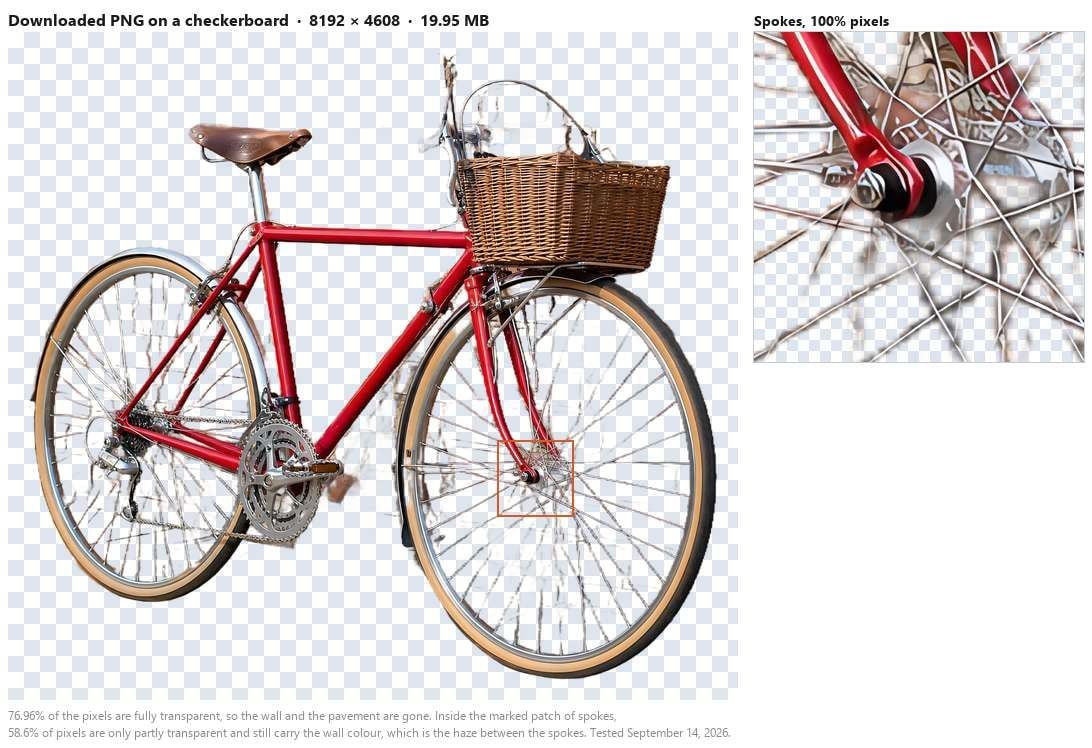
Across the whole frame, 76.96% of the pixels came back fully transparent. The wall and the pavement are gone, and the basket weave and the saddle edge hold up at full size.
The checkerboard also shows where this model runs out. Inside the marked patch of spokes, 58.6% of pixels are only partly transparent, and their average colour, RGB 131, 105, 97, is the brick and pavement that used to sit behind the wheel. Fine mesh keeps a haze of the old background. On a dark backdrop you will not notice it. On a light one you will.
One technical note for anyone who inspects their files. The subject pixels come back at alpha 254 rather than 255, roughly 99.6% opaque. In the bicycle file, 692 pixels out of 37.7 million reached a true 255. Nobody sees that on screen or in print, and it composites normally. It shows up only if you go looking at the channel.
Where Adobe Express Still Wins
An honest alternative piece has to say what you give up. Five things stay on Adobe's side of the line.
Replacing a background by describing it. Adobe's FAQ puts it plainly: "Once Adobe Firefly removes the background, you can use the Background Generator to replace it with any scene you describe, or apply a solid color background to your image." The free browser tool clears the background and stops. Anything new behind your subject comes from your own editor.
Staying in one place afterwards. Adobe's page continues: "Generate a new background, turn your subject into a sticker, or upscale your image all without leaving Adobe Firefly." That matters when a cutout is step one of five.
Volume. In Adobe's words, "Adobe Firefly offers batch background removal to enterprise users, and you can perform batch background removal with the Firefly AI Assistant." Fifty product shots through the free tool means fifty individual runs.
Video. Adobe runs a separate video background removal feature alongside the image one. The browser tool takes still images only.
Mobile. "Yes, Adobe Firefly works on mobile," says the same FAQ, covering upload, removal and download from a phone.
Then three limits of the model we tested, all measured rather than guessed. Sheer fabric keeps its shape and loses its transparency, so the colour of the old background stays baked into the cloth.
A pale subject in front of a saturated wall picks up that wall along its edge. Of the six inputs we measured on September 10, that combination was the one that showed it clearly, and contracting the selection by a pixel in your editor clears the tint. Fine mesh is the third: the bicycle wheels from the run above came back hazy rather than cleanly cut.
| Test input | What came back | Measured on the alpha channel |
|---|---|---|
| Sheer veil against foliage | Shape correct, fabric opaque | Veil sits at alpha 254, with 0.73% of pixels genuinely semi-transparent |
| White shirt against a deep red wall | Clean cut with a tinted rim | 69% of the semi-transparent edge pixels lean red |
| Golden retriever on grass | Clean cut | Green channel up 16 points at the edge, invisible at normal size |
| Bicycle spokes against brick | Frame and basket clean, wheels hazy | 58.6% of pixels in the spoke patch are partly transparent, averaging the wall's colour |
One more gap that belongs to physics rather than the tool. A small source photo stays small after the cut, so a cutout headed for print needs an upscaling pass. Our roundup of free image upscalers covers the ones that finish without stamping the result.
Adobe Express vs Atlas Cloud: Side by Side
Adobe's column holds its own published wording, or "not stated" where its pages say nothing. The Atlas Cloud column holds what we measured, with page claims marked as such.
| Adobe Express and Firefly | Atlas Cloud free AI background remover | |
|---|---|---|
| Free access | "for free with an Adobe account" plus "free daily generations" | Free to use, no account (tested) |
| Sign-in | Adobe's own steps start with "log in to Adobe Firefly with your Adobe ID" | None (tested) |
| File size ceiling | 40 MB on quick actions, 80MB on editor upload | 52.11 MB PNG accepted (tested); no cap stated on the tool page |
| Pixel ceiling | "4k x 4k at import" on quick actions, 65MP in the editor | 37.75 MP returned at full size (tested) |
| Transparent output | Set background to No fill, then choose Transparent PNG | RGBA PNG at the input size, no setting (tested) |
| Private browsing | "Private mode is not supported" on quick actions | Not tested |
| Batch | Enterprise batch and the Firefly AI Assistant | One image per run |
| Video | Separate video background removal feature | Images only |
| New background | Background Generator, described by prompt | None; bring your own editor |
| Watermark | Not stated | None (tested) |
| Sheer fabric | Not stated | Shape kept, transparency lost (tested) |
| Fine mesh | Not stated | Haze between bicycle spokes (tested) |
Should You Switch From Adobe Express?
If your work already lives inside Adobe, the answer is probably no, and adding a second tool is the better framing anyway. A cutout that feeds straight into a Firefly background generation, a batch that runs under an enterprise seat, a video clip that needs the same treatment: those stay where they are. Signing in costs you nothing extra when you were going to sign in regardless.
The free tool earns its place on the photos Adobe's doors turn away, or when the sign-in itself is the problem. A 24 MP camera file past the quick action ceiling, a one-off cutout on a borrowed laptop, a client image you would rather not attach to an account session. Download the PNG, then drop it into Adobe Express as a normal upload and carry on with the design work there.
| Stay with Adobe if | Add the free tool if |
|---|---|
| You already sign in to Adobe every day | You want a cutout without creating an account |
| You want a new background generated from a prompt | Your file is past 4k on the long edge |
| You process folders or video | You are working one image at a time |
| Your cutout feeds a longer Firefly workflow | You are near the end of a day's free generations |
Frequently Asked Questions
How do I remove the background of an image in Adobe Express?
Adobe Help Center's article "Remove background from images" carries the steps: open the design, select the image, then select Remove Background in the left Image panel. Selecting it again restores the original background, and for a transparent file the same page adds the No fill and Transparent PNG steps at download.
Follow that workflow on Adobe's own pages. This article covers what happens when your file is larger than the tool accepts.
Is the Adobe Express background remover free?
Adobe's Firefly page says yes with an Adobe account, on a daily allowance of free generations, with unlimited use attached to a paid Firefly plan. The Adobe Express Free plan page lists templates, fonts, standard editing tools, scheduling and stock, and does not name Background Remover among them.
Why did Adobe refuse my photo?
Check the long edge before the file size. Quick actions stop at "4k x 4k at import" and 40 MB, so a 6000 pixel camera file is over the pixel line while still being well under the weight limit. The Express editor path allows more, up to 65MP and 80MB on desktop web.
How do I get a transparent background without an Adobe account?
Run the image through the free AI background remover on Atlas Cloud and download the result. It returns an RGBA PNG at the size you uploaded, with no login and no watermark in our testing, and the transparency is already in the file rather than a setting you pick at export.
Does the free alternative put a watermark on the download?
No watermark appeared on any file we downloaded during testing on September 10, 2026. The tool page describes itself as free to use without an account, and our runs matched that.
Can it handle a folder of images or a video?
No on both. It takes one still image per run. Folder work and video background removal are the places where Adobe's paid and enterprise tiers hold a real advantage, and we would rather say so than pretend otherwise.
Conclusion
Adobe's background removal is good, and it is fenced. The fences are published on Adobe's own pages: an account and a daily allowance on the free Firefly route, 40 MB and 4k x 4k on photo quick actions, 65MP and 80MB through the Express editor, plus two extra clicks before a download is genuinely transparent. Neither of the ranking guides we read while researching this piece mentions the middle set of numbers, which is where camera files actually get stopped.
Our 8192×4608 test file, 37.75 megapixels and 52.11 MB, came back from a browser tab at 8192×4608 with no account attached to it. That is the narrow claim this Adobe background remover alternative makes. It does not generate a new scene behind your subject, it does not touch video, it works on one image at a time, and it leaves a haze inside fine mesh like bicycle spokes. For a full size cutout with nothing to sign, open the tool and drag the file in.





