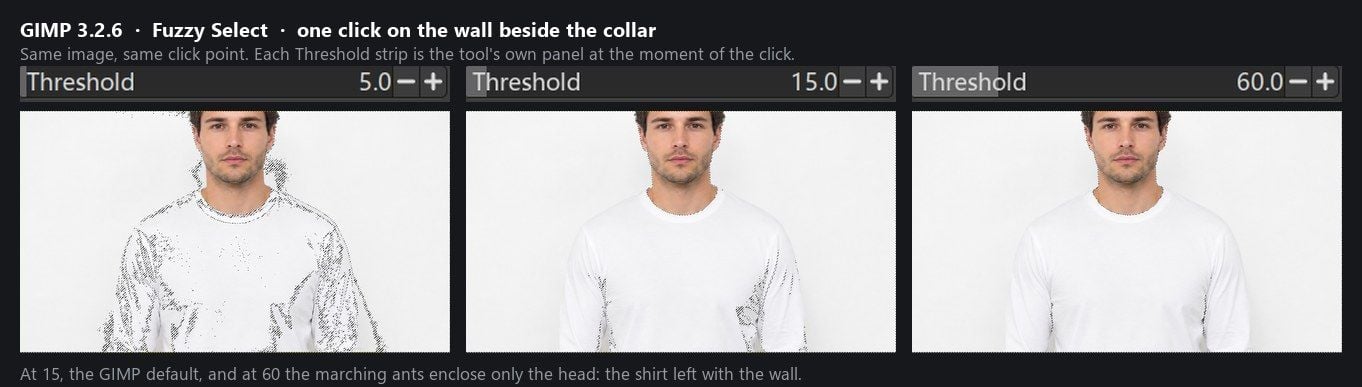
You click the wall beside the collar with Fuzzy Select, and the marching ants close around the man's head. Everything below it went into the selection, shirt and wall together. Drop the Threshold to a third of its default and the selection turns to confetti, tearing holes across the chest while patches of wall stay behind.
Every GIMP remove background guide we read opens with the same two tools, Fuzzy Select and Select by Color, and both do exactly what the GIMP manual says they do: pick pixels by how close their color sits to the one you clicked. A white shirt in front of a white wall gives them no distance to measure.
This article puts that photo through GIMP 3.2.6 and through a free browser tool that builds its mask another way, then repeats the exercise with hair and with a sheer veil. GIMP keeps several wins. The white shirt is not one of them.
Key Takeaways
- GIMP's Fuzzy Select and Select by Color choose pixels by how close their color is to the one you click, in the words of the GIMP 3.2 manual. A white shirt in front of a white wall gives them nothing to separate.
- Thefree AI background removeron Atlas Cloud cut that same white-on-white photoonthe first run, with no account and no watermark (tested September 10, 2026).
- Hair is the case both sides can handle. On ourportraitthe free tool returned the softest edge of anything we tested, a partly transparent band roughly four times as wide as the one it gave the white shirt.
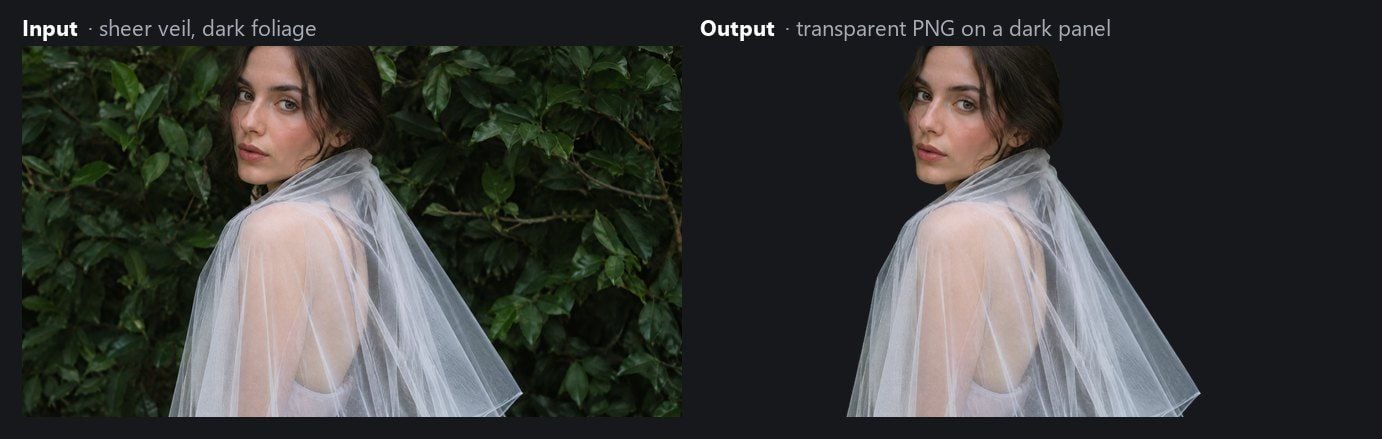
- Sheer fabric limits both sides: the AI outputkeptthe veil's shape butreturnedit opaque, and in GIMP the same area needs a hand-painted layer mask.
- GIMP keeps everything that needs a full editor: layers, paths, brushes, offline desktop work. The free tool does one photo per run and no video.
Why GIMP Remove Background Selections Stall on White Against White
GIMP offers four routes to a cutout, and three of them start from color. The manual's page on Fuzzy Select describes the tool as "designed to select areas of the current layer or image based on color similarity." Its Threshold slider sets how far that similarity stretches: "the higher the threshold, the larger the resulting selection."
Select by Color runs the same comparison and drops the rule that pixels must touch, so it grabs every similar pixel anywhere on the layer. The Select by drop-down that both tools share lists Composite, Red, Green, Blue, HSV Hue, HSV Saturation, HSV Value, LCh Lightness, LCh Chroma, LCh Hue and Alpha. Every entry is a color component. There is no setting for "the shirt."
Foreground Select is the third route. You lasso the subject roughly, paint strokes over what to keep, and a matting engine grows the mask from those strokes. It still leans on the difference between the colors you painted and the colors around them, which is why the manual warns you to keep the brush off background pixels. The fourth route, Paths, is hand-drawn point by point and has no opinion about color at all.
Now put the white shirt on the white wall. We measured our test photo: the wall's median brightness is 242 and the lit cotton's is 241. To keep the shirt out of the selection, the tool would have to resolve a gap of under one level. The shirt's own shadow folds, meanwhile, run 27 levels darker than its midtone. Any Threshold generous enough to hold the shirt together floods the wall and everything the wall touches, and the shirt touches the wall. This is a property of the method rather than of your patience. The manual says as much about the tool: with it "the more frustrated you become with the difficulty of selecting exactly what you want."
Here is that click, run three times at three settings.
The GIMP Remove Background Alternative: Free AI Cutout in the Browser
Atlas Cloud is a model platform that also keeps a short list of browser tools anyone can open without an account. The AI background remover in that list is the tool this article measures GIMP against. Disclosure: Atlas Cloud publishes this article and operates the tool.
There is no Threshold slider on the page, because the mask is not built from a color you click. Here is the white shirt photo that stalls Fuzzy Select, and what came back.
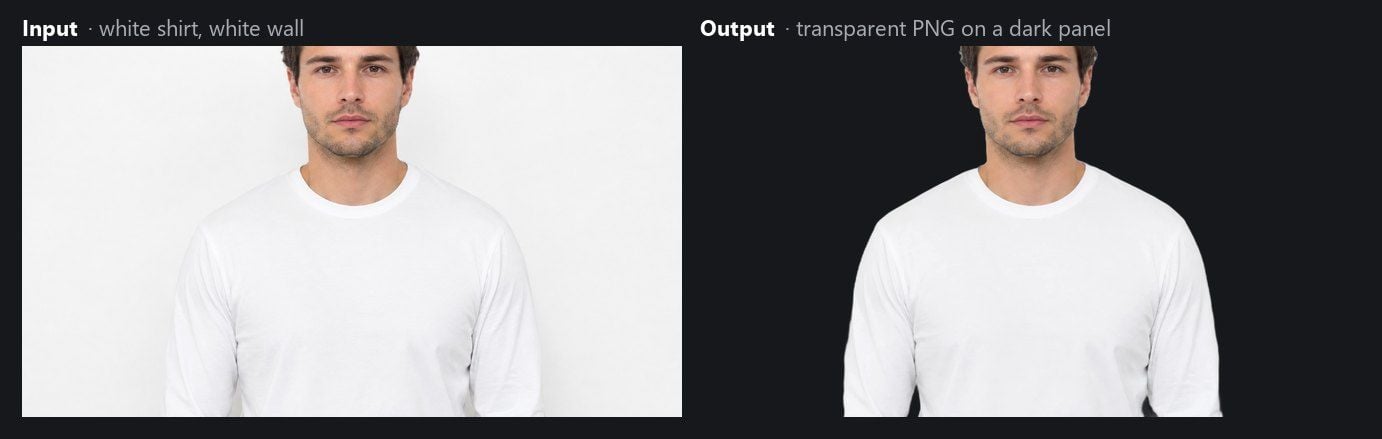
The wall is gone and the shirt is whole, tested on September 10, 2026 in Chrome on Windows. Counting the pixels of that transparent PNG by alpha value: 60.61% are fully transparent, the shirt is solid, and 0.88% sit in between. That last group is the one-to-three-pixel anti-aliasing band along the outline. Those edge pixels average a shade below the shirt body and carry no tint from the wall, so there is no fringe to clean up afterwards.
Three steps cover the run. Drop the photo on the page, or press Ctrl+V with a screenshot on the clipboard. Click Run Free. Download the PNG. The model runs inside the browser tab, a point we tested at length in a separate article and will not repeat here.
Judging by the white-on-white result, the model separates the subject by its shape rather than by color contrast with the background. That is the whole difference from the GIMP tools above, and it is why the shirt survives.
Hair Test: GIMP Foreground Select vs the AI Alternative
White on white is the case GIMP cannot reach. Hair it can reach, which makes this the section about effort and edge quality rather than about whether the cutout is possible at all.
In GIMP 3.2.6 the route is Foreground Select. The manual notes that one of its two engines, Matting Levin, is currently removed on Windows because of crashes, so a Windows install runs Matting Global. Lasso the head with a margin, paint strokes across the hair and face, toggle the preview, click Select, then Layer > Transparency > Add Alpha Channel, Select > Invert, Delete, and Export As a PNG. In the browser tool the route is the same three steps as the shirt.
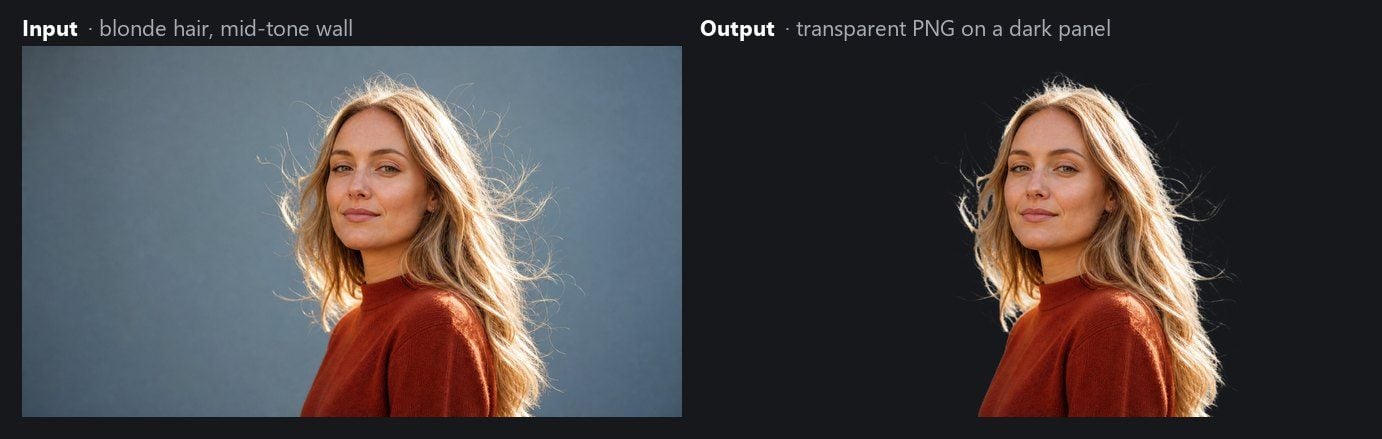
We counted the pixels of the tool's output the same way we counted the shirt. On the hair photo, 4.05% of pixels landed between fully transparent and fully opaque. The shirt gave 0.88% and the veil 0.73%. That band is where the cutout stops being a cutout and starts being a blend, and on hair it needs to be wide, because a strand lit from behind is genuinely part background. Four times the band means the loose strands around her head come away with light passing through them rather than as a hard-edged clump.
GIMP gets to the same place by a longer road. Foreground Select needs the lasso, the strokes, a preview, and usually several rounds of switching to Draw background to push the wall back out from between the strands. The manual is blunt about the cost: the tool "needs a lot of memory for its processing" and "is known to crash or slow down when using larger images." Matting Levin, the engine it calls the more accurate of the two, is "temporarily removed on Windows due to crashes," so a Windows install falls back to Matting Global.
Sheer Fabric: One Limit the Alternative Shares With GIMP
A veil in front of dark greenery is the photo that humbles both approaches. Each pixel of the fabric is a blend of thread and the leaves behind it. A color threshold cannot pull those two apart, because the blend is one color. Foreground Select has the same problem: the "foreground" you paint over is already half background.
The AI tool did not solve it either. The veil came back with its shape intact and its transparency gone. Of the output's pixels, 66.38% are fully transparent and only 0.73% are partly transparent, the same thin outline band the shirt has. Across the veil's skirt, the area you can see straight through in the original, 99.6% of the pixels came back fully opaque. The foliage is cleanly gone, and so is the fabric's translucency: the veil is now a solid pale grey shape that shows nothing behind it.
In GIMP the honest route for this photo is a layer mask painted by hand in grey values, so that the mask, not the pixel color, carries the translucency. That is real editing work, and it is the kind of work the browser tool has no brush for.
Make Background Transparent: What the PNG Holds From GIMP vs the Alternative
Deleting the background in GIMP does not make it transparent on its own. A JPG opens as a layer without an alpha channel, and the manual's Add Alpha Channel page explains why that matters: "The alpha channel represents the transparency of a layer." Without it, Delete fills the selection with the background color. The fix is Layer > Transparency > Add Alpha Channel before you delete, then Export As with a .png name. Save as JPG and the transparency is discarded again.
The browser tool skips those two decisions. Its output is a PNG with an alpha channel already in place, at the pixel size you gave it. Here is what that channel held in the two test files.
| Test file (tool output) | Fully transparent (alpha 0) | Solid subject | Partly transparent edge band |
|---|---|---|---|
| White shirt on white wall | 60.61% | 38.51% | 0.88% |
| Sheer veil on greenery | 66.38% | 32.89% | 0.73% |
The edge band is the part that lets the cutout blend into a new backdrop without a jagged rim. If the terms are unfamiliar, our explainer on what an alpha channel is covers why a JPG cannot hold one. A small technical note for the curious: the solid pixels in these files sit at alpha 254 rather than 255, a difference no screen can show.
Where GIMP Still Beats the Alternative
None of the above makes GIMP the wrong tool for image work. It makes it the wrong tool for one job on one kind of photo. On the jobs below GIMP is still the one to open.
| Job | GIMP 3.2.6 | Atlas Cloud free tool |
|---|---|---|
| Fix a cutout edge by hand | Paint on a layer mask, refine with Paths, feather the selection | No brush; the mask is final |
| Semi-transparent subjects | Layer mask in grey values carries the translucency | Shape kept, translucency lost (tested on the veil) |
| Composite onto a new scene | Layers, blend modes, color tools in the same window | Download the PNG, open another editor |
| Work with no connection at all | Desktop application, nothing leaves the machine | Browser page; model runs in the tab (page statement) |
| Many photos in one sitting | Open several images, repeat the workflow per image | One image per run |
| Video | Not a video editor | Not supported |
If your evening is going to end inside GIMP anyway, the sensible pairing is to let the browser tool produce the mask and finish the composite in GIMP. The PNG opens as a layer with alpha already set.
GIMP vs Atlas Cloud Background Remover: Side by Side
The GIMP column below holds the manual's own wording or our 3.2.6 attempt. The Atlas Cloud column holds what we tested on September 10, 2026, with page statements marked as such.
| GIMP 3.2.6 | Atlas Cloud free AI background remover | |
|---|---|---|
| How the mask is built | Fuzzy Select and Select by Color: color similarity within a Threshold. Foreground Select: matting from your strokes | Model output; no color threshold to set |
| White shirt on white wall | Shirt selected along with the wall at Threshold 15 and 60; shattered at 5 (tested) | Passed on the first run (tested) |
| Hair | Foreground Select, lasso plus painted strokes; Matting Global on Windows (manual) | 4.05% partly transparent edge band, the widest in our test set (tested) |
| Sheer fabric | Hand-painted layer mask | Shape kept, transparency lost (tested) |
| Transparent PNG | Add Alpha Channel, then Export As .png | RGBA PNG at the input size (tested) |
| Account | None, desktop software | None (tested) |
| Watermark | None | None (tested) |
| Batch | Per image inside the editor | One image per run |
| Video | Not a video editor | Not supported |
| Price | Free software | Free to use (page statement) |
Should You Drop GIMP for Background Removal?
If you already live in GIMP and your subject is a dark bottle on a white sweep, keep doing what you do. Fuzzy Select on a flat background is the manual's own example of where the tool works well, and the result lands in the layer stack where you want it.
Change the route when the photo is the problem rather than your settings: a light subject on a light wall, a pet against grass the same tone as its coat, a batch of portraits where every hairline needs strokes. Run those through the browser tool, download the PNG, then open it in GIMP if there is compositing left to do. For a portrait that is headed for a plain backdrop, our guide to headshot background colors lists the values that photograph well.
| Stay with GIMP if | Use the free tool if |
|---|---|
| The subject and background differ clearly in color | The subject and background share a color |
| You need to paint or refine the mask edge | You want the mask done before you open an editor |
| The subject is glass, veil or smoke and needs a grey mask | The photo is a person, pet, product or signature |
| The composite happens in GIMP anyway | The PNG is the final deliverable |
Frequently Asked Questions
How do you remove a background in GIMP?
Pick a selection tool that suits the photo: Fuzzy Select or Select by Color for a flat background that differs from the subject, Foreground Select for hair, Paths for hard edges. Add an alpha channel from the Layer > Transparency menu, invert the selection, press Delete, and export as PNG. The GIMP manual's Selection Tools chapter documents each tool's options in full.
Why does GIMP Fuzzy Select grab the whole image, or the subject instead of the wall?
Both are Threshold outcomes. The tool selects contiguous pixels within a color range of the one you clicked, so a high Threshold spills across similar colors and a low one stops at the first shadow. When subject and background share a color, no value in between separates them, which is the white shirt case above.
Does GIMP make background transparent automatically?
No. GIMP needs an alpha channel on the layer before deleted pixels can become transparent, and the file has to be exported as PNG rather than JPG. Layers without an alpha channel show in bold in the Layers dialog.
Is the GIMP alternative free, and does it need an account?
The Atlas Cloud tool required no account and added no watermark in our September 10, 2026 test, and the browser background remover page describes itself as free to use. We describe it the same way and make no claim about pricing forever.
Can the alternative process a folder of photos or a video?
No. It takes one image per run and returns one PNG, and it does not accept video. Both of those jobs stay with a desktop editor or a dedicated tool.
Conclusion
GIMP's selection tools are built on color similarity, and the manual says so on the first line of the Fuzzy Select page. That design serves most photos and fails one family of them on principle: a subject that shares its color with the background. Our white shirt on a white wall belongs to that family. A browser model that reads the subject's shape cut it on the first pass, then returned a sheer veil as an opaque shape, which is the limit it shares with any tool working from pixel color alone.
Keep GIMP for the mask edits, the layer work and the composites. For the photo where no Threshold value lands, the shortest GIMP remove background route now runs through a browser tab, and the PNG it hands back opens in GIMP with the alpha channel already in place.





