Rewind to the summer of 2024. AI video was slow, jittery, and mostly a demo-reel toy. Then a small Chinese startup shipped a model that could chain AI clips into a 40-second story — and, one month later, an update that cut the wait to about a minute per video. People noticed.
The model was PixVerse V2. The update was V2.5. This is the story of what those two releases actually did, how they stacked up against Kling at the time, and — with PixVerse now several generations further on — whether any of it still matters in 2026.
Key Takeaways
- PixVerse V2 launched July 24, 2024 from AIsphere, built on a Diffusion Transformer (DiT) architecture, generating eight-second clips and chaining up to five segments (~40s total) in one job.
- The PixVerse V2.5 update (August 22, 2024) ran roughly 2x faster than V2, added 4K upscaling, path-based motion control, and precise four-axis camera moves.
- In 2024 head-to-heads, PixVerse V2.5 beat Kling on speed and resolution but lost on realism and long-clip stability.
- V2 and V2.5 are retired — PixVerse's current API lists only recent-generation models. The old versions linger on some third-party aggregators, but there's no confirmed way to run the original weights.
- Atlas Cloud hosts the current PixVerse lineage on a metered, pay-as-you-go API for anyone who wants to build on that heritage today.

What PixVerse V2 Brought to AI Video in 2024
PixVerse V2 arrived on July 24, 2024, from AIsphere, the studio behind the PixVerse app. Its headline claim was architectural: according to trade coverage from kr-asia, it was one of the first practical video models from a Chinese startup built on a Diffusion Transformer (DiT) backbone rather than the older U-Net diffusion approach.
That backbone is what let PixVerse AI V2 do things V1 couldn't. Per aibase's launch report, V2 generated single clips up to eight seconds long. The trick that set it apart, covered in aibase's follow-up, was chaining: one to five consecutive segments in a single job, reaching roughly 40 seconds of continuous footage. It handled both text-to-video and image-to-video, offered anime and realistic styles, and used a self-developed spatio-temporal attention mechanism to keep complex scenes coherent from first frame to last.
Here's where V2 sat in the wider release timeline. Dates for the newer versions come from a third-party review timeline, so treat the later rows as approximate.
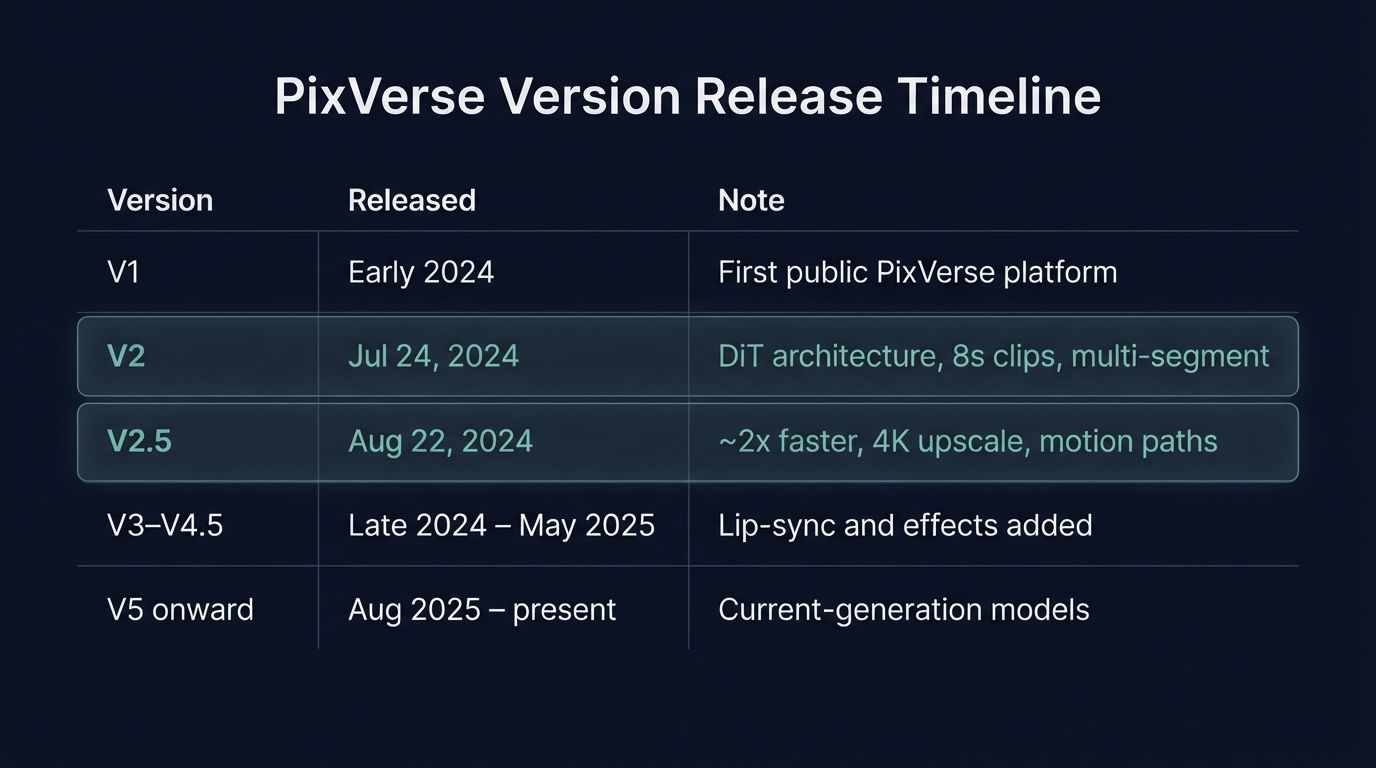
One caveat worth flagging: at least one review site lists V2 as a February 2024 release. The primary trade reporting (aibase, kr-asia) puts it firmly in July 2024, shortly after Kling AI's June debut — so July is the date to trust.
Inside the PixVerse V2.5 Update: 2x Speed, 4K, and Motion Paths
Barely a month after V2, PixVerse shipped V2.5 on August 22, 2024 — and this is the release most people actually remember. Where V2 proved the architecture worked, PixVerse V2.5 made it fast enough to feel casual.
The speed jump was the headline. aibase reported that V2.5 doubled generation speed over V2 — roughly one minute per video — while aipure's write-up framed it as "flawless" clips without the lag and distortion earlier versions were prone to. On top of speed, PixVerse AI V2.5 added real creative control: a Magic Brush upgrade that let you select a region and draw the exact path a subject should move along, plus precise camera moves across four axes (horizontal, vertical, roll, and zoom). A new High Performance mode boosted subject motion while reducing distortion.
| Capability | PixVerse V2 | PixVerse V2.5 |
|---|---|---|
| Generation speed | Baseline | 2x faster (1 min) |
| Max resolution | HD output | HD + 4K upscaling |
| Clip length | Up to 8s | 5s and 10s options |
| Motion control | Basic | Draw-a-path Magic Brush |
| Camera control | None | 4-axis (pan, tilt, roll, zoom) |
| Distortion handling | Standard | High Performance mode |
| Interface languages | Limited | 7 languages |
Note what V2.5 did not have: lip-sync. That feature only arrived in the V4 era, so any guide claiming the pixverse ai v2 5 release could sync mouths to audio is mixing up versions.
Where the PixVerse Lineage Runs Today: Atlas Cloud
Here's the practical wrinkle. Everything above is history — you can't call PixVerse V2 or V2.5 from PixVerse's API anymore, because they've been retired. What you can build on is the lineage that grew out of them.
Atlas Cloud hosts the current PixVerse model family on one metered API, billed per second with no subscription to commit to first. If the part of V2 you cared about was its image-to-video and motion work, the direct descendant is PixVerse image-to-video, which carries that same photo-to-motion idea forward with far better fidelity — our [image-to-video workflow guide](pixverse-ai-image-to-video.md) walks through the exact steps. Pricing is metered per second of output:
| Resolution | Without audio | With audio |
|---|---|---|
| 360p | $0.025 / sec | $0.035 / sec |
| 540p | $0.035 / sec | $0.045 / sec |
| 720p | $0.045 / sec | $0.060 / sec |
| 1080p | $0.090 / sec | $0.115 / sec |
The through-line: V2 and V2.5 were where PixVerse learned to move fast and stay coherent. The current lineage is where that same DNA became production-ready and callable from your own code.
PixVerse AI V2.5 vs Kling AI: The 2024 Speed-Versus-Quality Split
You can't understand why V2.5 mattered without the model it was chasing. In September 2024, PixVerse V2.5 and Kling AI were two of the loudest names in short-form AI video, and reviewers pitted them against each other directly.
The verdict, per aipure's comparison, was a clean trade-off. PixVerse won on speed and accessibility; Kling won on raw quality. If you wanted a stylized clip for social media in under two minutes, PixVerse AI V2.5 was the pick. If you wanted a photoreal scene with rich, stable backgrounds and didn't mind waiting, Kling edged ahead.
| Dimension | PixVerse V2.5 | Kling AI (Sept 2024) |
|---|---|---|
| Text-to-video speed | ~1 min | ~2 min |
| Image-to-video speed | ~1 min | ~10 min |
| Resolution | HD + 4K upscale | 720p |
| Free-tier clip length | Up to 10s | Shorter |
| Overall realism | Good, stronger when stylized | Better, richer backgrounds |
| Motion stability | Occasional artifacts | More stable |
That split — fast and flexible versus slow and pristine — defined the 2024 AI video market, and it's the same tension that still shapes model choices today.
The Honest Limits of PixVerse AI V2 and V2.5
For all the speed, PixVerse V2 and V2.5 had real rough edges, and the review record from the time is candid about them. fritz.ai's review is the most useful source here.
The recurring complaints: longer clips accumulated visible artifacts and often needed several retries to land a usable take. Outputs sometimes rendered in unintended slow motion, quietly wrecking a clip's pacing. And the model leaned stylized for a reason — realistic footage exposed motion and detail errors that anime and illustrated styles conveniently hid. Backgrounds, especially, came out thinner than Kling's.
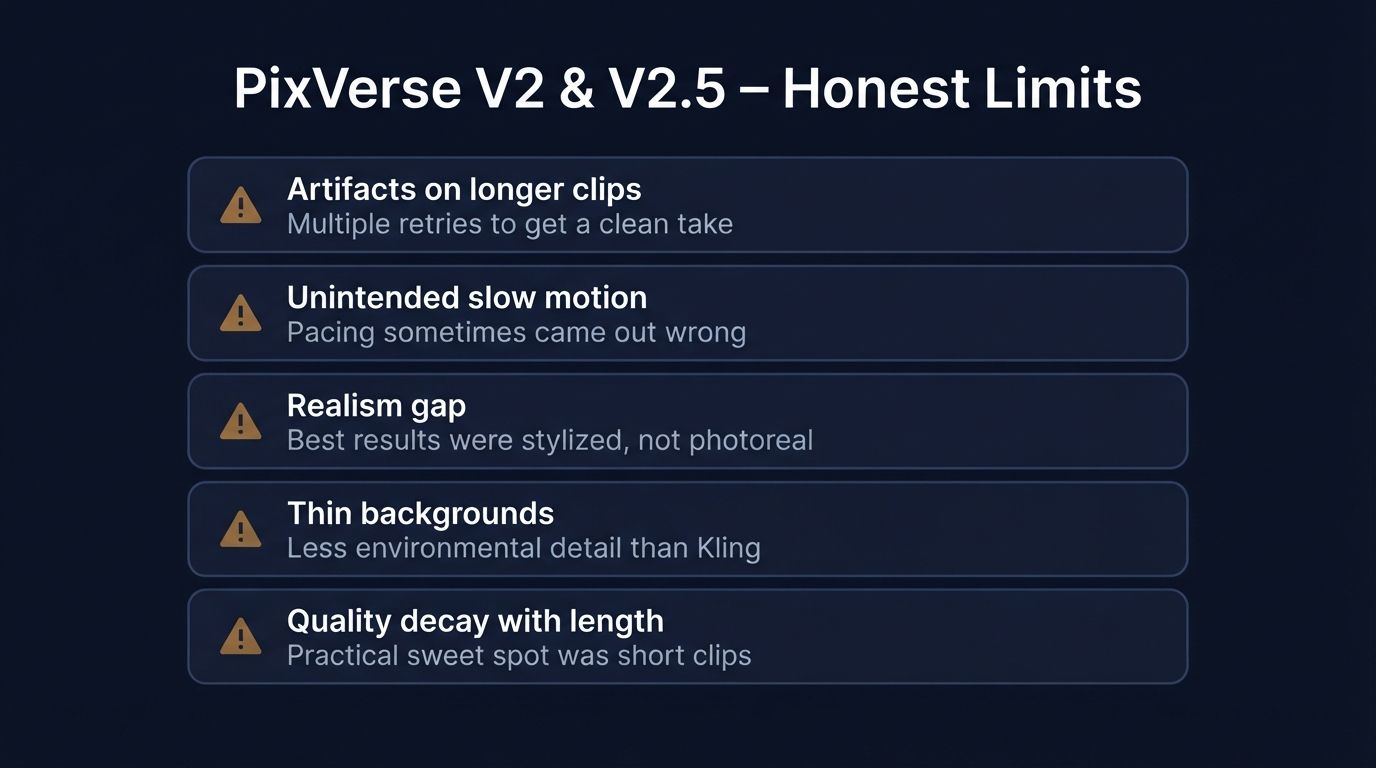
Reviewers also noted a mismatch worth keeping in mind: while the spec sheet advertised 10-second clips, quality in practice started slipping well before that on complex scenes. The 10s figure was a ceiling, not a guarantee.
Can You Still Use PixVerse V2 or V2.5 in 2026?
Short answer: not from PixVerse directly. The official platform model list today runs only from the current V5-generation models up to the latest flagship — nothing remotely as old as V2. PixVerse V2 and V2.5 have been fully superseded and pulled from the first-party product.
You'll still find V2 and V2.5 model pages living on a handful of third-party aggregator sites. But it's genuinely unclear whether those still route to the original 2024 weights or just kept the listing alive as a redirect to a newer model. Treat "run the original PixVerse V2" as unverified at best — if you need PixVerse-style output today, the current lineage covered earlier is the realistic route.
Frequently Asked Questions
Is PixVerse V2 still available in 2026?
Not on PixVerse's official platform. The current API lists only recent-generation models (V5 through the latest flagship). PixVerse V2 and V2.5 have been retired. A few third-party aggregators still show V2/V2.5 pages, but there's no confirmed way to run the original weights.
What is the difference between PixVerse V2 and V2.5?
PixVerse V2 (July 2024) introduced the DiT architecture, eight-second clips, and multi-segment chaining. The V2.5 update (August 2024) ran about twice as fast, added 4K upscaling, path-based motion control via an upgraded Magic Brush, four-axis camera moves, and a High Performance mode to reduce distortion.
When did PixVerse V2.5 come out?
PixVerse V2.5 launched on August 22, 2024, roughly a month after V2's July 24, 2024 release. Both shipped during the same busy summer that also saw Kling AI's global rollout.
Was PixVerse AI V2.5 better than Kling?
It depended on the goal. In 2024 comparisons, PixVerse V2.5 was faster and offered 4K upscaling plus longer free clips, while Kling produced more realistic, stable output with richer backgrounds. PixVerse suited quick stylized clips; Kling suited photoreal work.
Conclusion
PixVerse V2 and V2.5 don't matter today because you should use them — you can't. They matter because they set the template the whole PixVerse lineage still follows: prioritize speed, give creators direct motion and camera control, and accept a little stylization in exchange for a clip in about a minute.
That bet paid off, and it outlived both versions. If you were curious about pixverse ai v2 out of nostalgia, that's the history. If you want to build with what it turned into, the PixVerse models on Atlas Cloud are where to start.





