A lion billionaire owns the mansion, wears the gold chain, and can turn an ordinary purchase into a spectacle. Then his child wants something that changes the scene. The Sheru Bhai AI Lion Billionaire Series brings those two ideas together: a recognizable animal tycoon, extravagant settings, and short conflicts built around money, loyalty, and relationships.
For creators watching the trend on Indian Instagram, the useful question is how that character supports an ongoing show. A mansion supplies status in a single frame. A child's request, an insult, or an unexpected purchase supplies the reason to keep watching. The production challenge is keeping the lion recognizable while making each episode feel consequential.
Key takeaways
- Sheru Bhai appears across different creators' versions; a familiar lion design does not establish a shared production team or one official storyline.
- Luxury gives viewers immediate context, while family stakes and reversals create episode-level tension.
- The three source videos below illustrate a family premise, a purchase hook, and an explicitly serialized drama.
- A reusable character reference and a clear action in each shot make an original episode easier to plan and evaluate.
- The 99.8 million view claim remains unverified here; this article does not use it as a confirmed performance result.
What is the Sheru Bhai AI lion trend?
Sheru Bhai is a fictional lion-headed character placed in human social situations. Familiar versions wear a white or cream suit, dark sunglasses, a heavy chain, and a watch. The surrounding world makes his role legible: grand entrances, expensive cars, hotels, and large homes announce wealth before anyone explains a backstory.
Designs vary. White and golden-maned lions both appear in coverage, so there is no reason to treat one outfit or mane color as universal canon. A viewer can recognize the broader lion-boss format while following a particular creator's interpretation. That distinction matters when studying the trend or developing a separate character.
Indian coverage establishes that this is more than a few isolated prompt examples. Himani Gupta's November 12 report describes Sheru Bhai images and videos circulating on Instagram, including scenes where people pose beside the fictional character. It also identifies variation in the character's look. (Live Hindustan, November 2026.)
That participation helps explain why the format can spread between accounts. The character has a compact description and a recognizable social role, which makes adaptation possible. It does not prove that all accounts are connected, that the same model produced their videos, or that any particular account invented the format.
The November 19 Malayalam report describes the trend spreading from Hindi into other languages. Its examples include the lion buying an airport when he cannot get a first-class ticket and buying a tea shop after a delay. Those are examples reported by the outlet, rather than verified descriptions of every source clip embedded here. (Manorama News, November 2026.)
How big is it, and what does 99.8 million actually establish?
The brief behind this article included a claim that one video reached 99.8 million plays. We could identify the supplied Reel and its publisher, but the public video metadata available during this review did not expose a view count. The claim therefore remains unverified as of November 24, 2026. It should not become a headline statistic without a dated platform capture tied to a specific Reel.
There is narrower evidence of substantial reach. Findra reported 9,753,618 views for a November 19 @digitalsheru purchase-themed Reel in its November 20 article. That is a dated third-party observation, not a live count checked by this article. It also reports the account's creator claim as a self-description; that wording does not independently establish who first created Sheru Bhai. (Findra, November 2026.)
Keep three questions separate when evaluating a viral character: how widely a specific post circulated, whether people return for later episodes, and whether the account earns money. A view total answers only part of the first question. It cannot establish unique viewers, episode completion, revenue, or an average result a new creator should expect.
| Statement | Evidence available for this article | Appropriate interpretation |
|---|---|---|
| The supplied reference is a Sheru family-themed Reel | Public metadata names @sheru_mafiaa07 and includes father-son and lion-family tags | A source for studying the family premise |
| The character has reached Indian news coverage | Dated Live Hindustan and Manorama News reports | Evidence of wider cultural visibility |
| One purchase Reel had about 9.75 million views | Findra's November 20 report | An attributed historical snapshot |
| A single video reached 99.8 million plays | Not independently verified in this review | Keep out of confirmed performance claims |
| One account originated every Sheru storyline | No evidence establishing that relationship | Treat creator versions separately |
Three Sheru Bhai videos to study
These are existing creator videos, separate from the author-generated example later in the article. We checked their public metadata and sampled frames across each complete clip. The structural readings are editorial analysis, not statements about the creators' private analytics or exact generation tools.
1. A child's request turns the billionaire into a father
The supplied @sheru_mafiaa07 Reel was published on November 6, 2026. Its description frames a son's small wish, the parents' reactions, and whether Sheru will agree. That framing gives a wealthy character a domestic decision: he can possess extraordinary resources and still need to answer someone close to him.
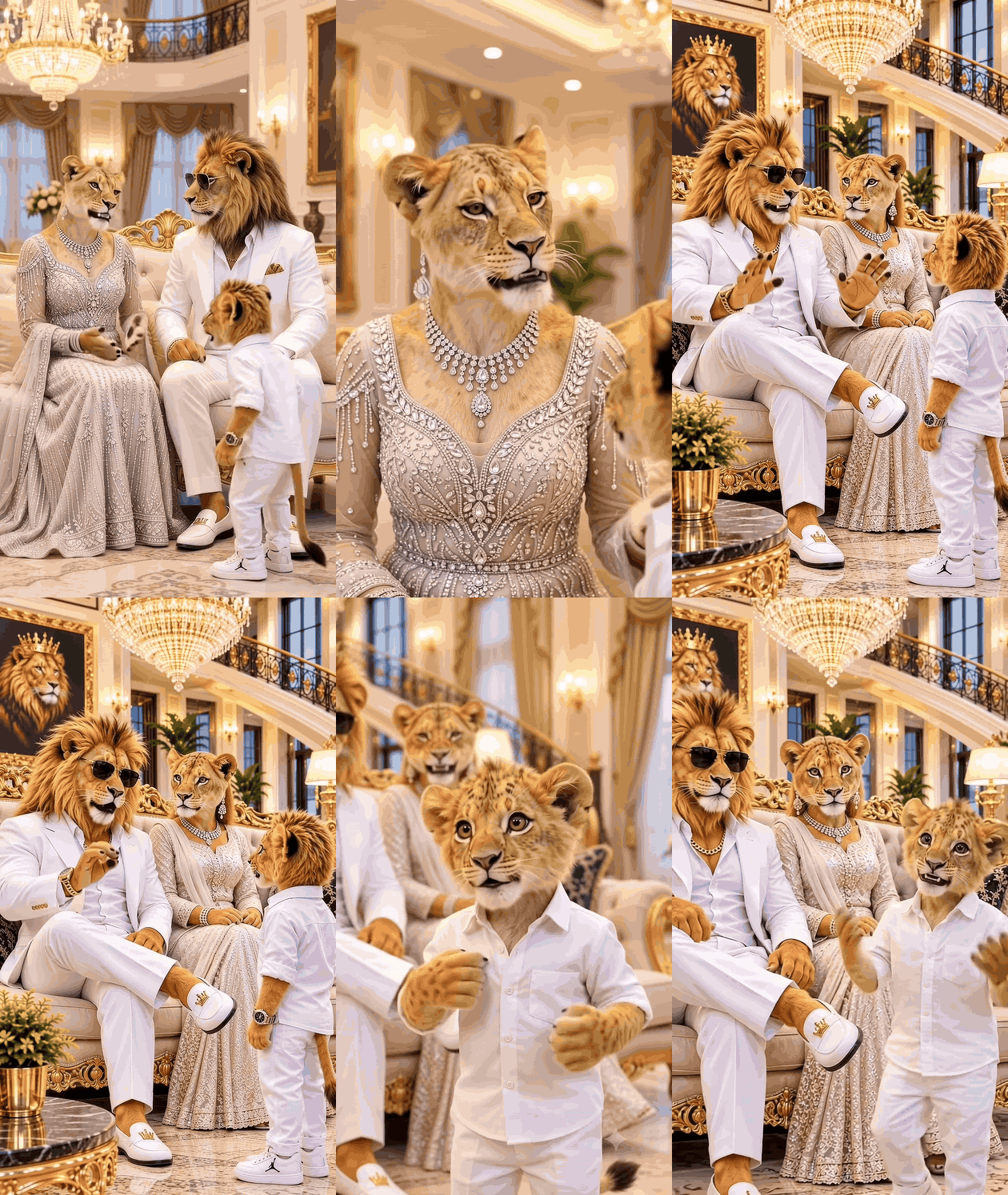
Online video 1: the supplied family Reel, @sheru_mafiaa07, November 6, 2026. This silent GIF shows one continuous 15-second excerpt from approximately 7.4 to 22.4 seconds of the source. The available source download has no audio track; this analysis uses its visuals and source description.
The frames show a golden-maned father in a white suit and sunglasses, a lioness in a silver dress, and a cub in white clothes. They sit and stand together in an ornate mansion, with close-ups cutting between family members. The contrast is already visible: a grand public image surrounds a small domestic exchange. No translation of the cub's exact request is claimed here.
The father's response becomes a useful story variable because viewers already understand the relationship. A later episode can change the request while preserving the family, the home, and the father's recognizable demeanor. The production gains a recurring cast; the viewer gains a familiar emotional situation.
For a new script, specify what the child wants and why the parent hesitates before writing the camera directions. A generic request for something expensive creates a predictable transaction. A request that challenges the father's assumptions creates room for an ending. The original example below uses that distinction without copying this Reel's dialogue or claiming to reproduce its plot.
2. A purchase hook makes wealth into an unanswered question
The November 19 @digitalsheru Reel is captioned “YE SHERU NE KYA KHARID LIYA,” asking what Sheru has bought. Its caption puts the object of the purchase at the center of curiosity. Findra's reported reach belongs to this specific post, rather than to all Sheru accounts or to the family Reel above.
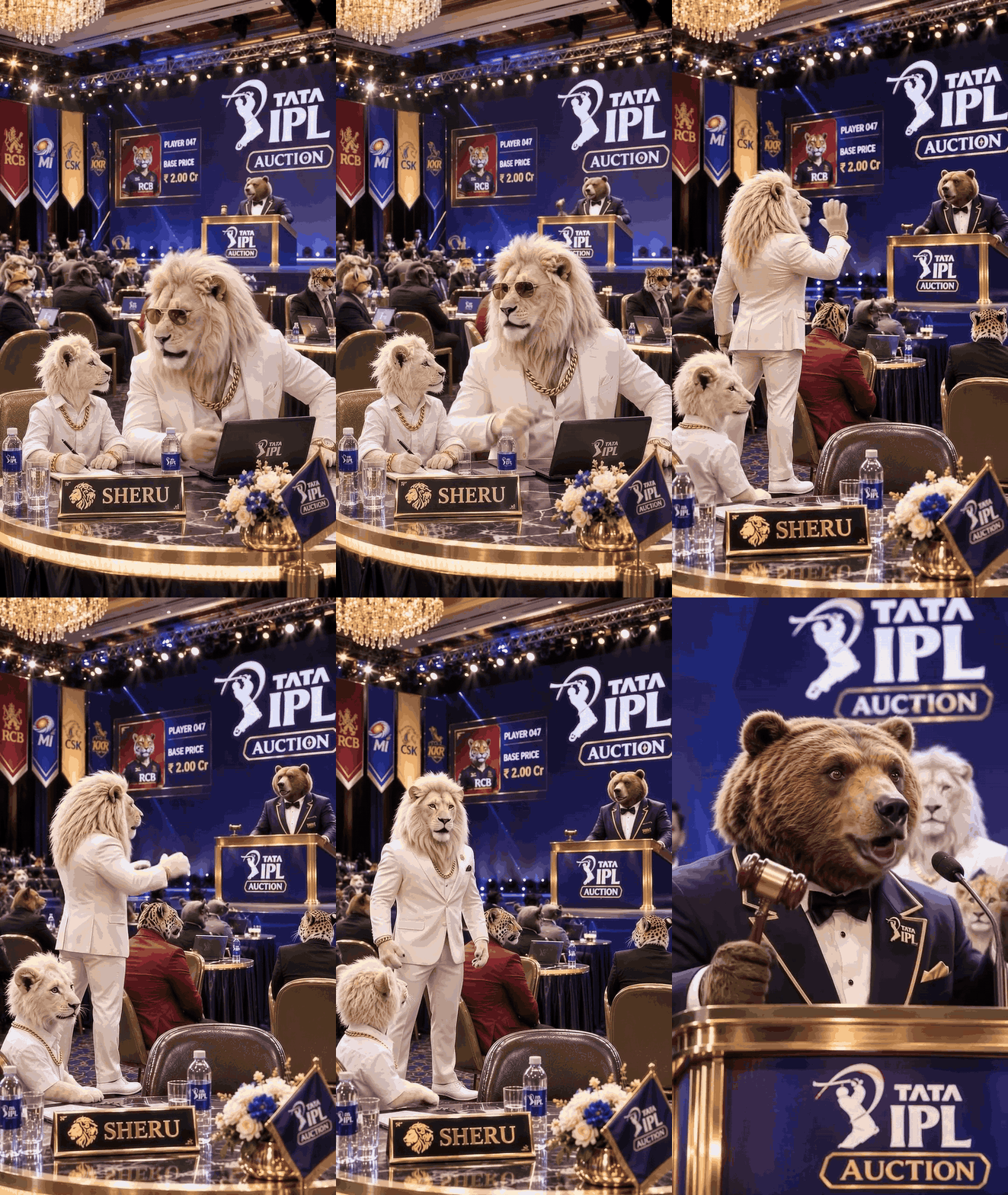
Online video 2: the purchase and auction Reel, @digitalsheru, November 19, 2026. This silent GIF shows a continuous 15-second excerpt from 34.5 to 49.5 seconds, focusing on the auction. The AI-generated scene uses cricket branding as part of its fictional story.
Here the scale extends beyond a room full of expensive furniture. The full source Reel moves from a cricket stadium tunnel to a phone call, then to an auction room where the lion and cub sit behind a named desk. The excerpt above focuses on this auction sequence. A bear appears at the auction podium. The child remains beside the wealthy parent while the setting changes, carrying the family relationship into a public display of purchasing power.
Wealth becomes dramatically useful when it changes the scale of a response. Someone expects an ordinary purchase; the lion treats the situation as an opportunity for an outsized one. The setup needs an understandable baseline, otherwise the escalation has nothing to exceed. Showing a luxurious room alone supplies atmosphere but leaves the dramatic question unresolved.
For a production team, this suggests a practical writing test: describe the expected outcome and the actual outcome in one sentence each. If they are effectively identical, another car or another mansion will not create much surprise. Change the consequence of the purchase, who benefits, or what the buyer misunderstood.
3. “Gangster and Lawyer” gives the character a continuing conflict
Another @digitalsheru Reel, published on November 2, is titled “GANGSTER AND LAWYER | PART 1.” The title explicitly positions it as an installment. Its source description also contains a generation-platform promotion, so it should not be treated as neutral evidence that one specific model produced every Sheru video.
Online video 3: “Gangster and Lawyer,” Part 1, @digitalsheru, November 2, 2026. The original clip retains its visible generation-platform promotional marks.
The sampled sequence includes a mansion conversation, a vehicle journey, and an exchange involving a folder outside a building. A white-maned lion and a red-maned lion recur alongside the golden-maned boss. These repeated faces, a carried document, and changes of location supply visual continuity beyond a single entrance. The folder's exact contents and any legal outcome are not asserted here.
A named relationship between two roles gives a series more room than repeated entrances. A lawyer can introduce rules, information, or obligations that wealth alone does not explain. That is a writing opportunity suggested by the premise, rather than a claim about an unseen later installment.
For your own series, let each short resolve one immediate action and leave one meaningful consequence open. A completed exchange rewards the current viewing session. An unresolved decision gives the next episode a purpose. Adding “Part 2” to a caption cannot compensate for a first installment in which nothing changes.
Why the same AI lion can carry different stories
The recurring lion serves as a shortcut. His silhouette, suit, and accessories communicate a social identity quickly enough for a vertical feed. Returning viewers need less introduction, and first-time viewers can still understand the basic situation. This is an editorial explanation of the format's usefulness; it is not a measured claim about Instagram's recommendation system.
Luxury settings strengthen that shortcut. A marble entrance or large dining room tells viewers what kind of power the character represents. Once that information has been established, the scene needs a competing value: a child's affection, an obligation, embarrassment, loyalty, or a rival's challenge. The contrast gives the surroundings a narrative job.
Family scenes are particularly reusable because roles persist between episodes. A father and son can disagree about attention, a promise, or a gift without rebuilding the whole world. The writer can spend a short running time on the decision itself. Keeping the relationship stable also makes a change in behavior easier for viewers to notice.
The format has a weakness when every answer is a larger number. Repetition makes the character recognizable but can make the ending obvious. A creator can preserve the lion's composure while changing what he learns, whom he helps, or what the apparent problem turns out to be. The audience should recognize the person before predicting every action.
Language adds another layer. A concise spoken line can carry timing and attitude that a silent mansion shot cannot. That makes voice continuity part of character continuity. When comparing episodes, check whether the speaking style, pace, and emotional temperature still belong to the same character, even when the setting changes.
Plan the series before generating the mansion
Start with a small character bible: one approved face and mane, fixed clothing, a height relationship to other characters, and a short description of temperament. Choose your own reference image or one you have permission to use. A reference can guide identity across shots, but it does not guarantee that a generator will preserve every feature.
Then write an episode premise that survives without the visual effects. “A wealthy father offers a gift, but his son asks him to stay” contains an offer, an expectation, and a reversal. Camera movement can make that exchange readable. It cannot supply a missing reason for either character to act.
| Production decision | Keep stable across episodes | Change when the story needs it | Review before accepting a take |
|---|---|---|---|
| Lion identity | Muzzle, mane, eye color, body proportions | Expression and pose | Does he remain recognizable after a cut? |
| Costume and props | Suit, shirt, chain, watch placement | One story-specific object | Do accessories jump or disappear? |
| Relationships | Family roles and relative heights | Request, disagreement, response | Can a new viewer understand who wants what? |
| Location | Layout within the current scene | Location between episodes | Do doors, furniture, and eyelines stay coherent? |
| Sound | Character voice and delivery | Dialogue and scene effects | Is the intended speaker clear? |
| Story payoff | A readable cause and consequence | The reversal itself | Does the ending change the opening situation? |
For readers using Atlas Cloud, the relevant choice is the generation mode. A text-to-video draft can test whether the action reads. A reference-guided workflow becomes useful when the same lion must return across scenes. Select the mode around that need rather than adding more adjectives to a drifting character description.
ByteDance Seedance 2.5 Reference-to-Video documents reference-guided video generation. Check the live controls for the inputs your selected mode accepts. The author-generated example below illustrates the gift-to-hug script. It does not establish which models the original Instagram creators used.
If you want to test the script without a reference first, the ByteDance Seedance 2.5 Text-to-Video lists vertical output, adjustable duration, and generated audio. Use 15 seconds and select 9:16 for a vertical Reel or 16:9 for a landscape version like the delivered example below. Evaluate the resulting action and dialogue before committing to a series.
An original episode: the gift money cannot choose
Our original short is called “The Bigger Gift.” Inside a mansion, a lion father offers his son a toy car. The planned reversal is simple: the cub responds to the toy offer, then the father realizes that the meaningful gift is a hug. He lowers himself to the child's height and embraces him. The expensive room establishes the father's resources; the child's gesture changes the meaning of the gift.
This is a new script, separate from the three online examples. In the delivered take, the father lowers himself to the cub's height and the red toy car ends on the sofa as they embrace. That visible change makes the emotional payoff readable without another extravagant purchase.
Original video: The Bigger Gift, supplied by the author. Approximately 15 seconds, 1280 x 720, 16:9, with audio. The original prompt below specifies 9:16; this delivered landscape version is displayed at its native aspect ratio.
Same characters, different moments
The comparison below checks the delivered video at four clear moments: the gift offer, the cub's response, the father bending down, and the hug. The father's ivory mane and cream suit and the cub's navy sweater and beige trousers remain recognizable across the cuts. Their poses change with the story while the clothing and main character features carry the scene forward.
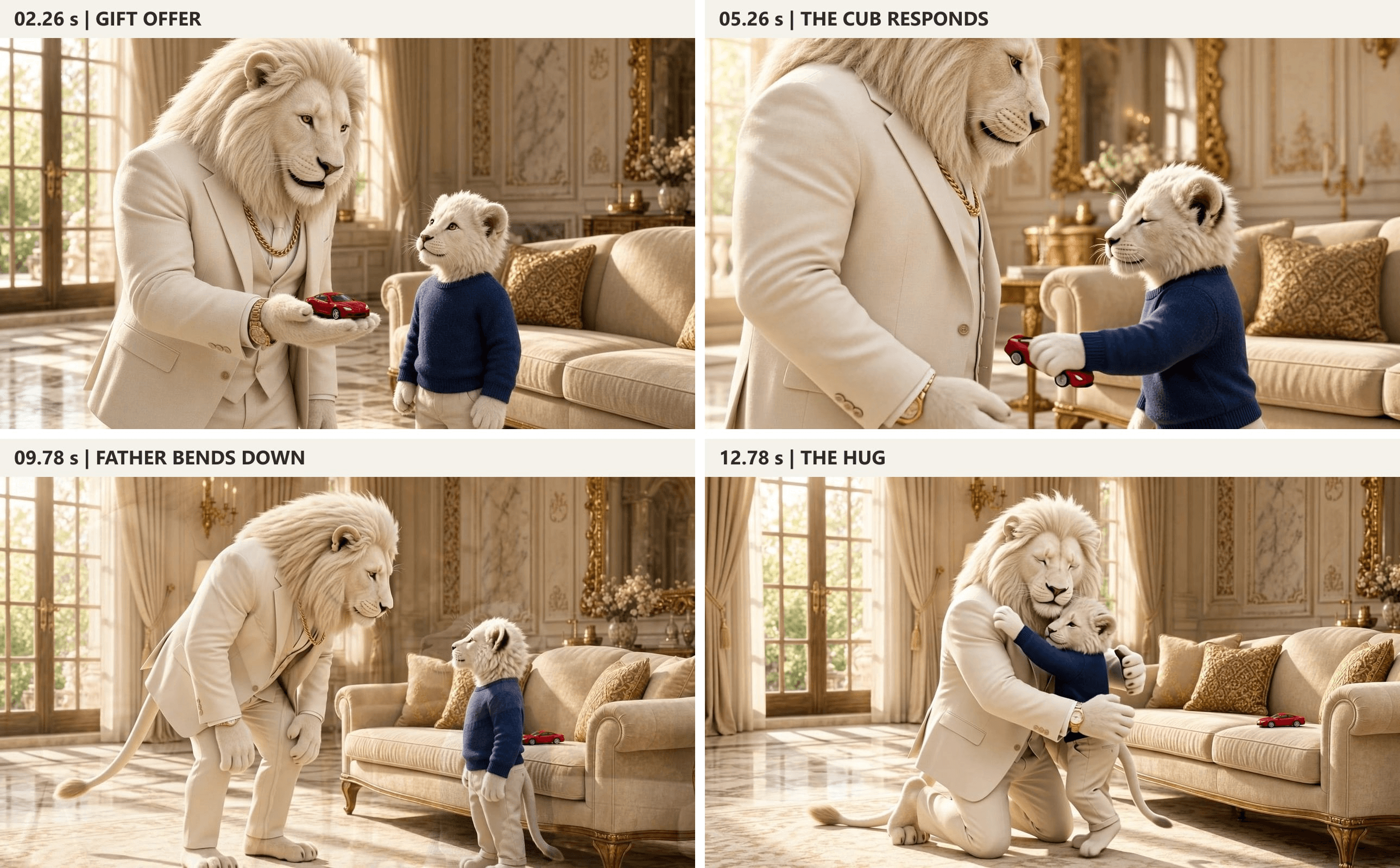
Frames at 02.26, 05.26, 09.78, and 12.78 seconds, extracted from the actual supplied video. Compare the mane, muzzle, suit, sweater, and trousers across the four views. The same main character features and wardrobe remain recognizable across these sampled moments.
Copyable video prompt
plaintext1Create an original 15-second vertical 9:16 cinematic AI animal family short, titled internally "The Bigger Gift". Three shots, one continuous moment. Realistic anthropomorphic animal fiction, warm domestic comedy, not a cartoon. No on-screen titles or subtitles. 2 3CHARACTERS: The father is a tall adult white lion with a broad muzzle, amber eyes and a full ivory mane, wearing an ivory three-piece suit, white shirt, one thick gold chain and a gold watch on his LEFT wrist. He has human-shaped hands covered in short white fur. His young white lion cub son has a short fluffy mane, a navy sweater and beige trousers, and reaches the father's waist. Keep both identities, clothing, body proportions and accessories consistent in every shot. If an approved character reference is attached, use it throughout without changing its face or costume. 4 5SETTING: The same Indian family mansion living room throughout: cream marble floor, a beige sofa on frame right, tall windows on frame left, late-afternoon warm sunlight, restrained gold details. The father and cub remain beside the sofa, father screen left, cub screen right. Only these two characters. 6 7SHOT 1, 0-5 seconds: A medium two-shot at the cub's eye level. The father bends slightly and offers a SMALL RED TOY CAR on his open palm. The cub looks at it, then looks up at his father. The father says warmly in Hindi, "Beta, tumhara gift." Natural cloth movement and a quiet room tone. The toy is clearly small enough to fit in the father's palm. 8 9SHOT 2, 5-10 seconds: Cut to an over-the-father's-shoulder view of the cub. The cub gently presses the father's hand holding the toy downward, then stretches both arms toward his father for a hug. The cub says softly in Hindi, "Papa, mujhe aap chahiye." Hold long enough to read the gesture. No crying and no exaggerated expression. Maintain screen direction and the same furniture positions. 10 11SHOT 3, 10-15 seconds: Cut to a wider side view. The father places the toy car on the sofa beside him, kneels, and the cub steps into his open arms. They share a gentle hug. The father says softly in Hindi, "Main yahin hoon, beta." The camera makes a short lateral arc that reveals the hug and ends in a steady composition. Quiet warm instrumental ending beneath the dialogue; no laugh track. 12 13MOTION AND CONTINUITY: Visible hand actions, the cub lifting his arms, the father kneeling, and a natural embrace. Smooth physical contact, stable lion facial anatomy, consistent scale, readable eyelines and distinct camera angles. Do not replace the action with a slow zoom. Do not make the toy grow, duplicate, float or turn into a real car. No extra characters, extra limbs, changing outfits, logos, captions or graphic violence. Keep each line assigned to its speaker, with clear voices and natural pauses. End on the completed hug.
The Hindi lines mean “Son, your gift,” “Dad, I want you,” and “I am right here, son.” These are the intended lines from the original brief; review the actual delivery and speaker assignment in the rendered video. If a generated take confuses the speakers, simplify the dialogue or add a clean voice track in editing. Review it with a fluent speaker before publishing to a Hindi-speaking audience.
The three shots also provide concrete acceptance criteria. Check the finished action against the brief: the toy should stay small, the cub's response should be readable, and the hug should resolve the exchange. In this take, the cub handles the toy in the middle shot and the car is on the sofa by the wider shot. That is a useful difference to catch when comparing the written prompt with the actual edit.
When a reference-guided model struggles with the full sequence, generate the three five-second shots separately using the same approved character images and join them into one 15-second short. Keep only one finished video in the article. Dialogue is part of this example's point, so retain an audio-enabled video rather than replacing it with a silent animation.
Measure whether you are building a show
For an initial run of episodes, compare results at the same age after publication. Record reach and viewing behavior available in your own account, then add a simple editorial label for the hook: family request, purchase, or continuing conflict. Otherwise an older post can look stronger simply because it had more time to circulate.
Look beyond the largest view total. If viewers stay for the reveal but do not follow, the individual joke may be clearer than the continuing premise. If comments ask about the son or an unresolved decision, they give you a specific question to answer in the next script. Treat comments as qualitative feedback, not proof that the whole audience wants the same episode.
The practical opportunity in the Sheru Bhai AI Lion Billionaire Series is a recurring character whose choices matter. Keep the recognizable lion, give him a relationship or obligation, and make the ending change something. The finished “The Bigger Gift” example shows the next useful test: can a viewer follow the offer, the child's gesture, and the father's changed response within one short? Use that complete exchange as the starting point for another episode, then change the decision rather than only the location.
Frequently Asked Questions
Is Sheru Bhai a real billionaire?
Sheru Bhai is a fictional AI-generated lion-headed character. His mansions, purchases, and enormous money claims belong to the stories. They do not establish the income or assets of the people producing the videos.
Are all Sheru Bhai videos part of one official series?
The same name and lion-boss styling appear in different creators' versions. The accounts examined here do not establish a single shared production team or one continuous storyline. Follow the publisher and its episode order when deciding which scenes belong together.
How can I keep an AI lion consistent across episodes?
Use the same approved character reference and repeat the details that define him: muzzle shape, mane, eye color, suit, accessories, and proportions. Compare the first and last frames of each shot before editing them together. A matching costume alone will not hide a changing face or body scale.
What should a 15-second Sheru-style episode include?
Give it one understandable situation, one response, and one visible payoff. In The Bigger Gift, the toy offer establishes the situation, the cub's open arms change the father's understanding, and the hug completes the exchange. Save another conflict for the next episode instead of crowding several plots into the same short.
Should I use a GIF or a video for an AI animal story?
Use a GIF when the example is about visible gestures and the loop remains clear without sound. The family and auction examples here each use one 15-second middle excerpt for that purpose. Keep a video when spoken lines or sound help tell the story, as in the author-generated gift-and-hug scene. Choose the format around what the reader needs to understand.