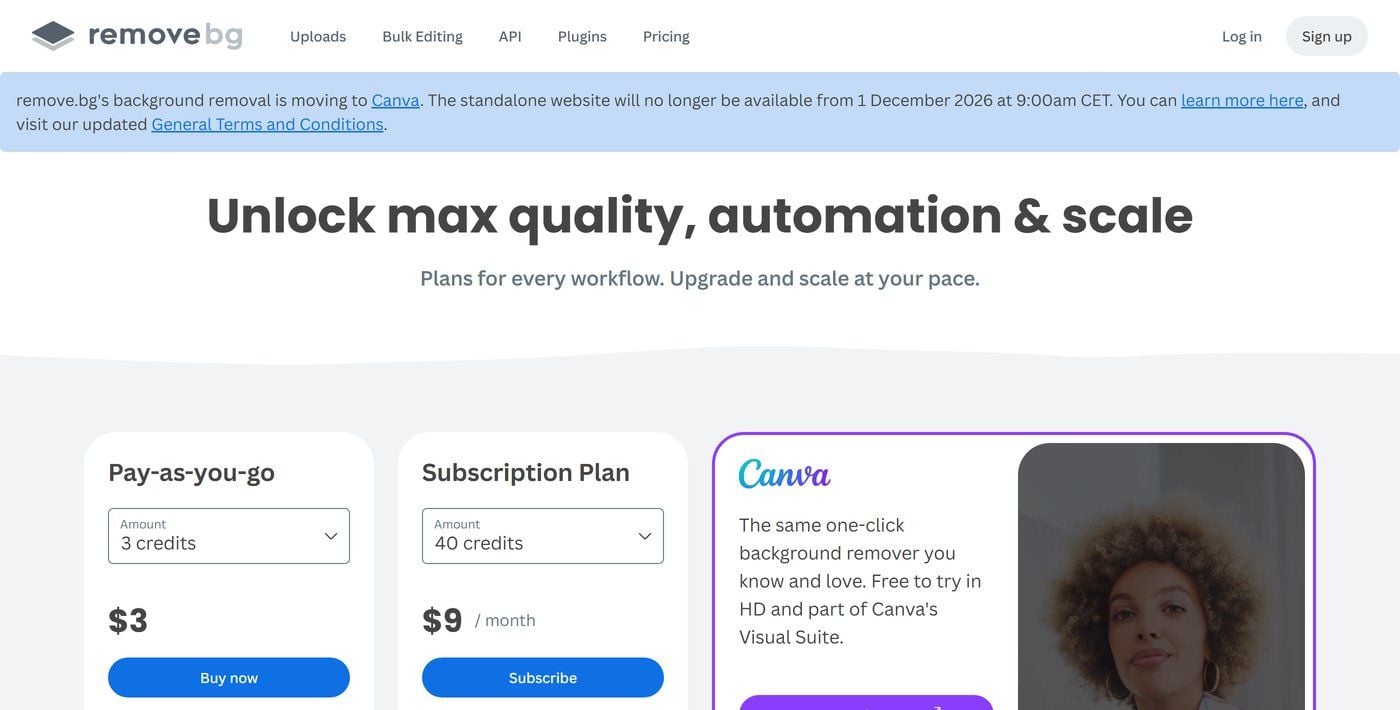
The tool that most roundups treat as the benchmark has a closing date on its own pricing page. remove.bg says its background removal is moving to Canva, and that "the standalone website will no longer be available from 1 December 2026 at 9:00am CET."
The two roundups we read in depth for this piece both still rank remove.bg as a top overall pick, with no mention of any of this. So we rebuilt the list out of published numbers: what each free tier hands you, what the first paid plan costs, and where your photo goes while the cut happens. Ten tools, ranked for people who want the best AI background remover that returns a file they can actually use.
Every price and limit below comes from each company's own pricing or help pages, read on September 16, 2026.
Key Takeaways
- The free AI background remover we rank first needs no account and adds no watermark, and it handed back an 8192 x 4608 cutout at full size.
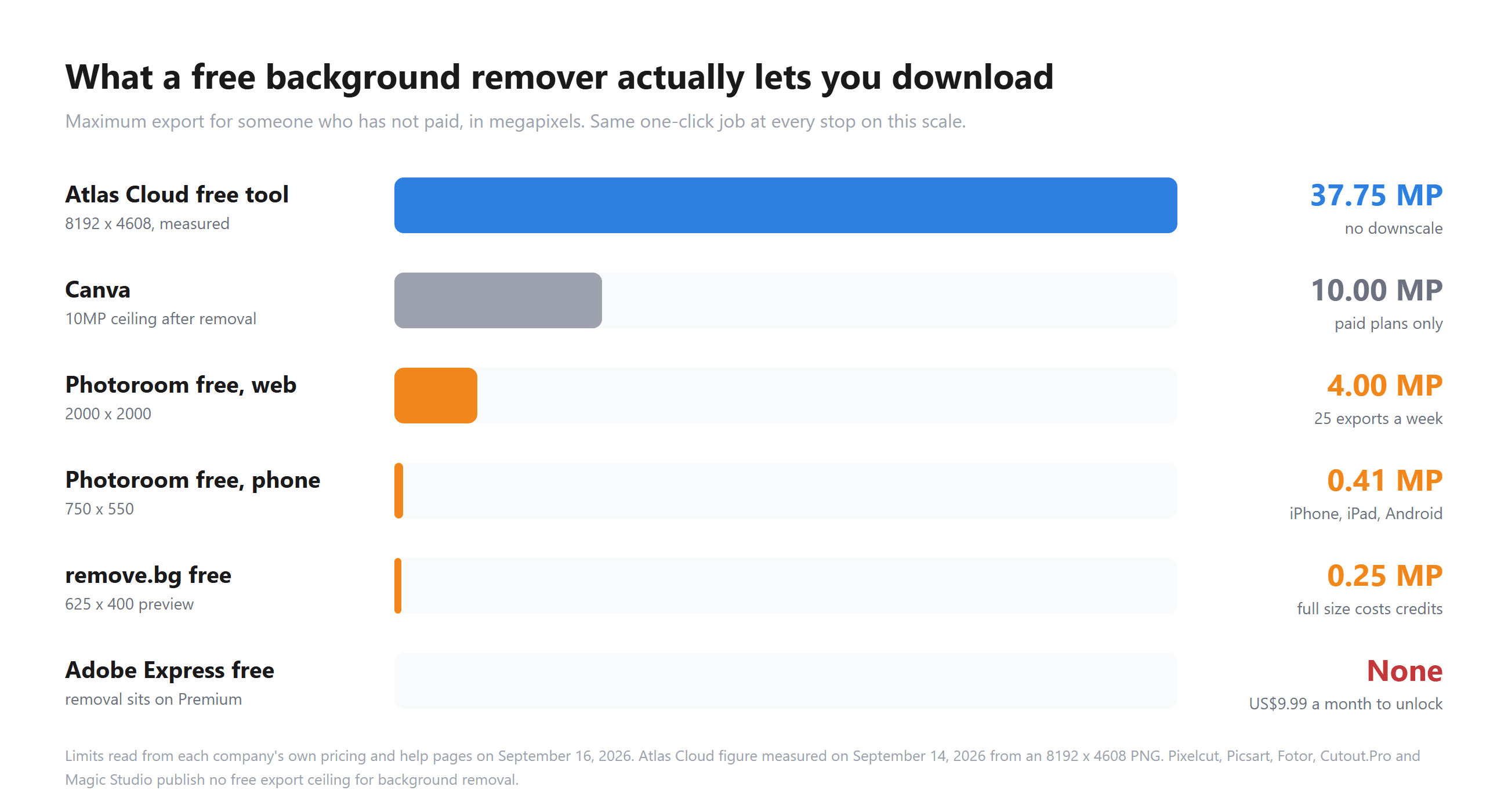
- Free tiers stop you in different places. Some shrink the download (a free remove.bg result is a 0.25 megapixel preview, a free Photoroom export on a phone is 750 x 550), and some remove the feature entirely (Canva and Adobe Express keep background removal behind a paid plan).
- remove.bg's standalone site closes on 1 December 2026, and its credits expire the same morning.
- Sheer fabric and glass came back opaque in every test we ran on our own tool. The shape is right, the transparency is gone.
- A hard edge against a saturated wall carries that colour with it. Check the cutout on a coloured layer before you ship it.
Best Free Background Remover Comparison Table
The published ceilings sit far apart. remove.bg stops a free result at 0.25 megapixels, Photoroom's phone apps at 750 x 550, Photoroom's web app at 2000 pixels on the longest side, and Canva downscales anything over 10MP once the background is gone. The tool at the top of this table returned an 8192 x 4608 file, measured.
Entry paid plans run from US$3.99 a month at Fotor to US$12.99 at Photoroom, with Canva Pro sold as US$144 a year. That is roughly a threefold spread for the same one-click job. Nine of these ten run the job on their own servers after you upload the image. One runs it in the browser tab.
| Tool | Best for | Free tier | Entry paid plan | What you can export free | Where your photo goes |
|---|---|---|---|---|---|
| Atlas Cloud | Keeping every pixel of a single image | No account, no watermark, page says Free, No charge | None published for this tool | 8192 x 4608 measured, no downscale | Your browser, page says processed locally |
| remove.bg | Photoshop and desktop users, until December | 100% free up to 0.25 MP on the website | US$9 a month for 40 credits | 0.25 MP preview, 625 x 400 | Their servers, deleted about an hour after upload |
| Photoroom | Marketplace product photos | Free account, 25 exports a week | US$7.50 a month billed yearly | 750 x 550 on phones, 2000 px on web | Their servers |
| Canva | Cutouts that go straight into a design | Background Remover sits on paid plans | Canva Pro US$144 a year | Nothing, the tool is paid | Their servers |
| Adobe Express | Teams already paying Adobe | Free plan, background removal excluded | US$9.99 a month Premium | Nothing, removal is a Premium feature | Their servers |
| Pixelcut | Quick social crops on a phone | Limited background removal, no watermark | US$8 a month billed yearly | Not published, free removals are limited | Their servers |
| Picsart | Editing inside a larger creative app | Limited free trial credits | US$10.50 a month Pro | Not published, free credits are a trial | Their servers |
| Fotor | One-off cutouts from a large file | Page says free with no sign up | US$3.99 a month billed yearly | Basic plan exports are watermarked | Their servers |
| Cutout.Pro | Paying per image instead of monthly | Free previews forever, 5 free credits | US$5 a month for 80 credits | Preview only, 1 credit per full image | Their servers |
| Magic Studio | A no-signup cut, 50 images at a time | Page says free to use, no signup required | Not published on the tool page | No published resolution limit | Their servers |
Where our own tool stops: one image per run, no batch queue, no video, and sheer fabric comes back opaque. Those limits get their own paragraphs below rather than a footnote.
How We Tested Every AI Background Remover on This List
We read the pricing page, the help centre article on limits, and the app store listing for every tool here on September 16, 2026. Where a company publishes a pixel number, that number is in the table. Where it publishes nothing, the table says so instead of guessing.
The tool we rank first is one we run, so it got the opposite treatment: measurement rather than reading. We pushed test files through it in Chrome on Windows on September 10 and September 14, 2026, then opened every output in Python and counted pixels in the alpha channel.
Four criteria decided the ranking:
- What you can export free. The resolution, the watermark, and the count of files you keep without paying.
- Edge quality on hard material. Hair, fur, thin line art, sheer fabric, glass, measured directly on the tool we run and weighed against app store ratings for the rest.
- Price transparency. Whether the cost of one usable cutout can be worked out from published numbers.
- Where the image is processed. Uploaded to a server, or handled in the browser.
The first one carries the most weight. We only ran full edge-quality tests on the tool we operate, so this list ranks the other nine on what they publish rather than on a side-by-side mask comparison. What we could compare directly is the file you are allowed to download, and that is where the published limits sit furthest apart: 0.25 megapixels at one end, 37.75 megapixels measured at the other.
Disclosure: Atlas Cloud publishes this article and runs the tool ranked first. No tool on this list paid for placement, and none of the other nine were contacted. Each is described from its own published pages.
1. Atlas Cloud: Best AI Background Remover Overall
Feed it an 8192 x 4608 product shot, 40.44 MB of PNG, and the file that comes back is 8192 x 4608 at 18.56 MB. Not a preview, not a 2000 pixel version waiting behind a login. That single measurement is why it sits at the top of this list.
Cut yours in the browser-based tool, then keep the PNG.
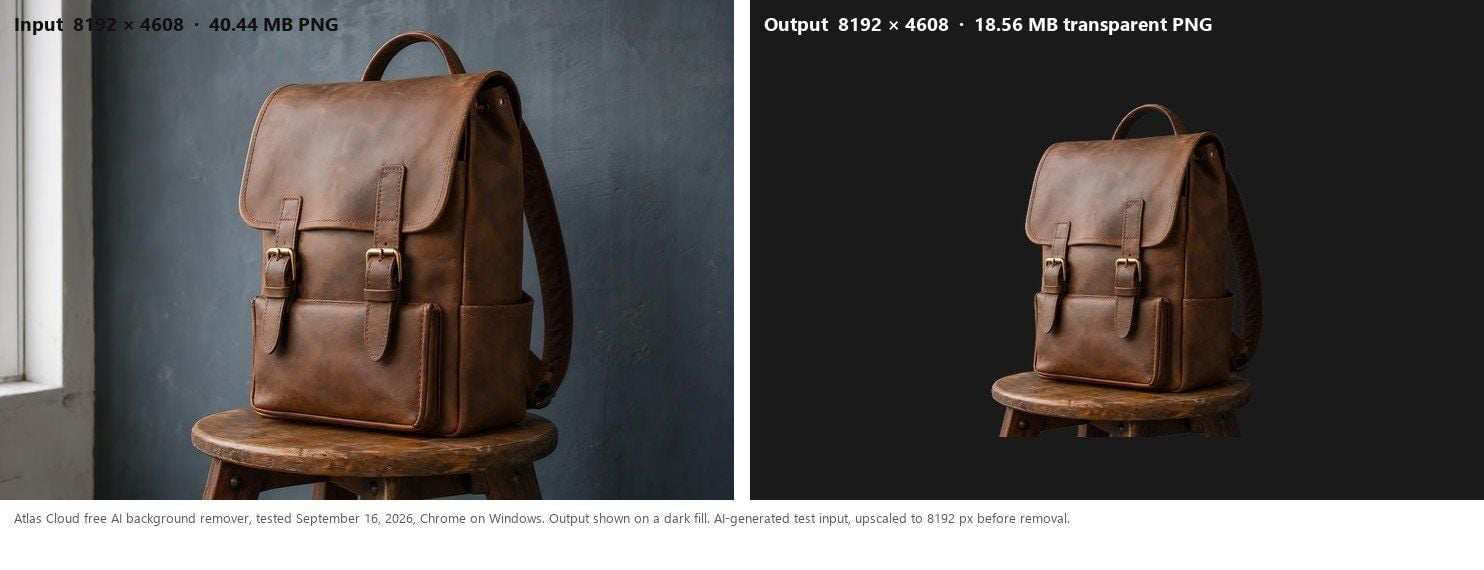
Why it stands out: The engine runs in the browser tab. The page says images are processed locally in browser, and we checked the hard way. With the network off and the VPN tunnel down, a second cutout still completed. Output lands as RGBA PNG, with the format control set to PNG (transparent background).
It also handles material that colour-based tools cannot touch. A white shirt against a white wall came out cleanly, because the model works from what it recognises rather than from pixel similarity. Line art keeps its holes: on a logo test, 98.19% of output pixels were fully transparent, including the negative space inside a ring.
Best for: Anyone cutting a handful of images who wants the pixels they started with. Photographers pulling a product off a table, sellers who need a transparent PNG for a listing, and anyone whose file is too big for a free tier elsewhere.
Pricing: Free with no account and no watermark. The page states Free, No charge, and nothing on it counts your runs.
Where it falls short: One image per run, so a catalogue of 200 is the wrong job for it. There is no video version. Sheer fabric is its clearest failure, and it gets a full section further down.
The same page lists the other free AI tools that run this way, including an upscaler and an object eraser.
2. remove.bg: Best Background Remover for Photoshop and Desktop Users
For years this was the default answer, and the plugin ecosystem is why: a Photoshop extension, desktop apps for Windows, Mac and Linux, and an API that half this category benchmarks against. The footer now reads "a Canva Austria GmbH brand," and the banner at the top of the pricing page explains the rest.
Where the free tier stops you: The help centre is blunt about it. remove.bg is "100% free for low-resolution images (up to 0.25 megapixels) processed on the website and for personal use," plus 50 free previews a month through the desktop app or the API. A preview tops out at 625 x 400. Paid accounts reach 50 megapixels.
What one usable cutout actually costs: Three credits cost US$3, so a single full-resolution file is US$1. The 40 credit subscription at US$9 a month brings that to about 23 cents an image if you spend the whole allowance.
What users report: 3.5 stars from 56.7K reviews on Google Play, the lowest average of any app here.
Where it falls short for background removal: The closing date. Credits expire on 1 December 2026 at 9:00am CET, the same moment the site stops serving, which makes a fresh annual commitment hard to justify.
Fits: Photoshop users who want a plugin and are happy to follow the tool into Canva. Not for you if : you are buying credits to spend slowly, or you need a free result bigger than a thumbnail.
3. Photoroom: Best AI Background Remover for Product Photos
Photoroom built its app around marketplace listings, and it shows in the extras: shadows, batch mode, a Shopify integration higher up the plans. It also publishes more detail about its own limits than anyone else here, which is unusual and worth crediting.
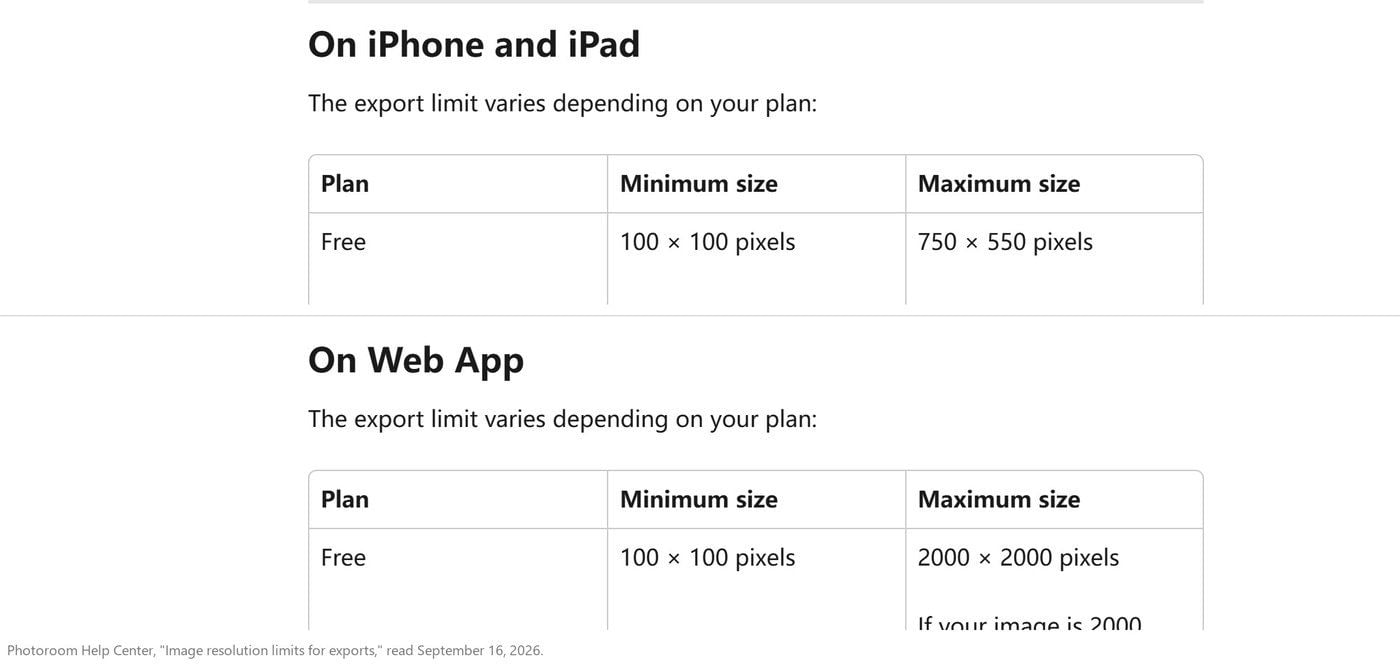
Where the free tier stops you: Three ceilings at once. Free exports max out at 750 x 550 on iPhone, iPad and Android, and at 2000 x 2000 in the web app, where the help centre spells out that "the largest side will be 2000 pixels." A free account gets 25 exports a week and 100 a month. The licence is personal, and Photoroom's help centre states that you cannot use a free account for commercial purposes.
What one usable cutout actually costs: Pro is US$7.50 a month billed yearly, listed against US$12.99 monthly, and it carries 1,000 exports. Spread across a full month of listings that lands under a cent an image, the cheapest per-file rate here for anyone working at volume.
What users report: 4.7 stars from 4.01M reviews on Google Play, the largest review base of any dedicated cutout app on this list.
Where it falls short for background removal: The commercial licence clause is the sting. A tool whose front page is built around selling excludes sellers from its free tier.
Fits: Someone with a catalogue, a subscription, and a need for shadows and batches. Not for you if : you want one full-size cutout today without an account. We ran the same 8192 pixel file through both in our Photoroom background remover comparison.
4. Canva: Best Background Remover Inside a Design Tool
Canva's cutout is a button inside the editor, which is the whole point of it. Remove a background and the subject is already sitting on the poster you were building. From December it inherits remove.bg's users as well.
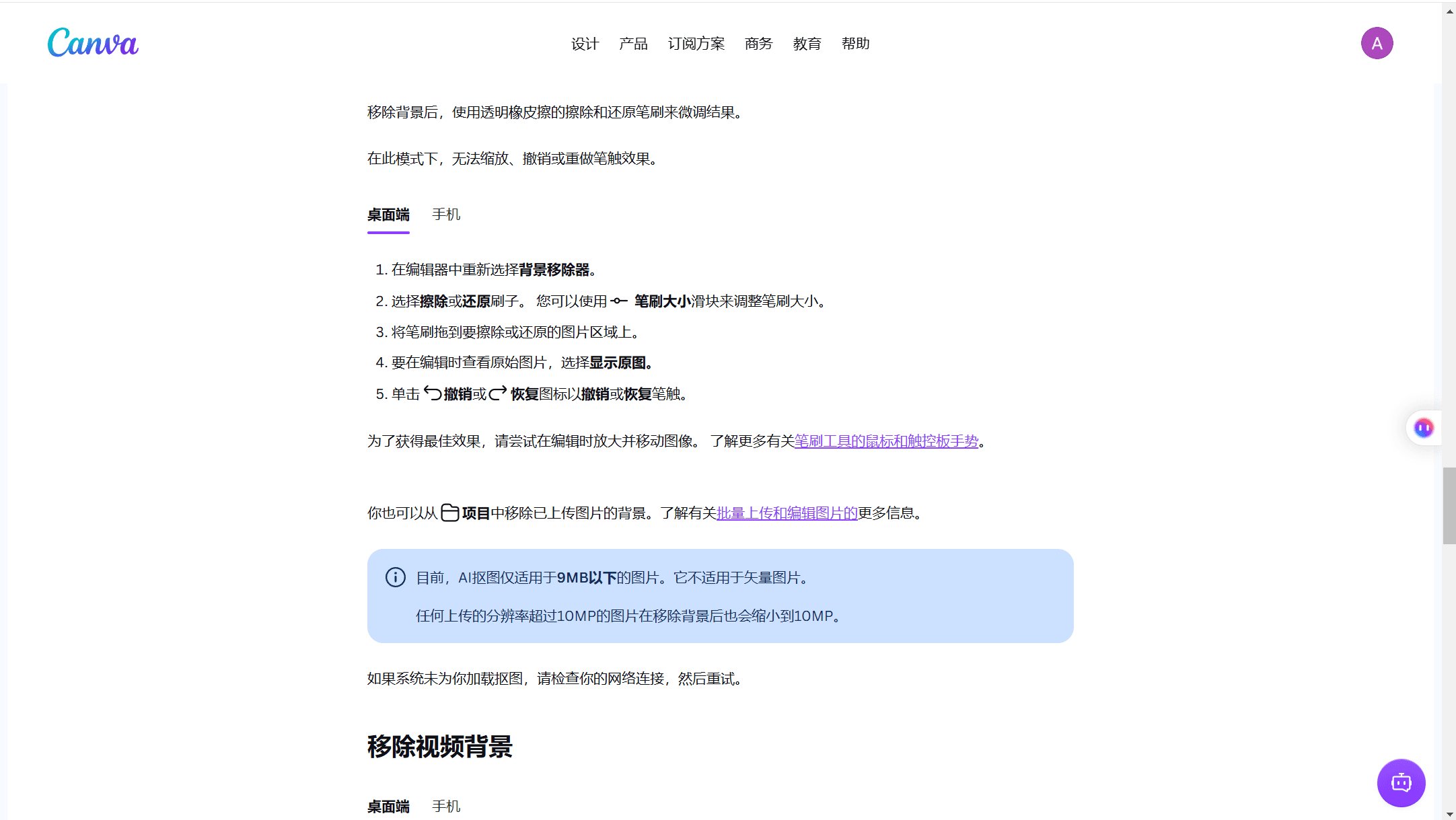
Where the free tier stops you: There is no free tier for this tool. Canva's Help Center says "Background Remover is included with paid plans," that it "only works for photos under 9MB in size," and that a larger image is "downscaled to 10MP after removing its background." We read those three lines on September 10, 2026.
What one usable cutout actually costs: Canva Pro is US$144 a year for one person, which prices a single cutout at whatever the other several hundred features are worth to you. Nobody buys Canva for this button alone.
What users report: 4.8 stars from 27M reviews on Google Play, the highest score in this comparison and by far the largest sample.
Where it falls short for background removal: The 9MB limit lands hardest on the files people most want to cut, which are camera originals. Our own 18.64 MB and 33.58 MB test files would both bounce off it.
Fits: Anyone already designing in Canva on a paid plan. Not for you if: the cutout is the whole task, or your source file came off a camera. Our Canva background remover alternative piece runs one file through both routes.
5. Adobe Express: Best AI Background Remover for Adobe Subscribers
Express is the quickest route to a cutout for anyone whose company already pays Adobe, and the result drops into Photoshop or InDesign without a detour. Adobe also markets its generative features as commercially safe, which matters more to a brand team than a pixel count does.
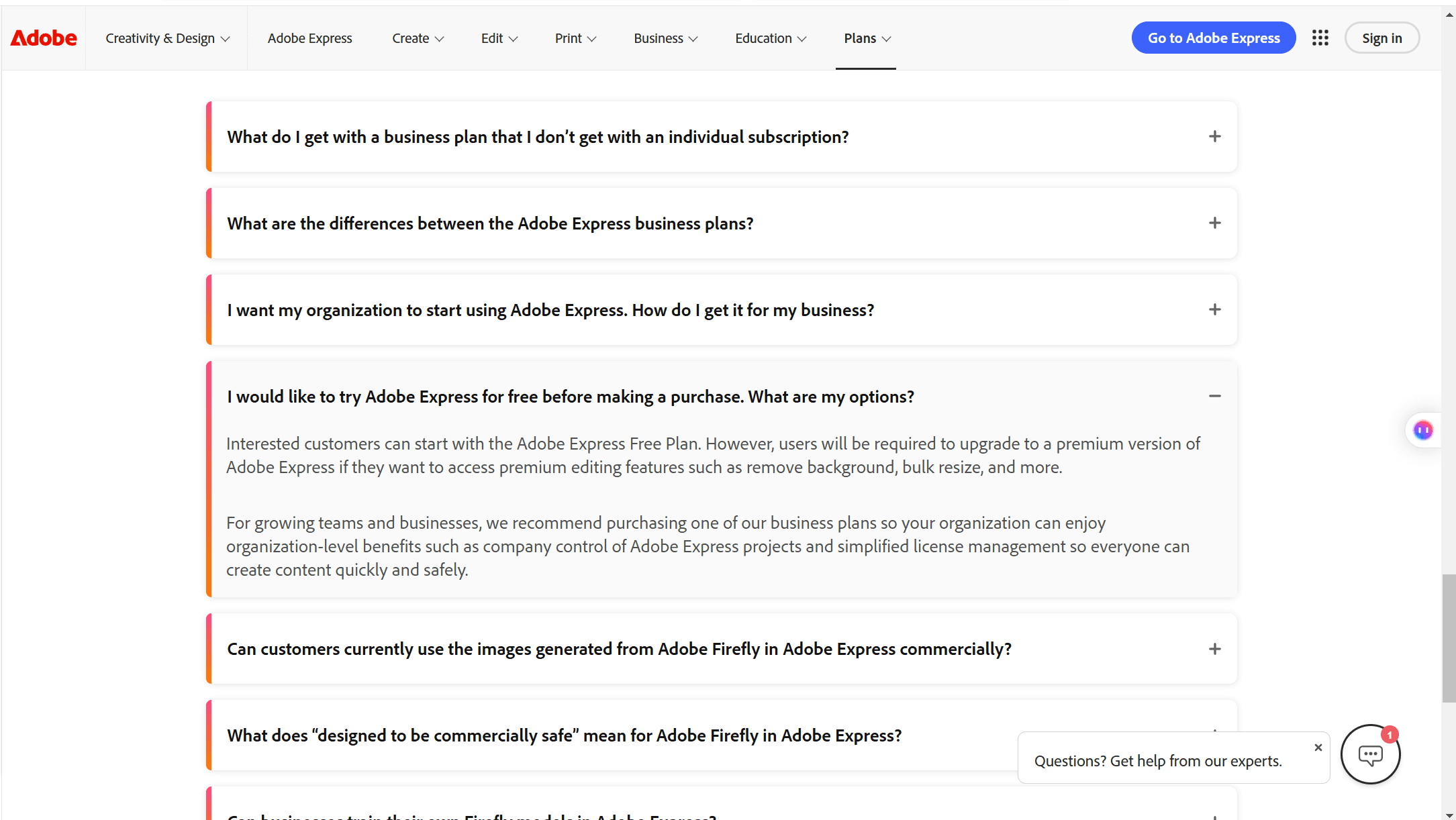
Where the free tier stops you: The free plan exists and the cutout is not in it. Adobe's own pricing FAQ says users "will be required to upgrade to a premium version of Adobe Express if they want to access premium editing features such as remove background, bulk resize, and more." Adobe's separate Firefly tool offers a free route to background removal, but it starts with an Adobe ID and a daily generation count instead of a subscription.
What one usable cutout actually costs: US$9.99 a month for Premium, which also carries 250 generative credits a month.
What users report: 4.6 stars from 851K reviews on Google Play.
Where it falls short for background removal: Three different Adobe products answer to the same search, each with its own gate, and the photo quick action path stops at 4k x 4k on import. We untangled which is which in the Adobe Express remove background comparison.
Fits: Brand teams inside an Adobe contract. Not for you if : you want to cut one image without signing in.
The Other Five AI Background Removers Worth Knowing
These five all work. Each sits below the line for its own reason: a ceiling the company has not published, a metered credit system, or in Fotor's case, two pages on the same site that disagree with each other.
| Tool | Free tier in its own words | The number that matters |
|---|---|---|
| Pixelcut | Limited background removal, free export without watermark | Pro at US$8 a month billed yearly |
| Picsart | Limited free trial credits | Pro at US$10.50 a month |
| Fotor | Free to use with no sign up needed | Basic plan lists watermarked exports |
| Cutout.Pro | Free previews forever, 5 free credits | 1 credit per full-resolution image |
| Magic Studio | Free to use. No signup required | 50 images per batch |
6. Pixelcut
Built for phone-first sellers, with the cutout feeding straight into product templates. The free plan promises an export without a watermark, but the word attached to free background removal itself is "limited" with no number behind it. Pro costs US$10 a month, or US$8 billed yearly. Worth a look if the work ends on a phone screen anyway.
7. Picsart
The cutout is one tool inside a very large creative app, and that app carries 4.0 stars from 12.1M Google Play reviews. Free access runs on trial credits, which the pricing page describes as limited until a plan starts. Pro is US$10.50 a month. Reasonable when you also want the collage, text and video tools around it, hard to justify for cutouts alone.
8. Fotor
Fotor's background remover page makes the loudest free claim in this comparison: "Yes, Fotor image background remover is free to use with no sign up needed," on files up to 60 MB and 8192 x 8192 pixels, in batches of 50. Its pricing page describes the same free Basic plan differently, listing "Watermarked JPG, PNG & PDF Exports" while the paid tiers get watermark-free output. Both pages were live on the same site when we read them. Fotor Pro is US$3.99 a month billed yearly, the cheapest subscription here.
9. Cutout.Pro
The pricing model is refreshingly literal. One image is one credit for background removal, a free account gets 5 credits plus "free previews forever," and full-resolution files need credits. Subscriptions start at US$5 a month for 80 credits, and pay-as-you-go starts at US$4.99 for 30 credits that do not expire. That last option suits someone who cuts a dozen images a year better than any subscription on this list.
10. Magic Studio
The free claim here is unusually clean: "Free to use. No signup required!" and "There is no resolution limited on the uploaded image," both on the tool page. It edits 50 images at once and offers an AI-assisted refinement step where you click points to keep. What it does not publish is any price or export ceiling for the background remover, so the shape of the paid boundary stays a mystery until you meet it.
Will Your Cutout Hold Up on a Coloured Background?
The two roundups we read for this piece rank edge accuracy and stop there. The test that decides whether a cutout is usable happens later, when you drop it onto a background that is not the one it was photographed against.
We measured what comes back on the tool we run. In the worst pairing, a white shirt in front of a deep red wall, the semi-transparent edge band came out 69.08% red-biased: those pixels averaged RGB (122, 79, 77) against a subject averaging (201, 193, 192). Put that cutout on a pale background and the rim reads as a dirty outline. The rest of the test set stayed clean, including a golden retriever on grass at 0.09% green bias.
This is not a flaw in one model. It is what an edge pixel is. PhotoshopCAFE, which has been teaching masking to photographers for two decades, opens its fringe tutorial with the same complaint: "After you cut out or mask an image in Photoshop, it's common to have black or white fringes or just jaggy around the edges." The halo on a cutout edge is old background colour trapped in pixels that were always a blend of two things.
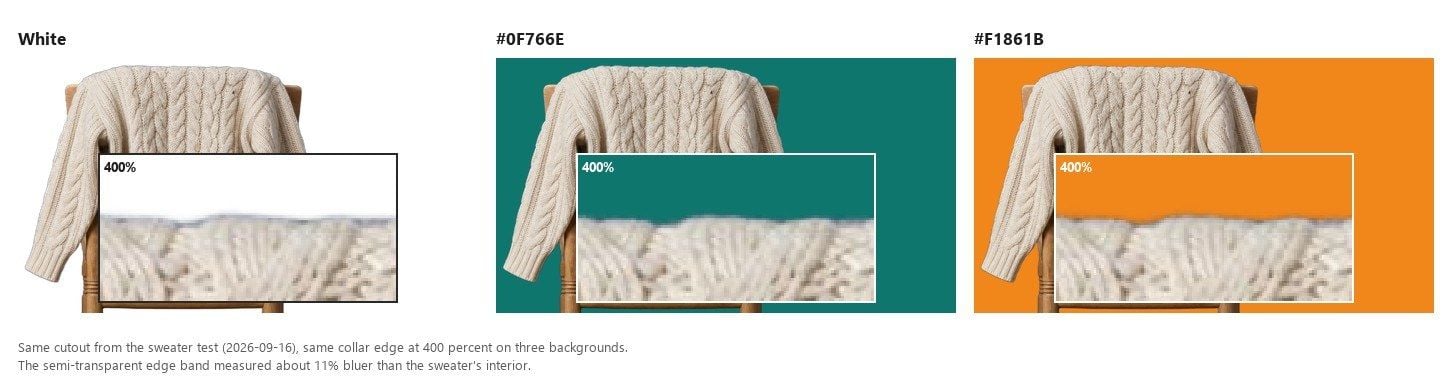
A milder pairing shows the same thing at a smaller scale. A cream sweater shot against a cobalt-blue wall came back with its collar edge measuring about 11% bluer than the sweater's own interior, faint enough to miss at normal size but visible at 400% on any of the three backgrounds above.
Transparency is the second thing nobody tests. A sheer veil came back with the shape perfect and the see-through gone. Only 0.73% of its pixels were genuinely semi-transparent, and the fabric itself sat at alpha 254, which is opaque. A glass bottle behaved the same way, with the liquid area 100% opaque and the empty neck still carrying the grey of the wall behind it at RGB (181, 171, 161).
One more detail neither of those roundups mentions. Across every file we measured on our own tool, the subject sits at alpha 254 rather than 255, so it is 99.6% opaque rather than fully opaque. Invisible at normal size, consistent enough to say something about how the mask gets built. If you want the mechanics, we wrote up what an alpha channel is format by format.
What to do instead:
- Pick a source where the background is not a saturated flat colour. Mid-grey and off-white leave almost nothing behind.
- Open the cutout on the colour it will actually sit on before you approve it, rather than on the checkerboard.
- If a rim shows, pull the mask in by one pixel. That removes the blended band and costs nothing visible.
- Treat veils, lace, glass and smoke as manual jobs. No tool here returns their transparency.
What Does Reddit Say About the Best Background Remover?
A thread in r/canva titled "Am I the only one mad that remove.bg is being shut down?" is the community reacting to the same closure this article opened with. One reply called the merge into Canva "going to be a pain to switch," and another said the fold-in means "it's just going to be another thing behind a paywall," pointing out that Canva's own cutout tool is "currently locked to pro only" inside a design. A third summed up what people actually valued: a free tool with "no daily limit of images," which is the thing a subscription tier structurally cannot offer.
The same thread turned into an impromptu alternatives list, and the recommendations line up with what we found reading pricing pages. One commenter pointed to Photoroom, calling it "higher quality and free too." Another pushed Adobe Express, claiming it "lets you download the result at full res for free." That second claim does not match what Adobe's own pricing FAQ says about Premium being required for background removal, and it is a useful reminder on its own: word of mouth on a free tool's limits drifts out of date fast, and the only way to know what you will get today is to read the company's current page or run the file yourself.
| What the thread worried about | What this article found |
|---|---|
| Losing a free tool with no daily image limit | Free tiers on this list either meter downloads (remove.bg, Photoroom) or gate the whole feature behind a paid plan (Canva, Adobe Express) |
| The Canva merge becoming "another thing behind a paywall" | Canva's own Background Remover already sits on paid plans only, with no free access at all |
| Word of mouth that Adobe Express exports full res for free | Adobe's pricing FAQ ties background removal to the Premium plan, not the free one |
Frequently Asked Questions
Which AI Background Remover Works With No Sign Up?
Three tools here publish that claim. Atlas Cloud's tool runs without an account and states that images are processed locally in the browser. Magic Studio's page says "Free to use. No signup required!" Fotor's background remover page says it is "free to use with no sign up needed," although its pricing page lists the free Basic plan's exports as watermarked. Everything else on this list starts with an account, and Adobe Express starts with an Adobe ID.
Is There a Background Remover With No Watermark on the Free Tier?
Yes, and the honest way to check is to download a file rather than trust a badge. Pixelcut advertises free export without a watermark. Atlas Cloud's output carried none in our tests, at every size we tried. A free remove.bg file is clean but tiny at 0.25 megapixels, which is a different kind of limit. Fotor is the one to watch, since its own two pages disagree about the answer.
What Is the Best Free Background Remover for High Resolution Downloads?
By published and measured numbers, the free tool we tested returned the largest file: 8192 x 4608, or 37.75 megapixels, with no downscale. A free remove.bg result is 0.25 megapixels. A free Photoroom export is 750 x 550 on a phone. Canva's tool is not free at all. If you need one big cutout rather than a hundred small ones, that gap decides it.
Can an AI Background Remover Handle Hair, Fur, and Glass?
Hair and fur, yes, on the tool we tested. Fine strands and a fluffy tail survived, and a white shirt against a white wall came out clean, which colour-threshold tools cannot manage. Glass and sheer fabric, no. Every cutout we ran through it came back opaque, with the original background colour baked into the pixels. Shape is preserved, transparency is not.
Conclusion
The category has quietly split in two. On one side sit the subscription editors, where the cutout is a feature inside a design app and the free version exists to show you the paywall. On the other sit the single-purpose tools, where the only questions are how many pixels you keep and how much of your photo leaves your machine.
Pick by the file you need. If you build listings all day and want shadows and batches, Photoroom's economics win. If you already pay Canva or Adobe, the button is right there in the editor. If you want one full-size transparent PNG this afternoon with no account, no watermark and no upload, the best AI background remover for that job is the one that hands the whole file back and then gets out of the way.





