
Hit the wall with Hailuo AI free credits? That one-time 200-credit allotment vanishes after just three days, leaving high-volume creators, developers, and agencies stuck with web queue bottlenecks, watermarks, and no hailuo ai credit reset in sight.
Transitioning to API Unit Economics
For agencies and developers, locking into a standard monthly subscription often means paying for unused capacity. Adopting a pay as you go video api lowers your baseline ai video generation cost by calculating expenses strictly on a per-second generation basis.
| Feature | Web Free Tier | MiniMax Video API |
| Credit Allocation | 200 credits (3-day expiration) | Flexible pay-as-you-go balance |
| Output Quality | Watermarked web exports | Zero-watermark exports |
| Execution Speed | Single queue processing | Parallel generation threads |
Connecting directly to the minimax ai video api provides immediate scaling, clean outputs, and predictable developer workflows.
Decoding Hailuo AI Free Credits: Limits, Expiration, and Queue Bottlenecks
Logging into your workspace only to discover your remaining balance vanished overnight is one of the most frequent friction points for new creators. Users constantly ask, "Why did my Hailuo free credits disappear?" or "Does Hailuo offer recurring daily free credits?" The core reason comes down to strict hailuo ai free credit rules.
Unlike platforms that replenish tokens every 24 hours, the web trial grants a strict allotment of hailuo 200 free credits 3 days after account registration. Once that 72-hour clock expires, unused balance vanishes automatically with no option for a trial extension. For a full comparison of every paid tier once those free credits run out, see our Hailuo AI pricing and cost guide.
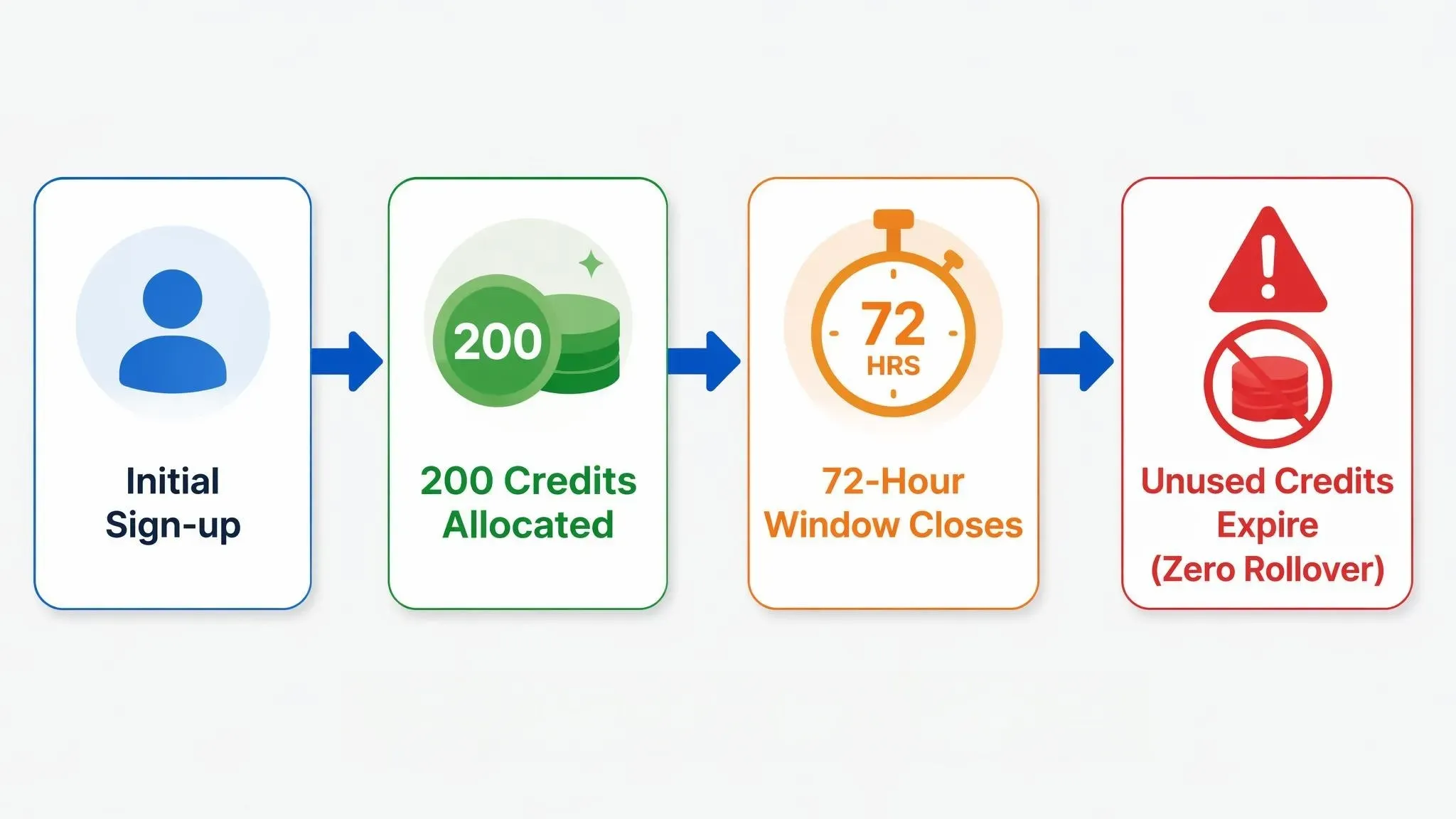
Free Tier Web Limitations vs. Commercial Demands
While 200 credits let you test basic prompt responses, the output parameters remain heavily throttled to protect web server capacity. Creators running commercial campaigns quickly hit hard walls when attempting to generate client-ready assets.
- Mandatory Branding Overlay: Free web exports contain embedded watermarks. True hailuo ai watermark removal is strictly reserved for paid tiers and direct API integrations.
- Resolution Caps: Web trial generations are locked at lower standard definitions such as 720p/722p, preventing high-bitrate video delivery.
- Single-Thread Bottlenecks: Free accounts share a heavily throttled rendering pool. Users face strict hailuo rendering queue limits, causing single generations to stall during peak hours.
| Parameter | Free Web Trial | Commercial Production Need |
| Credit Lifecycle | Free trial expiration in 72 hours | Permanent balance or pay-as-you-go |
| Queue Concurrency | Single thread (queue delay) | Multi-thread parallel processing |
| Commercial Usage | Watermarked output | Unbranded, clean MP4 output |
Fulfilling Production Requirements via Direct API
Relying on trial mechanisms for ongoing content creation leads to unstable production schedules. To maintain continuous workflows, technical teams must bypass the browser portal entirely. Switching to direct API calls guarantees clean output files, eliminates arbitrary credit expiration dates, and routes requests through dedicated server infrastructure rather than shared web queues.
Web Subscriptions vs. Pay-As-You-Go API: Cost Breakdown and Capacity Matrix
Paying a fixed monthly subscription fee without using every allocated credit creates unnecessary operational overhead for studios with fluctuating client demands. On the browser front, Hailuo AI structures web access into distinct subscription tiers: Standard, Pro, and Master.
| Plan | Monthly Price | Credits | Parallel Tasks | Unused Credits |
| Standard | $7.99 | ~1,000 | 1 | Expire at month end |
| Pro | $27.99 | ~4,500 | 2 | Expire at month end |
| Master | $63.99 | ~10,500 | 2 | Expire at month end |
When comparing the hailuo ai standard vs pro plan, higher subscription levels offer larger credit pools and queue acceleration. However, web-based subscription models force creators to absorb the cost of idle credits if production pauses before the billing cycle resets.
For minimax hailuo 2.3 fast api and the standard Hailuo-2.3 model the rates are:
| Model | Resolution & Length | Price |
| Hailuo-2.3-Fast | 768P, 6s | $0.19 |
| Hailuo-2.3-Fast | 768P, 10s | $0.32 |
| Hailuo-2.3-Fast | 1080P, 6s | $0.33 |
| Hailuo-2.3 | 768P, 6s | $0.28 |
| Hailuo-2.3 | 1080P, 6s | $0.49 |
You pay only for completed videos. No monthly floor, no expired balance. Parallel capacity scales with your account and rate limits rather than a hard plan ceiling of one or two concurrent jobs.
Hailuo AI pricing comparison at a glance
Evaluating a direct hailuo ai pricing comparison reveals significant operational differences in how rendering tasks execute.
| Metric | Web Subscription | Pay-As-You-Go API |
| Cost structure | Fixed monthly | Strictly per render |
| Cost per video second | Varies with plan utilization | Fixed and transparent |
| Parallel processing | 1–2 tasks | Higher concurrency available |
| Unused credit expiration | Yes, monthly | None |
Financial Advantages of Pay-As-You-Go Integration
Many developers ask: Is Hailuo AI API cheaper than web subscription tiers? For teams with batch-heavy or irregular schedules, the API model offers better value. Web plans operate on a "use-it-or-lose-it" basis, whereas programmatic execution charges strictly for generated output time.
Deploying models such as the minimax hailuo 2.3 fast api allows platforms to process hundreds of simultaneous requests during launch windows without paying recurring retainer fees during slow production months. This approach turns video generation into a controllable variable cost that scales directly with actual application usage.
Why Developers and Agencies Outgrow the Hailuo Web Interface
An agency producer opens twenty browser tabs, pastes the same base prompt with minor variations, then waits for each clip to finish one by one. By the time the last file downloads the deadline has already slipped. That daily grind exposes the hard ceiling of the web interface: every action stays manual, every export stays single-file, and concurrency stays locked to the plan’s UI limits. Our Hailuo AI API automated workflows guide covers exactly how to architect a pipeline once you make this switch.
Web workflows force users to type prompts by hand, click generate, monitor a progress bar, and download each result separately. Free accounts process only one video at a time and can queue just three tasks. Paid plans raise the parallel limit to two. No native batching exists inside the browser. Metadata must be added later in a separate tool. The result is slow, error-prone, and impossible to scale beyond a handful of clips per hour.
What the API removes
Two questions appear the moment volume rises: Can you generate Hailuo videos without watermarks via API? Does Hailuo support concurrent batch generation?
Yes on both counts. The MiniMax video generation endpoint returns clean files with no watermark when called through a valid API key. The same endpoint accepts multiple simultaneous requests, limited only by the account’s rate limits rather than a fixed UI cap of one or two jobs. Developers can fire dozens of tasks in parallel, track them with unique task IDs, and receive status updates through the optional callback_url webhook.
Unlocking Automation through Direct API Infrastructure
Transitioning from browser tabs to programmatic video rendering shifts video creation from manual assembly to scalable software architecture.
- Automated prompt chaining: scripts generate sequential or variant prompts and submit them without human intervention.
- Dynamic metadata injection: titles, project IDs, or client tags travel with each request.
- Webhook polling or callbacks: systems receive “success” or “failed” events the moment a render finishes.
- Direct integration: output files drop straight into a CMS, DAM, or editing pipeline.
Building hailuo ai automated workflows allows software applications to trigger dynamic text-to-video or image-to-video generations directly within custom dashboards. Connecting MiniMax video endpoints directly to external CMS platforms, editing suites, or cloud storage buckets removes human labor from the rendering pipeline completely.
Strategic Action Plan: Transitioning to Programmatic Infrastructure
To scale hailuo ai video production without getting trapped in fixed monthly billing cycles, implement three core adjustments:
- Audit Unit Economics: Evaluate your cost per clip across fixed subscriptions versus pay-per-second API models.
- Implement Multi-Model Routing: Deploy a pay as you go ai video key through an Atlas Cloud unified endpoint to send specific shot types to optimal model backends.
- Protect Wallet Balances: Ensure your infrastructure runs on a no expiration video api balance, preventing unused budget from forfeiting at the end of the month.
| Operational Metric | Web Subscription Strategy | Programmatic API Strategy |
| Credit Lifecycle | 30-day forfeiture (Use-it-or-lose-it) | Permanent balance persistence |
| Execution Speed | Shared sequential queues (1–2 tasks) | Multi-threaded parallel processing |
| Model Scope | Locked to a single provider portal | Dynamic routing across top video backends |
| Output Licensing | Watermarked on free; rigid on UI | Zero-watermark, commercial-ready MP4s |
Claiming a unified API key gives your engineering team full control over rendering volume, output quality, and monthly margin optimization.
How to Migrate from Hailuo Web Limits to Unified Video API in 3 Steps
You just watched another set of credits expire while a client waited for clean exports. The browser interface got you this far. Moving to the API removes the remaining friction in three practical steps.
Step 1: Calculate Your Unit Economics
Count the clips you actually ship each month. Fifty short social pieces cost far less than five hundred client deliverables. Compare the two main model families:
| Volume | Recommended Model | Typical Cost Driver |
| Low or experimental | MiniMax-Hailuo-2.3 | Higher quality per second |
| High or time-sensitive | MiniMax-Hailuo-2.3-Fast | Lower price per second |
Choose the variant that matches your average monthly volume. The pay-as-you-go structure charges only for completed renders, so quiet months stay cheap.
Step 2: Acquire API Credentials and Test Trial Credits
Log into the MiniMax platform and open Account Management > API Keys. Create a standard Open Platform key. No separate vendor contracts or locked web subscription is required. The same key works for both text-to-video and image-to-video. Top up a small balance if needed; the system bills only what you use. This answers the common developer question: how to get API keys for Hailuo AI MiniMax models without a subscription. One pay as you go api key covers the entire unified ai video endpoint.
Step 3: Deploy Automated Payload Requests
Send a POST request to https://api.minimax.io/v1/video_generation. A minimal text-to-video payload looks like this:
plaintext1{ 2 "model": "minimax/hailuo-2.3/t2v-standard", 3 "prompt": "A man picks up a book [Pedestal up], then reads [Static shot].", 4 "duration": 6, 5 "resolution": "1080P" 6}
For an image to video api call add the starting frame:
plaintext1{ 2 "model": "MiniMax-Hailuo-2.3-Fast", 3 "first_frame_image": "https://example.com/start.jpg", 4 "prompt": "The character turns and smiles", 5 "duration": 6, 6 "resolution": "768P" 7}
Optional callback_url lets your system receive status updates automatically. The minimax video api payload accepts the same resolution and duration options available in the web UI, yet returns watermark-free files and supports concurrent calls limited only by your rate limits.
These three steps convert browser testing into production-ready hailuo ai api setup. Once the first successful task_id returns, the migration is complete.
Maximizing Model Flexibility: Multi-Model Switching Beyond Hailuo
A product demo needs crisp physics on a spinning bottle, yet the next shot demands soft emotional lighting on a close-up face. Sticking to one web interface forces a compromise or a second paid subscription. If you have not compared Hailuo against other engines yet, our full Hailuo AI video generator review is a good next stop. That mismatch appears the moment production leaves simple test clips behind.
Hailuo (MiniMax) handles emotional close-ups and dramatic lighting well. Its motion remains stable on human subjects and atmospheric scenes. Other tasks often favor different strengths. Product motion and precise object physics can land cleaner on Seedance 2.5. Stylized or high-motion sequences frequently perform better on Kling 3.0 or PixVerse V5.6. No single model wins every shot.
The cost of separate subscriptions
Buying individual monthly plans for each tool multiplies expense and login friction. Credits sit idle on quiet models while another account runs dry. Teams end up managing five billing cycles instead of one production pipeline.
Single balance, multiple models
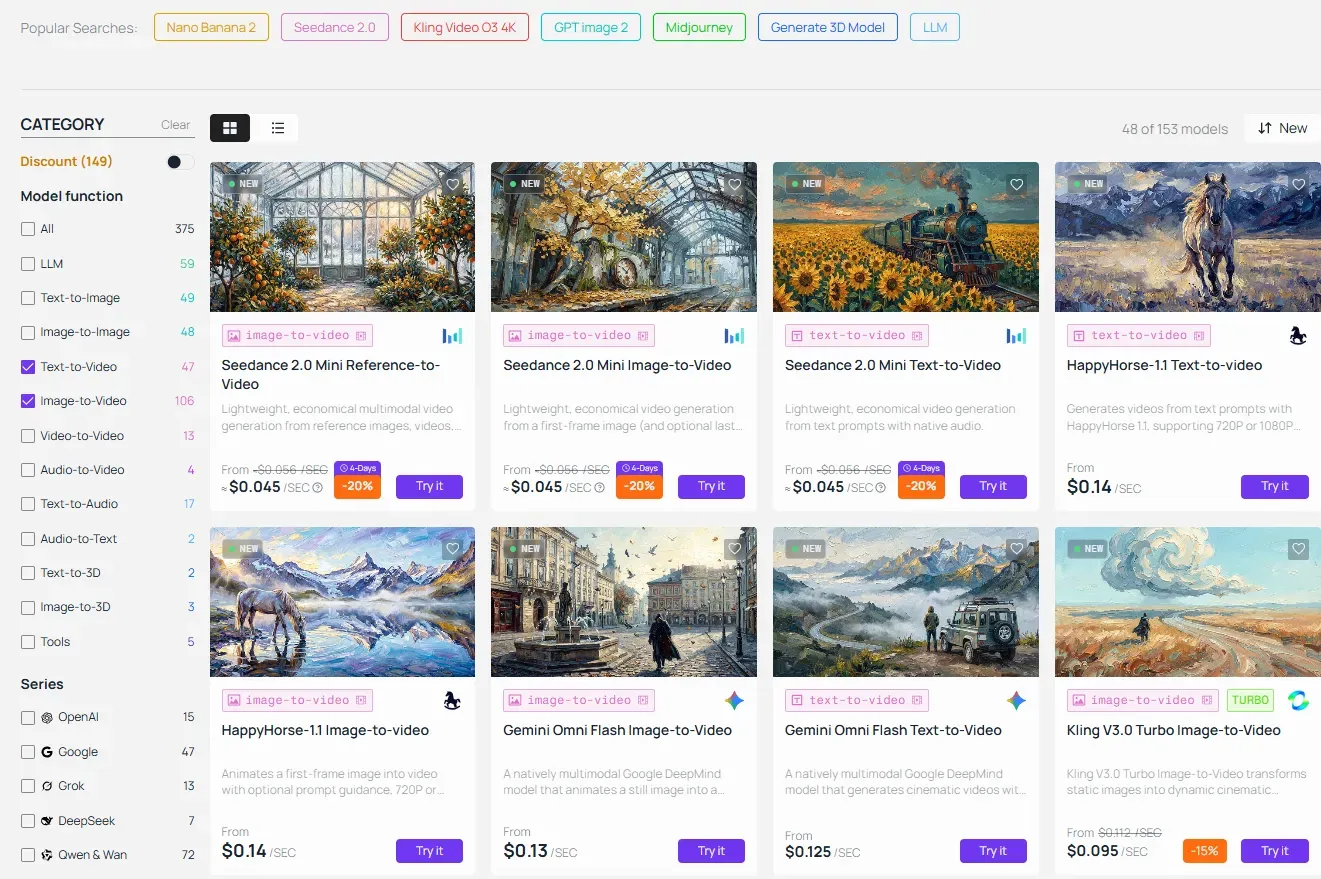
A unified platform such as Atlas Cloud solves the split. Developers keep one flexible ai credit balance and route each request to the model that fits the shot. The same API key and endpoint reach Hailuo, Seedance, Kling, PixVerse and additional video models. Switching happens inside the payload by changing the model name. No new contracts, no extra dashboards.
| Task Type | Stronger Fit | Why It Matters |
| Emotional close-ups | Hailuo 2.3 | Facial detail and lighting |
| Product physics | Seedance 2.5 | Object consistency and motion |
| High-motion sequences | Kling 3.0 | Dynamic camera and physics |
| Stylized or multi-shot | PixVerse V5.6 | Style control and continuity |
This multi model ai video api approach turns model choice into a per-shot decision rather than a monthly commitment. Hailuo vs seedance 2.5 api or kling vs hailuo api cost comparisons become simple lookups inside one billing account. Atlas cloud video api routing keeps the balance flexible and the workflow continuous. Production teams stop paying for unused capacity and start matching the right engine to every frame.
Conclusion
Watching a production line freeze because an online subscription hits its credit limit mid-task highlights the hidden downside of web-based rendering. Free trial credits are great for quick testing, but real commercial workflows need predictable costs, parallel processing, and no watermark limits.
To scale hailuo ai video production, calculate the real cost of every clip you ship today. Replace fixed plans that waste idle credits with a pay as you go ai video key. A no expiration video api lets you pay only for completed renders and keeps the balance available across quiet and peak months.





