

You have one photo of yourself you actually like. Someone else took it, at a friend's wedding, and it has been carrying your whole dating profile for two summers. Every other slot is a mirror selfie you tolerate.
That gap is where AI dating profile pictures earn their keep, and also where they go wrong. This guide covers what the apps themselves say makes a good photo, how to turn that one good photo into a phone-style selfie without touching your face, and what Tinder, Hinge and Bumble will do with the result.
The numbers come from the apps' own surveys and rulebooks, and the demo run is ours. Start with what "good" means to the people swiping.
Key Takeaways
- Tinder's own survey found men with more than one face photo were 71% more likely to match with women; a good dating profile picture starts with a clear, recent face.
- 88% of Hinge daters say they are uncomfortable with AI-generated profile photos, so the safe use of AI is a new angle of your real face, not a new face.
- Thefree AI selfie generatoron Atlas Cloud rebuilds one existing photo as an arm's-length selfie and keeps your face, hair and clothes.
- Tinder Face Check matches a live video selfie against your profile photos, so any AI picture must still be your face.
- Fill at most one or two of six photo slots with AI, and keep at least one untouched photo in the same profile.
What Makes a Good Dating Profile Picture, According to the Apps
The apps have asked their users this question, and the answers are more specific than "smile and use good lighting."
Tinder commissioned Opinium to survey 7,000 singles aged 18 to 25 across seven countries between June 21 and July 2, 2024.
The press release that published the results, dated July 17, 2024, reports that 85% said their profile matters for representing their true self, 52% found it hard to pick a profile image, and 18 to 24 year olds spent an average of 33 minutes choosing one.
The line that matters most for photo strategy is this one: "Men who include more than one face photo in their profiles increase their likelihood of matching with women by 71%." Face, plural. A good dating profile picture is rarely a single picture.
Then there is the AI question itself. Hinge's AI dating guide, published March 5, 2026, tells daters to "skip the AI-generated profile photos. 88% of Hinge daters are uncomfortable with them." The guide does not publish its sample or method, and the advice that follows is "choose recent photos that truly represent you."
Bumble's July 2024 survey, reported by Engadget when the app added a report option for AI photos, found 71% of Gen Z and Millennial respondents saw AI photos of false scenarios as a form of catfishing.
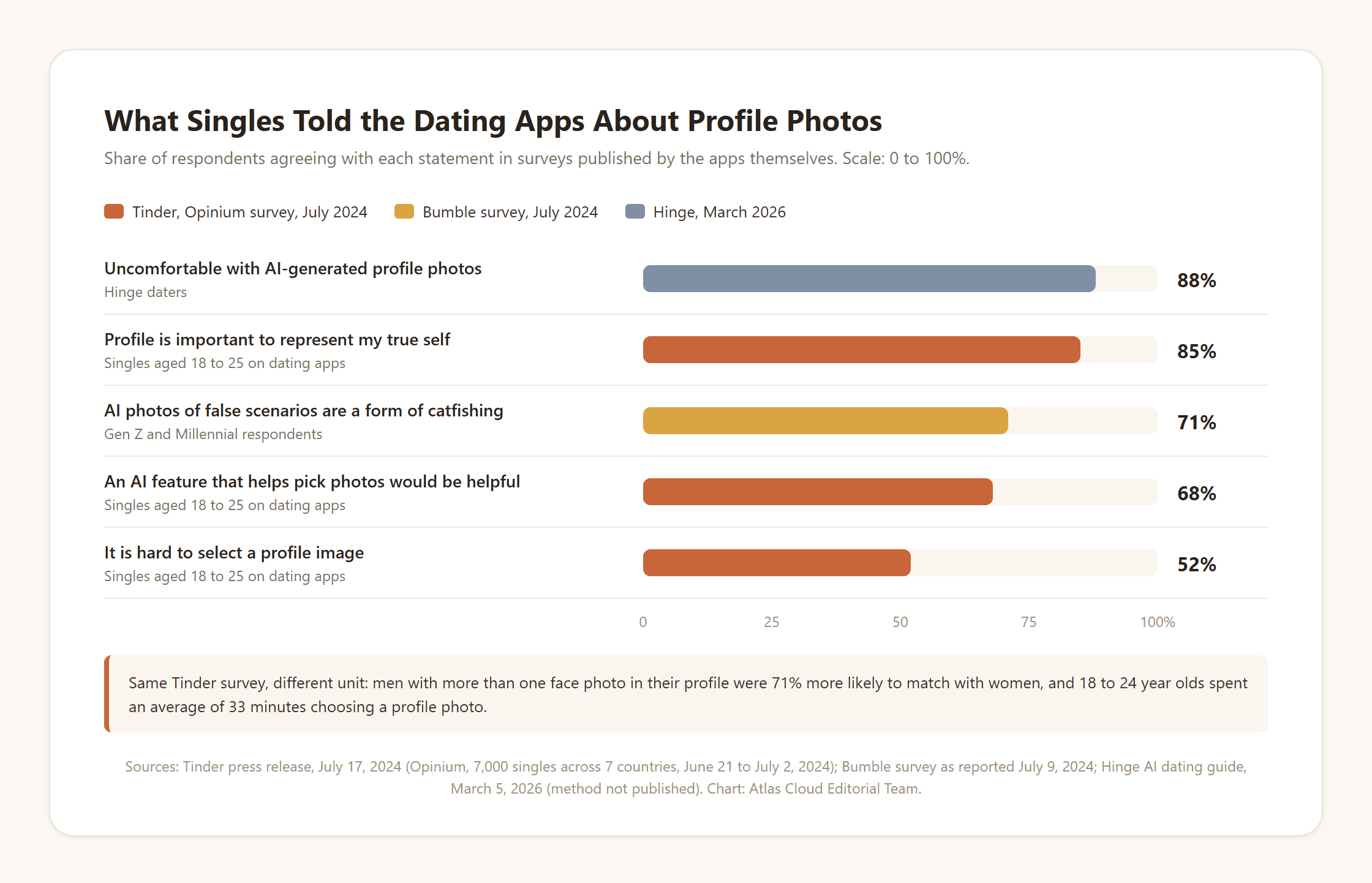
Read those two 71% figures together. Daters want more face photos of you, and they resent photos of a you that never happened. That leaves exactly one job for AI here: more real-looking pictures of your real face. Not a beach you never visited.
Make AI Dating Profile Pictures From One Photo on Atlas Cloud
Many photo generators want a stack of your selfies and give you back a stranger with your haircut. The Atlas Cloud selfie generator takes the opposite job: one photo in, the same face out, with the camera moved to arm's length. Here is what that looks like on a portrait someone else took.
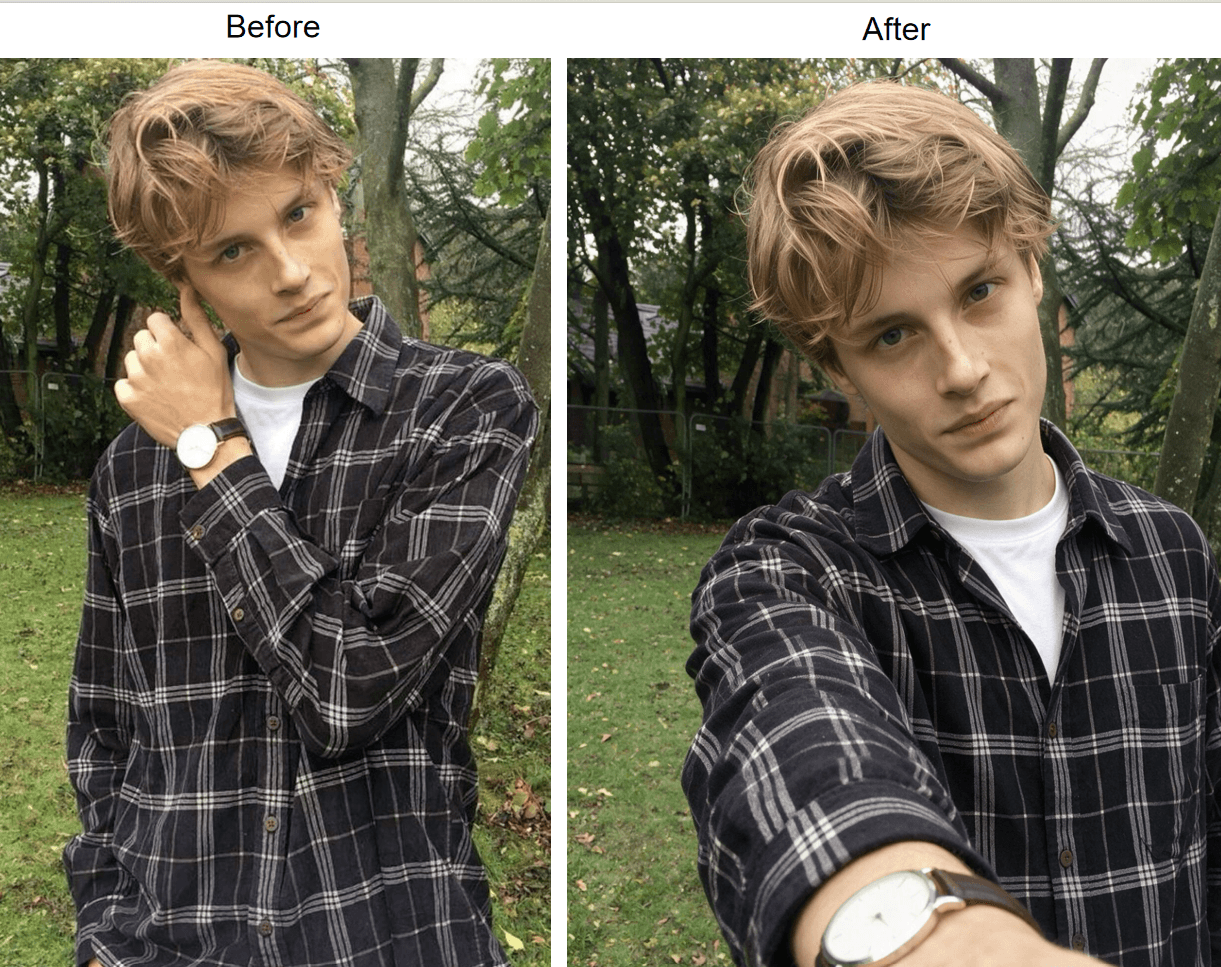
Left: input photo. Right: output from the Atlas Cloud free AI selfie generator, run by the Atlas Cloud Editorial Team on September 3, 2026.
The reframing is a rebuild, not a crop. The arm, the phone tilt and the slightly wide phone-lens look are new. Your face, hair, clothing and background carry over from the source. The tool page lists "Dating Profile Selfies" as a use case and describes why in one line: "profiles built on natural selfies feel approachable."
That is the whole pitch for a dating profile. A photo someone else took reads as posed. The same photo as a selfie reads as you, on a Tuesday, showing up.
Three Steps to an AI Tinder Selfie
The tool lives in the free AI tools family on Atlas Cloud, alongside the headshot, aging and hairstyle tools. Running it takes three steps:
- Sign in with Google, GitHub or email, then drop your portrait (up to 10MB) into the uploader on the selfie generator page.
- Leave the optional mood field empty for a first run. You want the setting you already have, with only the camera moved.
- Hit Run Free, wait about 30 seconds, and download a 1328 x 1776 portrait. The page's line on the free allowance: "Every eligible account gets 1 free generation."
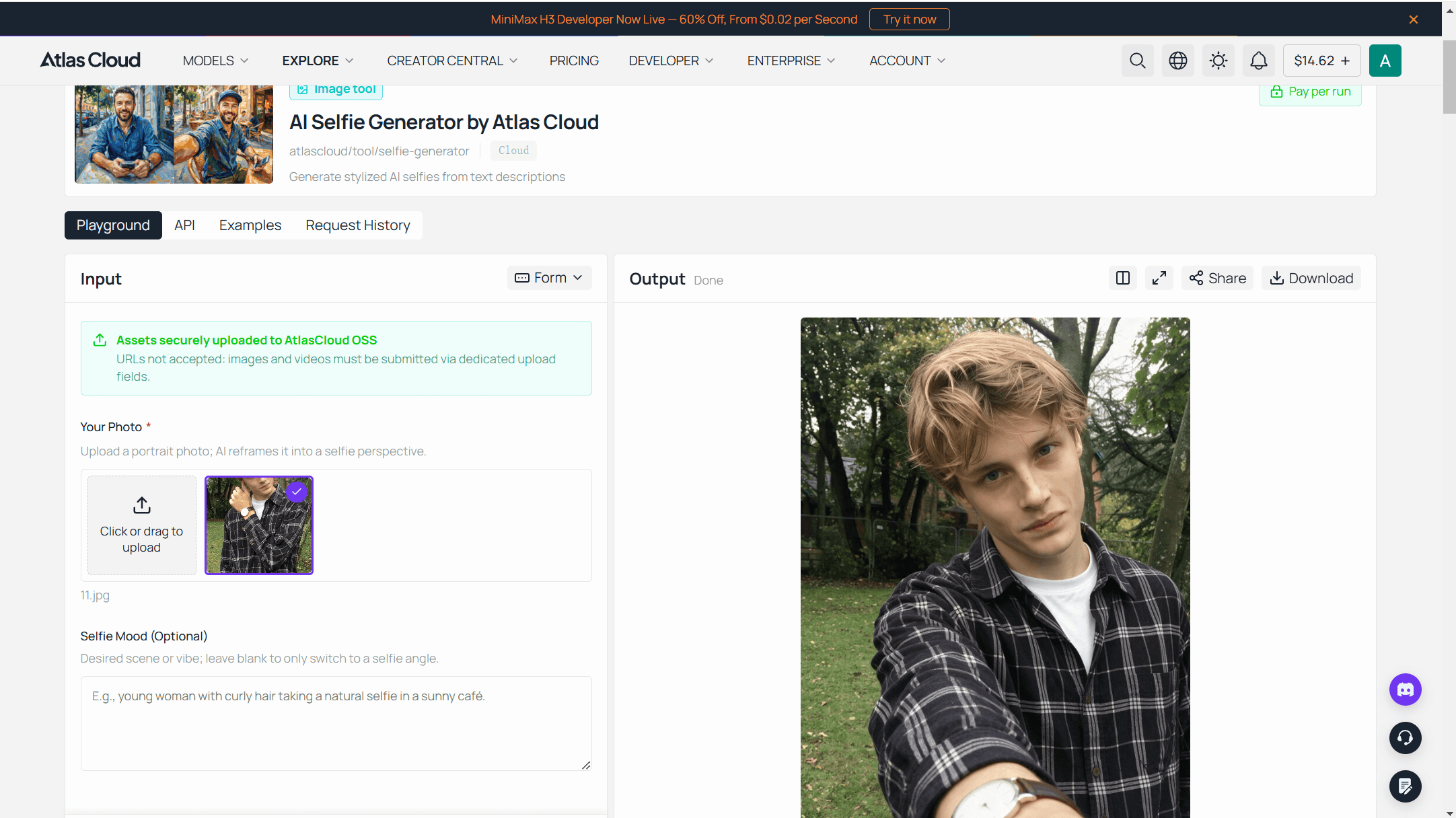
The 1328 x 1776 output is a 3:4 portrait with nothing stamped on it, so it uploads as-is. That is one slot filled. A profile has five or six more, and they should not all come from the same machine.
Pick the Input Photo That Survives the Rebuild
Because the entire frame is regenerated from your one photo, the input decides the output. The tool page's own tips are short: light your face with daylight or a bright lamp, choose a shot where both eyes and your whole face are visible, and start from a sharp file.
Two more rules from the dating side. Skip sunglasses. Tinder's Face Check and Hinge's Selfie Verification both compare a video selfie against your profile photos, and covered eyes give them less to match. And pick a photo from this year. Hinge's guide asks for recent photos, and a rebuilt angle does not make a five-year-old face current.
If your best photo has none of these problems, you are ready. If every photo has one, the sibling guide on making selfies look better covers how to shoot a usable source.
How to Make Good Tinder Photos as a Set of Six
Hinge's help center states that members "are required to have between four to six photos, depending on local requirements, along with three prompt answers." Six is the top of that range and the working number for this guide. The question is which slots an AI photo should fill and which it should never touch.
| Slot | What it shows | Shoot it or reframe it with AI | Verification risk |
|---|---|---|---|
| 1. Lead face photo | Clear face, daylight, no sunglasses, no group | Either. An AI reframe of a real photo works here as long as the face is untouched | Face checks match a video selfie against your profile photos, so this one must be your current face |
| 2. Full body | Head to toe, standing, real proportions | Shoot it | Low, but a generated body invites the mismatch daters call catfishing |
| 3. Activity | You doing the thing your bio mentions | Shoot it | An AI scene of a hobby you do not have is the "false scenario" 71% of Bumble respondents object to |
| 4. Social | You with friends, you clearly identifiable | Shoot it. Bumble Dating wants your face clearly visible in every photo | Low |
| 5. Candid | Unposed, mid-moment, phone-camera look | AI reframe is a good fit: turn a posed portrait into a phone-held moment | Low if the face carries over |
| 6. Scene or travel | A place that says something about you | Shoot it | High for AI: the place has to be real, or slot 3's problem returns |
Two AI slots out of six is the ceiling this table implies, and only slots 1 and 5, where the picture is still your real face at a new angle. Everything else is a photo the apps and their users expect to be a record of something that happened.
What Makes a Good Tinder Picture for the First Slot
The first slot does the most work and carries the most rules. Tinder's Photo Selector, the AI feature it launched in July 2024, describes its own logic in the press release: you "snap a selfie for facial recognition," the tool scans your camera roll, and it curates a selection of photos of that face for you to review. The app's own curation tool starts from a recognisable face.
So the checklist for slot 1 is short. Your face fills a good part of the frame. Both eyes are open and visible. The light comes from in front of you, not behind. Nothing covers your face, no hat brim shadow, no sunglasses, no friend's shoulder. It was taken this year.
An AI reframe of a photo that already passes this list gives you a second slot-1-grade picture without a second photo shoot. That is the realistic win. It will not rescue a dim, half-covered face, because the source is all it has.
Best AI Photo Generator for Dating Apps: One Photo or a Trained Model
Search for a dating photo generator and many of the results want ten or twenty of your selfies first. They train a model on you and hand back dozens of images in outfits and cities you have never seen. The one-photo route above does something narrower. Which is the best AI photo generator for dating apps depends on what you want the pictures to do.
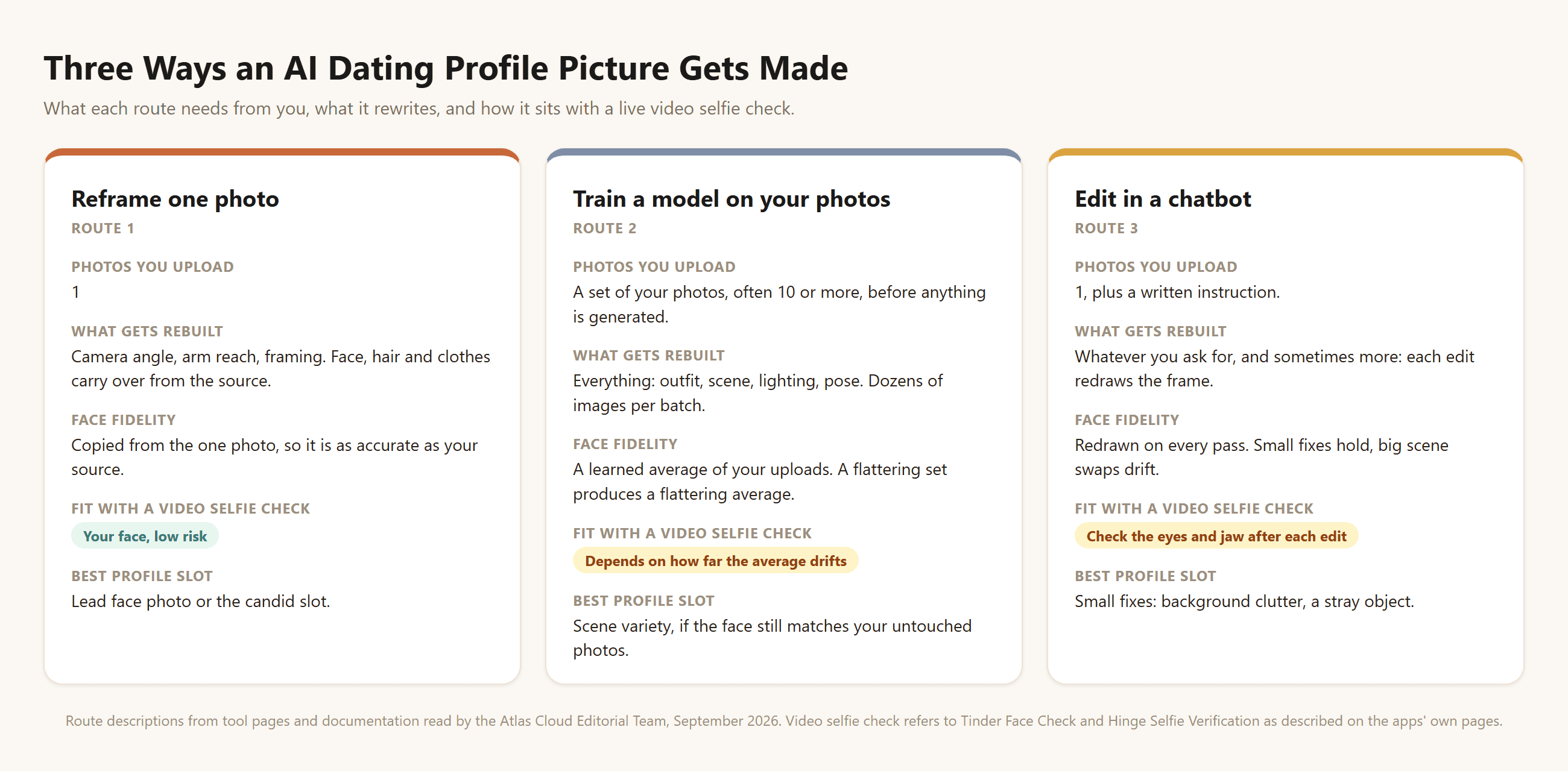
The trained-model route produces variety, and variety is what a dating profile looks like it needs. But the face it learns is an average of whatever you fed it. Feed it your ten most flattering photos and the average is more flattering than you. That is the drift a live video selfie can catch, and it is the kind of photo the 88% of Hinge daters say they are uncomfortable with.
The chatbot route is fine for small fixes: a cluttered background, a stray exit sign. Each edit redraws the whole frame, so the face shifts a little every pass, and after a few scene swaps the jaw can be someone else's.
The one-photo reframe changes the least, since only the camera position and framing move. For a dating profile, where the goal is one or two more convincing pictures of your actual face, changing the least is the point.
If you want to compare specific one-photo tools, the selfie generator ranking tests four of them on the same portrait.
Do Dating Apps Allow AI Dating Profile Pictures?
None of the three big apps' written rules bans an AI-made photo outright. All three ban misrepresenting yourself. Tinder now checks likeness with a camera for new users in some regions, and Hinge offers the same kind of check as a voluntary badge.
| App | Written rule | How it is enforced | Source date |
|---|---|---|---|
| Tinder | "People want to meet the real you. Not your fake persona. Don't create a fake account or pretend to be someone you're not, even if it's just for fun." | Face Check: a short video selfie matched against profile photos, required for all new users in seven countries and California | Guidelines current September 2026; Face Check expansion October 22, 2025 |
| Hinge | Users may not "Misrepresent themselves by posting someone else's photo or likeness" or "Use fake identities or AI-generated content to mislead others" | Selfie Verification, a voluntary video selfie compared to profile photos (a Face Check is required in certain regions); official guide advises skipping AI profile photos | Prohibited Content page current September 2026; AI guide March 5, 2026 |
| Bumble | Prohibits "Using someone else's photos, artificially-generated photos, or enhanced photos to deceive others" | In-app report category for AI-generated photos or videos, added July 2024 as reported by Engadget; AI Photo Feedback tool for US members from February 26, 2026 | Guidelines current September 2026 |
Tinder's October 22, 2025 announcement states that "Face Check is now required for all new users in seven countries and the state of California."
New members "complete Face Check by taking a short video selfie within the app," and the system confirms the person is real and present and that "their face matches the one shown in their profile photos." Tinder credits the check with a more than 60% drop in exposure to potential bad actors where it runs.
Hinge's Prohibited Content page hangs everything on two words: mislead and likeness. Bumble's Community Guidelines do the same with "to deceive."
An AI reframe of your own face, posted next to untouched photos of the same face, is not misleading anyone about your likeness. A trained-model set that shaves ten years off is.
One more practical note from Bumble's photo rules: Bumble Dating wants your face clearly visible in every photo, and its photo rules state "No watermarks or text overlaid over photos." Some free generators stamp a logo on the output. That stamp is a rules problem before it is a taste problem.
Why AI Tinder Photos Get Clocked as Fake
Daters are not running detection software. They are pattern-matching against every other profile they have seen, and AI photos share tells.
Skin with no texture. Real faces have pores, a stray hair, uneven color. Generators that "enhance" smooth all of it, and a smooth face next to a normal one in the same profile reads as edited.
One light, one background, six times. If six photos share the same soft key light from the same side, they look like a catalog, and nobody's camera roll looks like a catalog.
Studio perfect in a slot that should be candid. A generated "coffee shop" photo with magazine framing is the wrong kind of good for slot 5.
All six from a machine. The fix for every tell above is the same: at least one untouched photo, ideally two, sitting in the same profile as the AI ones. Face Check and Selfie Verification compare a live video selfie against your profile photos. People compare too, one thumb-swipe at a time.
And the source problem, which turned out differently from what we expected. A one-photo reframe copies whatever you give it, so we fed the same tool a daylight portrait and a dim, slightly soft indoor version of the same person to see what would break.
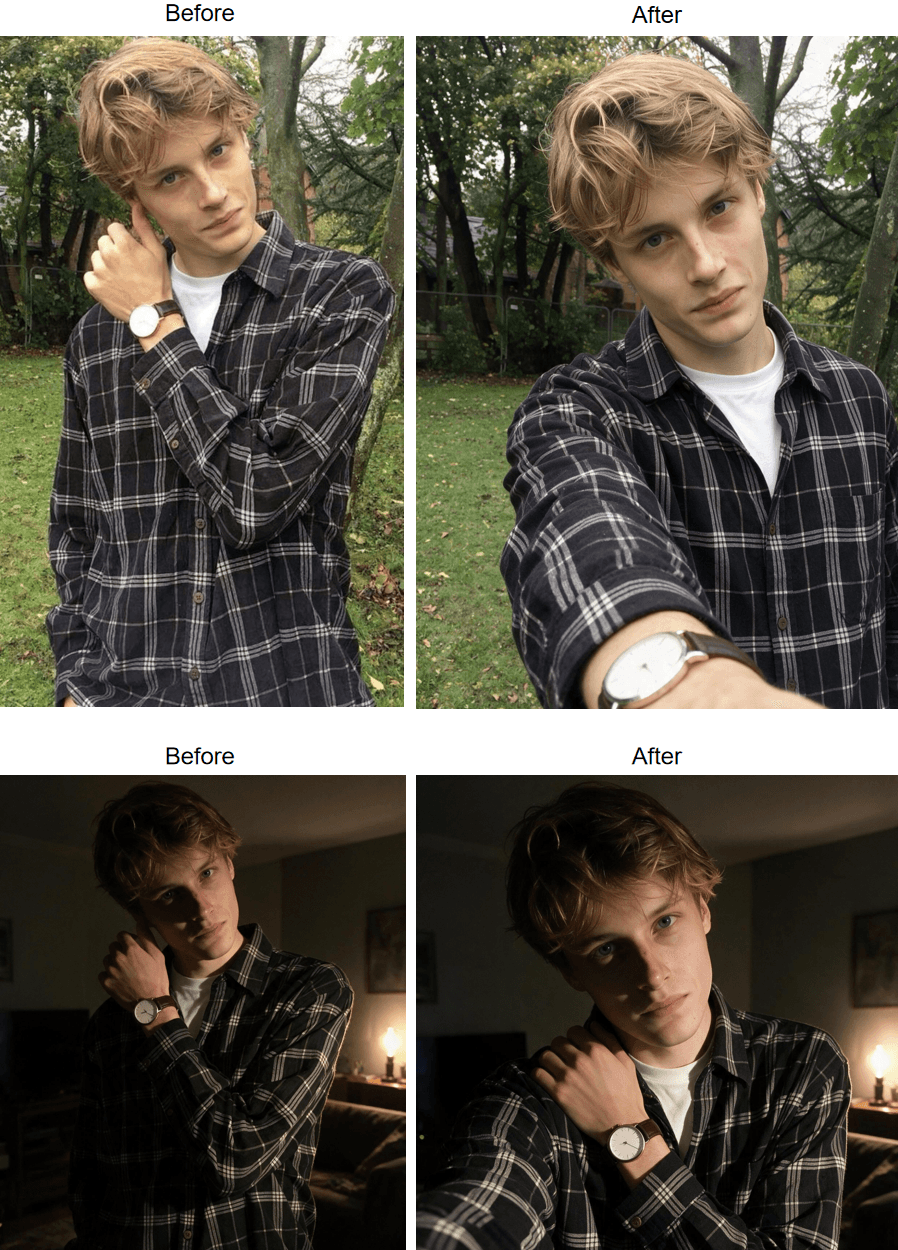
Both runs by the Atlas Cloud Editorial Team on September 3, 2026, mood field left empty. The dim indoor input was made by editing the daylight portrait with an image editing model to simulate a low-light phone photo; the face was checked against the original before the run.
Nothing broke. The dim input came back as a clean arm's-length selfie with the face intact, the watch still on the wrist, and the same single lamp still lighting one side of the face.
That is the point: the generator did not fix the lighting, it kept it. The dim pair is a good moody photo and a poor slot 1, because the light is not coming from the front. Same tool, same face, and the source still decided which slot the result can fill.
Frequently Asked Questions
Is there an AI dating photo generator free to use?
The Atlas Cloud selfie generator gives every eligible account one free generation after sign-in with Google, GitHub or email, and the output carries no watermark. That is enough to fill one profile slot from one photo. Trained-model generators typically sell packs of dozens of images rather than single runs, so "free" there usually means a preview.
Which AI dating profile picture generator works with only one good photo?
A one-photo reframer. It rebuilds the camera angle and framing from a single portrait and copies your face across, so it does not need a training set. Tools that ask for ten or more selfies are averaging your face, which is the opposite of what you want when you only trust one picture.
What makes a good dating profile picture if I am not photogenic?
Light and angle, which is most of what "photogenic" means in practice. A face lit from the front in daylight, shot at arm's length rather than from below, looks like the person their friends see. That is the angle the selfie generator produces, and it is also the angle you can shoot yourself with a window and an outstretched arm.
Does Tinder detect AI photos?
Tinder describes Face Check as two steps: confirming a live person is present, and matching that video selfie against the faces in your profile photos. Its description mentions nothing about detecting generated images. An AI reframe of your own face passes that test the same way a real photo does. A generated face that drifts from yours fails it the same way someone else's photo would.
How many of my dating photos can be AI?
One or two out of six, and only in the slots where the picture is still your real face at a new angle: the lead face photo and the candid. Full-body, activity, social and travel slots are records of things that happened, and daters treat them that way.
Should I tell matches a photo was made with AI?
The rules do not require it as long as the photo is a true likeness. Hinge's own guide tells daters to skip AI-generated profile photos, and Bumble lets users report AI photos they find deceptive. Mentioning it when it comes up costs nothing. Being found out costs the match.
Conclusion
The apps have already told you what a good photo is: your face, clearly, more than once, recently. Their surveys say daters want more of that and resent pictures of a life you did not live. Their verification systems now check the first part with a camera.
AI fits inside that rule when it changes the least. One real photo, rebuilt as an arm's-length selfie with the face left alone, gives you a second lead-grade picture and a candid without a photo shoot. Keep the rest of the profile untouched and current, and AI dating profile pictures become what they should have been all along: a better angle on the person who is going to show up.





