

Fashion brand Edikted built a Black Friday campaign on content from more than 500 everyday creators, and the results, per TikTok's published case study, included acquisition costs cut in half and a 4.76 return on ad spend over the holiday weekend. Results like that are why UGC ads show up in so many paid social plans: they are ads that look like the phone-shot posts people already trust, and feeds reward that look. This guide covers what the term means, the styles the format comes in, real campaigns with published numbers, and the script templates behind the ads that keep converting, plus a way to make your first one this afternoon from a product photo you already have.
Key Takeaways
- A UGC ad is paid advertising that keeps the look of user-generated content: footage that looks filmed on a phone, a person talking to camera, no studio polish.
- The category splits into three lanes: real customer posts boosted with permission, creator content licensed for ads, and UGC-style ads produced to imitate both.
- The results are documented, not folklore: TikTok case studies report a conversion rate above 55% for one Spark Ads campaign and a 50% CPA drop for another built on creator content.
- Ad libraries beat view counts for research. An ad that has been running for months is usually paying for itself; a viral clip may never have converted anyone.
- You can test the format without a creator: the free UGC Product Ad tool turns a product photo and a one-line brief into a voiced vertical ad.
UGC Ads Come in Three Lanes, and Only One Is Genuinely User-Generated
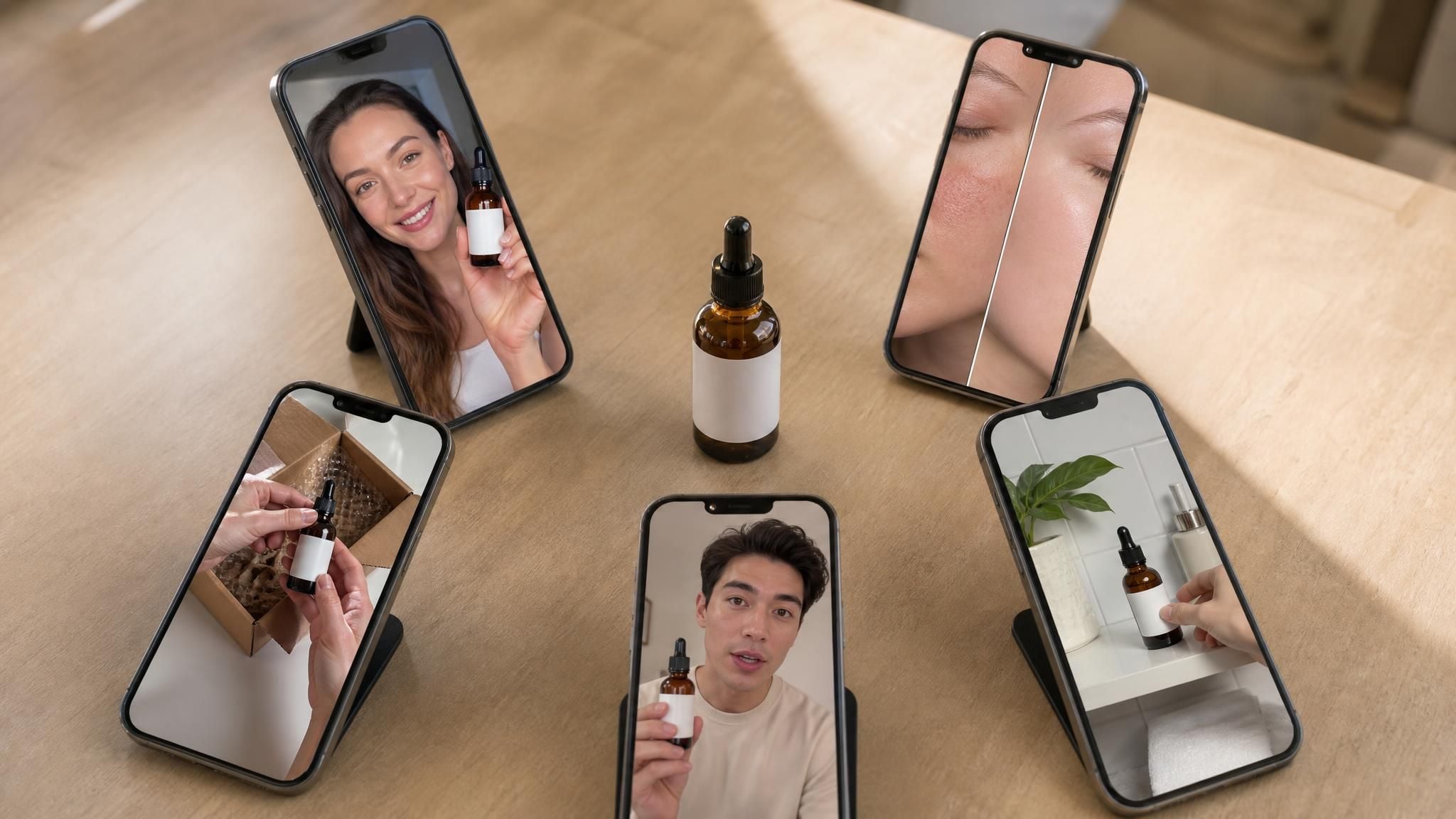
Start with the meaning of UGC ads, which fits in one line: UGC stands for user-generated content, and UGC ads are paid placements built from that content or made to look like it. Instead of a studio shoot, the creative is one person filming themselves with a product, hand-typed captions, and whatever lighting the room had. The format works because viewers learned to skip anything that looks like a commercial and keep watching anything that looks like a person.
Telling the three lanes apart saves real money, because they price and scale differently.
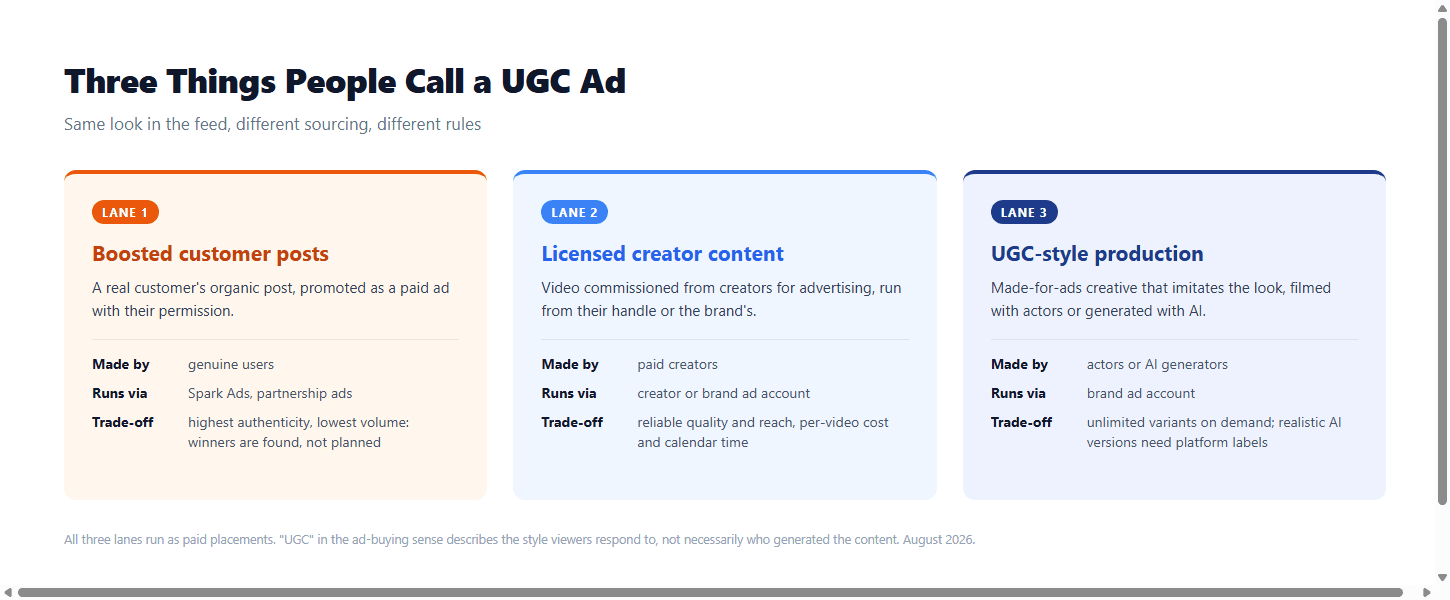
The first lane is genuine customer content a brand gets permission to promote. The second is creator content commissioned for advertising and run as UGC paid ads through formats like TikTok's Spark Ads or Instagram's partnership ads, which keep the creator's handle on the ad. The third lane is UGC style ads: creative produced from scratch, by a hired actor or by AI, to imitate the first two. Nothing in that lane is user-generated, and the industry keeps the name anyway because it describes the look buyers respond to. If the AI branch is what you are curious about, our AI UGC guide covers it in depth, including the consumer sentiment data.
Different Styles of UGC Ads
Watch fifty of these ads and the different styles of UGC ads collapse into a handful of repeating shapes. Six cover most of what runs today.
The creator testimonial is the default: one person, direct to camera, explaining why they like the thing. Unboxing sells anything where packaging, scale, or first impressions matter. Before and after belongs to products with a visible result, cleaning, skincare, fitness, home upgrades, because the change is visible on screen and the presenter only has to narrate it. The routine format, get-ready-with-me and day-in-my-life clips, places the product inside a sequence viewers already watch voluntarily. Reply-to-comment ads film an answer to a real or staged question, which makes the pitch feel requested. Street interviews rely on reactions from people in public, which read as less scripted than a solo pitch.
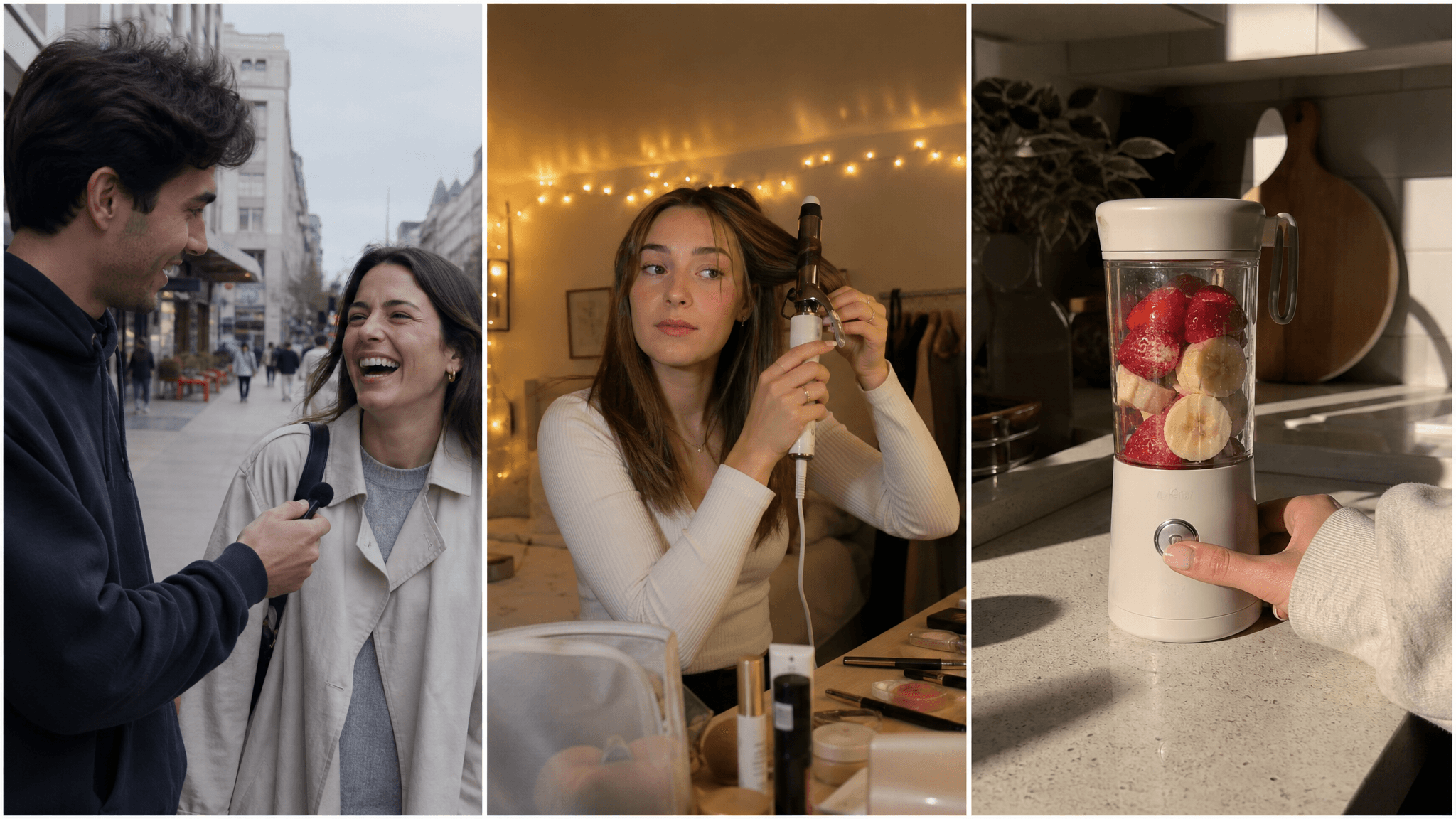
Three of the six styles , staged as single frames. AI-generated illustration.
None of these require a big following, which is the part newcomers miss. UGC video ads usually run as paid placements from the brand's own ad account, so the footage matters more than the poster's follower count. That is also why the format scaled: the entry requirement is a phone and a believable person.
Turn One Product Photo into a UGC Video Ad
Several of the styles above now ship as one-click presets in generators. Here is a 15-second clip generated from one product photo and a single line of text, no creator, no shoot.
Generated with the free UGC Product Ad tool on Atlas Cloud from a product photo and a one-line brief, August 2026.
The UGC Product Ad tool on Atlas Cloud takes a few minutes end to end, and its menus map straight onto the last section: the 16 ad formats include the testimonial, unboxing, and before-and-after shapes, joined by 11 hooks and 11 scene settings. Feed it up to four product photos and a one-line brief covering what you sell and who it is for, set anywhere from 4 to 15 seconds in 9:16 or 1:1, and generate. One pass returns the presenter, script, voice, and synced lip movement together. A photo of a specific person locks that face across a whole campaign; without one, the presenter is generated for you. There is a free plan, so the first test costs nothing but the upload.
The tool sits in a wider free AI tools collection covering image cleanup and editing, which becomes relevant the moment your product photo needs work before it fronts an ad.
Generate UGC Ads via API
One clip proves the format; a test matrix needs twenty. The generator behind the web tool is callable from code, which is how sellers batch a catalog into variants.
Step 1: Create an API key. Generate one in the Atlas Cloud console and keep it server-side.
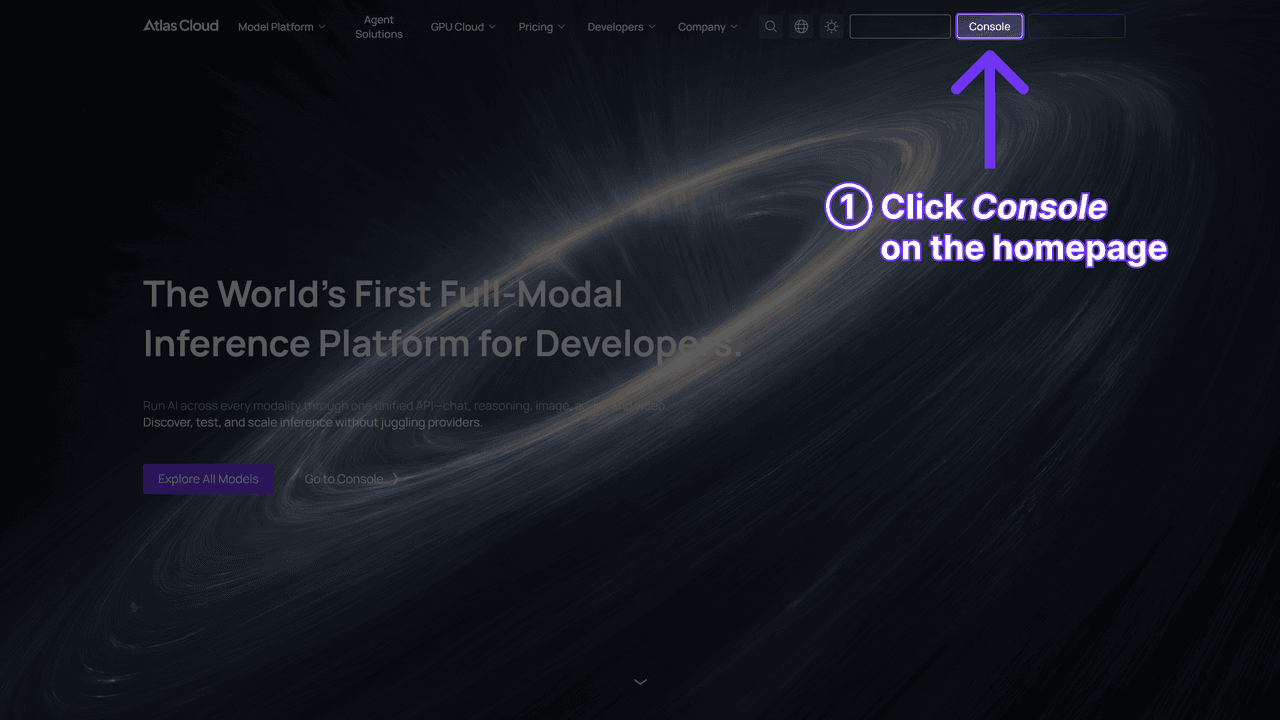
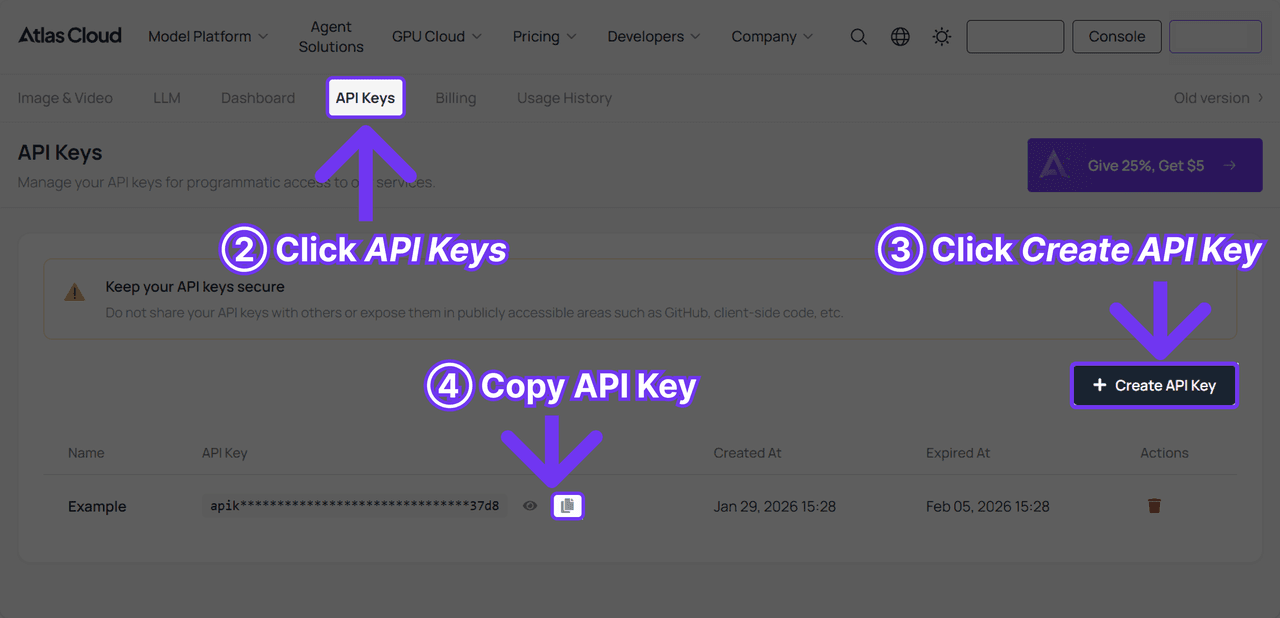
Step 2: Check the request shape. The API documentation covers authentication and polling. The endpoint wants a product image URL, your one-line brief, and the format choices from the web tool; ad_type takes creator recommendation, before-and-after, or unboxing, and count returns up to two variations per request.
Step 3: Send the request and poll. Generation is asynchronous. The first call returns a request id, and you poll until the clip is ready.
plaintext1curl -X POST "https://api.atlascloud.ai/api/v1/model/generateVideo" \ 2 -H "Authorization: Bearer $ATLASCLOUD_API_KEY" \ 3 -H "Content-Type: application/json" \ 4 --data-raw '{ 5 "model": "atlascloud/studio/ugc-ad", 6 "product_image": "https://your-store.com/products/glowmist-serum.jpg", 7 "user_prompt": "GlowMist vitamin C serum, fades dark spots within weeks. Calm, honest tone aimed at skincare skeptics.", 8 "ad_type": "before_after", 9 "duration": 12, 10 "ratio": "9:16", 11 "resolution": "480p", 12 "count": 2 13 }'
plaintext1curl "https://api.atlascloud.ai/api/v1/model/prediction/<request_id>" \ 2 -H "Authorization: Bearer $ATLASCLOUD_API_KEY"
When status reads completed, the outputs array holds hosted video URLs. Loop it over a product list and a hook list, and the whole catalog turns into a variant library.
UGC Ad Examples Worth Studying
Roundups of the best UGC ads tend to showcase whatever went viral last month. More useful are UGC ad examples with published performance data, and TikTok's own case study library has two worth reading closely.
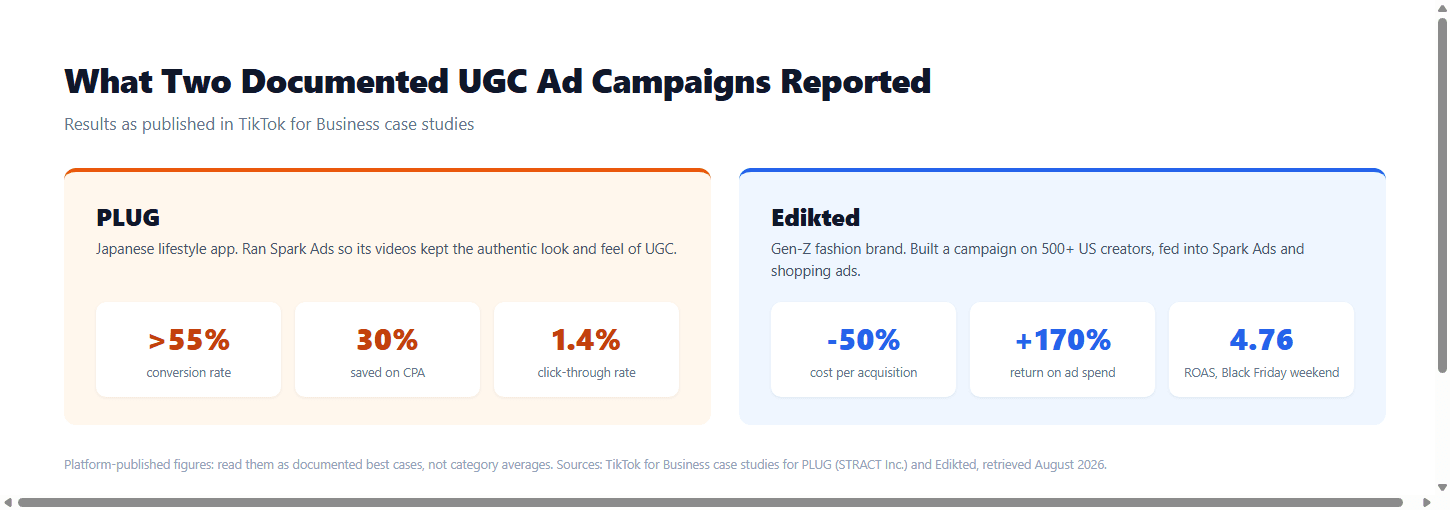
PLUG, a Japanese lifestyle app, ran Spark Ads so its videos carried, in TikTok's words, the authentic look and feel of UGC. The PLUG case study reports a conversion rate above 55%, a 30% saving on cost per acquisition, and a 1.4% click-through rate.
Edikted, a Gen-Z fashion brand, went the volume route: a campaign built on more than 500 US creators, with the resulting content fed into Spark Ads and video shopping ads. The Edikted case study reports acquisition costs down 50%, return on ad spend up 170%, and a 4.76 ROAS across the Black Friday to Cyber Monday window, during which the brand sold out twice.
Both sets of numbers come from the platform selling the ad product, so read them as best-case documentation rather than averages. What makes them instructive is the shared mechanic: neither campaign leaned on one hero video. Both ran many native-looking variants and let auction results decide where the budget went.
How to Spot High-Converting UGC Ads
You cannot see another brand's conversion data, but you can see where their money keeps going, and that is almost as good. Knowing how to spot high-converting UGC ads turns competitor budgets into your creative research. Here is how.
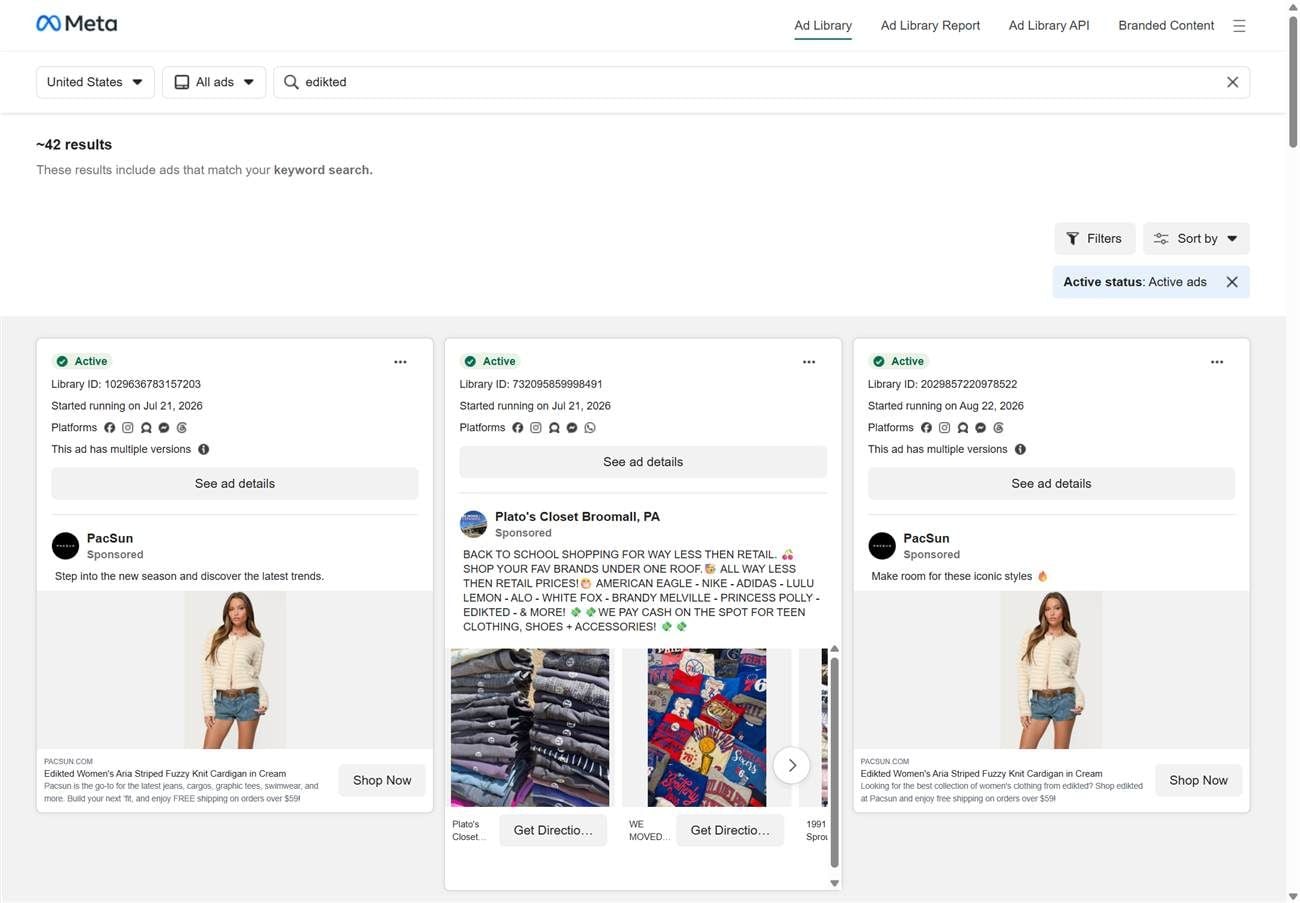
A keyword search in Meta's Ad Library, August 2026. Every result is a live ad, and each card shows its start date, the closest public signal to what is converting.
The strongest signal is longevity. Meta's Ad Library lists every active ad an advertiser runs, with the date each started. An ad still spending after two or three months is very likely profitable, because advertisers shut off losing creative fast; a clip with millions of organic views carries no such guarantee. TikTok offers a parallel view through its Creative Center, where the Top Ads section lets you filter live auction ads by region, objective, and format, and sort by reach or click-through rate.
Once you have a shortlist of long-runners, the on-screen patterns repeat. The first two seconds state a problem or a payoff, never a brand name. Captions are burned in for muted autoplay. The product appears in hands, in use, within the first third of the clip. And the framing stays imperfect on purpose: a bedroom, a car seat, a kitchen counter. Save five ads that check those boxes and you have a creative brief drawn from ads that already survived months of spend.
UGC Ad Templates That Consistently Work
The long-running ads you just shortlisted tend to follow scripts. These four are the UGC ad templates that consistently work across product categories, written here as beat-by-beat skeletons you can lift.
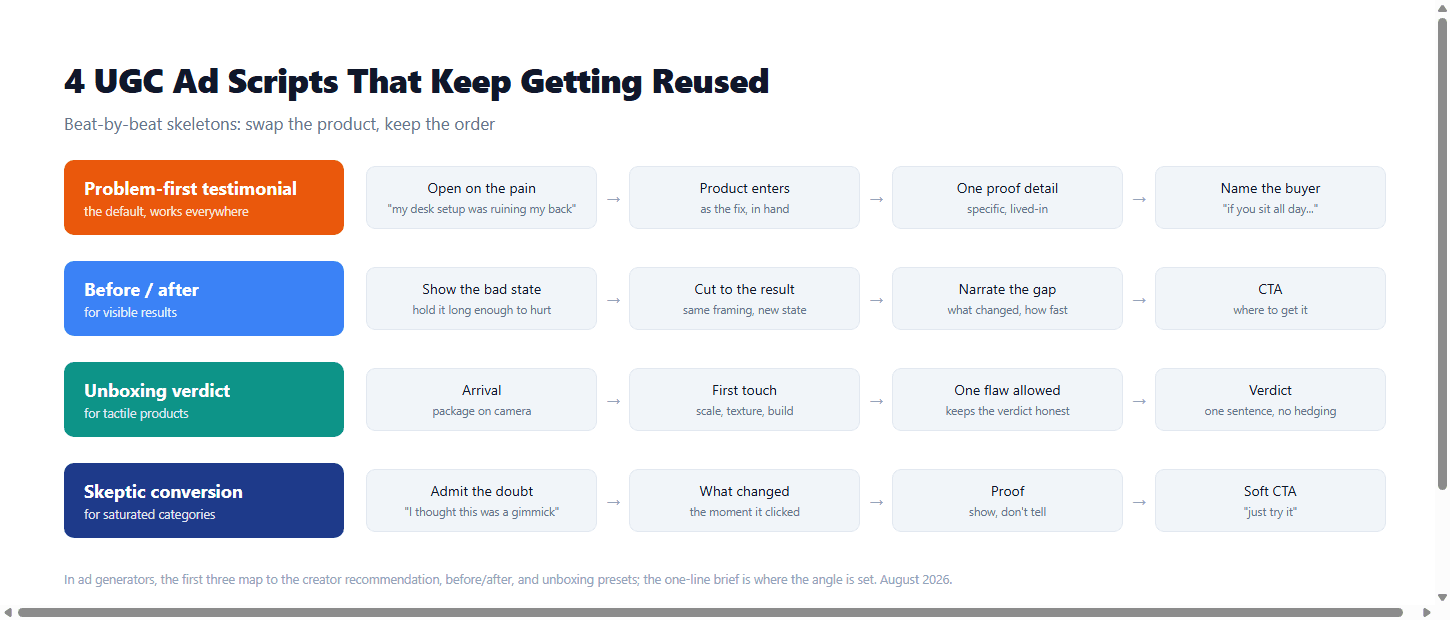
The problem-first testimonial opens on the pain, not the product: a line like "my desk setup was ruining my back" fills the first beat, the product enters as the fix, one specific detail proves the speaker actually used it, and the close names who should buy. The before-and-after template holds the bad state long enough to register, cuts to the result, and lets the presenter narrate only the gap between them. The unboxing verdict compresses arrival, first touch, and a one-sentence judgment into fifteen seconds, and works because the judgment is allowed to include a flaw. The skeptic conversion is the strongest for saturated categories: the speaker opens by admitting they assumed the product was a gimmick, which makes the praise that follows easier to believe.
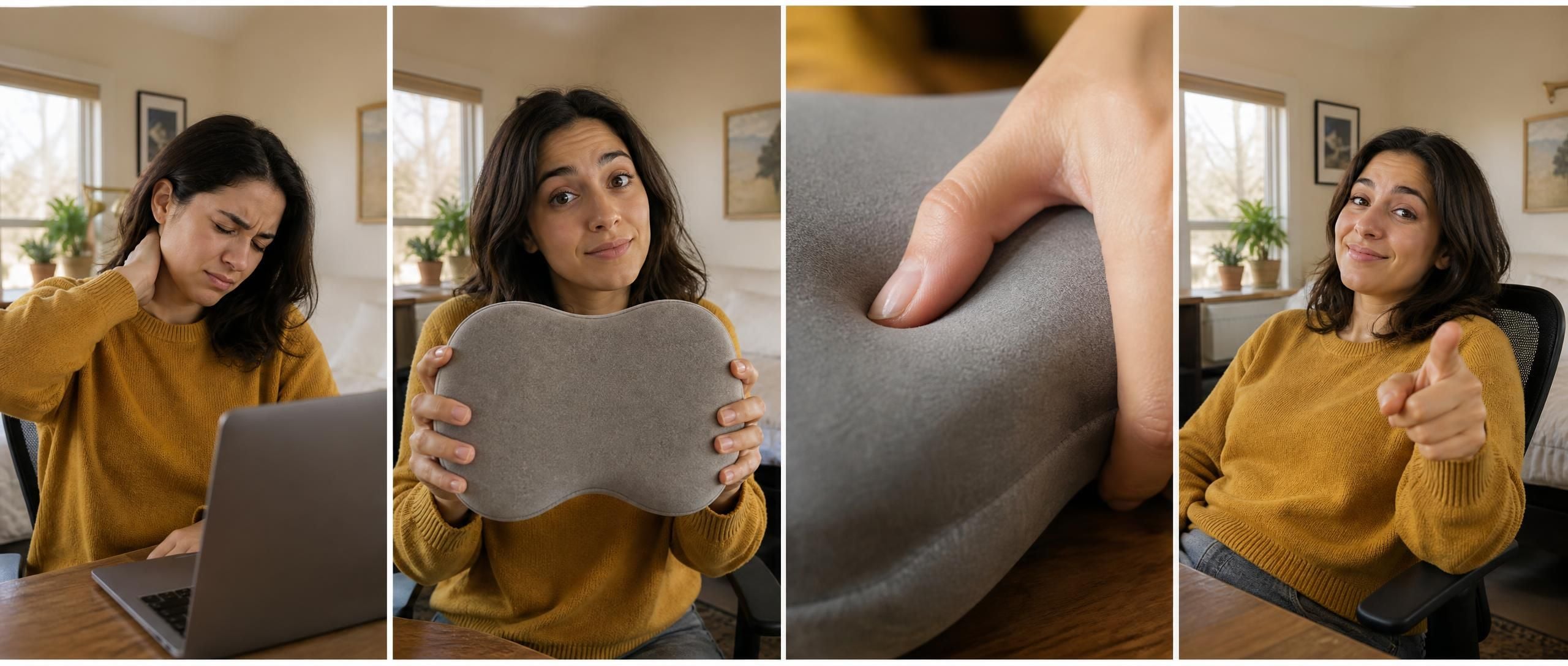
The first template as a storyboard: pain, fix, proof, close. AI-generated illustration.
If you generate rather than film, the mapping is direct: the presets in the tool above cover the testimonial, before-and-after, and unboxing shapes, and the one-line brief is where you set the skeptical or problem-first angle.
How to Create Effective UGC Ads
Templates decide the script. Process decides whether the account makes money, and the process behind how to create effective UGC ads is testing volume with fast exits.
Start with angles, not videos. An angle is one buyer plus one payoff, "commuters who want silence" or "parents who hate laundry day", and each angle deserves its own one-line brief. Then prepare the assets those briefs need: clean product shots, and for apparel brands, variations. A single garment photographed once can be restyled across looks with the free clothes changer tool, which is cheaper than reshooting a sample for every colorway an ad might mention.
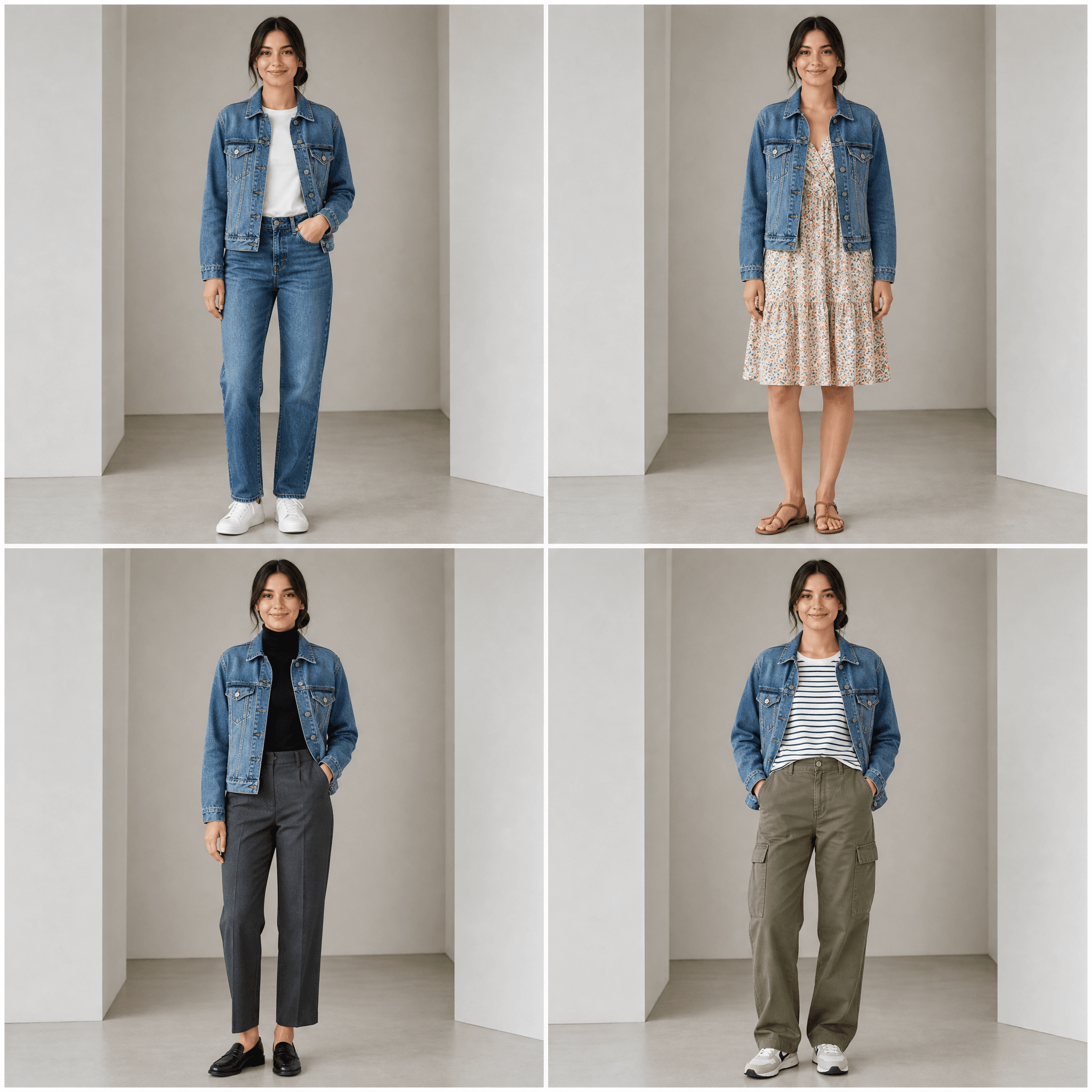
Four ad-ready looks from one garment photo. AI-generated illustration.
Production can go either way, and the two routes combine. Generate variants for speed, brief human creators for the angles that survive, or run both at once; the platform rankings we published compare ten generators on exactly this workflow. Launch each variant on a small budget, judge on cost per result rather than views, and kill losers within days. Edikted's campaign in the examples above is this loop at full scale. When performance sags, change the hook before you change the product story; the first two seconds wear out first.
TikTok and Instagram UGC Ads: What Changes by Platform
The creative barely changes between platforms. The ad formats, permissions, and research tools do.
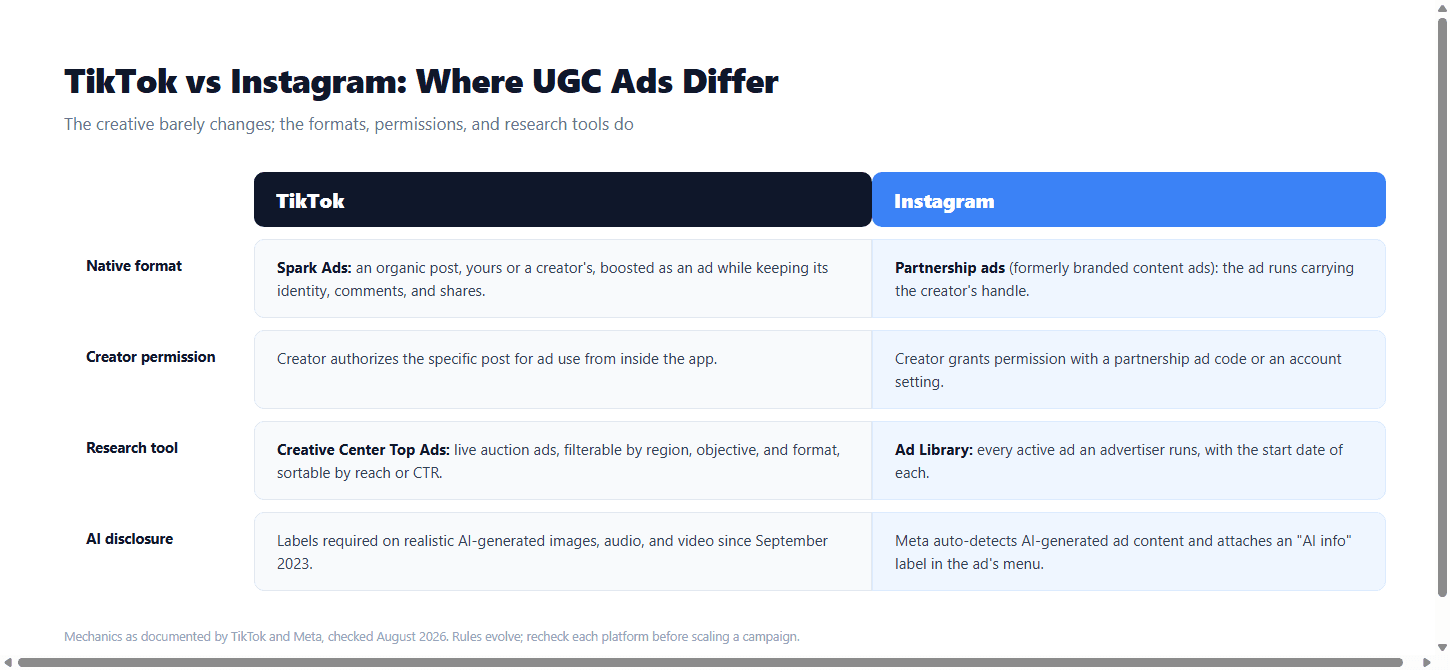
TikTok UGC ads center on Spark Ads, which TikTok describes as a native format for boosting organic content, either your own posts or a creator's with their authorization. The format's whole point is that the ad inherits the post's organic identity, and TikTok's own explainer claims a 134% higher completion rate and a 157% higher 6-second view-through rate than standard in-feed ads. Instagram UGC ads run through partnership ads, the format Meta previously called branded content ads: the creator grants permission with a code or account setting, and the ad runs carrying their handle. Same idea, permission flows swapped.
Disclosure is the other platform difference that matters in 2026. TikTok has required labels on realistic AI-generated images, audio, and video since its September 2023 label announcement, applied via a built-in toggle, sticker, or caption. Meta, under its February 2025 ads transparency update, automatically detects AI-generated content in ads and attaches an AI info label in the ad's menu. Neither rule blocks UGC style ads made with AI. Both mean a label can end up on the ad, so build creative that still works with one attached.
Frequently Asked Questions
What is a UGC ad?
A UGC ad is a paid advertisement built from user-generated content or styled to look like it: vertical video filmed the way a customer would film it, a real person talking to camera, casual framing instead of studio production. The term covers boosted customer posts, licensed creator content, and made-for-ads creative that imitates both.
What are UGC video ads?
UGC video ads are the video form of the format, usually 9:16 vertical clips under 30 seconds built for TikTok, Reels, and Shorts. Video dominates the category because short-form feeds are where the casual look pays off, and because ad accounts consume video variants in volume during testing.
How much do UGC ads cost?
Generating is metered instead of negotiated: our August 2026 test on the Atlas Cloud UGC Product Ad tool came to $1.772 for a full 15-second clip, which works out to roughly $0.12 per second at the current 480p output. Balances start at a $19 top-up, a free plan covers the first try, and media spend to run the ad is separate on either route.
Can UGC ads go viral?
Virality usually happens on the organic side, and paid distribution buys reach rather than shares. The practical link between viral UGC ads and paid performance is Spark Ads: when an organic post takes off, you can put budget behind that exact post. Chasing virality directly is a worse plan than testing many variants and scaling what converts.
Do UGC ads perform better than regular ads?
Often, and never automatically. TikTok's headline numbers favor the native format, and case studies like PLUG's 55%-plus conversion rate are real but selected by the platform publishing them. Sentiment research also shows consumers are more skeptical of AI-made ads than advertisers assume. The reliable claim is narrower: UGC ads make creative testing cheap enough that your account finds its winners faster, and the winners are what perform.
Conclusion
UGC ads rest on one premise: people trust people more than they trust production values. The premise keeps holding up. Platform case studies document it, the styles have stabilized into learnable templates, and the mechanics, Spark Ads on one platform and partnership ads on the other, are built into the ad systems themselves. What changed most recently is the cost of entry. A format that once required sourcing creators now starts with a product photo and a sentence.
The way to know whether UGC ads fit your product is not another article, it is a test. Pick one angle, one template from the four above, and one long-running competitor ad as a benchmark, generate or film a variant, and put a small budget behind it. The ad library screenshot you take three months from now, with your own ad still running, is the only proof that matters.





