

Somewhere in your feed tonight, a stranger will hold a product up to their phone camera, say something unscripted-sounding about it, and quietly outsell a commercial that had a crew, a set, and a budget. That is the entire pitch for UGC video.
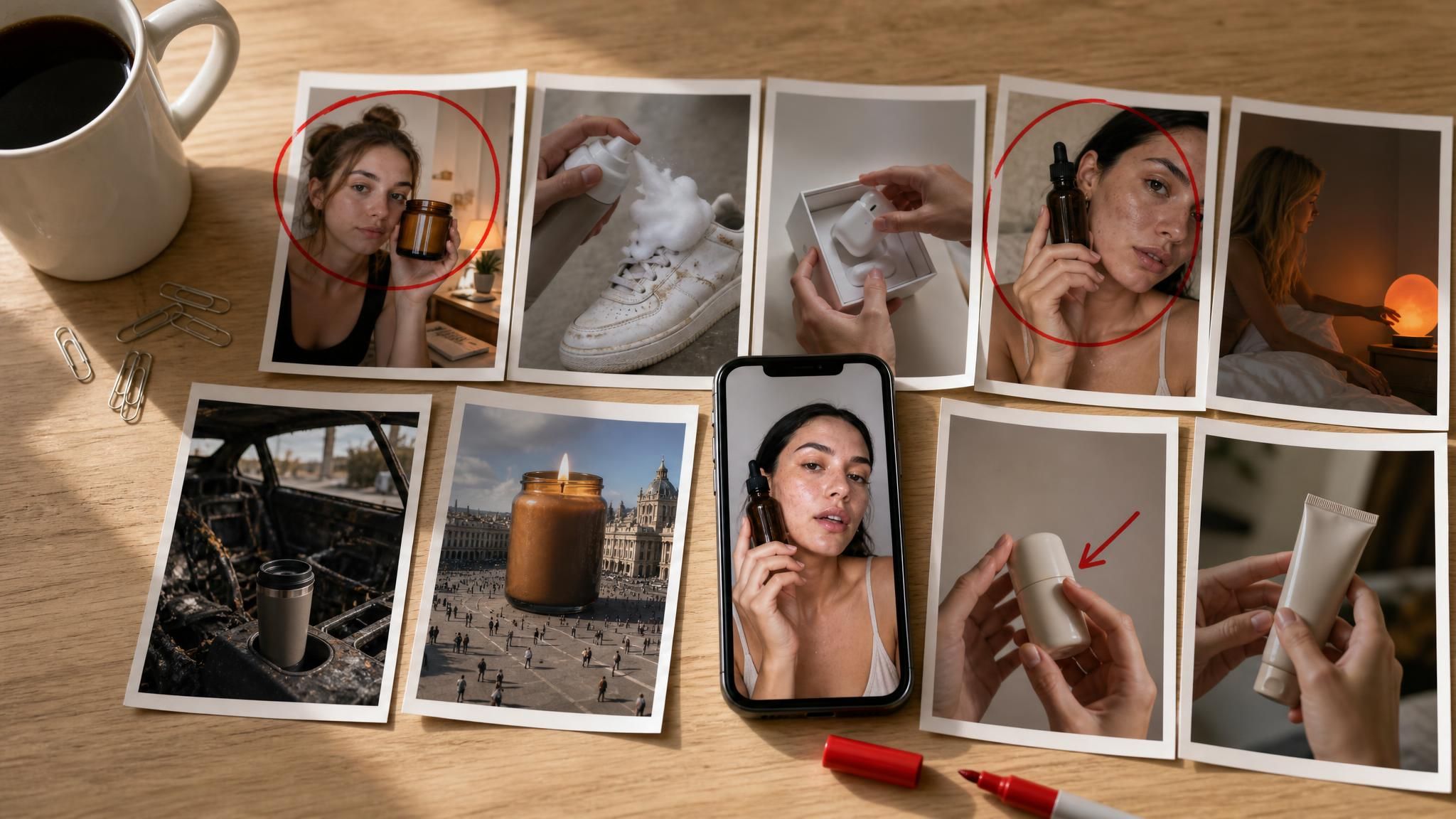
This article collects UGC video examples across the formats that keep converting, testimonial, unboxing, before-and-after, and a few stranger ones, then pulls each apart so you can see the hook, the structure, and the reason it works. Five of the seven were generated with AI from a few product photos and a written brief, and you can reproduce every one of them.
Key Takeaways
- A UGC video is short vertical content that looks filmed by a regular customer: phone framing, direct-to-camera speech, no studio polish.
- The examples that convert share one spine, a hook inside the first three seconds, one clear claim, and proof shown on camera.
- Five formats cover most of what you scroll past: testimonial, unboxing, before-and-after, problem-solution, and pure spectacle.
- UGC-style videos made with AI fall under platform labeling rules; TikTok requires labels on realistic AI-generated content.
- You can make a UGC-style video from a few product photos with the free UGC Product Ad tool, which is how every AI example in this piece was made.
Why UGC Videos Outsell Studio Ads
UGC stands for user-generated content, so the UGC video meaning, in plain terms: a video that a customer or creator films themselves, usually on a phone, showing a product the way a friend would show it to you. What are UGC videos doing in ad accounts, then? Borrowing trust. Viewers have learned to skip anything that opens like a commercial, and the same viewers keep watching anything that opens like a person.
The gap shows up in how the two formats are built.
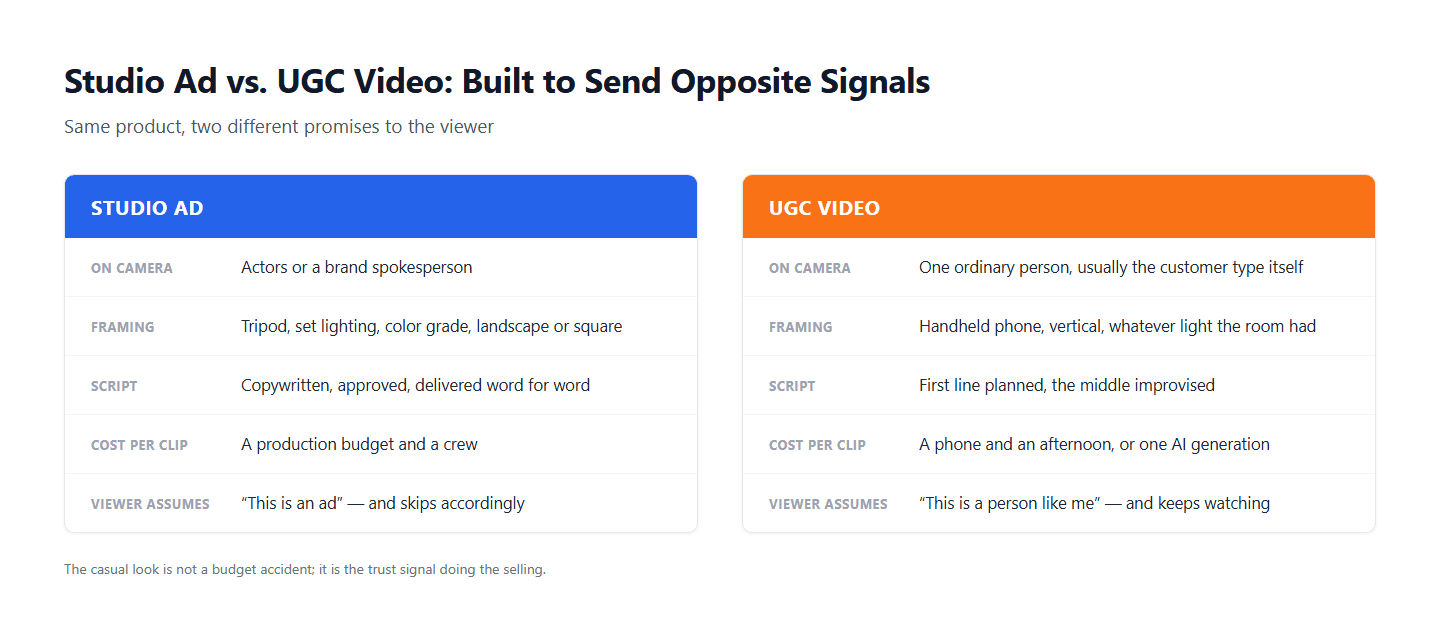
None of this is folklore anymore. The performance side is documented in platform case studies, several with published conversion numbers, which we walked through in our guide to how UGC ads work. The short version: ads built from creator-style footage keep beating polished creative on cost per acquisition, and brands noticed years ago. What changed recently is who can produce the format, which brings us to the tool used for most of the examples in this article.
Make UGC Videos with AI, No Creator Needed
Here is the fastest way to see the format from the inside. Atlas Cloud runs a free UGC Product Ad tool that turns a product photo and a short brief into a finished vertical clip, with a generated presenter, voice, and script. This is what came out of it:
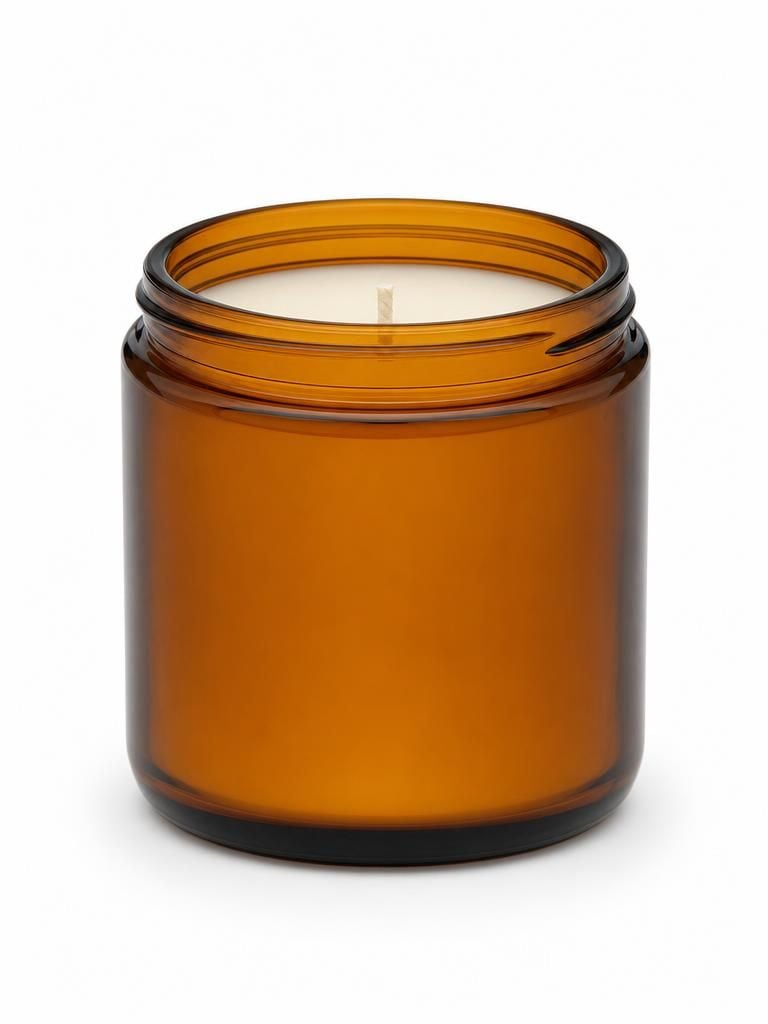
Generated with the free tool from a handful of reference photos of this candle plus a scripted brief, August 2026. The product shot that anchored it:
The workflow takes about two minutes of actual input:
- Upload 1 to 4 product photos, plus an optional actor photo if you want to lock the presenter's face.
- Pick an ad format from the menu, testimonial, unboxing, mess-to-fresh, and a dozen more, then an opening hook and a scene.
- Describe what should happen: who the presenter is, what they do with the product, what they say. A couple of casual lines work; the examples in this article used detailed shot-by-shot briefs for tighter control over hands, flames, and lip sync.
- Set length (4 to 15 seconds) and aspect ratio, then generate.
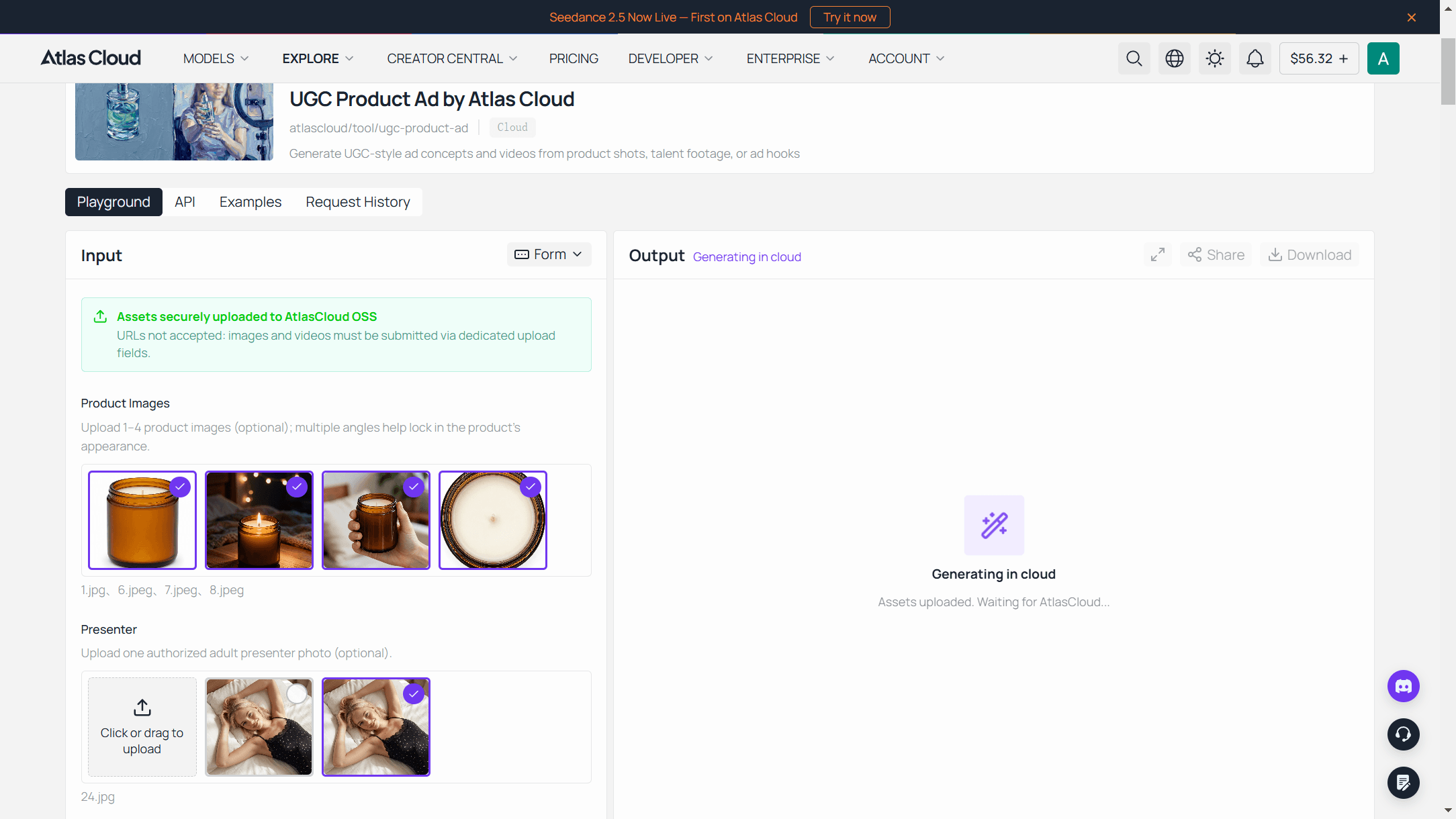
The same page sits inside a larger set of free AI tools covering image editing and other ad-adjacent jobs, useful when your product photo needs cleanup before the video step. Costs are covered in the FAQ; for now, the interesting part is what the output looks like across formats.
7 UGC Video Examples Worth Studying
Two of these are real campaigns, linked to their primary sources. The other five came out of the free tool above, one per format, so you can see exactly what a given brief produces. For each one: what happens on screen, where the hook is, and why the structure sells.
1. The Stanley cup that survived a car fire
In November 2023, a creator named Danielle posted a TikTok of her Stanley tumbler sitting in her burned-out car, ice still rattling inside when she shook it. Her caption: "Thirsty after you catch on fire? @Stanley 1913 is like no problem i gotchu." The original video is still up, sitting at over nine million likes as of August 2026.
This is the purest UGC video a brand could hope for: an unplanned product test, filmed by an actual customer. Stanley's president responded publicly within days, promising her replacement cups and a new car, and the reply became a story in its own right. Watch the structure: the hook is the wreck itself, the claim is never spoken, and the ice does the closing argument.
2. e.l.f.'s Eyes. Lips. Face. challenge
The scaled version of the same trust mechanic. In late 2019, e.l.f. Cosmetics commissioned an original song and asked TikTok users to show their own eyes, lips, and face to it. Per the company's own results announcement, people created over 2.8 million videos and the challenge passed 4 billion views on TikTok.
No single clip carried the campaign; the format did. Every video was a stranger's face and a stranger's bathroom lighting, which is exactly why feeds treated them as content instead of ads. The lesson for smaller brands is not the budget, it is the shape: give people a repeatable format and they will produce your creative for you.
3. The serum morning-routine testimonial
The clip opens with "Okay, real talk," a phrase that signals a confession rather than a pitch. What follows is the tightest testimonial script there is: a time claim (two weeks of daily use), a usage note (one dropper), a texture point, then proof, she points at her own cheek on the no-filter line. The CTA, "Run, don't walk," borrows creator slang instead of ad language, which is exactly the register this format needs.
4. The sunset lamp reveal
The hook is a complaint: "My room looked so boring on camera until this," which frames the product as the fix before you have even seen it. The proof lands mid-sentence, at the flip of a switch, when the wall behind her turns golden, an instant before-and-after with no cut. Specs get exactly one breath, and the close is the classic UGC sign-off: "Thank me later." Everything in the clip, the presenter, the room, the light change, is generated.
5. The sneaker rescue (mess to fresh)
The opening frame spoils the ending, a clean shoe next to the words it started filthy, and that spoiler is the hook. Before-and-after is the most literal proof format in UGC video content: the product's entire pitch happens visually, so it travels across languages and works with the sound off.
6. The earbuds unboxing
Unboxing runs on anticipation rather than argument. The lid comes off, the case flips open, and the viewer gets the small dopamine hit of a package that is not theirs. Notice there is no feature talk at all; the format's job is to make the product feel new and physical. Brands lean on unboxing when the packaging or first impression is a genuine selling point.
7. The five-meter candle (giant product)
The last one is not something a customer could ever film, and that is the point. Giant-product videos belong to the UGC-style spectacle lane, shot like a passerby's phone footage of something impossible. The format exists purely to stop thumbs; the product pitch is the object itself at absurd scale. Footage like this used to mean a CGI production; AI video turned it into a written brief.
A note on those briefs, because they decide whether you get a usable ad or a mess. Every generated clip above was briefed the same three ways: the spoken line written out word for word, the action broken into second-by-second beats, and a closing list of physical rules, one hand in frame, the flame away from hair, the same sneaker in every shot. Vague briefs produce vague videos; the tool rewards specificity.
Types of UGC Videos and When to Use Each
The examples above cover most of the lanes in the matrix below, and picking the wrong lane for your product is the most common way this format fails. A rough map:
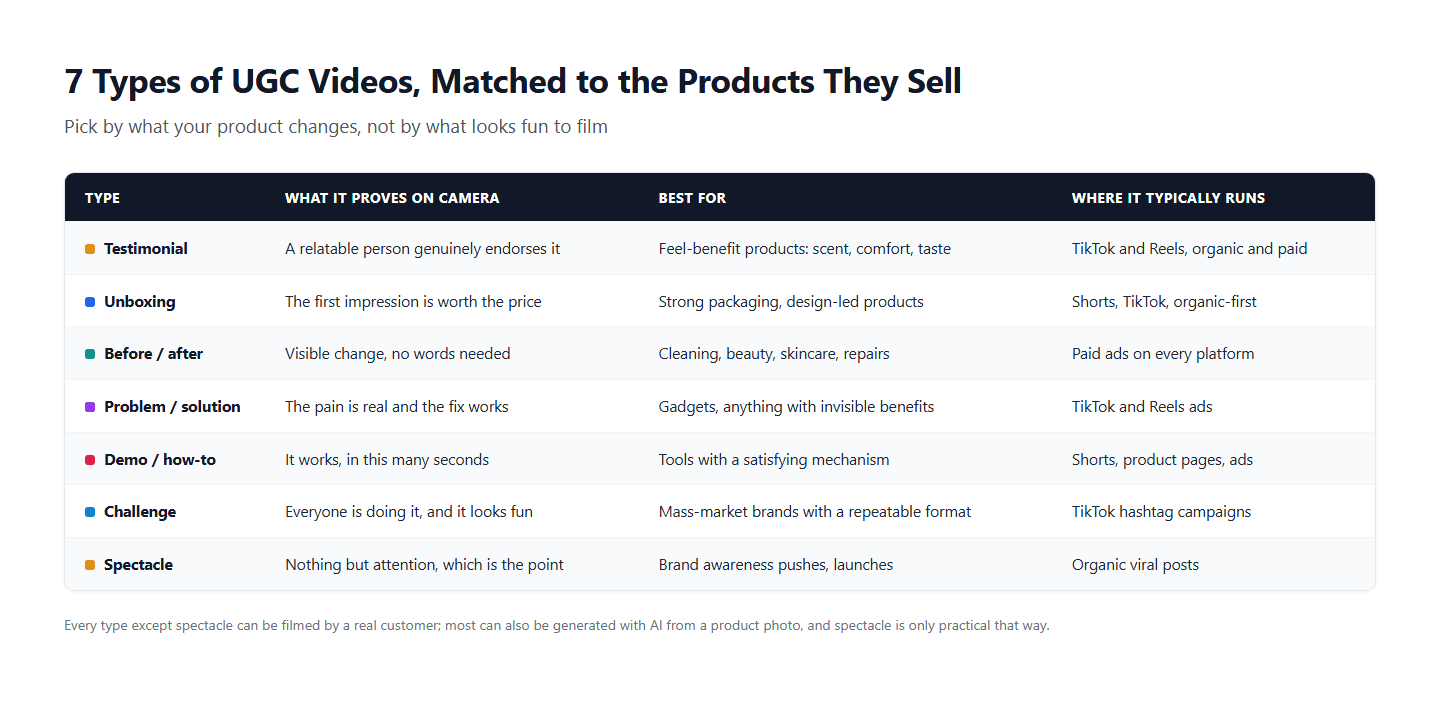
Two patterns worth pulling out of the grid. Products that change something visible, skin, shoes, surfaces, dirty couches, should default to before-and-after, because the proof needs no words. Products whose benefit is a feeling, comfort, taste, scent, need a human face doing the feeling, which pushes them toward testimonial and problem-solution. Demo formats sit in the middle and suit anything with a satisfying mechanism: a button press, a fold, a pour.
UGC vs UGC-Style Videos: Not the Same Thing
Everything labeled UGC in a marketing deck actually splits into three different things. Real UGC is a customer posting on their own; nobody paid them, and the trust it carries is the real article. UGC-style videos are produced to look like that, either by a hired creator or, increasingly, by AI. The style is identical on screen. The difference is disclosure.
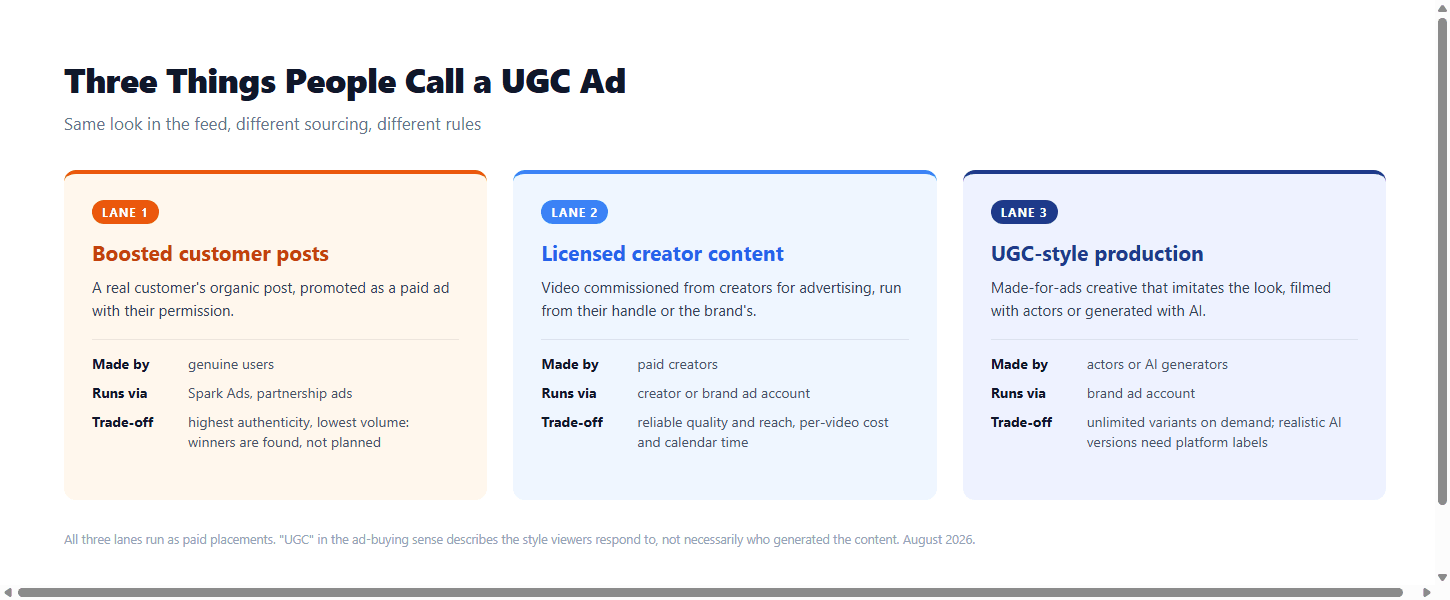
If the video is realistic AI-generated content, TikTok's rules require a label, applied through the built-in label or a clear sticker or caption. Meta applies its own AI labeling to generative ad creative it detects; the details, and what the rules do and do not demand, are covered in our breakdown of what AI UGC is. The label is not the sales killer people assume: in IAB's consumer research fielded through January 2026, 73% of consumers said an AI disclosure would either not change or would increase their purchase intent.
So treat the three lanes honestly. Repost real customers with permission, credit creators, label AI. The format keeps working either way; audiences mostly punish the pretending, not the production method.
UGC Video Ideas You Can Shoot This Week
If the examples sparked nothing specific, here are UGC video ideas that map onto the formats above and need one afternoon at most:
- Film the worst-condition unit of your product you can find, then restore it on camera. Instant mess-to-fresh.
- Answer your most-asked customer question as a talking-head reply, holding the product while you answer.
- Unbox your own product as if you had never seen it, and react to whatever genuinely surprises you.
- Shoot the 10-second version of your setup or first use, cuts allowed, narration optional.
- Stage the problem your product solves and let the fix play out in real time, no jump cut at the reveal.
- Take one absurd claim about your product and test it on camera, whatever the result.
One production note: scripts kill these. Write down the first line, know the last line, and improvise the middle; the stumbles are what make a UGC style video read as real. And if you have no one to put on camera this week, that is precisely the gap the free generator from earlier covers while you recruit actual customers.
Frequently Asked Questions
What is a UGC video?
A UGC video is content filmed by a regular person rather than a brand's production team, typically a short vertical phone video showing, testing, or recommending a product. In advertising, the term stretched: it now also covers UGC-style videos, ads deliberately produced to look user-filmed, whether by hired creators or generated with AI.
How long should a UGC video be?
Short, if it is an ad. The AI-generated examples in this article run 10 to 15 seconds, which is enough for one hook, one claim, and one proof shot. There is no single correct length, but the working rule is that the hook must land inside the first 3 seconds and nothing after your main proof point earns its runtime. Ads sit comfortably under 30 seconds; organic storytelling formats can run longer.
Do AI-generated UGC videos need a disclosure label?
On TikTok, realistic AI-generated content must be labeled under the policy the platform introduced in September 2023. Meta applies AI labels to generative creative it detects in ads. Rules differ by platform and keep moving, so check the current policy where you publish; the safe default is to label anything a viewer could mistake for a real person's footage.
How much does it cost to make UGC videos with AI?
The UGC Product Ad tool used for the examples here has a free plan, and paid generation works out to roughly $0.12 per second of video at 480p as of August 2026, so a 10-second clip costs just over a dollar. Hiring a UGC creator for a single clip costs far more, which is what makes AI the cheap way to test formats before commissioning humans; our ranking of UGC video platforms compares the options if you outgrow the free tier.
Conclusion
The stranger from the opening line was never really competing on production quality. Every example in this article, the real campaigns and the generated ones alike, runs on the same spine: a hook in the first three seconds, one claim a person could actually say out loud, and proof the camera can see. Format is just the costume that spine wears, testimonial for feelings, before-and-after for visible change, spectacle for attention.
The practical move is to steal the structure, not the clip. Pick the format that matches what your product changes, script the first line only, and produce the first draft cheaply, with your phone or with the free tool used throughout this piece. The fastest way to internalize what makes these UGC video examples work is to make a bad one, watch it back, and fix the hook.





