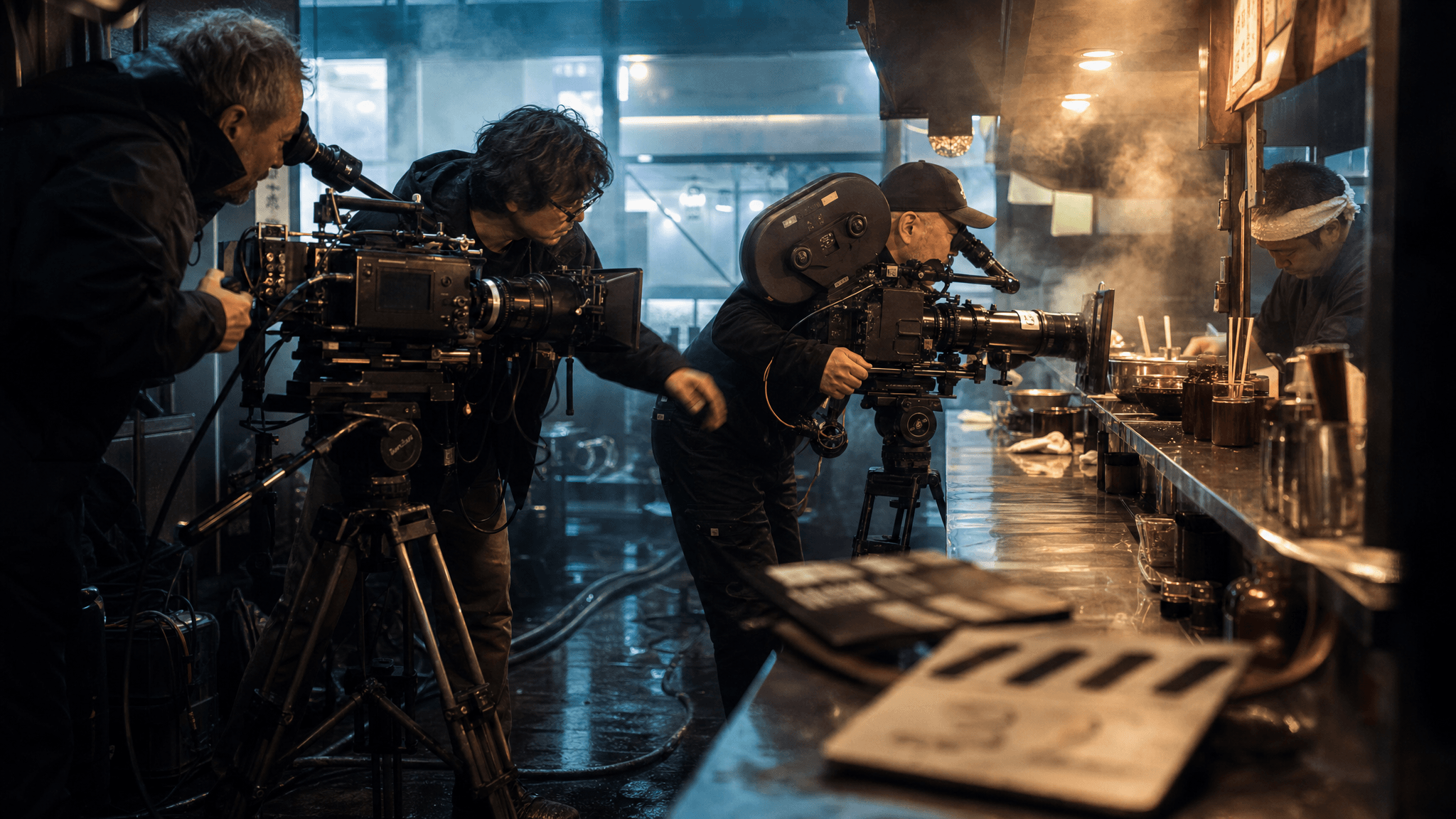
Three film cameras crowded around one small midnight ramen counter set, steam drifting through the heat lamp
One set, one scene number on the clapperboard, three different cameras pointed at it. That is the whole method of this article. Generated with openai/gpt-image-2/text-to-image.
Four days after MiniMax H3 started topping leaderboards, searches for its alternatives went up. That is not a contradiction.
Two kinds of people are typing it. One group is annoyed: the render queue is long, the invoice came in bigger than the quote in their head, and there is a Tuesday deadline. The other group is not annoyed at all. They like H3. They just remember that the model they committed to in February got replaced in March, and again in April, and again in June. They are not shopping for a replacement. They are shopping for an exit that does not cost a week of engineering.
I went looking for the answer the normal way, by reading leaderboards. The leaderboards refused to cooperate. As of 4 August 2026 there are three of them for video, and they crown three different models. So I stopped reading and started running: one brief, unedited, 5 seconds, straight into all three of the current #1s.
Key takeaways
- There is no single best MiniMax H3 alternative, because there are three #1s. On 4 August 2026: H3 leads video editing with audio (1,130 Elo), Gemini Omni Flash leads text-to-video with audio (1,245), Seedance 2.0 720p leads image-to-video with audio (1,196).
- Need maximum picture and no sound? Gemini Omni Flash. It also tops the no-audio text-to-video board at 1,324 Elo, and it bills less per second than H3.
- Animating a still frame? Seedance 2.0 leads that board. But its 720p rate works out higher per second than H3's 2K rate, so verify "switching to the cheaper one" before you commit to it.
- Text inside the frame is the test that actually separates them. On my identical brief, H3 and Gemini Omni Flash both held the title card clean; Seedance 2.0 scrambled the letters for a frame before resolving. Elo columns cannot tell you that.
- The budget floor is real, not imaginary: Veo 3.1 Lite still holds a scene together. Go lower on the public boards (LTX-2.3 Fast at $2.40/min, Elo 980) and what you buy is re-runs, not savings.
- Switching should cost almost nothing. Behind one API with one key and one JSON body, migrating is one string. That, not price, is what people searching this term actually need.
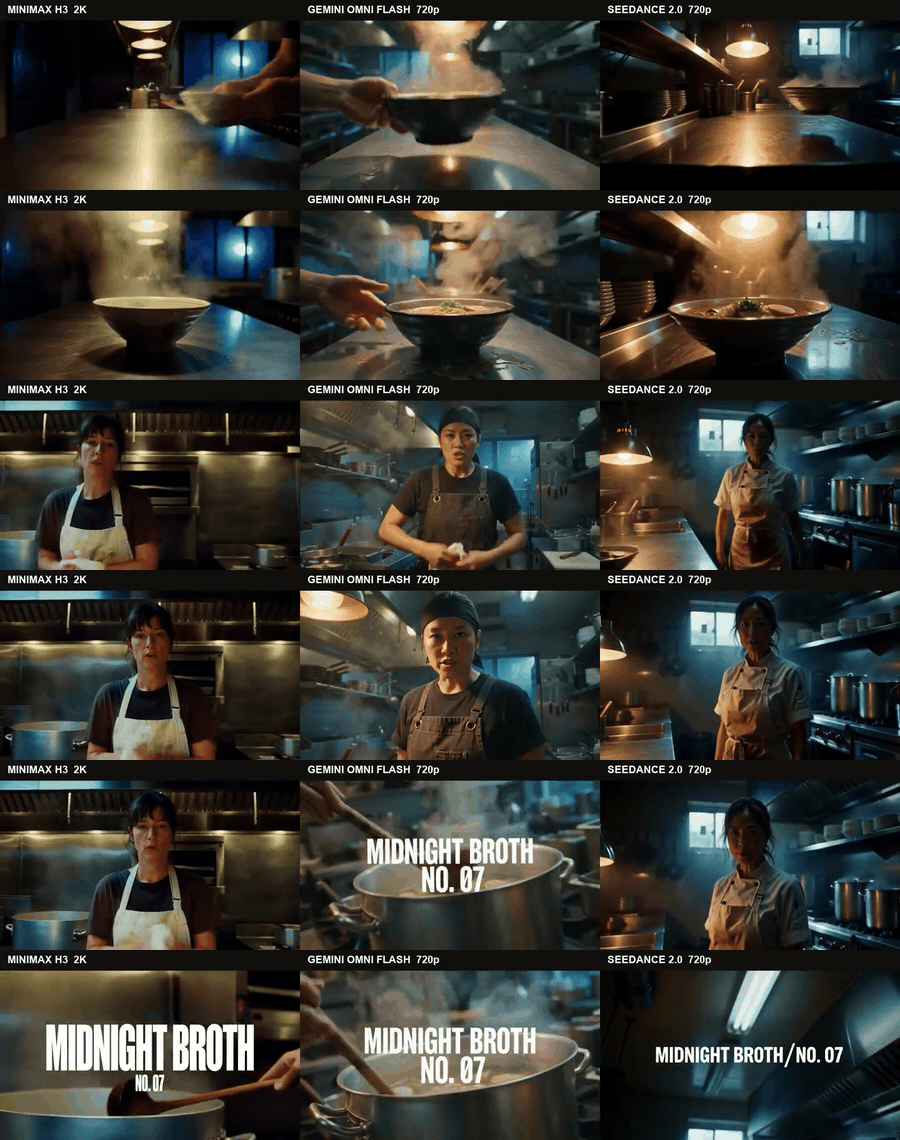
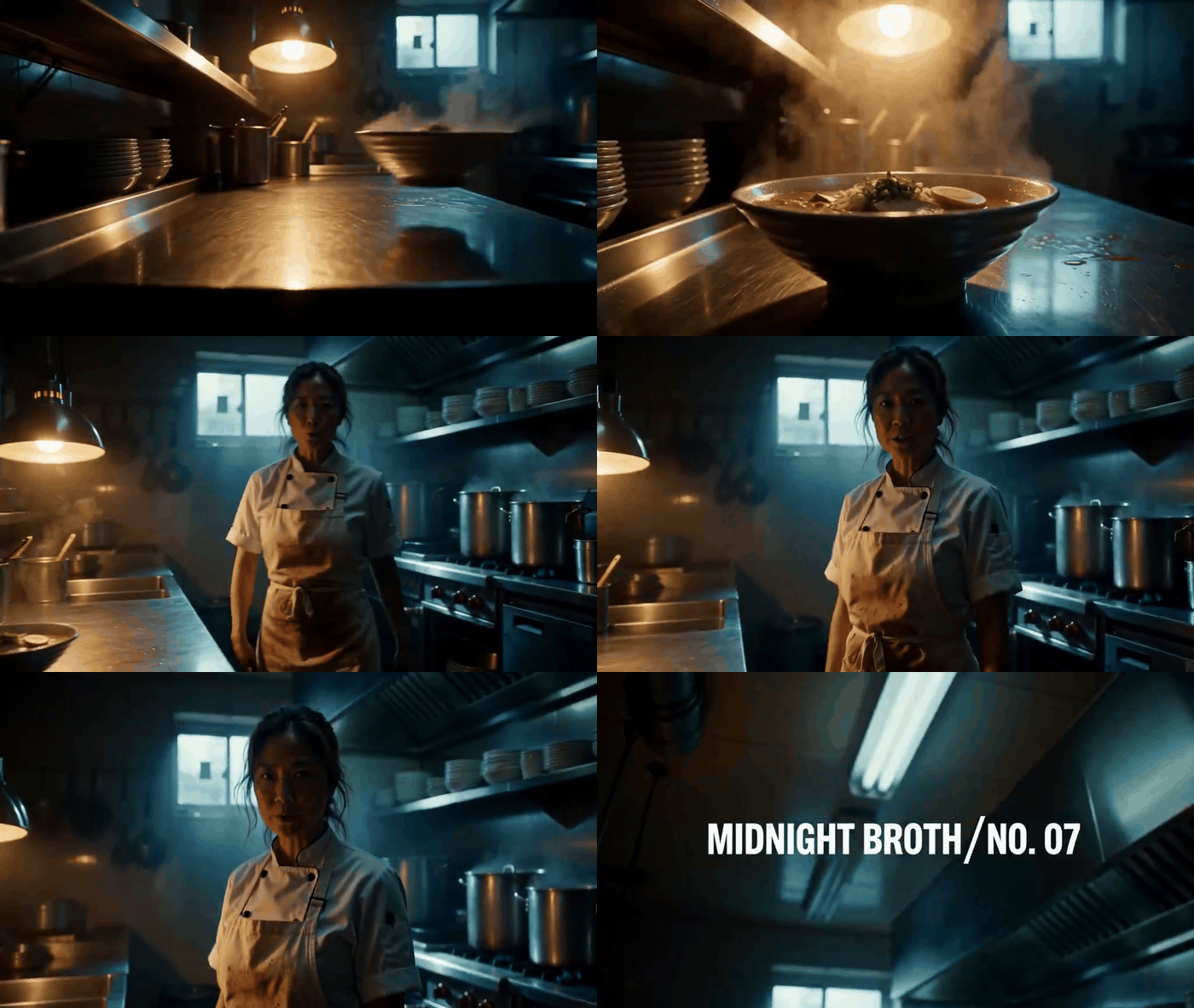
The same 5-second ramen brief, word for word, on all three current leaderboard leaders. Left: MiniMax H3 at 2K. Middle: Gemini Omni Flash at 720p. Right: Seedance 2.0 at 720p. Each model's own full clip is further down. Watch the last second, where the title card lands.
Why MiniMax H3 Alternatives Broke Every Shortlist in One Week
Here is the problem with the question. Video is not one task, and Artificial Analysis does not score it as one. It runs three separate arenas, and on the day I read them, each had a different winner.
| Leaderboard (with audio) | #1 | #2 | #3 | Where H3 sits | Listed API price of the leader |
|---|---|---|---|---|---|
| Video editing | MiniMax H3, 1,130 | Gemini Omni Flash, 1,122 | HappyHorse-1.0, 1,096 | 1st | $7.80 / min |
| Text-to-video | Gemini Omni Flash, 1,245 | MiniMax H3, 1,234 | Seedance 2.0 720p, 1,221 | 2nd, 11 back | $6.00 / min |
| Image-to-video | Seedance 2.0 720p, 1,196 | Gemini Omni Flash, 1,193 | MiniMax H3, 1,187 | 3rd, 9 back | $9.07 / min |
Scores read on 4 August 2026 from the Artificial Analysis Video Editing Leaderboard, the Text-to-Video Leaderboard and the Image-to-Video Leaderboard (Artificial Analysis, August 2026). All three are crowdsourced blind votes, so the numbers drift with vote volume. The listed price is the cost of one minute of 1080p on the creator's own API at default settings, which is not what you pay per finished clip on any given endpoint. Treat gaps under about 15 points as a tie, not a verdict.
Look at the third row again. First, second and third are separated by 9 points across a 95% confidence interval of roughly plus or minus 9. That is a three-way tie being printed as a ranking.
And this churn is not new. Over the past half year the top slot has changed hands roughly every four to eight weeks: Kling 3.0, then Veo 3.1, then Seedance 2.0, then Gemini Omni Flash, then Wan 2.7, then Seedance 2.5, now H3. Nobody reading this is picking a model for the next two years. They are picking one for the next six weeks and quietly pricing the cost of changing their mind.
So Elo cannot settle it. But one thing can, in about five seconds of watching: does your shot have text in it?
Typography that survives motion is the most common failure in this category. Letters wobble, edges smear, a serif grows a limb by frame 40. It is also binary in a way picture quality is not: either the word is spelled right in every frame or the take is dead. H3's own sample reels lean on exactly that, which tells you where it thinks its moat is. These three clips are MiniMax's official H3 output, not mine, and they set the bar an alternative has to clear.

A full noir title sequence: card after card of Latin and Japanese type, credits, panel wipes. Every letter holds its shape for the whole run. This is the job that decides whether you can switch.
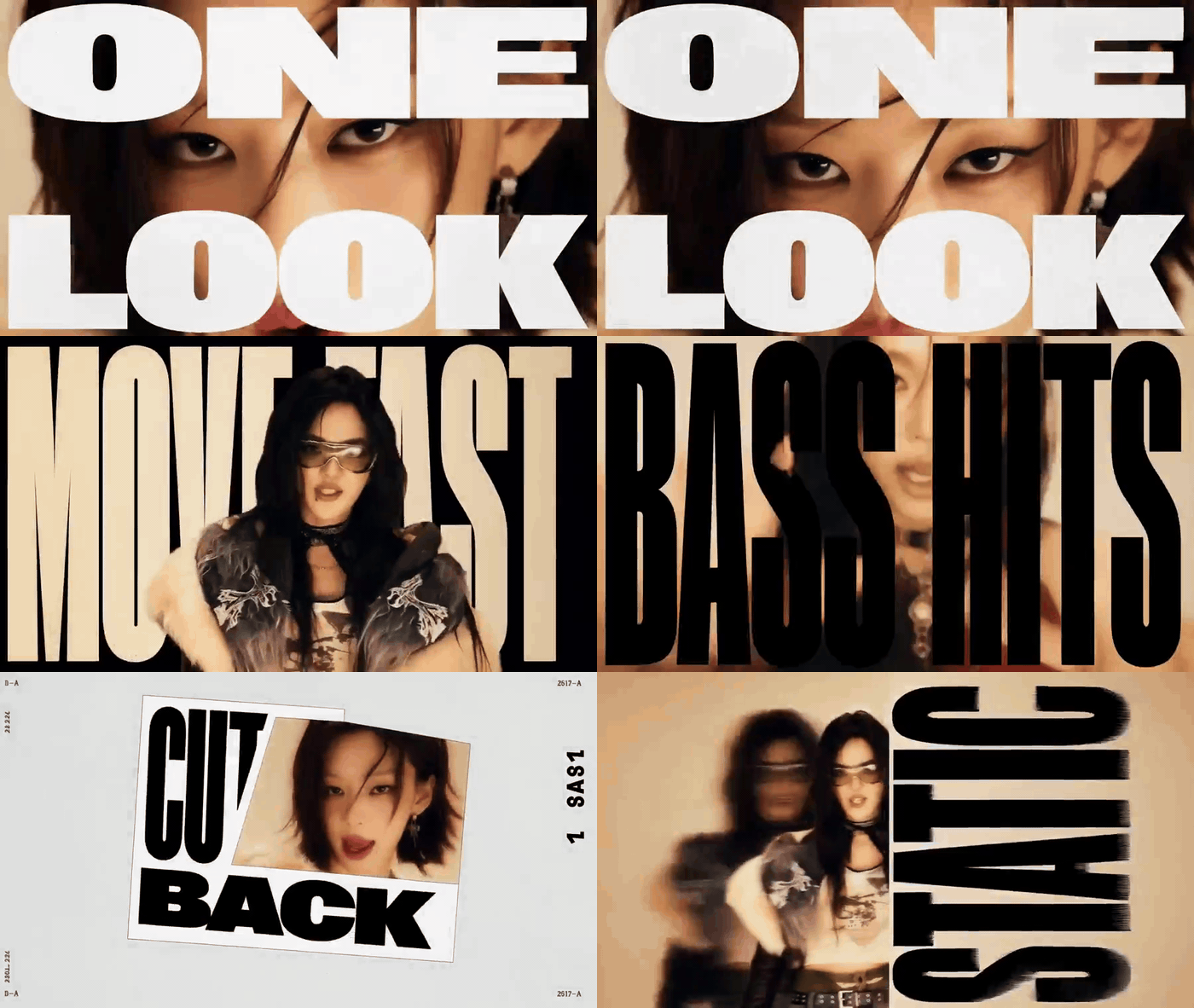
Fashion kinetic type. The words sit behind and around the subject instead of floating on top, which is the difference between designed and pasted on.
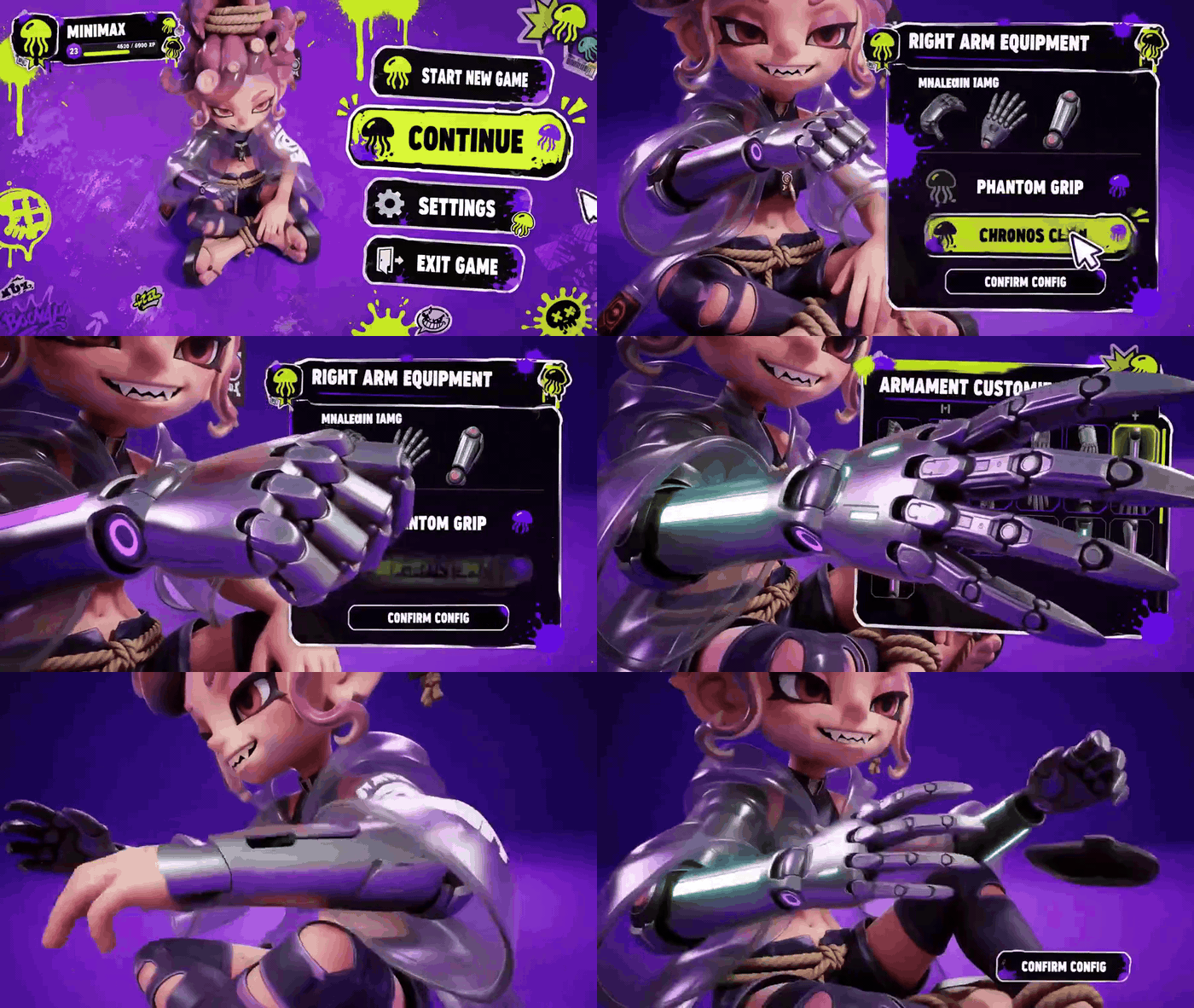
A game menu and an equipment panel. Labels stay put, the highlight lands on the row it is supposed to land on, then the camera leaves for the street. Interface elements stay where they were placed.
The MiniMax H3 Alternatives Shortlist, Routed by the Job You Shoot
Stop ranking models. Rank queues. Here is the routing table I actually use, with the per-second rate each endpoint bills on Atlas Cloud, read the same day as the leaderboards.
| The shot you are making | Route it to | Why | Rate |
|---|---|---|---|
| Maximum picture, no sound needed | Gemini Omni Flash Text-to-Video | #1 on the no-audio text-to-video board at 1,324 Elo, and #1 with audio too | $0.125 / s, 3s minimum |
| Animating a still frame | Seedance 2.0 Image-to-Video | #1 image-to-video with audio, 1,196 | token billed, about $0.2419 / s at 720p |
| Changing footage you already shot | MiniMax H3 Text-to-Video is the family, editing is its board | #1 video editing with audio, 1,130 | $0.14 / s at 2K |
| The same job when H3 is busy | Gemini Omni Flash Video Edit | 1,122, eight points behind. Closest like-for-like fallback there is | $0.14 / s |
| On-screen type as a designed title beat | MiniMax H3, with Gemini Omni Flash as a real second option | Both held the type on my brief; H3 treated it as a title card, Omni Flash as an overlay | $0.14 / s and $0.125 / s |
| Locking a look across 9 images and 3 clips | MiniMax H3 Reference-to-Video | Takes up to 9 images, 3 videos, 3 audio in one call | $0.14 / s |
| Batch drafts before you commit | Seedance 2.0 Mini | Cheap enough to burn on ten takes, has 1440p super-res tiers | $0.056 / s |
| Cheapest that still holds a scene | Veo 3.1 Lite | 1,089 Elo with audio at a $4.80/min list price | $0.05 / s |
| Discounted mid-tier this month | Kling V3.0 Turbo | 15% off as of August 2026, was $0.112 | $0.095 / s |
| Open-weights sibling at the same price | HappyHorse-1.1 and Wan 2.7 | 1,147 and 1,158 on text-to-video, both on the boards | $0.14 / s and $0.10 / s |
| You want to host it yourself | MiniMax H3 weights | The only open-weights model in the top three of any of the three boards | free locally, with caveats below |
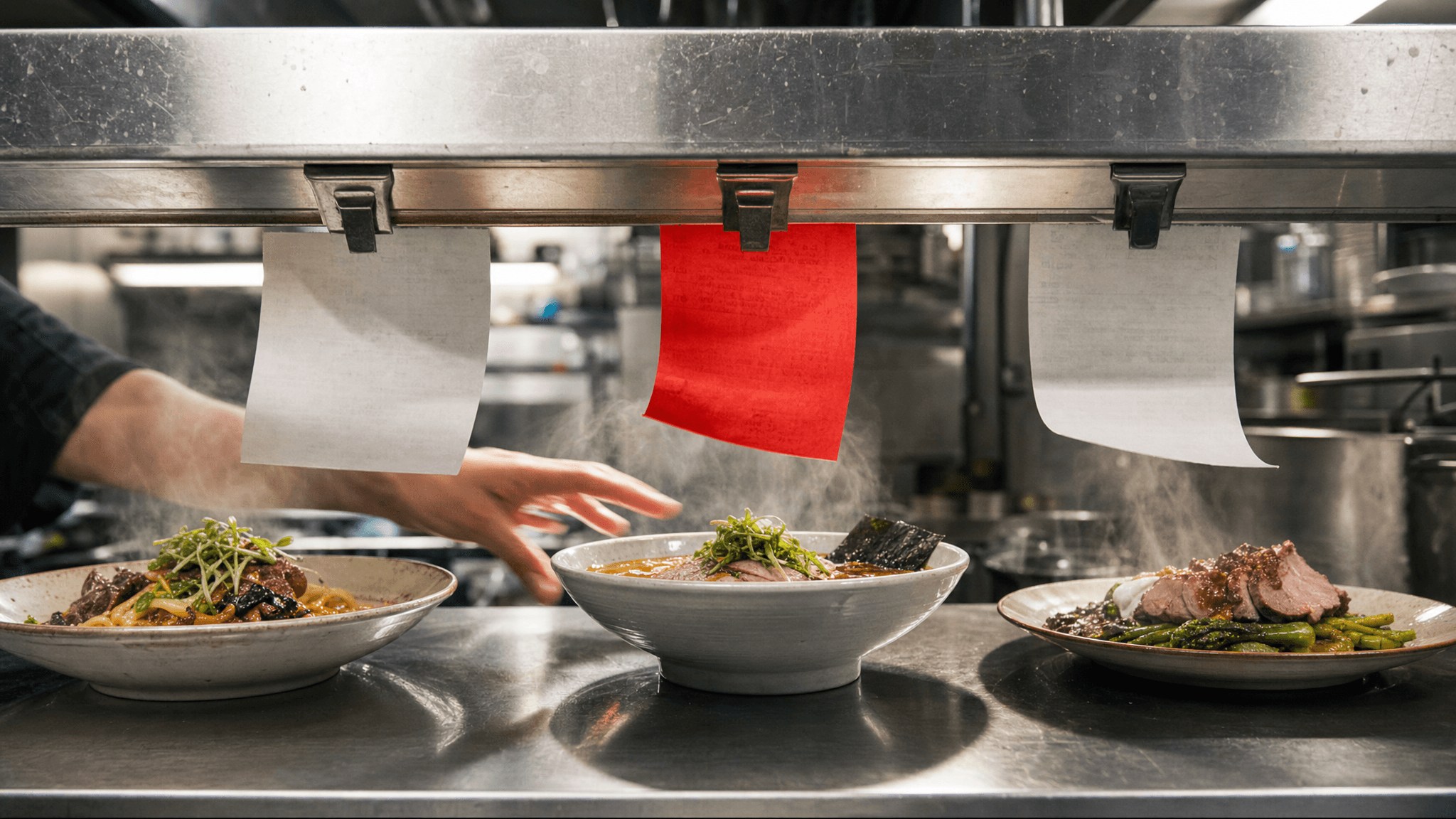
A restaurant pass at service peak, three tickets clipped to a rail and three finished bowls waiting under the heat lamp
Three tickets, three bowls, one hand reaching for the right one. Routing, not ranking. Generated with openai/gpt-image-2/text-to-image.
Here is the part that actually matters, and it is not the price column. Switching video providers the normal way means a new signup, a new billing entity, a new auth scheme, a new polling shape, a new set of error strings, and a new invoice to reconcile. Budget a week and a bad afternoon. Behind a single API with one key and one JSON body, the same migration is one string:
python1MODELS = { 2 "baseline": "minimax/h3/text-to-video", 3 "max_picture": "google/gemini-omni-flash/text-to-video", 4 "from_still": "bytedance/seedance-2.0/image-to-video", 5 "drafts": "bytedance/seedance-2.0-mini/text-to-video", 6} 7# same endpoint, same key, same poll loop. Change the value, not the pipeline. 8
That is the honest answer to the second search intent. If you are not angry at H3 and just want a backup, the thing to buy is not a different model. It is the property that changing models is a one-line diff.
One warning about the bottom of the market. Veo 3.1 Lite at $0.05 per second is a real floor, and it still composes a watchable scene. Below that the quality cliff is steep and measurable: on the public text-to-video board, LTX-2.3 Fast lists at $2.40 per minute and scores 980 Elo, about 265 points under Gemini Omni Flash. At that gap you are not buying a cheap model, you are buying extra attempts.
Step 1: Set the MiniMax H3 Baseline Every Alternative Has to Beat
One brief, four hard problems stacked into 5 seconds: typography moving through frame, a spoken line that has to match a mouth, liquid and steam physics, and sound generated in the same pass. Three of those four are exactly where the three leaderboards disagree.
Paste this verbatim. Do not improve it for any of the three models. If you rewrite the prompt between runs, you are not comparing models any more, you are comparing your own edits.
text1A ramen chef slams a finished bowl onto a steel pass in a cramped midnight kitchen, steam exploding upward. 2 3Shot 1: low-angle push-in as the bowl hits the steel, broth trembling at the rim, steam catching the overhead heat lamp. 4Shot 2: lateral tracking shot as she wipes her hands on her apron, looks straight into the lens and says, "Twelve hours. One bowl." 5Shot 3: quick tilt up as a kinetic title card wipes across the frame, condensed white type reading "MIDNIGHT BROTH / NO. 07", letters snapping into position one beat after the ladle knocks the pot. 6 7Handheld energy, tungsten heat lamp against cold blue window light, wet brushed steel, volumetric steam, shallow depth of field, 35mm grain. 8 9Audio: bowl clacking onto steel, broth sloshing, extractor fan hum, her line clear over the top, one wooden ladle knock as the title lands. 10
Settings on the MiniMax H3 Text-to-Video endpoint:
- Resolution:
2K. The model page documents a 768P tier at $0.10 per second, but the playground exposes 2K only, so plan around $0.14 per second and check your own invoice. - Aspect Ratio:
16:9. This field is required for text-only runs and it rejectsadaptive. Leave it unset and the request 400s. - Duration:
5, typed in explicitly. Do not leave it blank. The schema documents a default of 8, but an omitted duration has come back as a 5-second file billed as 5 seconds, so state what you want.
Cost of this run: 5 x $0.14 = $0.70. That is exactly what the finished job billed.
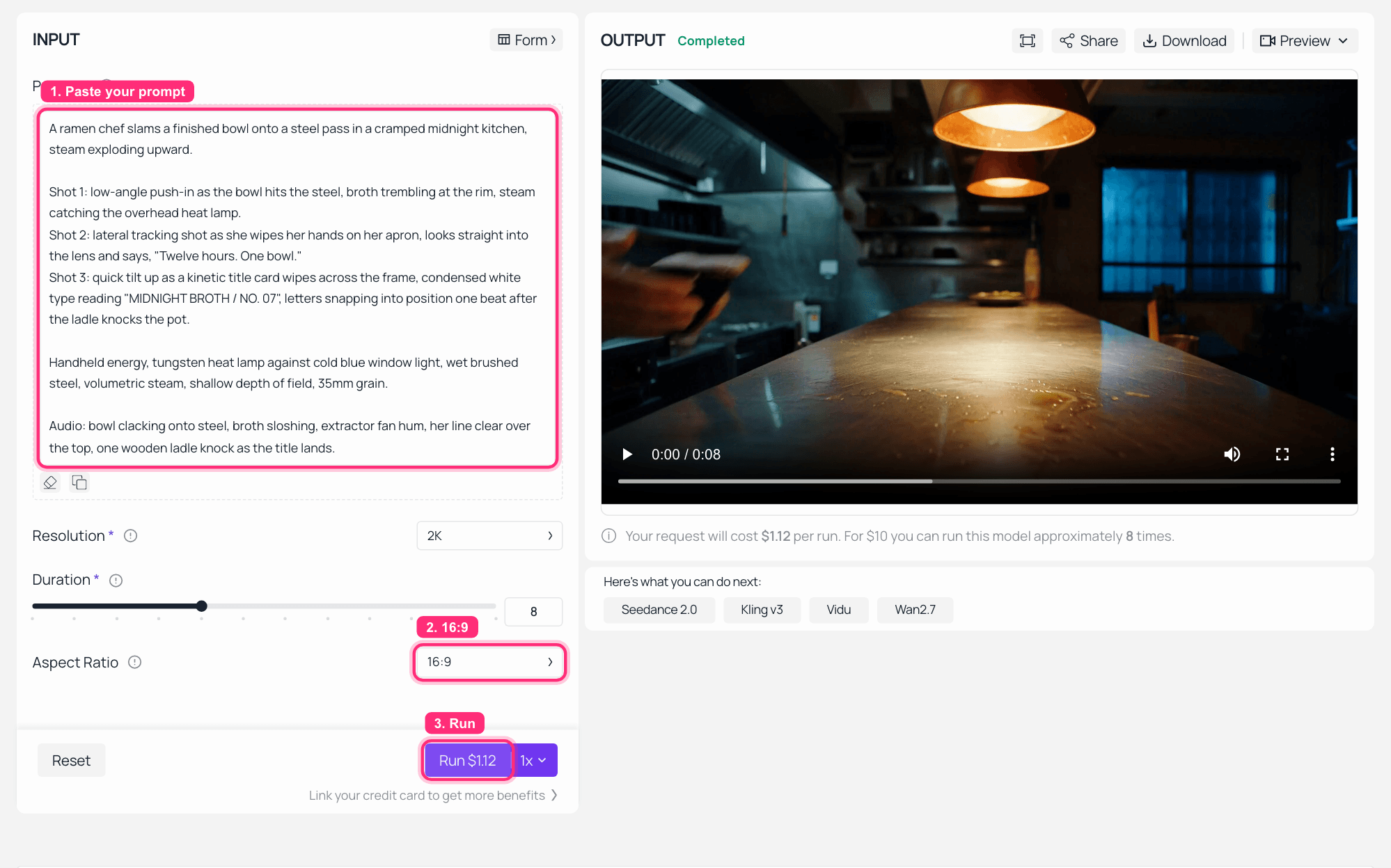
MiniMax H3 Text-to-Video playground on Atlas Cloud with the ramen brief filled in and the finished 2K clip in the OUTPUT panel
MiniMax H3 Text-to-Video: brief on the left, Resolution 2K, Aspect Ratio 16:9, finished clip playing on the right. The Duration slider is still on the page default of 8 in this capture, which is why the Run button quotes $1.12; drag it to 5 and the quote follows.
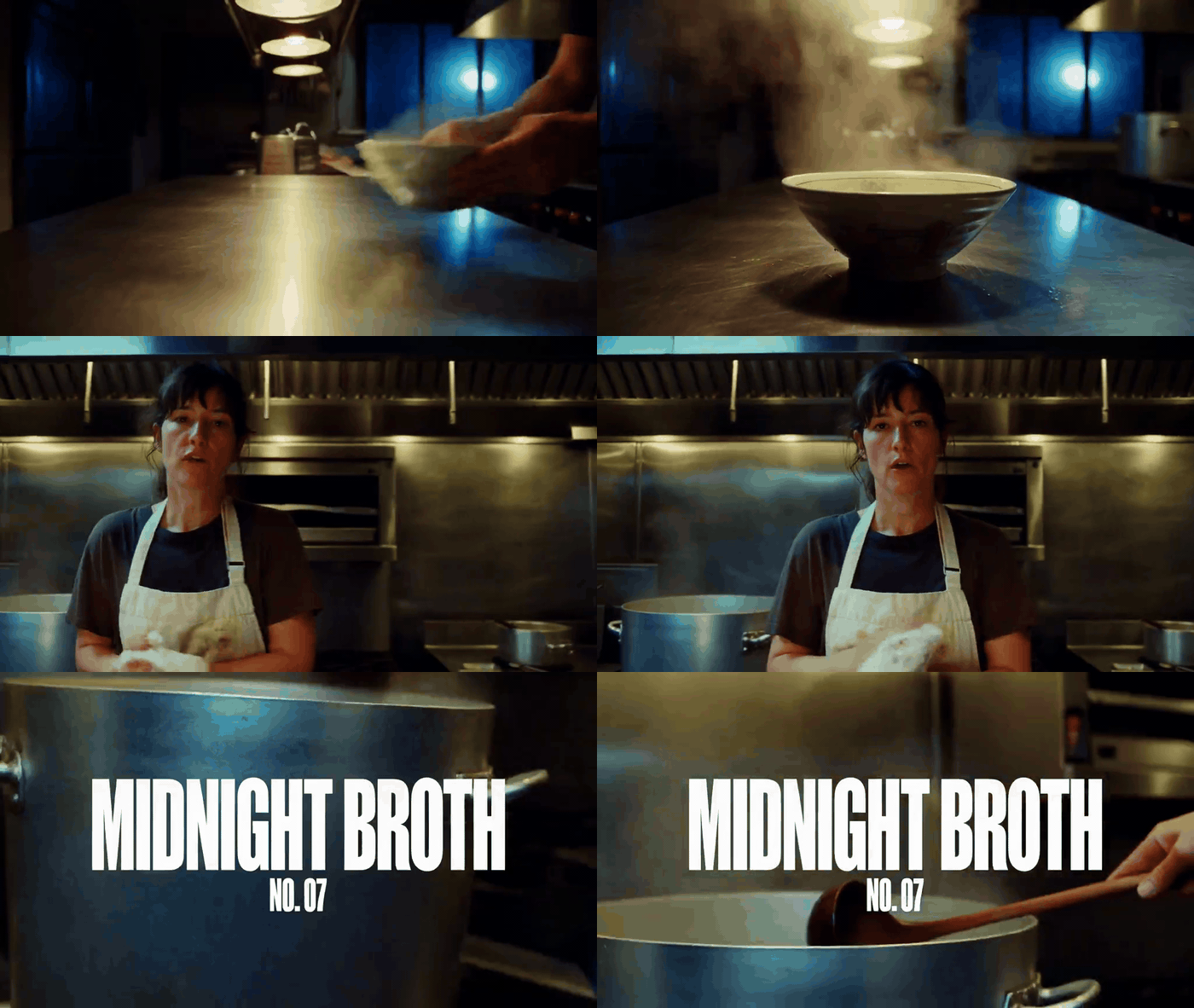
The baseline: MiniMax H3, 2560x1440, 24 fps, 32 kHz stereo generated in the same pass.
What it actually did with 5 seconds: three distinct shots, in order. The bowl lands, the chef speaks to camera, then the title card. "MIDNIGHT BROTH" comes in as a real card with a smaller "NO. 07" line under it, correct hierarchy, clean edges, no wobble as the frame moves. This is the bar.
Step 2: Run the Same Brief on the Strongest MiniMax H3 Alternative
Gemini Omni Flash is the one that beats H3 outright on text-to-video, with audio (1,245 to 1,234) and without (1,324 to 1,306). It also bills less per second. On paper this is the switch.
Same words. No additions, no "cinematic, 8k, masterpiece".
text1A ramen chef slams a finished bowl onto a steel pass in a cramped midnight kitchen, steam exploding upward. 2 3Shot 1: low-angle push-in as the bowl hits the steel, broth trembling at the rim, steam catching the overhead heat lamp. 4Shot 2: lateral tracking shot as she wipes her hands on her apron, looks straight into the lens and says, "Twelve hours. One bowl." 5Shot 3: quick tilt up as a kinetic title card wipes across the frame, condensed white type reading "MIDNIGHT BROTH / NO. 07", letters snapping into position one beat after the ladle knocks the pot. 6 7Handheld energy, tungsten heat lamp against cold blue window light, wet brushed steel, volumetric steam, shallow depth of field, 35mm grain. 8 9Audio: bowl clacking onto steel, broth sloshing, extractor fan hum, her line clear over the top, one wooden ladle knock as the title lands. 10
Settings on the Gemini Omni Flash Text-to-Video endpoint:
- Duration:
5. Range is 3 to 10, and billing has a 3-second floor. - Aspect Ratio:
16:9. The only other option is9:16. - Resolution:
720p. That is the whole enum on this endpoint, so there is no higher setting to reach for. - Thinking level:
default. Push it tohighonly if a complex prompt is coming back confused; it trades latency for quality. - Seed: leave blank for a random seed, or pin an integer if you want to iterate on one take.
Cost of this run: max(3, 5) x $0.125 = $0.625, billed to the cent. That is 11% under the H3 baseline.

Gemini Omni Flash Text-to-Video playground on Atlas Cloud running the same ramen brief at 720p with the result in OUTPUT
Gemini Omni Flash Text-to-Video: identical brief, Duration 5, 720p, Thinking Level on default, Run quoting $0.625.
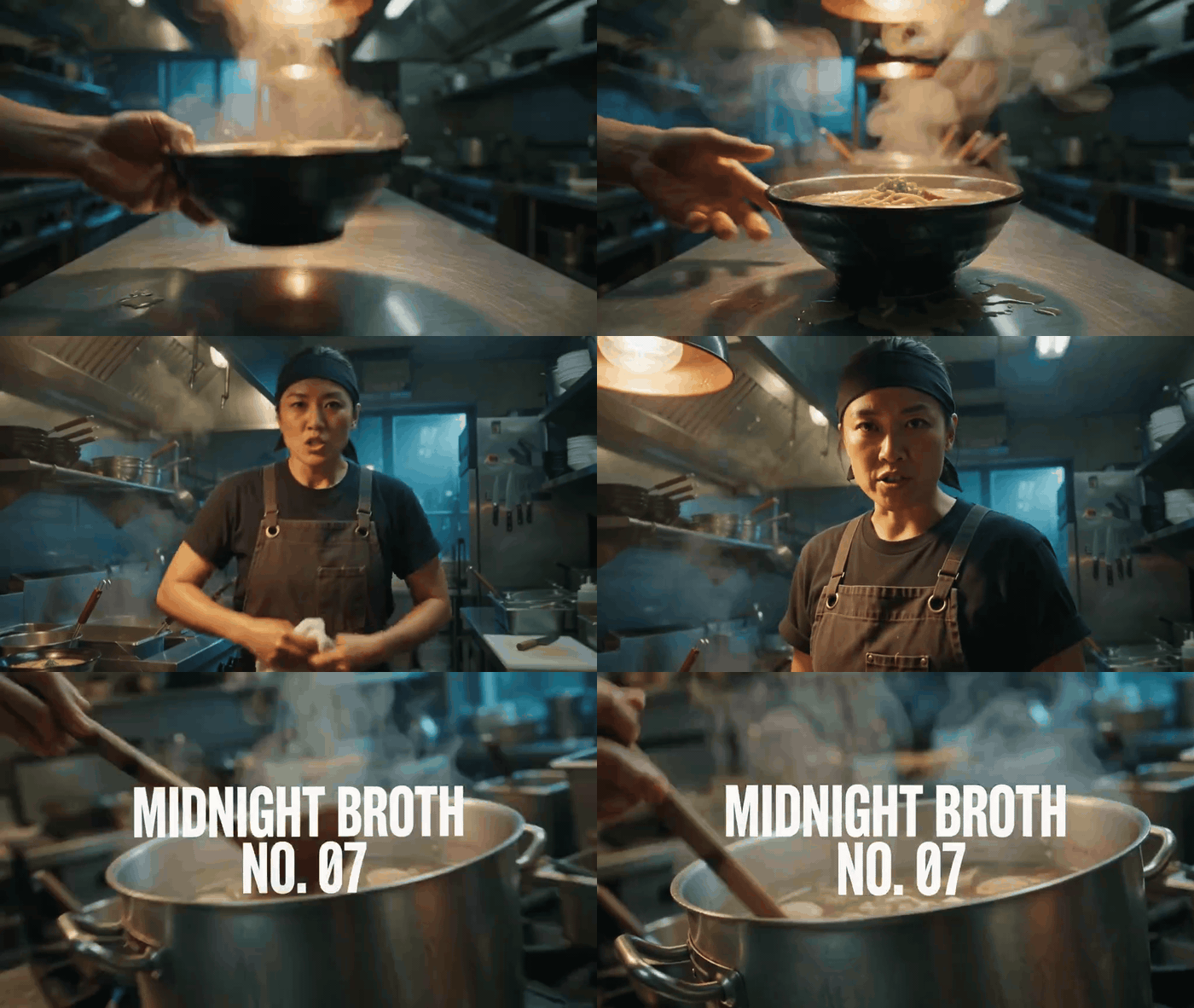
Gemini Omni Flash on the same 5 seconds, 1280x720, 48 kHz stereo.
It cleared the type test too, which was the genuine surprise. "MIDNIGHT BROTH / NO. 07" renders crisp and stays crisp. Where it differs is direction: it treats the words as an overlay that lives across several shots rather than a title card that arrives on a beat, and it spends more of the 5 seconds cutting than H3 does. Cheaper, sharper on words than expected, looser on the shot list. If your work is packaging where the title is a designed moment, that difference matters. If it is social where the words just have to be legible, it does not.
Step 3: Try the Image-to-Video Leader as a MiniMax H3 Alternative
Seedance 2.0 owns the image-to-video board, which makes it the most-recommended alternative in this whole category. Its text-to-video endpoint runs the same model family, so it is the fair third seat for one identical brief.
text1A ramen chef slams a finished bowl onto a steel pass in a cramped midnight kitchen, steam exploding upward. 2 3Shot 1: low-angle push-in as the bowl hits the steel, broth trembling at the rim, steam catching the overhead heat lamp. 4Shot 2: lateral tracking shot as she wipes her hands on her apron, looks straight into the lens and says, "Twelve hours. One bowl." 5Shot 3: quick tilt up as a kinetic title card wipes across the frame, condensed white type reading "MIDNIGHT BROTH / NO. 07", letters snapping into position one beat after the ladle knocks the pot. 6 7Handheld energy, tungsten heat lamp against cold blue window light, wet brushed steel, volumetric steam, shallow depth of field, 35mm grain. 8 9Audio: bowl clacking onto steel, broth sloshing, extractor fan hum, her line clear over the top, one wooden ladle knock as the title lands. 10
Settings on the Seedance 2.0 Text-to-Video endpoint:
- Duration: change it from
Autoto5. Leaving it on Auto hands the length to the model, and since this endpoint bills by pixels x seconds, it also hands over your bill. - Resolution:
720p. - Aspect Ratio:
16:9, notAuto, so it matches the other two runs. - Generate Audio: on. The brief asks for sound, and this is the switch that produces it.
- Bitrate Mode:
standard. Watermark: off.
Now the number that breaks the premise of this entire search term. Seedance 2.0 does not bill a flat per-second rate. The model page states it plainly: "For every second of 720p video you generated, you will be charged $0.2419/second. Your request will cost $0.0112 per 1000 tokens. The number of tokens is given by (height of output video x width of output video x (input duration + output duration) x 24) / 1024." My 5-second 720p run billed $1.21968. That is more than the H3 baseline at 2K, on the endpoint most people are told to switch to for savings. The leaderboard's own price column agrees, listing Seedance 2.0 720p at $9.07 per minute against H3's $7.80.

Seedance 2.0 Text-to-Video playground on Atlas Cloud with Duration set to 5, Generate Audio on, and the finished clip in OUTPUT
Seedance 2.0 Text-to-Video: same brief, Duration 5, 720p, 16:9, Generate Audio on, Watermark off. The token formula is printed under the OUTPUT panel, which is where the real number lives.
Seedance 2.0 on the same 5 seconds, 1280x720, 44.1 kHz stereo.
And this is where the dividing line showed up. The picture is beautiful, the steam is the best of the three, and then the title card arrives and the letters scramble. Step through the last second frame by frame: one frame reads as broken glyphs, roughly "MC. VNNUT10", before the next frame resolves into "MIDNIGHT BROTH / NO. 07". Freeze on the wrong frame and you have an unusable take. It also spent most of its 5 seconds on the chef standing still instead of running the three shots the brief asked for.
Three runs, one set of words, $2.54 total. Two models held the type, one broke it, and that answer would have been invisible in any of the three Elo columns.
Three variations worth running before you decide anything. Swap Aspect Ratio to 9:16 and re-run the same brief: vertical poster work with type in it is where the cheap tier drops out fastest, and it is a fast way to find your own floor. Second, draft on Seedance 2.0 Mini at $0.056 per second until the blocking is right, then spend the good rate only on the keeper. Third, if the look matters more than the words, move to a reference-to-video endpoint and feed it stills instead of adjectives; H3 accepts up to 9 images, 3 videos and 3 audio clips in one call, and Gemini Omni Flash takes up to 10 reference images on its own reference endpoint.
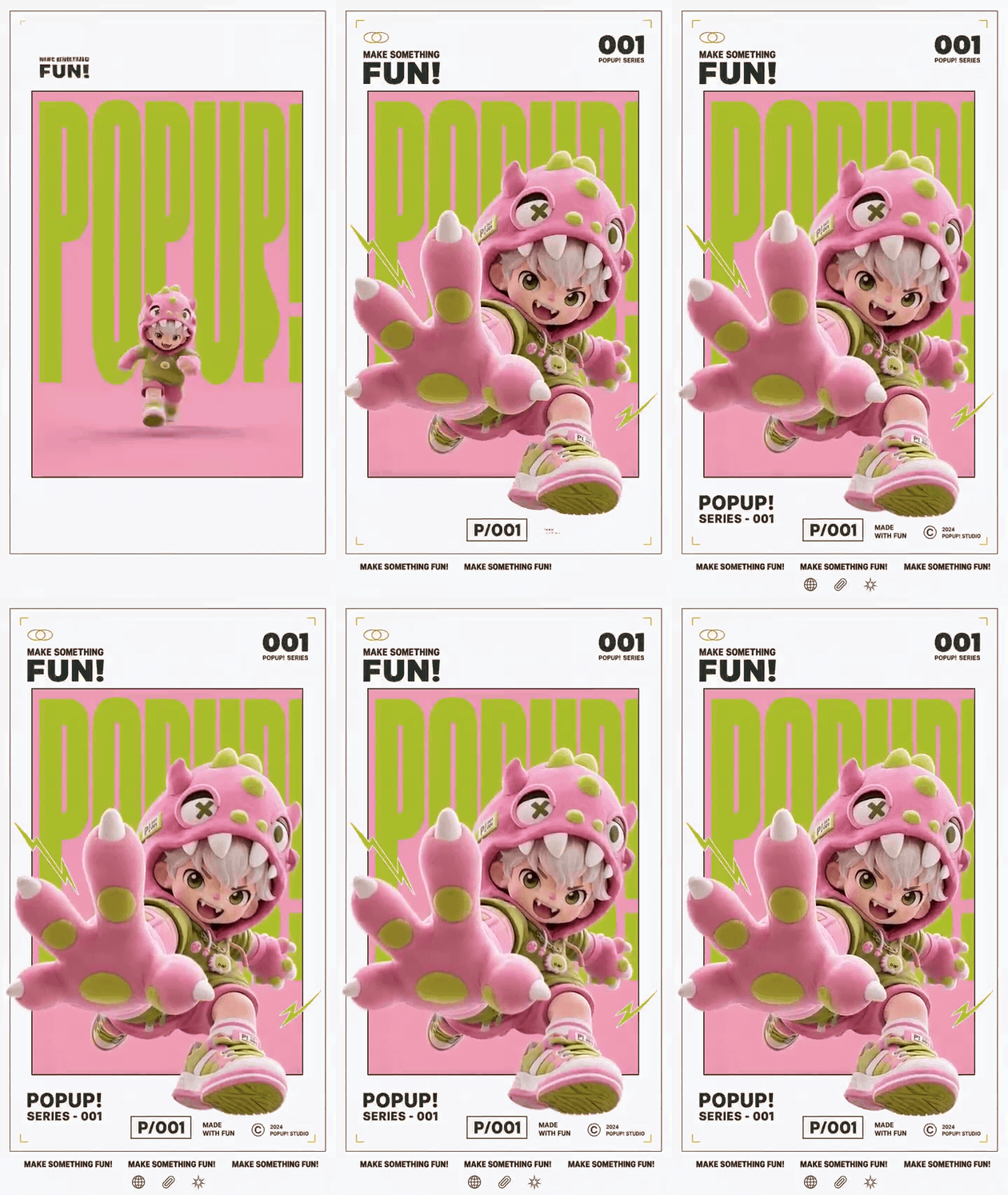
Vertical, poster-shaped, type-driven, from MiniMax's own H3 samples. This is the tier where "cheaper alternative" stops being a sentence you can finish.
What MiniMax H3 Alternatives Actually Cost Per Finished Clip
Per-minute leaderboard prices are the creator's own 1080p list rate. What you pay is the endpoint rate times the seconds you asked for. Here is the same 5-second clip across the shortlist, at rates read on 4 August 2026.
| Endpoint | Rate | One 5-second clip | Native audio |
|---|---|---|---|
| MiniMax H3 Text-to-Video, 2K | $0.14 / s | $0.70 | yes, stereo |
| Gemini Omni Flash Text-to-Video, 720p | $0.125 / s, 3s floor | $0.625 | yes |
| Gemini Omni Flash Video Edit | $0.14 / s | $0.70 | yes |
| Seedance 2.0 Text-to-Video, 720p | token billed, $0.2419 / s | $1.22, billed | yes, switchable |
| Seedance 2.0 Fast | $0.09 / s | $0.45 | yes |
| Seedance 2.0 Mini | $0.056 / s | $0.28 | yes |
| Wan 2.7 Text-to-Video | $0.10 / s | $0.50 | yes |
| Kling V3.0 Turbo, 15% off | $0.095 / s | $0.475 | yes |
| HappyHorse-1.1 Text-to-Video | $0.14 / s | $0.70 | yes |
| Veo 3.1 Lite Text-to-Video | $0.05 / s | $0.25 | yes |
Now multiply every row by the column nobody prints: attempts per usable take. A $0.25 clip you re-run four times costs $1.00 and an hour of your evening. The $0.70 clip that lands on the second try costs $1.40 and you are already editing. The only number that matters is cost per keeper, and you cannot read it off a leaderboard. You can only get it by running your own brief twice on two endpoints, which is what Steps 1 to 3 are for.
Two billing details worth knowing before you build a budget. On Seedance 2.0, a video input drops the token rate from $0.0112 to $0.00688 per 1000 tokens, which works out to about $0.1486 per second at 720p, so editing existing footage is materially cheaper there than generating from nothing. And on any endpoint, poll for the finished job and then re-check the prediction id afterwards. The price field is often still empty at the moment a job flips to completed.
The other way to answer "what does an alternative cost" is to stop paying per second. H3 is the only open-weights model in the top three of any of these boards, and the weights are out. That path is real, and it has a specific shape.
| Self-hosting H3 | API |
|---|---|
| 768px short edge, capped at 768x1344 | 2K |
| Minimum single-task file set around 42.5 GB; about 498.6 GB for the full repo | nothing to download |
| Consumer cards run it with heavy offloading, at render times in a different league | seconds of queue |
| Base model only; the 2K pass is a separate stage | 2K comes out of the same call |
| Community license, effective 2 August 2026 | commercial terms of your provider |
| Your UI must display "MiniMax H3" | not your problem |
Repo and license: MiniMaxAI/MiniMax-H3 on Hugging Face (Hugging Face, August 2026). The 768px native canvas and the day-zero ComfyUI integration are documented in ComfyUI's own release notes.
Read the license before you plan a deployment on it. The community license effective 2 August 2026 lists Excluded Territories in section I.5: the EU, the UK, the Republic of Korea and the United States. Section V.4 extends that restriction to the outputs, not just the weights. Over $20M in annual revenue requires written authorization from MiniMax. Section IV.2 requires you to display "MiniMax H3" in your interface, and section V.3 forbids using outputs to train competing models. The repo also ships a Q&A file describing the territory scope as not yet covered rather than permanently excluded, with an application route. Separately, and this applies to every model in this article: no model license grants you rights to somebody's face, somebody's trademark or somebody's song. That clearance is always yours.
Frequently Asked Questions
What is the best MiniMax H3 alternative right now?
It depends on the job, because three different models hold three #1 spots. Maximum picture with no sound: Gemini Omni Flash, 1,324 Elo on the no-audio text-to-video board. Animating a still: Seedance 2.0 720p, 1,196 on image-to-video. Changing footage you already have: H3 itself is still #1 at 1,130, and the closest fallback is Gemini Omni Flash Video Edit, eight points behind. All read 4 August 2026.
Is there a cheaper MiniMax H3 alternative that still generates native audio?
Yes, but check the endpoint rather than the headline. Gemini Omni Flash text-to-video at $0.125 per second genuinely undercuts H3's $0.14, with audio in the same pass. Seedance 2.0 does not: its 720p token billing works out to about $0.2419 per second, higher than H3 at 2K. If you need cheaper than both and can accept a quality step down, Seedance 2.0 Mini at $0.056 and Veo 3.1 Lite at $0.05 both still produce sound.
Which MiniMax H3 alternative is best for image-to-video?
Seedance 2.0 720p leads at 1,196, then Gemini Omni Flash at 1,193, then H3 at 1,187. Nine points with confidence intervals of about plus or minus 9 is a tie, so pick by behaviour instead of rank: run your own source frame through the top two and see which one respects your first frame instead of redrawing it. Iterate on Seedance 2.0 Mini first, then spend the real rate on the take you keep.
Do MiniMax H3 alternatives render on-screen text as reliably?
Some do. On the identical brief above, H3 and Gemini Omni Flash both rendered "MIDNIGHT BROTH / NO. 07" cleanly and kept it clean through the move. Seedance 2.0 produced a frame of scrambled glyphs before it resolved, which is enough to kill a take. Test it yourself with Shot 3 of the brief and step through frame by frame: does the type keep its weight, do the edges survive the wipe, does a letter deform when the camera moves. That one check tells you more about whether you can switch than any Elo column, because for packaging, UI motion and music-video work it is pass or fail, not better or worse.
Can I self-host MiniMax H3 instead of switching to an alternative?
Technically yes, and it is the only model in the top three of these boards where you can. Three things to check first. Local inference is a 768px short edge, not 2K, because the 2K pass is a separate stage. The minimum single-task file set is around 42.5 GB, with roughly 498.6 GB for the whole repo. And the community license currently excludes the EU, the UK, the Republic of Korea and the United States, with an application route documented rather than a permanent bar.
How hard is it to switch between MiniMax H3 and an alternative?
It depends entirely on how you integrated. Separate accounts means separate signups, billing entities, auth schemes, polling shapes and error handling per vendor, and that is a week of work you will resent. Behind one API it is a model id string and nothing else moves, which is why the full model list is worth skimming before you need it. Wire the backup in while things are calm. The point of a second model is that it already works on the day the first one does not.





