In December 2025, YouTube terminated Screen Culture and KH Studio. Two channels, more than two million subscribers between them, over a billion views. They spliced official footage with AI images to make franchise trailers that looked official. Screen Culture had shipped 23 versions of one Fantastic Four trailer by March, and some of them outranked the real one in search (Deadline, December 2025).
They did not get banned for using AI. They got banned for spam and misleading metadata: passing someone else's movie off as officially released material.
But a billion views proved something else. The trailer is the highest-leverage fifteen seconds in film marketing. The format was never the problem. Attribution was.
So here is the useful version of that experiment: use the same format on a film that belongs to you. One 15-second teaser, 2K, native stereo, one line of narration, a score, a title card. One generation. No edit timeline, no voice booth, no music license, no After Effects pass.
Key takeaways
- A trailer is the densest thing you can ask a video model for: multi-shot, narration, score, sound design, and on-screen type, all stacked. H3 is currently ranked first on the Artificial Analysis video-editing-with-audio leaderboard, and film title sequences are on MiniMax's own first-party use-case list.
- 15 seconds is H3's hard ceiling. That is not a theatrical teaser (those run 30 to 60 seconds), but it is exactly the length of the social cut that does most of the actual work.
- Write the prompt as a cue sheet with timecodes, not as a pile of adjectives. Establish, conflict, climax, title card. Four beats.
- There is no audio parameter anywhere in the API. If you do not order the score, the narration and the sound design in words, you get whatever the model felt like.
- Real numbers on Atlas Cloud: 768p draft $1.50, 2K final $2.10, plus about $0.17 for the opening frame. A finished teaser lands between $2.03 and $3.77.
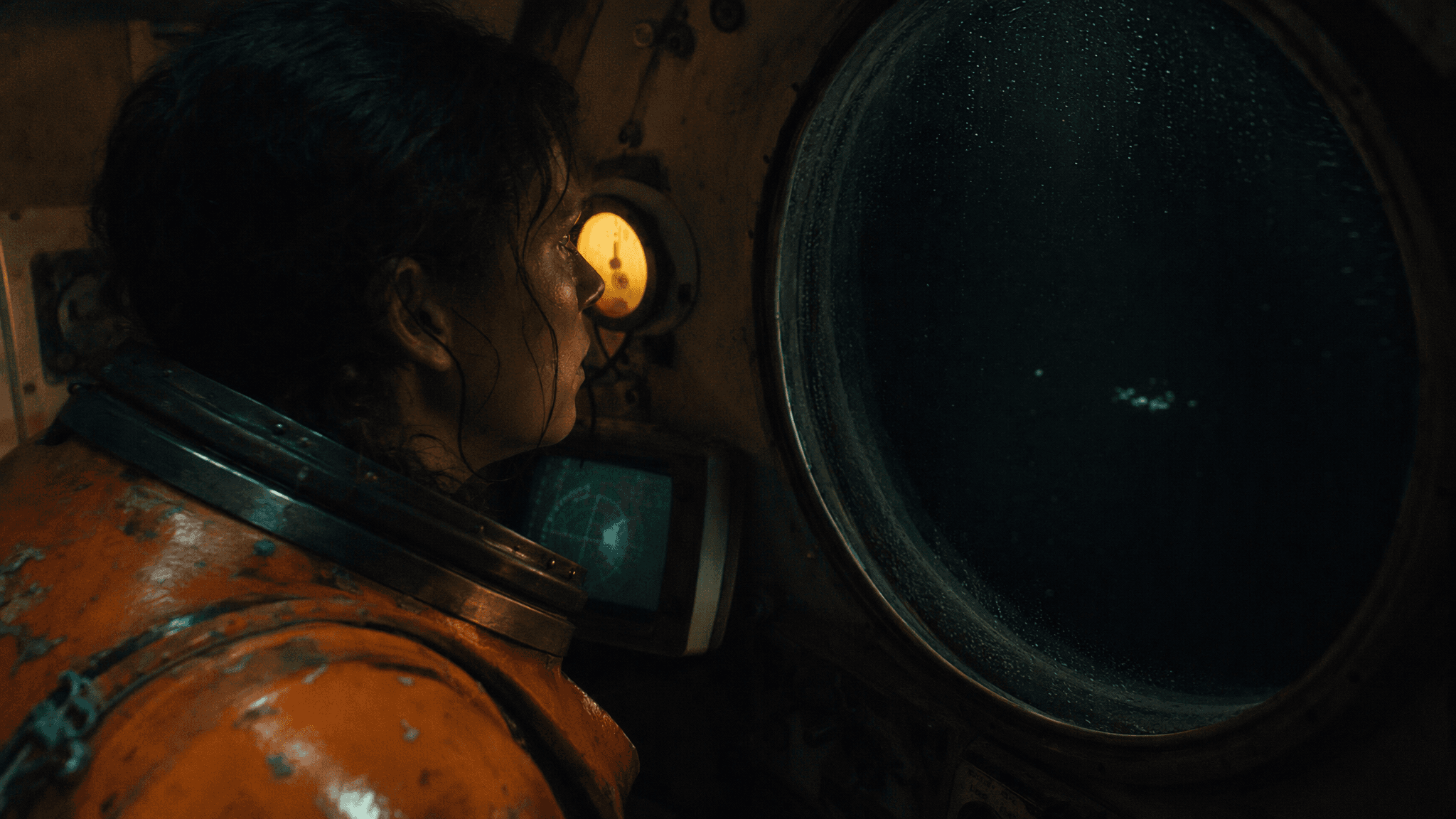
The GPT Image 2 opening frame that locks the film: the interior of a 1970s steel diving bell, a woman in a scuffed orange dive suit, amber instrument lamp and sonar-green wash_The_ frame everything else is built on. Generated with openai/gpt-image-2/text-to-image at quality high , 2048x1152. This single image is what keeps the 768p draft and the 2K final from becoming two different films.
The MiniMax H3 Movie Trailer I Made in One Generation
Here it is first, before any theory. An original deep-sea thriller teaser called SALVAGE. One API call, no cuts added afterwards.
SALVAGE, 15 seconds, one generation on minimax/h3/image-to-video . Sound on: the hull groan, the sonar ping, the string cluster and the one line of narration all came out of the same call as the picture. Billed $2.10.
What is in that file, and where each piece came from:
- Four distinct shots with hard cuts, no dissolves. One generation.
- 24 fps, AAC stereo at 32 kHz. Not added in post.
- One line of narration, female, placed between 5 and 7.5 seconds because the prompt said so.
- A title card that holds dead still for the last two seconds.
That is five traditional post passes collapsed into one. Which is the entire reason a trailer is a good stress test for this model, and a bad one for most others.
Why Most MiniMax H3 Movie Trailer Attempts Fall Apart at Second Nine
Trailers are the hardest category to fake, because you cannot hide a weakness. If the type jitters, you see it. If the lip flap drifts, you hear it. If the score does not land on the cut, the whole thing feels like a slideshow with music on top.
That is roughly why H3 sits where it sits. On the Artificial Analysis video-editing-with-audio leaderboard it is first at 1,130 Elo on 8,249 votes, nine points clear of Gemini Omni Flash and 93 points clear of Dreamina Seedance 2.0, and it is the only model in that top group marked Open Weights (Artificial Analysis, August 2026). MiniMax's own launch material lists film title sequences among the first-party use cases, alongside animated posters and character-consistent game cinematics (MarkTechPost, August 2026).
Here is the official 15-second sci-fi opening from that launch set, so you can hear what "native audio" means before you spend anything:
THE LAST FLEET LEFT EARTH, from MiniMax's official H3 showcase set. Delivered at 2560x1440, 24 fps, AAC stereo 32 kHz. Watch the tracked-out title card and the mid-trailer "SHE KNEW WHY" card hold still while the camera keeps moving.
Now the failure list. Every one of these is something that actually went wrong on the way to the clip at the top of this page.
- Trying to fit a 60-second trailer into one call. 15 seconds is a hard ceiling. Ask for a full trailer's worth of story and you get mush, because the model compresses eight beats into four. Write a teaser.
- Writing adjectives instead of a cue sheet. "Epic cinematic trailer, dramatic, high tension" gives you a mood, not a structure. Timecodes give you a structure.
- Blurry title cards. If you do not put the literal string in the prompt, plus how the type should be treated, plus an explicit "rock-steady" instruction, you get approximate letters. Three or more lines of type is where it starts breaking down.
- Getting a silent file, or a score you never asked for. There is no
audioparameter on text-to-video, image-to-video or reference-to-video. Audio is ordered in prose inside the prompt, or not at all. - Drafting cheap on bare text-to-video. With no first frame locked, 768p and 2K return two different films, because the 2K pass is an in-context regeneration and not an upscale. Your cheap draft teaches you nothing about your expensive final.
- Not sending
duration. The schema documents a default of 8, but leaving it out has billed as a 5-second job and returned a 5-second file. Your trailer gets guillotined at the conflict beat. - Assuming HTTP 200 means it complied. Name a real franchise and input screening rejects the job in seconds. Other prompts get quietly trimmed and billed as normal.
Points 4, 5 and 6 are the expensive ones, and none of them are in the docs.
The MiniMax H3 Movie Trailer Generator Workflow, and What Each Step Costs
Five steps, five models, one browser tab and one API key. The prices below are the live per-second rates on each model's page today, not blog numbers.
| Step | Model | What it does | Price today (August 2026) |
|---|---|---|---|
| Lock the opening frame | GPT Image 2 (text-to-image) | One frame that fixes cast, wardrobe and grade | Token-based. Measured $0.1745 for high at 2048x1152 |
| Draft and finish the teaser | MiniMax H3 image-to-video | The 15-second trailer itself, picture and sound | 2K $0.14/s, 768p $0.10/s |
| Text-only variants | MiniMax H3 text-to-video | Same beat sheet with no frame locked | Same rates |
| Vertical cut, cast locking | MiniMax H3 reference-to-video | 9:16 social version, up to 9 image references | Same rates |
| Rescue a 768p keeper | Atlas Cloud Video Upscaler | Lift a draft you liked instead of rerunning | 1080p $0.018/s, 2K $0.024/s, 5s minimum |
The three H3 endpoints on the Atlas Cloud model directory . Text-to-video, image-to-video and reference-to-video are separate routes on the same key, which is why the whole chain below never leaves one tab.
Parameter facts worth writing on your hand, all checked against the live schemas today rather than the readme: resolution is 768P or 2K, defaulting to 2K. duration is any integer from 4 to 15. The field is called ratio, not aspect_ratio, and on image-to-video it is ignored entirely because the output shape is inherited from your input frame. Text-to-video and reference-to-video accept 21:9 through 9:16. Everything runs async: POST /api/v1/model/generateVideo, then poll /api/v1/model/prediction/{id}.
MiniMax H3 Movie Trailer Tutorial: 15 Seconds, Four Beats, One Generation
The film is an original deep-sea thriller. One word for a title, so the type has room to breathe. One line of narration. Copy the prompts verbatim and swap the nouns for your own project.
Step 1: Lock the Opening Frame With GPT Image 2
Do not start with the video model. A frame costs about seventeen cents and a 15-second 2K generation costs $2.10, so you want the look settled an order of magnitude cheaper. More importantly, the locked first frame is the only thing that makes your 768p draft predictive of your 2K final.
Plain1Cinematic film still, anamorphic look inside a 16:9 frame: the interior of a 1970s steel 2diving bell descending into black water, seen over the shoulder of a woman in a scuffed 3orange dive suit. Her face is lit only by a single amber instrument lamp and the pale 4green wash of a sonar screen. Condensation beads on the thick porthole glass; beyond it, 5absolute darkness with one faint drift of particles. Heavy 35mm film grain, deep crushed 6blacks, teal-and-amber palette, shallow depth of field, practical lighting only. 7No lens flare, no text, no logos, no watermark, no subtitles.
Settings: quality high, size 2048x1152, output format png. Quality high is not optional here, because the grain and the crushed blacks are what the video model will carry forward for fifteen seconds.
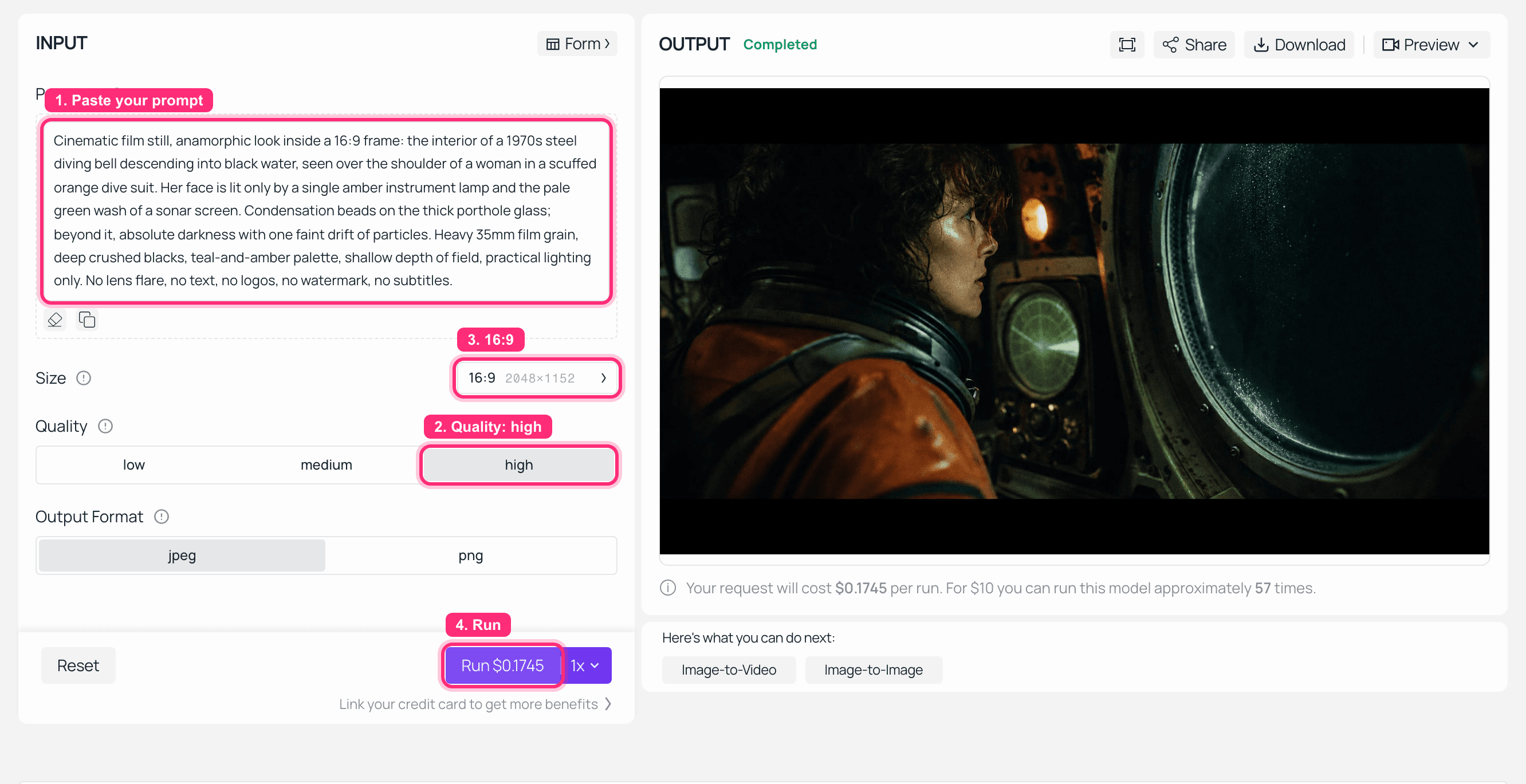
GPT Image 2 playground on Atlas Cloud with the diving bell prompt loaded and the finished opening frame in the output panel_GPT Image 2 on Atlas Cloud, run completed: the prompt above on the left, the frame that became this article's hero on the right._
Step 2: Write the 15-Second Trailer Beat Sheet (Establish, Conflict, Climax, Title Card)
This is the part nobody in the "best trailer generator" roundups will give you. A trailer prompt is a cue sheet. Picture gets timecodes, audio gets timecodes, narration gets a window, and the title card gets its literal string.
Here is the structure on its own, so you can refill it with your own film:
| Beat | Window | Picture | Cutting | Audio cue |
|---|---|---|---|---|
| Establish | 0.0-4.0s | One slow move on your protagonist in their world | No cuts, single push or track | Room tone, one signature sound, low bed |
| Conflict | 4.0-8.0s | Wide that shows the scale of the problem, then back to a detail | Two hard cuts | The bed tightens, one metallic accent, strings enter |
| Climax | 8.0-12.0s | Three rapid details, then black | Three hard cuts, then six frames of black | Rising cluster, one impact, then hard silence |
| Title card | 12.0-15.0s | Fade up on the title, dead still for two full seconds | No movement at all | One sub-bass hit, then a decaying tail |
And here is that structure filled in, ready to paste into image-to-video with the Step 1 frame attached:
Plain115-second 16:9 teaser trailer for an original deep-sea thriller. Continue exactly from the 2supplied first frame: same woman, same orange dive suit, same amber-and-sonar-green 3lighting, same heavy grain. Four beats, hard cuts, no dissolves. 4 50.0-4.0s ESTABLISH. Slow push-in past her shoulder toward the porthole. Dust motes drift. 6The sonar screen sweeps once. She breathes; her exhale fogs the glass. 74.0-8.0s CONFLICT. Hard cut to a low wide: the dive bell tiny against a black cliff face, 8cable taut above it. Hard cut back to her hand snapping a switch. The instrument lamp 9stutters. A shape passes the porthole, out of focus, unidentifiable. 108.0-12.0s CLIMAX. Three rapid cuts: extreme close-up of her eye catching a red overload 11light; the porthole glass flexing with a hairline crack; total black for six frames. 1212.0-15.0s TITLE CARD. Fade up from black on one title, centred, holding dead still for the 13last two seconds: SALVAGE 14Extremely wide letter-spacing, heavy condensed serif, brushed cold steel with a faint rust 15edge and a restrained inner glow, not pure white. Below it, small caps at half the size: 16NOTHING DOWN HERE STAYS LOST 17Both lines rock-steady: no jitter, no warping, no drift, no re-render between frames. 18 19AUDIO, generate natively, do not deliver a silent track: 200.0-4.0s low hull groan around 40 Hz, one sonar ping at 1.5s with a long tail, distant 21pressure hiss. 224.0-8.0s the hiss tightens; a single metallic clank at 6.2s; strings enter on one 23sustained low note. 248.0-12.0s rising string cluster, a rivet pop at 10.5s, then hard silence at 11.8s. 2512.0-15.0s one deep sub-bass impact on the title card, then a slow decaying reverb tail 26over quiet sonar. 27NARRATION, one line only, female voice, low and unhurried, mixed under the music, spoken 28between 5.0s and 7.5s: "Nothing down here stays lost." 29 30NEGATIVE: no on-screen text other than the two title lines; no subtitles, no captions, no 31watermark, no studio logo, no lens flare, no whip pans, no camera shake beyond a slow 32handheld float, no daylight, no visible creature, no gore, no blood.
Three things in there are doing more work than they look like. The AUDIO block exists because there is no audio parameter to set. The "rock-steady" line exists because type stability is the single most common trailer failure. And the six frames of black at 11.8 seconds is what makes the title card feel like a title card instead of another shot.

Four frames pulled from the finished SALVAGE teaser, labelled ESTABLISH, CONFLICT, CLIMAX and TITLE CARD, showing the beat sheet as it actually rendered_The_ same four beats as they actually came out, pulled from the 2K file. Left to right: the push-in at 2s, the low wide at 5s, the overload light at 10s, the title card at 14s.
Step 3: Draft the MiniMax H3 Movie Trailer at 768p for $1.50
Same frame, same prompt, resolution: "768P", duration: 15. Do send duration explicitly. Leaving it out has billed as a 5-second job. You get 1344x768, 24 fps, AAC stereo, and a bill of $1.50.
The 768p draft. Structurally the same film as the 2K final, because the first frame is locked. The small type in the title card is where you can see the resolution gap.
Judge it on four things only, and ignore sharpness entirely:
- Are the cuts on the beats, or has one beat eaten another?
- Does the narration exist, and does it land inside the 5 to 7.5 second window?
- Does the title card sit still, or does it crawl?
- Does the score hit the impact at 12 seconds?
If any of those fail, fix the prompt and redraft at $1.50. Do not fix it at $2.10.
Step 4: Finish the MiniMax H3 Movie Trailer at 2K
Change exactly one field. Same image, same prompt, resolution: "2K". Output is 2560x1440 and the bill is $2.10.
Because the first frame is locked, the two passes differ in detail rather than in content. The honest version of that: the big type reads fine at 768p, but the second line resolves into actual letterforms only at 2K.
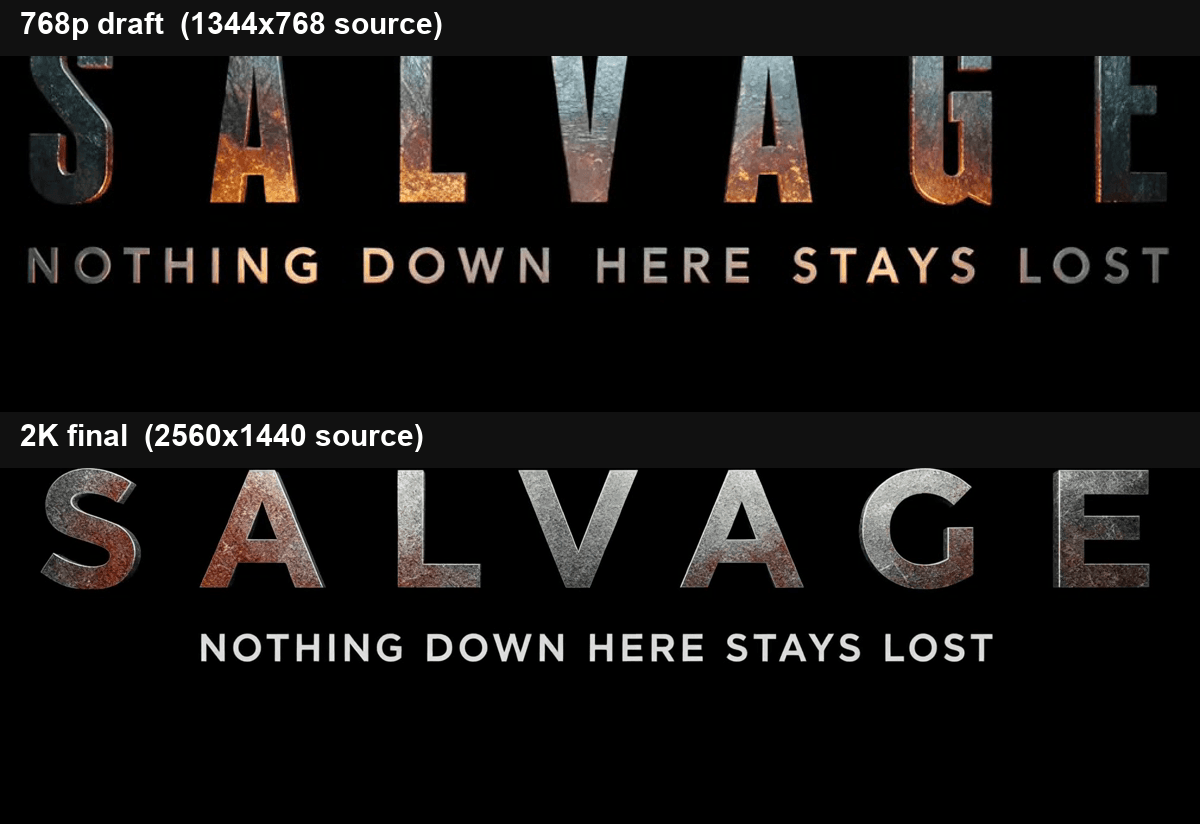
Title card crop at 100 percent, 768p on the left and 2K on the right, showing the subtitle line resolving into readable letterforms only at 2K_Same second, same frame, cropped at 100%. The wide-tracked SALVAGE survives both. The half-size line under it is the reason you finish at 2K._
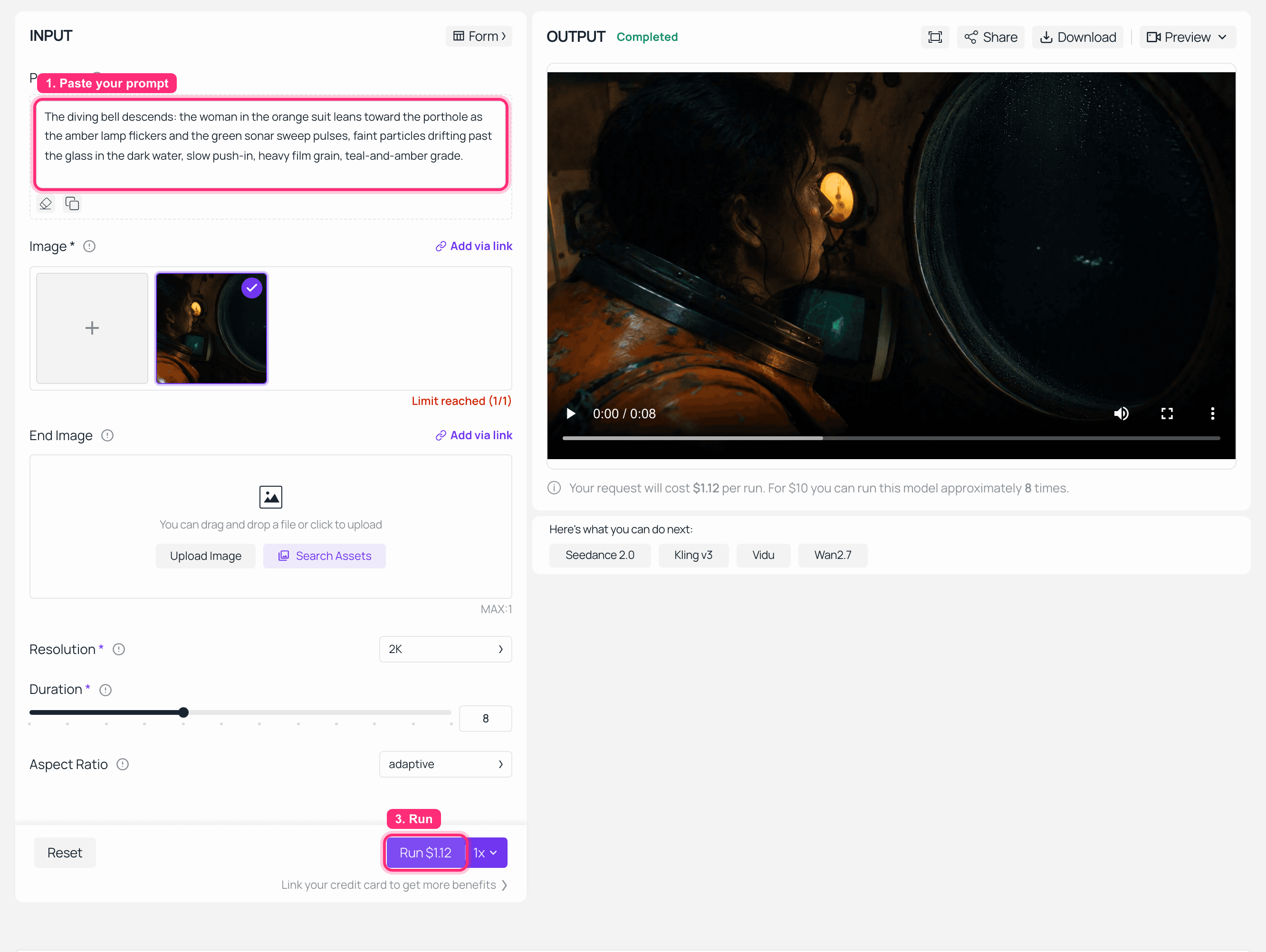
MiniMax H3 image-to-video playground on Atlas Cloud with the diving bell frame loaded and a finished clip in the output panel_MiniMax H3 image-to-video on Atlas Cloud, run completed. The playground's resolution and duration selectors were left at their defaults for this capture, so the clip in OUTPUT is a shorter run than the 15-second call described above, not the finished teaser._
There is a cheaper finish. If a 768p take is already a keeper, send it through the video upscaler at $0.024 per second to 2K, which is $0.36 for 15 seconds. It protects the take you already like, but it cannot invent letterform detail that was never in the source, and the 2K route caps at 23 seconds of input.
Step 5: Cut a Vertical MiniMax H3 Movie Trailer With Reference-to-Video
The 16:9 file is for the site. The 9:16 file is what actually gets watched. Reference-to-video takes up to nine image references plus video and audio, so you can lock the same lead and the same grade into a portrait reframe instead of hoping.
Send refers as an array with the Step 1 frame plus a look board, ratio: "9:16", duration: 15, resolution: "2K". The prompt is the same beat sheet with vertical blocking: the conflict beat becomes a single medium close-up instead of a low wide, and the title card gets bigger type with the subtitle broken onto two lines.
One trap that costs money because it never errors: do not send image and refers in the same request. They are mutually exclusive, the API accepts both, and one of them gets dropped silently.
The vertical cut from minimax/h3/reference-to-video , same cast, same grade, reblocked for a phone.
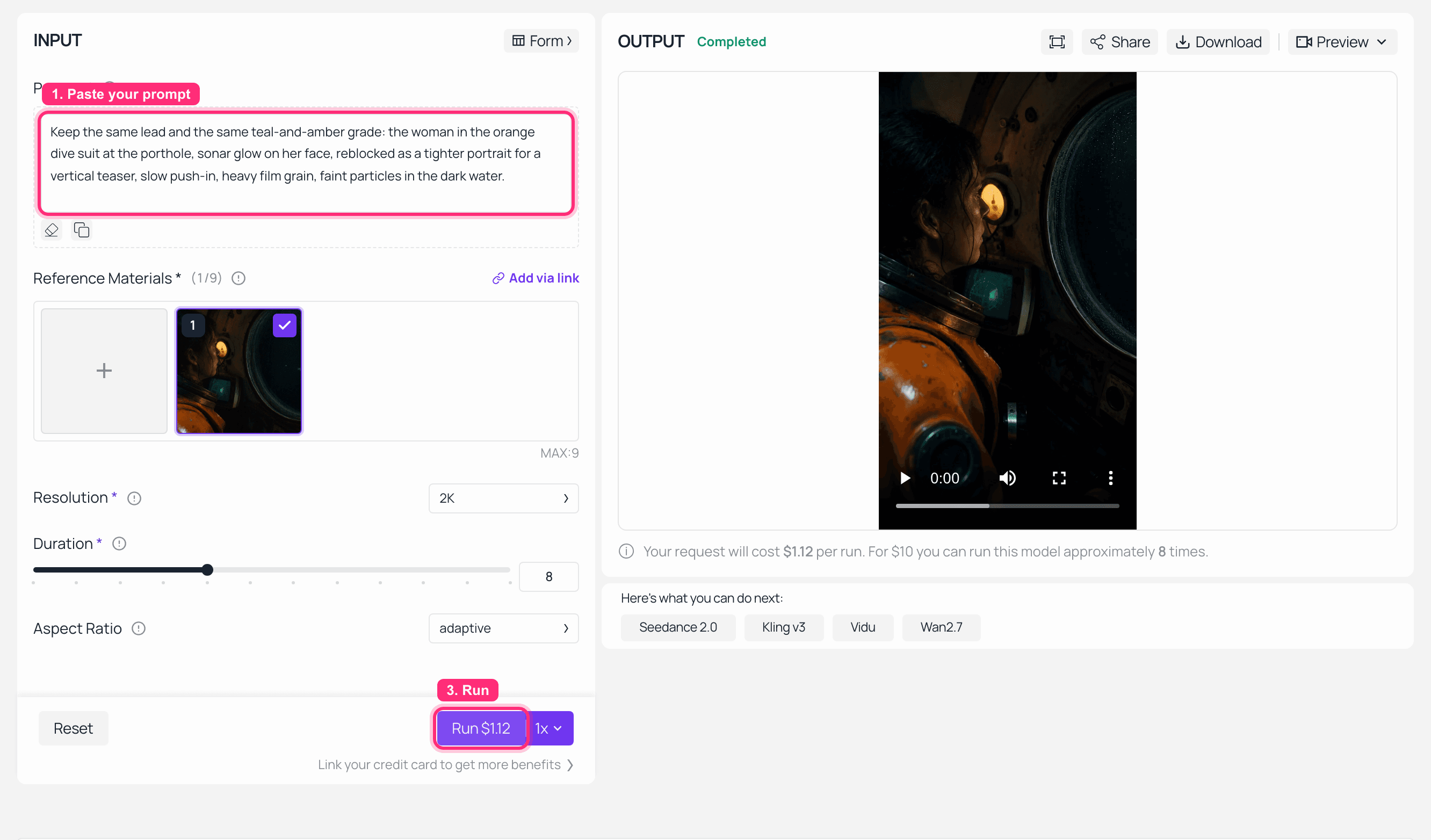
MiniMax H3 reference-to-video playground on Atlas Cloud with reference materials loaded and a finished clip in the output panel_MiniMax H3 reference-to-video on Atlas Cloud, run completed, with the reference slot filled. Resolution and duration are again at playground defaults._
Four Variations on the MiniMax H3 Movie Trailer Prompt
Same beat sheet, four different deliverables.
Scope. Change ratio to 21:9 on text-to-video or reference-to-video. Same cue sheet, wider letterbox, and the title card gets noticeably more tracking room.
Title sting only. Drop beats one through three, keep the title card, set duration: 4. That is $0.56 at 2K for a logo animation with a sub-bass hit on it. Useful far outside film, since a "trailer" is often for a game, a book or a podcast.
Another language. H3 handles narration in multiple languages natively, so the same beat sheet with the narration line rewritten in Japanese gives you a localised teaser without a separate dub track.
Another category. Vertical drama teasers are the same four beats with dialogue instead of narration. Here is an official 9:16 example from the H3 showcase set: fifteen seconds, eight shots, one character held consistent across all of them, with spoken lines rather than voiceover.
Official MiniMax H3 vertical teaser, 1440x2560, 15 seconds, eight shots, AAC stereo with dialogue. The same beat structure, aimed at a short-drama audience.
Want a 30-second teaser? Take the last frame of clip one and use it as the first frame of clip two. Details are in our MiniMax H3 video length guide.
What a MiniMax H3 Movie Trailer Actually Costs
Four honest paths to one finished 15-second 2K teaser. Frame cost is the measured $0.1745 for GPT Image 2 at high, 2048x1152.
| Path | Line items | Total |
|---|---|---|
| Straight to 2K | frame $0.1745 + 2K $2.10 | $2.27 |
| Draft then finish (recommended) | frame $0.1745 + 768p $1.50 + 2K $2.10 | $3.77 |
| Draft then upscale | frame $0.1745 + 768p $1.50 + upscale $0.36 | $2.03 |
| A realistic session, three drafts | frame $0.1745 + 3 x $1.50 + 2K $2.10 | $6.77 |
| Add the vertical cut | + $2.10 | — |
MiniMax's own direct pricing is a little lower per second than the Atlas rate, so you will see a $1.95 figure for a 15-second 2K clip quoted elsewhere. On Atlas the rate is $0.14 per second, which is $2.10, and that is the number every bill in this article uses.
And here is what that $2.10 replaced, honestly graded:
| Traditional post pass | Who normally does it | Does H3 deliver it in one run? | How well, measured |
|---|---|---|---|
| Multi-shot assembly | Editor | Yes | Four beats held; cuts landed on the written timecodes |
| Narration record | VO artist plus booth | Yes | Landed inside the 5 to 7.5s window as written |
| Score | Composer or library license | Yes | Arc and the 12s impact both present |
| Sound design | Sound designer | Yes, with a caveat | Cues land on the beat, not frame-accurate to the named timecodes |
| Title card animation | Motion designer | Yes | Stable at 2K; the half-size line is soft at 768p |
If you want to price this against the rest of the H3 endpoints line by line, the MiniMax H3 API pricing breakdown has the per-call arithmetic, and the three endpoints above live on one key in the same model directory if you want to run the chain yourself.
Fan Trailers, Real Films, and the Metadata That Got a Billion Views Deleted
Worth being precise about what actually happened to those channels, because the lesson is not "do not make trailers with AI."
Both channels were suspended, made corrections, got readmitted to the Partner Program, then reverted and were terminated under YouTube's spam and misleading metadata policies. The problem was presentation: titles and thumbnails that read as official studio material for films that had no such trailer. If you are making a concept piece for an existing property, label it in the title, the thumbnail and the description, and do not let the metadata imply it came from the studio.
H3 pushes back on this at the API level too. Name a real franchise or a specific film in the prompt and the job fails during input screening within seconds rather than generating something you then have to think about. It is a blunt filter, and it will occasionally catch an innocent prompt, but it is a useful signal about where the line sits.
One more note if you are self-hosting rather than calling the API: the released weights ship under the MiniMax H3 Community License Agreement, and the H3-Context-IR and H3-Regenerate-2K modules that produce the 2K pass are not part of the open release, they stay API-side. Our commercial use and licensing guide covers the terms; none of it applies to the API route used in this article.
Frequently Asked Questions
Can the MiniMax H3 movie trailer generator make a full trailer, or only 15 seconds?
15 seconds is a hard ceiling per generation. A theatrical teaser runs 30 to 60 seconds and a full trailer 90 seconds to three minutes (Beverly Boy, 2026), so one call gives you the social cut, not the theatrical one. For longer, chain generations by feeding the last frame of one clip in as the first frame of the next.
Does MiniMax H3 generate the trailer voiceover and music, or do I add them in post?
Natively, in the same call as the picture, delivered as AAC stereo at 32 kHz alongside 24 fps video. But there is no audio parameter on any of the three endpoints. You order the score, the narration and the sound effects in prose inside the prompt, with timecodes. Skip that block and you get a soundtrack you did not choose.
Will the on-screen title card text actually come out readable?
Yes, if you write the literal string, describe how the type should be treated, and add an explicit stability instruction like "rock-steady, no jitter, no warping." Keep it to two lines. Large tracked-out type survives 768p; small secondary lines only resolve properly at 2K.
How much does one MiniMax H3 movie trailer cost?
On Atlas Cloud, 15 seconds at 2K is $2.10 at $0.14 per second, and the same length at 768p is $1.50 at $0.10 per second. Add roughly $0.17 for the opening frame. A finished teaser runs $2.03 to $3.77 depending on whether you upscale a draft or rerun at 2K. Always send duration explicitly.
Can I make a trailer for a real, existing movie?
Technically the input screening blocks named franchises, so the model will refuse before it bills you. Practically, YouTube has already terminated channels with a billion views over misleading metadata on exactly this content. Make it original, or label it clearly as a concept or fan piece in the title and description.
Can I keep the same lead across a longer trailer?
Use reference-to-video, which accepts up to nine reference images plus reference video and audio, and lock your cast there rather than hoping text alone holds them. Do not send image and refers in the same request: they are mutually exclusive, the API will not complain, and one of them gets dropped without telling you.





