A sheet of 16 poses needs a playback check: does the hand travel naturally, do the feet maintain contact, and does the final frame reconnect with the first?
These GPT Image 2.5 Stilled Animation Test Results are awaiting the benchmark described below. The generation environment currently presents an access login page. No animation-quality findings, pass counts, or model winner have been measured. This draft preserves the full experiment and reproduction instructions; it is not a completed results report.
Here, stilled animation means generating a sheet of consecutive still frames, extracting its cells, and playing those cells in order.
It is our working term, not a verified official feature name. An animation-style still is a single picture; a sequential frame sheet contains multiple pictures; native video generation produces motion through a different workflow.
The planned comparison covers five tasks, two models, and three independent requests per combination. GIF assembly happens locally after image generation. Measure how much movement survives without new frames or hidden repairs.
Key Takeaways
- No benchmark requests have completed; unavailable measurements must not be read as model failures.
- Judge consecutive transitions, contact points, and loop seams separately from character appearance.
- Budget for extraction and inspection alongside generation, and keep raw playback distinct from repairs.
What We Tested and How We Scored It
The benchmark is specified for GPT Image 2.5 Sunburst Text-to-Image and GPT Image 2.5 Flare Text-to-Image. Generation is intended to run in the logged-in Atlas Cloud test environment. Its waiting times, when measurable, describe that environment and session rather than a production service commitment.
| Control | Preregistered setting |
| Input | Identical text prompt for each matched task; no reference images |
| Image output | PNG, 2048×1152, quality=max, n=1 |
| Background | Opaque for waving, pouring, rotation, pedaling; transparent for walking |
| Repetitions | Three independent requests per task and model; 30 requests total |
| Layout | Four columns, four rows; target cell size 512×288 |
| Extraction | Left to right, then top to bottom; retain all 16 nominal crops |
| Playback | Target 125ms per frame, 8fps, approximately two seconds |
| Processing | No interpolation, reordering, stabilization, or deleted failure frames |
A 2048×1152 sheet supplies 512×288 pixels per equal cell. Enlarging the GIF cannot recover detail absent from those cells. The 480 target cells belong to 30 requests, so they are correlated observations rather than 480 independent trials.
For each sheet, inspect layout, identity, 15 adjacent transitions, and task-specific physical relationships. Looping tasks add transition 16→1. A qualified raw sheet must meet every applicable check; frame-level counts remain separate. Record ambiguous or occluded details as unresolved instead of awarding an unsupported pass.
Execution alternates Sunburst and Flare, keeping each request separate. Display the first completed request in each group, retaining earlier request failures. A completed image with incorrect motion stays in the dataset. Three repetitions cannot establish a general success rate.
An earlier published experiment generated ten keyframe grids and documented unequal panel boundaries. Its storyboards and settings differ from ours, so its results supply background only. (Genflick, September 2026.)
GPT Image 2.5 Stilled Animation Test Results: Caterpillar-to-Butterfly Transformation
A transformation sequence tests whether the model can keep one small world stable while the subject changes state. The clay caterpillar begins beneath the same bent branch, hangs down, forms a cocoon, and emerges as a butterfly. The camera remains fixed at table height, giving the branch, tabletop edge, and background a clear role as reference points.
The first inspection follows the caterpillar from its curved pose under the branch into its hanging pose. Its body should move in small steps while the branch fork, base, and the point of attachment stay in the same place. A recognizable caterpillar in isolated frames does not establish that it followed a continuous route into the cocoon.
The middle of the sequence is where the set must remain especially stable. The cocoon can change shape as the action develops, but the branch should not lengthen, shift, or acquire a new texture. Watch the horizon line and branch base as well as the subject, because background drift can make a genuine pose change look like a camera move.
The final frames introduce the butterfly. Check whether it emerges from the cocoon at a readable location and whether its scale remains plausible relative to the branch. The transformation is clearer when the viewer can compare one preserved set against one advancing subject, rather than trying to infer a change across rebuilt scenes.
Current evidence: This case provides a clear visual example of a short, one-direction transformation. It does not supply a qualified benchmark score, a pass count, or a comparison between models.
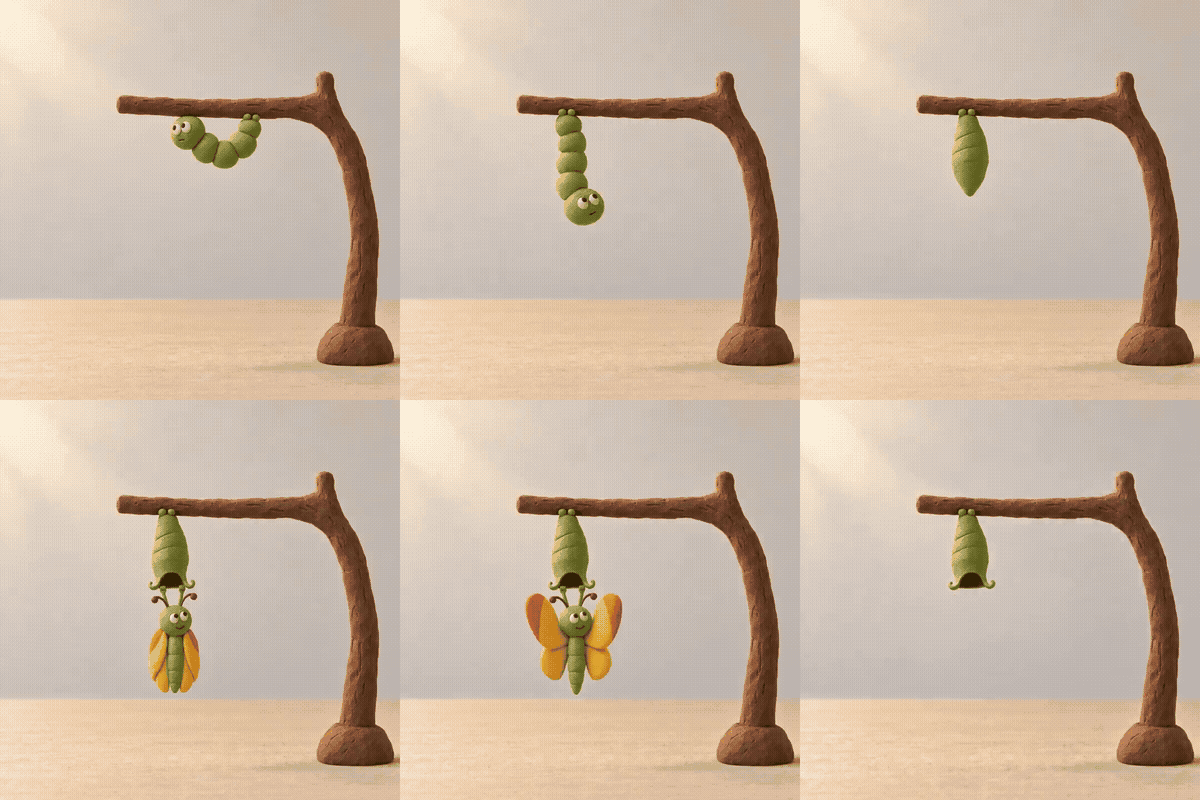
Clay caterpillar becoming a butterfly beneath a fixed branch
Inspect the branch, tabletop, and locked camera separately from the caterpillar-to-butterfly change.
This sequence should play forward. Reversing it would turn the finished butterfly back into a cocoon and weaken the intended action. A production workflow should preserve each underlying still so any jump can be located and corrected at the responsible state.
GPT Image 2.5 Stilled Animation Test Results: DNA Continuity Comparison
A rotating DNA double helix is a compact test of structural continuity. The action can be simple, but the object has repeated features that make drift easy to spot: two outer rails, evenly spaced rungs, a lower tip, and a soft shadow beneath the object. Those anchors should retain their relationships as the sequence advances.
The side-by-side presentation makes adjacent transitions easier to review. Begin with the silhouette: a change in orientation is expected, but a sudden change in helix height, width, or twist is not part of a controlled rotation. Then follow the rungs and lower tip to see whether the object remains one coherent structure.
Lighting and framing matter here as much as geometry. If the shadow shifts direction or the helix slides sideways, the viewer cannot tell whether the apparent movement came from object rotation, camera drift, or a rebuilt scene. A stable background is useful precisely because it removes that ambiguity.
This kind of example should be judged frame to frame rather than by selecting the strongest still. An attractive last image may hide a broken transition in the middle. Record the first pair that introduces a shape, position, or lighting change that does not follow the intended motion.
Current evidence: This case shows how a short object sequence can be inspected for shape, position, lighting, and framing continuity. It is not a general performance score or a model-ranking claim.
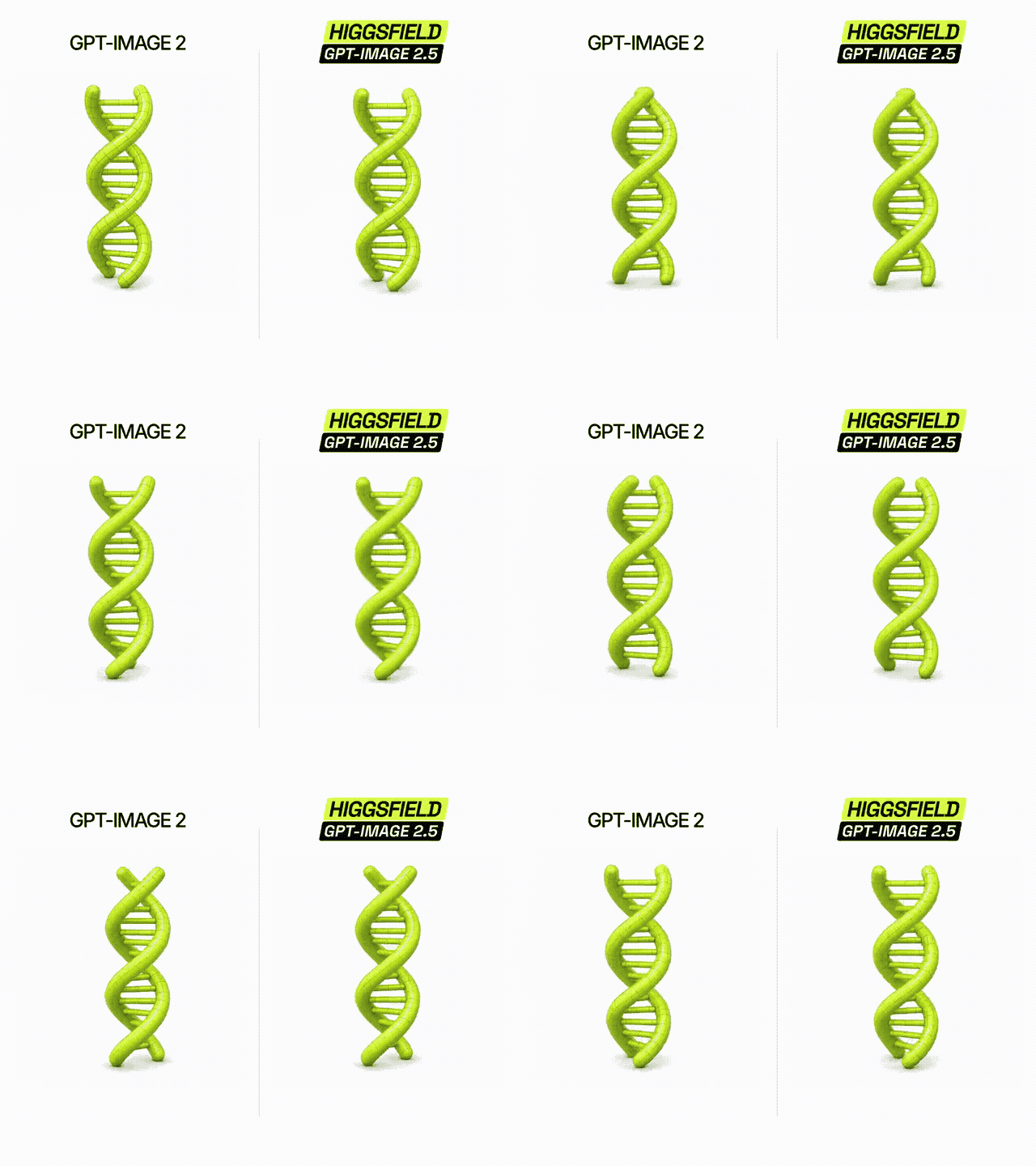
Side-by-side green DNA sequence for continuity inspection
Follow the outer rails, rungs, lower tip, framing, and shadow across neighboring frames.
The sequence can loop only if its final pose reconnects cleanly with its first pose. If the end state holds a different orientation, present it as a forward sequence instead of hiding a reset with a ping-pong effect.
GPT Image 2.5 Stilled Animation Test Results: Peony Bloom Sequence
A peony bloom tests controlled change across a whole object. The flower begins as a tight bud, opens through several petal states, and finishes as a full bloom. The intended change is substantial, so the elements that should remain fixed need to be stated clearly: stem, leaf attachment, camera, background, and lighting.
Start by following the stem from the soil line to the flower head. It should remain upright and retain the same thickness as the petals open. The leaves should stay connected at the same nodes; a leaf that shifts to another stem position indicates a rebuilt object rather than a continuous bloom.
Next inspect the petals. Their opening should progress outward from the bud rather than jumping directly from closed to fully open. The bloom can become larger, but its center should remain aligned with the stem. A sudden change in petal color, edge texture, or lighting direction belongs in the transition notes.
The dark background and fixed viewpoint make this one-way change readable. They also make a useful contrast with the flower itself: the petals may evolve, while the surrounding world should not. That distinction is the basis for reviewing product reveals, character reactions, and other progressive state changes.
Current evidence: This case demonstrates a clear, one-way opening action with stable scene anchors. It does not establish a qualified benchmark result or a reliable outcome for another prompt.
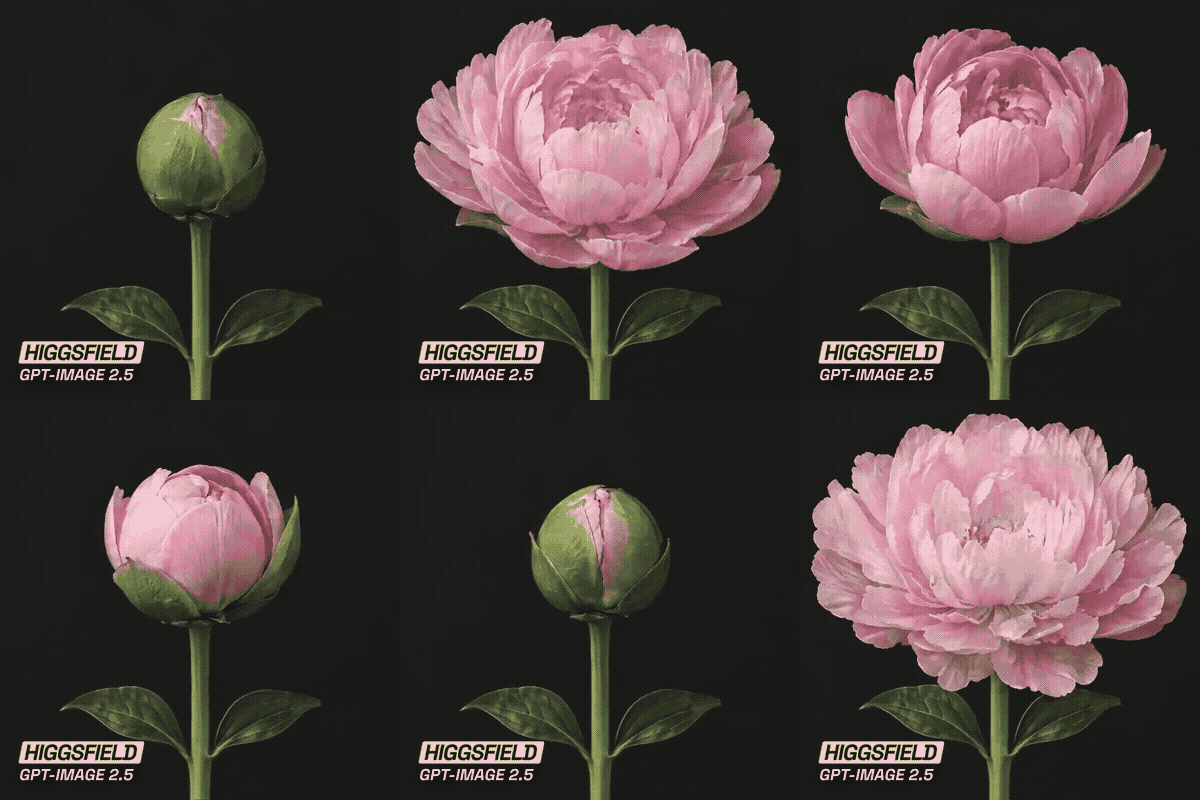
Peony opening from bud to bloom
Check petal progression while the stem, leaf attachment, background, camera, and lighting remain stable.
This sequence should play once. A ping-pong loop would make the flower close again and add motion that is not part of the intended bloom. Keep raw stills beside the final GIF so a reviewer can isolate any broken step without confusing it with compression artifacts.
Independent repeated tests elsewhere have also evaluated prompt following and consistency separately, with task-dependent outcomes. Their rubrics do not supply animation scores for this article. (PromptFrenzy, accessed September 2026.)
Reproduce the Workflow and Count the Real Cost
- Open the model and commit the settings.
Use the Sunburst playground for the first request and the Flare playground for its matched request. Select max quality, 2048×1152, PNG, and one image. Set opaque for A, B, C, and E; transparent for D.
The official image guide documents max quality, custom dimensions, and PNG or WebP for transparency. These output controls do not guarantee an evenly divided frame sheet. (OpenAI, accessed September 2026.)
Verify the selected values after leaving each control. Preserve the quote and the actual request settings. The completed screenshots below are reserved for real outputs; a model page's sample image cannot establish that an experiment ran.
- Use these prompts without rewriting between models.
Prompt A: Waving
plaintext1Create one 2048x1152 image containing exactly 16 consecutive animation frames arranged in a strict 4-column by 4-row grid, read left to right and then top to bottom. Each cell is exactly 512x288 pixels. No gutters, borders, captions, numbers, or text. 2 3Show the same adult office worker seated at a plain wooden desk in every frame. They have short dark hair, a teal long-sleeved shirt, and no accessories. Use natural window light, a plain light-gray wall, and a locked eye-level medium camera shot. Keep the face, clothing, desk, background, lighting, and camera identical. 4 5Animate one greeting: frames 1-4 gradually raise the right hand from the desk; frames 5-10 show one small side-to-side wave; frames 11-15 gradually lower the hand; frame 16 returns to the resting pose. Keep the left hand on the desk. Preserve five fingers and the same sleeve length. The transition from frame 16 to frame 1 should be continuous. Advance the action by small readable increments.
Prompt B: Pouring coffee
plaintext1Create one 2048x1152 image containing exactly 16 consecutive animation frames in a strict 4-column by 4-row grid, read left to right and then top to bottom. Each cell is exactly 512x288 pixels. No gutters, borders, captions, numbers, or text. 2 3Use a locked side-view close-up of a clear glass cup on a wooden kitchen counter. One adult hand holds a small stainless-steel coffee pot above and to the left of the cup. Use soft daylight and keep the camera, counter, cup, hand, and pot design unchanged. 4 5Frames 1-3 show the pot tilting toward the empty cup. Frames 4-11 show a continuous narrow stream of black coffee entering the cup while its liquid level rises progressively. Frames 12-14 show the pot returning upright and the stream stopping. Frames 15-16 show the cup half full and the upright pot held still. Keep the stream connected to the spout while pouring. Do not spill or change the cup shape. This is a one-way action, not a loop. The coffee must remain in the cup at the end.
Prompt C: Product rotation
plaintext1Create one 2048x1152 image containing exactly 16 consecutive product-rotation frames in a strict 4-column by 4-row grid, read left to right and then top to bottom. Each cell is exactly 512x288 pixels. No gutters, borders, captions, numbers, logos, or text. 2 3Show one unbranded white low-top canvas sneaker with six pairs of eyelets, white laces, a thin navy stripe around the rubber sole, and a small red fabric tab centered on the heel. Place it on a neutral light-gray seamless surface. 4 5Keep the camera locked at product height with a slight downward view. Rotate only the shoe around a fixed vertical axis. Frame 1 is the front view. Each following frame advances the rotation by 22.5 degrees in the same direction. Frame 16 is at 337.5 degrees so the next frame can return smoothly to frame 1. Keep the shoe scale, rotation center, materials, eyelets, sole stripe, heel tab, and lighting consistent. Reveal physically plausible side, rear, and opposite-side views.
Prompt D: Walk cycle
plaintext1Create one 2048x1152 transparent PNG containing exactly 16 consecutive animation frames in a strict 4-column by 4-row grid, read left to right and then top to bottom. Each cell is exactly 512x288 pixels. No gutters, borders, ground line, captions, numbers, or text. 2 3Show one full-body adult pedestrian in a clean, flat 2D game-prototype style, facing right in strict side view. The pedestrian has short black hair, a mustard jacket, navy trousers, and white shoes. Keep the character centered at the same horizontal position and the feet on the same baseline in every cell. Preserve the same character scale, clothing shapes, and colors. 4 5Create one complete in-place walking cycle. Frame 1 has the left foot forward at contact; frame 5 is a passing pose; frame 9 has the right foot forward at contact; frame 13 is the opposite passing pose. Fill all intervening frames with progressive motion. Frame 16 should lead naturally into frame 1 without repeating it. Keep the arms swinging opposite the legs and preserve left-right limb identity throughout.
Prompt E: Pedaling
plaintext1Create one 2048x1152 image containing exactly 16 consecutive animation frames in a strict 4-column by 4-row grid, read left to right and then top to bottom. Each cell is exactly 512x288 pixels. No gutters, borders, captions, numbers, or text. 2 3Show a full-body adult cyclist on a plain stationary exercise bicycle in strict side view. The cyclist wears a blue short-sleeved shirt, black shorts, and white shoes. Use a light-gray studio background and a locked camera. Keep the bicycle frame, saddle, handlebars, rider identity, clothing, and lighting unchanged. 4 5Animate exactly one complete crank revolution. Start with the visible near-side pedal at the top. Advance the crank by 22.5 degrees per frame in one consistent direction. Keep the opposite pedal 180 degrees away. Each shoe must remain attached to its own pedal, with the knees and hips moving plausibly. Keep both hands on the handlebars. Frame 16 should connect naturally to frame 1. Do not swap the legs, detach the feet, or deform the bicycle.
- Extract and inspect the original files.
Save the downloaded PNG, not the page thumbnail. Use the supplied local script:
plaintext1python slice-grid.py sheet.png --rows 4 --cols 4 --out frames --fps 8
Add --once for coffee. The script saves numbered PNGs, a GIF, and a JSON crop log. Check the log's actual dimensions and alpha values, then inspect each crop for neighboring-panel fragments. Automatic division does not validate the illustrated boundaries.
GIF stores delays in hundredths of a second, so it cannot encode exactly 125ms in a single frame delay. The helper alternates 120ms and 130ms, retaining a two-second total for 16 frames. The log discloses this quantization; the PNG sequence remains available for exact 8fps playback elsewhere.
- Separate correction work from the raw sequence.
| Problem | How to identify it | What local processing can address |
| Uneven panel boundaries | Neighboring image enters a nominal crop | Separate manual crops, if intact content exists |
| Anchor or scale drift | Fixed scene points move between cells | Measured alignment in a labeled repair version |
| Identity or geometry change | Clothing, limbs, or object structure changes | Cropping cannot restore missing structure |
| Wrong action phase | Pose order skips, reverses, or repeats | Timing changes cannot invent absent movement |
| Physical contradiction | Liquid disappears or feet detach | Requires content correction beyond raw extraction |
Record active minutes for cropping, timing, and repairs separately. Preserve both versions and describe every operation. A repaired animation may suit a project while the raw sheet still fails the benchmark.
- Calculate cost from measured usage.
As checked on September 15, 2026, the model directory displayed rounded starting prices near $0.004 and $0.003 per picture, with a 20% discount label for both models. These are catalog starting prices. The selected max setting needs its own quote, and token-based settlement can differ.
| Cost field | Sunburst | Flare |
| Planned settings | max, 2048×1152, PNG | max, 2048×1152, PNG |
| Exact selected-settings quote | Unmeasured | Unmeasured |
| Actual billed total | Unmeasured | Unmeasured |
| Confirmed submitted baseline requests | 0 | 0 |
| Qualified sheets | Unmeasured | Unmeasured |
| Actual generation cost per qualified sheet | N/A | N/A |
| Crop / timing / repair labor | Unmeasured | Unmeasured |
Divide actual billed generation cost by qualified sheets only when both quantities exist. If no sheet qualifies, report N/A. Keep labor separate or apply your own hourly rate explicitly. A starting-price multiplication cannot establish the cost of a usable animation.
Run the same prompt with your own subject after checking a complete raw sequence. The final GPT Image 2.5 Stilled Animation Test Results must support that decision with downloaded evidence; this access-blocked draft does not yet establish an outcome.
FAQ
Can GPT Image 2.5 generate an animated GIF directly?
This workflow requests a PNG frame sheet and assembles a GIF locally. Image output settings should not be described as native animation or video generation. Every displayed motion result must identify its source sheet and processing, including the playback order and delays.
What does “stilled animation” mean in this test?
It means generating consecutive static frames within one image, extracting them, and displaying them sequentially. We use it as an operational description. It does not name a verified official model feature, and a single animation-style picture does not satisfy the definition.
Is Flare or Sunburst better for consistent animation frames?
The comparison is unresolved because no baseline requests have completed. Once available, results should be reported task by task across all three requests. Within-sheet identity, transition quality, and physical coherence need separate inspection; one selected example cannot establish a general winner.
Why does my sprite sheet look consistent but jitter when played?
Check panel boundaries, character anchors, changing scale, action phases, and frame durations. Similar-looking stills can occupy different positions within their cells. Keep the original equal crops while testing corrections, so you can determine whether alignment helps or the source movement itself needs revision.
Does GPT Image 2.5 improve on GPT Image 2 for this workflow?
This benchmark includes no concurrent GPT Image 2 control. It therefore cannot establish an improvement percentage, a speed advantage over that model, or a lower usable-animation cost. External experiments use different prompts and settings; they provide context rather than a missing control group.
How much does it cost to create one usable animation?
Use actual charges for every submitted request, including billed failures, plus the work required to inspect and repair the output. Divide generation charges by the number meeting your acceptance standard. Exact-setting quotes, settlement, and usable outcomes are unmeasured here, so no numerical per-animation cost is defensible yet.





