The translated headline looks right. Then you notice an English label hiding in the corner, a longer sentence touching an arrow, and a product detail that has changed. Those checks often decide whether a localized image is ready to deliver.
GPT Image 2.5 Translate Text in an Image works through image editing: upload the original, specify the target language and editing boundaries, then request a new image. Check the translation, missed text and unchanged areas before publishing. A convincing thumbnail is only the start of that review.
Key takeaways
- Prepare the original, define the language, configure the editor, run the prompt, then review.
- Start every language from the same original image.
- Check individual text regions and the artwork separately.
- Use editable text layers when exact placement or frequent updates matter.
GPT Image 2.5 Translate Text in an Image: What Works
The useful outcome is a new image with another language placed inside the existing design. That can save you from rebuilding a flattened promotional graphic, provided you can inspect the result carefully. It does not automatically recover the original designer's document.
OpenAI publishes a coffee-machine infographic translated into Spanish, with instructions to preserve everything else. Its example uses 1024x1536 and high quality. The guide explicitly recommends checking the translation and words left in the source language. One published example supports this editing use case; it does not establish equal reliability across every language or design. (OpenAI Image prompting, accessed September 2026.)
Start by deciding which deliverable you need. Someone reading a foreign-language menu may only need extracted text and a translation. A marketer preparing a regional campaign needs a replacement image. A designer maintaining monthly offers needs text layers that remain editable next month.
| Input type | Desired deliverable | Suitability for image editing | When OCR or the design source is preferable |
|---|---|---|---|
| Infographic | Localized labels in an existing visual | Useful if you can verify every label and connector | Dense explanations, exact diagrams or repeated revisions |
| Product image | Another language on promotional callouts | Useful for a reviewable marketing draft | Exact packaging claims, fine print or brand typography |
| Poster | Translated headline and event details | Useful when the wording fits the existing hierarchy | Frequent date changes or strict font requirements |
| Real UI screenshot | Help readers understand interface labels | Can produce an explicitly labeled localization mockup | Capture the actual localized application for documentary evidence |
| Scanned document | Readable translated content | Usually awkward for long passages | OCR, human review and a rebuilt document |
OCR means extracting characters from an image. It gives you text to translate, search or edit, but someone still needs to put that text back into a design. Image editing combines those visible changes in a new raster output, while giving you less direct control over individual letters and positions.
A PNG has pixels, not the original live text boxes, font styles or component hierarchy. Keep your source file whenever it exists. If the artwork must remain pixel-identical, preserve that artwork and replace text with a deterministic editing method.
The English coffee-machine source used here is an input illustration published by OpenAI. It is a generated example, not a verified machine schematic. Its component numbers and specifications are things to preserve during translation, not engineering claims this article endorses.
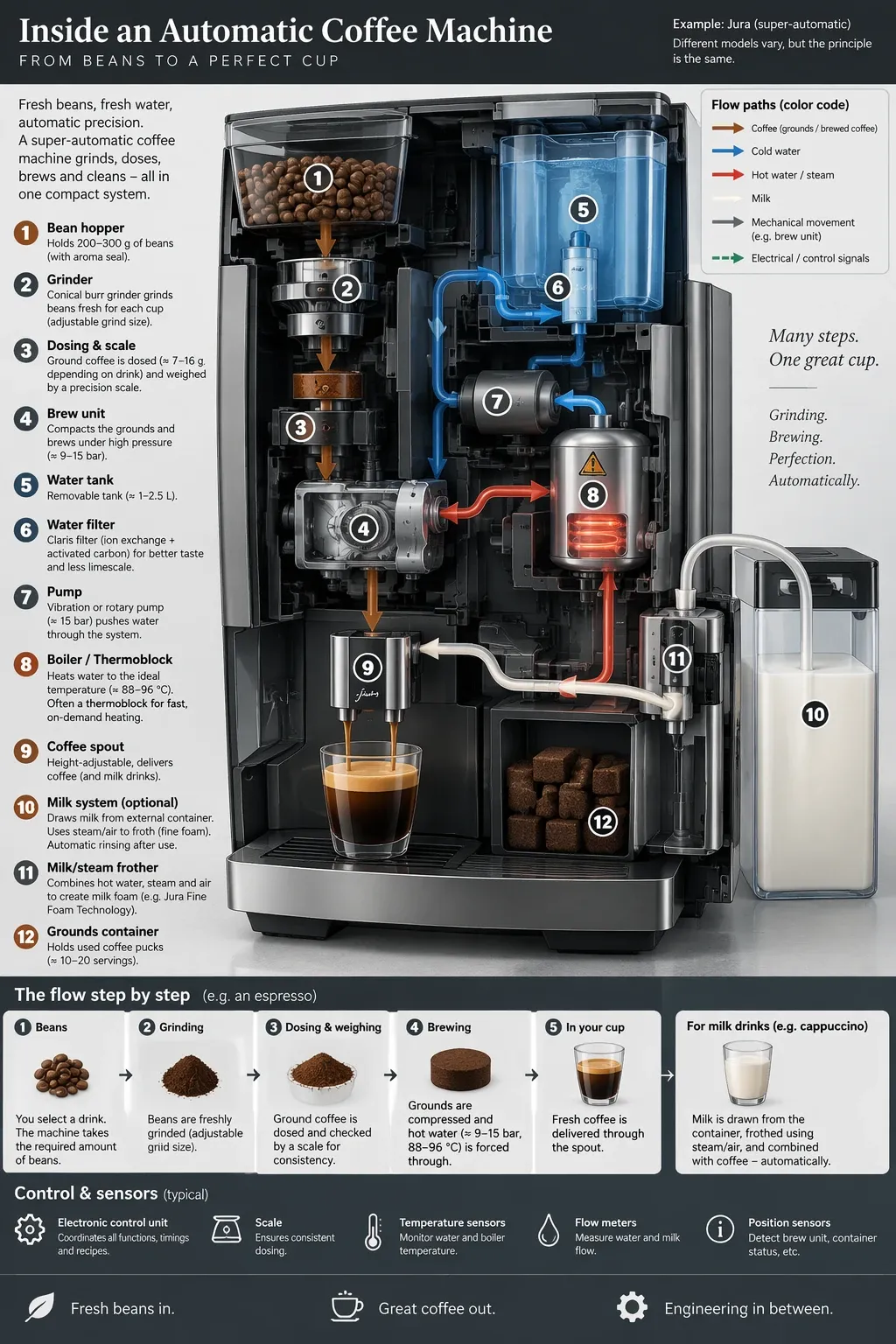
Official English coffee-machine infographic used as the source for the image-translation procedure
Input illustration published by OpenAI. The 42-region review inventory groups each heading with its associated explanation; this image is the source, not an output from this session.
GPT Image 2.5 Translate Text in an Image: 5 Steps
1. Prepare a readable original and inventory the text.
Use the largest original export available. Inspect the headline, small labels, legends, footers and text on objects. If you cannot read a phrase, resolve it before asking the model to translate it. Enlarging a blurry screenshot does not establish what its missing letters originally said.
For this source, the review inventory contains 42 semantic text regions. Each component heading and its explanation count together as one region. The 12 numbered component descriptions therefore count as 12, regardless of line wrapping. Numeric markers and proper-name logos receive a separate preservation check.
2. Specify the language, locale and protected content.
Choose Spanish for Spain, German for Germany or Simplified Chinese for mainland China. Identify brand names that should remain unchanged. Tell the editor whether it may wrap lines and which features must stay fixed: arrows, illustrations, numbers, colors and text-area positions.
Keep a copy of the original outside the working output folder. For a real campaign, also keep the approved translation as plain text so a reviewer can compare wording without deciphering every rendered character.
3. Upload the original and set the output.
On Atlas Cloud, open Sunburst Edit. Upload the English coffee-machine image. Use model openai/gpt-image-2.5-sunburst/edit, quality max, size 1024x1536, output png, background opaque and number 1. Leave Mask empty for this natural-language constraint test.
These are the requested test settings. Confirm the form displays them before running. The source is portrait, so keep its 2:3 ratio. A landscape comparison card can contain two portrait images without changing either generated canvas.
The official Spanish example uses high; this procedure requests max. It is therefore an adaptation of the example, not an identical parameter reproduction. Higher quality also does not remove the need for proofreading.
4. Paste a complete prompt, run and download.
Use the Spanish prompt below for the first run. Change neither its preservation instructions nor its input halfway through the test. Wait for a completed output and download the actual generated image. Save the prompt, displayed estimate, elapsed time and resulting dimensions alongside it.
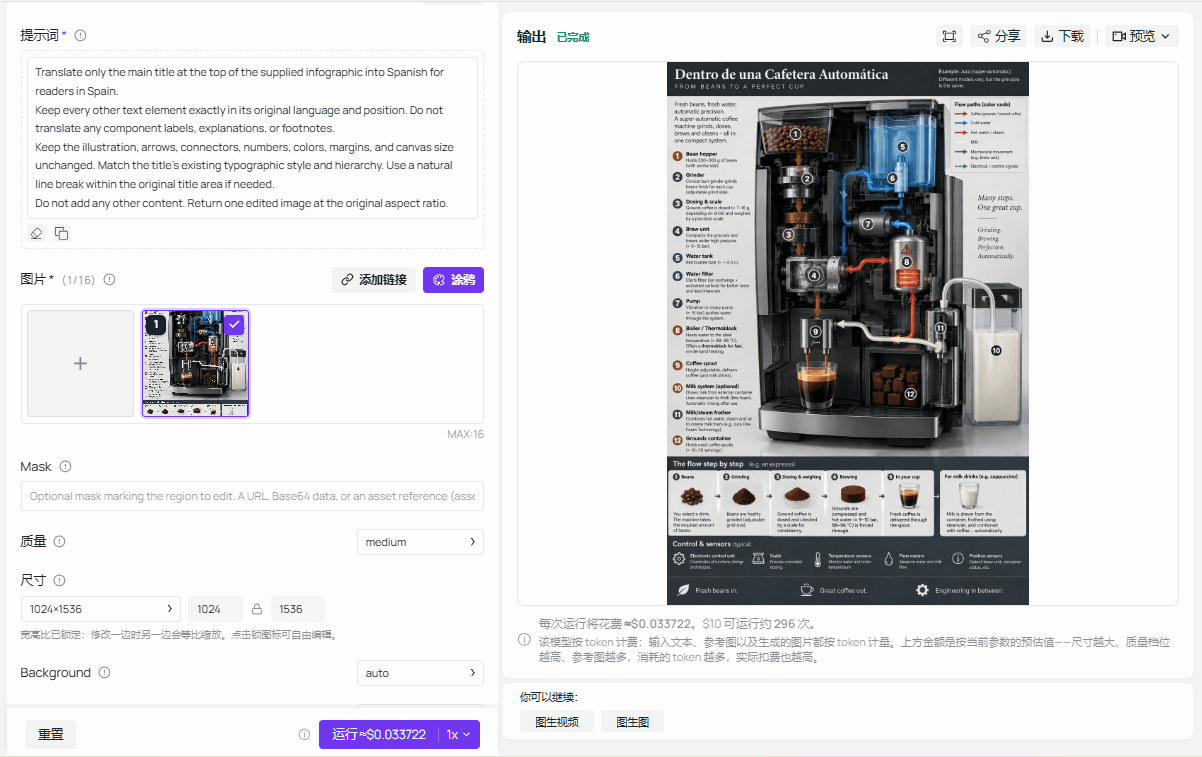
Sunburst Edit completed-run screen showing the title-only Spanish translation result
Completed-run screen in Sunburst Edit. The source image, prompt, output preview, 1024×1536 size, and per-run estimate are visible for this title-only Spanish edit.
5. Review, then accept or revise.
Compare every inventory region with the original, reading the downloaded file at full size. Then inspect it at the size readers will actually see. Check language, meaning, units, truncation, diacritics and unintended English separately from the machine, arrows and layout.
Accept the file only when its intended use permits the observed differences. Record a specific correction if one region fails. If the product or diagram has changed, restart from the original. A file requiring exact brand typography may need normal text layers even when its translation reads well.
GPT Image 2.5 Translate Text in an Image: 3 Languages
Each experiment uses the same English source independently. Translating Spanish into German and then into Chinese would combine translation drift with repeated image editing. Keep input, model and settings constant so that the comparison answers a narrower question: how does each localization fit this particular design?
The source includes 12 component descriptions, 6 flow-legend entries, a 6-card process strip, 5 sensor descriptions and text around those groups. Those crowded lower cards are as important as the large title. A region only passes when its full content is readable and translated without an evident textual defect.
Spanish: complete coverage and accents
Input: the English infographic. Goal: a complete Spanish version for Spain, with the original label-to-arrow relationships. Paste:
plaintext1Translate every readable English text element in the supplied coffee-machine infographic into Spanish for readers in Spain. 2 3Translate the title, section headings, component labels, explanations, and footnotes. Use consistent terminology throughout. 4 5Keep every illustration, arrow, connector, number, symbol, color, margin, and text-box position unchanged. Preserve the original typographic hierarchy and match the existing type style as closely as possible. 6 7Fit the translation inside the existing text areas. Allow natural line breaks, but do not move illustrations or shrink text until it becomes difficult to read. 8 9Do not add explanations, new claims, labels, decorations, or watermarks. Return one edited image at the original aspect ratio.
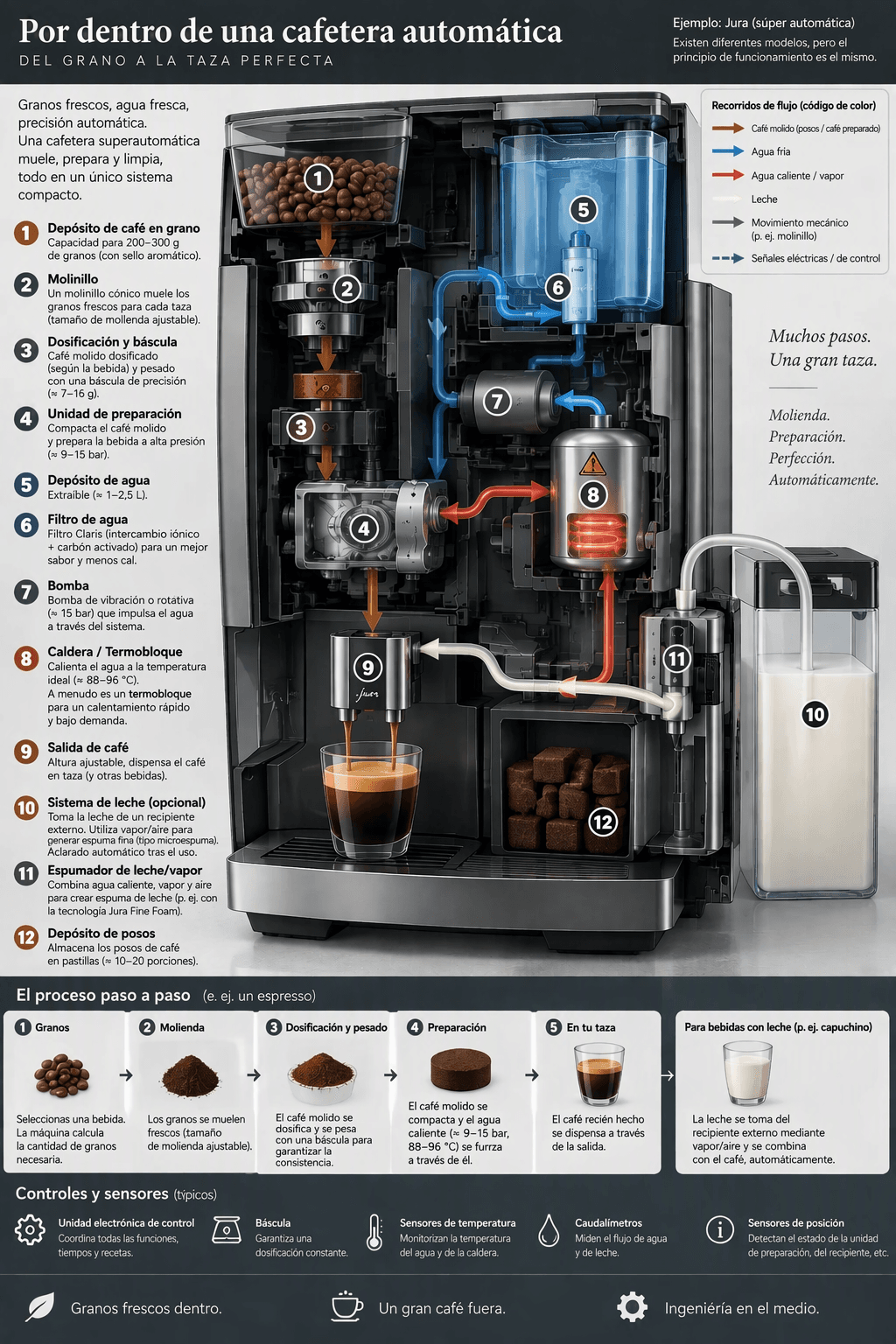
Spanish localization output: coffee-machine infographic translated into Spanish
Spanish localization output. Review every translated region, accent, number, arrow relationship, and protected illustration before approval.
Check accents in both large headings and small explanations. A correct title cannot compensate for a missed temperature-sensor description. Preserve proper names such as Jura and Claris where appropriate; an unchanged brand is different from an untranslated ordinary label.
Also compare the numbered circles. The translation may sound reasonable while the associated arrow moves toward another part. For instructional content, that changes what the reader understands. Acceptance requires both the text review and a separate check of those relationships.
German: long terms inside existing areas
Input: the English original again. Goal: readable German without expanding the canvas or deleting information to fit. Paste:
plaintext1Localize all readable English text in the supplied coffee-machine infographic into German for readers in Germany. 2 3Use clear technical German and consistent component names. Preserve all numbers and symbols exactly as shown. 4 5Keep the coffee-machine illustration, arrows, connectors, colors, margins, and the position of every text area unchanged. 6 7Use natural German line breaks inside the existing text areas. Keep the text readable. Do not stretch letters, move illustrations, enlarge the canvas, or omit words just to make the translation fit. 8 9Match the existing hierarchy of title, headings, and labels. Do not add any new content. Return one edited image at the original aspect ratio.
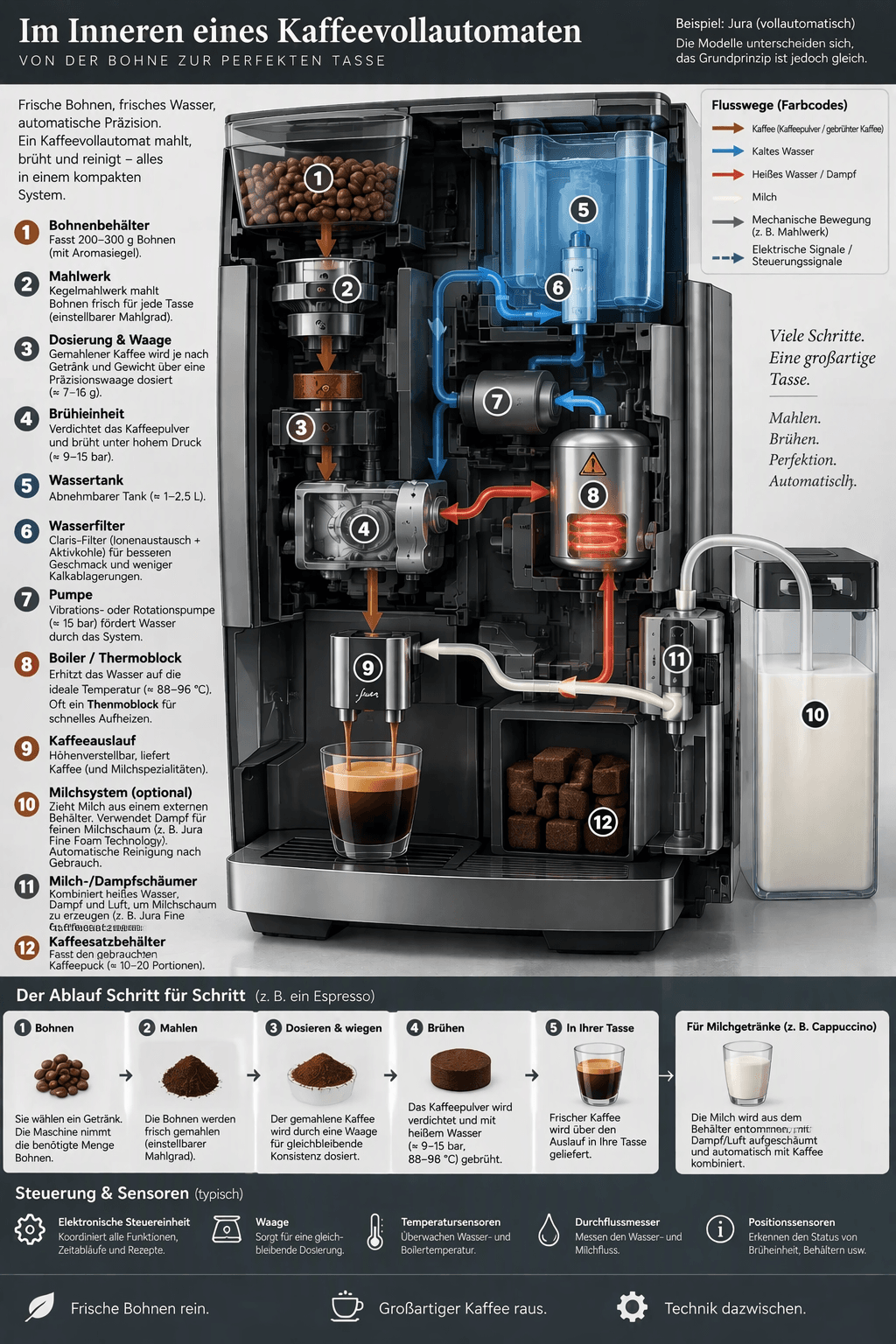
German localization output: coffee-machine infographic translated into German
German localization output. Review compound nouns, line breaks, text size, and all protected visual regions before approval.
Inspect compound nouns, line breaks and the smallest explanations. A paragraph can remain inside its area while becoming too small for the intended placement. Check the page at publication size before calling that a successful fit.
Avoid judging German by whether it occupies exactly the same number of lines as English. Meaning, readable spacing and sensible word breaks are more useful acceptance criteria. If the text needs shortening, have someone approve the shorter translation before placing it.
Simplified Chinese: characters and terminology
Input: the English original again. Goal: clear Simplified Chinese with consistent component names and natural punctuation. Paste:
plaintext1Translate every readable English text element in the supplied coffee-machine infographic into Simplified Chinese for readers in mainland China. 2 3Use concise, natural technical terminology. Translate the title, headings, component labels, explanations, and footnotes. Use the same Chinese term whenever the same component appears. 4 5Preserve all numbers and measurement symbols. Keep every illustration, arrow, connector, color, margin, and text-box position unchanged. 6 7Use clear Simplified Chinese characters and natural Chinese punctuation. Fit the text within the existing text areas while preserving the original hierarchy. 8 9Do not invent specifications or add explanatory content. Do not leave English text untranslated except for proper names or standard symbols that should remain unchanged. Return one edited image at the original aspect ratio.
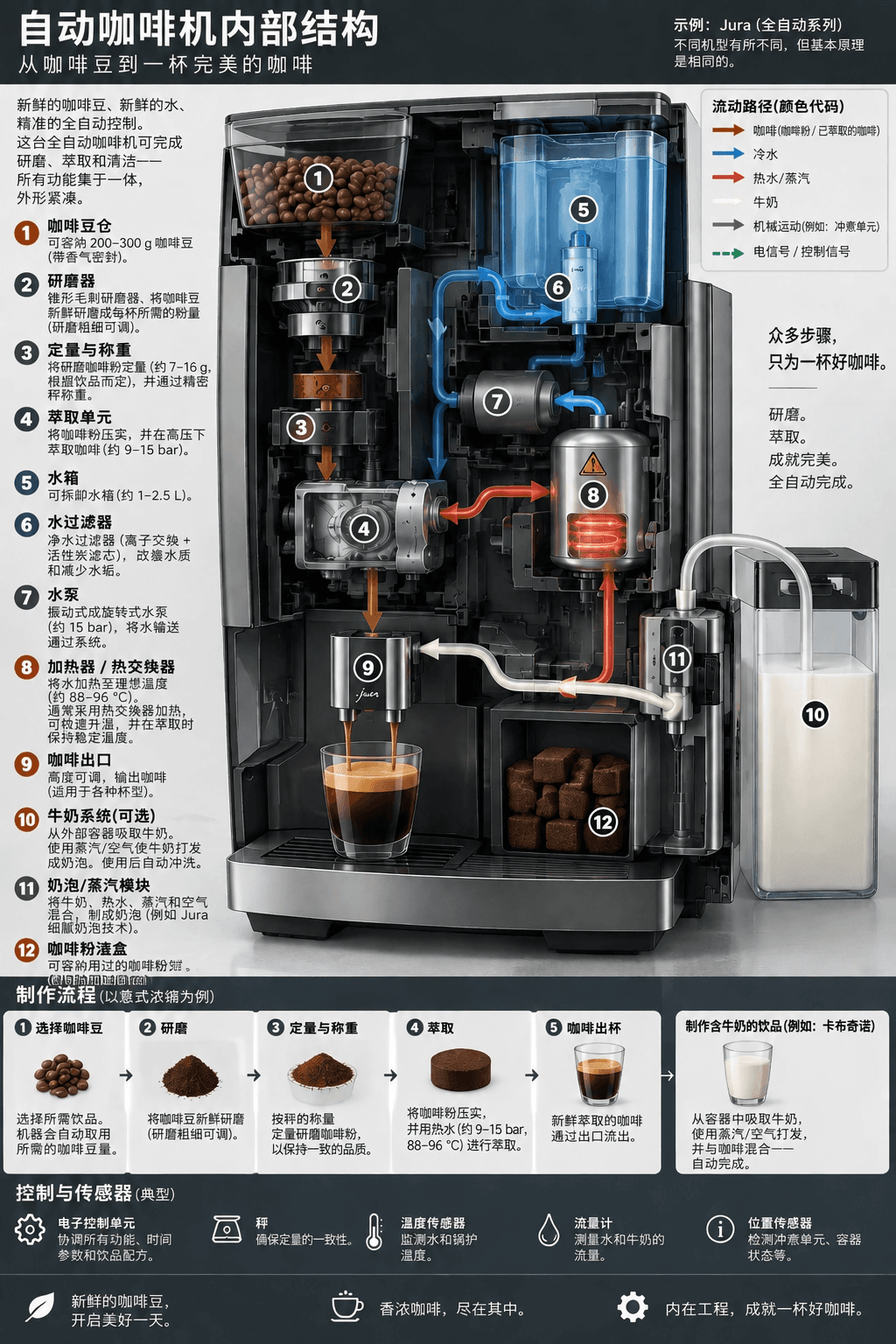
Simplified Chinese localization output: coffee-machine infographic translated into Chinese
Simplified Chinese localization output. Review terminology, punctuation, character rendering, and all protected visual regions before approval.
Read the characters rather than relying on their overall appearance. Check repeated component terms across the side labels and process strip, and distinguish legitimate symbols from unintended English leftovers. Compact wording still needs to preserve the original qualifications and measurements.
GPT Image 2.5 Translate Text in an Image: Keep the Layout
Layout preservation has two separate tests. First, the words must communicate the intended meaning. Second, the surrounding image must keep the relationships you rely on. A translation can pass one test and fail the other.
For a product image, compare the silhouette, printed markings, accessories and background edges. For this infographic, compare the numbered components, arrow endpoints, hoses, cup, legends and lower process cards. Inspect protected text too: a title-only edit has failed its scope if it rewrites a component description.
Use a deliberate preservation order:
- Keep meaning, values and label-to-object relationships correct.
- Preserve the positions of non-text elements.
- Keep text within its assigned areas.
- Maintain readable lettering and spacing.
- Match the original typographic appearance where possible.
That order gives you a decision when constraints conflict. A longer translation may need another line. Demanding identical font size, an unchanged box and every translated word simultaneously can leave no feasible fit. Define an acceptable compromise before reviewing the output.
Selective edit: translate only the top title
Return to the English source and use the following prompt. This experiment checks the boundary of the instruction, rather than another full-language version.
plaintext1Translate only the main title at the top of the supplied infographic into Spanish for readers in Spain. 2 3Keep every other text element exactly in its original language and position. Do not translate any component labels, explanations, or footnotes. 4 5Keep the illustration, arrows, connectors, numbers, colors, margins, and canvas size unchanged. Match the title's existing typographic style and hierarchy. Use a natural line break within the original title area if needed. 6 7Do not add any other content. Return one edited image at the original aspect ratio.
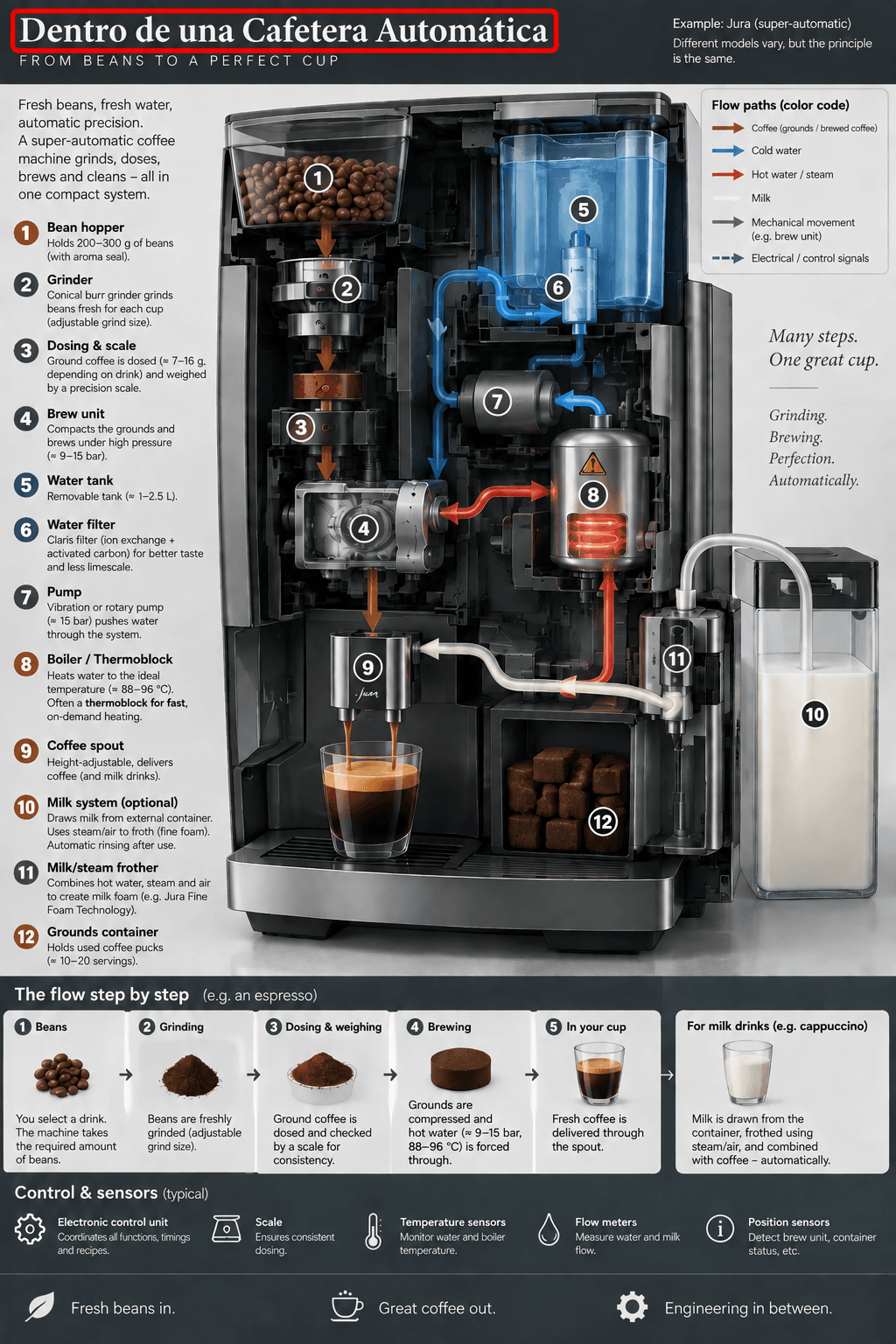
Title-only Spanish edit output, with the changed headline marked by a red outline
Title-only Spanish edit output. The red outline identifies the changed headline; verify that all 41 protected regions remain in their original language and position.
At a minimum, compare the subtitle, first component description, flow legend and footer immediately after checking the new headline. Continue through the remaining regions before acceptance. Spot checks can reveal a failure quickly; they cannot establish that every protected region stayed unchanged.
For real UI screenshots, charts and engineering drawings, use the source document or a deterministic overlay when exactness matters. An AI-edited interface image is a localization mockup. It cannot prove that the actual software displays those labels or implements the depicted controls.
Likewise, matching appearance at normal viewing size does not establish pixel identity. A strict no-change requirement calls for an image-difference check and a workflow that preserves the background pixels directly.
GPT Image 2.5 Translate Text in an Image: Fix Errors
Start a correction by naming one observed defect. Record the source phrase, what the output says and the approved replacement. That gives the next attempt a clear purpose and makes its result easier to evaluate.
Missed text. Identify the region and provide the exact replacement. Check other small labels after the repair. A single missed caption may be easy to correct, but the same run can also modify previously acceptable lettering.
Wrong terminology. Ask a reader who knows the language and subject to approve the wording. Then specify that wording verbatim. Asking for a more accurate translation without identifying the disputed term gives you little control over the next version.
Text that no longer fits. First consider a shorter translation that preserves the meaning. Then allow a natural line break within the original area. Avoid solving overflow by shrinking every label, because the resulting graphic may become unreadable on a mobile screen.
Changed artwork. Return to the original source if the machine, arrows or other protected areas have moved. Repeatedly repairing a changed image makes that changed image the next reference. You then have more differences to identify and explain.
| Symptom | Possible cause, not a diagnosis | Next action |
|---|---|---|
| One label stays English | The model may have missed a small or ambiguous region | Name the region and supply the replacement text |
| Component terms vary | Context or terminology may have been interpreted inconsistently | Provide an approved glossary and check every occurrence |
| German wording overflows | The translation may exceed the available area | Approve a concise equivalent or a natural line break |
| Characters look plausible but are wrong | The rendering may have introduced a textual error | Supply exact characters and inspect at native size |
| Arrows or product details change | The edit may have affected more than the intended text | Restart from the original or preserve artwork with text layers |
| Fine print remains unreadable | Source detail or output legibility may be insufficient | Obtain a clearer original or rebuild from the design source |
These are troubleshooting hypotheses. An imperfect result does not establish that the user wrote a bad prompt. The input, crowded design, translation length and image-editing behavior may all contribute.
When everything except one text region has passed, a targeted repair can use that accepted intermediate file. If unrelated regions have changed, restart from the original and include the approved replacement wording. Keep each attempt separately so reviewers can see whether the correction introduced another problem.
For this workflow, use a limit of 2 targeted correction attempts before moving to conventional text layers. That is an editorial stopping rule, not a claim about the model's capability limit. It prevents an afternoon of unpredictable revisions on a file that needs exact typography.
For unreadable fine print, solve the source problem first. Do not accept invented wording because it sounds appropriate for a coffee machine or marketing poster. Uncertain source content should remain uncertain until you obtain a readable original.
Choose Sunburst, Flare, or Editable Text
Sunburst is the sole model specified for these experiments. OpenAI positions it for work where editing precision matters and lists low, medium, high, xhigh, max and auto quality settings. That positioning explains the choice; it does not promise that every label or protected pixel will survive. (Sunburst model documentation, accessed September 2026.)
The official prompting guide presents Flare as the speed-oriented starting point and Sunburst for more demanding quality requirements. This article does not run a Flare comparison, so it provides no translation accuracy ranking or measured speed advantage between them.
Choose by what you need to hand over:
- Product callouts: try a reviewable image edit when the artwork is flattened and the copy is short. Check the product itself as carefully as the language.
- Campaign posters: editable text is useful when dates, locations and offers change frequently. An image edit can help with an occasional localized version.
- Teaching materials: verify every arrow, number and technical term. Dense explanation cards can justify rebuilding the typography.
- Real software interfaces: change the application's language and capture it again when the image must document actual behavior.
- Scanned pages: extract and review the text, then rebuild the document when accessibility, search or long-form reading matters.
These are workflow choices, not customer success stories. The right route depends on the existing source files, delivery requirements and reviewer time.
Editable text layers offer direct control over font selection, line breaks, kerning and positioning. They also let a colleague replace one phrase next week without regenerating the whole image. If you already have the source design, that control may matter more than the convenience of a single image-editing prompt.
A useful mixed workflow preserves the original illustration, obtains an approved translation and typesets it conventionally. Keep that option available from the beginning, especially for recurring campaigns or regulated product wording. You can still use image edits for exploratory versions while reserving final typography for a controlled document.
What Image Translation Actually Costs
Separate catalog starting price, configured estimate and actual charge. They describe different things, and none alone tells you the cost of a final, accepted localized image.
On September 18, 2026, the Atlas model directory displayed Sunburst Edit at approximately $0.006 per picture before discount and $0.005 after discount, with a 20% off label. Those rounded amounts are catalog starting figures. The discount is a dated observation, not a permanent offer.
The public detail page initially displayed approximately $0.005 per run and explained that billing includes text input, reference-image input and generated-image tokens. It also stated that size, quality and reference-image count affect cost. Its initial controls showed medium quality, a square size and automatic background, not this tutorial's requested settings.
The exact estimate and actual consumption for max + 1024x1536 + this reference image were not retained with the supplied outputs. Do not use the directory figure as this experiment's measured price.
Use this metric for your own batch:
Generation cost per accepted image = total generation charges, including retries, divided by accepted final images.
If no output meets the requirements, report zero accepted images and the amount spent. The ratio has no usable denominator. Keep reviewer time separate: record minutes spent checking text, comparing artwork and making manual corrections.
A practical run log contains the model, source filename, target locale, committed settings, displayed estimate, actual charge if available, attempts and acceptance decision. Include rejected generations in the total. For recurring work, compare the combined generation and editing effort against starting with a reusable design template.
That record is more useful than assuming the lowest advertised number describes every deliverable. It also shows whether longer text, stricter typography or a crowded source is consuming most of the team's review time.
Image Translation FAQ
Can GPT Image 2.5 translate text directly inside an image?
Yes. The official prompting guide demonstrates an image-editing request that replaces infographic text with Spanish. Supply the image and ask for an edited image in the target language. Inspect the returned file for omissions and unintended changes. A plain-text translation alone is a different deliverable and will not replace pixels inside your source.
How do I translate image text without changing the background?
Specify which areas may change and list protected features such as objects, colors, arrows and positions. Start with a clear original, then compare protected areas after generation. Instructions express the intended boundary; they do not establish a pixel-preservation guarantee. When the background must remain exact, keep it intact and place approved translations through conventional text editing.
Can it preserve the original font and layout exactly?
Do not assume exact font recovery or identical spacing from a flattened image. Longer translated wording can require different line breaks, and a new script needs appropriate glyphs. Ask for the same hierarchy and a close visual match, then check the result. Use the original design and licensed fonts when precise brand typography is part of acceptance.
Why is some text still in the original language?
The output alone may not reveal the cause. Small text, ambiguous lettering or an incomplete edit are possible explanations. Compare the whole source inventory, identify the missed phrase and provide an approved replacement. Exempt proper names and standard symbols deliberately, so a reviewer can distinguish an intentional exception from a missed translation.
Can I translate only one title or label?
Yes, you can request a selective edit by naming that region and protecting all other text and artwork. The title-only prompt above provides the full instruction. Inspect every protected region afterward. If another caption changes, the output has failed that scope requirement even if the new title is correct. Use a text layer when that boundary must be exact.
Is GPT Image 2.5 image translation free, and what affects the cost?
Do not assume free access. Check the chosen provider and account, then read the estimate after uploading the source and selecting size and quality. Include retries and human review in your delivery budget. For a GPT Image 2.5 Translate Text in an Image task, the relevant outcome is an accepted file with verified wording and acceptable preservation.
Try one image in Sunburst Edit on Atlas Cloud, then check the translated text and unchanged areas before creating more language versions.





