On October 6, 2026, Google shipped Nano Banana 2.1 with a thinking level you can set before the model draws. Two days later Midjourney posted that it was testing a "Thinking Mode" on its alpha site that looks at a finished V8.2 image, finds where it missed the prompt, and generates again. The oldest argument in AI imaging, Nano Banana vs Midjourney, suddenly has both sides reasoning about your words before you see a pixel.
That changes the question people have been asking on Reddit for a year. It used to be realism against artistry. Now it is: which model reads a brief more faithfully, and what does each one actually cost per picture? We ran the same four prompts through both models on one platform, read the official spec and pricing pages on both sides, and worked the GPU minutes down to a per-image number. Here is where the line sits in October 2026.
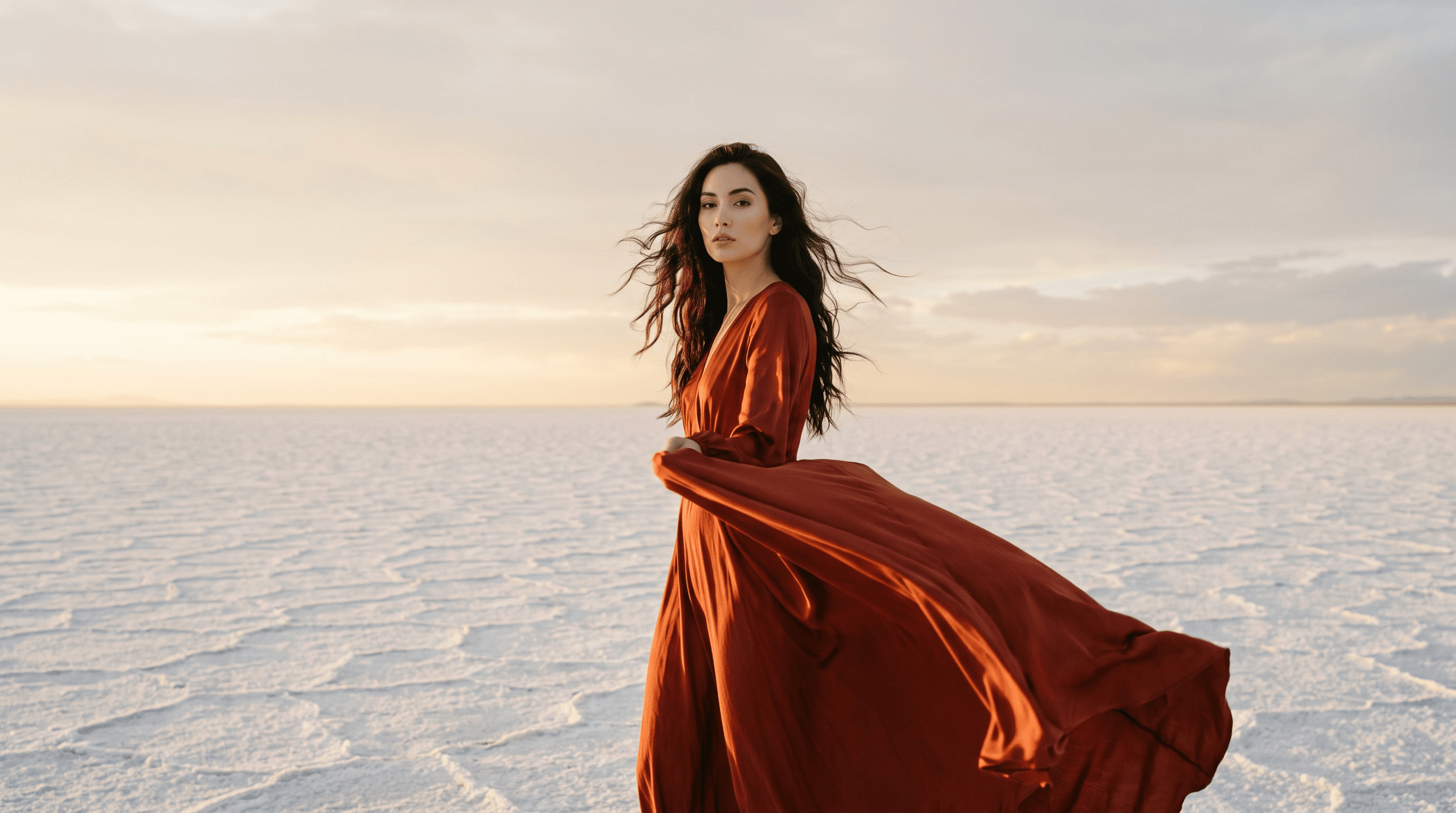
Nano Banana 2.1 on Atlas Cloud, 2K, 16:9, default thinking, first attempt. The brief was Midjourney's home ground: muted film palette, wind, negative space.
Key Takeaways
- Nano Banana 2.1 shipped on October 6, 2026 with three thinking levels. Two dayslaterMidjourney began testing a Thinking Mode that reruns a V8.2 job to fix missed objects, layout, anatomy and text.
- Midjourney V8.2 renders native 2K and sells GPU hours by subscription. Nano Banana 2.1 renders 1K to 4K and bills per image through an API.
- Midjourney replaced Omni Reference with a four-image Edit Model in V8. Nano Banana 2.1 takes up to 14 reference images and holds 4 characters and 10 objects.
- Midjourney still publishes no API and its terms forbid automated access. Nano Banana 2.1 is API-first, and the Nano Banana 2.1 family runs on Atlas Cloud with one key.
- Reddit's standing verdict gives realism to Nano Banana and artistry to Midjourney. Our four same-prompt rounds test whether the 2026 models moved that line.
Nano Banana 2.1 vs Midjourney V8.2: Two Models, Two Business Models
Start with what each company says its model is for. Google's model card describes Nano Banana 2.1 as a Flash-class image model built on Gemini 3.6 Flash. The Gemini API docs list it as generally available from October 6, with output at 1K, 2K and 4K, up to 14 reference images, and a thinking setting of minimal, medium or high. Midjourney's Version page describes V8.2 as the default model since July 24, 2026, "focused on aesthetics, image quality, and Personalization," and says it "features the new Edit Model, which replaces Omni Reference, Character Reference, and the Retexture tool."
One model is an API that returns one image per call. The other is a creative subscription that returns four images per prompt and tunes itself to your taste over time. That difference runs through everything else in this comparison, from how text gets rendered to how a picture gets paid for.
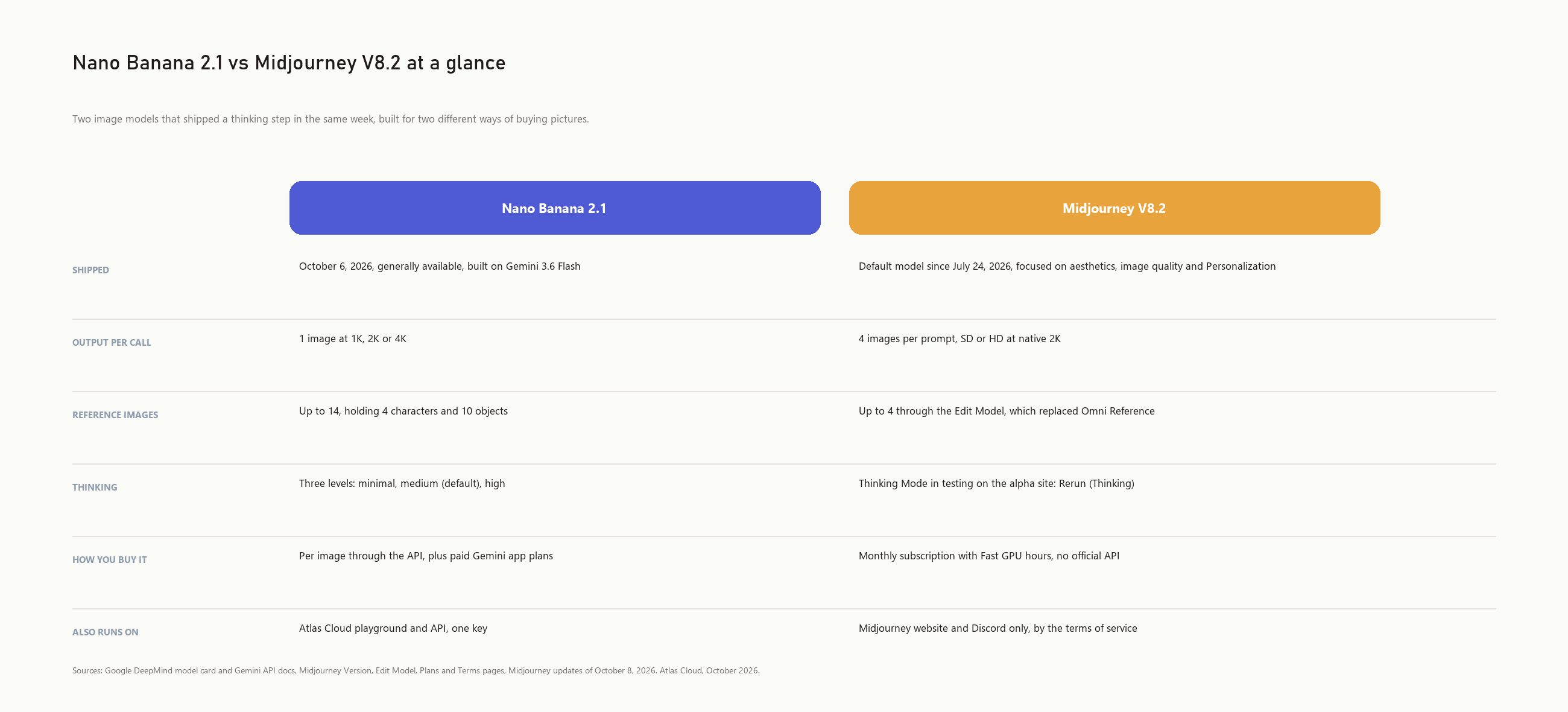
The thinking step is the new overlap. Nano Banana 2.1 reasons before it draws, and the level is a request parameter. Midjourney's version, announced on updates.midjourney.com on October 8, 2026, is a button under the lightbox labelled "Rerun (Thinking)" that reruns an existing 8.2 job. Section four takes that apart.
Running Both Models on Atlas Cloud
Both models in this article ran on Atlas Cloud, which puts a Midjourney render and a Nano Banana render side by side under one account, one prompt box and one request history.
Method 1: Paste One Brief Into Both Playgrounds
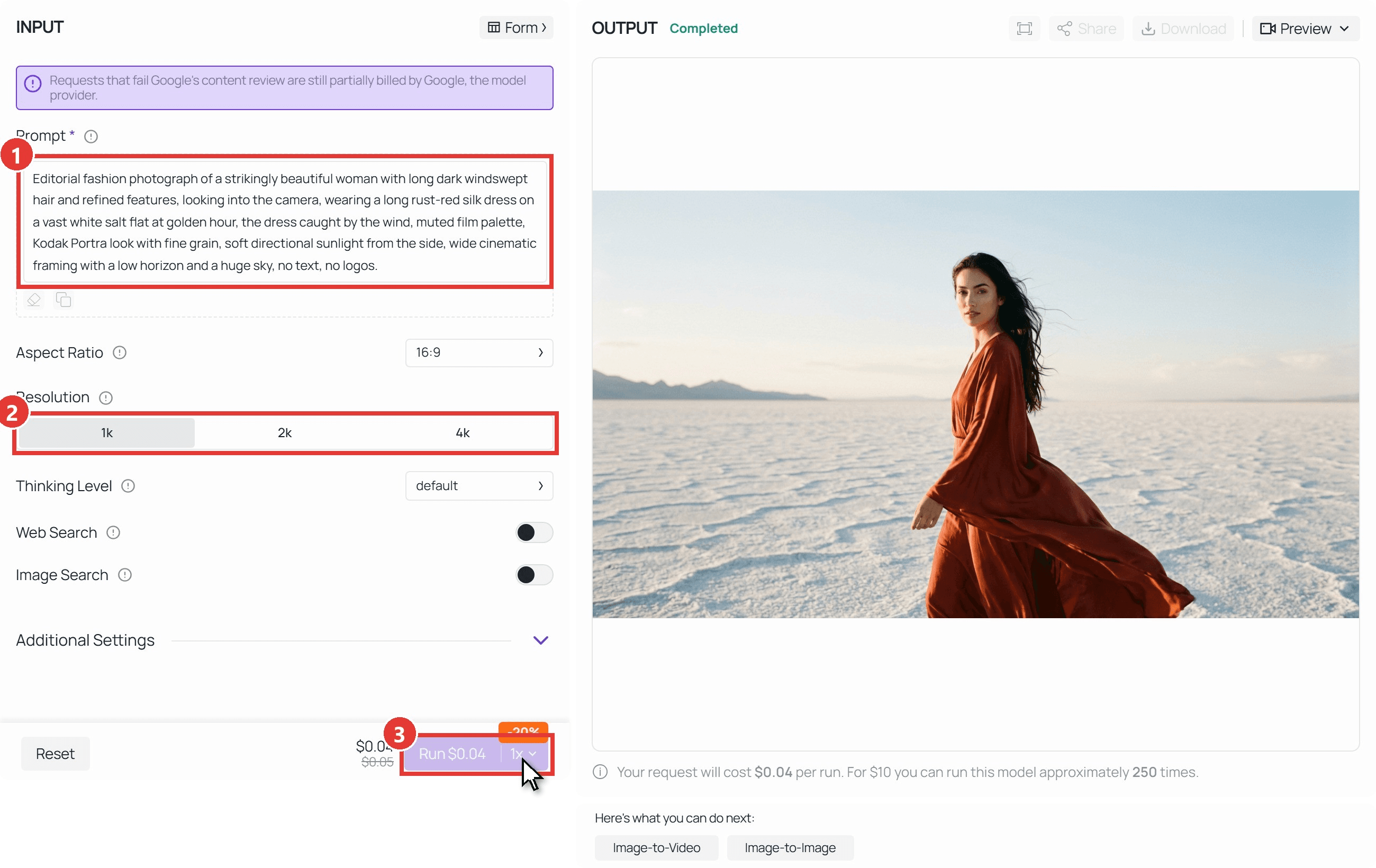
Open the Nano Banana 2.1 text-to-image playground and sign in. Three controls do the work:
- Paste the prompt. Spell out any words that must appear in the image, in capitals if they should render in capitals.
- Pick a resolution tier. 1k is the default and the one we used for every comparison round. The Run button updates its estimate as you switch.
- Press Run. Our 1K runs this week returned in roughly 15 to 35 seconds, and the result lands in the OUTPUT panel.
Midjourney lives one family over. On Atlas Cloud the Midjourney text-to-image endpoint runs on the V8.1 checkpoint, while V8.2 is exposed for image-to-image work, blends and style transfer. Open the Midjourney text-to-image page and the form mirrors the Midjourney parameter list: aspect ratio, an HD switch for native 2K, and sliders for stylize, chaos and weird.
- Paste the same prompt. The box takes up to 1,024 characters.
- Set the aspect ratio. We matched the Nano Banana side at 16:9 and left HD off, which keeps Midjourney on its standard-definition tier.
- Press Run. One run returns four images, so the OUTPUT panel switches to a numbered grid.
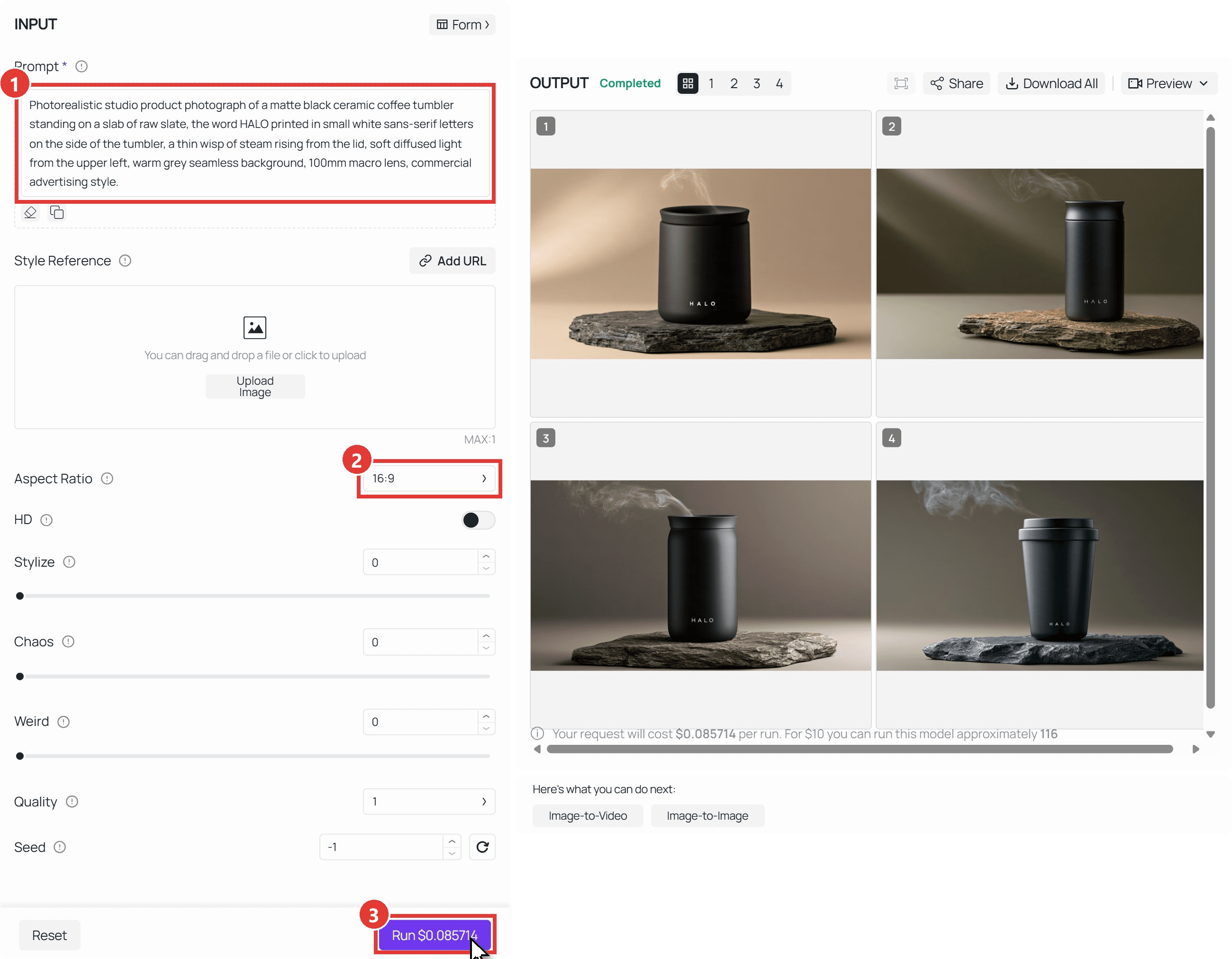
That four-to-one ratio is the thing to keep in mind through the next section. A Midjourney grid is four interpretations of one brief. A Nano Banana 2.1 result is one interpretation that is expected to be right.
Method 2: Swap the Model String in One Request
Step 1: Get your API key. Create a key in the Atlas Cloud console and keep it in an environment variable rather than in client-side code.
Step 2: Check the API docs. Endpoints, parameters and authentication live in the API documentation.
Step 3: Make your first request. Submit the job:
plaintext1curl -X POST https://api.atlascloud.ai/api/v1/model/generateImage \ 2 -H "Content-Type: application/json" \ 3 -H "Authorization: Bearer $ATLASCLOUD_API_KEY" \ 4 -d '{ 5 "model": "google/nano-banana-2.1/text-to-image", 6 "prompt": "Photorealistic photograph of a printed concert poster pinned to a sunlit brick wall, bold headline reading NIGHT SIGNAL, second line Live at The Foundry, third line Saturday 24 October, 8 PM, bottom line Tickets at the door, deep navy background with one orange circle", 7 "aspect_ratio": "16:9", 8 "resolution": "1k", 9 "thinking_level": "medium" 10 }'
The response returns a prediction ID. Poll it until the status reads completed:
plaintext1curl https://api.atlascloud.ai/api/v1/model/prediction/<prediction_id> \ 2 -H "Authorization: Bearer $ATLASCLOUD_API_KEY"
To send the same brief to Midjourney, change the model string to midjourney/v8.1/text-to-image, drop the resolution and thinking fields, and add the Midjourney parameters you want, such as stylize or hd. The header, the submit-and-poll loop and the key do not change. That is the point of one API: the two models in this comparison are one field apart.
Nano Banana 2.1 vs Midjourney on Four Identical Prompts
Four briefs, chosen so that each model had to play on the other's field. Both sides got the identical prompt text, 16:9, default settings, one attempt, no cherry-picking. Nano Banana 2.1 ran at 1K with the default medium thinking. Midjourney ran at SD with stylize, chaos and weird at zero. For Midjourney we show the whole grid of four, because picking the best of four is how the product is meant to be used.
Round 1: a concert poster with four lines of copy. This is a text rendering test. The prompt named a headline, a venue line, a date line and a footer line.
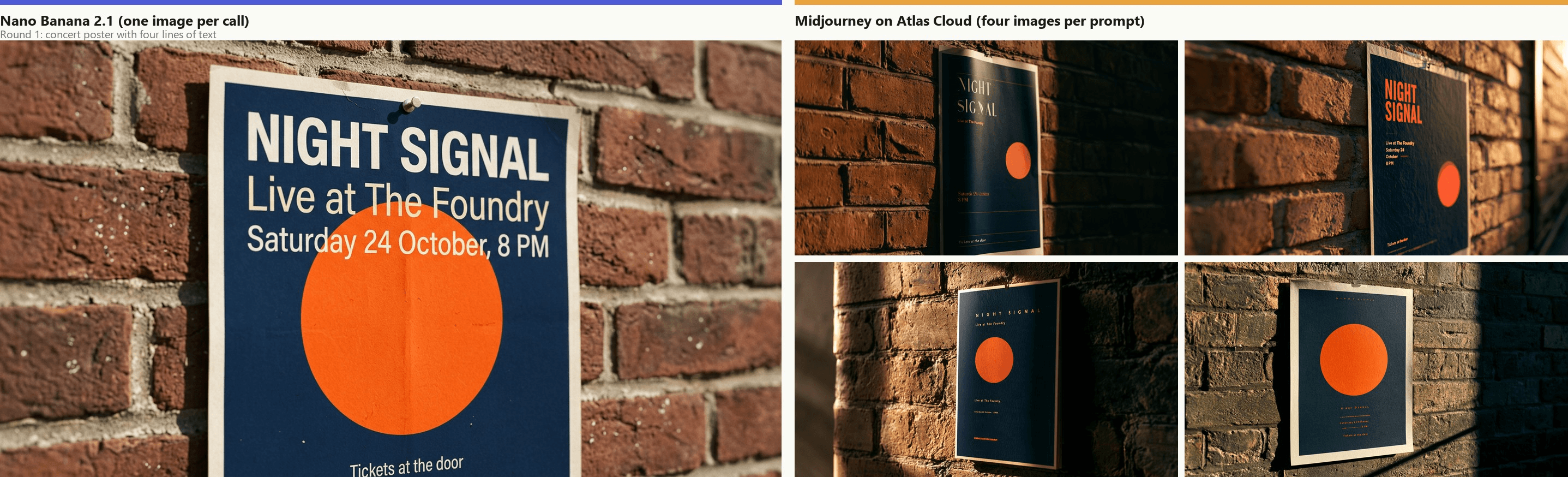
Nano Banana 2.1 rendered all four lines, in order, on the first try. Midjourney's grid is more beautiful as light and paper, with a late-afternoon rake across the brick that the Nano Banana image does not attempt, but only one of the four frames carries every line intact. One frame turns the date into non-words, and two push the small copy into illegible marks. If you need the words, round one is decided before you open a second tab.
Round 2: a rainy night portrait with a neon sign. Realism plus scene text. The sign had to read WASH & FOLD.
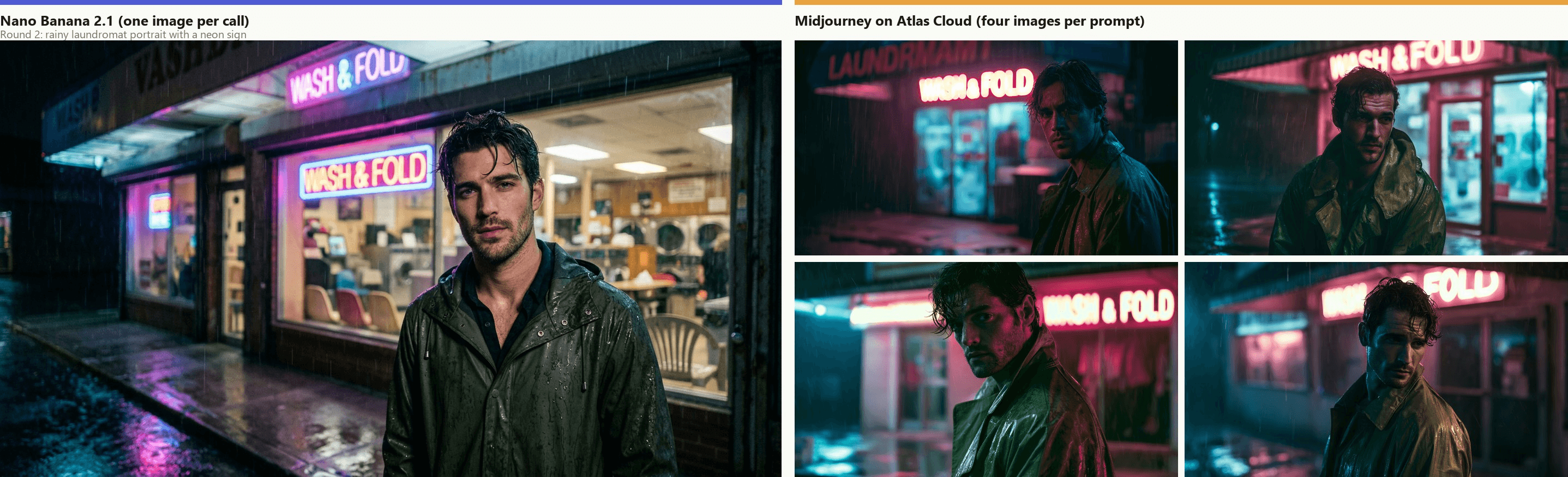
Both models produced a convincing man in rain. Nano Banana 2.1 kept the laundromat lit and legible, with the sign spelled correctly twice. Midjourney went darker and closer, with the moodier colour grade and the more arresting face, and spelled the sign correctly in two of four frames. The Nano Banana image looks like a photograph taken outside a real laundromat, the Midjourney grid looks like a film still.
Round 3: a low-saturation editorial fashion frame. Midjourney's territory by reputation. Full body, cream coat, empty parking structure at dawn, Portra palette.
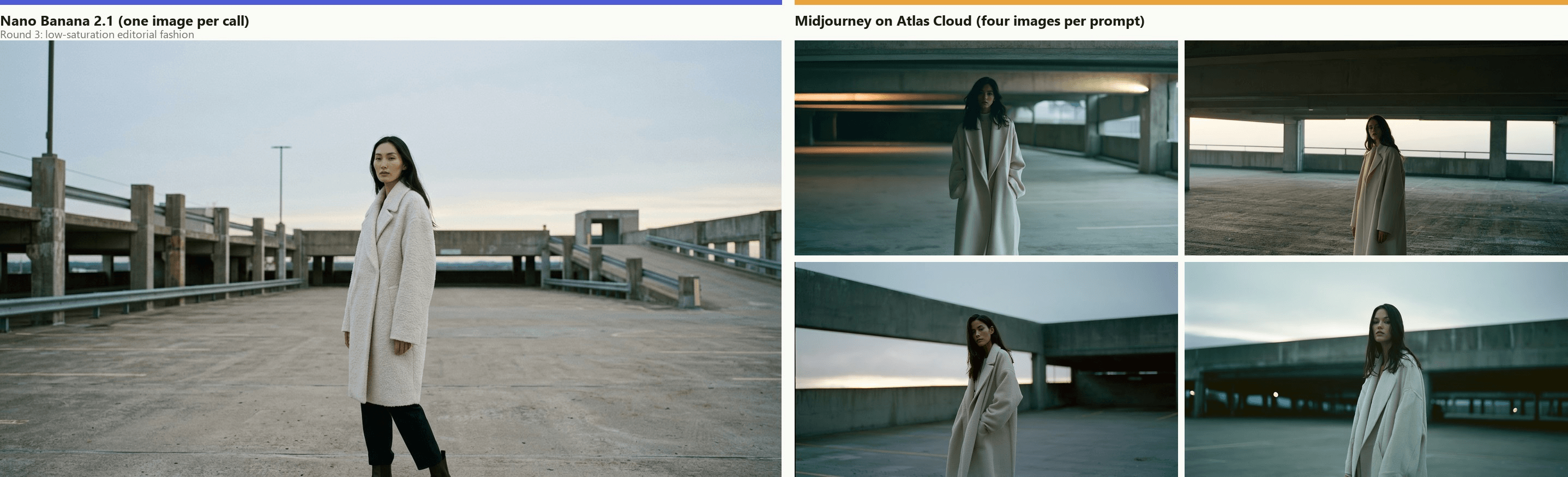
Midjourney wins this one on feel. All four frames have the hush the brief asked for, with grain, fall-off and a palette that reads as film. Nano Banana 2.1 followed the words more literally, a full-length figure on an open deck under a dawn sky, and delivered a frame that would sit in a lookbook but reads as a sharper, more catalog-like picture. If you are chasing an atmosphere rather than a spec, this is where the subscription earns its keep.
Round 4: a product shot with a brand word. Matte black tumbler on slate, the word HALO in small white type, steam, commercial lighting.
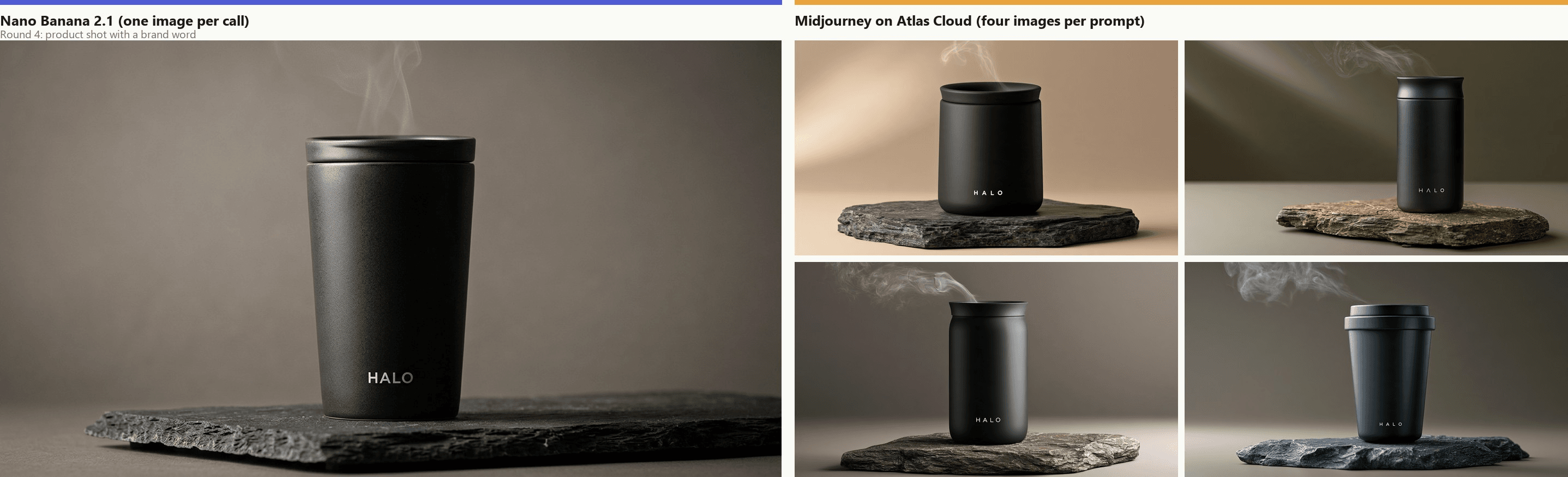
A draw on the brand word: both models printed HALO cleanly. The interesting difference is what each did with the object. Nano Banana 2.1 made one tumbler that matches the brief. Midjourney made four different tumblers, from a squat ceramic cup to a takeaway cup with a lid. For a product that already exists, the single faithful render is what you want. For a product that does not exist yet, four shapes for one prompt is a design session.
| Round | Nano Banana 2.1 | Midjourney (grid of four) |
|---|---|---|
| Poster copy | All four lines correct, first try | One of four frames fully correct |
| Neon sign portrait | Sign correct twice, documentary realism | Sign correct in two frames, stronger mood |
| Editorial fashion | Literal, sharp, catalog-clean | Four cinematic frames, wins on atmosphere |
| Branded product | One faithful tumbler | Four product designs, all with the mark |
Does Midjourney's Thinking Mode Close the Prompt Gap?
The text failures in rounds one and two are exactly what Midjourney says its new mode is for. The October 8 announcement describes a test on alpha.midjourney.com where you open a job's lightbox and click "Rerun (Thinking)," and reports that the company is "finding in tests that this helps make the model better at prompt accuracy, typography, and coherence." The alpha changelog of the same week is more concrete: "Midjourney looks at your image, finds where it missed your prompt (wrong objects, layout, anatomy, text) and generates again. This is an early version."
Read those two sentences against how Nano Banana 2.1 thinks and the difference is where the reasoning happens.
| Nano Banana 2.1 thinking | Midjourney Thinking Mode | |
|---|---|---|
| When it runs | Before the image is drawn | After a finished 8.2 job, as a rerun |
| How you set it | thinking_level of minimal, medium or high in the request, medium by default | A "Rerun (Thinking)" button under the lightbox |
| What it targets | Prompt interpretation and layout planning | Wrong objects, layout, anatomy and text the first pass missed |
| Where you can use it | Gemini API, paid Gemini app plans, Atlas Cloud | Alpha website only, subscribers, described as an early test |
| Stated plans | Shipped | "In the future we might make this available broadly" |
Nano Banana 2.1 spends its thinking before the first pixel, so each single-attempt Nano Banana result in this article already includes it. Midjourney's version is a second pass that inspects the first result. It is a repair step rather than a planning step, and it costs another job.
Midjourney also says it applies to standard and edit jobs made with 8.2, so it is tied to the current model rather than a separate mode you select up front.
We could not run Thinking Mode ourselves: it lives on the alpha site behind a subscription and is not exposed through any endpoint. The rounds above, run on the V8.1 checkpoint, show the gap it is aimed at is real: the Midjourney posters failed on exactly what the changelog lists, text and layout.
How 2.1's three levels behave on dense layouts, and why the default level explains most of the complaints about it, is covered in our Nano Banana 2.1 launch guide, so this article does not repeat that test.
Character Consistency: 14 References vs the Midjourney V8.2 Edit Model
Here the spec sheets alone set up the contest. Google's image generation documentation lists up to 14 reference images for Nano Banana 2.1, with consistency held for up to 4 characters and 10 objects. Midjourney's Edit Model page says the Edit Model can "generate new images using up to 4 reference images (replacing Omni Reference and Character Reference)."
On Atlas Cloud the two routes are the Nano Banana 2.1 edit endpoint, which takes 1 to 14 reference images and a prompt, and Midjourney V8.2 Blend, which fuses two to five images into four results with an optional guiding prompt. We gave both the same two reference portraits, a man and a woman generated earlier in the Nano Banana 2.1 playground, and the same instruction: put these two people together at a seaside market stall at golden hour, keep their faces, hair and clothing exactly as shown.
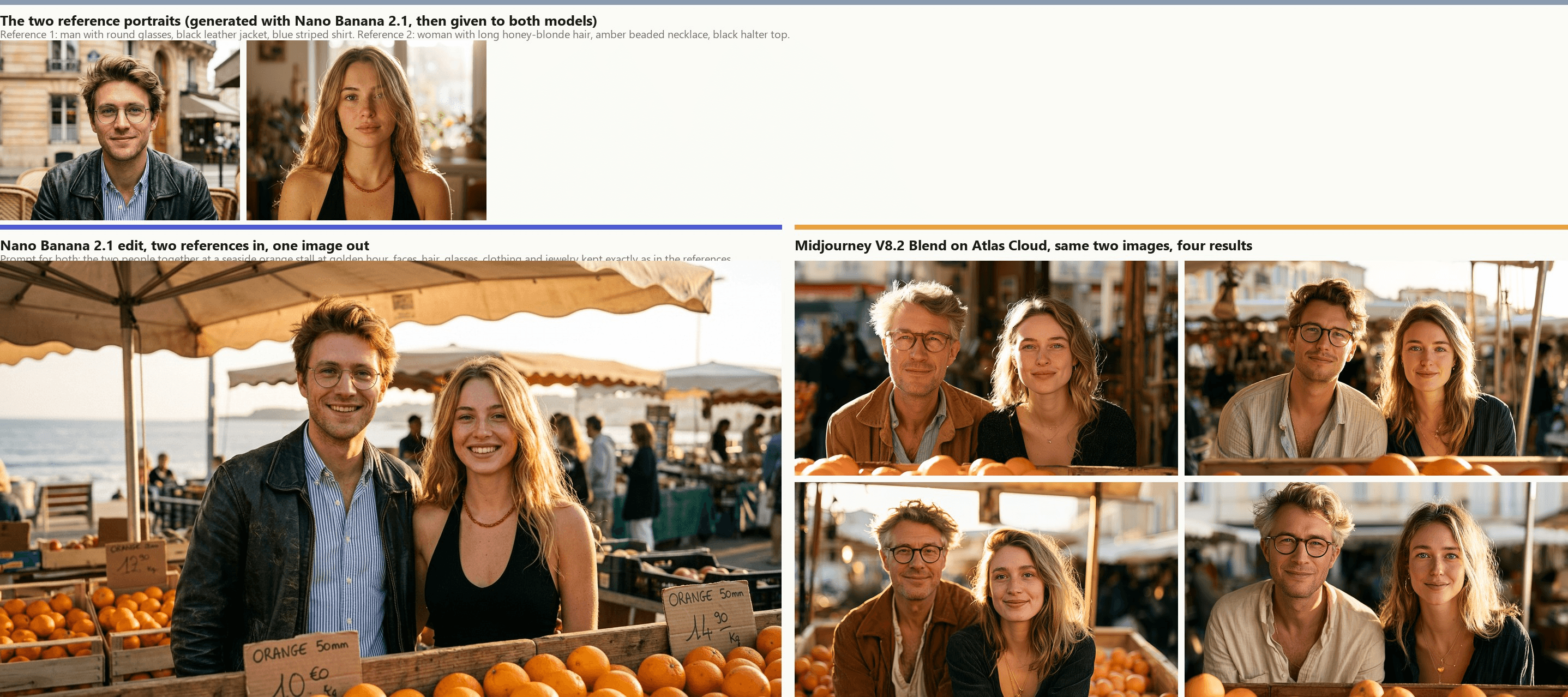
Nano Banana 2.1 returned the two people from the references. The round glasses, the leather jacket over the striped shirt, the honey-blonde hair falling over one eye and the amber necklace all survived the move to a new location, a new light and a two-shot composition, in one call that cost a little more than a single text-to-image run.
Blend did what its name says: it fused the two portraits with the prompt into four pleasant market scenes, but the man came back a decade older with grey hair and a different jacket, and the woman came back with a different necklace and top. Blend is a mood and composition tool rather than a character reference. Midjourney's own four-image Edit Model lives on midjourney.com, and the 14-reference gap in the spec sheets is still the gap that decides this section.
Nano Banana vs Midjourney Pricing: GPU Hours vs Per Image
The two companies do not even sell the same unit, so the honest comparison starts with converting one into the other.
Midjourney's plan comparison page lists four subscriptions: Basic at $10 a month, Standard at $30, Pro at $60 and Mega at $120, with annual billing at $96, $288, $576 and $1,152. The plans carry 3.3, 15, 30 and 60 hours of Fast GPU time a month, extra Fast hours cost $4 each, Relax mode for images is available from Standard upward, Stealth mode from Pro upward, and the page adds that "you must purchase the Pro or Mega plan if you are a company making more than $1,000,000 USD in gross revenue per year." All four are paid subscriptions, and the page lists no free plan.
Midjourney's GPU speed page then prices a job in minutes: an SD prompt uses about 0.8 GPU minutes, an HD prompt about 1.3, and each prompt returns four images.
Google's Gemini API pricing page bills Nano Banana 2.1 image output at $30 per million tokens. A 1K image is 1,120 tokens, a 2K image 1,680 and a 4K image 3,780, which works out to $0.0336, $0.0504 and $0.113 per image. Input is $1.50 per million tokens and thinking output $7.50 per million, so a reference-heavy edit or a high thinking level adds a little on top.
The API has no free tier, and in the Gemini app the model is reserved for Google AI Pro, Plus and Ultra subscribers.
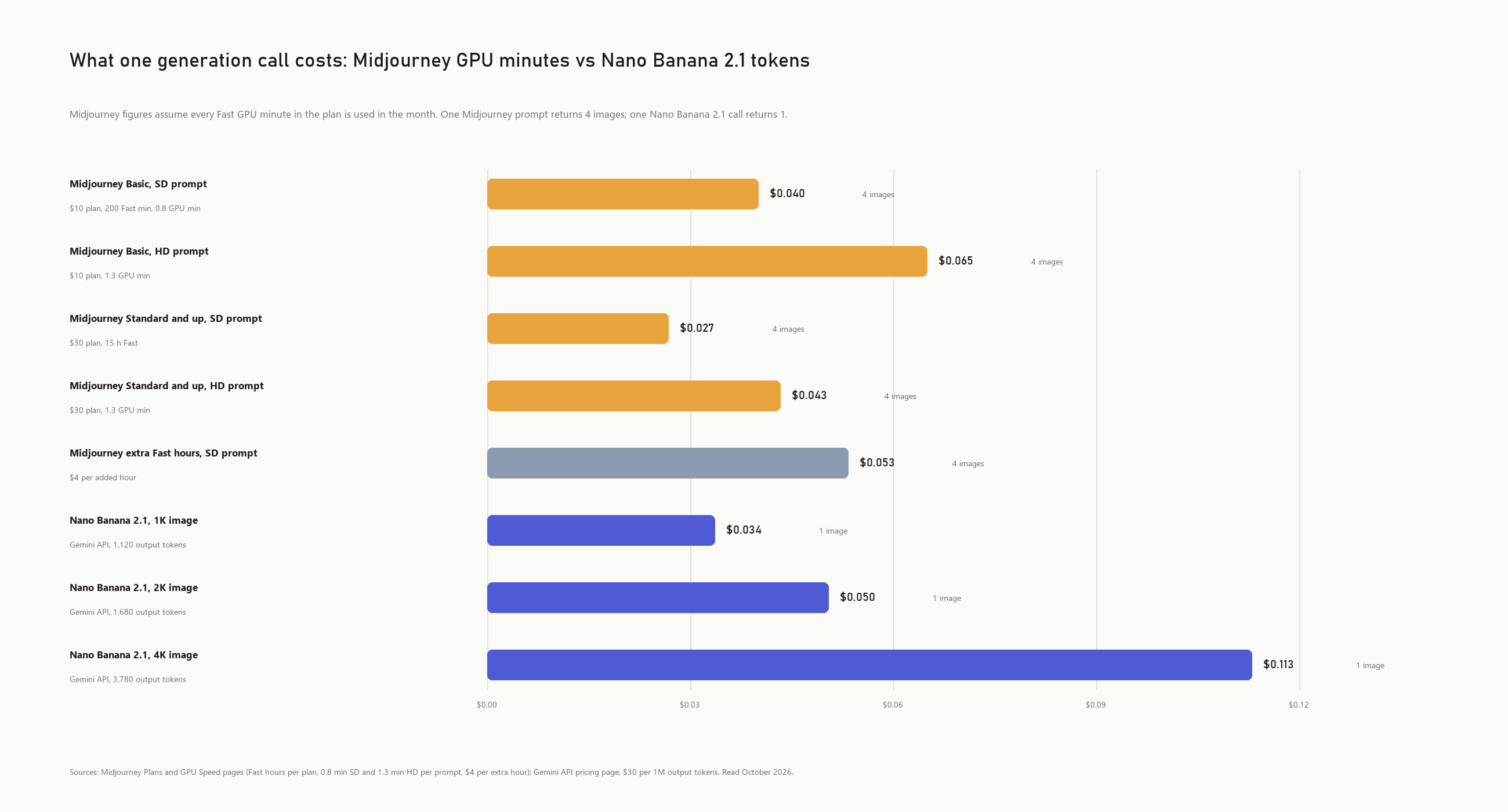
If you use every Fast minute, a Midjourney prompt on the $30 plan costs about $0.027 and returns four images, which is under a cent per image. A Nano Banana 2.1 image at 1K costs $0.034 and returns one. On paper Midjourney is cheaper per picture by a wide margin, and Relax mode, which the plan page lists as unlimited image generation from Standard upward, is a separate slower queue on top of the Fast allowance.
The catch is in the word "if." A subscription bills whether you generate or not, Fast hours are a monthly allowance, and a company over the revenue line is required to start at $60. Nano Banana 2.1 bills nothing until a call is made. For a studio generating hundreds of frames a day, Midjourney's bundle is hard to beat on unit cost. For an app that generates ten images on a quiet day and ten thousand on a launch day, per-image billing is the model that fits.
What Reddit Says About Nano Banana vs Midjourney
Open the Nano Banana vs Midjourney Reddit threads and the one Google surfaces first is nine months old, titled, in full, "Has Midjourney been outclassed by Nano Banana?" on r/midjourney. The poster wanted opinions because Nano Banana Pro's "prompt adherence and level of realism is actually insane," and the top answer, with the thread at 44 upvotes and 46 replies, was six words: "For realism yes, for creativity and artistry no." That sentence has been the community's settled position ever since.
Most of these threads are really Midjourney vs Nano Banana Pro arguments, written against Midjourney V7, before either of the models in this article existed.
| Thread | Where | Size | What it argues |
|---|---|---|---|
| Has Midjourney been outclassed by Nano Banana? | r/midjourney | 44 upvotes, 46 replies | Realism to Nano Banana, creativity and artistry to Midjourney |
| Is Nano Banana Pro the real MidJourney editor? | r/midjourney | 50+ comments | Top reply: the two combined "do wonders" |
| Ran the same short prompt through Midjourney V8.2, Nano… | r/generativeAI | 10+ comments | The one thread we found that puts V8.2 itself on the bench |
| Nano Banana Pro vs. Midjourney (nature photos) | r/aiArt | 18 answers | Which frames look real, realism over style |
| Is Midjourney getting worse? | r/midjourney | 29 answers | Style reference drift, posted before V8 |
Three details in those threads matter more than the headline split. The outclassed thread concedes realism in its top reply and keeps artistry for Midjourney, which is close to what our rounds two and three showed. The top reply in the editor thread says the two combined "do wonders" and that its author no longer spends hours editing an image, which treats the pair as a pipeline rather than a contest.
And the r/generativeAI thread is, as far as we could find, the one public same-prompt test that names V8.2, and it drew a dozen comments rather than a hundred. The verdict everyone quotes predates the models everyone is now using.
The r/aiArt nature thread is the Nano Banana vs Midjourney realism question in its purest form. Its top answer picked out the frame that looked "the most AI" because of "the beautiful colors and lighting which makes it a bit fake looking." Beauty, in that corner of Reddit, counted against the image, and our round two rain portrait shows why: the Midjourney grid is the one you would frame, the Nano Banana frame is the one you would believe.
Should You Pick Nano Banana 2.1 or Midjourney?
The rounds, the spec sheets and the threads point the same way, so the decision table is short.
| The job | Pick | Why |
|---|---|---|
| A poster, label or ad with exact copy | Nano Banana 2.1 | Four lines rendered correctly on one attempt in round one |
| A product that already exists | Nano Banana 2.1 | One faithful render, references up to 14 images |
| A product that does not exist yet | Midjourney | Four designs per prompt, HD at native 2K, personalization |
| Concept art, moodboards, a film look | Midjourney | Round three, and a year of Reddit agreeing |
| One character across many scenes | Nano Banana 2.1 | 14 references and 4 characters against 4 references |
| Anything that runs unattended | Nano Banana 2.1 | API-first, per-image billing, no automation clause in the way |
Plenty of working artists refuse the choice and run both: Midjourney for finding the image, a reference-driven model for producing it to spec. That is a reasonable answer in October 2026, with one new wrinkle: if Midjourney's Thinking Mode graduates from the alpha site, the text and layout half of that pipeline gets a second contender.
Frequently Asked Questions
Is Nano Banana 2.1 better than Midjourney?
For briefs with exact text, a real product or a character that must stay consistent, yes: Nano Banana 2.1 rendered every line of our poster on one attempt and takes up to 14 reference images. For mood, grain and a signature film look, Midjourney won our fashion round and still owns that reputation on Reddit. Which is better depends on whether your brief is a specification or a feeling.
Does Midjourney have an API?
No. Midjourney publishes no API, and its terms of service state that "you may not use automated tools to access, interact with, or generate Assets through the Services." Nano Banana 2.1 is an API first and an app second, which is why a pipeline that has to run unattended ends up on the Nano Banana side regardless of how the images compare.
Is Nano Banana 2.1 cheaper than Midjourney?
Per image, usually not, if you use your whole Midjourney plan. A Standard plan prompt works out to under a cent per image across its four results, while a Nano Banana 2.1 image costs $0.0336 at 1K through the Gemini API. Per month, Nano Banana 2.1 is cheaper for anyone who would not use most of a $10 to $120 subscription, and through the API it carries no monthly bill at all.
Can Midjourney V8.2 keep a character consistent?
Partly. V8.2 routes references through the Edit Model, which takes up to four reference images, and Midjourney's own guide suggests combining your characters into a single reference image when their features start to get mixed up. That tip matters most in two-person scenes like our test, where the V8.2 Blend endpoint kept the idea of each person but not the person. For a cast of several characters across a long series, start on the Nano Banana side.
Can you run Midjourney on Atlas Cloud?
Yes, through endpoints that Atlas Cloud lists under the Youchuan family and describes as Midjourney's licensed platform for China, a description that Midjourney itself has not confirmed, as our Seedream 5.0 Pro vs Midjourney comparison explains.
At the time of writing the Midjourney text-to-image run costs about $0.086 and returns four images, HD costs 1.5 times that, and style transfer costs $0.129. Nano Banana 2.1 text-to-image shows $0.04 at 1K, $0.06 at 2K and $0.112 at 4K, each marked as 20 percent off a list price that the page gives as $0.05 at 1K and $0.14 at 4K, with no end date shown. Both are billed per run with no subscription.
Conclusion
Four rounds on one platform did not overturn Reddit's verdict so much as sharpen it. Nano Banana 2.1 is the model that reads the brief: every line of the poster, the sign spelled right, the tumbler as specified, one attempt each. Midjourney is the model that reads the room: a parking deck at dawn that belongs in a magazine, a laundromat lit like a thriller, four product designs where one was asked for. The thinking step each company shipped this month sits at opposite ends of the process, planning on Google's side and repair on Midjourney's.
So the practical version of Nano Banana vs Midjourney in October 2026 is a question about the job, not the model. Specification, references, text and automation go to Nano Banana 2.1. Atmosphere, exploration and a look you want tuned to your taste go to Midjourney. Both are one prompt box apart on Atlas Cloud, which makes running the same brief through each a cheap way to settle the argument for your own work.





