

Generating long AI choreographies usually ends in frustration when limbs liquefy around second eight. Real-world testing on the native output of Wan 3.0 shows a major leap in motion retention, keeping physical anatomy and character identity intact across 30-second continuous renders.
In this Wan 3.0 dance benchmark, we evaluate two extended dance styles under strict zero-edit constraints, testing how the model balances complex garment physics, multi-subject tracking, and native camera stability—earning an average score of 4.2 out of 5.
| Dance | Score | Temporal Stability | Primary Artifacts |
| Belly Dance Veil Test | 4.6 / 5 | High facial identity retention and clean 360° veil physics | Minor floor friction loss and finger softening past second 24 |
| Traditional Partner Dance | 3.8 / 5 | Flawless dual-character identity lock through total occlusion | Unprompted jump cuts causing frame flickering and lighting pops |
The test confirms Wan 3.0 resists severe AI video motion decay during long-form generation. While older video generators melted complex joint movement, Wan 3.0 retains structural alignment, facial identity, and clothing dynamics across a full 30-second AI dance video.
Testing Methodology: Evaluating Continuous Motion Logic and Anatomy Retention
Most AI video benchmarks hide high failure rates behind three-second trimmed clips and multi-take cherry-picking. To evaluate authentic physical stability, our Wan 3.0 dance test methodology enforces a strict zero-edit protocol. Every output evaluated in this test uses raw single-shot video generation across the full 30-second duration without post-production fixes.
Standardized Generation Constraints
We locked all execution parameters to isolate core model physics:
- Resolution & Speed: 1080p native output rendered at 24 frames per second.
- Seed Control: Fixed seed values across comparative prompt runs.
- Motion Controls: Baseline motion strength settings held at default value 0.50.
- Post-Processing: Zero temporal cuts, stitching, or speed adjustments.
Primary Evaluation Pillars
- Anatomical Integrity: Tracking finger counts, wrist articulation, and facial geometry through fast pivots.
- Physics & Momentum: Measuring weight transfer and gravity reaction on flowing garments, such as silk sleeves and belly dance veils.
- Spatial Continuity: Evaluating identity consistency through motion during 360-degree rotations and multi-subject occlusions.
This framework creates a repeatable AI dance generation benchmark that separates true temporal reasoning from brief visual tricks.
Test Case 1: Belly Dance Fluidity, Torso Isolation, and Fabric Physics
Prompting extended drapery and slow-motion fabric handling in earlier video models usually resulted in cloth tearing, hand-mesh clipping, or facial distortion behind sheer textiles. Executing our Wan 3.0 belly dance test revealed how effectively the model manages continuous veil layering, hand-to-face occlusion, and rotational garment momentum across a 30-second continuous timeline.
Note: All video clips below are raw, unedited outputs generated via Atlas Cloud's Wan 3.0 Image-to-Video at 1080p, 30 seconds, $4.80 per render.
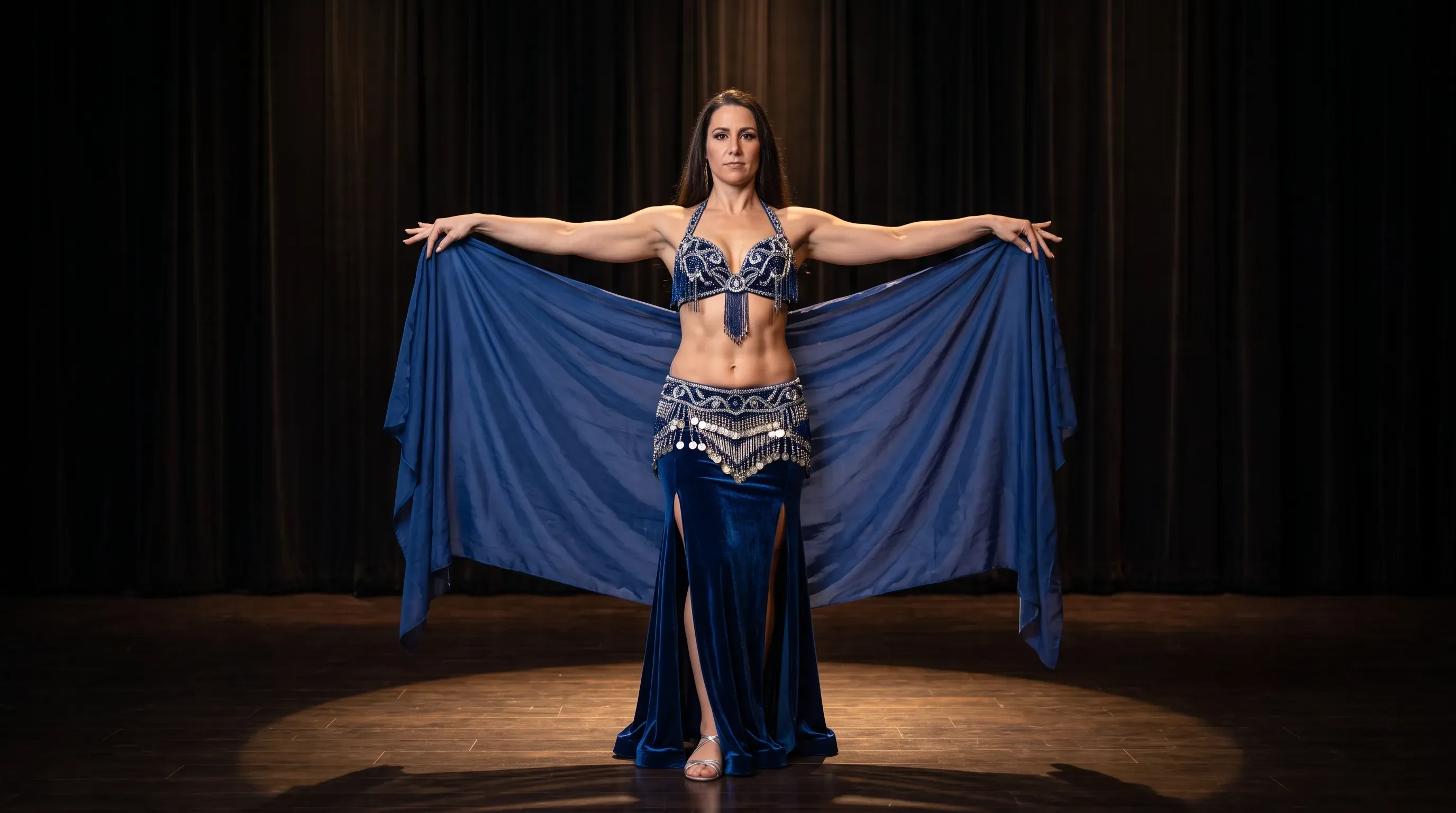
Our video's first-frame image:
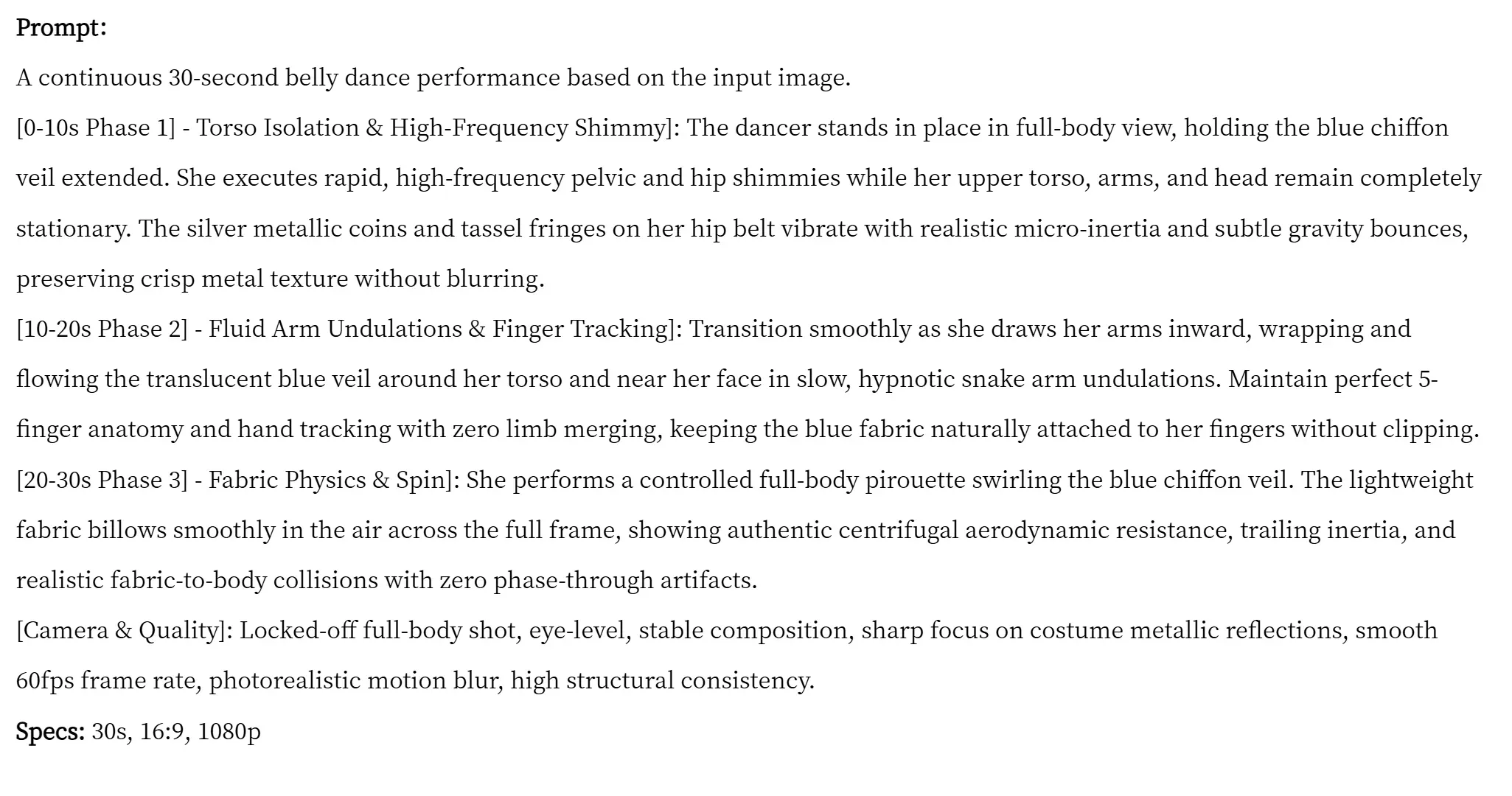
Our prompt design:
The video output:
Evaluating Motion Realism and Veil Occlusion
Rather than relying on fast camera cuts, the model maintains frame stability through deliberate, slow-tempo choreography and full-body spins. This test highlights how Wan 3.0 handles layered transparent textiles and close-proximity finger tracking without visual artifacts.
| Movement Element | Motion Behavior Observed | Score |
| Baseline Pose & Frame Retention | Rock-solid initial stance holding wide veil extensions with zero background flicker | 4.9 / 5 |
| Hand Geometry & Facial Occlusion | Slow serpentine arm undulations retain five distinct fingers while layering veil across the face | 4.4 / 5 |
| Rotational Fabric Physics | Sheer silk veil responds accurately to angular momentum during a full 360-degree spin | 4.6 / 5 |
Garment Dynamics and Collision Behavior
Key physical observations from our 30-second continuous render include:
- Static Baseline Lock (0s to 13s): The model anchors the opening wide-arm pose under stage spotlighting, maintaining bead texture clarity on the bedlah costume without micro-flicker or posture drift.
- Finger Integrity and Layered Occlusion (14s to 23s): As the dancer wraps the sheer blue veil across her face and chest, individual finger joints stay articulated. High tracking stability prevents the hand geometry from fusing into the face mesh or dissolving into cloth textures.
- Centrifugal Garment Momentum (24s to 29s): The silk veil exhibits no cutting through skin or hair as it flares forth under realistic centrifugal force during full 360-degree rotation and smoothly drapes about the shoulders when it stops.
These clean fabric wraps and stable facial tracking confirm Wan 3.0 handles layered textile motion without the frame-tearing typical of long AI renders.
Test Case 2: Traditional Partner Dance, Dual-Body Contact, and Spatial Occlusion
Rendering two dancers in a single shot usually breaks AI video models within seconds, resulting in merged limbs or one performer stealing the other dancer's outfit during a spin. Testing a Wan 3.0 partner dance featuring a traditional two-person duet reveals how the model handles complex spatial interactions, garment overlaps, and multi-subject tracking.
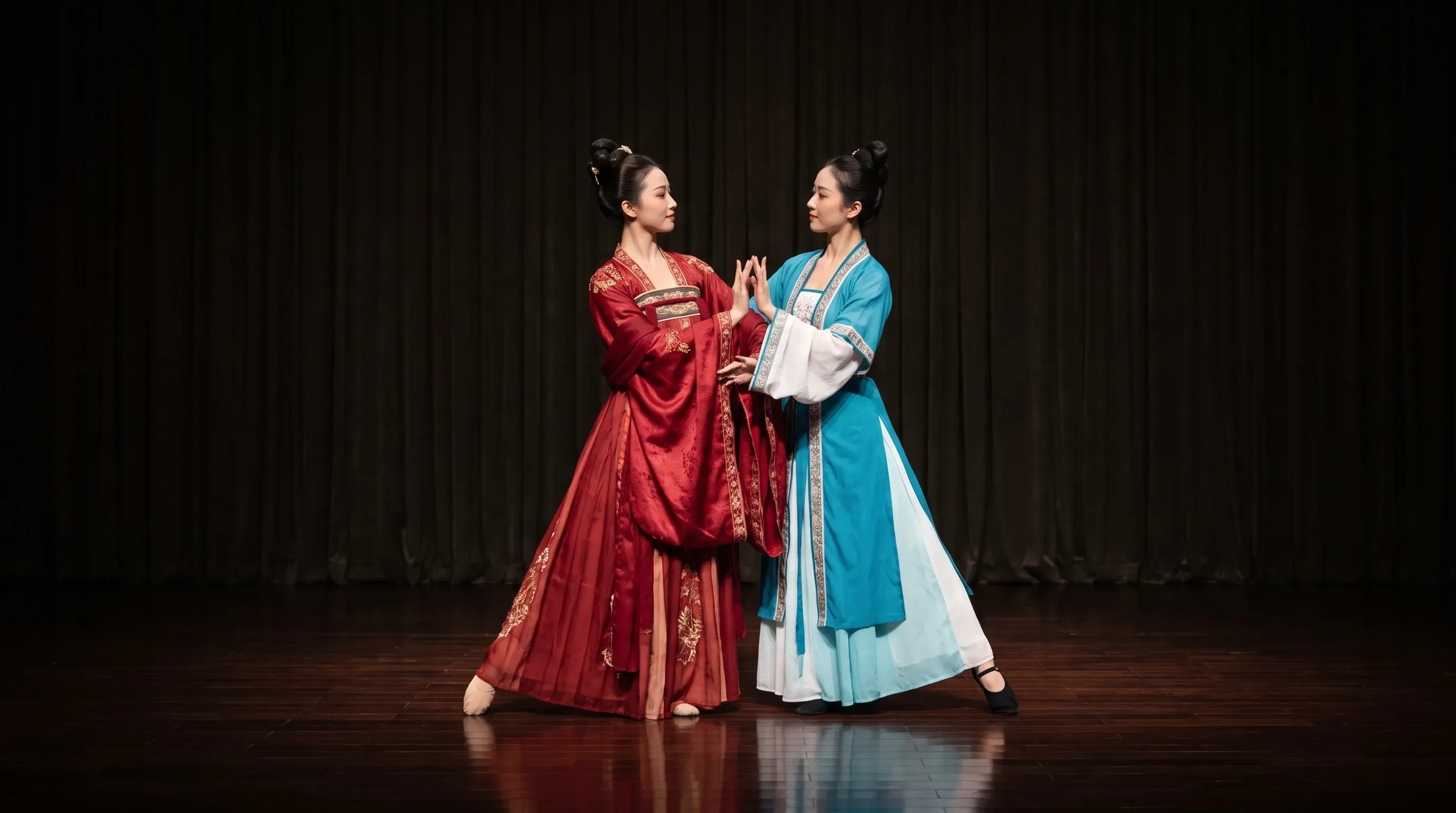
Our video's first-frame image:
Our prompt design:
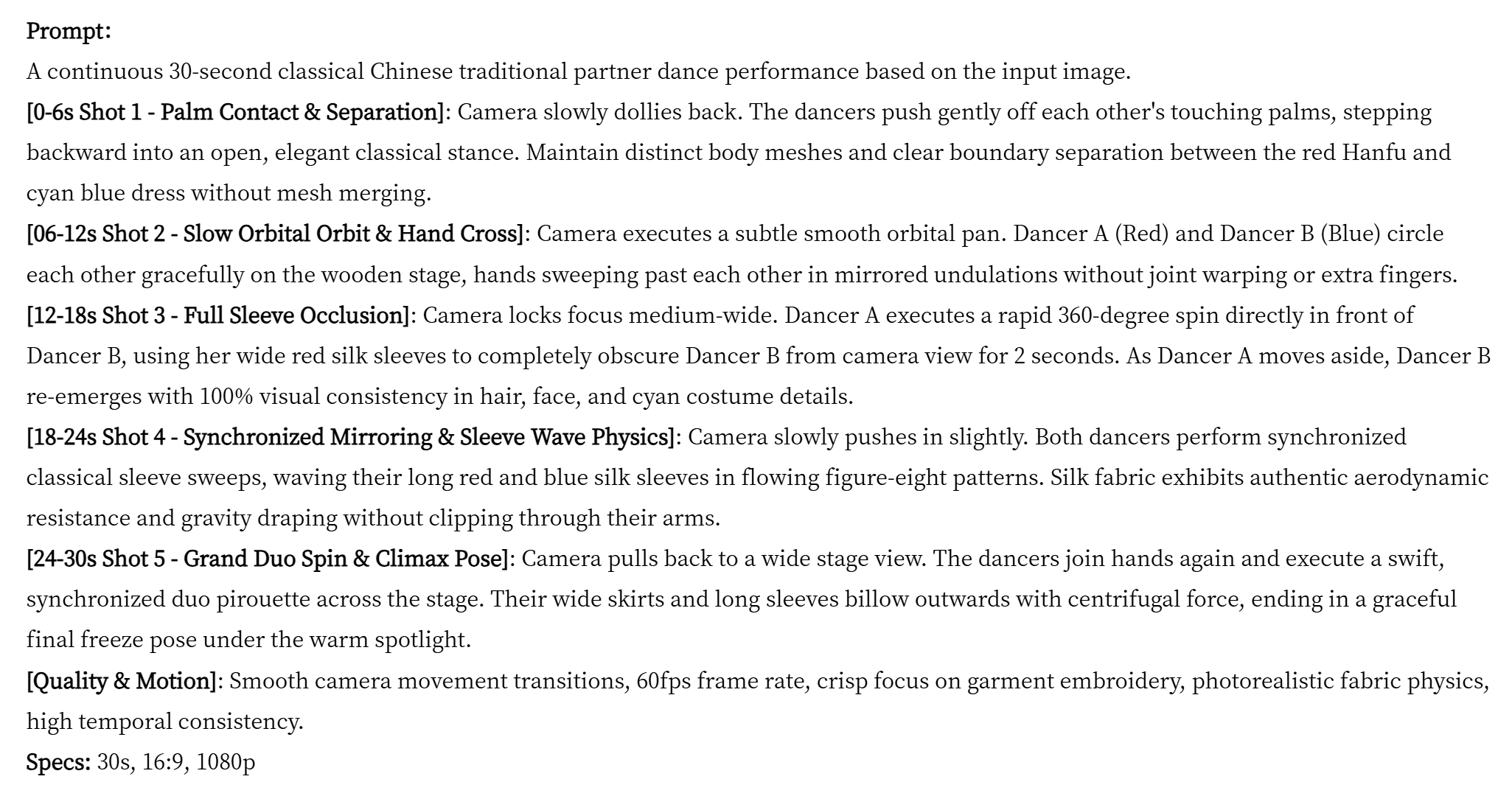
The video output:
Multi-Subject Tracking and Spatial Occlusion Performance
In our tests of a traditional Guofeng AI dance video, two performers in contrasting red and blue Hanfu garments executed synchronized spins and sleeve maneuvers across a 30-second continuous take.
| Multi-Person Metric | Observed Model Behavior | Score |
| Dual-Character Identity Lock | Red and blue Hanfu details remain distinct across all camera cuts | 4.7 / 5 |
| Spatial Occlusion Recovery | Background dancer recovers cleanly after red dancer's back-view turn (12s–17s) | 4.3 / 5 |
| Camera Continuity & Transitions | Frequent native jump cuts trigger sudden framing jumps and slight light flickering | 3.2 / 5 |
Garment Intersections and Temporal Flaws
- Identity Lock Across Occlusions (00s to 17s): When the red dancer turns and completely blocks the blue dancer from view (12s–16s), the model recovers the hidden dancer seamlessly—retaining her exact facial geometry, hair ornaments, and blue Hanfu trim.
- Sleeve Dynamics and Separation (18s to 23s): Overlapping water sleeves pass across chest lines without texture merging, fabric tearing, or color bleeding.
- Native Jump Cuts and Lighting Pops (01s, 11s, 23s): Rather than staying on a single continuous take, Wan 3.0 tends to snap between camera angles—like forcing a tight rear-view cut at second 11. These abrupt shifts break the rhythm and trigger brief lighting pops and frame stutters.
Creator Note: While Wan 3.0 handles multi-subject identity locking exceptionally well, locking continuous framing requires explicit negative prompts like camera jump cuts, sudden scene switch, lighting pops to prevent unsolicited angle cuts.
30-Second Temporal Decay Timeline: Tracking Anatomical Integrity from Second 0 to 30
Generating 30-second AI dance clips usually reveals latent decay around second 20, where feet lose friction on the floor while fingers soften. Analyzing our test renders reveals how Wan 3.0 manages decay across extended timelines.
0 to 10 Seconds: Baseline Lock and Static Stability
During the initial ten seconds, Wan 3.0 delivers sharp edge definition and zero drift in low-velocity poses.
- Foot Anchoring: Feet maintain solid friction on the stage floor during static stances and subtle hand passes.
- Costume Sharpening: Metallic fringe, silk drapes, and hair ornaments retain crisp high-frequency detail without micro-flicker.
- Anatomical Integrity: Facial features and finger counts remain 100% locked.
10 to 20 Seconds: Micro-Decay and Framing Cuts
Between second 10 and 20, core body mechanics hold firm, though model-generated camera jumps introduce brief transition artifacts.
- Occlusion Performance: Finger geometry stays intact during slow face-and-chest veil wraps (belly dance test).
- Unprompted Framing Cuts: Sudden perspective switches—such as the rear-view cut at second 11 in the duet test—cause momentary lighting pops, though character identities stay locked.
20 to 30 Seconds: Terminal Limit and Floor Friction Loss
The final ten seconds expose the boundary of Wan 3.0's motion budget.
- Rotational Floor Sliding (24s–28s): During full-body spins and dual-character rotations, feet lose mechanical friction with the wooden stage, causing subtle "ice skating" floor slide.
- Identity Isolation: Despite floor sliding and camera switching, facial geometry remains completely identical to frame one.
While Wan 3.0 isn't entirely immune to late-stage motion decay—specifically floor friction loss past second 20—its ability to isolate facial identity from physical drift marks a genuine generational leap. For creators, this means long-form renders remain production-usable, provided full-body spins near the 25-second mark are managed through medium framing or brief post-production cuts.
Copy-Paste Prompt Recipes for Stable AI Dance Generation in Wan 3.0
Typing simple requests like "woman dancing" into Wan 3.0 usually results in chaotic camera swings and unanchored limb spins. Achieving predictable 30-second motion continuity requires structured spatial cues, exact anatomical motion descriptors, and camera constraint syntax built upon comprehensive Wan 3.0 prompt engineering principles.
This Wan 3.0 dance prompt guide provides tested AI dance video prompt recipes optimized for single-shot generation.
Micro-Isolation Recipe: Belly Dance Parameters
When prompting micro-movements like chest isolations or hip shimmies, specify camera distance first to prevent unwanted full-body spins.
-
Positive Prompt Template:
Medium eye-level shot, static locked-off framing. A professional female dancer with dark hair in a low bun, wearing an ornate jewel-encrusted royal blue bedlah trimmed with hanging silver coin fringe. She performs a continuous belly dance routine on a dark wooden stage, feet firmly locked to the floor surface. She executes controlled torso isolations, subtle chest undulations, and fluid snake arm waves while handling a sheer royal blue silk veil. Natural fabric momentum, shallow depth of field, warm volumetric stage spotlighting, continuous 30-second take without perspective shifts.
-
Key Execution Notes: Use exact movement terms like "torso isolation" and "rhythmic hip shimmy" in your belly dance prompt parameters to force the attention mechanism onto core torso grid coordinates rather than broad limb movements.
Multi-Subject Choreography Recipe: Guofeng Partner Dance
Dual-character generation fails when prompt descriptions blend both subjects into a single phrase. Separate performers by costume color and explicit spatial positions.
-
Positive Prompt Template:
Full-body shot, wide angle. Two female dancers performing a traditional Chinese Guofeng duet on a wooden stage. Left dancer wears a red Hanfu with long wide sleeves; right dancer wears a blue Hanfu. Synchronized sleeve spin, slow hand-in-hand turn, elegant weight sharing, and graceful footwork. Smooth camera tracking shot following their circular movement. Rich stage lighting, clear spatial depth, continuous 30-second long take, photorealistic.
-
Key Execution Notes: This Guofeng dance prompt example anchors each performer with distinct color-coded clothing to lock identity consistency during spatial crossover turns.
Essential Negative Prompts for Dance Stability
To prevent physical distortions during rapid velocity changes, apply these targeted Wan 3.0 negative prompts for dance:
| Target Artifact | Recommended Negative Keyword String |
| Limb & Joint Distortion | merged limbs, extra arms, floating feet, joint dislocation, melted hands, fused fingers |
| Temporal Instability | jittery frame interpolation, sudden camera cuts, morphing clothing, flickering fabric |
| Motion Artifacts | floor sliding, ice skating feet, sudden motion blur, unnatural body warping |
Using these structured recipes ensures Wan 3.0 allocates motion budget toward rhythmic movement rather than camera jitter.
Creator Workflows: When to Use Native 30s vs. Multi-Cut Edits
Spending hours rendering a 30-second music clip only to discover the performer's feet lose floor friction by second 22 remains a major headache in digital video pipelines. Deciding between unbroken takes and modular cuts depends on your target platform and movement tempo.
Strategic Pipeline Choices: Native 30s vs Multi-Cut AI Dance
Understanding the trade-offs in native 30s vs multi-cut AI dance strategy helps optimize GPU render budgets while maintaining visual quality across short-video formats.
| Production Approach | Best Content Formats | Primary Technical Advantages | Known Limitations |
| Native 30-Second Take | Atmospheric Guofeng dance reels, cinematic long takes, solo showcases | Unbroken spatial continuity, synchronized native audio, zero cut edits | Minor floor sliding and finger blur near second 25 |
| Modular 8 to 12s Cuts | High-tempo dance battles, rapid footwork clips, multi-angle music videos | Eliminates temporal decay, boosts visual pacing, allows dynamic camera switches | Requires post-production timeline assembly |
Deploying Native 30-Second Generations
Single-shot renders excel in atmospheric Guofeng showcases where fluid sleeve motion and uninterrupted camera tracking take priority. Leveraging Wan 3.0 native audio-visual sync keeps continuous choreography aligned with soundtrack beats without manual lip-syncing or external audio stitching.
Deploying Short Modular Edits
Fast-paced TikToks and Shorts work best with quick 8 to 12 second cuts. Short takes keep the pacing snappy, flush the model’s memory before frame drift sets in, and give editors clean cut points between wide shots and face tracking.
Practical Production Pipeline for AI Dance Creators
Implementing an efficient Wan 3.0 short-video creator workflow requires structuring inputs before hitting render:
- Lock Reference Images: Pass character photos into Wan 3.0 multimodal reference inputs to preserve facial geometry across complex spins.
- Apply Audio Guidance: Feed reference tracks directly into the model to harness built-in audio-visual alignment.
- Set Framing Limits: Combine medium-wide camera tags with explicit negative prompts to contain spatial movement within active camera bounds.
This systematic approach brings consistent quality control to AI dance video production. Our practical Wan 3.0 recommendation is to deploy native 30-second passes for continuous solo routines, while reserving 8-second multi-angle cuts for fast group choreography.





