

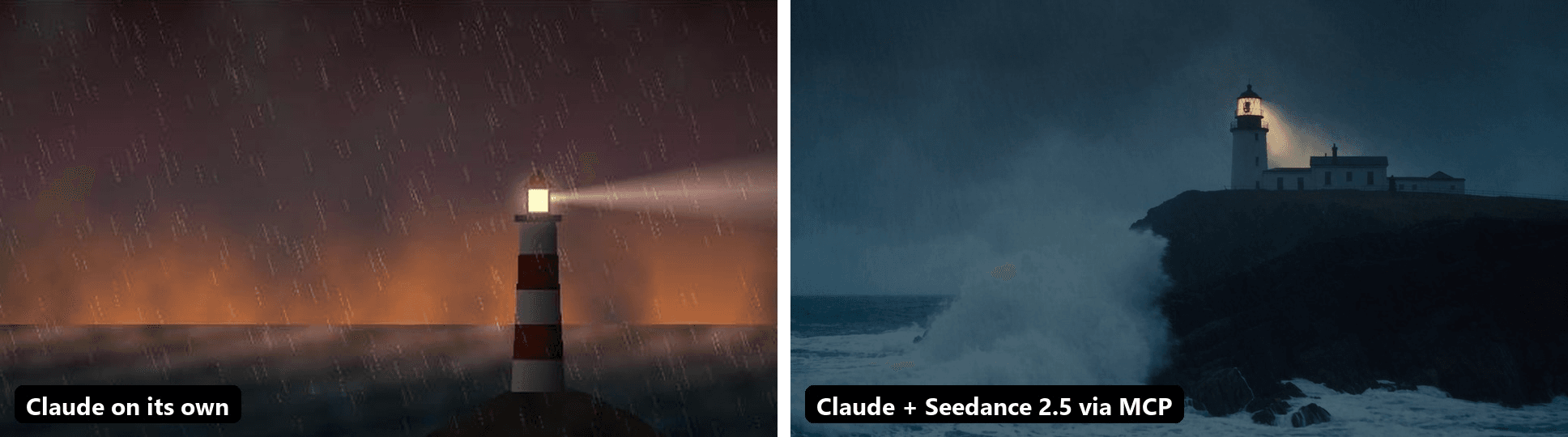
We asked Claude for an eight-second MP4 of a lighthouse in a storm. Five minutes later it handed one over: a cartoon lighthouse, painted rain, a beam that sweeps twice. So can Claude generate videos? It can render one with code, and it says plainly that the result is not footage. For a clip that looks filmed, Claude needs a video model to call. We connected one through the Atlas Cloud MCP server and asked for three clips: from a text prompt, from a studio portrait, and from a café photo. Here is what came back and what it cost.
Key Takeaways
- Claude can render a stylized MP4 with code, but it has no video model for real footage.
- Claude Motion animates text, charts and shapes as code, and it is limited toTeamandEnterpriseplans.
- One MCP server for Claude lets Claude Desktop and Claude Code call Seedance 2.5 and return a real clip.
- Setup is one JSON block in Claude Desktop or one command in Claude Code, then a restart.
- Text, photo and reference prompts all work from the same chat, and every clip is saved to your Atlas account.
Does Claude Have Video Generation Built In?
Not a video model, no. What Claude has is a code sandbox, and that turns out to be enough for a certain kind of clip. In a plain claude.ai chat we typed: "Make me an 8-second video of a lighthouse in a storm at dusk, waves hitting the rocks. I need an MP4 file I can download."
Claude wrote a small renderer, ran five commands and about five minutes later delivered lighthouse_storm.mp4: 8 seconds, 1280×720, 30 fps, H.264, every frame drawn by code. The beam sweeps twice and lightning flashes at 2.6 and 6.1 seconds. Claude was upfront about the limits in the same reply: "stylized, procedurally animated," not photorealistic, and no sound.
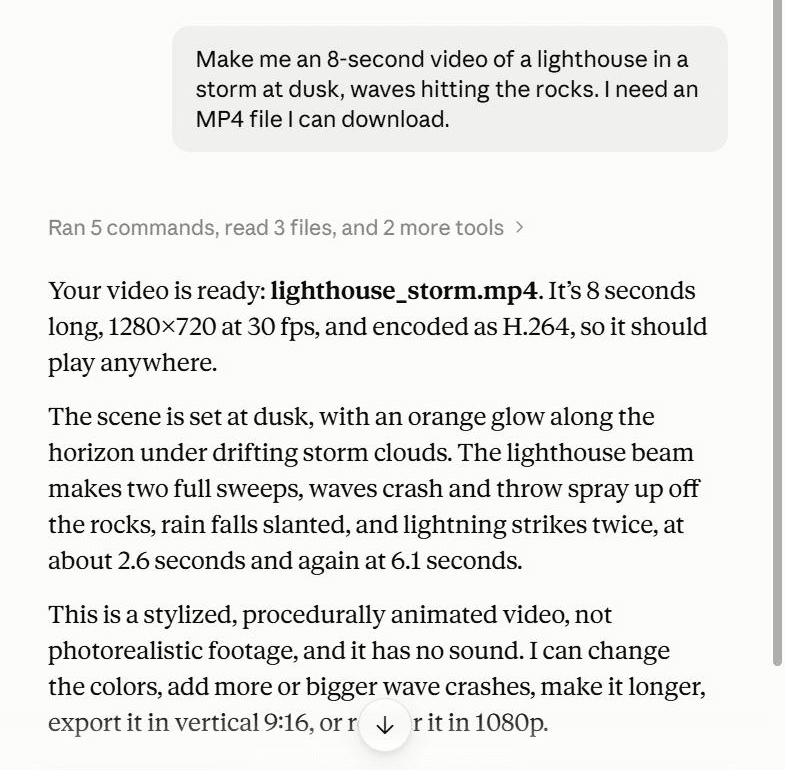
That is a real file you can post. It is also as far as code goes: shapes, gradients and particles, not a believable face or a drone shot. ChatGPT without a plugin hits the same ceiling.
Several Reddit threads take the code route further, wiring Claude Code to Remotion to render explainers from a script. Same ceiling, more control.
What Claude Motion Can and Cannot Make
Claude Motion is Anthropic's packaged version of that idea, released in beta in October 2026. You describe an animation, Claude builds it as code inside an artifact, and it plays like a short video: an animated chart for a board deck, a product walkthrough, an all-hands explainer. Change one number or one word and the rest stays put. Export gives you an MP4.
Two limits matter before you plan a project around it. Anthropic's help page states that "Claude Motion doesn't use a video generation model, so it doesn't create realistic footage or people." And it is a Team and Enterprise feature during the beta, on by default for Team and off by default for Enterprise until an owner enables it. Pro and Max plans are not on that list.
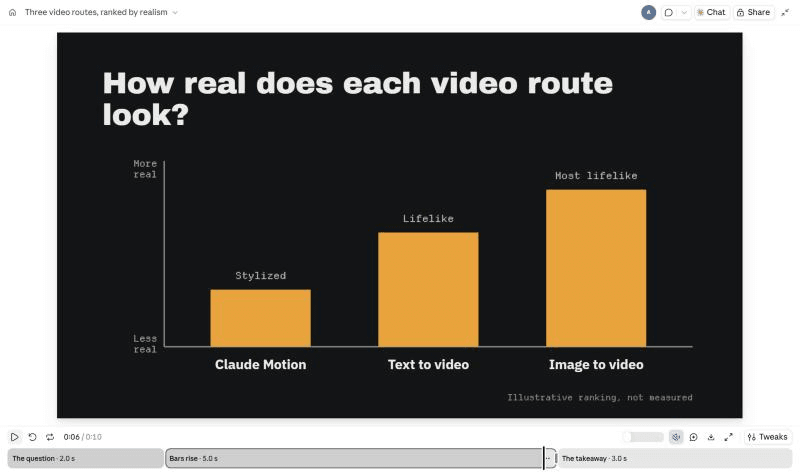
On a Team account we asked for a 10-second bar chart. Claude had us pick a style, then built a three-scene animation with a music track in about two minutes. With no data from us, it labeled its own bars "Illustrative ranking, not measured."
| Claude Motion | Claude with a video model | |
|---|---|---|
| Output | Animated text, shapes, charts, images | Filmed-looking footage with sound |
| People and camera moves | No | Yes |
| Editing | Change the code, re-export | New prompt or reference clip |
| Who can use it | Team and Enterprise beta | Any Claude Desktop or Claude Code user with the MCP server |
So for a pricing explainer, Motion is the right tool. For a skier on a slope at sunrise, keep reading.
How to Make Videos With Claude Using the Atlas Cloud MCP Server
Real Claude video generation means handing the job to a model built for footage. Atlas Cloud publishes an open-source MCP server, atlascloud-mcp, that turns Claude into a Claude AI video generator: it can search models, upload your files, submit a job and fetch the result. Its video filter returned 246 entries when we queried it, Seedance 2.5 among them in text, image and reference modes. Full install notes are on the Atlas Cloud MCP server page.
You need Node.js 18 or newer and an Atlas API key. The server is free and MIT licensed; clips are billed to your Atlas balance.
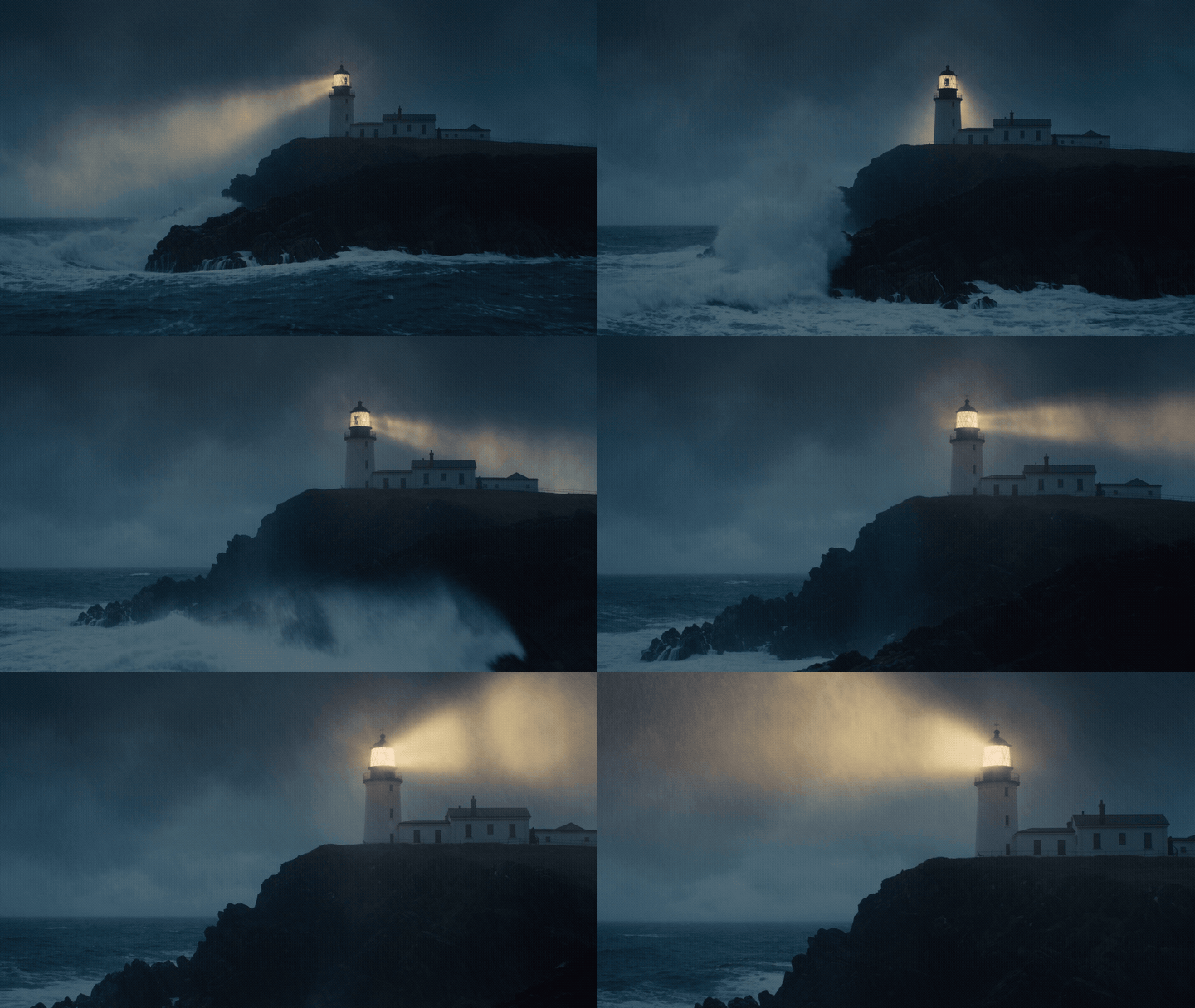
Once connected, we sent the same lighthouse idea as a pure text request, this time routed to Seedance 2.5 text-to-video at 8 seconds, 720p and 16:9. The job went through atlas_generate_video, Claude checked on it with atlas_get_prediction, and the finished 1280×720 MP4 with sound was back in 2 minutes 39 seconds. Compare it with the code-drawn version above: real surf, real spray, and sound.
Claude Desktop: one JSON block and a restart
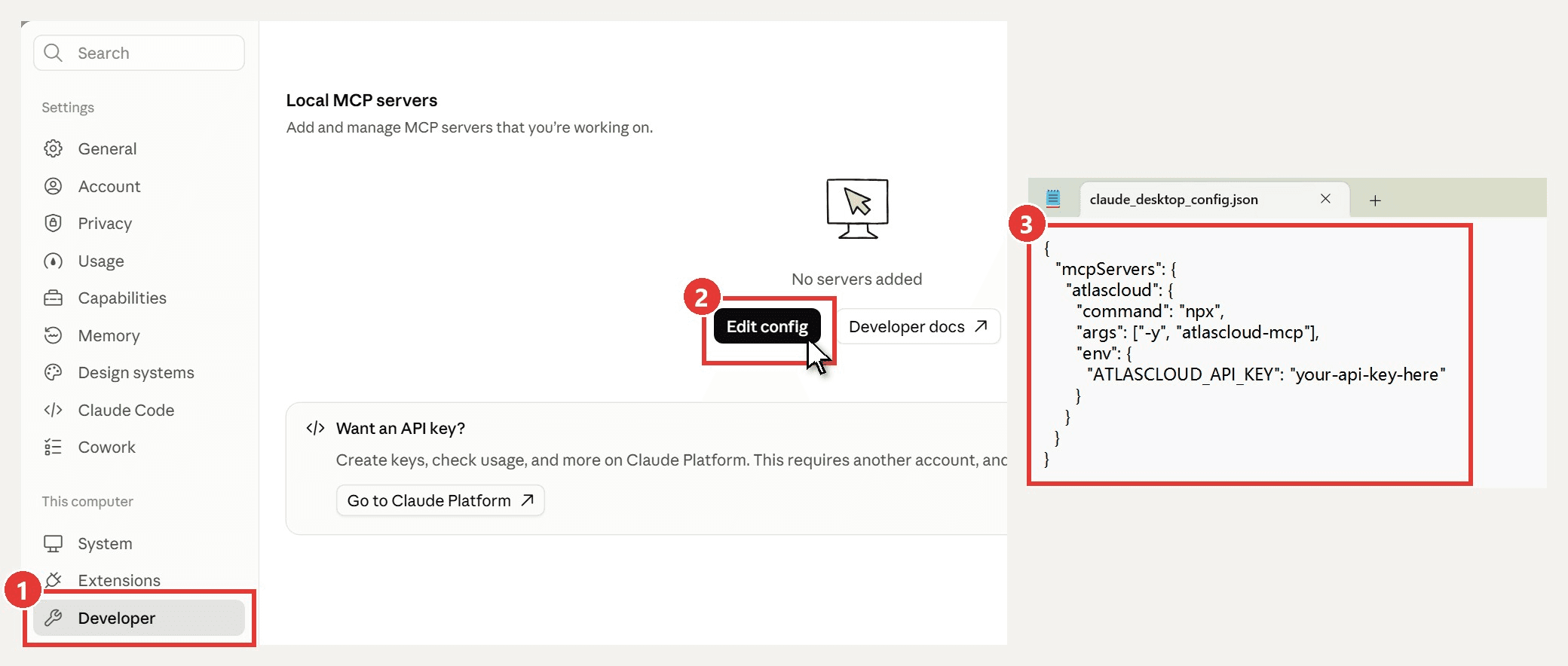
- Open Settings (Ctrl+, on Windows) and choose Developer under This computer.
- Click Edit config. It opens claude_desktop_config.json wherever your install keeps it: ~/Library/Application Support/Claude/ on macOS, %APPDATA%\Claude\ on Windows, or the app's package folder on the Microsoft Store build.
- Paste the block below with your own key and save. Quit and reopen Claude Desktop, then check the + button under the chat box: Connectors now lists atlascloud.
plaintext1{ 2 "mcpServers": { 3 "atlascloud": { 4 "command": "npx", 5 "args": ["-y", "atlascloud-mcp"], 6 "env": { 7 "ATLASCLOUD_API_KEY": "your-api-key-here" 8 } 9 } 10 } 11}
Claude Code: one command
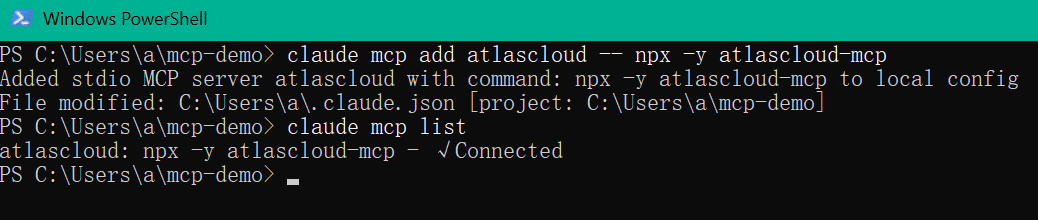
In a terminal, run:
plaintext1claude mcp add atlascloud -- npx -y atlascloud-mcp
Then set ATLASCLOUD_API_KEY in your shell (or pass it with the --env flag) and run claude mcp list. The entry should read ✔ Connected. By default the server is registered at local scope, meaning the current project folder only; add --scope user to use it everywhere.
From here both apps work the same way. Describe the clip, name the model, and ask for a dry run first: the server checks every parameter against the model's schema, so a wrong duration fails before it costs a credit.
Can Claude Generate Videos of a Real Person From One Photo?
This is the test that separates a connector from a toy. We used a studio portrait of a red-haired woman in a white satin dress and asked for a scene that has nothing in common with the photo: a cream ski jacket, goggles pushed up on her forehead, a sunlit slope at sunrise. Seedance 2.5's reference-to-video mode takes the photo as @Image1 and builds a new shot around her.
The prompt that went to Seedance 2.5 (8 seconds, 720p, 16:9), word for word:
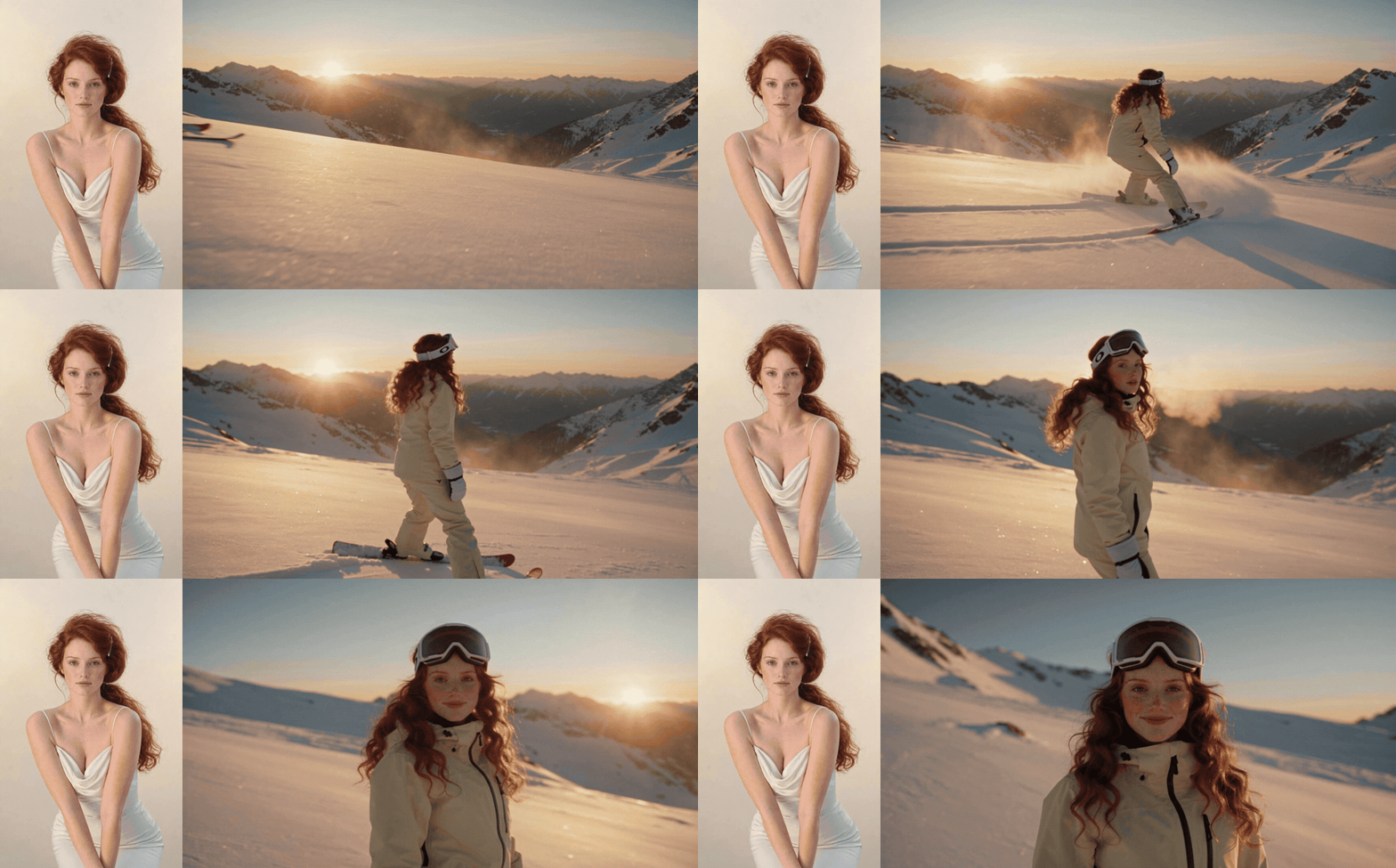
The photo went up through the server's upload tool, atlas_upload_media, which returns a URL that becomes the first reference image. In the clip she skis into frame, slows to a stop and turns to the camera. The freckles and long red curls carried over from a plain studio shot. As the Seedance 2.5 prompt guide suggests, name what changes and say the face stays the same instead of describing her from scratch.
Claude Image to Video: Animate a Photo From the Chat
The third mode starts from a photo and moves it. We used a street-café shot: a woman in a navy sweater at a red bistro table, chin on her hand, espresso cup in front of her. The request was six seconds at 720p. In image-to-video mode Seedance 2.5 keeps the source aspect ratio, so there is no ratio to pick. The prompt:
plaintext1She lifts the espresso cup, takes a slow sip, sets it down, then looks toward the camera and smiles warmly. Gentle camera push-in, bright afternoon sunlight on the café terrace, natural subtle motion, everything else stays as in the photo.
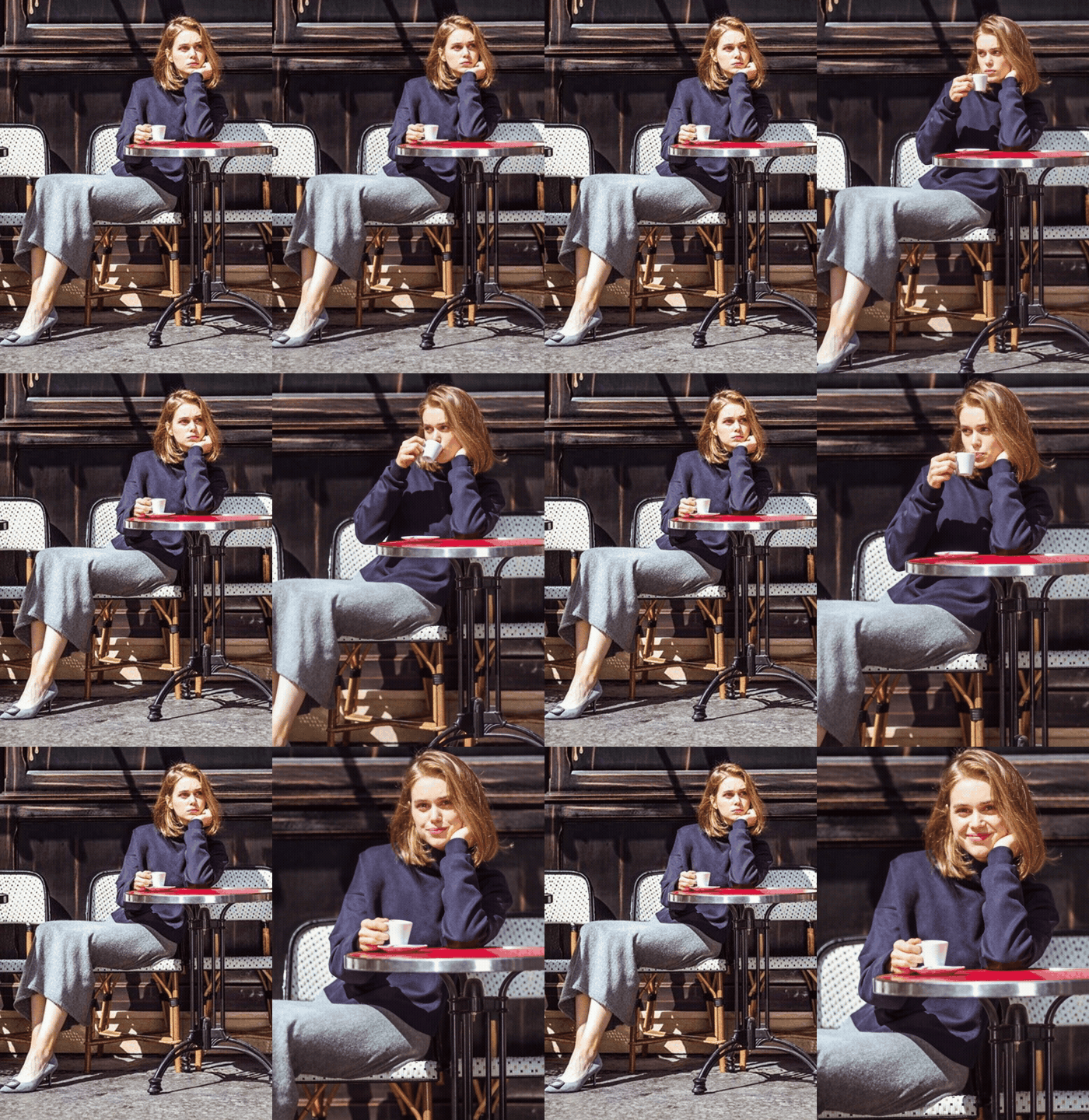
The first frame is the photo itself, which suits product shots and portraits you already own. She sips, sets the cup on its saucer and breaks into a smile, and her other hand never leaves her chin. The camera pushes in until the table edge drops out of frame. If you want her to stand up and walk out of the café, that is a reference-to-video job, not image-to-video.
Claude Text to Video, Image to Video or Claude Motion: Which One Fits
| Route | Starts from | Best at | People and footage | Where it runs |
|---|---|---|---|---|
| Claude's code sandbox | A prompt | Simple stylized scenes, title cards, loops | No | Any Claude chat with code execution |
| Claude Motion | A prompt, a screenshot, a link | Explainers, charts, product walkthroughs | No | claude.ai on Team and Enterprise |
| Claude text to video (via MCP) | A prompt | Scenes you can describe but do not have | Yes | Claude Desktop, Claude Code |
| Claude image to video (via MCP) | One photo | Bringing a shot you own to life | Yes | Claude Desktop, Claude Code |
| Reference to video (via MCP) | One or more photos | Same person or product in a new scene | Yes | Claude Desktop, Claude Code |
Remotion and Manim projects written by Claude Code sit on the code side of this table, with more control and the same lack of real footage.
Pick the sandbox or Motion when the content is information. Pick a video model through the MCP server when the clip has to look filmed. Both live happily in the same account, and the same atlascloud-mcp package also plugs into Codex, Gemini CLI and Cursor.
FAQ
Can Claude make videos for free?
Claude costs nothing extra beyond your plan, and the MCP server is free. Atlas bills each clip to your balance. As of October 2026 Seedance 2.5 is 20% off on Atlas: our 8-second 720p text-to-video and reference-to-video clips cost $2.42 each, the 6-second image-to-video clip $1.82. A 480p draft of 8 seconds is about $1.12, the cheap way to test a prompt.
How long a video can Claude generate?
Through the MCP server, as long as the model allows. Seedance 2.5 takes 4 to 30 seconds per request, or -1 to let the model choose; a 30-second 720p clip is $9.03 at the current discount. Drafting at 8 seconds first keeps the experiments cheap. Claude Motion animations count toward your plan's usage limit, and longer ones use more of it.
Can Claude generate videos from images?
Yes, in two ways. Image-to-video uses your photo as the first frame and animates it, which is the café example above. Reference-to-video uses the photo as a character or style reference and builds a new scene around it, which is how the portrait became a skier. Attach the file to the chat and Claude uploads it through the server for you.
Does the MCP server work in the Claude web app or on mobile?
Not the local version. A server launched from claude_desktop_config.json or claude mcp add runs on your computer, so it works in Claude Desktop and Claude Code only. Web and mobile use remote connectors, which Pro, Max, Team and Enterprise plans can add. The ChatGPT plugin from Atlas runs on that hosted model.
Conclusion
Claude on its own can code an animation and save it as an MP4, and Claude Motion polishes that into explainers for Team and Enterprise users. Neither uses a video model, and both say so. For footage, the answer is a connector, and the Atlas Cloud MCP server took us a few minutes to install in either Claude app.
After that, the three clips here came from ordinary messages: a lighthouse from a sentence, a skier from a studio portrait, a café sip from a street photo. So, can Claude generate videos that look filmed? With the right server attached, it can call a model that does and hand you the file.


