Three flagship coding models shipped inside ten days this month: Claude Fable 5.2 on November 9, GPT-6.2 on November 17 and Gemini 4 Neon on November 18. Each launch post put its own model on top of a chart. So which is the best AI model for coding when you are the one paying for the tokens?
We ran seven of the ten models below through the same three coding tasks with one API key on Atlas Cloud, three runs each, graded by hidden tests the models never saw. Claude Fable 5.2, Claude Opus 5.5 and Gemini 4 Neon are ranked on public benchmarks, and each section says whose numbers you are reading. Here is the ranking, and what a correct answer cost in time and tokens.
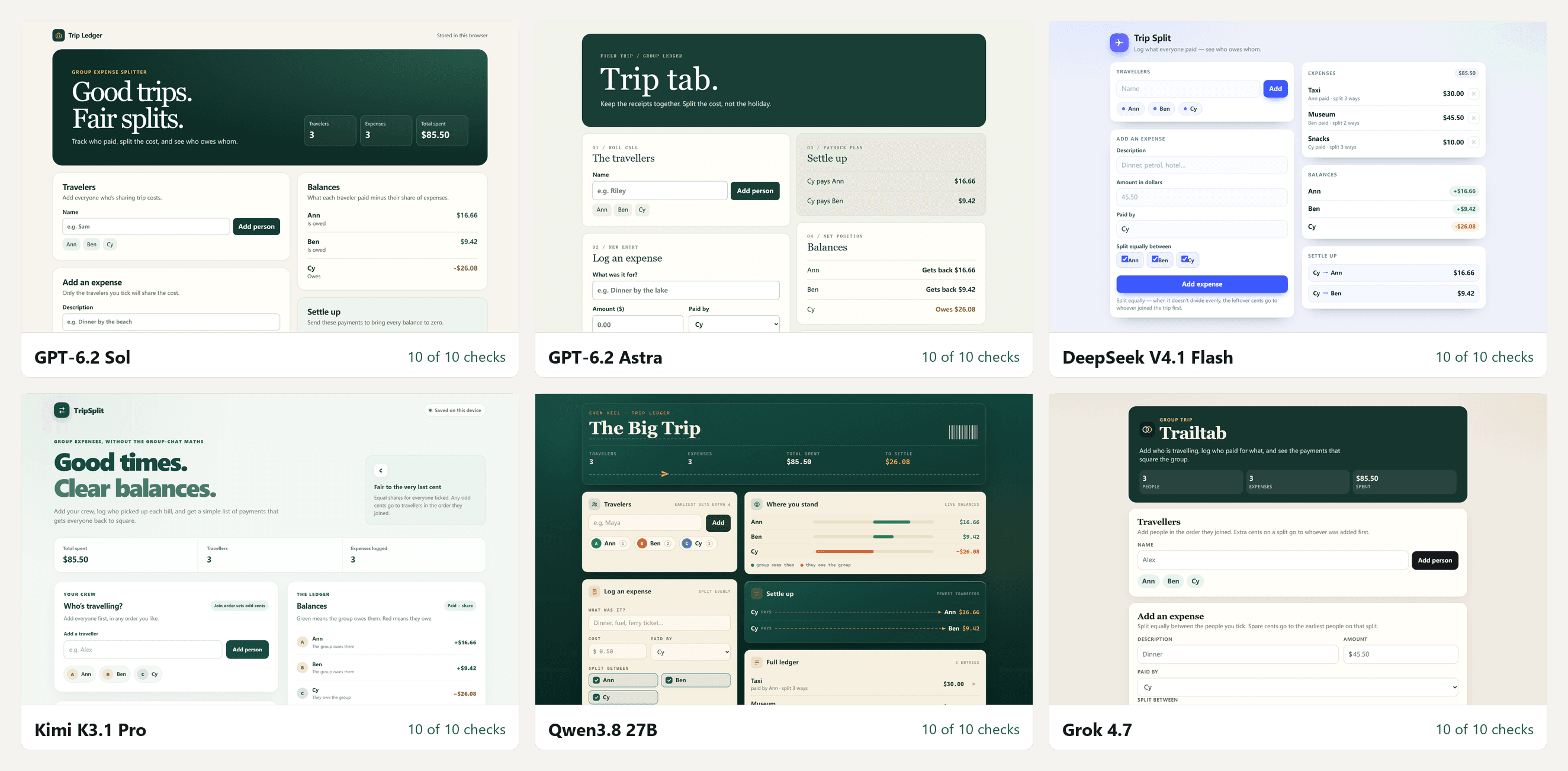
Real outputs from our third test. Each app is one reply to the same prompt, opened in a browser with no edits, on November 20, 2026.
Key Takeaways
- OpenAI's GPT-6.2 Sol is our best AI model for coding overall: all nine test runs solved, at about 24 seconds per run.
- Four of the seven models we ran solved all nine runs. Mean time per run ranged from 23 seconds to about eight minutes.
- Gemini 4 Neon and Claude Fable 5.2 top the Artificial Analysis Coding Agent Index, less than a point apart.
- DeepSeekV4.1 Flash is the best free AI for coding: free in DeepSeek's own app, with MIT-licensed weights.
- Qwen3.8 27B is our pick for the best local AI model for coding, with open weights under Apache 2.0.
Best AI Model for Coding: 2026 Comparison Table
What AI is best for coding depends on which column you read. Four of the ten models publish open weights, and seven were run here. List prices run from $0.30 to $8 per million input tokens, a gap of about 27 times. In our runs, the cost of a solved run spread about 13 times, from 3 cents to 39 cents.
API price is the Atlas Cloud list price for the seven models we ran and the maker's list price for the other three, all as of November 20, 2026. The Coding Agent Index comes from Artificial Analysis, read the same day, with each model inside the agent that page pairs it with.
| Model | Best for | Weights | API price, in / out per 1M | Coding Agent Index | Our runs: solved, mean time | Cost per solved run |
|---|---|---|---|---|---|---|
| GPT-6.2 Sol | Everyday coding overall | Closed | $2 / $10 | 50 | 9 of 9, 24 s | $0.04 |
| Claude Fable 5.2 | Long, hard tasks | Closed | $8 / $40 | 58 | Not run | Not run |
| Gemini 4 Neon | Coding agents | Closed | $3 / $15 | 59 | Not run | Not run |
| GPT-6.2 Astra | Code review | Closed | $8 / $40 | 53 | 9 of 9, 23 s | $0.11 |
| DeepSeek V4.1 Flash | Free use | Open, MIT | $0.30 / $1.20 | 37 | 9 of 9, 139 s | $0.03 |
| Claude Opus 5.5 | Claude on a smaller budget | Closed | $4 / $20 | 58 | Not run | Not run |
| Kimi K3.1 Pro | Open-weight agent work | Open, custom license | $2 / $10 | 49 | 9 of 9, 489 s | $0.18 |
| Qwen3.8 27B | Local use | Open, Apache 2.0 | $0.50 / $3 | Not listed | 8 of 9, 491 s | $0.12 |
| GLM 5.3 | Low-cost bug fixes | Open, custom license | $1.40 / $4.40 | 40 | 6 of 9, 301 s | $0.25 |
| Grok 4.7 | A free agent trial | Closed | $2 / $6 | 42 | 6 of 9, 495 s | $0.39 |
How We Tested Every AI Model for Coding on This List
We ran the tests on November 20, 2026 and read every price and leaderboard the same day. Each tested model got the same prompt through the plain API: no system prompt, default reasoning effort, no coding agent around it.
- Build from a spec. A Python business-hours deadline calculator, graded by 20 hidden tests.
- Fix bugs across files. A TypeScript stock-reservation module with four planted bugs, graded by 12 hidden tests.
- One-shot web app. A single-file trip expense splitter, graded by 10 automated browser checks.
A run counts as solved only when every check passes. Three runs per task makes nine runs per model and 63 in total.
Four criteria decided the ranking:
- Solved runs. How many of the nine runs passed every hidden check.
- Cost and time per solved run. Total spend divided by solved runs, plus mean seconds per run.
- Public agent benchmarks. The Artificial Analysis Coding Agent Index, Terminal-Bench 4.1 and LiveBench 2.0, as published on November 20, 2026.
- Access. Free tiers, open weights and API list price.
Solved runs came first, and four models tied at nine of nine. Cost and time per solved run broke that tie, so they carried the most weight among the seven we ran. Public agent benchmarks placed the three we did not run.
One note on the cap. We first limited each reply to 20,000 output tokens, and five models ran into that limit on at least one task, most of them while still reasoning. We raised the cap to 64,000 and reran the cut-off calls, and every number here comes from that setting.
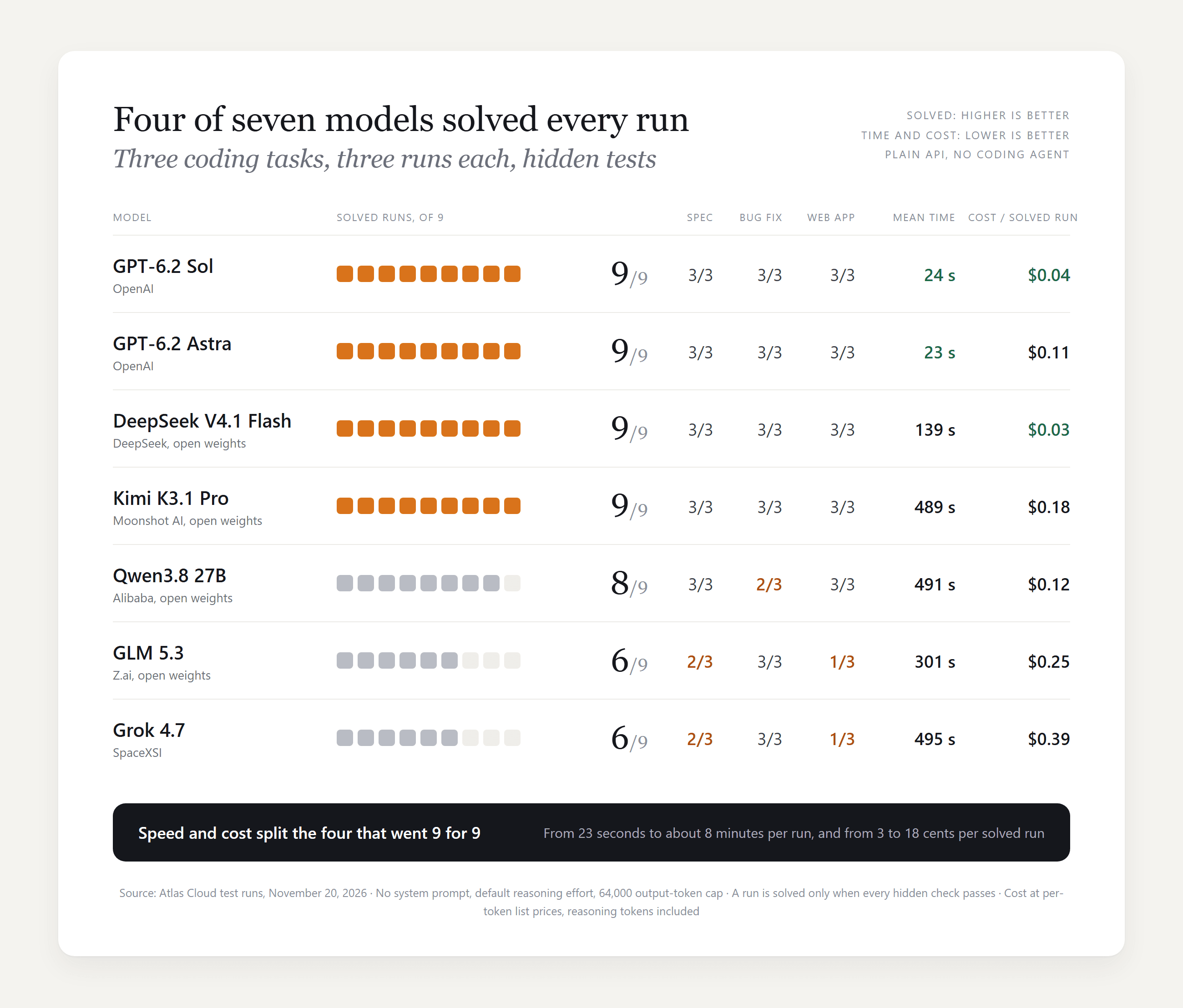
Chart by Atlas Cloud from our own runs on November 20, 2026.
Disclosure: Atlas Cloud publishes this article and hosts the seven models we ran, including the first-ranked one. No model maker paid for placement, and every model is described from its public data and our own runs.
1. GPT-6.2 Sol: Best AI Model for Coding Overall
GPT-6.2 Sol solved all nine of our runs and took about 24 seconds per run. On the web app task, each of its three replies opened as a working expense splitter and passed all 10 browser checks with no edits.
Try a coding task of your own in the GPT-6.2 Sol playground.
Why it stands out: Four models solved all nine runs. Of those four, Astra alone was as fast, at 2.8 times the cost per solved run, and DeepSeek V4.1 Flash alone cost less per solved run, at about six times the wait.
Sol's Coding Agent Index of 50 sits below the leaders, and the detail matters. Its widest gap to the index leader is on the technical Q&A set, one of the index's three parts. On the software engineering set, Sol at max effort scored 41.5 to Astra's 41.7.
Best for: Everyday work where the first answer has to be right. In our runs it built a deadline calculator from a written spec and fixed four bugs across three TypeScript files, each inside half a minute. High-volume API work benefits most, because the cost of each correct answer stays low.
Pricing: Pay per token, with no subscription. New accounts get a small trial credit once a payment method is on file. The FAQ lists the per-token rates.
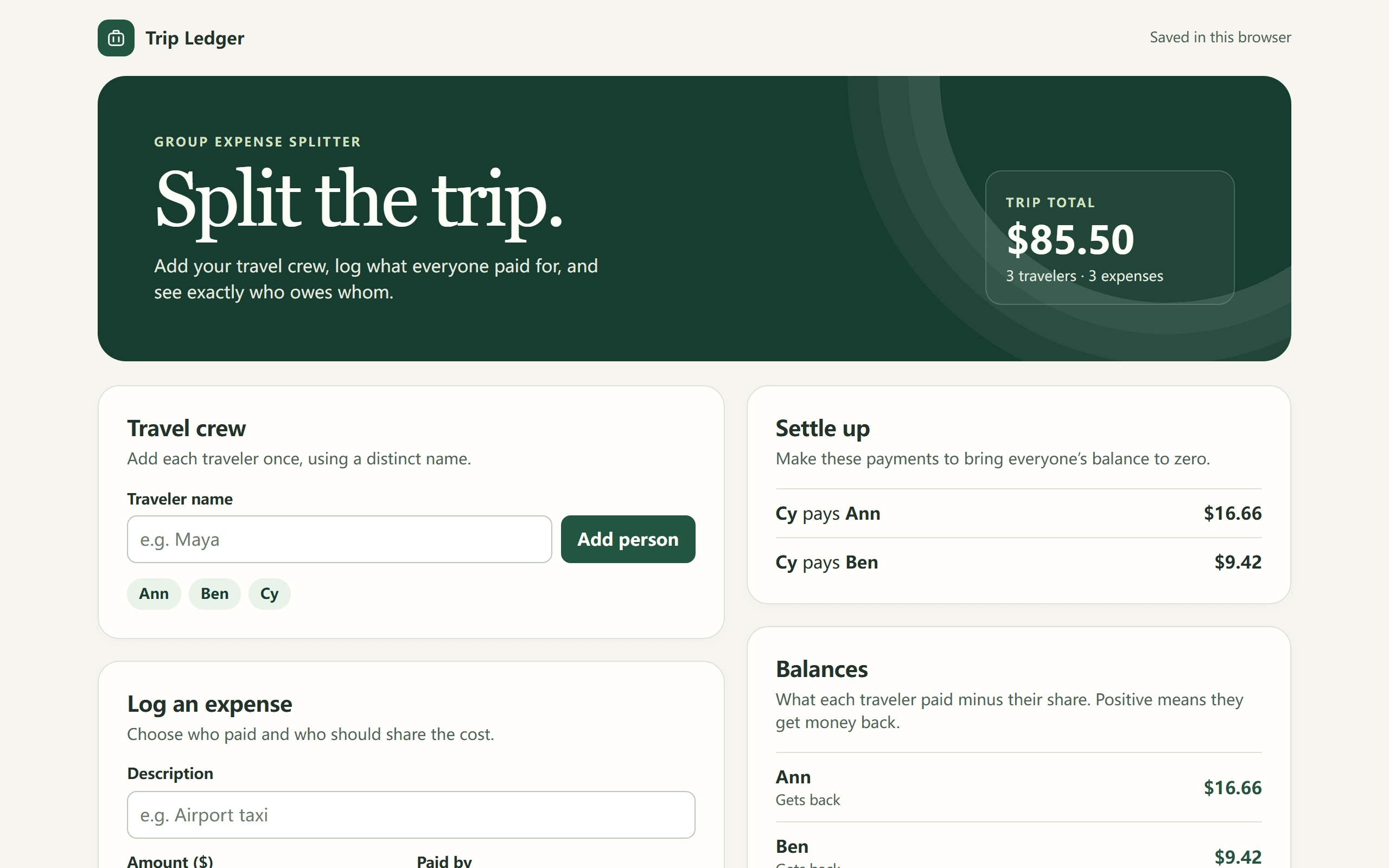
Output of GPT-6.2 Sol on our web app task, run on Atlas Cloud on November 20, 2026. The reply passed all 10 automated browser checks.
Run Your Own Coding Test on Atlas Cloud
Both routes call the model with its default settings, as our tests did.
Method 1: the playground. Log in, open the GPT-6.2 Sol playground and follow two steps.
- Paste your task prompt into the message box.
- Click the purple send arrow. The reply streams into the panel above the box.
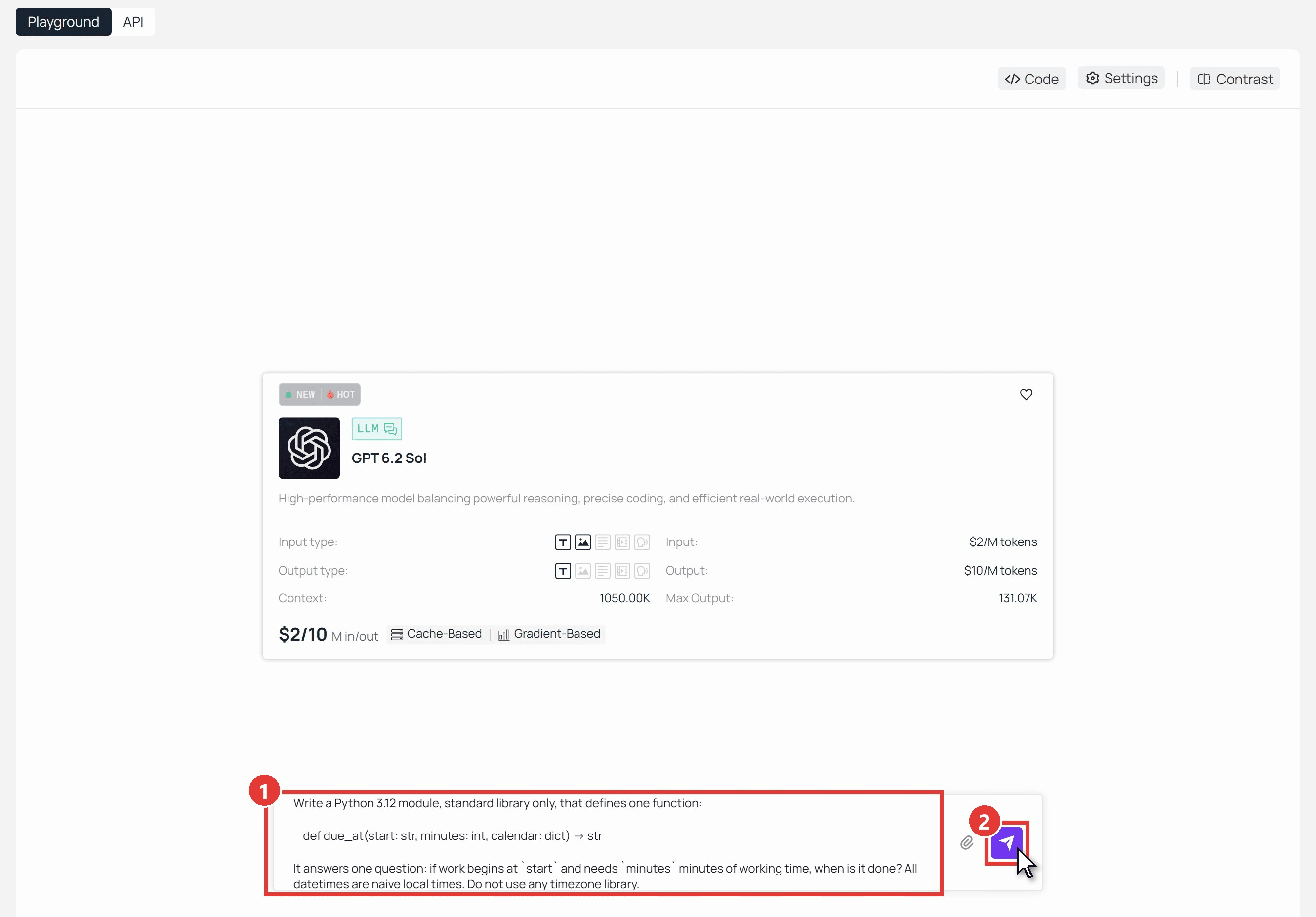
Copy the code block out of the reply, save it and run your own tests against it.
Method 2: the API. Use this route to repeat a test several times or to script it.
Step 1: Create an API key. In the console, open Settings, go to API Keys and click Create API Key. One key covers every model on the platform.
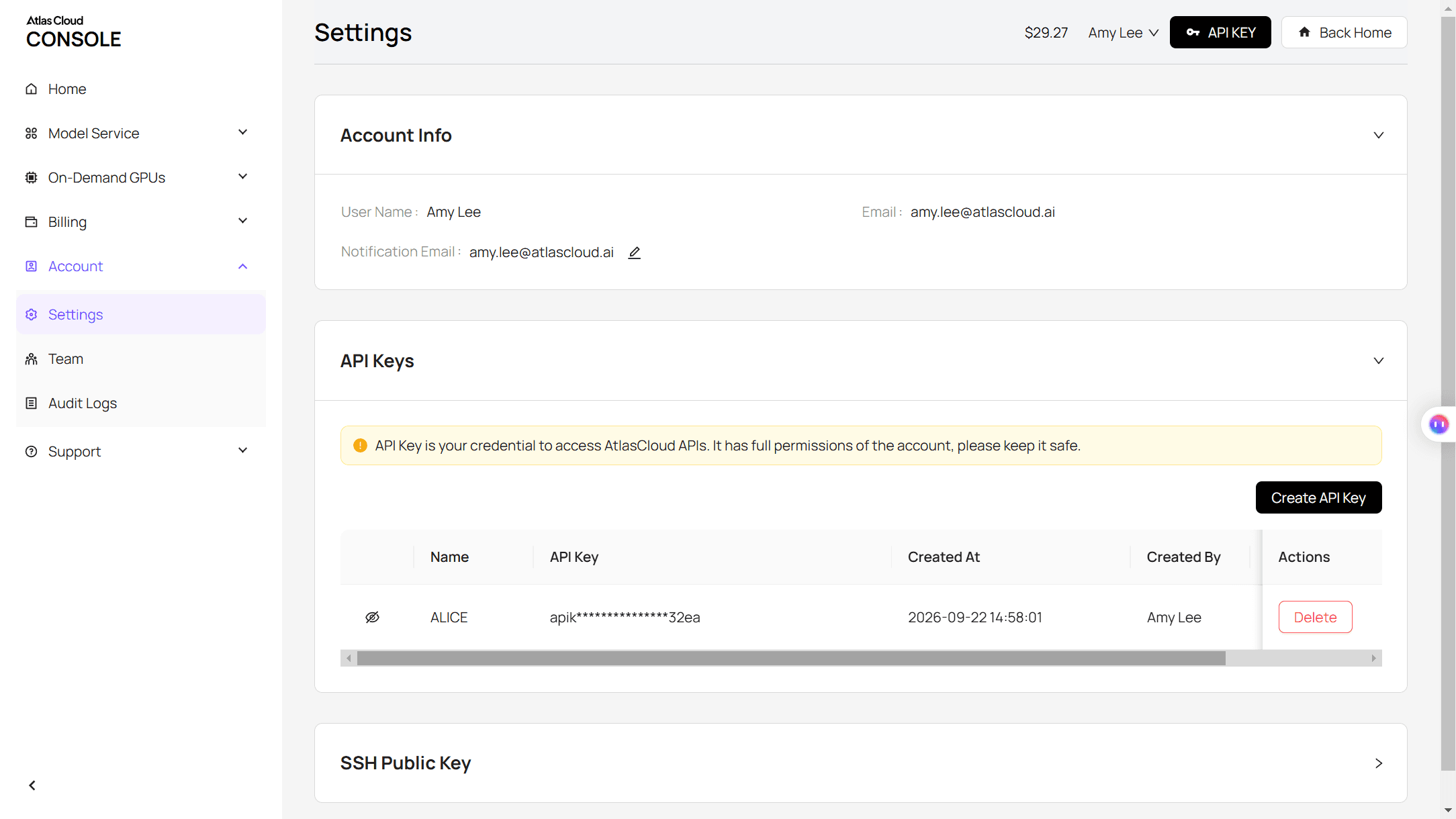
Step 2: Check the request format. The Atlas Cloud API docs list the supported LLM request formats. GPT-6.2 Sol takes the OpenAI Responses format shown below.
Step 3: Send the request. Put your own task in the input field.
plaintext1curl -s -X POST "https://api.atlascloud.ai/v1/responses" \ 2 -H "Authorization: Bearer $ATLASCLOUD_API_KEY" \ 3 -H "Content-Type: application/json" \ 4 -d '{ 5 "model": "openai/gpt-6.2-sol", 6 "input": "Write a Python 3.12 module, standard library only, that defines due_at(start, minutes, calendar) and returns when the work is done. Reply with one fenced python code block.", 7 "max_output_tokens": 64000 8 }'
The reply text sits in the output array, and the usage block counts input, output and reasoning tokens. Change the model string to openai/gpt-6.2-astra and the same request runs on Astra, with the same endpoint and the same key.
2. Claude Fable 5.2: Best AI for Coding on Long, Hard Tasks
Anthropic released Claude Fable 5.2 on November 9, 2026 and reported 49.1% on FrontierCode 2.0 at its Xhigh setting, which it calls the highest score of any released model it tested. We did not run Fable 5.2 ourselves. Every number in this section comes from a public benchmark or Anthropic's own pages.
Where free access stops: On Anthropic's pricing page, checked November 20, the Pro plan bills Fable 5.2 to usage credits, and Max includes it for up to half of the weekly limit.
What a solved task costs: Artificial Analysis measured $15.47 per task for Fable 5.2 in Claude Code. Gemini 4 Neon came in at $6.86 and GPT-6.2 Astra at $5.12 on the same index.
What the public benchmarks say: A Coding Agent Index of 58.5 before rounding, against 58.6 for Gemini 4 Neon, across 322 tasks with three attempts each. On Terminal-Bench 4.1, Claude Code with Fable 5.2 scores 65.8%.
Where it falls short for coding: Time. A Fable 5.2 task took 53.3 minutes on average in that index, against 25.1 for Astra.
Fits: multi-hour refactors and large codebases, where a failed attempt costs more than the tokens. Not for you if: you pay per token for routine fixes.
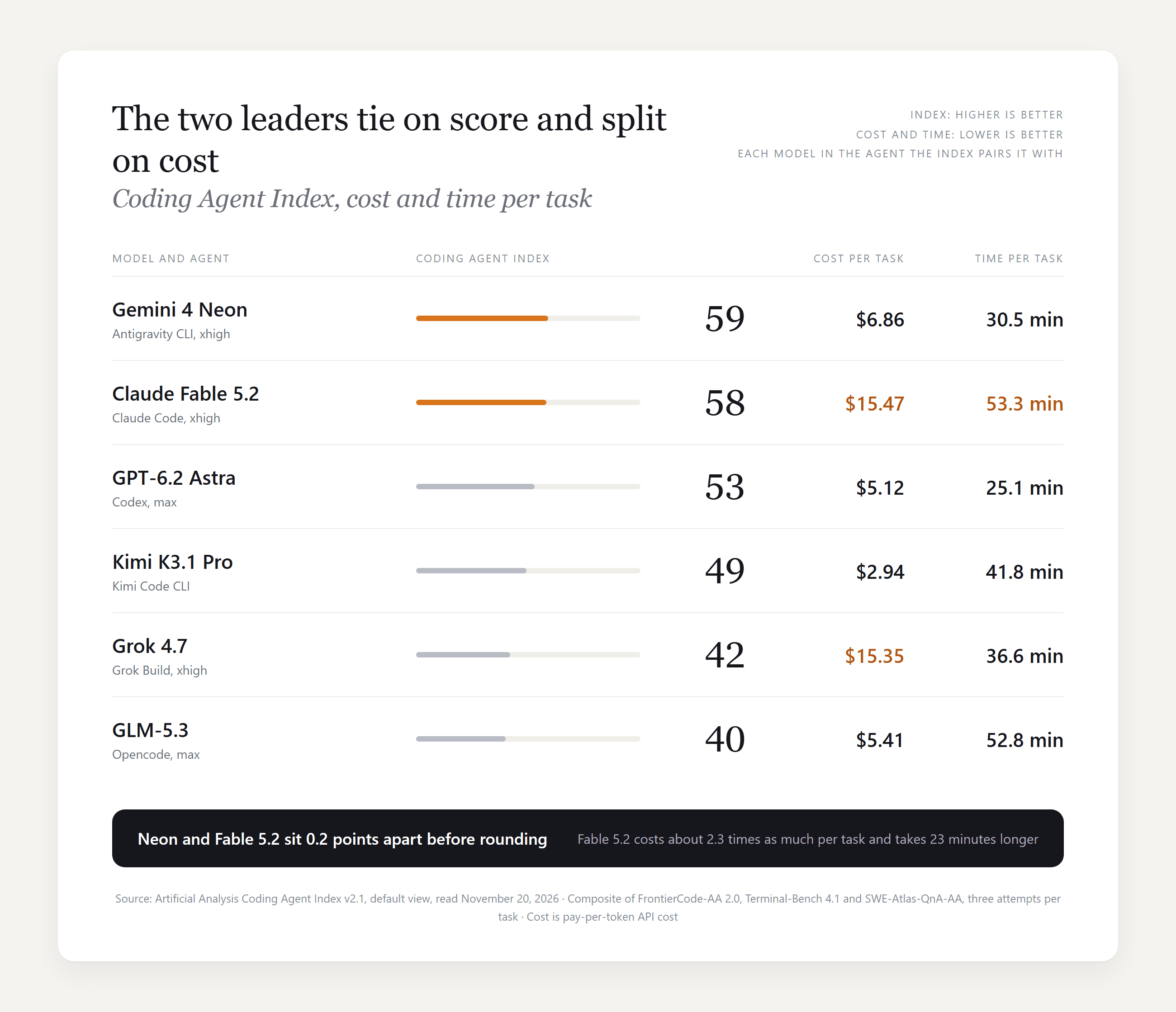
Chart by Atlas Cloud from Artificial Analysis data, read November 20, 2026.
3. Gemini 4 Neon: Best AI Model for Coding Agents
Google launched Gemini 4 Neon on November 18, 2026, and it tops the Artificial Analysis Coding Agent Index at 59, running in Google's Antigravity CLI. We did not run Neon ourselves, so this section rests on public data.
Where free access stops: Google's pricing page says Gemini 4 Neon is not available on the free tier of the Gemini API. In Antigravity and the Gemini app, it comes with the paid Pro and Ultra plans.
What a solved task costs: LiveBench 2.0 puts Neon at $2.65 per successful task, against $9.85 for Fable 5.2. The API lists at $3 per million input tokens and $15 per million output tokens.
What the public benchmarks say: Neon leads LiveBench 2.0 overall at 87.4 and scores 82.6 on its long-running agentic suite, 0.3 behind Fable 5.2. Google reports 65.2% on Terminal-Bench 4.1.
Where it falls short for coding: The record is two days old, and the Terminal-Bench leaderboard did not list Neon when we read it on November 20. Its headline scores also come from inside Google's own agent, which the harness section below returns to.
Fits: agent workflows where one model plans, edits and runs commands for half an hour at a stretch. Not for you if : you need a free tier.
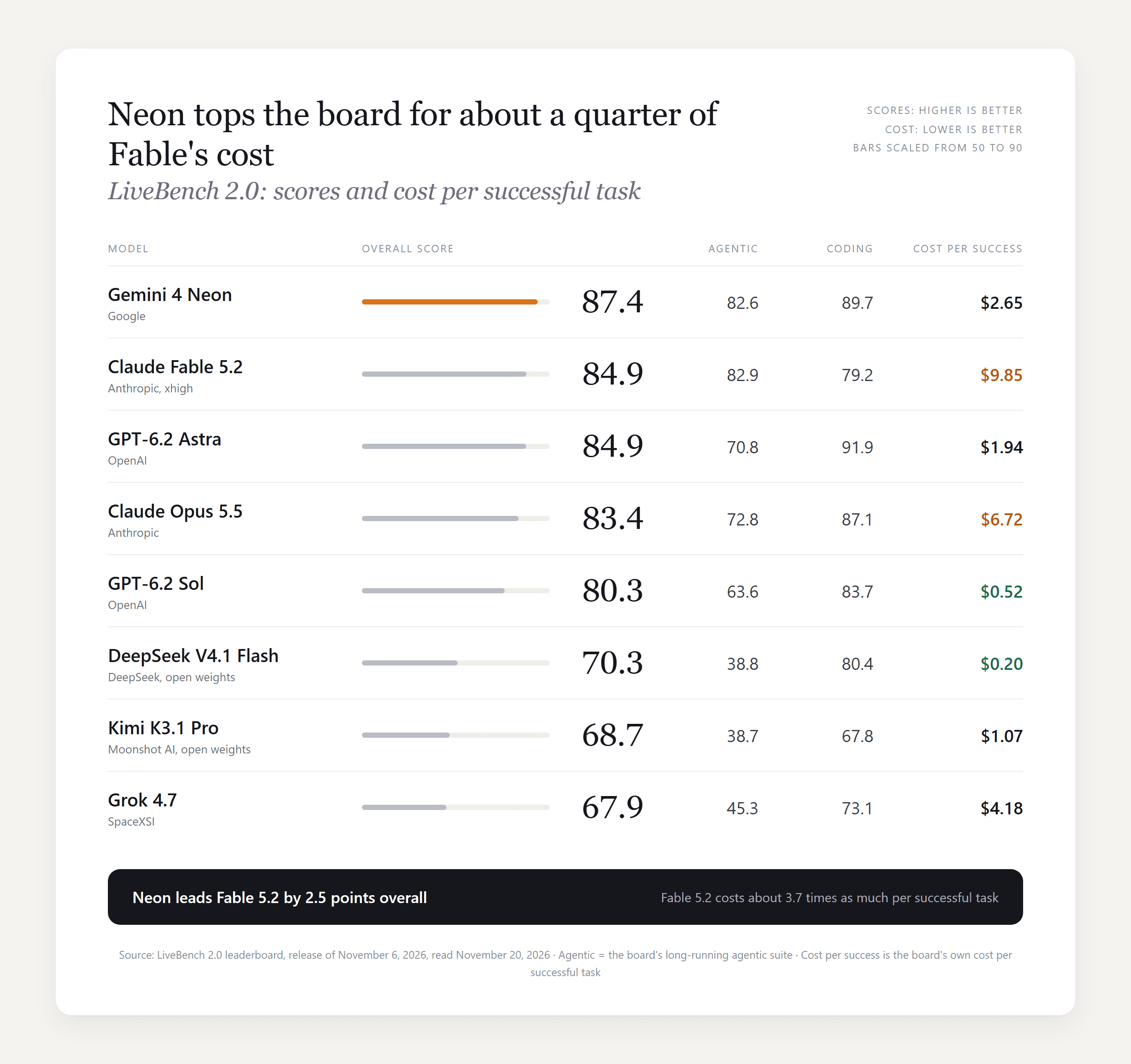
Chart by Atlas Cloud from LiveBench 2.0 data, read November 20, 2026.
4. GPT-6.2 Astra: Best AI Model for Code Review
GPT-6.2 Astra is OpenAI's flagship from the November 17 release. It solved all nine of our runs at 23 seconds per run, the same result as Sol at 2.8 times the cost per solved run.
Where free access stops: OpenAI launched GPT-6.2 inside ChatGPT Work and Codex, not regular Chat. Outside those two, Astra is an API model.
What a solved task costs: About 11 cents per solved run in our tests, against 4 cents for Sol.
What the public benchmarks say: Astra's 91.9 is the highest LiveBench 2.0 coding score among the nine models here that the board lists. Code review is where it pulls away from Sol. In a third-party test covered in our GPT-6.2 review, Astra caught 96% of the issues at xhigh effort, against 84% for Sol.
Where it falls short for coding: On our three tasks, the higher price bought no extra solved runs.
Fits: a second review pass on changes where a missed bug is expensive. Not for you if: your work is routine fixes, where Sol returned the same results for less.
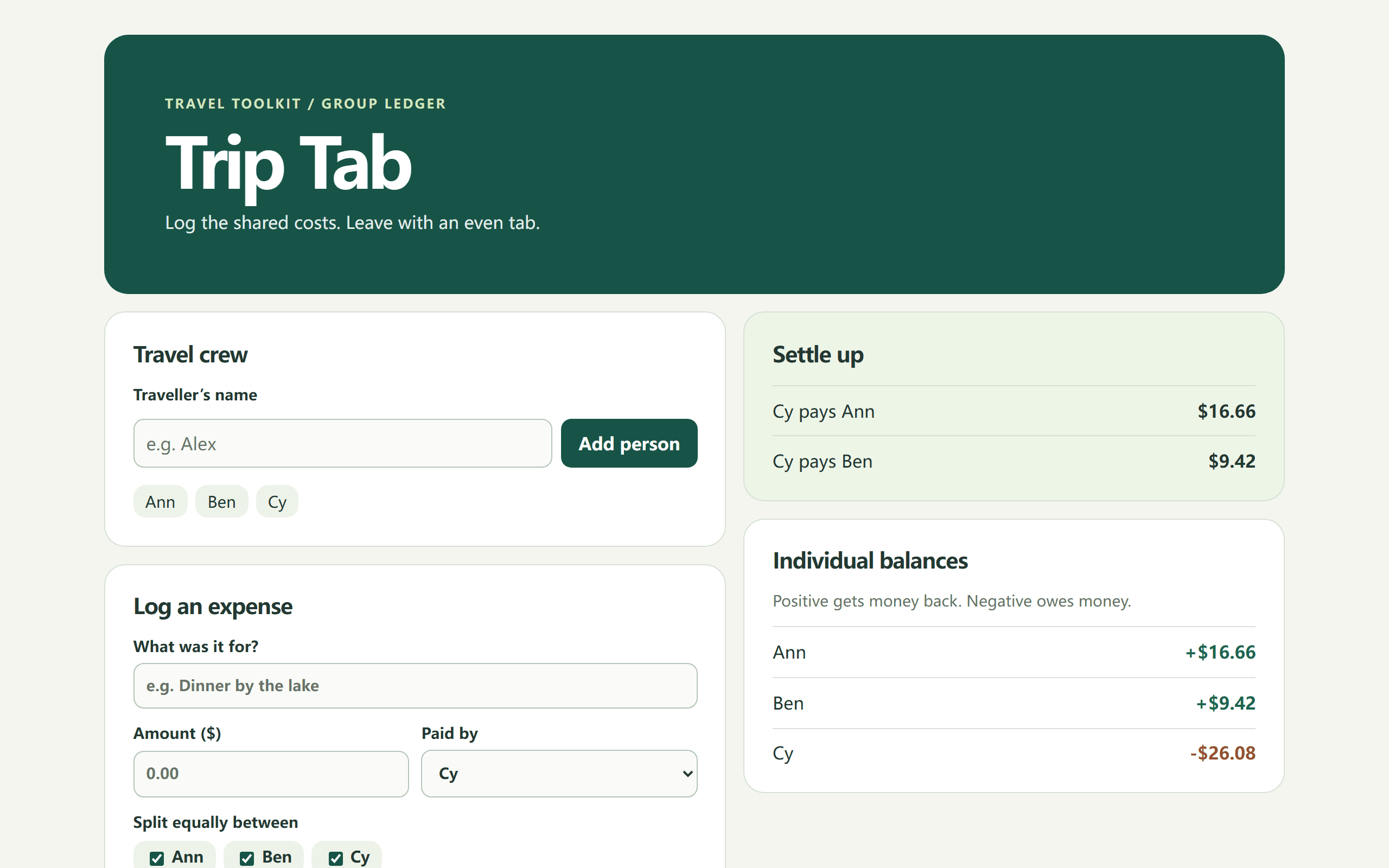
Output of GPT-6.2 Astra on our web app task, run on Atlas Cloud on November 20, 2026. The reply passed all 10 automated browser checks.
5. DeepSeek V4.1 Flash: Best Free AI for Coding
DeepSeek V4.1 Flash runs in DeepSeek's own app, which DeepSeek describes as free to use, and its weights are published under the MIT license. Through the API it solved all nine of our runs at the lowest cost per solved run of the seven models we ran.
Where free access stops: DeepSeek's app launch post describes the app as free to use, with no ads or in-app purchases, and its October 17, 2026 changelog says the web and app models moved to the V4.1 Flash 1017 update. API use is paid per token.
What a solved task costs: About 3 cents per solved run in our tests. LiveBench 2.0 puts it at 20 cents per successful task.
What the public benchmarks say: 80.4 on LiveBench 2.0 coding, about three points behind Sol. Agent work is weaker: 38.5% on Terminal-Bench 4.1 in Claude Code and a Coding Agent Index of 37.
Where it falls short for coding: The wait. A run took 139 seconds on average against 24 for Sol, because the model spent about 21,000 tokens reasoning before it wrote the answer. Give it room. Under our first 20,000-token cap, eight of its nine replies were cut off before the answer was complete.
Fits: students, side projects and teams that want MIT-licensed weights. Not for you if: you need answers in seconds, or long agent sessions.
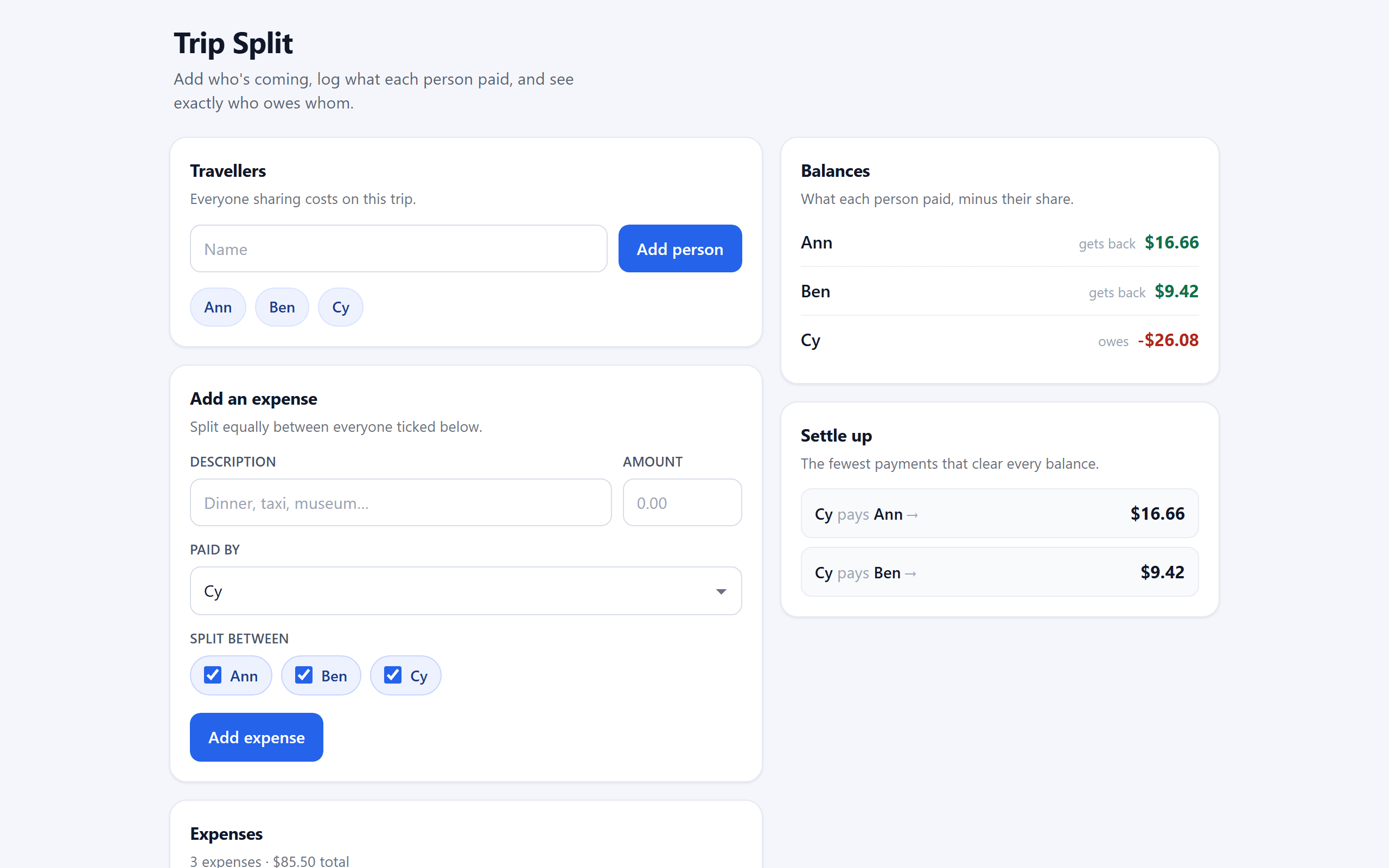
Output of DeepSeek V4.1 Flash on our web app task, run on Atlas Cloud on November 20, 2026. The reply passed all 10 automated browser checks.
The Other Five AI Coding Models Worth Knowing
These five sit lower on our criteria: fewer solved runs or longer waits in our tests, or, for Opus 5.5, a slightly lower agent index than Fable 5.2. They still earn a place when your constraint is specific: a Claude budget, an open license, a GPU of your own.
| Model | Pick it when | Terminal-Bench 4.1 | LiveBench 2.0 coding |
|---|---|---|---|
| Claude Opus 5.5 | Fable 5.2 costs too much | 65.8% | 87.1 |
| Kimi K3.1 Pro | You want open weights for agent work | 59.7% | 67.8 |
| Qwen3.8 27B | The code has to stay on your machine | Not listed | 69.3 |
| GLM 5.3 | You are fixing bugs on a small budget | 41.2% | Not listed |
| Grok 4.7 | You want to try an agent before paying | 38.8% | 73.1 |
6. Claude Opus 5.5
Opus 5.5 is the Claude to pick when Fable 5.2's price is the problem. Released on September 22, 2026, it lists at half of Fable's per-token rate and ties it on Terminal-Bench 4.1 in Claude Code. We did not run it. The trade shows on the hardest work: on the Coding Agent Index's software engineering set, Fable 5.2 leads 49.2 to 44.0.
7. Kimi K3.1 Pro
Kimi K3.1 Pro is the open-weight pick for agent work. Its Coding Agent Index of 49, in Kimi Code CLI, is the highest of the open-weight models on this list that the index covers, and it scores 59.7% on Terminal-Bench 4.1 in Claude Code. The weights ship under Moonshot AI's own license. It solved all nine of our runs, at about eight minutes per run.
8. Qwen3.8 27B: Best Local AI Model for Coding
Qwen3.8 27B is the model to run on your own hardware. It ships under Apache 2.0 with 27 billion parameters and a native context of 262,144 tokens, and the official FP8 build is 30.9 GB, so check your memory before downloading. Through the API it solved eight of our nine runs. The miss was a bug-fix run that failed three of the 12 hidden tests after a money-conversion error.
Our local Qwen coding guide walks through an Ollama and Cline setup with an earlier Qwen coding model. Qwen4-Max, released on November 16, 2026, is API-only for now, and Alibaba says smaller open-weight Qwen4 models will follow.
9. GLM 5.3
GLM 5.3 earns its place on one job. On our bug-fix task it solved all three runs in about 24 seconds each, level with Sol on speed, for about 2.5 cents per solved run. The other tasks went worse. One spec reply spent the whole 64,000-token budget reasoning, and two of its three web apps missed one browser check each. That left six of nine. The weights are open under a custom license.
10. Grok 4.7
Grok 4.7 thinks the longest. All three of its web apps passed every browser check, but two used more than 64,000 output tokens, past our cap, so one counts. One spec reply described the module without including the code.
That left six of nine runs solved, at about eight minutes each and the highest cost per solved run of the seven. The Grok 4.7 launch page invites users to try the model in Grok Build for free, a cheap way to see whether its long reasoning suits your work.
Which AI Agent Is Best for Coding? The Harness Moves the Score
Agent leaderboards rank pairs: a model plus the agent wrapped around it. Google's own launch numbers show how much the wrapper matters. In the Gemini 4 Neon announcement, the model solved 12.8% of the SWE-sweep benchmark in a bare-bones mini-SWE harness and 39.0% inside Google Antigravity. Same model, three times the score.
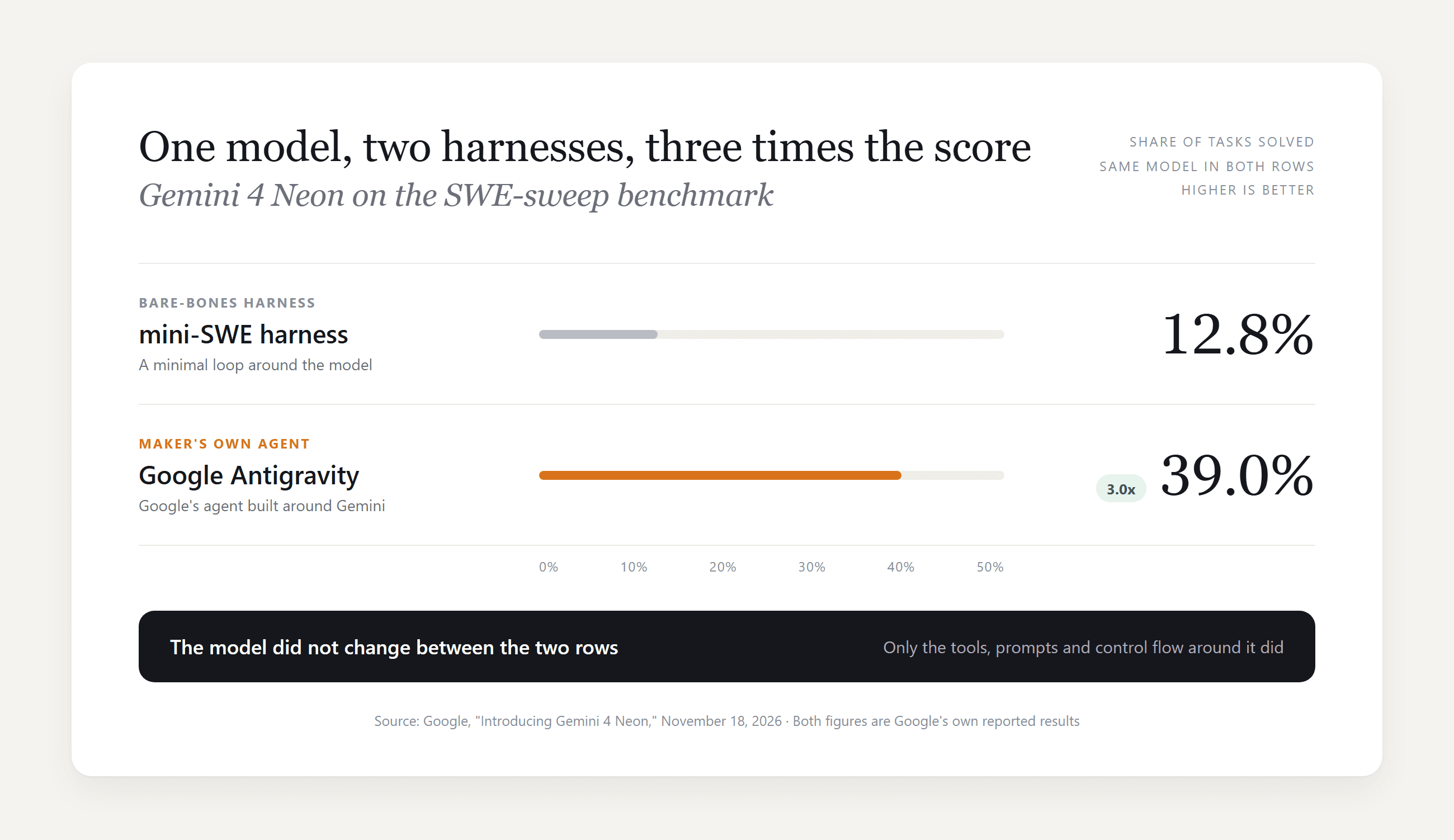
Chart by Atlas Cloud from figures in Google's Gemini 4 Neon announcement, November 18, 2026.
Researchers made the same point at an ICML 2026 workshop. In a poster on harness evaluation, Jiwoo Han and Yuekai Sun wrote that "the harness matters as much as the LLM."
So the best AI agent for coding is a pairing of model and harness. Three from this list sit high on the Coding Agent Index: Antigravity CLI with Gemini 4 Neon at 59, Claude Code with Claude Fable 5.2 at 58 and Codex with GPT-6.2 Astra at 53. Our own tests go the other way on purpose. They call the bare API with no agent, so the model is the only variable.
What to do instead: Take a bug your team already closed, keep its tests hidden and hand the ticket to two pairings, three runs each. Count passes, minutes and dollars. That hour reflects your codebase, which a public index cannot see.
What Does Reddit Say About the Best AI for Coding?
We read these threads through Google's index on November 20, 2026: titles, comment counts and the preview text Google shows for each thread.
| Subreddit | Thread | Comments | What the preview says |
|---|---|---|---|
| r/ollama | Best Current Model for Coding? | 50+ | Claude Opus 5.5 |
| r/GeminiAI | Neon outperform fable 5.2 in coding agents wow | 30+ | Neon is cheap and strong at coding, Fable 5.2 handles project context better |
| r/AI_Agents | A student's request for free or cheaper AI for coding | 10+ | DeepSeek and GLM |
| r/LocalLLaMA | Qwen 3.8 27b is sometimes so smart it scares me... | 250+ | Close to frontier models, but slower |
| r/LocalLLM | Stick with Qwen3.8 27B or move away? | 60+ | Stay, and serve it with llama.cpp |
With no budget attached, the previews lean toward Claude. The top answer in the r/ollama thread is Opus 5.5, and the Neon thread still credits Fable 5.2 with the better grasp of a whole project.
Budget threads sound different. In the r/AI_Agents thread on free and cheaper options, the top answer names DeepSeek and GLM. On the local forums, the top answer in r/LocalLLM is to stay on Qwen3.8 27B and change how it is served.
GPT-6.2 splits opinion. r/codex has long threads on both sides of the 6.2 release, which fits a model that scores near the top on some boards and mid-table on others.
FAQ
Which AI is number 1 in coding right now?
It depends on the board. As of November 20, 2026, Gemini 4 Neon leads the Artificial Analysis Coding Agent Index at 59. On Terminal-Bench 4.1, Claude Fable 5.2 and Opus 5.5 share 65.8% in Claude Code, behind GitHub Copilot's Fusion entry at 71.2%. GPT-6.2 Astra has the top LiveBench 2.0 coding score among the models on this list, 91.9.
Is Claude or ChatGPT better for coding?
On the one repository where we ran both agents, they tied on correctness. Claude Code with Opus 5.5 and Codex with GPT-6.2 Sol each passed all eight hidden tests on a payroll bug. Codex finished in 120 seconds against 208, and Claude wrote more tests of its own. The full run is in our Claude vs ChatGPT comparison.
What is the best AI for vibe coding?
For a small app from one prompt, GPT-6.2 Sol. On our web app task it returned a working expense splitter in about 36 seconds, three times out of three, and GPT-6.2 Astra matched it at a higher cost. DeepSeek V4.1 Flash, Kimi K3.1 Pro and Qwen3.8 27B also went three for three, with waits of two to thirteen minutes per app. For a larger app built over many steps, pick an agent pairing from the harness section instead.
What does it cost to run these models through an API?
As of November 20, 2026, Atlas Cloud lists the seven models we ran at these rates per million input and output tokens: GPT-6.2 Sol $2 and $10, GPT-6.2 Astra $8 and $40, DeepSeek V4.1 Flash $0.30 and $1.20, Kimi K3.1 Pro $2 and $10, Qwen3.8 27B $0.50 and $3, GLM 5.3 $1.40 and $4.40, Grok 4.7 $2 and $6.
Billing is per token with no subscription. In our tests a solved run cost between 3 cents and 39 cents depending on the model. Reasoning tokens bill as output, so a model that thinks longer costs more per correct answer.
Conclusion
Seven models, three tasks, 63 runs. Four models solved every one, and what separated them was the wait: from 23 seconds to about eight minutes per run. GPT-6.2 Sol sat at the fast end with one of the two lowest costs per solved run, which is why it leads this list.
The best AI model for coding still depends on the job. Use Claude Fable 5.2 or Gemini 4 Neon inside their own agents for long, hard work, DeepSeek V4.1 Flash when the budget is zero and Qwen3.8 27B when the code has to stay on your machine. Then run one of your own closed bugs through two of them before you commit.