
 Atlas Cloud is now an authorized U.S. reseller of Dreamina Seedance 2.5 and Seedream 5.0 Pro.Atlas Cloud is now an authorized U.S. reseller of Dreamina Seedance 2.5 and Seedream 5.0 Pro.


Tripo API brings Tripo3D's latest H3.1 engine to your stack, turning text prompts and single images into detailed 3D models. Generate dense meshes of up to 2 million polygons with configurable PBR materials, quad topology for rigging, and GLB or FBX exports. Atlas Cloud serves it through one API key with transparent per-call pricing at $0.10 per generation and Day-0 access to new releases. Start building today.
Tripo is developed by VAST AI. Atlas Cloud (operated by Atlas Cloud AI LLC) provides access to it and does not own it. All trademarks belong to their respective owners.
Atlas Cloud provides you with the latest industry-leading creative models.
A modality-by-modality look at how each Tripo API route turns your input into a ready-to-use 3D asset, with the capabilities that matter to production laid side by side.
| Modality | Description |
|---|---|
| Tripo API Text-to-3D (tripo-h3.1/text-to-3d) | The Text-to-3D endpoint converts a written prompt of up to 1,024 characters into a textured, production-ready mesh, generating PBR materials with geometry and texture quality each selectable up to a detailed level. Face counts range from 1,000 to 2,000,000, and switching on quad topology exports an FBX file instead of the default GLB. At a flat $0.10 per generation, it fits concept artists and game developers who want to build assets straight from a description. |
| Tripo API Image-to-3D (tripo-h3.1/image-to-3d) | Supply a single reference image by URL and this endpoint reconstructs it as a fully textured 3D model that preserves the subject's shape and appearance. Choose whether the texture aligns to the original image or to the geometry, then layer on PBR materials, orientation control, or auto-scaling to real-world meters for finer output. Priced at $0.10 per generation, it serves studios rebuilding product shots, characters, or props from existing artwork. |
From a single line of text or one reference image, the Tripo API builds textured, PBR-ready meshes with tunable geometry and texture quality, quad topology, real-world scaling, and seed-level reproducibility.
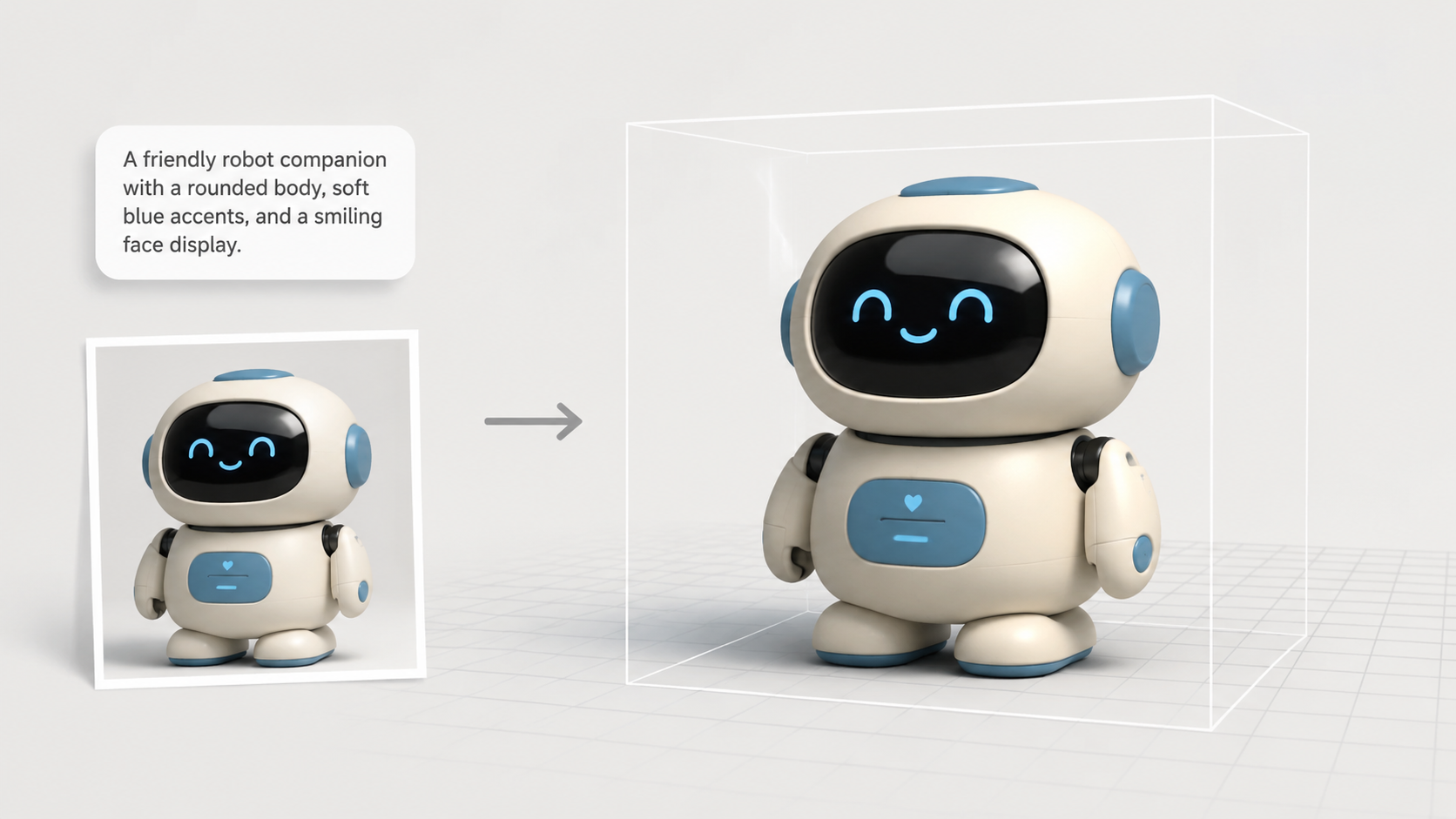
Two entry points feed the same H3.1 engine: describe an object in up to 1,024 characters of prompt text, or hand it a single reference image. Text-to-3D also accepts a negative prompt to steer the model away from unwanted shapes or styles. Each path starts at $0.10 per generation, so teams can prototype from a rough idea or lock geometry to an existing asset without switching tools.

Every model ships with PBR materials generated by default, giving surfaces that respond correctly to light inside real-time engines. Texture generation can be toggled on or off, and texture quality steps from standard to detailed when you need higher-resolution maps. Pick detailed for hero assets that fill the screen and standard for background props where render budget matters more than pore-level fidelity.
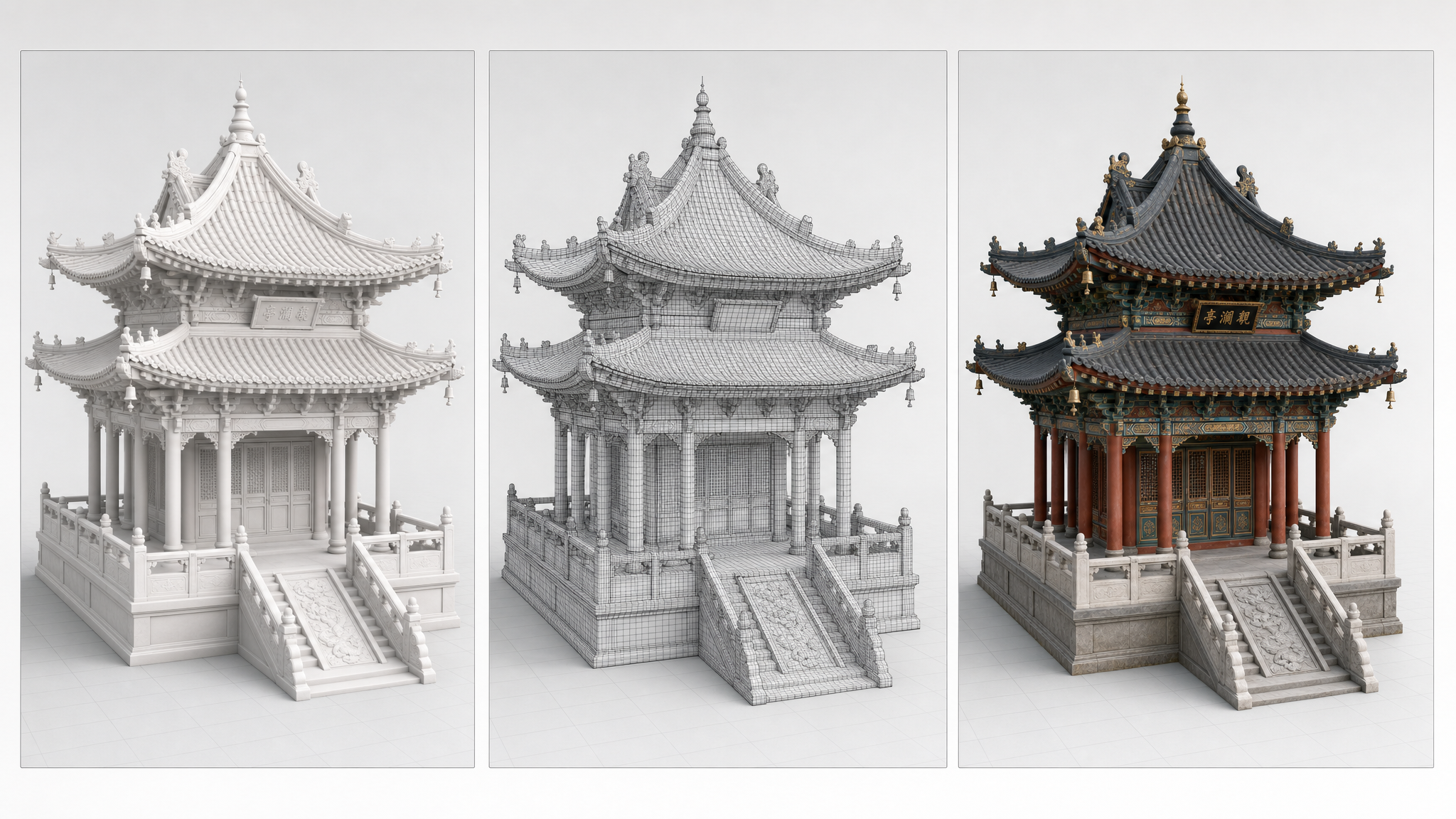
How dense should the mesh be? Set a target face count anywhere from 1,000 to 2,000,000 faces, or leave it unset to let H3.1 decide adaptively. Geometry quality toggles between standard and detailed, and enabling quad mode swaps triangles for a quad topology exported as FBX. Clean quads matter for sculpting and animation, while a capped face count keeps game-ready assets inside strict polygon limits.
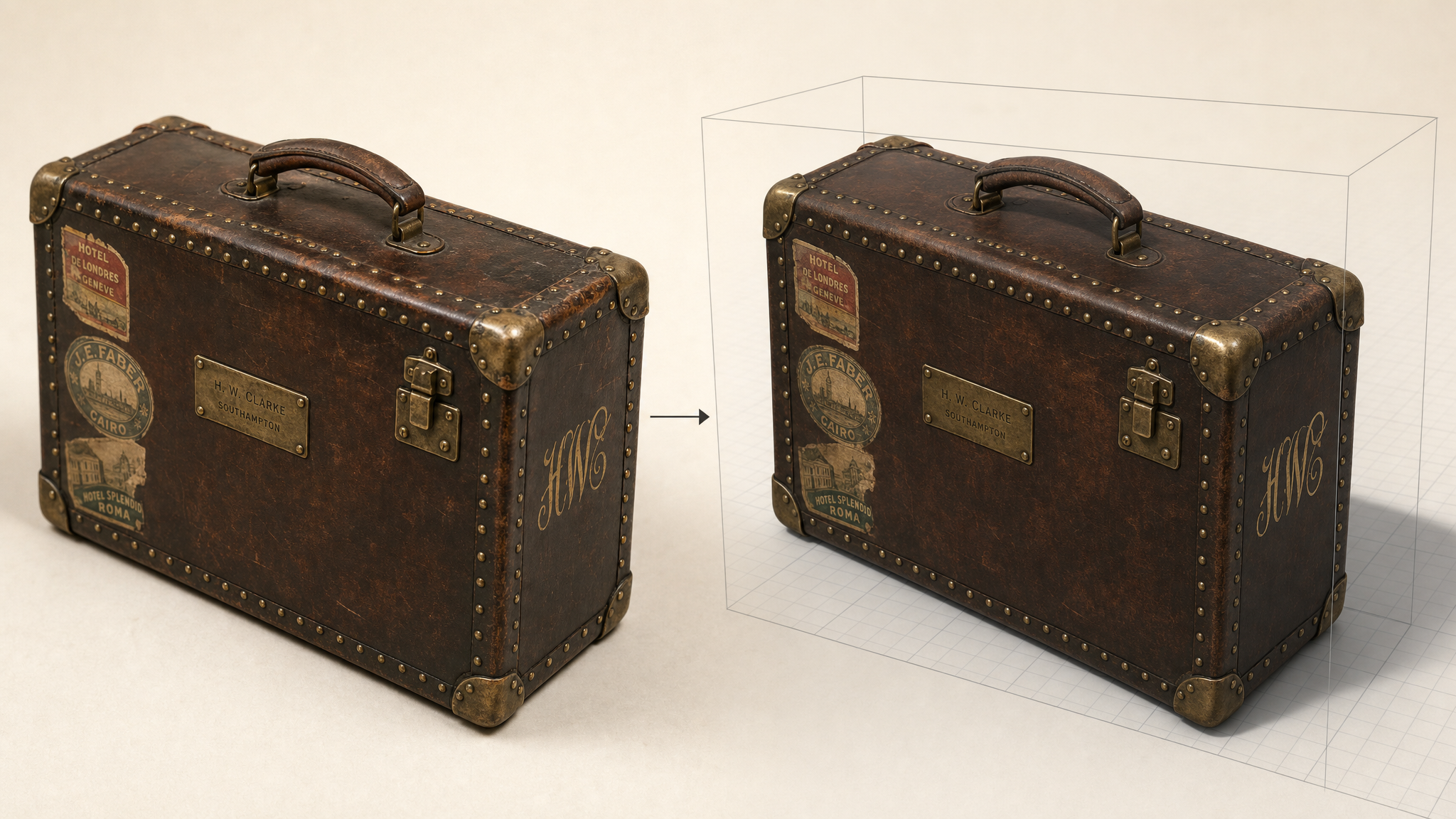
When you convert a photo, the Tripo API lets you align textures to either the original image or the generated geometry, and orientation can auto-match the input rather than the default pose. These controls keep logos, labels, and front-facing detail exactly where the source shows them. The result is a mesh that reads as the same object customers already recognize, not a loose approximation.
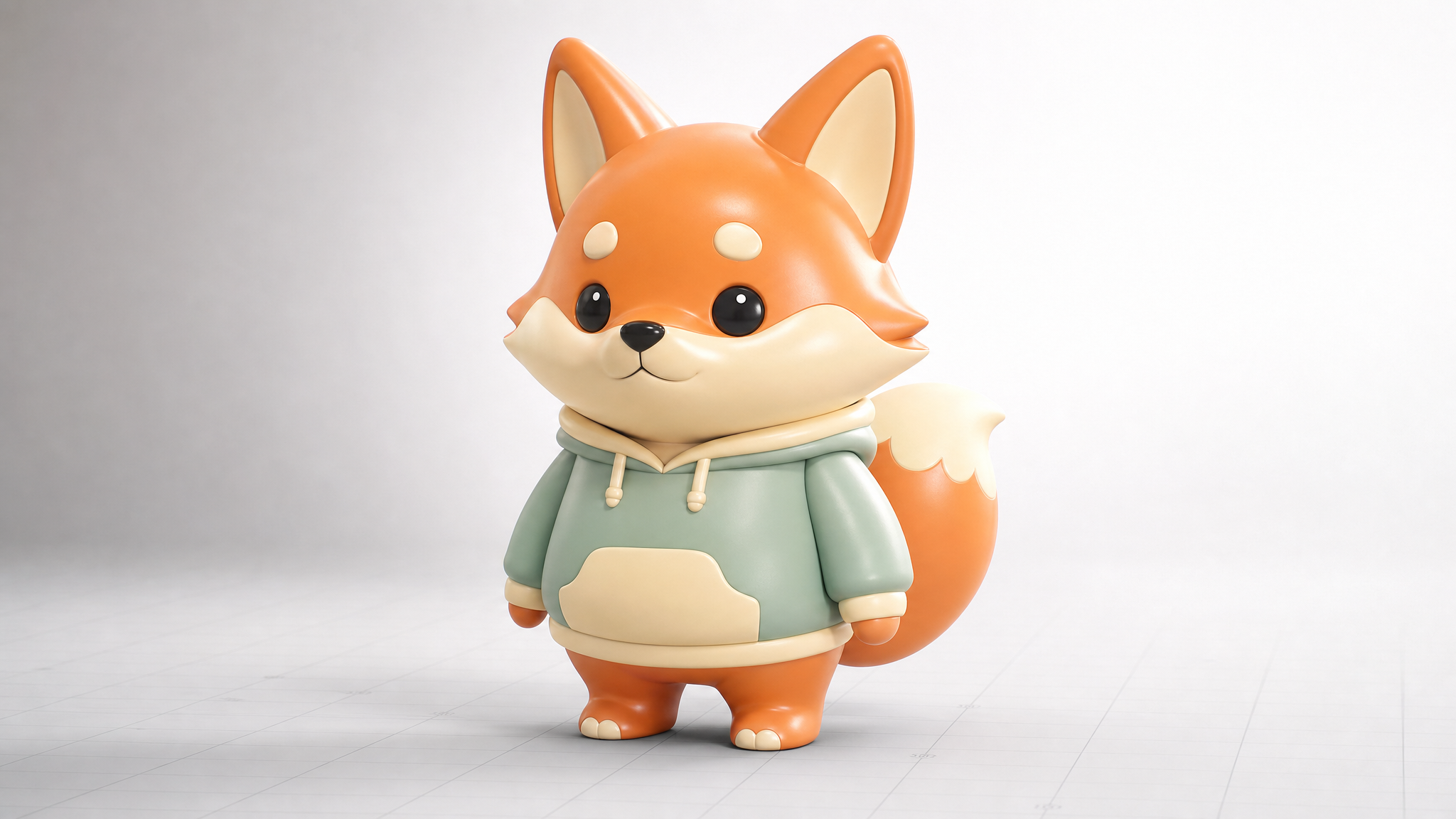
Reproducibility is built in through separate seeds for geometry, the text-to-image step, and texture generation, so a saved seed regenerates the same result on demand. Auto-size can scale the mesh to real-world dimensions in meters instead of arbitrary units. Together these make the Tripo API dependable for pipelines where an asset must be regenerated, versioned, or dropped into a scene at true scale.
Push a single reference image through the Tripo API next to Seed3D 2.0 and Hunyuan 3D Rapid, then compare how faithfully each engine rebuilds the same object as a textured 3D mesh.
A Venetian hand-blown glass octopus figurine resting on a small clear glass base, its bulbous mantle a swirling gradient of amber-gold and deep sea-blue murano glass, translucent body shot through with dense trapped air bubbles and scattered flecks of gold leaf suspended inside. Eight tentacles spiral outward from the base, coiling and tapering to feather-thin, near-transparent curling tips, each inner arm lined with rows of raised rounded suckers that refract tiny rainbow halos. Uneven glass thickness makes thick zones deep-toned and edges nearly light-transmitting. Soft rim backlight from behind plus gentle underlighting glow the delicate tentacle tips and reveal floating bubbles, while frontal key light traces flowing surface texture and wet glossy highlights. Realistic volume and refraction, 3/4 view slightly above. single object, centered, full view, clean soft neutral studio background, photorealistic product photography
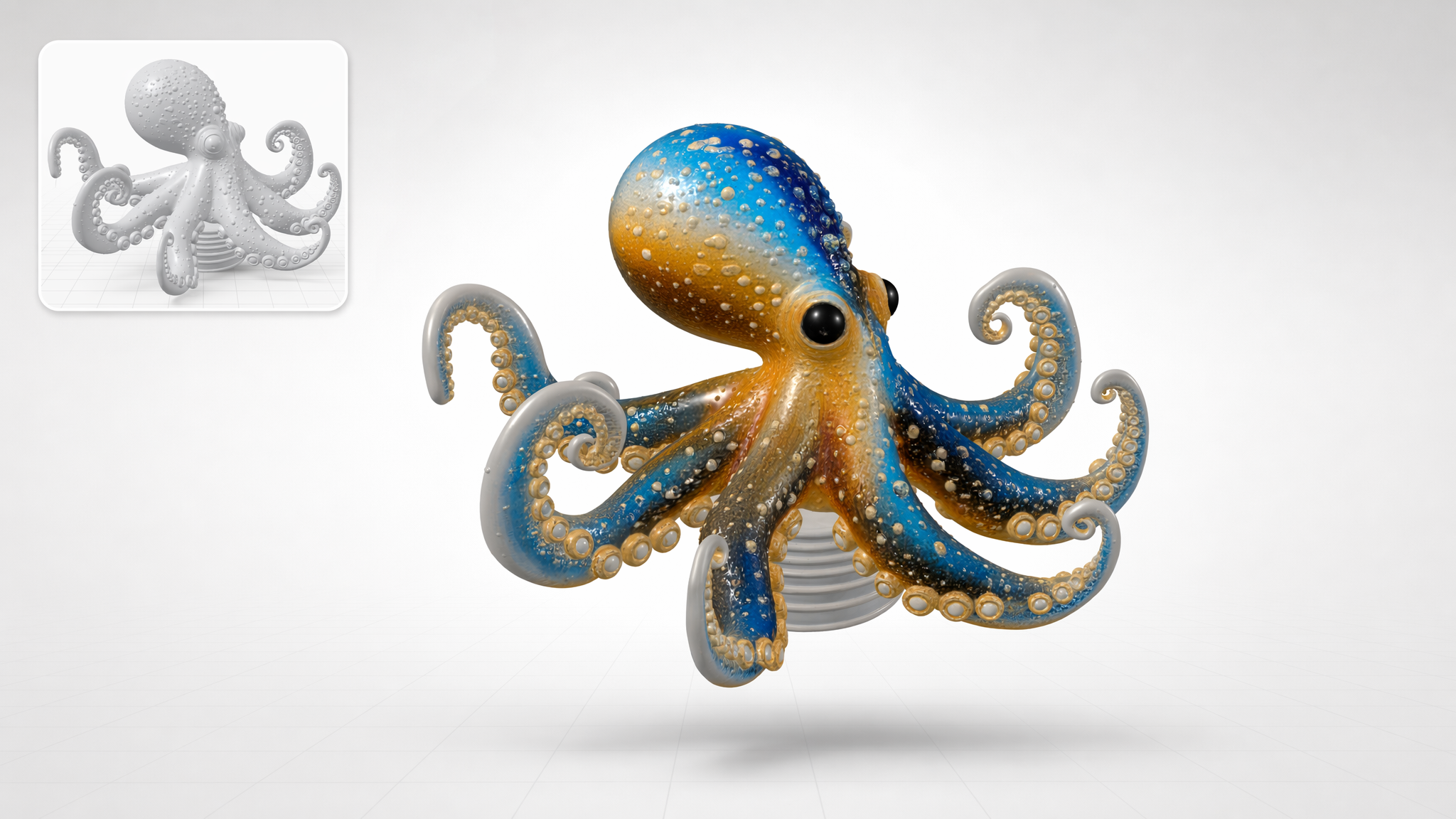
Generated with Tripo H3.1 Image-to-3D on Atlas Cloud
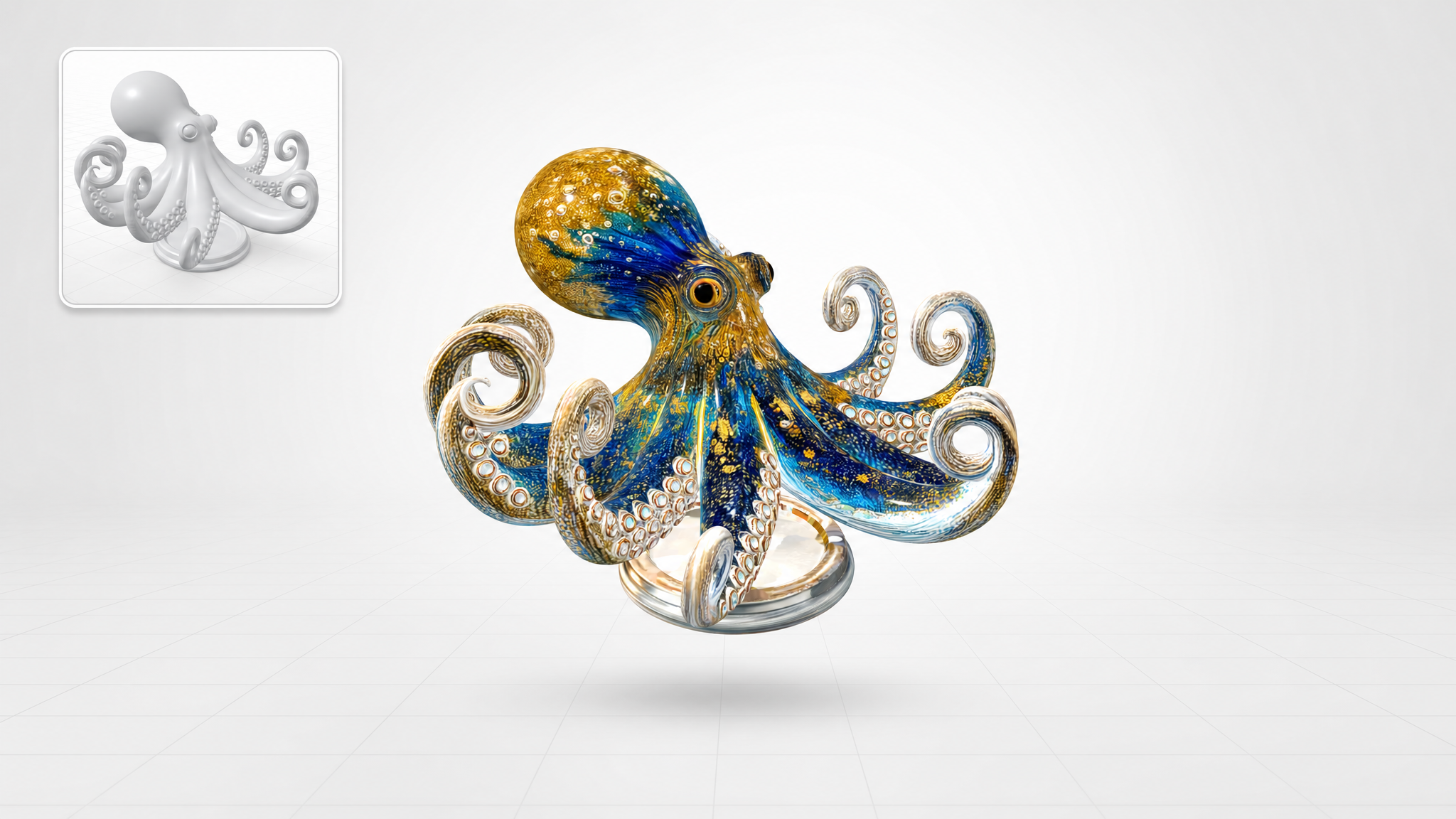
Generated with Seed3D 2.0 Image-to-3D on Atlas Cloud
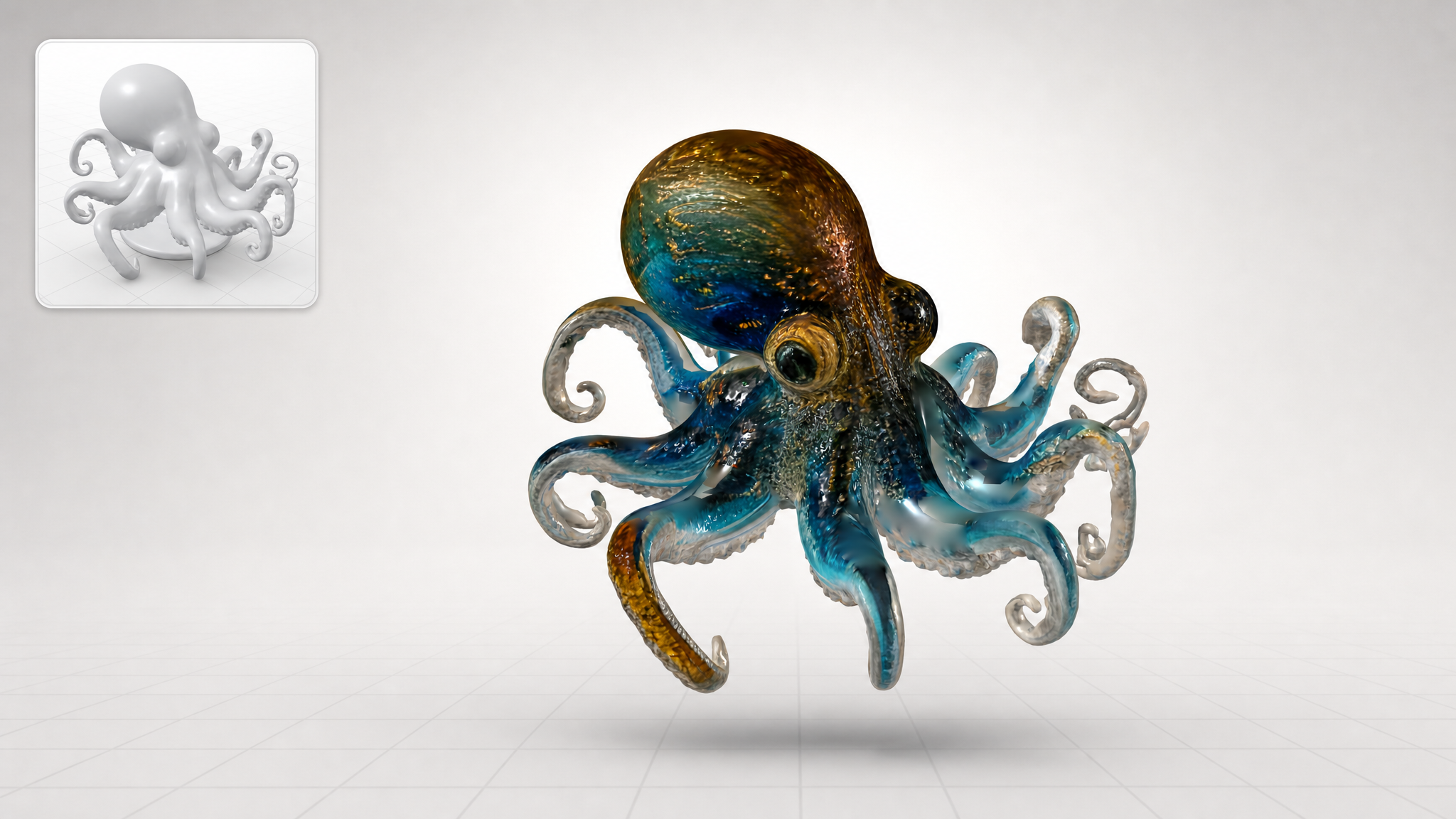
Generated with Hunyuan 3D Rapid Image-to-3D on Atlas Cloud
A rustic hand-thrown ceramic bowl brimming with a layered succulent arrangement, the wood-fired stoneware showing mottled ash-glaze kiln flashing and a matte grainy surface, its soil topped with pale volcanic gravel and fine green moss; clustered inside are seven or eight varieties—a powder-blue echeveria rosette dusted with white farina, translucent jelly-like Haworthia cooperi windows glowing at the tips, trailing strings of pearls spilling over the rim, coral-red-edged sedum, and a spiky purple-tinged form—their thick fleshy leaves overlapping in dense soft translucent curves, lit by gentle directional studio light raking across waxy highlights, velvety frost, and glowing subsurface leaf interiors, three-quarter slightly elevated view, single object, centered, full view, clean soft neutral studio background, photorealistic product photography
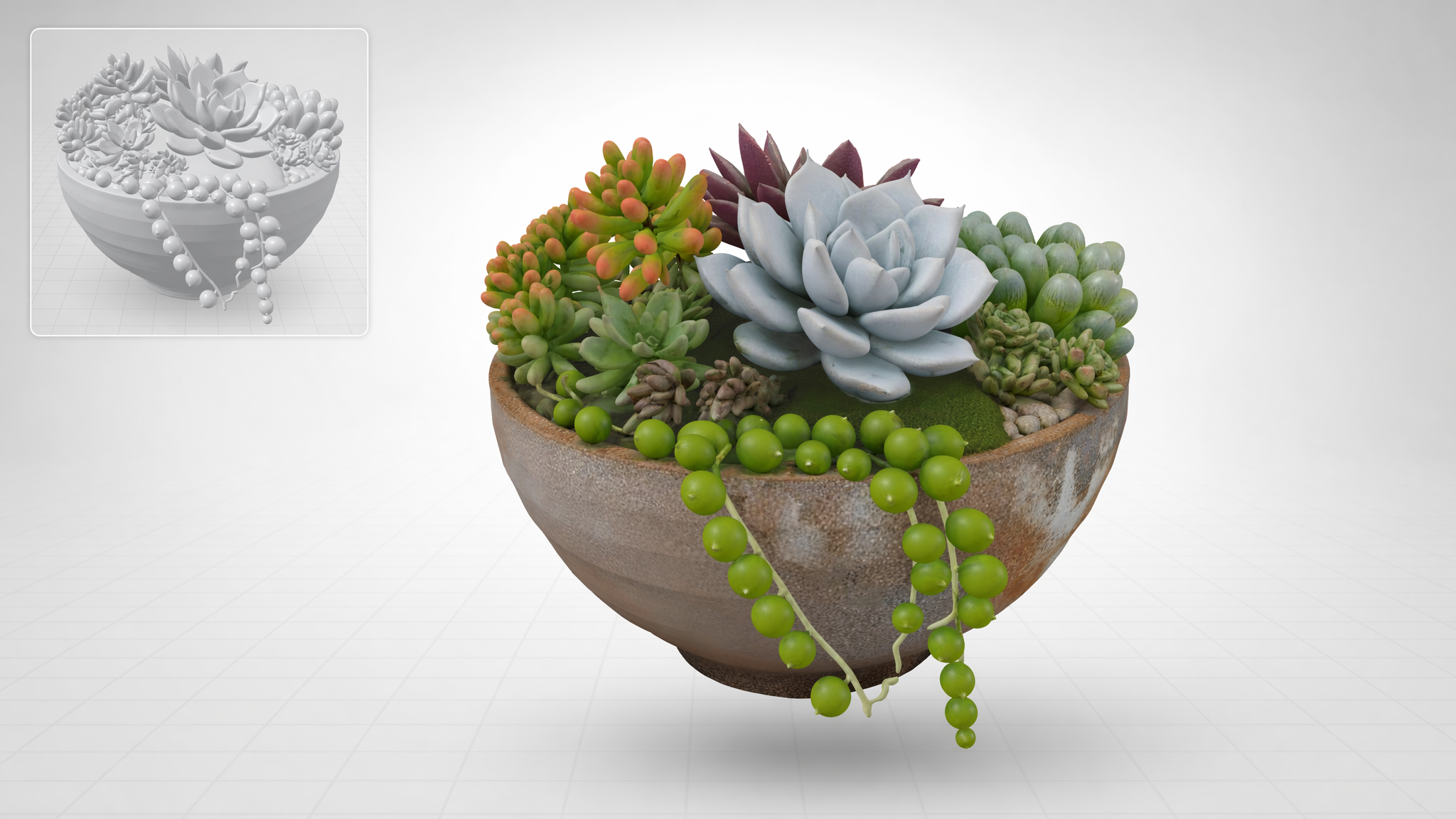
Generated with Tripo H3.1 Image-to-3D on Atlas Cloud

Generated with Seed3D 2.0 Image-to-3D on Atlas Cloud
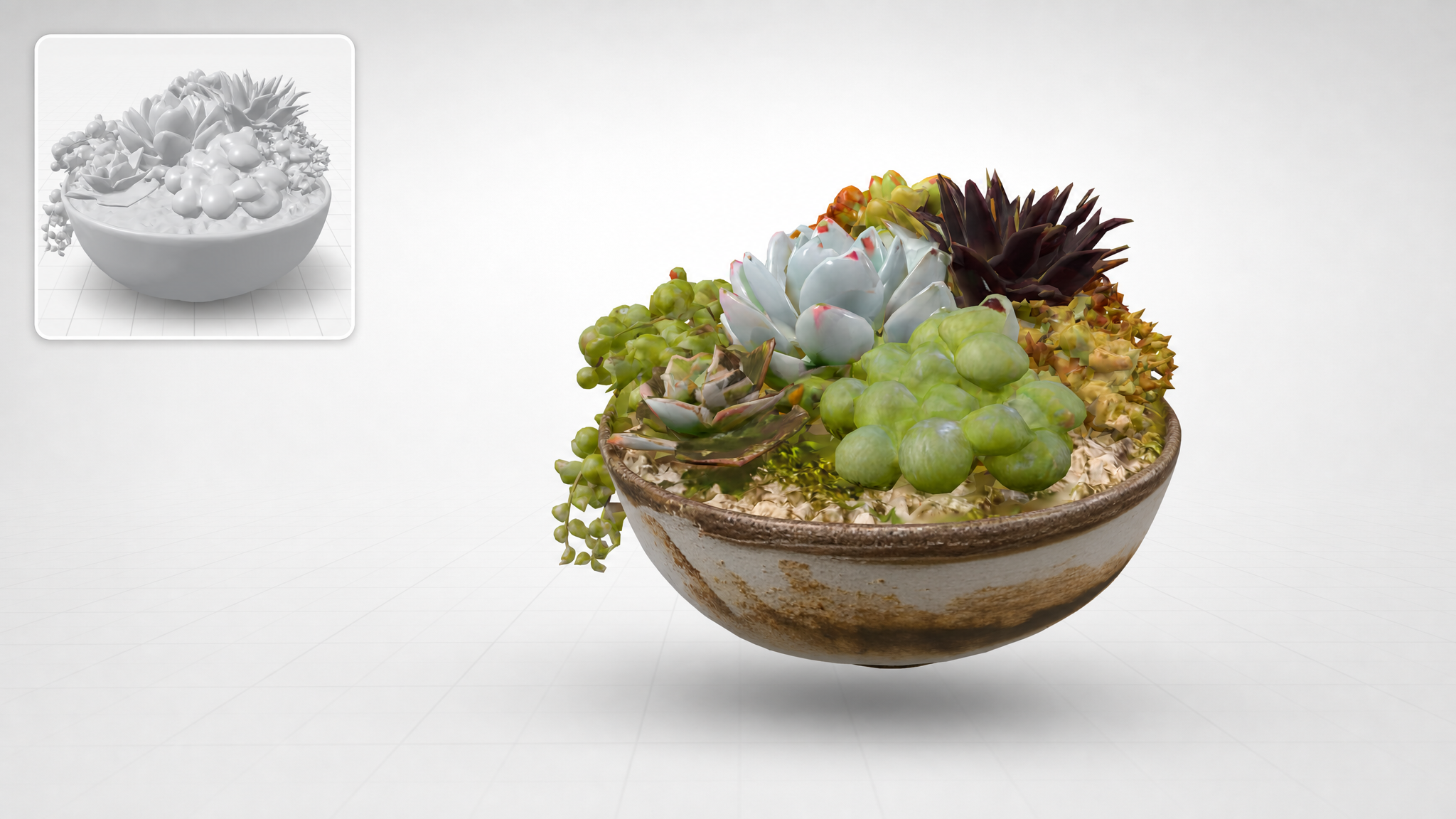
Generated with Hunyuan 3D Rapid Image-to-3D on Atlas Cloud
Spanning game props, animation-ready rigs, AR scenes, e-commerce viewers, and print-ready parts, the Tripo API covers the full 3D workflow from a text prompt or a single reference image.

Set a target face count between 1,000 and 2,000,000 and generate textured meshes sized for real-time engines. Studios use it to populate levels with props, weapons, and background objects fast.

A single product photo becomes a PBR-textured 3D model through the Tripo API. Online stores turn these assets into 360 viewers and AR try-on experiences that lift buyer confidence and reduce returns.

When quad output is enabled, every model exports as FBX with clean four-sided topology built for rigging. Animators bring these meshes straight into Blender or Maya without retopologizing by hand.

PBR materials and automatic scaling to real-world meters make generated objects drop cleanly into AR and VR scenes. Developers place lifelike furniture, gear, and characters without any manual resizing step.

How fast can an idea become a 3D object? The Tripo API renders a full textured model from a single text prompt, letting designers test silhouettes and forms before any manual sculpting begins.

Detailed geometry quality combined with adjustable face limits produces clean meshes with controllable polygon counts for printing workflows. Makers turn photos or prompts into figurines, replica props, and custom parts.
See how the Tripo API stacks up against Tencent Hunyuan 3D and ByteDance Seed3D on input support, geometry detail, export formats, and per model pricing, all reachable through one Atlas Cloud key.
| Model | Provider | Input Types | Max Geometry | Output Formats | Price |
|---|---|---|---|---|---|
| Tripo H3.1 Text-to-3D | Tripo | Text | Up to 2M faces | GLB, FBX | $0.10 / model |
| Tripo H3.1 Image-to-3D | Tripo | Image | Up to 2M faces | GLB, FBX | $0.10 / model |
| Hunyuan 3D Pro | Tencent | Text, Image | Up to 1.5M faces | GLB, USDZ | $0.02 / model |
| Hunyuan 3D Rapid | Tencent | Text, Image | - | GLB, USDZ | $0.02 / model |
| Seed3D 2.0 Image-to-3D | ByteDance | Image | - | GLB, OBJ, FBX, STL, USDZ | $0.353 / model |
Get started in minutes — follow these simple steps to integrate and deploy models through Atlas Cloud's platform.
Sign up at atlascloud.ai and complete verification. New users receive free credits to explore the platform and test models.
Combining the advanced Tripo models with Atlas Cloud's GPU-accelerated platform provides unmatched performance, scalability, and developer experience.
Low Latency:
GPU-optimized inference for real-time reasoning.
Unified API:
Run Tripo, GPT, Gemini, and DeepSeek with one integration.
Transparent Pricing:
Predictable per-token billing with serverless options.
Developer Experience:
SDKs, analytics, fine-tuning tools, and templates.
Reliability:
99.99% uptime, RBAC, and compliance-ready logging.
Security & Compliance:
SOC 2 Type II, HIPAA alignment, data sovereignty in US.
The Tripo API is Tripo AI's interface for turning text prompts and single images into production-ready 3D models. On Atlas Cloud it powers the Tripo H3.1 Text-to-3D and Image-to-3D endpoints, each returning a textured mesh with PBR materials. You reach both through one Atlas Cloud API key with pay-as-you-go pricing.
From a single sentence or one reference image, Tripo generates game characters, mechanical parts, props, and product visuals as complete 3D meshes. Because the output ships with PBR textures, assets move straight into game engines, AR scenes, and 3D commerce pipelines without a manual rebuild.
Sign in to Atlas Cloud, create your API key, and send a prompt or image to the Tripo H3.1 endpoint through the same interface you use for other models. Generation runs asynchronously, and the response returns a downloadable GLB file once the model is ready. Start building today.
Both endpoints accept text descriptions or a single image, with the Text-to-3D model taking prompts up to 1024 characters. Results return as GLB, the glTF 2.0 based binary format that opens directly in Blender, Unity, Unreal Engine, and Three.js.
Tripo H3.1 Text-to-3D and Image-to-3D each cost $0.10 per generation on Atlas Cloud, and you are billed only for the calls you make. There are no subscriptions or seat fees, so spend scales directly with how much you generate.
Several parameters let you tune the result: PBR materials, texture quality set to standard or detailed, and geometry quality for finer surfaces. Quad mesh topology is available too when animation or sculpting workflows need clean edge loops rather than a triangle mesh.
Latency depends on the settings you choose, since detailed textures and higher geometry quality take longer than standard runs. Improved generation speed was one of the core upgrades in H3.1, and because requests process asynchronously your app can submit a job and poll for the finished model.
Rather than generating geometry token by token, H3.1 builds shapes natively in 3D probabilistic space, which keeps structure coherent and edges sharp. Against earlier releases it improves input alignment, geometry precision, and texture consistency, reducing the manual cleanup needed before assets reach production.
Seedance 2.5 API is now available on Atlas Cloud! It gives developers ByteDance's newest video model. It generates up to 30 seconds of native video in a single pass from text, a single image, or as many as 50 multimodal references, with synchronized audio and in-frame multilingual text. On Atlas Cloud you reach it through one key, with subject consistency and improved physics keeping long shots coherent. (Update: Seedance 2.5 1080P API Is Available NOW!)

Wan 3.0 API is the next generation of Alibaba's Wan video family, built to push long-form generation, multi-reference control, and audiovisual quality to new heights. Atlas Cloud already hosts Wan 2.7, 2.6, and 2.5, and Wan 3.0 runs on the same unified key with no separate setup. Start building today. Scroll down to the showcase to see what Wan 3.0 can create.
MiniMax H3 is MiniMax's multimodal video family for text, image, and reference guided creation. Across supported routes, it preserves subjects from reference media, offers flexible aspect ratios, and pairs generated sound with visuals through H3 Developer, with output profiles selected by endpoint. Atlas Cloud unifies the family behind one OpenAI-compatible key with transparent pay-as-you-go pricing from the standard rate of $0.038 per second. Start building today.
The gpt-image-2.5 family from OpenAI gives developers a choice of Flare and Sunburst for production image workflows. Render at arbitrary resolutions up to 3840x2160 and select from five quality tiers, including xhigh and max, to match specific output requirements. Atlas Cloud provides ready-to-use REST inference with no cold starts and standard pricing from $0.004 per generation. Start building today.
Seedream 5.0 Pro API gives developers ByteDance's controllable image editing model on Atlas Cloud. It places edits precisely with anchors and coordinates, separates images into editable layers, fuses multiple references, and matches exact colors and materials, with multilingual text at 2K and 3K. On Atlas Cloud you reach it through one key!
Seedance 2.0 is ByteDance’s production video model for precise shot creation. Turn prompts into video, animate a first-frame image with optional last-frame guidance, or shape results with reference media and optional web search. Atlas Cloud brings these workflows into one unified API with transparent pay-as-you-go pricing and one OpenAI-compatible key. Start building today.
The Kling 3.0 API brings Kuaishou's flagship video suite to Atlas Cloud through one OpenAI-compatible key. It spans two models, Kling 3.0 for AI Director storytelling, multilingual lip-sync, and precise on-screen text, and Kling 3.0 Omni (O3) for subject and voice cloning from a short video or image. Both generate native audio in the same pass, with output up to 4K. Build cinematic narratives, global marketing, multilingual ads, and serialized character content on reliable infrastructure.
Grok Imagine Video gives developers access to xAI’s video family for creating, animating, extending, and editing clips. Generate 1 to 15 second videos from prompts, guide people, objects, or styles with up to seven reference images, and work at 480p or 720p. Atlas Cloud brings these capabilities together through OpenAI-compatible endpoints with transparent pay-as-you-go pricing. Start building today.
Vidu Q4 is Vidu's latest flagship video model, designed for image-to-video and reference-to-video generation. It can animate a single still image and create automatic scene transitions, giving developers two input paths for different product workflows. Atlas Cloud provides dedicated API endpoints with published parameter schemas at the verified standard price of $0.04 per second. Start building today.
Gemini Omni 1.1 Flash is Google DeepMind’s natively multimodal video family for flexible production workflows. Edit existing footage through text instructions, maintain visual consistency with up to 10 reference images and 3 video clips, or extend a shot in chainable segments to 40 seconds. Access every workflow on Atlas Cloud with one OpenAI-compatible API key, pay-as-you-go pricing, and Day-0 availability. Start building today.
Nano Banana 2.1 is Google's image model family built on Gemini 3.6 Flash. It delivers Pro-level generation and editing at Flash-level speed, supports natural-language edits and merges across 1 to 14 input images, and maintains consistency for up to 4 characters and 10 objects. Through Atlas Cloud, developers can access the family with one OpenAI-compatible key, reliable uptime, and Day-0 availability. Start building today.
Build with the Nano Banana 2 API, powered by Google's Gemini 3.1 Flash Image model. It generates native 4K visuals up to 4096x2304 with accurate text rendering and consistent characters across up to 14 reference images for both generation and editing. On Atlas Cloud you reach it through one unified API alongside 300+ models, with pricing from $0.04 per image, 99.99% uptime, and free credits to start.
Guides, tutorials, and product updates to help you get the most out of Atlas Cloud.



