
Depth Anything V2 for Detailed Depth Maps
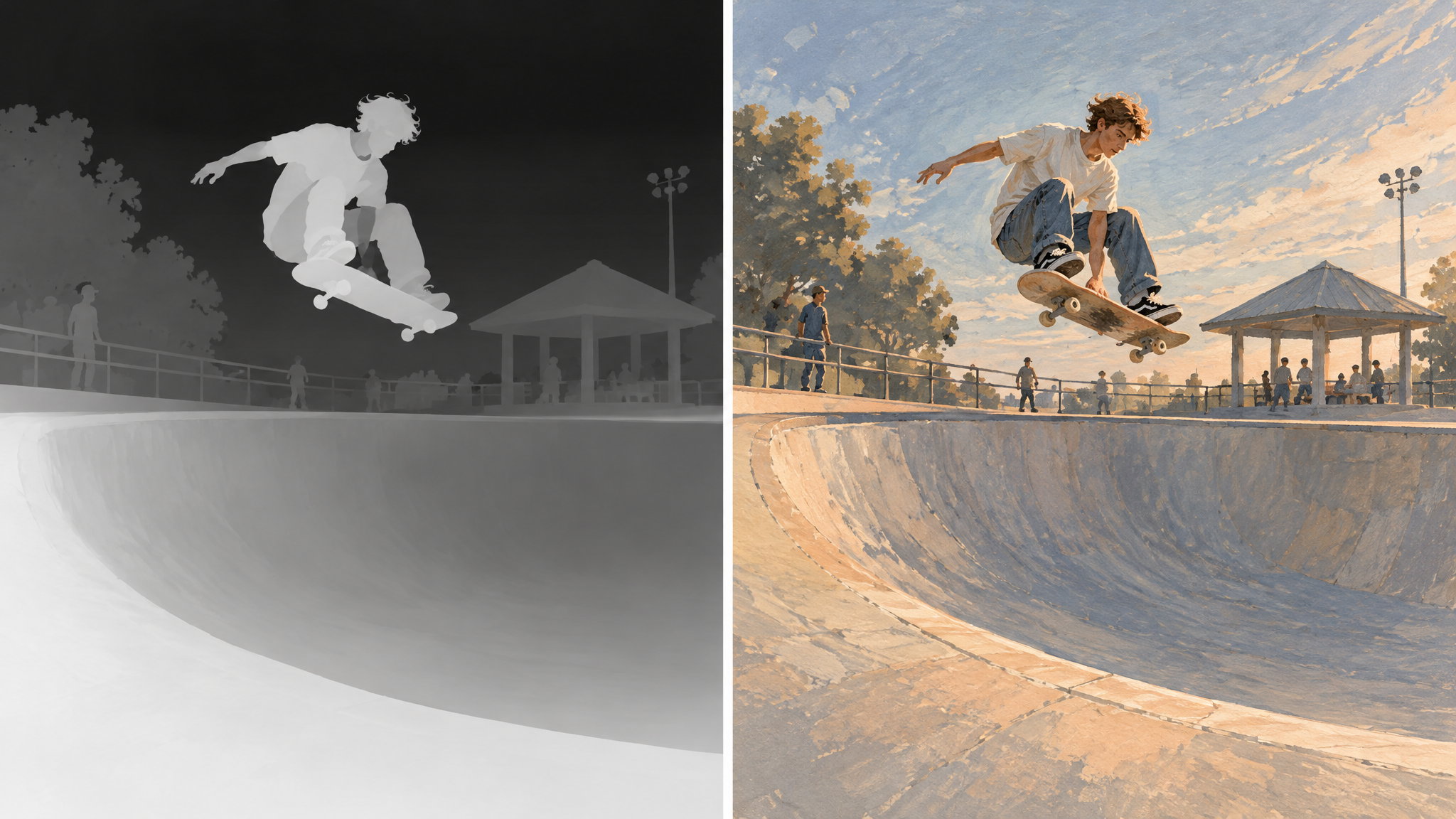
Depth Anything V2 comes from researchers at HKU and TikTok, bringing finer depth detail than V1. Brighter regions indicate closer objects, so the resulting maps can guide image generation or support depth of field effects. Atlas Cloud provides access through a unified API alongside other AI models, with transparent standard pricing of $0.002 per image. Start building today.
Depth Anything V2 is developed by ByteDance. Atlas Cloud (operated by Atlas Cloud AI LLC) provides access to it and does not own it. All trademarks belong to their respective owners.
Explore the Leading Depth Anything V2(1)

Depth Anything V2: From Still Images to Depth Maps
Explore single image depth estimation, output characteristics, and practical applications.
| Modality | Description |
|---|---|
| Depth Anything V2 Depth Estimation API (Image to Depth Map) | Convert a single still image into a grayscale relative depth map with Depth Anything V2. The output matches the input resolution, with brighter areas indicating closer objects. Use the map for ControlNet depth control, depth of field effects, or 3D and parallax effects. |
Depth Anything V2: Scene Depth from One Image
From a single still image, Depth Anything V2 returns a grayscale depth map at the input resolution for downstream ControlNet, depth-of-field, and 3D or parallax workflows, with unified API access and pay-as-you-go pricing on Atlas Cloud.
Depth Anything V2 from One Image
Depth Anything V2 estimates relative depth from a single still image and returns a grayscale map, with brighter areas representing nearer surfaces. Submit one image to extract its near-to-far structure. Use the tonal values to distinguish foreground, middle distance, and background within that scene. This provides a starting point for effects that need spatial information from an existing photograph.
Depth Maps at Input Resolution
A depth map is returned at the resolution of the input image, keeping its pixel dimensions consistent with the source. Place the map alongside the original in a compatible editing workflow. The shared canvas size lets you work with corresponding image locations when applying depth effects. For compositing projects, this provides a depth layer that fits the source image's existing canvas.
Depth Anything V2 for ControlNet
Use the grayscale output of Depth Anything V2 as a depth control for a compatible ControlNet workflow. Start with one reference image, estimate its relative depth, then supply that map to your generation pipeline. The downstream model uses the depth signal as structural guidance. This approach suits image variations where the reference scene's spatial arrangement matters alongside the new visual direction.
Depth Guided Focus
Generate a static side-by-side photographic comparison of the identical young woman laughing as a loose ribbon catches on her sleeve at an outdoor flower market. Keep her face, pose, clothing, objects, lighting, colors, camera position, and framing identical in both panels; only the depth-dependent focus treatment changes. The left image has the scene in focus, while the right keeps her face and sleeve sharp and softly blurs the nearer flower stems and distant stalls. Golden side backlight from the left illuminates flyaway hair, with restrained lavender and warm yellow colors, natural skin texture, creased linen, and subtle film grain. Use foreground floral occlusion and an editorial portrait composition, with a narrow warm-white divider and no labels or interface, wide 16:9 aspect ratio, full-bleed.
A Foundation for 3D and Parallax
One still image can supply the relative depth information used in 3D and parallax effects. The grayscale map describes which visible surfaces sit nearer or farther within the scene. Bring it into a compatible effect or compositing tool to build depth-based movement from your source photograph. Layered travel scenes and editorial images offer clear opportunities to turn static compositions into spatial presentations.
Unified Access at $0.002 per Operation
At a standard $0.002 per image operation, Atlas Cloud provides Depth Anything V2 through its unified API with pay-as-you-go billing. Submit a still image and pass its grayscale depth map into the next stage of your application. Keep depth preparation alongside your other model calls under one platform. This makes the processing cost explicit when planning image editing tools and creative workflows.
Depth Anything V2: Two Scenes for Depth Exploration
Prepare contrasting reference images to explore how Depth Anything V2 represents foreground subjects, overlapping objects, and distant backgrounds.
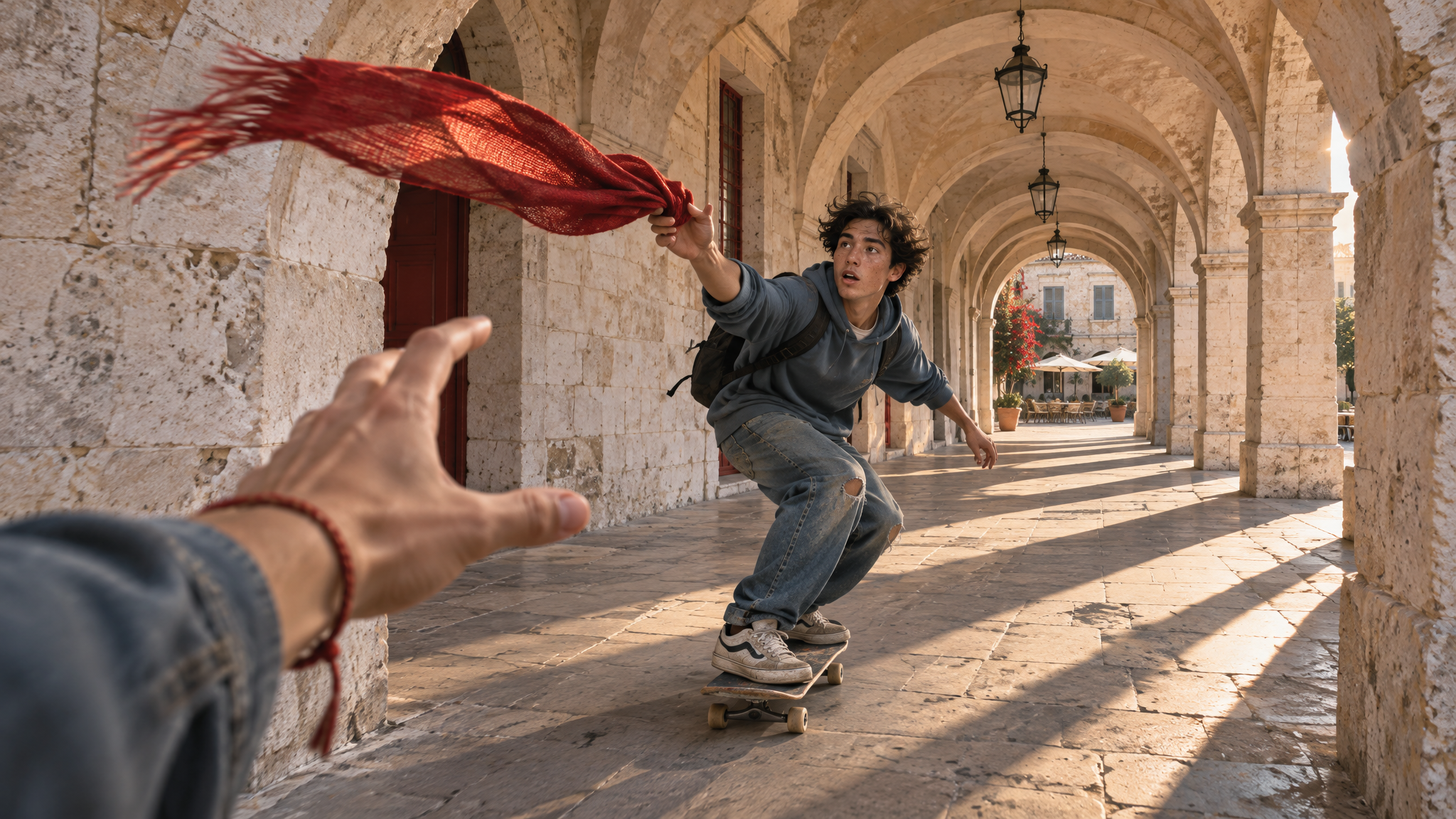
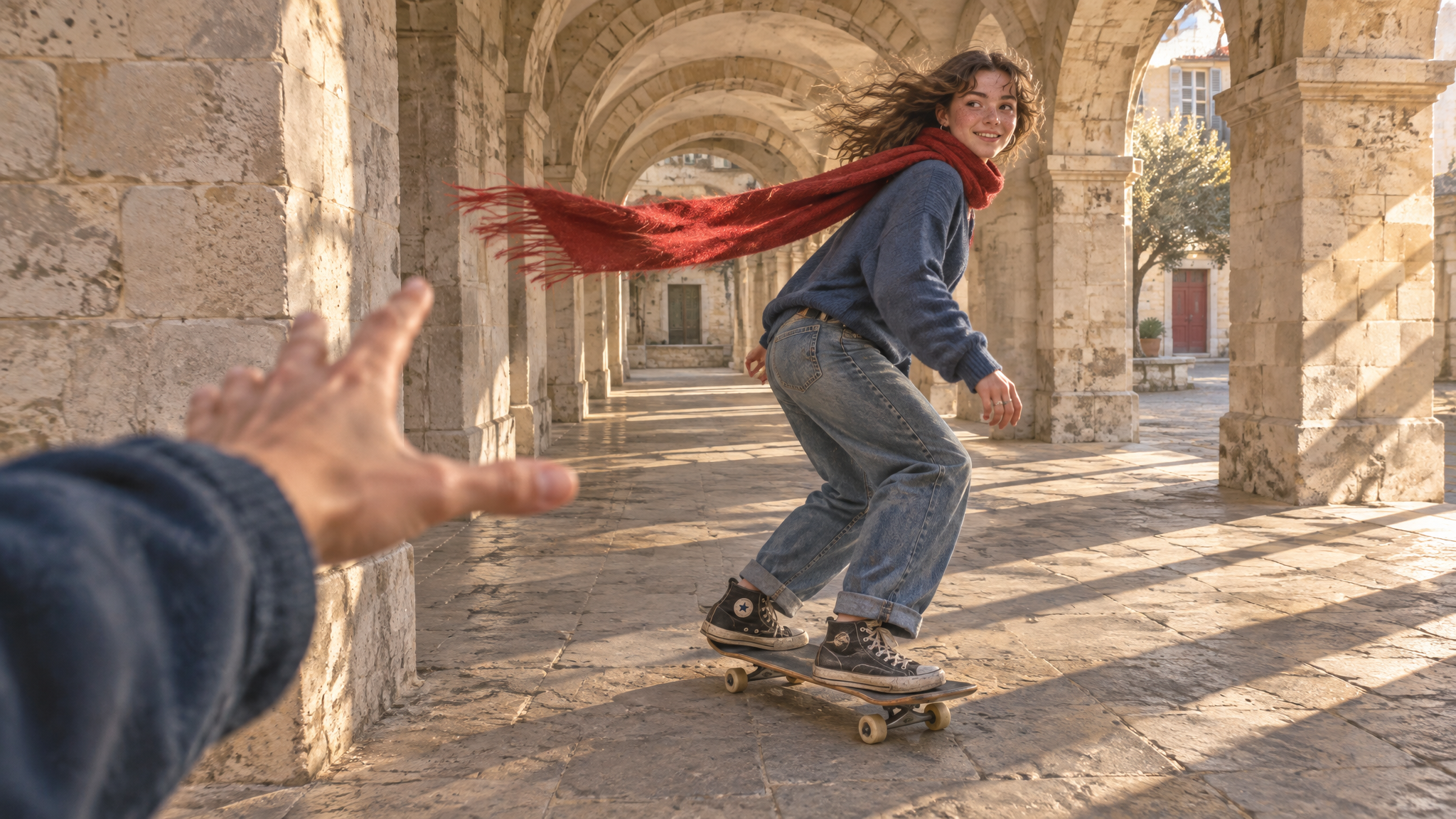
Create a documentary photograph of a young skateboarder catching a windblown red scarf while rolling through a pale limestone arcade. An outstretched hand occupies the near foreground, the skateboarder crosses the middle distance, and repeating arches recede toward a small sunlit courtyard. Warm afternoon light enters from the right, grazing the scarf's woven fibers and casting clean diagonal shadows across worn stone. Frame the action through the nearest arch, keeping the subject distinct from the background. Use restrained red accents against cream stone and muted blue clothing. Preserve natural skin texture, scuffed shoes, and slight motion blur at the scarf's tip. Environmental sports photography, 35mm lens, moderate depth of field, wide 16:9 aspect ratio, full-bleed.
Generated with Depth Anything V2 on Atlas Cloud
Generated with Seedream v5.0 Pro on Atlas Cloud
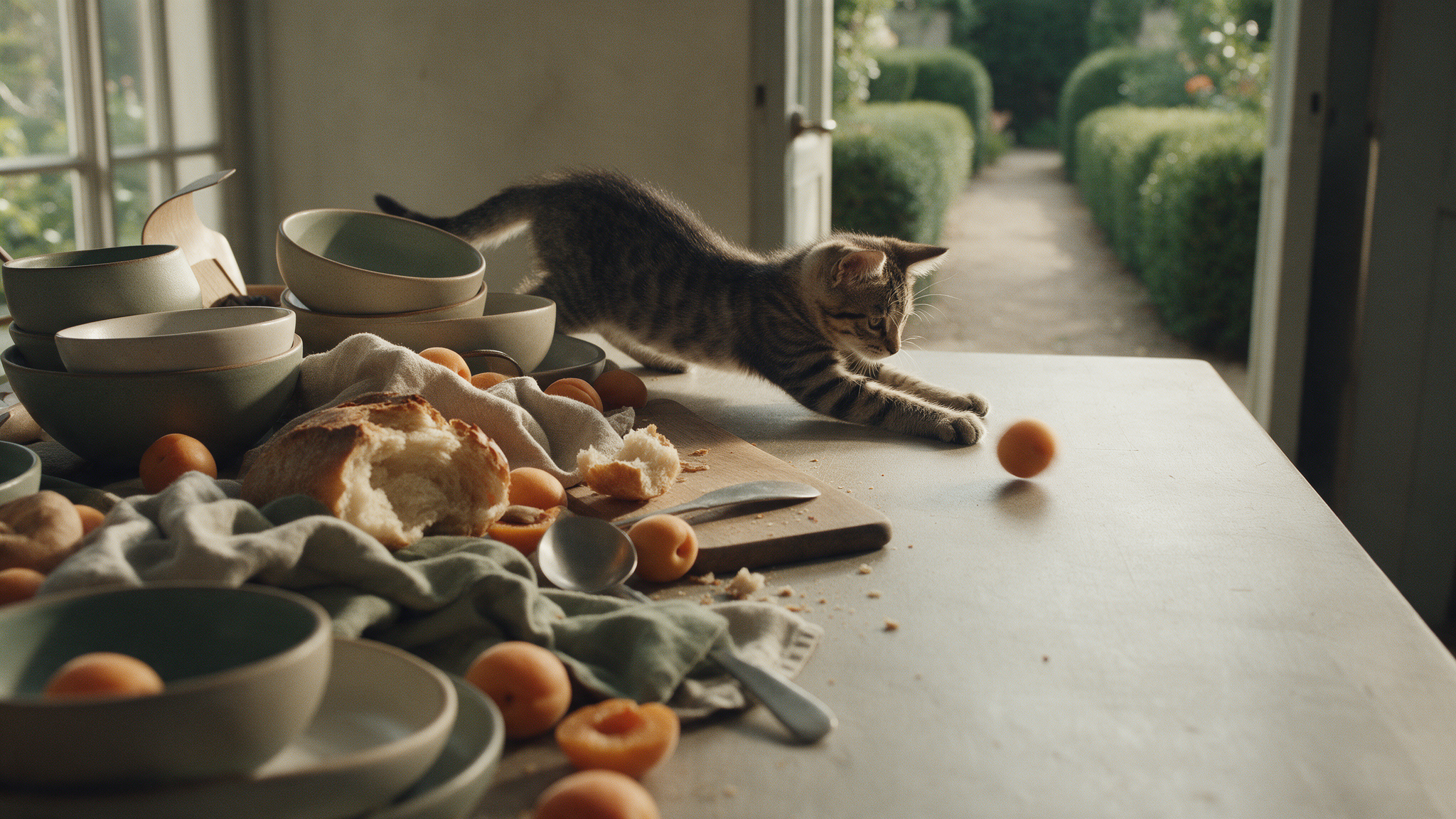
Photograph a striped kitten stretching across a sunlit breakfast table to investigate a rolling apricot. Arrange overlapping ceramic bowls, torn bread, folded linen, scattered apricots, a wooden cutting board, and a brushed steel spoon in a dense cluster on the left, balanced by open tabletop on the right. Beyond the table, an open doorway reveals a garden path receding between clipped hedges. Soft morning window light enters from the left, revealing bread crust, linen fibers, matte pottery, and fine whiskers. Shoot from just above table height, using the tabletop edge as a leading line through foreground, subject, and garden. Keep warm ochre and sage green restrained, with gentle film grain and readable background shapes. Editorial food photography, 50mm lens, wide 16:9 aspect ratio, full-bleed.
Generated with GPT Image 2.6 Sunburst on Atlas Cloud

Generated with Seedream v5.0 Pro on Atlas Cloud
Depth Anything V2: Put Relative Depth to Work
With Depth Anything V2 depth maps as inputs, compatible tools can guide ControlNet image generation, add selective background blur, and animate still photos with parallax.

Depth Anything V2 for ControlNet
A single reference image becomes a relative depth map for ControlNet depth conditioning. Feed the map into a compatible generation workflow to guide composition when creating illustrations, concept art, or design variations.

Selective Focus for Still Photos
For portrait and product photography, relative depth estimates provide a guide for selective background blur. Apply the grayscale output in an editing workflow to create depth of field effects from existing photos.

Depth Anything V2 Parallax Effects
Build parallax effects from a still image using its estimated relative depth. Combine the map with the original photo in animation tools to add spatial movement to portfolios, presentations, or social content.

3D Relief Previews
Turn a photo into a grayscale depth map that can drive surface displacement in compatible 3D software. Artists can use the result to prototype shallow reliefs and explore dimensional image treatments.

Layered Graphic Composites
When layered graphics need spatial ordering, estimated relative depth provides a guide for separating nearer and farther regions. Convert the map into masks in compositing software to place text behind foreground elements.

Atmospheric Fog Effects
Relative depth maps from still images provide a grayscale guide for controlling atmospheric overlays. Remap and invert the output in compositing software to blend fog more strongly across distant scenery in landscape artwork.
Depth Anything V2 and Image-to-3D Models Compared
Compare Depth Anything V2 with adjacent image-to-3D models to understand their different tasks, outputs, controls, and standard Atlas Cloud pricing.
| Model | Primary Task | Returned Asset | Output Details | Standard Price |
|---|---|---|---|---|
| Depth Anything V2 | Single-image relative depth estimation | Grayscale depth map | Matches input resolution; brighter pixels indicate closer surfaces | $0.002 per image |
| Hunyuan 3D Rapid Image-to-3D | Generate geometry from a single image | 3D mesh | Optional PBR materials and a separate geometry-only mesh | $0.02 per image |
| Hunyuan 3D Pro Image-to-3D | Create textured assets from an image | Textured or untextured 3D mesh | Configurable face count; PBR materials available for textured output | $0.02 per image |
| Seed3D 2.0 Image-to-3D | Image-based 3D asset generation | Textured, PBR-shaded 3D model | Selectable mesh subdivision; GLB, OBJ, USD or USDZ delivered in a ZIP archive | $0.353 per image |
How to Use Depth Anything V2 on Atlas Cloud
Get started in minutes — follow these simple steps to integrate and deploy models through Atlas Cloud's platform.
Create an Atlas Cloud Account
Sign up at atlascloud.ai and complete verification. New users receive free credits to explore the platform and test models.
Why Use Depth Anything V2 on Atlas Cloud
Combining the advanced Depth Anything V2 models with Atlas Cloud's GPU-accelerated platform provides unmatched performance, scalability, and developer experience.
Performance & flexibility
Low Latency:
GPU-optimized inference for real-time reasoning.
Unified API:
Run Depth Anything V2, GPT, Gemini, and DeepSeek with one integration.
Transparent Pricing:
Predictable per-token billing with serverless options.
Enterprise & Scale
Developer Experience:
SDKs, analytics, fine-tuning tools, and templates.
Reliability:
99.99% uptime, RBAC, and compliance-ready logging.
Security & Compliance:
SOC 2 Type II, HIPAA alignment, data sovereignty in US.
Depth Anything V2: Your Depth Map Questions Answered
Depth Anything V2 is a monocular depth estimation model that predicts relative depth from a single still image. On Atlas Cloud, it returns a grayscale depth map showing which surfaces are closer to or farther from the camera.
Depth maps can support depth of field, 3D effects, and parallax animation from a still image. In a parallax workflow, the estimated depth helps separate foreground and background movement.
Open the model's playground on Atlas Cloud and provide a still image to generate a depth map. For API integration, select the model ID depth-anything/depth-anything-v2/depth-estimation and follow the model page's current request schema.
Atlas Cloud's standard price for Depth Anything V2 is $0.002 per image. At that rate, processing 1,000 images costs $2.
A single still image is the input, and the output is a grayscale depth map at the same resolution. Brighter regions represent surfaces estimated to be closer to the camera, while darker regions represent those farther away.
Pass the resulting grayscale map to a compatible ControlNet depth workflow as its depth control input. Depth Anything V2 estimates the map, and the downstream generation model uses that map to guide scene structure.
Relative depth describes how near or far surfaces are compared with one another, so this endpoint does not provide calibrated distances in meters. The upstream project offers separately fine-tuned metric depth models, which should not be confused with the relative-depth endpoint on Atlas Cloud.
According to the official project, Depth Anything V2 improves fine-grained detail and robustness over V1. Compare outputs on your own images to judge whether those improvements help your particular workflow.
This Atlas Cloud endpoint processes a single still image, so a video file is outside its documented input. For workflows that need consistent depth across frames, the upstream Video Depth Anything project is a separate model designed for video.
Explore More Families
Seedance 2.5
The Seedance 2.5 API gives developers ByteDance Seed’s joint audio and video model, generating 4 to 30 seconds in one pass at up to native 4K from text, a first frame, or up to 50 references across images, video, and audio. It edits selected regions, extends clips, and follows white-model and green-screen inputs.

Seedance 2.5 Flash
The Seedance 2.5 Flash API gives developers the faster, lower-cost tier of ByteDance Seed’s Seedance 2.5, released on November 12, 2026. It generates video at nearly twice the speed of Seedance 2.5, renders up to 30 seconds per clip at 480p or 720p, and takes up to 10 images, 5 videos, and 5 audio clips per request, with video editing for quick variants.
Kling 4.0
The Kling 4 API delivers Kling 4.0, the video model Kuaishou released on October 15, 2026. It generates up to 30 seconds in a single pass, follows up to 10 keyframes, blends 15 images, videos, and subjects through Omni Reference, and adds stereo audio with lip sync. Atlas Cloud serves all four endpoints, including video editing, on one OpenAI-compatible key from $0.11 per second. Start building today.
Seedream 5.5
Seedream 5.5 is ByteDance Seed's image generation and editing family. Guide edits with up to 10 reference images, or split an image into a base image and up to 99 editable layers, with optional OCR for text layers. On Atlas Cloud, generation, editing, and layer decomposition each cost a standard $0.02 per image, helping developers plan image workflow budgets. Start building today.
Kling 4.0 Flash
As a lower-cost option in the Kling 4.0 family, Kling 4.0 Flash combines images, videos, and subjects to create consistent 720p clips lasting 3 to 20 seconds. Start from a text prompt or animate a first-frame image to suit different production workflows. Atlas Cloud offers all four model variants at a standard price of $0.094 per second. Start building today.
Wan 3.0
Wan 3.0 is Alibaba’s newest video model, producing up to 30 seconds of 1080p video at 30fps with audio in one generation. Steer it with a text prompt, a first frame, up to 10 reference images, or a document. Standard costs less per second, while Prime keeps the same capabilities and returns results faster. Both run on the same Atlas Cloud key as Wan 2.7, 2.6, and 2.5.
GPT Image 2.6
The GPT Image 2.6 API gives developers OpenAI’s image model released on November 4, 2026, in two versions: Flare for fast iteration and Sunburst for detailed visual work. It generates images 50% faster than before and adds animated GIF output, SVG export, markup edits that target the area you circle, and a complexity setting. Atlas Cloud serves both models on one OpenAI-compatible key with pay-as-you-go pricing.
Kling Image 4.0
Kling Image 4.0 is Kling AI's image generation model for detailed visual design. Reference images guide compositions, while long layouts bring product imagery and brand messaging into complete page visuals. High resolution output provides room for cropping and display. Atlas Cloud simplifies integration with a unified API and transparent pay-as-you-go pricing. Start building today.
MiniMax H3 Image
MiniMax H3-Image builds on MiniMax's H3 family, combining image generation and editing in one checkpoint. Detailed prompts guide characters, scenes, and composition, while reference inputs steer visual changes. Atlas Cloud offers hosted access with pay-as-you-go billing, helping you integrate image workflows without managing model infrastructure. Start building today.
MiniMax H3
MiniMax H3 is MiniMax's multimodal video family for text, image, and reference guided creation. Across supported routes, it preserves subjects from reference media, offers flexible aspect ratios, and pairs generated sound with visuals through H3 Developer, with output profiles selected by endpoint. Atlas Cloud unifies the family behind one OpenAI-compatible key with transparent pay-as-you-go pricing from the standard rate of $0.038 per second. Start building today.
GPT Image 2.5
GPT Image 2.5 is OpenAI’s image generation and editing model, released on September 8, 2026 in two API versions. Flare is the default, with up to 50% lower latency than GPT Image 2, while Sunburst takes longer to give finer control over detailed edits. Both support up to 16 reference images, five quality tiers, transparent backgrounds, and custom sizes up to 3840px. Atlas Cloud serves the GPT Image 2.5 API at OpenAI’s per token rates, or at a flat price per image by 1K, 2K, or 4K tier.
Seedream 5.0 Pro
Seedream 5.0 Pro API gives developers ByteDance's controllable image editing model on Atlas Cloud. It places edits precisely with anchors and coordinates, separates images into editable layers, fuses multiple references, and matches exact colors and materials, with multilingual text at 2K and 3K. On Atlas Cloud you reach it through one key!
Recommended Articles
Guides, tutorials, and product updates to help you get the most out of Atlas Cloud.





