
Production agentic pipelines frequently crash due to unexpected schema violations. Even top-tier autoregressive LLMs fail JSON parsing during high-volume tool calls, forcing developers to build complex retry loops and custom error handlers.
TypeSafe Jev solves this structural flaw by abandoning sequential, token-by-token generation entirely. Operating as a non-autoregressive decision model, Jev ingests application state and evaluates pre-declared schema questions in a single parallel forward pass. Because possible output choices are strictly bounded before execution, Jev mathematically eliminates malformed JSON, invalid tool names, and off-schema text.
Quick Takeaways: What is TypeSafe Jev AI? Performance & Speed Benchmarks
TypeSafe Jev AI is a non-autoregressive decision model built specifically for sub-second classification, intent scoring, and structured microservice routing. Unlike autoregressive LLMs, Jev evaluates pre-declared schema choices in a single forward pass.
- Zero Hallucination at Type Level: Replaces string decoding loops with bounded state schema primitives, yielding a 0% type error rate.
- Sub-500ms Execution: Non-autoregressive parallel sampling achieves 70ms–500ms P95 latency up to 200x faster than standard LLMs.
- Free Output Tokens: Zero generated sequential tokens means output tokens are completely free $0.042/1M input tokens.
- Best For: Microservice routing, agentic tool dispatching, ticket triage, and intent gating.
Rethinking the AI Stack: System 1 Intuition vs. System 2 Reasoning
When engineering scalable backend software, forcing simple conditional checks through a heavy chat completion endpoint creates severe system latency. Most microservices do not require creative prose or multi-step chain-of-thought generation; they require immediate, deterministic selection over known choices.
Applying the Kahneman Cognitive Framework to Software Architecture
TypeSafe co-founder Diogo Almeida, who previously co-created Reinforcement Learning from Human Feedback at OpenAI, introduced a structural pivot with TypeSafe Jev to resolve this inefficiency. Drawing directly from the Kahneman cognitive framework, the platform divides processing into two distinct operational layers within modern AI stack architecture:
- System 2 Slow, Deliberate Reasoning: Standard autoregressive LLMs operating via sequential, token-by-token generation. These models excel at drafting long documents, handling ambiguous reasoning, and writing complex code.
- System 1 Fast, Intuitive Decisions: A dedicated System One AI model trained via Reinforcement Learning for Calibrated Decisions rather than traditional RLHF. It is engineered specifically for sub-second classification, intent scoring, and execution routing without conversational overhead.
Jev vs LLM Cost & Architecture: Decision Models vs. Chat Models
Replacing general-purpose chat models with specialized typed decision models fundamentally optimizes microservice workflows by isolating quick evaluation from deep generation.
| Architectural Dimension | Autoregressive LLMs (System 2) | TypeSafe Jev (System 1) |
| Primary Task | Open-ended text synthesis | Discrete choice and schema evaluation |
| Execution Latency | 3,000ms to 30,000ms+ | 70ms to 500ms |
| Output Format | Unstructured text stream | Strictly typed schema primitives |
| Compute Loop | Sequential token decoding | Single forward-pass evaluation |
| Training Objective | Human preference (RLHF) | Calibrated decision confidence (RLCD) |
Offloading routing, safety guardrails, and function dispatching away from standard chat models resolves the performance bottlenecks inherent to autoregressive LLMs. Incorporating a System One AI model ensures heavy reasoning engines trigger only when open-ended generation is genuinely required.
How TypeSafe Jev Model Delivers Type-Level Zero Hallucination
Even with strict JSON mode enabled, frontier LLMs regularly return off-schema keys or hallucinated enum values during high-concurrency production runs, causing 0.5% to 5% of pipeline requests to fail. Production microservices require absolute type determinism, yet autoregressive models remain inherently vulnerable to string generation errors.
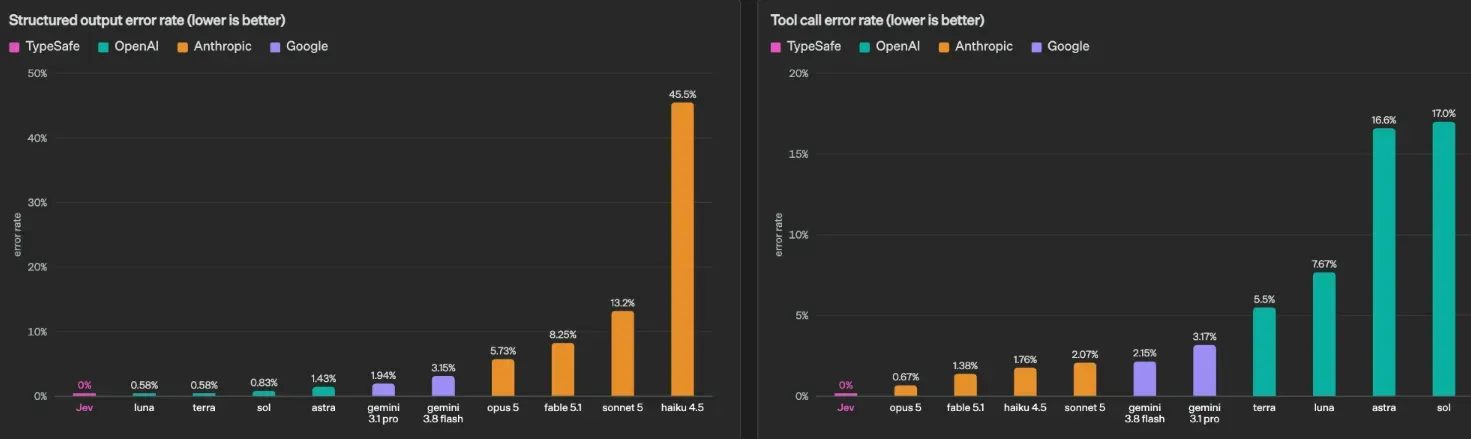
TypeSafe Jev solves this by replacing string decoding loops with a bounded state architecture. Instead of generating arbitrary text and attempting to force it into JSON syntax, Jev evaluates input data against predefined schema constraints in a single pass. This structural shift delivers true zero hallucination AI at the type level, resulting in 0% type errors across automated workflows.
The Three Core Schema Primitives
Jev processes all input questions through three explicit primitives:
- Choice Primitive: Selects exactly one option from a predefined list of up to 255 categorical choices, returning the winning label alongside full probability distributions.
- Score Primitive: Evaluates input against an ordered numeric scale or descriptive rubric, providing ratings alongside probability spreads across each level.
- Noul Primitive: Calculates the exact probability of a yes or no condition as a float between 0.0 and 1.0, eliminating intermediate text rationale.
Because every query maps strictly to these three primitives, the execution engine cannot emit invalid keys, off-list tool names, or malformed payloads.
Type Safety in Structured Output Evaluation
Traditional chat models generate syntax character by character, creating constant parsing risks in backend pipelines.
| Evaluation Metric | Autoregressive JSON Mode | TypeSafe Jev System One |
| Output Type Enforcement | Post-generation string validation | Native math-bounded primitives |
| Type Error Frequency | Variable (0.5% to 5%+ failure rate) | 0% type errors (schema bounded) |
| Invalid Enum Risk | High without custom retry loops | Zero (impossible by design) |
Constraining model execution strictly to a bounded state guarantees reliable structured output evaluation. Applications consume Jev outputs directly without writing exception handlers for broken JSON schemas.
Note on Type Determinism vs. Probability: TypeSafe Jev guarantees 0% type errors and schema matching by design, mathematically eliminating malformed syntax, missing keys, and off-list enum values. However, like all decision models, its output choices remain probabilistic. On inherently ambiguous inputs, confidence scores should be used to gate execution rather than assuming absolute semantic certainty.
How Non-Autoregressive Parallel Sampling Drives Sub-500ms Latency and Free Outputs
Using standard chat endpoints for simple classification tags like {"category": "billing"} introduces unnecessary latency into production microservices. Because autoregressive models rely on sequential token decoding, backend threads remain blocked while waiting for single-character generation loops.
The Mechanics of Single-Pass Evaluation
Traditional transformers execute autoregressive generation loops where every new token requires a separate pass through the network stack. This sequential dependency creates high latency and inflates infrastructure costs based on generated token volume.
TypeSafe Jev eliminates sequential generation by utilizing non-autoregressive parallel sampling. As outlined in the TypeSafe launch release, Jev ingests the context state and evaluates all pre-declared schema choices simultaneously within a single forward pass.
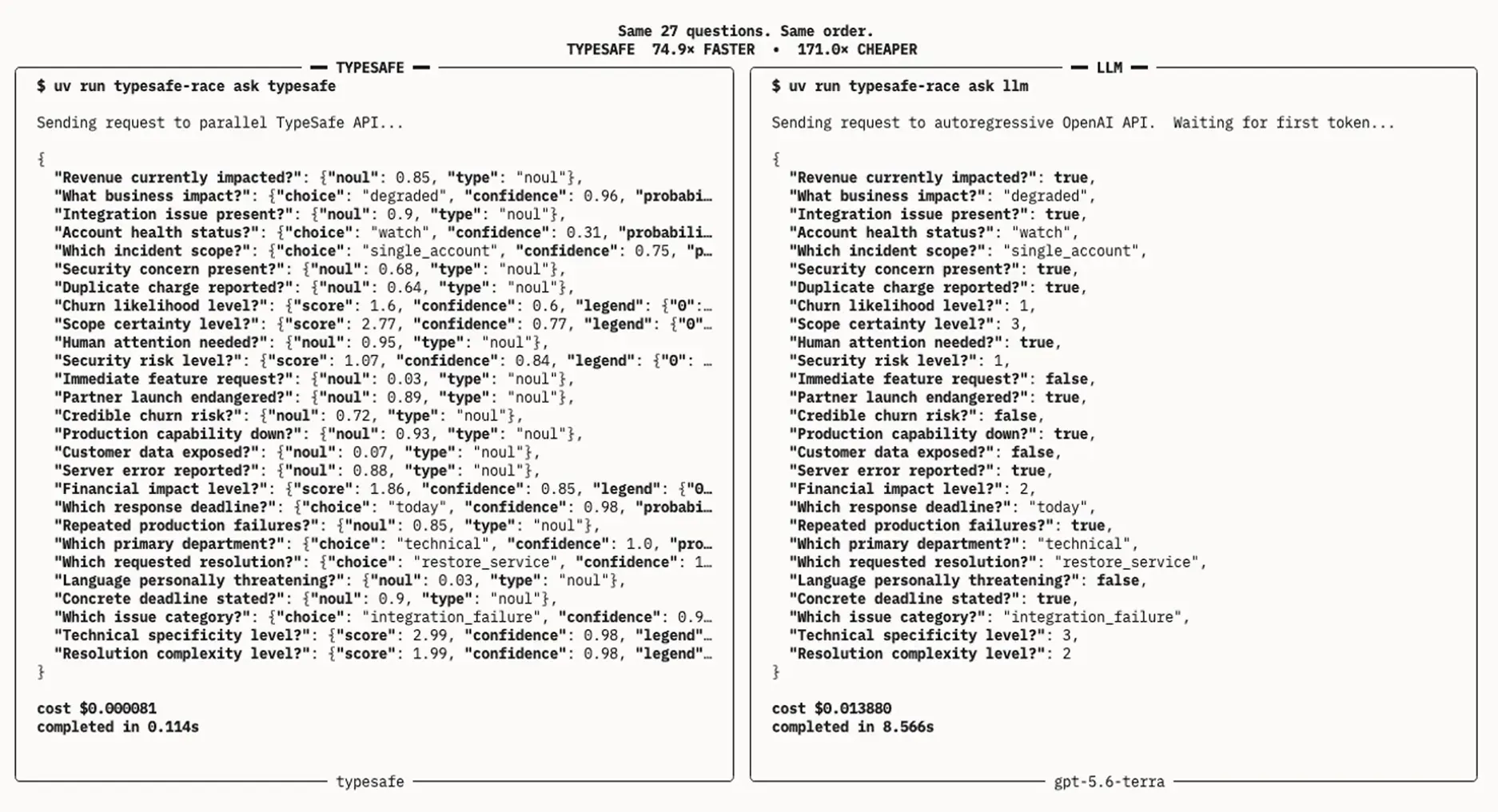
Terminal benchmark comparison running 27 simultaneous schema evaluation questions on TypeSafe Jev vs. GPT 5.6 Terra endpoint
Because the model calculates probability distributions over predefined outputs rather than generating free text, output decoding loops disappear entirely. This structural shift yields three primary performance gains:
- Free Output Tokens (Too Cheap to Meter): Because Jev evaluates choices in a single forward pass without generating sequential tokens, output evaluation incurs virtually zero incremental compute, making output tokens effectively free.
- Predictable Pricing: Context processing costs a flat $0.042 per million input tokens. Evaluating static prompt schemas with Jev prevents exponential API bill inflation compared to traditional long-context execution overhead associated with heavy chat endpoints.
- Sub-Second Execution: Published TypeSafe Jev latency benchmarks demonstrate P95 response times consistently between 70ms to 500ms, running up to 200 times faster than frontier chat models.
Architectural Performance Breakdown
| Metric / Dimension | Traditional Autoregressive LLMs (System 2) | TypeSafe Jev System One Engine |
| Execution Loop | Token-by-token sequential decoding | Single parallel pass over pre-declared schema |
| Output Type | Unstructured text strings / JSON strings | Typed decision primitives (Choice, Score, Noul) |
| Schema Error Rate | 0.58% to 45%+ depending on model/prompt | 0% type error rate (mathematically bounded) |
| P95 Latency Profile | 3,000ms to 30,000ms+ | 70ms to 500ms |
| Output Economics | Variable per token ($15 to $60 / MTok) | FREE (too cheap to meter) No sequential output token generation |
| Primary Domain | Reasoning, draft writing, open synthesis | Classification, tool selection, confidence gating |
Bypassing the Memory Bandwidth Bottleneck
In standard LLM inference, memory bandwidth saturates as model weights reload into memory logic for every single token. By completing decision evaluations in a single forward pass, Jev circumvents this memory bottleneck entirely, sustaining stable response speeds even under heavy concurrent traffic.
Reinforcement Learning for Calibrated Decisions and Confidence Gates
Standard chat models regularly output incorrect statements with 99% self-reported confidence because conventional fine-tuning rewards persuasive phrasing rather than statistical truth. In production microservices, an overconfident wrong decision leads directly to corrupted database records, broken tool arguments, and unexpected system downtime.
Aligning Model Confidence with Empirical Accuracy
To resolve this structural overconfidence, TypeSafe introduced Reinforcement Learning for Calibrated Decisions. Unlike traditional RLHF methodology that optimizes for subjective human preference, RLCD trains decision models specifically to produce calibrated probabilities.
Through accuracy-aligned confidence, a 0.90 probability output from Jev means the candidate choice is empirically correct 90% of the time across test sets. This mathematical calibration enables dependable probabilistic decision making without requiring developers to write complex prompt heuristics to estimate output certainty.
Implementing Confidence-Gated Routing in Production
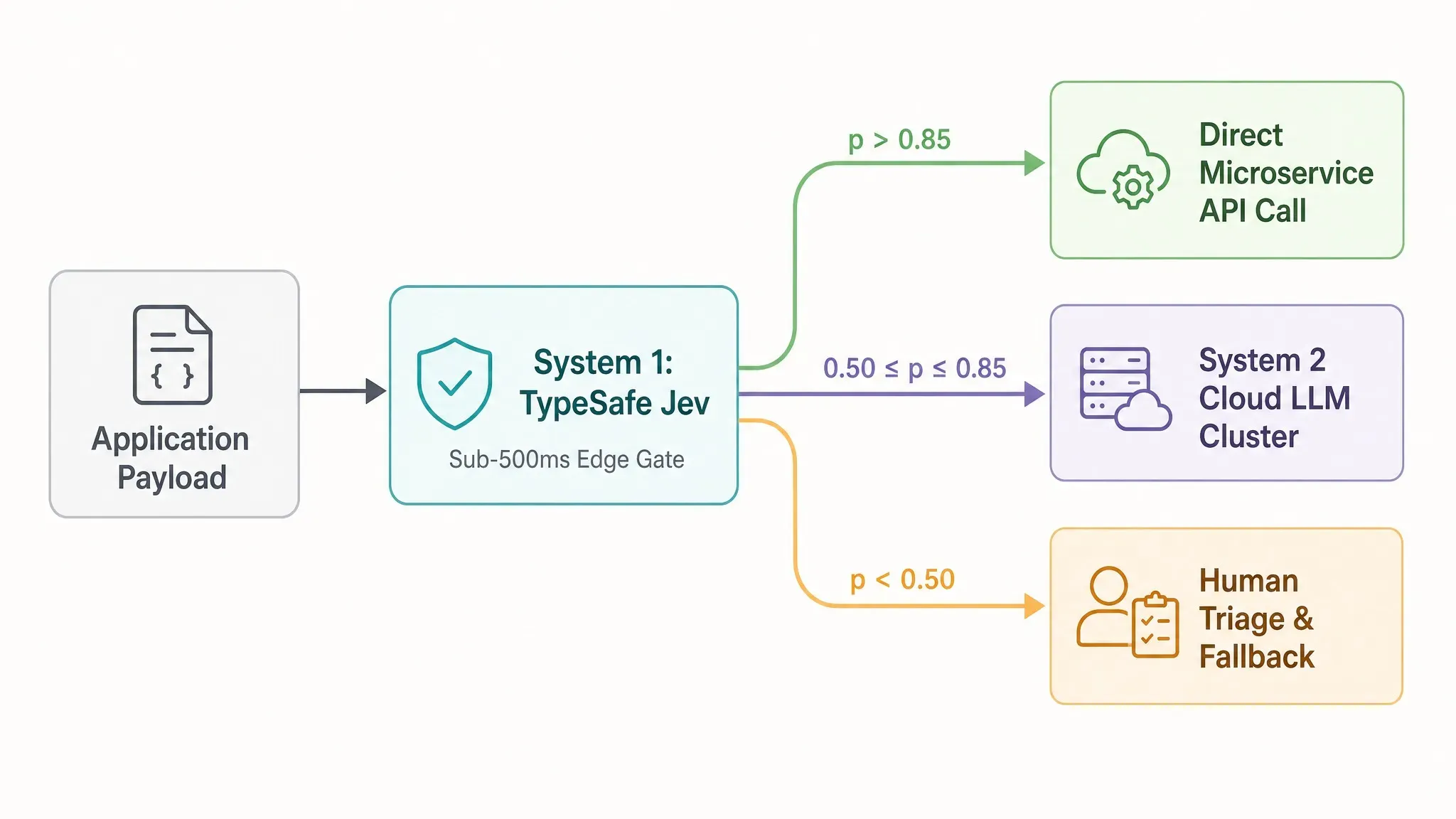
Engineers can leverage these calibrated probability distributions to configure threshold-based decision gates, e.g., in a typical production setup:
p > 0.85(Fast-Path Execution): Execute immediately in the high-speed path, bypassing slow LLM endpoints entirely.0.50 ≤ p ≤ 0.85(System 2 Escalation): Pass borderline outputs to a reasoning LLM to handle ambiguous edge cases.p < 0.50(Fallback Triage): Trigger safety defaults or push the request to a human review queue.
For borderline edge cases 0.50≤ p ≤ 0.85, confidence-gated routing redirects the payload to an enterprise reasoning tier. Utilizing GPT 5.6 Terra on Atlas Cloud offers an optimal fallback target for these escalated requests, leveraging its 1,050K context window and cost-efficient $2/$12 token pricing to execute deep analysis without inflating microservice infrastructure costs.
Raw logprobs from autoregressive LLMs are notoriously uncalibrated and shift whenever system prompts change. By integrating RLCD directly into the core training process, Jev makes confidence-gated routing production-ready, allowing software teams to safely automate high-volume pipelines while isolating edge cases.
Production Design Patterns: High-Speed AI Pipelines in Practice
Production AI agents frequently crash when an LLM invents a non-existent function signature like get_user_billing_v2() or passes invalid parameter types to an internal API endpoint. Chaining multiple conditional checks through standard chat completion endpoints compounds total system latency, causing customer-facing microservices to time out.
Core Architectural Patterns for High-Volume Microservices
Integrating sub-second decision engines into production AI pipelines allows software teams to replace unpredictable prompt loops with deterministic backend design patterns:
- Agentic Tool Selection: When picking tools inside automated agent workflows, Jev evaluates available function signatures against the current application state. Because candidate functions are passed as explicit choices in the request schema, Jev cannot return undefined function names, eliminating silent runtime failures during agentic tool selection. This fast pre-filtering guarantees valid schema payloads before passing instructions down to autonomous LLM coding agent pipelines.
- Parallel Multi-Question Evaluation: Standard chat endpoints force applications to evaluate conditional questions sequentially, multiplying total latency by the number of checks performed. Jev enables parallel multi-question evaluation by evaluating dozens of schema questions over a single state payload in one parallel forward pass. Running fifteen discrete classification checks takes the same 100ms window as running one.
- Ticket Triage Automation: For high-volume microservices processing inbound customer tickets, Jev parses customer sentiment, routes technical priority, and checks refund eligibility simultaneously. Implementing ticket triage automation with sub-second response times prevents queue backlogs during sudden traffic spikes.
Implementing System One Decision Nodes via SDK
Developers instantiate low-latency decision nodes by integrating the official typesafe-sdk into existing microservices. The execution payload submits the application state alongside pre-declared schema primitives directly to the https://api.typesafe.ai/v1/systemone endpoint.
plaintext1import { TypeSafe } from "typesafe-sdk"; 2 3const client = new TypeSafe({ apiKey: process.env.TYPESAFE_API_KEY }); 4 5const result = await client.systemone.evaluate({ 6 state: "Customer input: 'I was double-charged $49 on invoice #1092 and need a refund immediately.'", 7 questions: [ 8 { 9 id: "routing_category", 10 type: "choice", 11 options: ["billing_dispute", "account_access", "feature_request"] 12 }, 13 { 14 id: "is_urgent", 15 type: "noul" 16 } 17 ] 18});
Traditional tool-calling setups re-tokenize the entire prompt context for every single function evaluation. By decoupling state representation from decision questions, Jev executes multi-branch classification pipelines in backend systems without multiplying context token overhead, inflating API bills, or sacrificing P95 latency guarantees.
Known TypeSafe Jev Limitations and Architectural Trade-Offs (What Jev Cannot Do)
Deploying a non-autoregressive decision model expecting it to write a polite email response or sum up line items on an invoice inevitably breaks production code. Engineering teams that attempt to replace general-purpose LLMs entirely with System One models quickly run into physical architectural limits.
Structural Boundary Analysis
Understanding specific Jev failure modes is critical before wiring Jev into microservice workflows. Jev's single forward-pass design enforces strict boundaries across several core tasks:
- Open-ended text generation: Jev produces zero conversational text. It cannot write essays, summarize documents, or generate natural language explanations for its selections.
- Multi-hop reasoning limits: The architecture evaluates immediate state representations. Complex, sequential logic chains or multi-step reasoning limits require delegating tasks back to traditional autoregressive LLMs.
- Arithmetic limitations: Jev cannot perform math calculations or reliably count items inside a context string. Arithmetic limitations require keeping financial calculations and array operations inside standard backend code.
- Literal criteria interpretation: The model follows prompt rules literally without inferring unstated business logic. Ambiguous schema options lead to unexpected probability spreads.
- Context rot under heavy payloads: Passing massive, unstructured logs creates context rot, degrading evaluation accuracy. Filtering noise out of input state payloads before sending requests remains essential.
Architectural Mapping: System One vs System Two Capabilities
| Operational Task | TypeSafe Jev System One | Autoregressive LLM System Two |
| Categorical Classification | Native (Sub-500ms) | Slow (Sequential text) |
| Text Synthesis & Drafting | Impossible (No decoding loop) | Native (Open-ended text generation) |
| Mathematical Calculation | Unsupported (Arithmetic limitations) | Variable (Requires code execution) |
| Noise Resistance | Prone to context rot in large states | Higher context window resilience |
Treating Jev as a sub-second decision node rather than a universal reasoning engine ensures proper system design across production microservices.
Future Cloud Infrastructure: Orchestrating Fast Decision Nodes
Routing every incoming user request directly to a 70-billion parameter reasoning model burns thousands of dollars in wasted GPU cycles while forcing users to wait several seconds for basic security checks and payload routing. Modern microservice stacks cannot afford to treat every incoming HTTP payload as an open-ended reasoning problem.
The Shift Toward Hybrid AI Architecture
Cloud environments are shifting away from monolithic LLM endpoints toward a decoupled hybrid AI architecture. In this emerging paradigm, cloud orchestrators place fast decision nodes at the network edge to evaluate incoming payloads instantly.
By handling edge AI routing, schema verification, and confidence scoring within sub-500ms execution windows, fast decision nodes filter traffic before hitting heavier model clusters. This topology optimizes resource allocation across three distinct cloud operational layers:
- Edge Guardrails and Routing: Fast decision nodes evaluate user intent, sanitize inputs, and verify schema compliance in a single forward pass.
- State Handover and Orchestration: Cloud orchestrators analyze confidence scores, executing high-certainty requests immediately and forwarding complex reasoning tasks.
- Centralized System 2 Reasoning: Heavy LLM clusters receive pre-filtered, structured payloads only when multi-turn synthesis or open-ended generation is strictly necessary.
Deploying System One Models at Scale
As cloud platforms expand their hosting capabilities, incorporating a TypeSafe Jev deployment into AI infrastructure provides an efficient pattern for edge microservices. Running non-autoregressive decision models close to end users dramatically reduces round-trip times and cuts compute costs for high-throughput applications.
Building pipelines with dedicated decision layers ensures backend networks remain responsive under heavy load while keeping frontier reasoning models focused exclusively on tasks that require deep computation.





