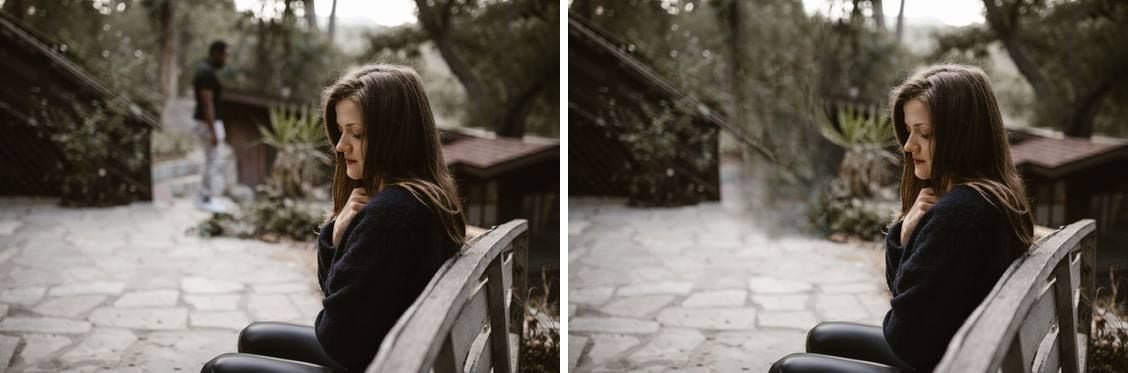
You got the shot. Good light, everyone looking at the camera, nobody blinking. Then you spot the man in the red jacket four feet behind your daughter, checking his phone, dead centre in the frame.
Working out how to remove a person from a photo is where people hit a wall that erasing a bin or a power line never gave them. A bin is one shape against one background. A person is four problems stacked together.
Hair breaks into hundreds of strands that no loop follows cleanly. There is a shadow on the ground, and often a reflection in water or glass. In a group shot, the person you want gone is usually touching the person you want to keep.
This guide walks those four in the order they get harder, with the same free browser eraser used for every test. The last two sections cover the case where erasing is the wrong tool, and the question of whether a real person should be erased at all.
Key Takeaways
- Select the person's shadow and any reflection in the same pass . A missing shadow reads as fake faster than a missing person does.
- Zoom until the person fills about half the visible frame before you draw the selection. The edge you draw decides the result.
- When the person overlaps someone you are keeping, run two passes: the body first, the leftover fragment second.
- If the person covers a straight line, such as a railing, a doorframe or a tiled wall, cropping beats erasing.
- Atlas Cloud's free AI image eraser works in the browser with no account, and the photo stays on your device.
How to Remove a Person From a Photo in Your Browser
Atlas Cloud runs an object eraser that does the whole job inside the browser tab. The page states it plainly: "Images processed locally in browser. Assets aren't uploaded to OSS or processed by AtlasCloud backend." For a photo with a real person in it, that matters more than it does for a photo of a parked car.
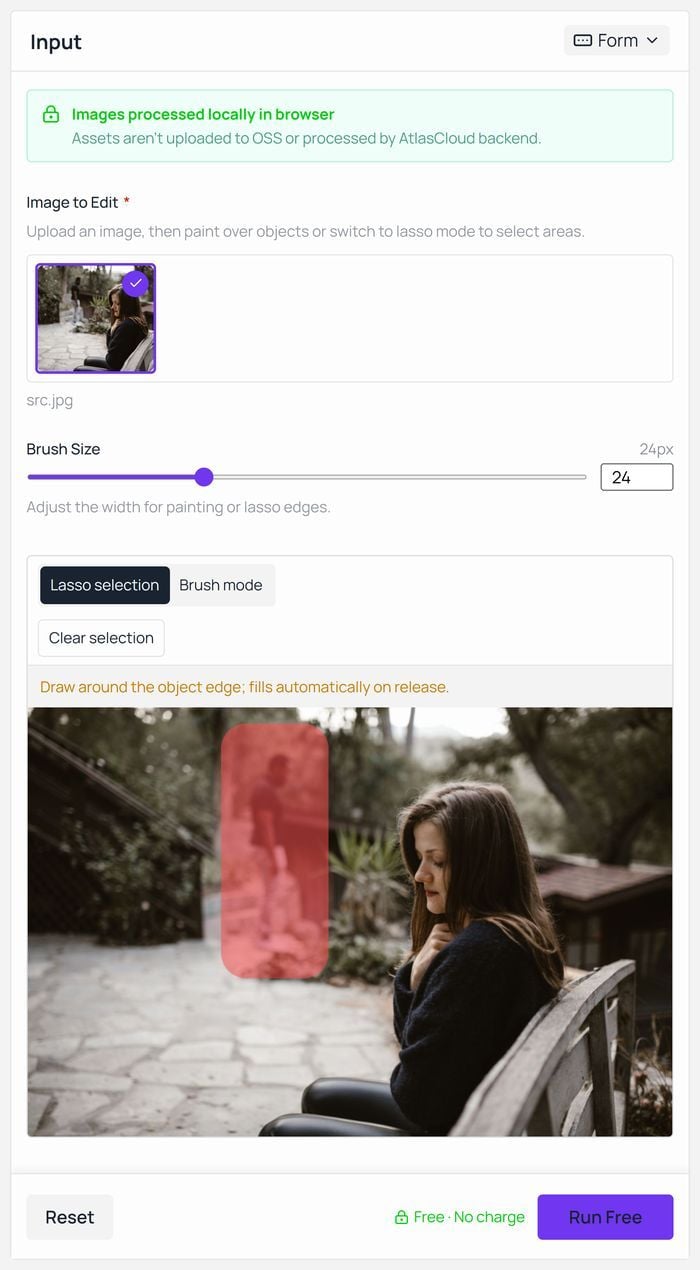
Alt: The free AI image eraser in a phone-width browser window with a courtyard photo loaded, a red lasso loop drawn around the man standing in the background, the Brush Size slider at 24 px, the Lasso selection and Brush mode buttons, and the Run Free button below the canvas
Five steps, start to finish:
- Open the browser eraser and drag the photo onto the upload area.
- Pinch or scroll until the person fills roughly half the canvas. Everything below depends on this.
- Lasso selection is already on. Draw around the person's outline and let go. The hint on the canvas says it well: "Draw around the object edge; fills automatically on release."
- Click Run Free and wait. The first run loads the model once, so stay on Wi-Fi for that one.
- Check the result at full size, then Download.
The page needs no sign-in. Its FAQ answers that directly with "No account is needed at any point", and it lists "no credits, no daily limits" for how much you erase. It sits in the same set of free AI tools that open without an email gate.
The erase runs in browsers with WebGPU support, which on an iPhone means Safari on iOS 26 or later. Phone users who also want the built-in Photos route should read the guide to removing objects on iPhone, which covers which models get Apple's Clean Up and which do not.
Lasso or Brush: Selecting a Person Without Clipping Them
Both selection modes sit on the same canvas, and most person removals use both.
| Lasso selection | Brush mode | |
|---|---|---|
| How it works | Draw a loop around the outline, it fills when you release | Paint over the area you want gone |
| Use it for | The whole body in one go, including the gap under a raised arm | Hair, a leftover sliver, the tail of a shadow |
| What the size slider does | Sets the width of the loop's edge | Sets stroke width, 6 px to 64 px, default 24 |
| Where it goes wrong | Hugging the outline too tightly | Missing a thin strand you cannot see at that zoom |
Clear selection wipes the mask without touching the photo, so there is no cost to redrawing a loop you are unhappy with.
Hair Edges: What AI People Removers Leave Behind
Hair is where the selection gets decided. Every other part of a person has an edge you can point at. Hair does not, so the outline your eye draws sits somewhere inside the actual strands.
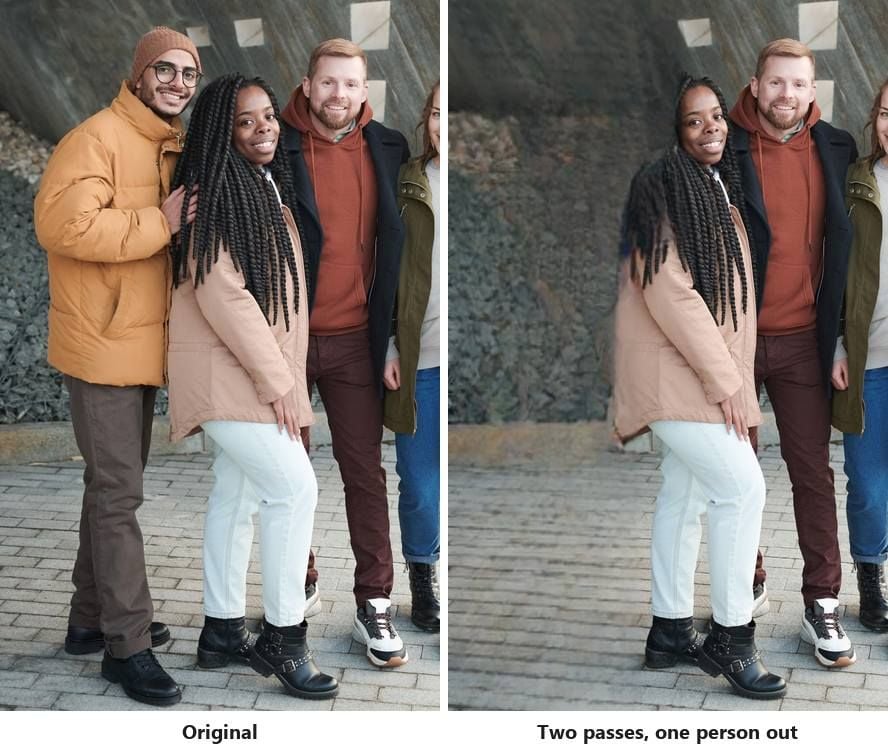
What comes back then is not a smudge. It is hair. The middle frame below is the same photo and the same tool as the right frame, with the loop drawn just inside her silhouette instead of outside it, and a lock of it is still hanging in the hedge with the person it belonged to gone.
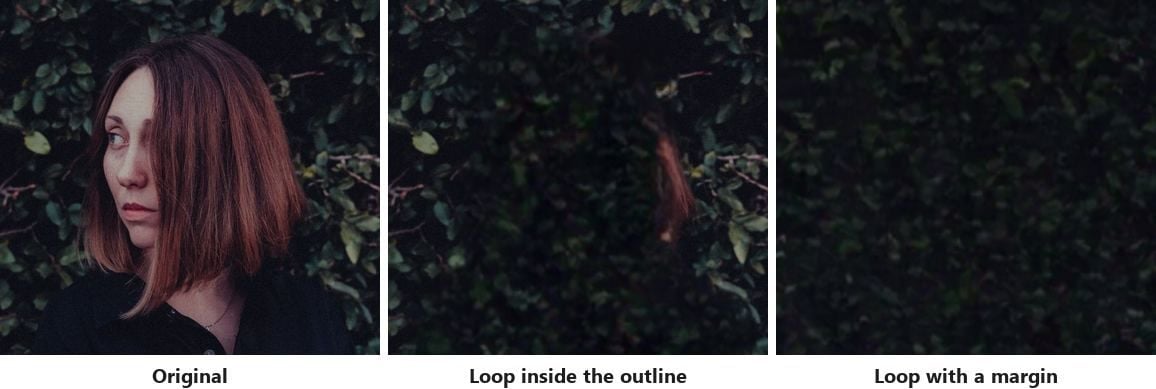
So the fix costs nothing: draw the loop a visible distance outside the strands, into clean background. The fill is built from what surrounds the selection, and a selection that ends in leaves gets rebuilt from leaves.
Widening the loop does cost some detail. The right frame is a flatter patch of hedge than the untouched wall of leaves above it, because a bigger gap gives the fill less to go on. On texture that trade is worth taking. On a background with structure in it, it is the signal to read the crop section below before you start.
The Shadow on the Ground Gives It Away
Look at the picture before you touch anything and find the sun. Somewhere opposite it there is a dark shape on the ground, attached to a pair of feet. Erase the person and leave that shape and you get a photo nobody can explain.
When the shadow runs straight off the feet into open ground, take it inside the same loop. The selection gets long and awkward, and that is fine. When the shadow breaks across a kerb or disappears behind a railing, split it: one pass for the body, a second for the shadow section, so neither selection has to swallow the structure in between.
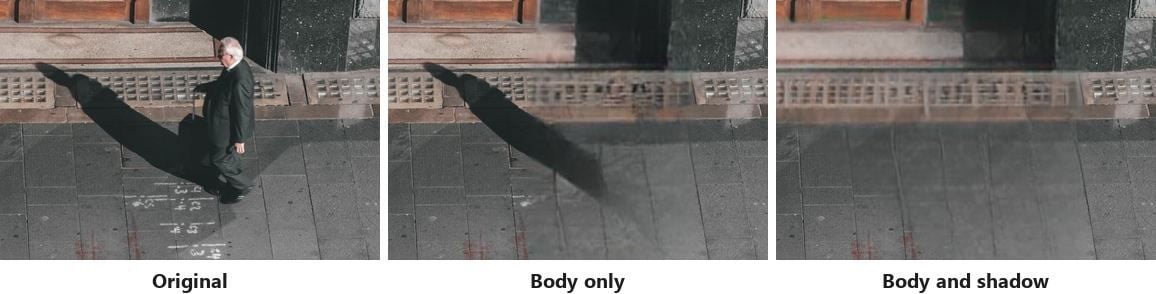
Water, wet sand, polished floors and shop windows all do the same thing one step further. A reflection is a second copy of the person, usually softer and lower in contrast, and it survives a body-only pass completely intact. Treat it as its own object and give it its own pass.
How to Remove One Person From a Group Photo
A group photo changes the maths. Every extra person is another edge the fill has to respect, and the one you are removing is rarely standing in clear space.
Guides on how to remove people from photos tend to assume the easy version, which is someone standing at the end of the row. Loop them with a margin into the background beside them, take their shadow along, and the tool rebuilds a wall or a lawn. Someone in the middle is a different job, because the background behind them is not in the file at all. Nothing in the photo records what their body was covering, so whatever appears there is invented.
This is a well-worn problem rather than a new one. In one r/photoshop thread, a working designer described being asked to take one person out of a ten-person law firm portrait where she overlapped a sofa seat and a colleague's legs.
There was no spare frame of the room to borrow from, which is the constraint the file imposes on every tool. Whatever goes into that gap has to be invented, because nothing in the photo recorded it.
When the Person You Remove Is Touching Someone You Keep
Overlap is the case where one pass will not do it. Order matters more than brush size here.
| Pass | What to select | What to check afterwards |
|---|---|---|
| 1 | The body, stopping just short of the neighbour's outline | Whether the neighbour's arm, sleeve or shoulder line stayed intact |
| 2 | The fragment left sitting on or beside the neighbour, in Brush mode at 6 px to 12 px | Whether the neighbour's edge now reads as a single continuous line |
Take the neighbour's edge as a boundary you never cross. A loop that clips into a kept face or hand asks the tool to redraw that face, and redrawn faces are obvious. When two people are genuinely interlocked, arm through arm, the next section applies.
When to Crop Instead of Erase
Some removals are not close calls. They are the wrong tool.
The research behind this class of model says so in its abstract. The authors of the WACV 2022 paper on large-mask inpainting note that inpainting systems "often struggle with large missing areas, complex geometric structures, and high-resolution images". Straight lines are the giveaway in practice.
A railing, a doorframe, a row of tiles, a course of brick or a line of windows all have to meet up on both sides of the gap. A fill that is off by a few pixels reads as wrong even to someone who is not looking for it. In the middle frame below, the dark band running across the tiles steps out of line exactly where the man was standing.
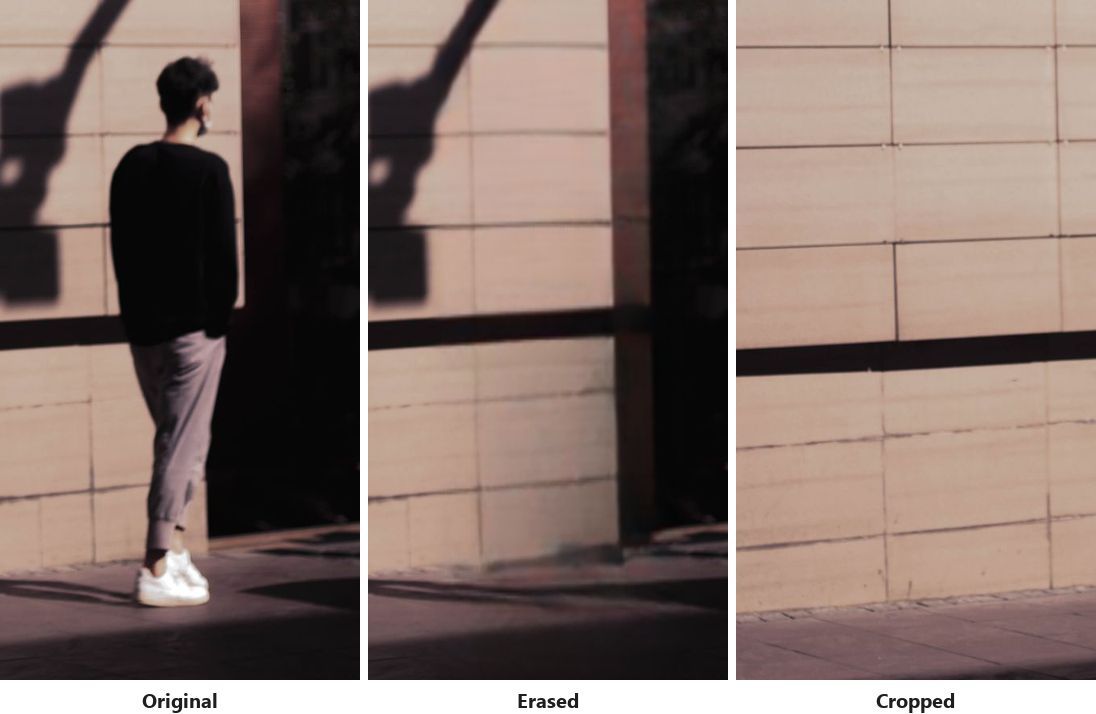
A short checklist decides it. If the person covers more than about a third of the frame, if they cover a line that has to reconnect, or if they are interlocked with someone you are keeping, reach for the crop tool. Cropping loses pixels and keeps the photo true to the room. Erasing keeps pixels and invents the room.
One more case gets mistaken for this one. If what you actually want is everything behind the subject gone rather than one person, that job belongs to a background remover, which cuts along the subject instead of rebuilding what sat behind them.
Should You Remove Someone From a Photo You Publish?
Erasing a stranger from the back of a holiday snap is nobody's business but yours. Erasing a named person from a photo other people will see is a different act, and it is worth thirty seconds of thought before the download.
Photojournalism settled its version of this a long time ago. NPPA's code of ethics tells visual journalists not to "manipulate images or add or alter sound in any way that can mislead viewers or misrepresent subjects". Most photos are not journalism. The test underneath it still travels: does the edited picture tell the viewer something that did not happen.
| Scenario | What to weigh |
|---|---|
| A stranger in the background of a family photo | Nothing to weigh. Nobody is being represented |
| An ex-partner in a picture you keep for yourself | Your photo, your call, and the original file is still there if you keep a copy |
| A former guest in a shared album | Other people in that album were there and remember who else was |
| A colleague in a team photo on a company page | Ask the team. A missing person in a staff photo gets read as a statement |
| A news, documentary or evidentiary image | The code above applies whether or not you work in news |
| A photo going to a contest or a client | Check their rules first. Plenty of them draw the line at removing content |
The local-processing point earns its place here. When the edit runs in the browser tab rather than on a server, the photo of a real person stays a photo you hold rather than one you handed over to have changed.
Frequently Asked Questions
Can AI remove a person from a photo for free?
Yes, and without login on the browser eraser above. The page states no account is needed at any point, and lists no credits and no daily limits on how much you erase, so a group photo that takes four passes costs the same as one that takes a single pass. Free tiers elsewhere often meter the number of erases, which is what turns a fiddly overlap into a decision about whether to spend another credit.
Why does the spot look blurry after I remove someone?
Two different things get called blurry and they need opposite fixes. A wide, paint-like smear across the whole gap means the selection was bigger than the fill could reason about in one go, so break it into two or three smaller passes. Something still recognisable sitting in the gap, a lock of hair or the edge of a sleeve, means the loop cut inside the outline and left part of the person behind, which the hair section above shows.
Can I remove a person from a photo without it looking edited?
Most of the time, if you take the shadow and any reflection with them and stay off the edges of people you are keeping. Give yourself one check before posting: open the original and the result side by side at full size, not at thumbnail size. A fill that looks clean on a phone preview often shows a soft seam once someone taps it open, and that is the view your photo will be judged in.
Does removing a person change the photo's resolution?
No. The browser eraser returns a PNG at the same width and height as the file you put in, so a 4,000 pixel wide original comes back 4,000 pixels wide. One thing to expect on the way out: the download is a PNG even when you uploaded a JPG, so the file on disk will be noticeably larger than the one you started with. Convert it back to JPG before emailing it if size matters.
What if the person is in the middle of a crowd?
Take them out in pieces. Loop the head and shoulders, run it, then come back for the torso and legs in a second and third pass. Each pass leaves more solved background around the next selection, which is exactly the reference the fill needs. If three passes still leave a smear, the crowd is dense enough that cropping or reframing will look better than any erase.
Conclusion
Four things decide whether an edit holds up, and only one of them is the person. Hair needs a margin. Shadows and reflections need their own pass. A neighbour's outline is a line you do not cross. A straight line running behind someone is a signal to crop rather than fill.
Work in that order and most photos take two passes and a couple of minutes in a browser tab. The ones that fight back are telling you something real: the file does not contain what was behind that person. Knowing how to remove a person from a photo is half the skill, and knowing which photos to leave alone is the other half.





