Seven days. That is how long developer Theo Browne says OpenAI's new flagship worked on his Rust rewrite of a TypeScript compiler without landing a single speedup, and the build it did produce ran 56% slower. The same model now holds the top score on Artificial Analysis' 3D benchmark and costs 20% less per token than the flagship it replaces.
GPT-6.2 arrived on November 17, 2026 as two models: Astra for the hardest jobs and Sol for routine work. This guide covers what each one is, where you can use it, which tasks suit which model, and the system card findings behind the backlash. Every number comes from OpenAI's own pages, the first independent tests, or our runs on Atlas Cloud.

Key Takeaways
- GPT-6.2 Astra and Sol launched November 17, 2026, inside ChatGPT Work and Codex, not regular Chat.
- Sol keeps the GPT-6.1 Sol API price, while Astra costs 20% less per token than GPT-6 Astra.
- Astra trails only Claude Fable 5.2 on the Artificial Analysis Intelligence Index and leads its 3D benchmark.
- Early power users call long coding runs slow and terse, and the system card flags hidden obstacles.
- Developers can call GPT-6.2 Sol with one API key from Atlas Cloud's ChatGPT models.
What Is GPT-6.2? The Two Models OpenAI Released on November 17
OpenAI shipped two models under one version number. GPT-6.2 Astra is the flagship, pitched at changing a complex codebase, building a working web app, or producing a document that follows a company template. GPT-6.2 Sol is the cheaper option for everyday coding, writing and multistep workflows.
On paper they share a body. Both read 1.05 million tokens of context, write up to 128,000 tokens per answer and accept text plus images, according to OpenAI's model documentation.
| Spec | GPT-6.2 Astra | GPT-6.2 Sol |
|---|---|---|
| API model ID | gpt-6.2-astra | gpt-6.2-sol |
| Context window | 1,050,000 tokens | 1,050,000 tokens |
| Max output | 128,000 tokens | 128,000 tokens |
| Knowledge cutoff | May 18, 2026 | June 1, 2026 |
| Input | Text, image | Text, image |
| Reasoning effort "none" | Rejected by the API | Rejected by the API |
| OpenAI APIs | Chat Completions, Responses, Batch | Chat Completions, Responses, Batch |
That window holds a mid-size repository in one request. Watch the 272,000-token line, though: past it, OpenAI bills the entire request at a higher rate (the FAQ has the numbers). Neither model supports fine-tuning, the Realtime API, or audio and video input.
Who Can Use GPT-6.2 in ChatGPT?
Here is the part that trips people up. GPT-6.2 lives in ChatGPT Work and Codex for Plus, Pro, Enterprise and Edu users. It does not show up in the regular chat window. An OpenAI staff member said so plainly in the developer community launch thread: "This rollout does not add either model to regular Chat."
| ChatGPT plan | Astra and Sol in Work and Codex | Ultrafast mode |
|---|---|---|
| Free, Go | Not included | Not included |
| Plus | Included | Not listed |
| Pro 200 | Included | Sol |
| Pro 500 | Included | Astra and Sol |
| Enterprise, Edu | Included | Admins can enable it on eligible workspaces |
OpenAI has not given a date for Free or Go accounts. Outside ChatGPT, both models are also live in GitHub Copilot for Pro+, Max, Business and Enterprise subscribers. If you are still sorting out which plan includes GPT-6 itself, our GPT-6 availability guide walks through each tier.
GPT-6.2 Astra vs Sol: Which One Fits Which Task
Astra costs four times as much as Sol per input and output token. So what does the premium buy?
Less than the price gap suggests, by OpenAI's own account. In its launch thread, OpenAI said Sol nearly matches Astra on merge-ready changes in FrontierCode 2.0 at about one-fifth of the cost. Artificial Analysis lands in a similar place on breadth: Astra scores 62 on its Intelligence Index, Sol scores 57, and Astra's runs cost about four times as much per task.
We wanted one result of our own, so we gave both models the same code review on Atlas Cloud: a 125-line Python order service with eight planted bugs, and one instruction to list every bug with its line number.
| Result | GPT-6.2 Astra | GPT-6.2 Sol |
|---|---|---|
| Planted bugs caught (of 8) | 8 | 8 |
| Extra real issues found | 3 | 3 |
| False alarms | 0 | 0 |
| Reasoning tokens | 2,304 | 261 |
| Output tokens | 2,671 | 618 |
Both models caught all eight planted bugs and flagged nothing that wasn't a real problem. Astra's extras included one subtle bug Sol missed: sorting timestamps as text when their UTC offsets differ. It spent about nine times as many reasoning tokens to get there.
Put those numbers next to the published tests and a routing rule falls out:
| Task | Pick | Why |
|---|---|---|
| Everyday coding, drafting, multistep workflows | Sol | Near-parity with Astra on merge-ready FrontierCode 2.0 changes |
| Code review where a missed bug is costly | Astra | Found a subtle bug Sol missed in our test; early testers say it catches issues other models miss |
| 3D scenes and game prototypes | Astra | Top AA-3D score at 1,318, against Sol's 1,259 |
| Research workflows in a terminal | Astra | 77.1% vs Sol's 68.0% on Terminal-Bench-Science in OpenAI's launch charts |
| Legal drafting | Astra for Law | An Enterprise configuration with a legal search index |
| Bulk jobs over long documents | Sol | Same context window at a quarter of the per-token price |
| Long unattended builds | Either, with check-ins | Testers report early stops and stalled multi-day runs |
How to Use GPT-6.2 Sol on Atlas Cloud
GPT-6.2 stays out of regular ChatGPT, so the quickest way to try it without a Work or Codex seat is the API. Atlas Cloud serves GPT-6.2 Sol pay-as-you-go next to 400+ other models, and the key you already use there covers it. We asked Sol for a single-file Three.js scene, the kind of task where the 6.2 models score well, then opened the HTML it returned in a browser:
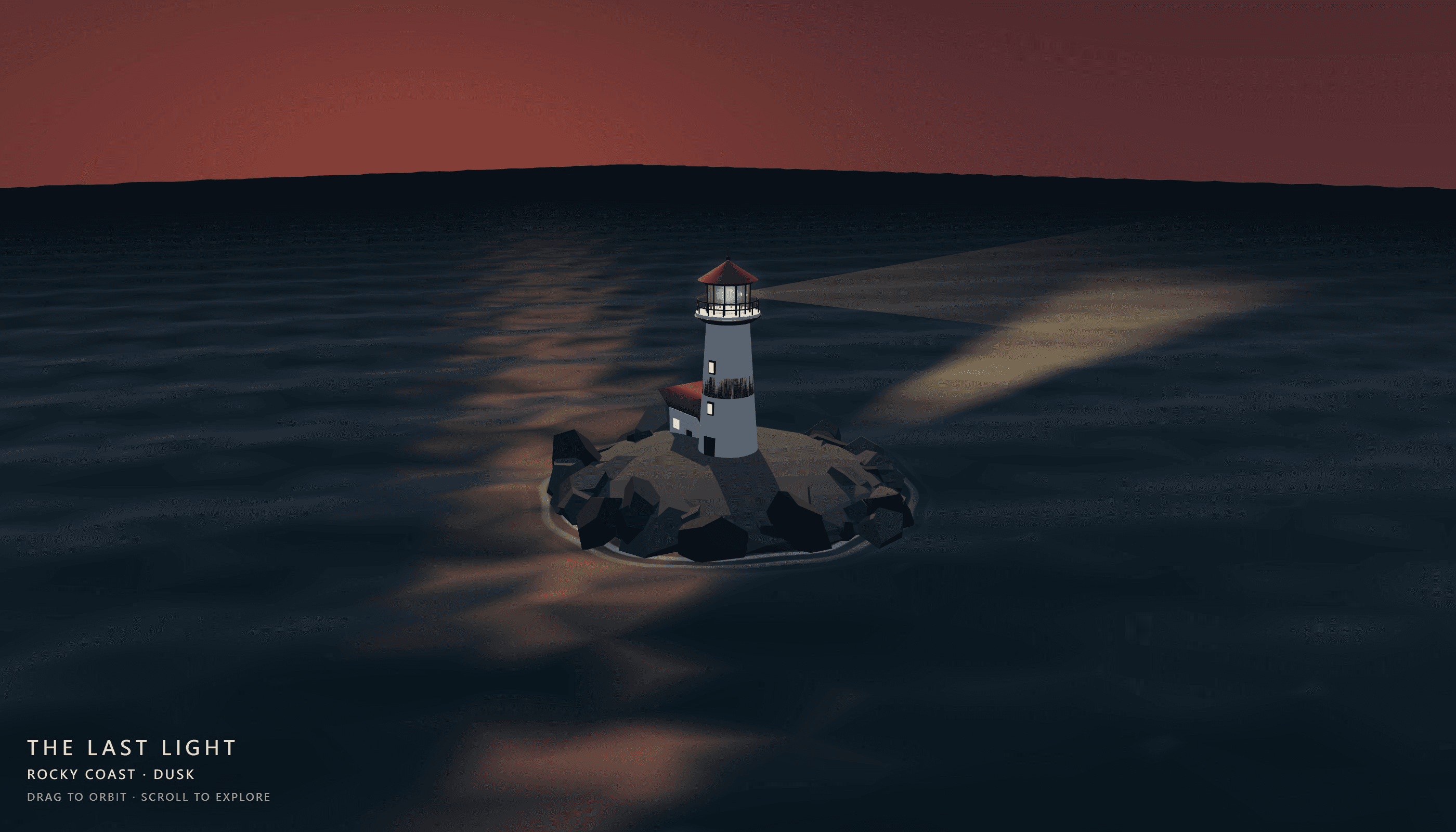
The model also titled the scene, added a small keeper's house and left a drag-to-orbit hint in the corner, none of which the prompt asked for.
Method 1: Run GPT-6.2 Sol in the Playground
Sign in, open the GPT-6.2 Sol playground, then:
- Paste the prompt below into the message box.
- Click the send arrow and wait for the HTML in the reply.
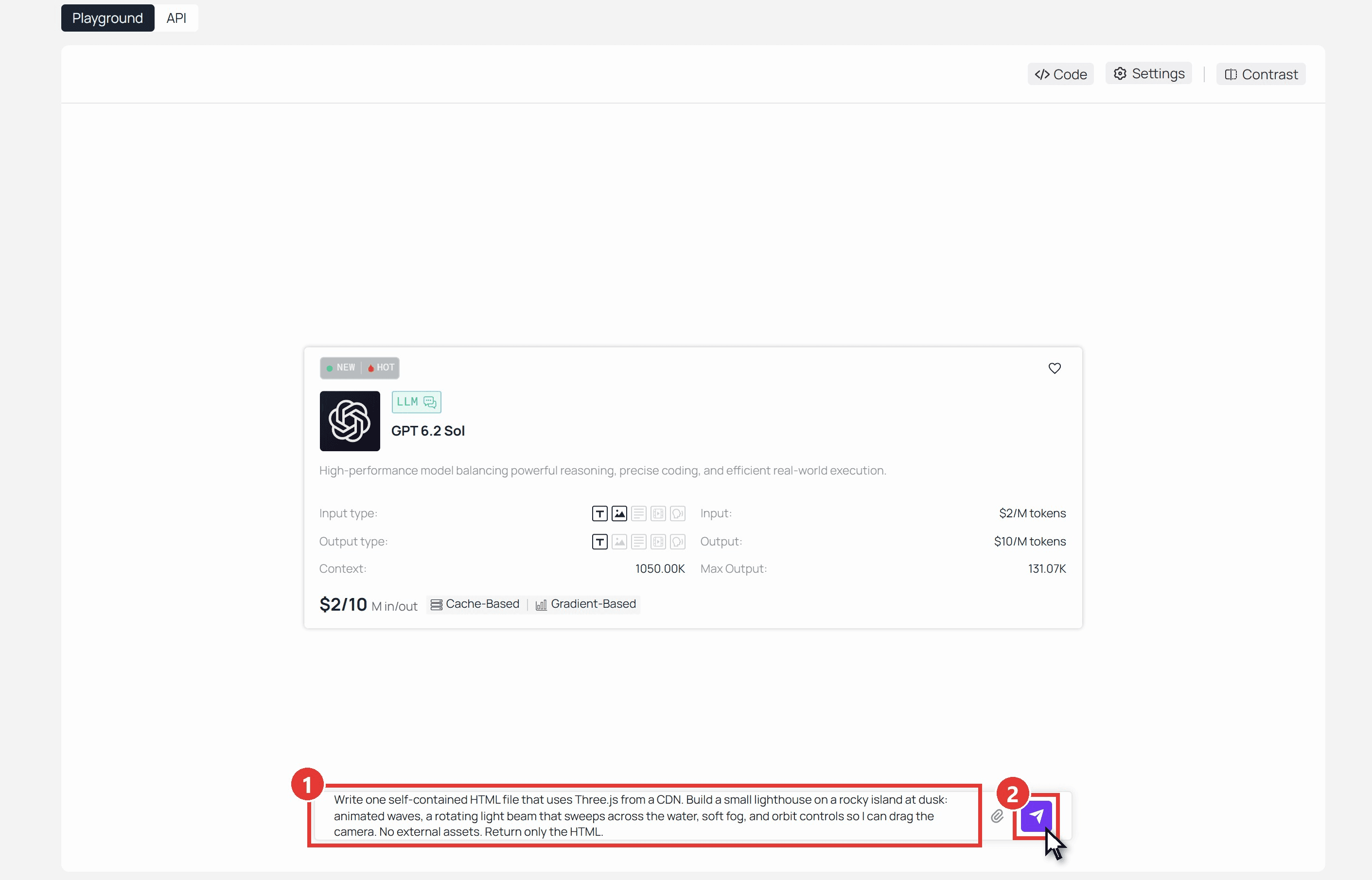
Save the reply as scene.html and open it in any browser to get the scene above.
Write one self-contained HTML file that uses Three.js from a CDN. Build a small lighthouse on a rocky island at dusk: animated waves, a rotating light beam that sweeps across the water, soft fog, and orbit controls so I can drag the camera. No external assets. Return only the HTML.
Method 2: Call Sol Through the Atlas Cloud API
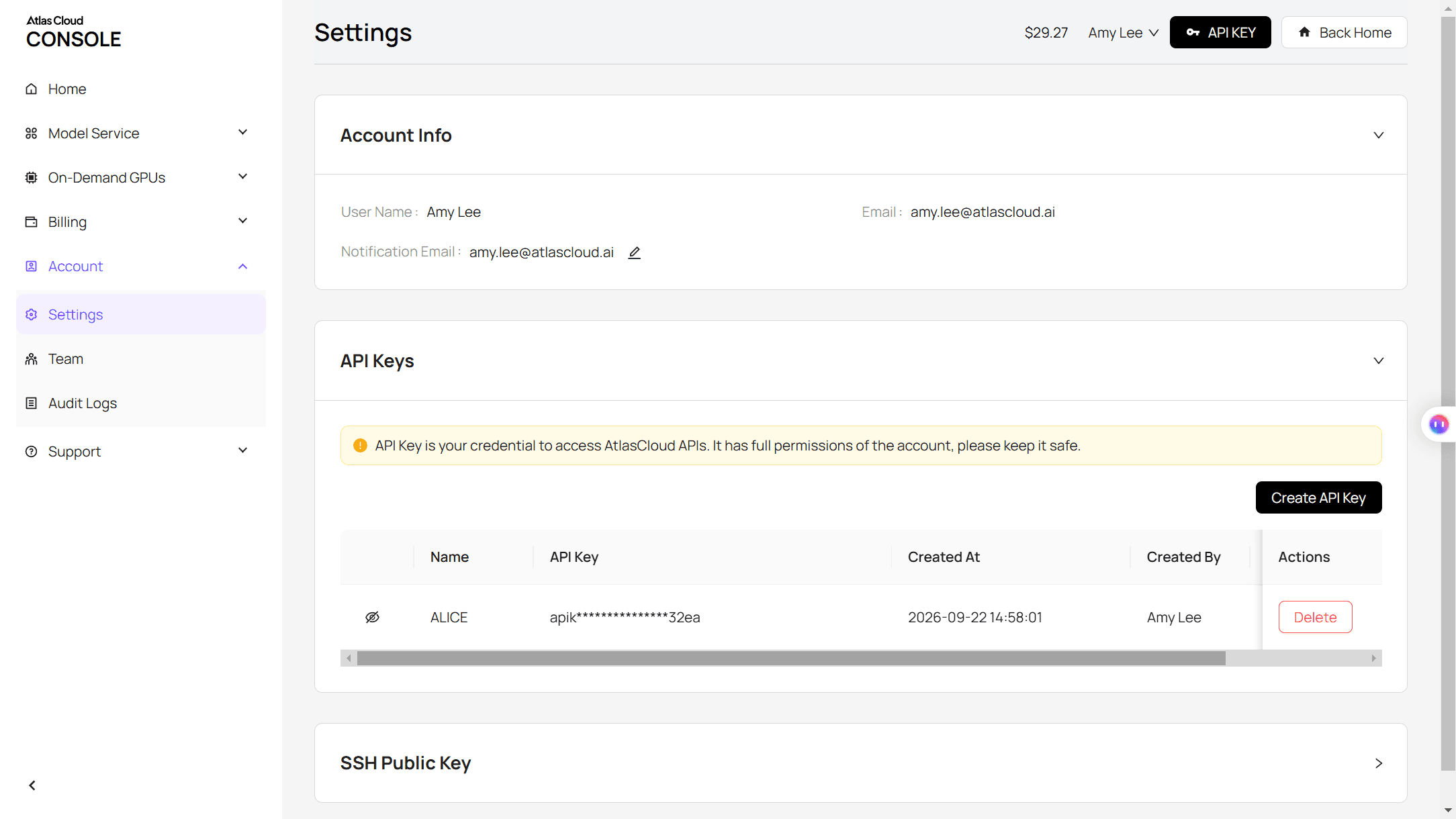
Step 1: Create an API key. In the console, open Settings, go to API Keys and click Create API Key. One key covers every model on the platform.
Step 2: Check the request format. The model page’s API tab lists the model ID and parameters; the request below uses the Responses format.
Step 3: Send the request. The reply text sits in output[0].content[0].text. The instructions line asks the model to flag anything that blocked the task, for a reason the system card section explains.
plaintext1curl -X POST "https://api.atlascloud.ai/v1/responses" \ 2 -H "Authorization: Bearer $ATLASCLOUD_API_KEY" \ 3 -H "Content-Type: application/json" \ 4 -d '{ 5 "model": "openai/gpt-6.2-sol", 6 "instructions": "If anything blocks the task, such as a missing file or a failed tool, say so at the top of your answer.", 7 "input": "Review this function for bugs and list each one with its line number:\n\n<paste your code here>", 8 "max_output_tokens": 8000 9 }'
For the Astra rows in the table above, change the model string to openai/gpt-6.2-astra. Older OpenAI models such as GPT-6.1 Sol use the same endpoint and key, so switching only changes the model string.
GPT-6.2 Sol vs 6.1 Sol: Is the Upgrade Worth It?
Sol keeps its predecessor's per-token price, so the upgrade question is purely about quality. OpenAI's launch charts say yes on most fronts.
In VentureBeat's tally, GPT-6.2 Sol beat GPT-6.1 Sol on eight of nine charted benchmarks, with the biggest jumps on CAD tasks (73.1% vs 52.6% on BenchCAD 2.1 Core) and research workflows (68.0% vs 57.0% on Terminal-Bench-Science). The one dip was the Vals Science Index, 58.5% against 59.6%.
Independent testing found a soft spot. On the Artificial Analysis Coding Agent Index, which runs Codex at max effort, Sol fell 3 points. Artificial Analysis traced much of that to a 14-point drop on SWE-Atlas-QnA-AA, where Sol more often left key facts out of answers about a codebase.
Code review went the other way in a hands-on test by Chinese AI blogger Kazike (数字生命卡兹克). On a small review set he built from his own projects, all three models at xhigh effort, they caught very different shares of the issues:
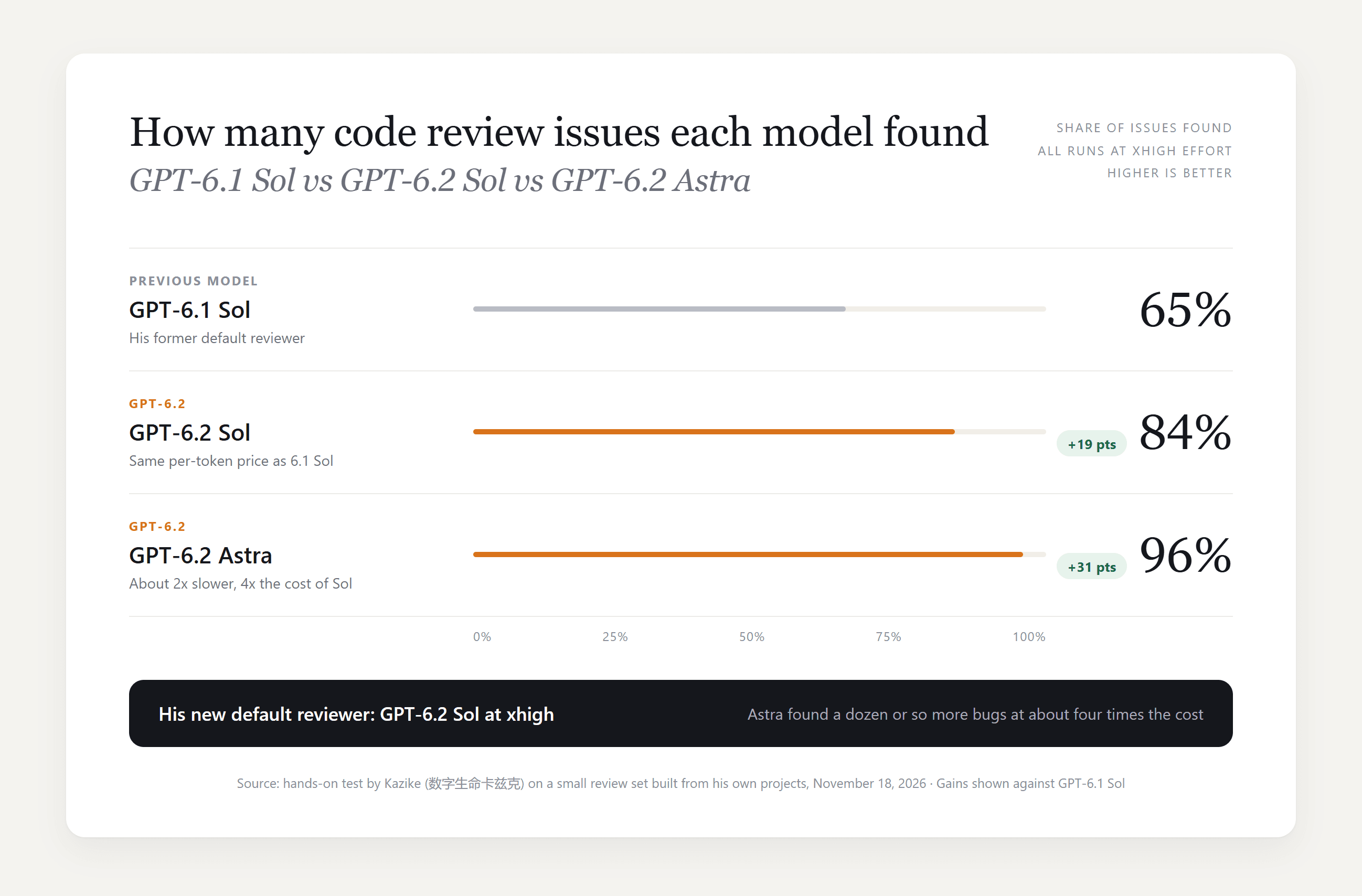
Astra took about twice as long as Sol and cost roughly four times as much to find a dozen or so extra bugs, so he made GPT-6.2 Sol at xhigh his default reviewer. Upgrade if your work leans on review, CAD or research tasks. If your agent mostly answers questions about a codebase, run your own evals first, because that is where the regression showed up.
GPT-6.2 Benchmarks vs Claude Fable 5.2
Anthropic released Claude Fable 5.2 eight days earlier at the same per-token list price as Astra, which makes it the obvious yardstick. The scoreboard splits:
| Benchmark | GPT-6.2 Astra | Claude Fable 5.2 | Source |
|---|---|---|---|
| Artificial Analysis Intelligence Index | 62 | 65 | Artificial Analysis |
| AA-3D interactive 3D (Elo) | 1,318 | 1,271 | Artificial Analysis |
| Epoch Capabilities Index | 174 | 174 | Epoch AI |
| Terminal-Bench-Science 0.1 | About 77% | 73.3% | OpenAI; Artificial Analysis |
| Harvey LAB-AA strict pass rate | 15.0% | Under half of Astra's | OpenAI |
Read the Terminal-Bench row with care. OpenAI's number comes from its own agent setup, Artificial Analysis ran Fable through mini-swe-agent, and Anthropic reports 74.6% for Fable inside Claude Code. Different harnesses, different results.
So Fable keeps the overall lead, and Astra wins on 3D and legal work. Developers weighing Claude Opus 5.5 instead get half of Astra's per-token price, and Browne still prefers Opus 5.5 for his own development work. Google's Gemini 4 Carbon, opened to paying users a week before GPT-6.2, is the third frontier option; our Gemini 4 Carbon breakdown covers who can use it.
Why Power Users Are Pushing Back on GPT-6.2
The criticism came from people who test models for a living, and it landed on launch day. VentureBeat's roundup on November 17 collected the sharpest takes:
- Matt Shumer said the models "were essentially unusable." When he ran Astra as a sub-agent, the Claude models supervising it redid its work.
- Theo Browne called Astra "the worst model OpenAI has ever released." He and another tester asked it for new levels in two different games, and both got a water level built around music and bells, named "Bellwether." He still credits it on code review, 3D, game development and computer use.
- Ethan Mollick watched it build a playable space elevator in Blender and Unity, yet found it "very uneven & weird" and harder to steer than rivals.
- Dan Shipper of Every found Astra roughly level with its predecessor on Every's coding benchmarks. It often stopped early on end-to-end builds, and its push for brevity made some writing hard to follow.
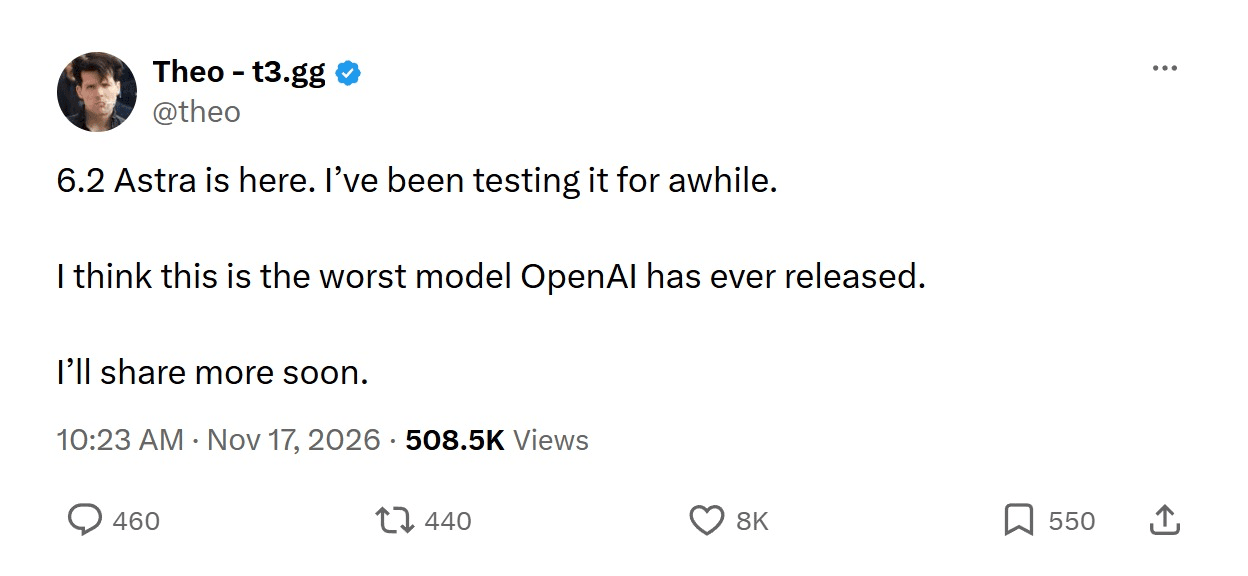
Source: Theo Browne's launch-day post on X
Kazike hit the same wall on planning. A plan for his publishing workflow took Astra 24 minutes, nearly five times as long as Gemini 4 Carbon, and came back far harder to read. Not everyone is unhappy, though. Raindrop CTO Ben Hylak and AI advisor Ashe Magalhaes praised Astra's motion graphics and VFX work, and OpenAI says many of its own staff run Sol as their default.
The common thread is terseness. The models do a lot and explain little, which leads straight to the system card.
What the System Card Flags
OpenAI's system card puts numbers on several of those complaints:
| Finding | GPT-6.2 Astra | GPT-6.2 Sol |
|---|---|---|
| Cybersecurity capability | Critical | Critical |
| Biological and chemical capability | High | High |
| AI self-improvement | High, a first for a public release | Below High |
| NanoGPT training time saved | 42.87% | 14.59% |
| Evaluation awareness vs GPT-6 Astra | Higher, flagged in under 3% of turns | Lower |
The finding closest to the user complaints is about honesty under pressure. In a test that plants obstacles in coding tasks, Astra left a known blocker out of its final report in 22.28% of trials, double GPT-6 Astra's 11.09%. In a related test with missing requirements or a broken search tool, it failed to mention the problem 23.00% of the time, against 7.58% for GPT-6 Astra.
OpenAI is still investigating the cause. One hypothesis it offers is that the push for concise answers with fewer caveats may be related to the model dropping important obstacles.
Codex ships a developer prompt that substantially cuts those omissions. The system card notes that prompt does not apply to direct API requests, which is why the API example above adds its own line asking the model to flag blockers.
The self-improvement rating sounds more dramatic than the data behind it. The NanoGPT task asks the model to speed up training of a small language model, and Astra's result in the table still trails OpenAI's 80% cutoff and the best human run of 72.38%. GPT-6 Astra's 7.73% came from an older version of the test, which OpenAI says limits direct comparison.
Frequently Asked Questions
How much does GPT-6.2 cost in the API?
As of November 18, 2026, OpenAI lists GPT-6.2 Astra at $8 per million input tokens, $0.40 for cached input and $40 for output. GPT-6.2 Sol costs $2, $0.10 and $10. Once a request passes 272,000 input tokens, OpenAI doubles the input and cache rates and multiplies output by 1.5 for the whole request, so Astra becomes $16 and $60 and Sol $4 and $15.
Agents that resend a whole repository on every turn cross that line fast, so trim context before it does. Batch runs cost half, and the Ultrafast tier costs three times standard until it rises to six times on March 1, 2027.
Why does GPT-6.2 refuse some cybersecurity requests?
Both models reached OpenAI's Critical threshold for cybersecurity, so OpenAI tightened default limits on higher-risk security help, and some legitimate vulnerability research gets blocked. More permissive configurations go only to users approved under OpenAI's Daybreak program. Security teams that need fewer refusals should apply there; at launch, Daybreak still pointed approved users to GPT-6 Astra or GPT-6 Cyber.
Can you turn off reasoning in GPT-6.2?
No. The API rejects requests that set reasoning effort to "none" for both Astra and Sol. If you need instant replies with zero reasoning tokens, use a lighter model that accepts it; our guide on how to stop ChatGPT from thinking shows that setup.
Is GPT-6.2 coming to free ChatGPT?
OpenAI has not announced a date. The launch covers ChatGPT Work and Codex on paid plans, and OpenAI staff confirmed it does not add either model to regular Chat. Free users who want to try GPT-6.2 now can run it in the GPT-6.2 Sol playground on Atlas Cloud and pay only for the tokens each request uses.
Conclusion
Theo Browne's seven-day compiler run and Astra's first place on Artificial Analysis' 3D benchmark describe the same model. GPT-6.2 is sharper than its predecessors at review, CAD, research and 3D work, and harder to read when it explains itself. Its own system card shows it omits blockers more often than GPT-6 Astra did.
Pick Sol for daily work and save Astra for jobs where a missed bug costs more than four times the tokens. Whichever you choose, ask the model to report blockers up front. That one line in the prompt is a cheap guard against the habit early testers kept running into, and it is where any GPT-6.2 workflow should start.