You finally have the shot you wanted, and there is a studio name stamped across the bottom of it. Or a date burned in by a camera nobody has owned since 2009. The words are not sitting on a layer you can switch off. They are pixels, exactly like the wall or the grass they cover.
So when you remove text from image files, the tool is not deleting anything. It is painting over the hole and guessing what used to be there. Whether that guess passes is decided almost entirely by what the letters were sitting on, and barely at all by which brand of eraser you picked.
We put that to a test you can check yourself. One line of white type, four different backgrounds, one erase pass, then a pixel by pixel comparison against the untouched original. The gap between the best and worst case turned out to be about nine to one.
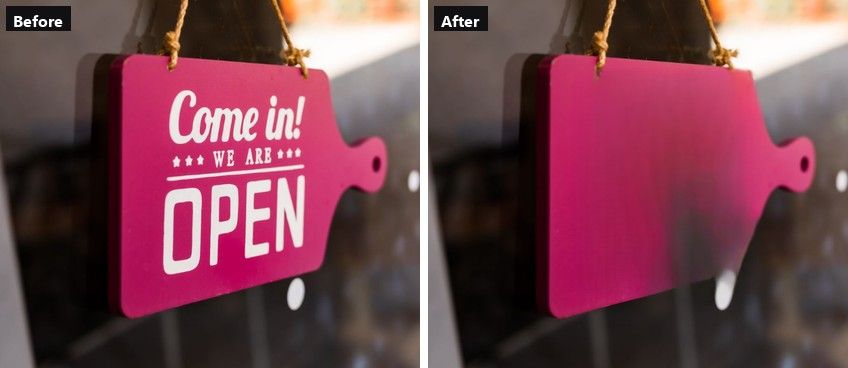
Three lines of printed type removed in a single pass. Source photo from Pexels, erased in the browser on 20 September 2026.
Key Takeaways
- Text in a photo is pixels, not a layer. Any text remover has to invent whatever sat behind the letters.
- Atlas Cloud's browser-based image eraser runs the whole job on your own machine, so the photo never leaves your device.
- Flat paint and soft blur come back clean. Dense grass and brick leave a patch you can spot.
- Erasing text and removing a background are two different jobs with two different outputs.
- Your own photos, screenshots, and date stamps are fair game . Someone else's watermark is not.
Why an Image Text Remover Has to Rebuild the Background
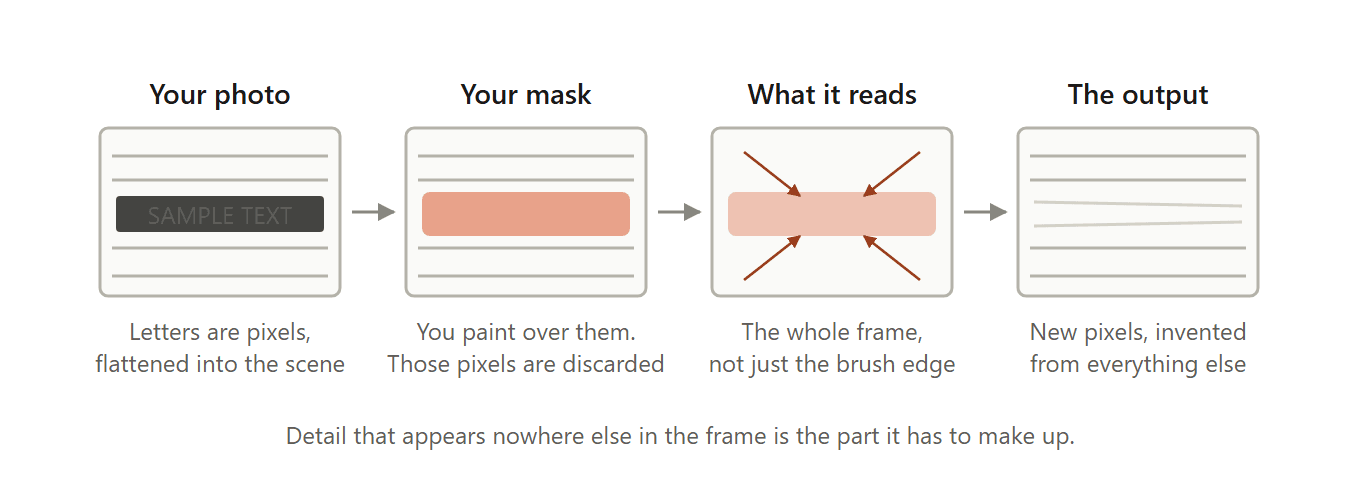
Open any photo in an editor and try to select the letters. There is nothing to select. The type was flattened into the image when it was saved, which leaves an image text remover one route in: you mark a region, the model throws those pixels away, and it synthesises new ones.
The interesting part is where the new pixels come from. Modern inpainting models do not just smear in the colours touching the edge of your brush stroke.
One widely cited approach in this research area, published in 2021 as Resolution-robust Large Mask Inpainting with Fourier Convolutions, is built on convolutions that carry an "image-wide receptive field". A single layer can take in the entire frame at once instead of a small neighbourhood around the hole.
That design is why erasing a word off a brick wall produces brick and not beige mush. The rest of the wall is right there in the frame, so the model has plenty of bricks to learn the pattern from.
It also explains the failure mode. When the covered area contains detail that appears nowhere else in the frame, there is nothing to copy from, and the model settles for something smooth and plausible. Smooth and plausible is exactly what your eye catches.
How to Remove Text From a Picture in Your Browser
The sign at the top of this article went from three lines of type to a blank pink panel in one pass, and the panel kept its gradient and its worn edge. Here is the state of the canvas one second before that happened.

The brush selection over one line of text. Red marks what gets thrown away and rebuilt.
Load a photo into the free AI image eraser and you get two ways to mark type. Lasso selection is faster when the words sit in a block, since you draw a loop around the whole thing and it fills on release.
Brush mode suits a single line. The Brush Size slider runs from 6 to 64 pixels, so you can match the stroke to the height of the letters.
Drag the size up until one pass covers the type plus a few pixels of breathing room, paint over every word you want gone, then hit Run Free. Clear selection wipes the mask if you overshoot.
Four things worth knowing before you start:
- The photo is processed on your own machine. The page states it plainly: "Images processed locally in browser. Assets aren't uploaded to OSS or processed by AtlasCloud backend."
- You get a PNG back at the same pixel dimensions you put in. An 886 by 606 input came back 886 by 606 in our runs, and the download carries no watermark.
- There is no account step and no daily quota, which the FAQ on the page confirms with "No account is needed at any point."
- The eraser runs on WebGPU, so it wants a recent browser. On iPhone and iPad that means Safari 26 or later, and on the desktop an up-to-date Chrome, Edge, or Safari. Your first run downloads the model once and caches it, so run two onward starts immediately.
How to Remove Text From an Image Without Removing the Background
Plenty of people who set out to remove text from image files add "without removing the background" to the search, which tells you they have been burned before. Upload a photo to the wrong tool and you get your subject floating on a transparent checkerboard, with the scenery gone along with the caption.
Two different jobs, two different outputs:
| Text remover | Background remover | |
|---|---|---|
| What you mark | The words only | Nothing, it detects the subject |
| What it deletes | The marked pixels | Everything outside the subject |
| What comes back | The same scene, rebuilt where the text was | The subject alone |
| Typical output | PNG or JPG, opaque | PNG with an alpha channel |
| Right call for | Date stamps, captions, price tags, your own watermark | Product cutouts, profile photos, e-commerce listings |
An eraser leaves the scenery you did not paint over alone. Across our runs the untouched parts of the frame came back within about one brightness level out of 255, which is under the threshold any screen or eye will show you.
If the checkerboard is actually what you were after, that is a separate tool in the same free AI tools collection, and we ranked ten of them by where the free tier stops in our guide to AI background removers.
Which Backgrounds a Text Remover Can Actually Rebuild
Here is the test. We built one 886 by 606 image out of four stock photos: a flat painted wall, an out of focus grey backdrop, dense grass, and a brick wall. The same line of white 30 pixel bold type went onto all four tiles in the same position. One brush stroke per tile at 44 pixels, one Run, four erases in a single forward pass.
Then we rebuilt the identical composite with the text left off. That gives a ground truth, which is what the guides currently ranking for this search tend to skip. Outside the brushed strips, the no-text version and the input matched at 0.000 difference, so any gap inside the strips is the model's work and nothing else.
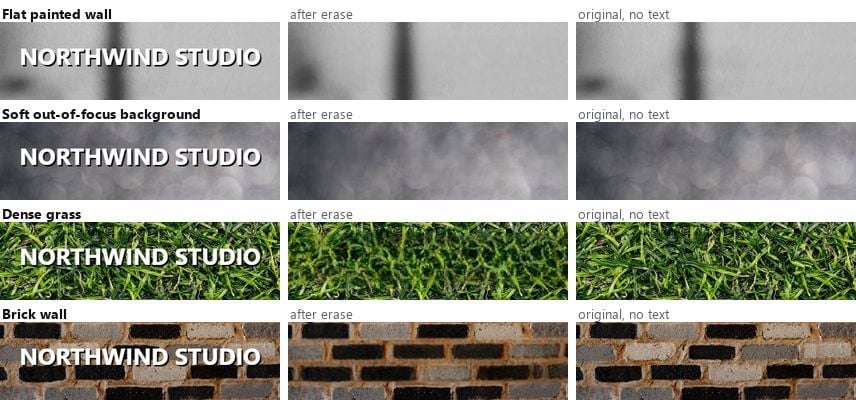
Same type, same brush, same run. Stock photos from Pexels, tested 20 September 2026.
Measuring the erased strip against the original gives a number on a 0 to 255 brightness scale:
| Background | Average error in the erased strip | Verdict |
|---|---|---|
| Flat painted wall | 6 | Invisible |
| Soft out-of-focus backdrop | 9 | Invisible at normal size |
| Brick wall | 39 | Pattern rebuilt, joints misaligned |
| Dense grass | 53 | Visible smear |
Where the Text Comes Back Clean
Paint, sky, blurred backdrops, car bodies, table tops, and anything else with low detail all land in the same bracket. The wall tile scored an error of 6 out of 255, which is under 3% and sits below the point where a screen resolves it.
The blurred backdrop scored 9. Its only giveaway is that the soft light circles inside the strip came back slightly flatter than the ones above it.
Print, screen, or crop these and nobody will find the seam. If your text sits on a wall, a sky, a shirt, or a blurred background, stop reading and go erase it.
Where the Patch Always Shows
Grass scored 53, the worst of the four. Look at the third row of the comparison and the erased strip has turned into a green blur where the original has individual blades. High frequency random detail is the hardest case for an inpainting model, because every blade in the source is unique and there is no repeating unit to borrow from.
Brick behaved differently and it is worth understanding why. The error came in lower at 39, and the strip still reads as brick, yet the model rebuilt the courses in the wrong place. Mortar lines that should run straight across the wall step up and down where the text used to be.
So there are two failure modes with two different tells. Regular patterns come back confidently and wrongly. Random texture comes back flattened.
Printed type on a real object sits in a third bracket again. This enamel sign carries genuinely printed letters, not an overlay, on a panel with rust, scuffs, and an uneven highlight.
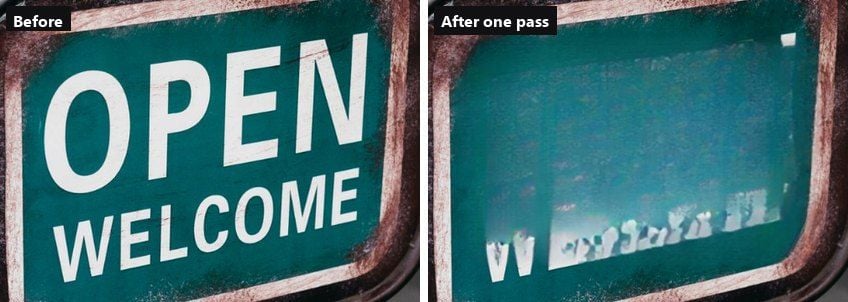
One pass over both lines with a 64 pixel brush. The words are gone, the rebuilt rectangle is not. Source photo from Pexels, tested 20 September 2026.
The letters left, and so did the panel's character. What replaced them is a clean rectangle sitting a shade brighter than the enamel around it, with the bottom of WELCOME still visible as broken white chips. Very large type is a hard case for a simple reason: once the mask covers half the surface, there is not much surface left to learn from.
Remove Text From a Screenshot Without Blurring the Rest
Screenshots are the easy case and the risky one at the same time. Easy, because interface text almost always sits on flat fill, and flat fill is the bracket that scores a 6. A notification banner, a toolbar label, or a timestamp will vanish without a trace.
Risky, because of what people usually want gone. A clean erase leaves no mark that anything was edited, and that is the wrong property when you are hiding an order number in a support ticket or a name in a bug report.
| What you want gone | Erase it | Cover it |
|---|---|---|
| Status bar clock, battery, carrier name | Yes | |
| Cookie banner, promo strip, toast notification | Yes | |
| Your own watermark or export stamp | Yes | |
| Email address, order ID, account balance | Box or blur it | |
| Anything in a screenshot used as evidence | Box or blur it |
The rule of thumb: erase when the text is clutter, cover when the text is a secret. A black box says "I removed something here" and nobody can accuse you later of quietly altering a record.
What to Do When the Text Remover Leaves a Smear
Three things go wrong, and each has a different fix.
Letter fragments survive when your mask stopped short of the descenders or the drop shadow, which is what left those white chips on the enamel sign above. Run a second pass over the leftovers alone, with a smaller brush.
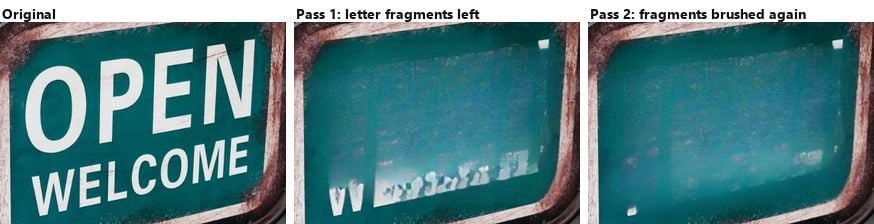
Pass two removed the leftover chips. The rectangle behind them stayed put.
Note what the second pass did not fix. The bright rectangle was still there, because that came from the size of the first mask rather than from any leftover ink. Once a patch that big exists, another pass tends to widen it rather than blend it.
A wide smear means your mask was too generous. Undo, and take the same text in two or three narrower strokes instead of one wide band, giving the model more untouched pixels to reference between passes.
Repeated watermarks across a whole photo are the case to walk away from. Painting over a tiled pattern means masking most of the frame, and at that point you are asking the model to invent the picture rather than repair it. Find the original file instead.
Where Erasing Text Crosses a Line
The technique is neutral. What you point it at is not.
| Situation | Where it stands |
|---|---|
| Date stamp on your own family photo | Fine |
| Your own studio watermark on your own work | Fine |
| Old price or promo text on a product shot you own | Fine |
| Stock library watermark on an unlicensed preview | Off limits |
| Another photographer's credit line | Strips attribution, usually a licence breach |
| Text on an invoice, ID, ticket, or receipt | Off limits, whatever the reason |
Two extra notes. A stock library preview watermark exists to mark an unpaid file, and erasing it does not buy you the licence. And on AI generated images, taking off a visible corner badge leaves any invisible provenance signal untouched, because signals of that kind are carried in the pixel data rather than drawn on top of it.
Frequently Asked Questions
Can I remove text from an image for free?
Yes, and free here means no account, no credits, and no daily limits, which the Atlas Cloud eraser states on its own page. Money is rarely what decides the result anyway. What decides it is the background behind your letters, which is why the same tool can be flawless on a wall and obvious on a lawn.
Does removing text lower the resolution?
No. Every run in this test returned a PNG at exactly the input dimensions, with no crop and no downscale. The pixels that change are the ones you painted over, so if you erase a caption from a 4000 pixel wide photo, you still have a 4000 pixel wide photo with one rebuilt strip in it.
Can an AI text remover put new text back in its place?
Not this kind. An AI text remover fills the gap with background, which is what you want when the goal is a clean plate. Once you have the clean plate, add your new wording in any layout tool, and it will sit on an untouched surface rather than on top of the old letters bleeding through.
How do I remove text from a picture on my phone?
Same browser tool, same steps, with two fingers instead of a mouse. Pinch to zoom before you brush, because a 44 pixel stroke is easy to misplace at phone scale. If you would rather use what is already on the device, we walked through the built-in route and its model requirements in our guide to erasing objects on iPhone.
What if the text is the only thing I want to keep?
Then you want the opposite tool. Extracting words from an image is optical character recognition, and it reads the letters into editable text while leaving the photo alone. Searching for a way to remove text from a picture will hand you erasers all day, so search for OCR instead and you will find your answer in one hop.
Conclusion
The tool matters far less than the surface. A caption on a wall, a sky, or a blurred backdrop came off at an error of 6 on a 255 point scale, which is to say it came off perfectly. The same caption on grass came off at 53 and left a mark anyone can see. Look at what the letters are sitting on before you start.
When the background cooperates, the whole thing takes one brush stroke and one click. Paint over the words, run it, download a PNG at the original size. That is the realistic version of what it takes to remove text from image files, and on a photo where the letters sit on paint, sky, or blur, it is all you need.





