
Doubao Seed API for Reasoning and Coding
The Doubao Seed API opens ByteDance's full Seed lineup, from the flagship Seed 2.1 Pro to a dedicated Code Preview and the efficient Lite and Mini tiers. Every model handles deep reasoning, agentic planning, and repository-scale coding, with streaming and a shared 256K context. Atlas Cloud serves them all through one endpoint, with pay-as-you-go pricing from $0.1 per million tokens and Day-0 access. Start building today.
Seed is developed by ByteDance. Atlas Cloud (operated by Atlas Cloud AI LLC) provides access to it and does not own it. All trademarks belong to their respective owners.
Explore the Leading Seed
Atlas Cloud provides you with the latest industry-leading creative models.









Specs Comparison
Doubao Seed Family: A complete suite of language models spanning frontier reasoning to high-throughput inference.
| Model | Tier | Best For | Context | Max Output |
|---|---|---|---|---|
| Doubao Seed 2.0 Pro | Flagship | Complex reasoning, agents, hardest tasks | 256K | 131K |
| Doubao Seed 2.0 Code Preview | Code (Preview) | Code generation, refactoring, repo-scale work | 256K | 131K |
| Doubao Seed 2.0 Lite | Balanced | Production apps needing quality at lower cost | 256K | 131K |
| Doubao Seed 2.0 Mini | Efficiency | High-volume, latency-sensitive, cheap inference | 256K | 131K |
| Doubao Seed 1.8 | Prev-gen flagship | Stable, proven general-purpose reasoning | 256K | 131K |
| Doubao Seed 1.6 Flash | Prev-gen fast | Fast responses, real-time UX | 256K | 131K |
| Doubao Seed 1.6 | Prev-gen base | Cost-efficient general-purpose tasks | 256K | 65K |
Inside the Doubao Seed API: Reasoning, Coding, and Cost-Tuned Tiers
The Doubao Seed API brings ByteDance's full Seed lineup under one OpenAI-compatible key, spanning flagship reasoning, a dedicated coding model, and cost-tuned Lite and Mini tiers that all share a 256K-token context window and pay-as-you-go pricing from $0.1 per million tokens.

Frontier Reasoning Across the Doubao Seed API
The flagship Seed 2.1 Pro tier anchors the family with premium reasoning, coding, and enterprise-grade problem solving over a 256K-token context. It sustains long, multi-step chains of thought inside a single request, so hard analytical and planning tasks resolve without truncation. Reach for it whenever correctness on the toughest workloads outweighs raw cost, at $0.9 per million input tokens.
A Dedicated Model for Software Engineering
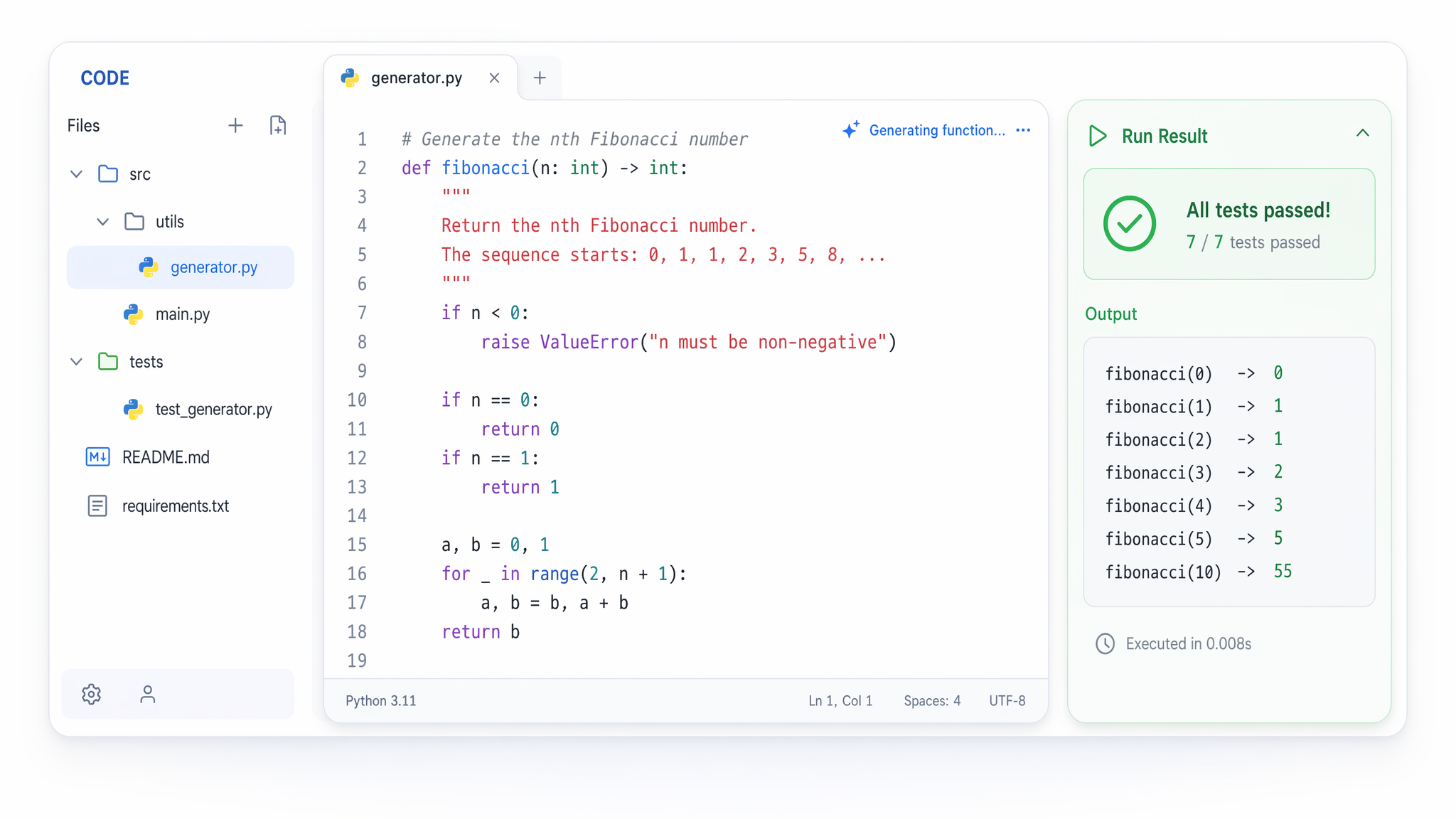
Seed 2.0 Code Preview is tuned specifically for coding agents, repository understanding, and everyday software engineering. The same 256K window lets it read across an entire codebase before writing new functions, refactoring modules, or explaining unfamiliar logic. It also plugs into AI coding assistants through Atlas Cloud Skills and the MCP Server, priced at $0.5 per million input tokens.

Match Every Job to the Right Seed Tier
Need production quality without flagship pricing? Seed 2.0 Lite delivers near-flagship output at $0.25 per million input tokens, while Seed 2.0 Mini drops to just $0.1 for high-volume classification, routing, and lightweight agent steps. Because the whole lineup shares one interface, you can route each request to the cheapest tier that still clears the bar.
256K-Token Context on the Doubao Seed API
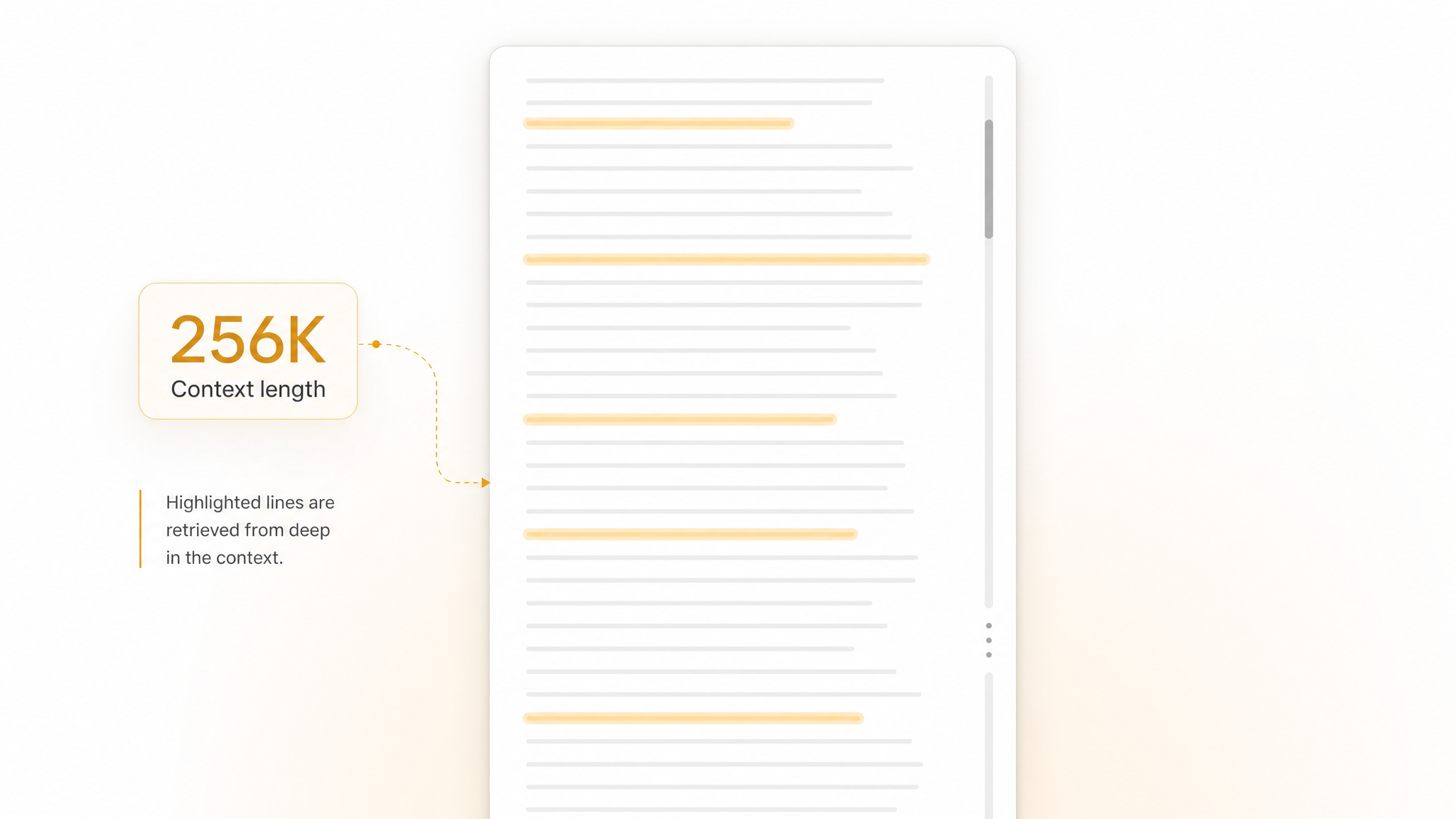
Every model in the family carries a 256K-token context window, several hundred pages of text in a single call. Feed it long documents, multi-file repositories, or lengthy conversation history and it keeps the full picture in view. Responses stream back token by token over standard server-sent events, so your interface stays responsive even on large jobs.
Transparent, Pay-as-you-go Token Pricing
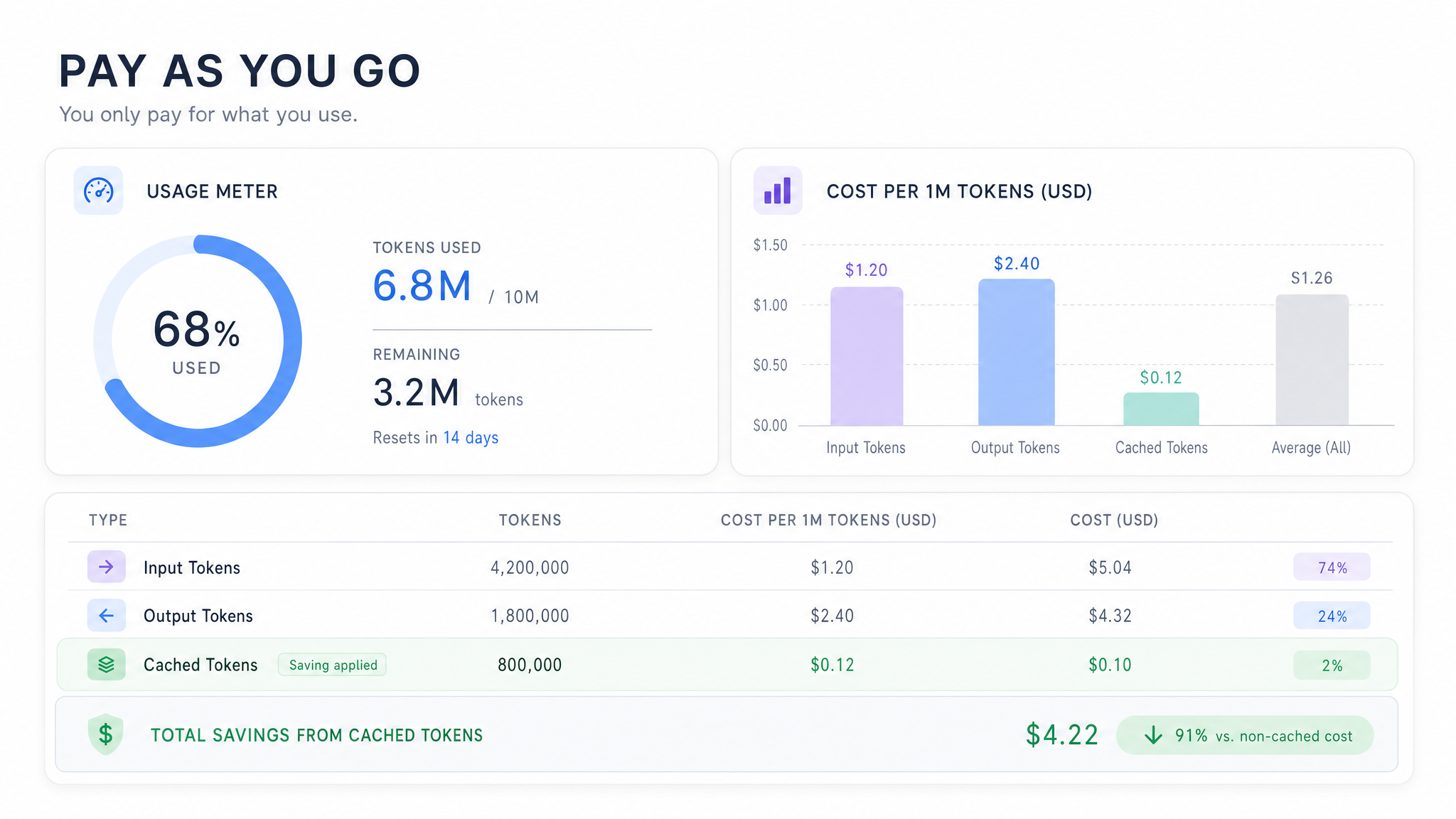
Pricing is pure pay-as-you-go, billed per token with no subscription required. Prompt caching cuts the cost of repeated context sharply, with cached input on Seed 2.0 Mini priced at just $0.02 per million tokens. Longer prompts move to clearly published higher-rate tiers, so your spend stays predictable as workloads scale from a prototype into production.

One Key for the Entire Doubao Seed API
Should you standardize on one tier or mix several? A single OpenAI-compatible key reaches every Doubao Seed model, from the flagship 2.1 Pro to the budget Mini and the prior-generation 1.6 line. Existing OpenAI SDK code works after a base-URL and key swap, so you can send hard requests to Pro and cheap sub-steps to Mini inside one application.
One Prompt, Three Builds: Doubao Seed API Head-to-Head
Feed the identical prompt to three models on the Doubao Seed API and compare how each one turns a single instruction into a working, self-contained HTML page.
Build a complete single-file HTML page — one .html document with all CSS and JavaScript inlined, zero external dependencies, no CDN links, no web fonts, no image files or data URIs. Every visual must be drawn procedurally at runtime with the Canvas 2D API or inline SVG; there must be no bitmaps, photographs, or emoji anywhere. The page is a real-time generative canvas titled something like "Harvest Field — Aerial Geometry Studio," and the entire concept is a god's-eye, top-down view of a cultivated farmland that the user shapes with sliders while a single pixelated combine harvester crawls across it, wiping ordered stripes out of raw crop — the quiet, satisfying moment of order being cut from chaos. Composition and rendering: fill the whole viewport with a regular rectangular grid of rye-like field plots laid out in flat-vector shapes with a subtle isometric / faux-2.5D lift, so each plot reads as a low block, not a flat rectangle. Light the scene as a single directional dusk sun raking in from one corner (warm, low-angle); every plot and the harvester must cast a long soft shadow in the opposite direction to reinforce the geometric, blocky solidity of the field. The palette is a restrained, tasteful earth-tone family: mustard yellow, ochre, olive green, and a single accent of scorched tilled burnt-umber for freshly turned soil — no neon, no pure primaries, keep it high-end and muted. Overall style is flat vector meets isometric micro-relief, precise and architectural. The living behavior: within each plot, render fine drill-seeding rows (thin parallel lines) whose density is adjustable. One pixelated combine harvester — a small blocky sprite drawn from a few rectangles — is the ONLY moving element and the only thing that breaks the grid's symmetry. It advances slowly along either a spiral inward path or a serpentine boustrophedon (回字 / back-and-forth) route across the plots. As it moves it must "erase" the standing crop directly in its swath and leave behind real-time harvest stripes — alternating light and dark cut bands, like a mown lawn or a real combine's header trail — permanently painted onto the field until reset. The harvest is a continuous, self-running animation via requestAnimationFrame; watching it fill the field should feel calm and hypnotic. Interactivity — all controls are sliders (plus a couple of small toggles/buttons) in a clean, minimal side or bottom panel, and every one must respond live without a page reload: a slider for number of field plots (grid resolution, e.g. 3×3 up to 12×12), a slider for drill-seeding row density, a slider for crop hue (shifting the standing crop across the mustard-ochre-olive range), a slider for harvest progress or harvester speed, and a toggle to switch the harvester's path between spiral and boustrophedon. Provide a subtle Reset/Replant button that regenerates the field and restarts the pass. Changing plot count or density should regenerate the layout smoothly; dragging hue should retint in real time. Make it fully responsive so the grid and shadows recompute on window resize, keep the frame rate smooth, and ensure the code is clean and self-contained so it opens correctly by double-clicking the file. This is neither a game nor a dashboard — it is a generative art instrument. Push the procedural geometry, the path animation, and the parameter linkage as far as they go; the quality of the isometric shading, the long dusk shadows, and the crispness of the harvest stripes are what should make this render stand out.
Generated with Doubao Seed 2.1 Pro on Atlas Cloud
Generated with DeepSeek V4 Pro on Atlas Cloud
Generated with Doubao Seed 2.0 Pro on Atlas Cloud
Build a single self-contained HTML file (inline CSS and JavaScript only — absolutely no external libraries, CDNs, frameworks, fonts, or image URLs) that renders an interactive, physically-plausible mechanical pocket-watch movement teardown bench, drawn entirely with SVG and/or Canvas. The page must open and run correctly by double-clicking it in any modern browser, with everything computed and animated in real time. THE SCENE. A top-down view of an exploded brass watch movement laid out on a workshop bench. Render, as living vector art, a mainspring barrel, a stacked gear train (barrel wheel → center wheel → third wheel → fourth wheel → escape wheel), a pallet fork that rocks back and forth, a balance wheel with a spiraling hairspring, and hour/minute/second hands sweeping over a subtle chapter ring. Draw real gear teeth (involute-style flanks, not plain circles), correct meshing at the pitch circles, and visible arbors, jewels, bridges, and screws. The whole assembly is composed concentrically around the movement core; the control panel is tucked into a dark corner. THE MECHANICS (this is the point — make it truly simulate, not fake). Model the gear train with real gear ratios: each wheel's angular velocity equals its neighbor's times the negative ratio of their tooth counts, so meshing wheels visibly counter-rotate at proportional speeds and teeth interlock without overlapping or sliding. The escapement must actually tick: the escape wheel advances one tooth at a time in discrete steps, locked and released by the oscillating pallet fork, which is driven by the balance wheel swinging at a fixed beat. Each release ("tick") produces a crisp step in the escape wheel and an audible tick using the Web Audio API (synthesized, no audio files). The seconds hand advances in beat with the escapement; minute and hour hands derive from it through the gear ratios. Drive the animation with requestAnimationFrame and real elapsed time so timing stays accurate. THE INTERACTIONS (all must respond live). - A draggable winding crown/knob: drag it (mouse or touch) to wind the mainspring — a wind-up gauge fills and the spring coil visibly tightens. Release to let stored energy discharge, powering the train; the movement runs until the spring unwinds, then coasts to a stop. - A "rate" slider that scales the beat/running speed so you can watch it tick slowly or race. - An "explode" slider that continuously separates the stacked components along their axes from fully assembled to a fanned-out exploded diagram, with smooth interpolation, connector guide-lines between separated parts, and everything still rotating correctly at any explosion level. - Hover (or tap) any component to act like a jeweler's loupe: highlight that part, dim the rest, and float a labeled callout with the part's name and a one-line function description. - Buttons: Wind, Release, Reset. THE LOOK. Realistic watchmaking-workshop industrial aesthetic: warm aged brass, distressed steel-grey, deep ink-black background, crisp metallic highlights, finely etched gear teeth and beveled bridges. Simulate a single shaft of window light raking in from the upper-left across the bench so parts cast soft elongated shadows, and let specular highlights travel along the gear faces as they turn. Use gradients, filters, and subtle grain for depth. Clean, legible HUD-style controls and labels in the dark corner. REQUIREMENTS. Everything in one .html file; responsive layout that scales to the viewport; smooth 60fps animation; no placeholder graphics — the movement must be procedurally drawn and genuinely mechanically coupled so that a capable model produces a watch that really winds, meshes, and ticks, while a weak one collapses into static spinning circles. Add brief inline comments naming the gear ratios and the escapement logic.
Generated with Doubao Seed 2.1 Pro on Atlas Cloud
Generated with DeepSeek V4 Pro on Atlas Cloud
Generated with Doubao Seed 2.0 Pro on Atlas Cloud
Build Production Systems on the Doubao Seed API
From coding agents and repository-scale refactoring to real-time chat and high-volume pipelines, the Doubao Seed API tiers slot into every layer of a production stack behind one OpenAI-compatible key.

Build Coding Assistants with the Doubao Seed API
Seed 2.0 Code Preview is tuned for coding agents and repository understanding, reading a 256K-token context in a single call. Wire it into IDE copilots, PR reviewers, and refactoring bots via Atlas Cloud Skills.

Orchestrate Multi-Step Agents
Let Seed 2.0 Pro handle planning and tool orchestration, then delegate cheap sub-steps to Mini to keep cost per run predictable. The split powers research agents, workflow automation, and pipelines that chain many calls.

Run High-Volume Inference Pipelines
Firing thousands of calls for classification, tagging, or structured extraction? Seed 2.0 Mini is built for edge scenarios and cost-sensitive automation, so per-token economics stay in your favor at scale.

Analyze Long Documents at Depth
When a task spans long contracts, research papers, or full knowledge bases, Seed 2.0 Pro applies deep reasoning across its 256K-token window. Teams use it for analysis, extraction, and question answering over large documents.

Route Traffic Across the Doubao Seed API
One OpenAI-compatible key reaches every tier of the Doubao Seed API, from flagship Pro to efficient Mini. Route hard requests to the strongest model and high-volume work to the cheapest to control spend.

Power Real-Time Chat on the Doubao Seed API
Seed 2.1 Turbo and Seed 1.6 Flash are engineered for ultra-low latency, high throughput, and streaming responses. They keep chatbots, live assistants, and interactive product UX responsive even under heavy request volume.
Doubao Seed API vs Top Reasoning and Coding Models on Atlas Cloud
See how the Doubao Seed API stacks up against leading reasoning and coding models available on Atlas Cloud across context window, output ceiling, and transparent per-token pricing.
| Model | Provider | Context Window | Max Output | Price (Input / Output per 1M tokens) |
|---|---|---|---|---|
| Doubao Seed 2.1 Pro | ByteDance | 256K | 256K | $0.90 / $4.50 |
| Doubao Seed 2.0 Code Preview | ByteDance | 256K | 128K | $0.50 / $3.00 (≤128K prompt), $1.00 / $6.00 (>128K) |
| Doubao Seed 2.1 Turbo | ByteDance | 256K | 256K | $0.45 / $2.25 |
| DeepSeek V4 Pro | DeepSeek | 1M | 384K | $1.74 / $3.45 |
| Kimi K2.7 Code | Moonshot AI | 256K | 256K | $0.95 / $4.00 |
| GLM 5.2 | Zhipu AI | 1M | 128K | $1.40 / $4.40 |
| Qwen3.6 Plus | Alibaba Qwen | 1M | 64K | $0.50 / $3.00 (≤256K prompt), $2.00 / $6.00 (>256K) |
How to Use Seed on Atlas Cloud
Get started in minutes — follow these simple steps to integrate and deploy models through Atlas Cloud's platform.
Create an Atlas Cloud Account
Sign up at atlascloud.ai and complete verification. New users receive free credits to explore the platform and test models.
Why Use Seed on Atlas Cloud
Combining the advanced Seed models with Atlas Cloud's GPU-accelerated platform provides unmatched performance, scalability, and developer experience.
Performance & flexibility
Low Latency:
GPU-optimized inference for real-time reasoning.
Unified API:
Run Seed, GPT, Gemini, and DeepSeek with one integration.
Transparent Pricing:
Predictable per-token billing with serverless options.
Enterprise & Scale
Developer Experience:
SDKs, analytics, fine-tuning tools, and templates.
Reliability:
99.99% uptime, RBAC, and compliance-ready logging.
Security & Compliance:
SOC 2 Type II, HIPAA alignment, data sovereignty in US.
Doubao Seed API: Common Developer Questions
The Doubao Seed API is Atlas Cloud's unified endpoint for ByteDance's Seed family of large language models, built for reasoning, coding, and high-volume agentic workloads. It spans the flagship Seed 2.1 Pro and Seed 2.0 Pro, a dedicated Seed 2.0 Code Preview, cost-efficient Lite and Mini tiers, and the proven Seed 1.8 and 1.6 generations. One OpenAI-compatible key reaches every model, so you can match the right tier to each task through a single interface.
The lineup runs from frontier reasoning to high-throughput inference. Seed 2.1 Pro and Seed 2.0 Pro take on the hardest reasoning and agent tasks, Seed 2.1 Turbo targets low-latency responses, and Seed 2.0 Code Preview specializes in software engineering. Cost-sensitive traffic goes to Seed 2.0 Lite and Mini, while the earlier Seed 1.8 and 1.6 checkpoints remain available for teams that value stable, predictable behavior.
Sign up on Atlas Cloud, generate one API key, and point your existing OpenAI SDK at the Atlas Cloud base URL. Billing is pay-as-you-go with transparent per-token pricing and no subscription, and new Seed releases land with Day-0 access. Start building today.
Yes. Every Doubao model uses the standard chat-completions format with temperature, top_p, frequency and presence penalties, up to four stop sequences, and SSE streaming. Existing OpenAI SDK code works after a base-URL and key swap, with no rewrite of your request logic.
All models in the family provide a 256K-token (262K) context window for large documents and long conversations. Maximum output depends on the tier: up to 262K tokens on the Seed 2.1 models, 131K on the Seed 2.0 tiers, and 65K or 32K on the earlier 1.8 and 1.6 checkpoints.
Atlas Cloud offers SDK access in Python, JavaScript, Swift, Kotlin, Java, and Dart. You can also connect the models to AI coding assistants through Atlas Cloud Skills and the MCP Server, which is handy for repo-aware agents built on Seed 2.0 Code Preview.
Pricing is pay-as-you-go per token with no subscription. Standard rates start at $0.075 per million input tokens on Seed 1.6 Flash and $0.1 on Seed 2.0 Mini, rising to $0.9 input and $4.5 output on the flagship Seed 2.1 Pro. Because every tier sits behind one key, you can tune spend by routing each request to the cheapest model that meets the quality bar.
Absolutely. A single Atlas Cloud key reaches every Seed generation, so a common pattern routes hard requests to Seed 2.1 Pro or Seed 2.0 Pro and delegates high-volume sub-steps to Mini or Lite. This lets you hold quality where it matters while controlling cost per run.
ByteDance positions the Seed 2.1 and 2.0 models against frontier US systems on reasoning and coding tasks, and independent reviews report competitive results on hard math and software engineering. The practical draw for developers is that the Doubao Seed API delivers this class of capability at a low, transparent per-token rate well below most Western flagships.
Explore More Families
Seedance 2.5
Seedance 2.5 API is now available on Atlas Cloud! It gives developers ByteDance's newest video model. It generates up to 30 seconds of native video in a single pass from text, a single image, or as many as 50 multimodal references, with synchronized audio and in-frame multilingual text. On Atlas Cloud you reach it through one key, with subject consistency and improved physics keeping long shots coherent. (Update: Seedance 2.5 1080P API Is Available NOW!)

Wan 3.0
Wan 3.0 API is the next generation of Alibaba's Wan video family, built to push long-form generation, multi-reference control, and audiovisual quality to new heights. Atlas Cloud already hosts Wan 2.7, 2.6, and 2.5, and Wan 3.0 runs on the same unified key with no separate setup. Start building today. Scroll down to the showcase to see what Wan 3.0 can create.
MiniMax H3
MiniMax H3 is MiniMax's video model family for text, image, and reference driven generation. Create 5 to 15 second clips, guide motion with an optional last frame, preserve subjects from reference images, or select H3 Developer when generated audio fits the workflow. Atlas Cloud brings H3, H3 Fast, H3 Max, and H3 Developer into one API workflow, with standard pricing starting at $0.038 per second. Start building today.
Seedream 5.0 Pro
Seedream 5.0 Pro API gives developers ByteDance's controllable image editing model on Atlas Cloud. It places edits precisely with anchors and coordinates, separates images into editable layers, fuses multiple references, and matches exact colors and materials, with multilingual text at 2K and 3K. On Atlas Cloud you reach it through one key!
Seedance 2.0
The Seedance 2.0 API gives you production access to ByteDance's multimodal video model — quad-modal inputs (text, image, video, audio) and an industry-leading "Universal Reference" system that locks composition, camera movement, and character actions across shots. Integrate director-level control with one API call, a flat $0.09/s, instant key, and no waitlist — backed by enterprise-grade uptime and compliance. Seedance 2.0 Native 4K is now live!
GPT Image 2.5
The gpt-image-2.5 family from OpenAI gives developers a choice of Flare and Sunburst for production image workflows. Render at arbitrary resolutions up to 3840x2160 and select from five quality tiers, including xhigh and max, to match specific output requirements. Atlas Cloud provides ready-to-use REST inference with no cold starts and standard pricing from $0.004 per generation. Start building today.
GPT Image 2
The GPT Image 2 API gives developers access to OpenAI's latest image model, the successor to GPT Image 1.5. It generates and edits images with accurate text rendering across Latin and CJK scripts, plus strong composition for posters, mockups, and infographics. On Atlas Cloud you reach it through one unified API alongside 300+ models, with free credits, 99.99% uptime, and no OpenAI organization verification required.
Gemini Omni Flash
The gemini omni API brings Google DeepMind's natively multimodal Gemini Omni Flash family, including Gemini Omni 1.1 Flash, to developers. Create cinematic video with synchronized native audio, animate still images with precise start and end frame control, or revise existing footage through text guided edits that preserve untouched content. Atlas Cloud provides one OpenAI-compatible key, unified access, and transparent pay-as-you-go pricing. Start building today.
Grok Imagine
The Grok Imagine API covers xAI's image, video, and speech models, from Image 2.0 to Video 1.5 and xAI TTS v1. Render 1K or 2K stills across 14 aspect ratios, push a scene to 15 seconds of 1080p motion, steer shots with up to 7 reference images, or narrate them in 20 languages. Atlas Cloud runs every mode on one endpoint, priced pay-as-you-go from $0.02 per image and $0.05 per second. Start building today.
Google's most powerful creative models are all available on Atlas Cloud. Veo 3.1 delivers cinematic video generation, Nano Banana 2 powers high-fidelity image creation, and Gemini brings multimodal intelligence to every workflow. Access the full Google model suite through one API key with Day-0 availability and pay-as-you-go pricing.
Seedance 2.0 Mini
The Seedance 2.0 Mini API is the lightest, lowest-cost tier of ByteDance's Seedance video line, built for teams where throughput and unit cost matter more than maximum polish. Use it for batch generation, rapid prototyping, and draft passes, all through one OpenAI-compatible key on Atlas Cloud.
ByteDance
From cinematic video generation to high-fidelity image creation, ByteDance's most powerful models are live on Atlas Cloud. Run Seedance and Seedream at scale with the lowest inference pricing and zero infrastructure overhead.
Recommended Articles
Guides, tutorials, and product updates to help you get the most out of Atlas Cloud.





